Showing posts with label Ambrose Bierce. Show all posts

Sunday, August 17, 2025

A Resumed Identity

Ambrose Bierce (1842–1914?)
From Ambrose Bierce: The Devil’s Dictionary, Tales, & Memoirs

“He thrust forward his head and saw the reflection of his face, as in a mirror.” Illustration by American artist Norwood H. MacGilvary (1874–1950) for the “The Man” [later retitled “A Resumed Identity”] in the September 1908 issue of Cosmopolitan.
For the last decade of his life, Ambrose Bierce went on numerous trips to revisit the locations where he had fought during the Civil War. During one excursion, in 1903, he spent several weeks trudging through the hills and woods of West Virginia, where he first served in the Union Army from June 1861 through early 1862. Now, four decades later, Bierce came across a forest near one of his early posts that, as he wrote to a friend, seemed “a fitting place to lay down ‘my weary body and my head’”:
The element of enchantment in that forest is supplied by my wandering and dreaming in it forty-one years ago when I was a-soldiering and there were new things under a new sun. It is miles away, but from a near-by summit I can overlook the entire region—ridge beyond ridge, parted by purple valleys full of sleep. Unlike me, it has not visibly altered in all these years, except that I miss, here and there, a thin blue ghost of smoke from an enemy's camp. Can you guess my feelings when I view this Dream-land—my Realm of Adventure, inhabited by memories that beckon me from every valley? I shall go; I shall retrace my old routes and lines of march; stand in my old camps; inspect my battlefields to see that all is right and undisturbed. I shall go to the Enchanted Forest.
Four years later, during the summer of 1907, Bierce and a friend, the author Percival Pollard, interrupted a trip to Galveston, Texas, with a stop in Tennessee. They visited the site of the battle of Stones River, which occurred from December 31, 1862, to January 2, 1863. Only twenty years old at the time, Bierce had just been promoted to second lieutenant in the brigade commanded by Colonel William Babcock Hazen. In the days leading up to the battle, the Army of the Cumberland, commanded by General William S. Rosecrans, gathered outside of Murfreesboro, while the Army of Tennessee, led by Confederate General Braxton Bragg, prepared for the expected offensive.

Instead, while Bierce and his fellow soldiers were preparing breakfast on the morning of New Year’s Eve, Confederate forces unexpectedly struck and succeeded in nearly doubling the Union battle line back on itself. Hazen’s brigade was soon isolated on a slightly elevated four-acre wood called Round Forest—later known as Hell’s Half Acre—and the soldiers fought off wave after wave of Confederate forces. “It was the only part of the original line of battle that was held, and it proved to be the pivotal point and key of the Federal position,” Hazen later wrote. “My brigade sustained the first assault alone, but later we were aided by other troops.” The brigade held out for a tactical but costly victory when the rebel forces abandoned the offensive and then retreated. The three-day battle was one of the bloodiest clashes of the Civil War, with nearly 13,000 Union and 12,000 Confederate soldiers killed, wounded, or missing—about a third of each army. Of the 1,400 soldiers in Hazen’s brigade, more than 400 were killed or wounded.

At the height of the battle, Bierce’s commanding officer, First Lieutenant James D. Braden, was fighting alongside him when Braden was shot in the head and fell to the ground, choking on his own blood. “Now, Bierce was a queer, stern, and austere sort of person,” Braden told a journalist years later. “To many people, he was cold and unapproachable. But that day at Stones River, when he knelt beside me and gripped my hand in what we both thought was a last goodbye, I tell you he was crying like a little girl.” Then Bierce picked up the injured man and carried him off the field under heavy fire. Braden eventually recovered, returned to duty, and was still alive when Bierce and Pollard revisited the battlefield.

Within months after the battle, Hazen was promoted to brigadier general, Bierce was promoted to first lieutenant, and Hazen appointed Bierce as his topographical engineer. Bierce and his regiment spent the first half of 1863 in the region around Murfreesboro and nearby Readyville. That summer, several members of the brigade, under Hazen’s direction and at his expense, built a large limestone monument for the men killed at Stones River. It was to revisit this monument, and other nearby sites, that Bierce interrupted his trip to Galveston forty-four years later. (The monument still stands—the oldest Civil War memorial still in its original location.)

The following year, in 1908, Bierce wrote a story inspired by his visit to the monument and it appeared in Cosmopolitan magazine as “The Man.” When Bierce revised the story for the updated edition of Can Such Things Be?—the third volume of Bierce’s Collected Works, published in 1910—he changed the title to “A Resumed Identity” and, perhaps more pivotally, rewrote the final sentence.

Notes: Union General Philip Henry Sheridan and Confederate General George Edward Pickett fought in the battle of Sayler’s Creek, Virginia, April 6, 1865, a devastating defeat for the Confederates that helped force the surrender of the Army of Northern Virginia at Appomattox Court House on April 9, 1865. In the Arabian Nights (29–30), a tailor tells the story of a barber who relentlessly pesters him with questions when all he wants is a haircut. “Lo, all our pomp of yesterday / Is one with Nineveh and Tyre!” is from Rudyard Kipling’s poem, “Recessional: June 22, 1897,” written for Queen Victoria’s Jubilee.

In the magazine version of the story, the final sentences read, “His arms gave way; he fell, face downward, into the pool. And within that hospitable wall, among the comrades of his youth, he sleeps no less soundly than they.”

*   *   *
One summer night a man stood on a low hill overlooking a wide expanse of forest and field. . . . If you don't see the full selection below, click here (PDF) or click here (Google Docs) to read it—free!

This selection may be photocopied and distributed for classroom or educational use.

Sunday, June 16, 2024

Soldiers and Ghosts

“A Baffled Ambuscade” and “Two Military Executions”

Ambrose Bierce (1842–1914?)
From Ambrose Bierce: The Devil’s Dictionary, Tales, & Memoirs

“‘It means this,’ he said, throwing open his coat.” Illustration by American artist Charles B. Falls (1874–1960) for “Two Military Executions,” the second of two “Soldiers and Ghosts” stories by Ambrose Bierce in the November 1906 issue of Cosmopolitan.
In the aftermath of the Battle of Nashville in December 1864, Union General Samuel Beatty received word that one of his brigades, in pursuit of the retreating Confederate forces, had become separated from the main army and was in danger of being routed. First Lieutenant Ambrose Bierce was assigned to lead a force to reinforce the isolated brigade. Two decades later, he mockingly recalled and embellished his role in the “rescue”:
I never felt so brave in all my life. I rode a hundred yards in advance, prepared to expostulate single handed with the victorious enemy at whatever point I might encounter him. I dashed forward through every open space into every suspicious looking wood and spurred to the crest of every hill, exposing myself recklessly to draw the Confederate fire and disclose their position. I told the commander of the relief column that he need not throw out any advance guard as a precaution against the ambuscade—I would myself act in that perilous capacity, and by driving in the rebel skirmishers gain time for him to form his line of battle in case I should not be numerically strong enough to scoop on the entire opposition at one wild dash. I begged him, however, to recover my body if I fell.
Arriving at the destination, Bierce quickly realized that Confederate forces had fled the scene and that the detached “troops were holding their ground nobly, reading dime novels and playing draw poker.” His commander later learned the report had been the result of a misunderstanding but, Bierce joked, “my unusual gallantry elicited the highest commendation in general orders, and will never, I trust, be forgotten by a grateful country.”

Several biographers and critics have suggested that this expedition and Bierce’s illusory bravery probably inspired “A Son of the Gods,” one of the most popular of his stories during his lifetime. A “young officer on a snow-white horse” with a bright scarlet saddle blanket suicidally gallops onto the open field in the hope of learning if and where Confederate forces are hidden on the other side. The officer and his horse are shot and killed, thus revealing the hidden enemy, but his suicidal bravery unexpectedly motivates the soldiers to rush out to avenge his death, resulting in the “many, many needless dead” the hero had hoped to avoid by his selfless act.

“A Son of the Gods” is not Bierce’s only story featuring a protagonist who gives up his life to save his fellow soldiers. Late in his career, he used another of his war experiences to create a second tale with a self-sacrificing hero. In April 1863, Bierce took part in an expedition to raid the Confederate camp in Woodbury, Tennessee, and to chase the fleeing soldiers into an ambush. The Union troops marched fourteen miles through a territory notorious for soldiers and snipers hiding in the forest. Although the concluding ambush had to be called off, the Third Ohio Cavalry commanded by Major Charles B. Seidel successfully raided the camp. Colonel William B. Hazen, Bierce’s commanding officer, reported “three of the enemy killed (his wounded is not known)” and the capture of “twenty-five prisoners, fifty horses, four wagons, eight mules, with all their baggage and provisions.”

This nighttime raid forms the basis of “A Baffled Ambuscade,” in which Bierce portrays Major Seidel under his real name. As in “A Son of the Gods,” the tale spotlights a soldier who bravely risks his own life to reveal the enemy hiding in the woods, yet Bierce adds a supernatural element to what would otherwise be a straightforward report of a skirmish. The ghost is so ambiguously and subtly introduced that many readers who encounter the story on its own are perplexed about what happens. When “A Baffled Ambuscade” was originally published in the November 1906 issue of Cosmopolitan, however, it appeared with another tale under the heading “Soldiers and Ghosts,” thereby letting readers know that they were about to read two ghost stories. In addition, the appearance of the ghost-like figure in the magazine version is less ambiguously (and more gruesomely) the image of a dead man, “his face showing a great gout of blood.” When Bierce reprinted the story in the 1910 edition of Can Such Things Be?, he eliminated the gore, perhaps calculating that readers wouldn’t need everything spelled out in a book collecting three dozen tales of the supernatural.

For the second of his “Soldiers and Ghosts” stories, Bierce once again mined one of his Civil War experiences. “Two Military Executions” describes a unit much like Bierce’s 9th Indiana Volunteer Infantry Regiment under General Don Carlos Buell, and the climax of the story occurs after the first day of the Battle of Shiloh in April 1863, when the regiment “ferried over the Tennessee River to assist in succoring Grant’s beaten army.” (Bierce disparaged Grant in numerous stories and essays and attributed the meager Union victory at Shiloh to the last-minute arrival of reinforcements commanded by Buell.) In this second story, the supernatural element seems more obvious—although Christopher Kiernan Coleman in an article on Bierce’s Civil War experiences in Tennessee intriguingly suggests that the story is ambiguous enough to be interpreted as an account about what we would now call fragging.

For our Story of the Week selection, we present both of the “Soldiers and Ghosts” stories together again, using the revised texts from the 1910 edition of Can Such Things Be?

Note: In Shakespeare’s Twelfth Night, Sir Andrew Aguecheek is a vainglorious fool goaded into challenging Olivia (disguised as Cesario) to a duel: “I’d have seen him damn’d ere I’d have challeng’d him.”

*   *   *
C onnecting Readyville and Woodbury was a good, hard turnpike nine or ten miles long. . . . If you don't see the full selection below, click here (PDF) or click here (Google Docs) to read it—free!

This selection may be photocopied and distributed for classroom or educational use.
Sunday, June 11, 2023

A Lady from Redhorse

Ambrose Bierce (1842–1914?)
From Ambrose Bierce: The Devil’s Dictionary, Tales, & Memoirs

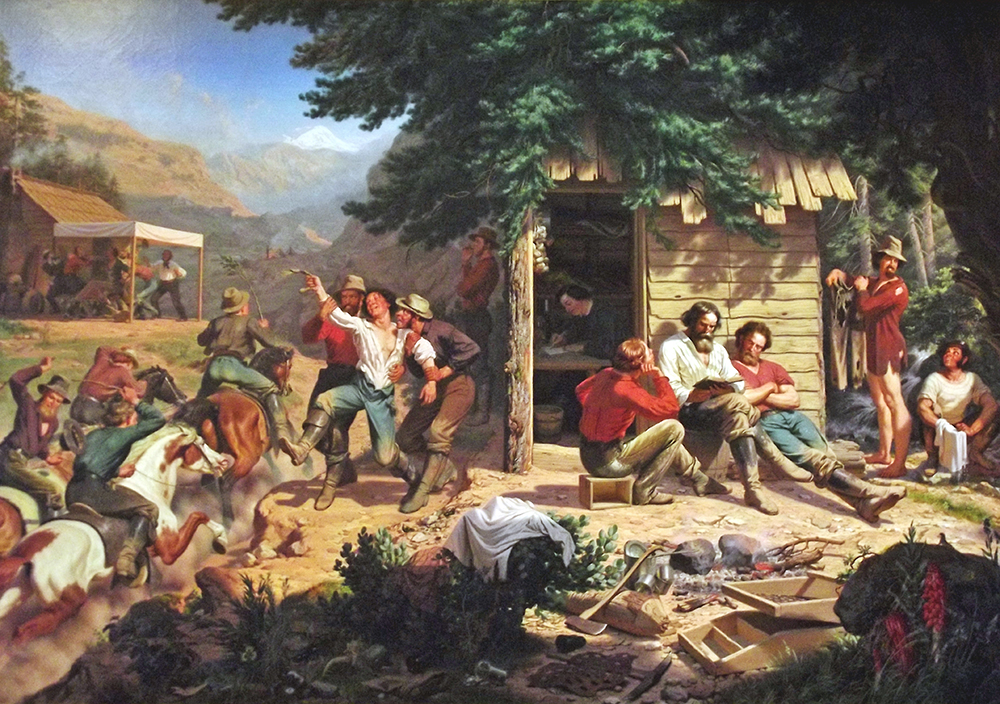
Sunday Morning in the Mines, 1872, oil on canvas by German-born American artist Charles Christian Nahl (1818–1878). Wikimedia Commons.
Soldiers, ghosts, and fiends—the name Ambrose Bierce conjures for most readers the ill-fated characters in his stories of the Civil War and his tales of horror and suspense. Many readers are also familiar with his cynically humorous Devil’s Dictionary. So it comes as a surprise when one encounters the short story “A Lady from Redhorse,” first published as “An Heiress from Redhorse” in the San Francisco Examiner on March 15, 1891, and reprinted in all three editions of Bierce’s In the Midst of Life (Tales of Soldiers and Civilians).

Biographers and reviewers have not known what to make of this curious tale by the man who came to be known to his contemporaries as “Bitter Bierce.” The year the story first appeared, it was reprinted in, of all places, the New York magazine Romance, alongside such selections as “How He Won Her” and “How a Woman Loved”; in 1929, it was included in the anthology World’s Great Romances. The critic Robert A. Wiggins, who once described Bierce as a “misanthrope pessimistically at odds with all mankind,” admitted that the tale is “unusual for Bierce in that it employs an epistolary form and ends happily. It might easily have graced the pages of a women’s magazine. Its ominous tone, suggesting imminent terror, is Biercean enough, but not the surprise conclusion with a cheerful ending.”

In 1981, the scholar Lawrence I. Berkove, who has called the tale a “romantic comedy,” came across a forgotten magazine piece that might shed light on the story’s origin. The week before “An Heiress from Redhorse” appeared in the Examiner, W. C. Morrow, who (like Bierce) was well known for his horror fiction, published a short item in the San Francisco literary weekly Wave. He described a day he had recently spent with Bierce at the Cliff House, a popular establishment overlooking the ocean on the western side of the city. On the train to the resort, a woman and her mother were brazenly staring at and talking about the two men—and especially, it seemed, about Morrow—and they followed the authors to the veranda of the restaurant. After a while, Bierce left to return to the city, the mother departed from the veranda, and at last the beautiful daughter approached Morrow. “I read everything you publish,” she gushed. “Oh, the terrible stories you write, that keep me awake and make me afraid when I’m alone! What a master mind to do these things! I have worshiped you so long from a great distance.” When she began to describe some of her favorite characters, it dawned on Morrow that the young woman thought he was Ambrose Bierce. He was unable to get in a word before “the poor girl had thrown her arms around my neck, clasped me close to her breast and pressed her lips to mine.” Both Morrow’s yarn (almost certainly embellished) and Bierce’s short story are set in seaside resorts and, as Berkove notes, feature “impressionable young ladies who fall hopelessly in love with handsome and somewhat mysterious men with personalities that were awesome yet attractive.” In other words, Bierce’s story might have been a whimsical response to Morrow’s teasing anecdote.

A better-known inspiration for Bierce’s story is Bret Harte’s similarly titled “An Heiress of Red Dog” (1878), about a young woman who unexpectedly inherits three million dollars from a man who had squirreled away seemingly worthless shares in the Rising Sun Mining Company, “which a day or two after his demise . . . suddenly sprang into opulence and celebrity.” In Bierce’s story, the heiress also gets her million from gold; her father struck it rich after years of hardship in a destitute mining town. Donald T. Blume, in his critical study Ambrose Bierce’s Civilians and Soldiers in Context (2004), points out that Bierce may have even taken his heiress’s name, Miss Dement, from Harte’s story. The testator during his final days had been “showing hints of his insanity [and] acts clearly attributable to dementia,” which, his estranged wife contends, explains why he left his supposedly moderate estate to “a freckle-faced maid-servant” at a local hotel. The will’s only stipulation is that the heiress cannot give a cent of it to any man with whom she falls in love.

Blume argues convincingly that Bierce’s story is “a lesson about human gullibility masquerading as a love story masquerading as a mystery”; a closer reading, certain textual evidence, and the historical context all suggest that, instead of a happy ending, the credulous heiress’s inevitable fate was—at best—ambiguous. (Readers may want to postpone reading the rest of this introduction until after they’ve read the selection.) The story isn’t only about a wealthy young woman falling madly in love with a mysterious stranger, who may or may not be after her money. Bierce also outlines her impoverished childhood in Redhorse, a California gold mining community, with her two friends, Jack Raynor (“Giggles”) and James Barts (“Dumps”), both of whom became miners themselves before moving on to other prospects. Raynor was hired by Wells, Fargo, & Company, and Miss Dement hints in passing that he had recently proposed and she had turned him down because he wasn’t her type. Barts, she believes, was killed while working as a stage driver, although Blume points out that Bierce may have modeled this character after real-life rogues, including the notorious stagecoach robber Black Bart (who was even the subject of one of Bierce’s poems).

In the end, the two storylines converge, the “mystery” is revealed, and Miss Dement believes she will live happily ever after. Yet Blume notes that in later editions Bierce, perhaps frustrated that readers had misunderstood the ending, changed the closing of the final letter from “they have played it upon / Your affectionate friend,” to “they have roped in your affectionate friend”—suggesting a trap rather than a prank. Blume concludes that “the revised statement seems to have been added by Bierce as a broad hint to readers that Miss Dement’s happy love story is not quite what she thought it to be.” There is still the matter of the money, after all, casting doubt on the motivations of the gold diggers who have successfully corralled her.

Notes: Coronado is an island near San Diego and was the site of a resort hotel for the wealthy. Helena Petrovska Blavatsky was a Russian mystic and founder of theosophy, who lived near Madras (in southeastern, not northern, India) from 1878 to 1885. The Sepoy Mutiny in 1857–58 was a large uprising of Indian soldiers (sepoys) serving in the British army. Thugs were members of the Thuggee cult, a group of Indian criminal gangs. They were suppressed by the British, who executed the last Thug in 1882. David Garrick was an eighteenth-century British actor and playwright; Bierce’s reference is to David Garrick Between Tragedy and Comedy, a famous painting by British artist Joshua Reynolds.

Chloriding the dumps was the process of using a corrosive chemical solution on mine tailings to extract any remaining traces of gold, silver, and other ores. In the story, Barts’s mother was “chlorided to her fathers,” suggesting that she was poisoned by the stuff—and, Blume posits, Barts might have played a role in the poisoning.

*   *   *
I find myself more and more interested in him. It is not, I am sure, his—do you know any good noun corresponding to the adjective “handsome”? . . . If you don't see the full selection below, click here (PDF) or click here (Google Docs) to read it—free!

This selection may be photocopied and distributed for classroom or educational use.

Sunday, March 26, 2023

Stratford-on-Avon

Washington Irving (1783–1859)
From Shakespeare in America: An Anthology from the Revolution to Now

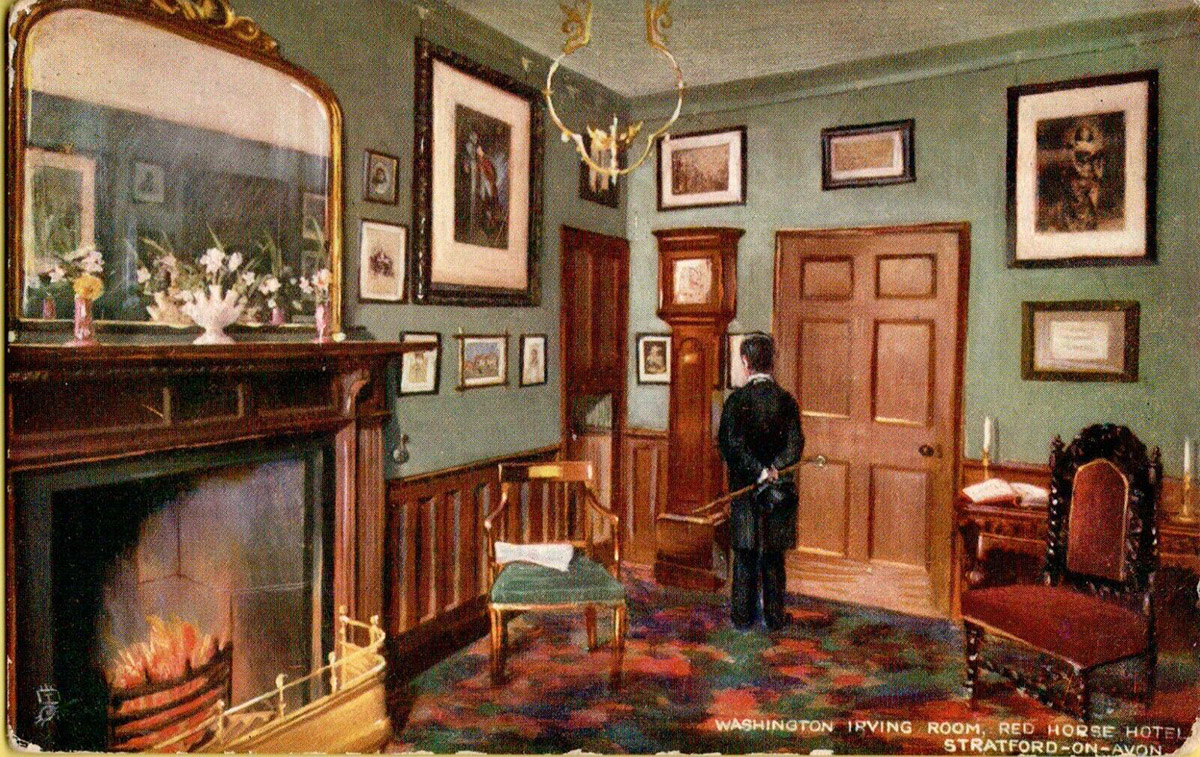
“Washington Irving Room, Red Horse Hotel, Stratford-on-Avon,” c. 1910, postcard printed by Raphael Tuck & Sons, London. Other than the addition of the man in the middle, the arrangement of elements in the painting is virtually identical to that of a photograph included in A. Van Doren Honeyman’s illustrated guidebook Bright Days in Merrie England (1901). Image: eBay.
In September 1831 Martin Van Buren, the newly appointed British minister, arrived in London, where Washington Irving had worked for the previous two years as a secretary at the American legation. Irving had planned to resign his position that year and return to the States in order to focus on his writing and on the family business, but he agreed to serve as chargé d'affaires until the new minister arrived. Before Irving went home, however, he took Van Buren and his son on a three-week excursion through England, including an obligatory stop at Stratford-upon-Avon, the hometown of William Shakespeare.

A decade earlier, in The Sketch Book of Geoffrey Crayon, Esq., Irving had written about his first visit to Stratford in July 1815. His essay mentioned a memorable stay at the Red Horse Inn, where, for the weary tourist, “The arm chair is his throne; the poker his sceptre, and the little parlour of some twelve feet square, his undisputed empire.” He was in for quite a surprise upon his return, though, as he related to his sister Catherine:
We next passed a night and part of the next day at Stratford-on-Avon, visiting the house where Shakspeare was born and the church where he lies buried. We were quartered at the little inn of the Red Horse, where I found the same obliging little landlady that kept it at the time of the visit recorded in the Sketch Book. You cannot imagine what a fuss the little woman made when she found out who I was. She showed me the room I had occupied, in which she had hung up my engraved likeness, and she produced a poker which was locked up in the archives of her house, on which she had caused to be engraved, “Geoffrey Crayon’s Sceptre.”
Although literary tourists had been making pilgrimages to Stratford ever since the actor David Garrick had hosted the Shakespeare Jubilee in 1769, Washington Irving’s little essay in The Sketch Book exponentially increased the flood of visitors to the small market town. “Americans, in particular, followed the tourist trail set out by Irving,” writes Julia Thomas in Shakespeare’s Shrine, “and, as they did so, appropriated or laid claim to Stratford-upon-Avon, transforming this quintessentially English site of pilgrimage into a curiously American one.” Tourists visited the home where Shakespeare was born and lived, with its ever-increasing accumulation of dubious “relics” (ranging from the playwright’s tobacco box to the little chair used by his son, Hamnet, who had died as a boy), and the gravesite and funerary monument in Holy Trinity Church. Those willing to stay an extra day could travel to the estate of Sir Thomas Lucy, who allegedly had Shakespeare arrested and punished for poaching deer and who was believed to have been the inspiration for the character of Justice Shallow in The Merry Wives of Windsor. (There is little evidence for any aspect of this tale.) Much to Irving’s dismay, however, another destination had been added: the Red Horse Inn parlor and the room in which Irving had slept in 1815 had been turned into lucrative shrines of their own.

Four years later, in 1835, the journalist Nathaniel Parker Willis, an overseas correspondent for the New York Mirror, came to Stratford. “I had stipulated with the hostess that my baggage should be put into the chamber occupied by Washington Irving,” he reported to readers of the newspaper. Willis met with Mrs. Gardiner, the same proprietor who had hosted Irving:
“I have brought up, mem,” she said, producing a well-polished poker from under her black apron, before she took the chair set for her at the table—“I have brought up a relic for you to see, that no money would buy from me.”

She turned it over in my hand, and I read on one of the flat sides at the bottom—“GEOFFREY CRAYON’S SCEPTRE.”
When Willis and his companion inquired how she knew that this poker was the same poker used by Irving, she responded:
“Why, sir, you see there’s a Mr. Vincent that comes here sometimes, and he says to me one day—‘So, Mrs. Gardiner, you’re finely immortalized. Read that.’ So the minnit I read it, I remembered who it was, and all about it, and I runs and gets the number three poker, and locks it up safe and sound, and by-and-by I sends it to Brummagem, and has his name engraved on it, and here you see it, sir—and I wouldn’t take no money for it.”
“Among all my many loiterings in many lands, I remember none more intellectually pure and gratifying, than this at Stratford-on-Avon,” Willis concluded. “My sleep in the little bed consecrated by the slumbers of the immortal Geoffrey, was sweet and light; and I write myself his debtor for a large share of the pleasure which genius like his lavishes on the world.”

The number of accounts by nineteenth-century literary figures about their own pilgrimages to the Red Horse Inn could be extended infinitely. “At Stratford I handled, too, the poker used to such good purpose by Geoffrey Crayon,” reported New-York Tribune correspondent Margaret Fuller in 1846. “The muse had fled, the fire was out, and the poker rusty, yet a pleasant influence lingered even in that cold little room, and seemed to lend a transient glow to the poker under the influence of sympathy.” Even the usually skeptical Ambrose Bierce paid homage when he, “by the merest accident, blundered into the famous ‘Red Horse Inn. . . . I took my meals in the ‘Irving Parlor,’ seated in the ‘Irving Chair’ (duly labelled with a brass plate), stirred my fire with the ‘Irving Poker’ (‘Geoffrey Crayon’s sceptre’), and gazed my fill at Irving in every style hanging against the papered walls.” Bierce was particularly impressed that, unlike other overpriced English tourist sites, he was presented with “a most moderate bill for most comfortable and gentlemanly accommodations.” The British novelist Mary Elizabeth Braddon opens Asphodel (1881) during "the season of American tourists doing Stratford and its environs, guide book in hand, and crowding in to The Red Horse parlour, after luncheon, to see the veritable chair in which Washington Irving used to sit.” By the end of the century, Thomas notes, the glorified poker “was wrapped up in an American flag and only brought out on special occasions.”

Both the chair and the poker seem to have vanished from public view by the mid-1930s. Today, the building that housed the Red Horse Inn is a Marks & Spencer department store. Irving’s essay, however, remains in print and we present it below.

Notes: The town of Stratford-upon-Avon is in the district of Stratford-on-Avon, but the names were often used interchangeably in nineteenth-century sources.

The Santa Casa of Loretto [Loreto], in Italy, is said to be the house in which the Virgin Mary lived at the time of the Annunciation, miraculously transported to the spot by angels at the end of the thirteenth century, just before Christian forces were expelled from the Holy Land. British engraver and author Samuel Ireland published his Picturesque Views on the Warwickshire Avon in 1795. The book’s anecdotes about Shakespeare and his times (including those quoted by Irving) are local traditions and legends, but shortly before publishing the book, Ireland fell victim to a series of Shakespearean forgeries, ranging from deeds, letters, and manuscripts to two complete plays, all fabricated by Ireland’s 19-year-old son and many of which initially fooled numerous “experts.” Reginald Scot, a member of Parliament during the 1580s, published The Discoverie of Witchcraft in 1584, a skeptical treatise exposing the charlatanism behind conjuring and similar practices.

In his footnote describing country gentlemen in the decades after Shakespeare, Irving quotes English cleric (later bishop) John Earle, who in 1628 anonymously published the humorous work Microcosmographie, or a Peece of the World discovered, in Essayes and Characters, poking fun at contemporary society and manners. Irving’s next quote, about “Mr. Hastings,” is from Remarks on Forest Scenery, and Other Woodland Views (1791) by English cleric and travel writer William Gilpin, although Gilpin was quoting a passage from John Hutchins’s History and Antiquities of Dorset (1784). .

*   *   *
To a homeless man, who has no spot on this wide world which he can truly call his own, there is a momentary feeling of something like independence and territorial consequence, when, after a weary day’s travel, he kicks off his boots, thrusts his feet into slippers, and stretches himself before an inn fire. . . .
If you don't see the full selection below, click here (PDF) or click here (Google Docs) to read it—free!

This selection may be photocopied and distributed for classroom or educational use.
Sunday, October 2, 2022

An Affair of Outposts

Ambrose Bierce (1842–1914?)
From Ambrose Bierce: The Devil’s Dictionary, Tales, & Memoirs

Battle of Shiloh, April 6–7, 1862, by American illustrator Thure de Thulstrup (1848–1930). Chromolithograph published by L. Prang & Co., Boston, 1888. Library of Congress.
“For fifteen hours we had been wet to the skin,” wrote Ambrose Bierce in 1881, recalling the day two decades earlier, near the end of fighting at Pittsburg Landing in Tennessee. “Chilled, sleepy, hungry and disappointed—profoundly disgusted with the inglorious part to which they had been condemned—the men of my regiment did everything doggedly. The spirit had gone quite out of them.” It was the afternoon of April 7, and the Ninth Indiana Regiment had arrived the previous evening in the midst of the Battle of Shiloh. That morning, when some Union officers believed that the enemy, outnumbered and outgunned, had abandoned the field and fled 20 miles south to the Confederate camp in Corinth, Mississippi, Sergeant Bierce led his men right into an ambush:
Then—I can’t describe it—the forest seemed all at once to flame up and disappear with a crash like that of a great wave upon the beach—a crash that expired in hot hissings, and the sickening “spat” of lead against flesh. A dozen of my brave fellows tumbled over like ten-pins. Some struggled to their feet, only to go down again, and yet again.
The Ninth Indiana Regiment would lose 170 men at Shiloh—its worst casualty count of the war. During the two-day battle, more than one in five of the 110,000 soldiers were killed or wounded. “Shiloh’s casualties eclipsed the total of the Revolutionary War, the War of 1812, and Mexican War combined,” writes Ron Chernow. Although the battle was and is considered a Union victory, the casualties were so horrific that some contemporary journalists and observers blamed Generals Ulysses Grant and Benjamin Prentiss (the latter taken prisoner after surrendering his division) for not anticipating the Confederate attack. The lieutenant governor of Ohio visited the field after the battle and found among the surviving soldiers “a general feeling among the most intelligent men that Grant and Prentiss ought to be court-martialed or shot”—a sentiment shared by Bierce. For the rest of his life, Bierce attributed the meager Union victory at Shiloh to the last-minute arrival of reinforcements commanded by General Don Carlos Buell and minimized Grant’s successes during the war—an argument he reiterated in several essays and stories, including “An Affair of Outposts.”

A year earlier, in April 1861, eighteen-year-old Ambrose Bierce had enlisted in Indiana just seven days after Confederate troops had attacked Fort Sumter. In late May, the regiment departed for the front, sent off with a formal review conducted by General George McClellan and a rousing speech delivered by Governor Oliver P. Morton. Shortly after the Battle of Shiloh, Morton traveled to Tennessee to check in on the young men he had dispatched the previous year. Morton was generally popular among Union troops and would have the steadfast support of veterans after the war, but one might guess what the exhausted, filthy soldiers thought of the intrusion onto the field of the governor and his well-dressed retinue. In “An Affair of Outposts,” however, Bierce doesn’t leave it to our imagination: “The bedraggled soldier looked up from his trench as they passed, leaned upon his spade and audibly damned them to signify his sense of their ornamental irrelevance to the austerities of his trade.” Although Bierce’s story was written a full thirty-five years later, in 1897, long after Morton’s death, there is no mistaking that the flabby, faint-hearted politician in the tale is a merciless caricature of the former governor.

Roy Morris Jr., in his 1999 biography of Bierce, regards “An Affair of Outposts,” as one of his strongest stories, “a bitter denunciation of both romantic betrayal and fatuous patriotism. Its unusual mixture of the two can be read on one level as an old soldier’s disgusted farewell to arms, his hard-earned realization that impassioned appeals to patriotism are in a way the ultimate seduction. . . . It is a theme that Bierce would reiterate in several of his stories.”

Notes: The quotations by Bierce in the above introduction are from his essay “What I Saw of Shiloh.” The “unwritten law” in the story refers to the supposed right of an individual to avenge moral offenses committed against members of his family; here, the right of a husband to kill his wife’s lover. The phrase “excursions and alarums” are the sounds of war and battle, used as a stage direction in Elizabethan plays for moving soldiers across the stage. Bierce’s description of “the unstrained quality of this military humor dropped not as the gentle rain from heaven” echoes Shakespeare’s The Merchant of Venice: “The quality of mercy is not strained; / It droppeth as the gentle rain from heaven / Upon the place beneath.”

*   *   *
Two men sat in conversation. One was the Governor of the State. . . . If you don't see the full selection below, click here (PDF) or click here (Google Docs) to read it—free!

This selection may be photocopied and distributed for classroom or educational use.

Sunday, June 21, 2020

Working for an Empress

Ambrose Bierce (1842–1914?)
From Ambrose Bierce: The Devil’s Dictionary, Tales, & Memoirs

Cropped image of L'Evasion de Rochefort [Rochefort's Escape], 1881, oil on canvas by French artist Edouard Manet (1832–1883). Courtesy of Wikimedia Commons.
As a young man, Victor Henri Rochefort, Marquis de Rochefort-Luçay, dabbled in various careers, including a lengthy spin as a writer of highly successful vaudevilles, before he was hired by the Parisian newspaper Le Figaro in 1863. His acid pen soon ran afoul of the monarchy and the editors were compelled to terminate his column. He founded La Lanterne in 1868, which quickly reached a readership of over 100,000, but not even a dozen issues were published before his vitriolic attacks on Napoleon III and the Empress Eugénie earned him a year in prison. He avoided his sentence by fleeing to Belgium, where he met the novelist Victor Hugo, also in exile, and together they continued the publication of La Lanterne. His election to the French legislature in 1869 enabled him to return to Paris but, after the imperial government collapsed, Rochefort’s public support of the Communard radicals resulted in another prison sentence—this time for life. In August 1873 he was transferred to the Pacific island penal colony of New Caledonia, but he escaped on an American ship after only a few months and arrived in San Francisco in May 1874.

It is at this point that readers might expect Rochefort’s path to intersect with the career of Ambrose Bierce, who had been working as a writer in San Francisco since 1867. As it happens, however, Bierce and his family had moved two years earlier to England, where he was busy writing humor pieces for the magazine Fun, columns for the semi-weekly London Figaro, and letters from England for the Alta California back home. Bierce seemed to enjoy the cerebral atmosphere of his new Fleet Street social circle. “I have not elsewhere heard such brilliant talk as among the artists and writers of London,” he later wrote. “I found those men agreeable, hospitable, intelligent, amusing.” Yet, as he wrote to a friend who was on his way to England, “London—literary London—is divided into innumerable cliques . . . if you fall into the hands of one clique, all the others will give you the cold shoulder.”

Bierce visited Paris with his wife and mother-in-law in the autumn of 1873, arriving just weeks after Rochefort left France on the four-month journey that would take him to New Caledonia. When the family returned to England, Bierce’s chronic asthma forced him to move to Bristol, then to Bath, and then to Leamington Spa, where he felt sadly isolated from the “cliques” of London and where he lived when the following story took place.

Captured during the Franco-Prussian War, Napoleon III was deposed in September 1870 and lived in exile with the Empress and their entourage at Camden Place, a palatial country house in Kent, until his death in January 1873. James Mortimer, an American who served in France as an imperial private secretary, followed Louis-Napoleon and Eugénie to England and, with their financial support, established the London Figaro, the semi-weekly that hired Bierce to write a column. In the spring of 1874, when Bierce had been in England for two years, Mortimer wrote him with a strange proposal: to edit and write a new publication called The Lantern, which was to be modeled after the seditious French journal published years earlier by Rochefort. Because Mortimer’s patron and friend, the Empress Eugénie, regarded the just-escaped Rochefort as “a menace and a terror,” Bierce was puzzled and discomfited by the offer. But his qualms were mostly overcome when was also told that the new magazine, like its predecessor, should be “irritatingly disrespectful of existing institutions and exalted personages”—a prospect that “delighted” Bierce. Still, the purpose of the new enterprise mystified him.

Thus, like Rochefort, Bierce went from writing columns for (Le) Figaro to being the editor and writer of The Lantern. He produced two generously funded and lavishly printed issues of the magazine, and then Mortimer abruptly shut it down. It was only later that Bierce learned the raison d’être for the English version of Rochefort’s magazine—a truth that most everyone other than the publication’s editor seemed to have grasped. Originally published in 1882 and later collected as one of the episodes in his memoir Bits of Autobiography, “Working for an Empress” explains the mystery and reveals the information Mortimer kept from him.

Note: The reference in Bierce’s opening sentence is to Sir Walter Scott’s romance novel Kenilworth (1821).

*   *   *
In the spring of 1874 I was living in the pretty English town of Leamington, a place that will be remembered by most Americans who have visited the grave of Shakespeare at Stratford-on-Avon, or by personal inspection of the ruins of Kenilworth Castle have verified their knowledge of English history derived from Scott’s incomparable romance. . . . If you don't see the full selection below, click here (PDF) or click here (Google Docs) to read it—free!

This selection may be photocopied and distributed for classroom or educational use.

Friday, October 12, 2018

Moxon’s Master

Ambrose Bierce (1842–1914?)
From Ambrose Bierce: The Devil’s Dictionary, Tales, & Memoirs

Portrait de joueurs d'échecs (Portrait of Chess Players), 1911, oil on canvas by French artist and chess player Marcel Duchamp (1887−1968). Courtesy of WikiArt.
In 1770, at the court of Empress Maria Theresa of Austria, Wolfgang von Kempelen unveiled the Turk, the world’s first chess-playing automaton. Encased in an elaborate cabinet with visible gears and cogs, the machine was able to play chess against a human opponent—and more often than not it won. On top of the cabinet, a life-sized costumed mannequin with turbaned head and robe-cloaked torso straddled one side—thus, the name. After its debut in the empress’s court, the machine’s fame spread throughout Europe and, a decade later, von Kempelen took it on tour. Among the challengers in Paris was a bemused Benjamin Franklin, who lost his match.

Before each demonstration, von Kempelen would open various doors and compartments so that spectators could inspect the machine’s elaborate inner workings. Although many observers were skeptical, no one could adequately explain how it worked. The most common theories were that von Kempelen was somehow able to operate the machinery remotely or that a child, dwarf, or amputee was hidden away in a secret compartment.

When its creator died in 1804, the machine and its secrets were sold to Johann Mälzel, who continued the tour throughout Europe, across the Channel to England, and eventually to America. One young man who was impressed but skeptical was Englishman Charles Babbage, who was sure the machine was a hoax but began to wonder if such a thing were really possible. Soon after his own games against the Turk (he lost both), Babbage published the first designs for his Difference Engine—the world’s first automatic computing machine. His autobiography, which appeared in 1864, reaffirmed his belief in the inevitable development of game-playing machinery, and late in life he included in his journals schemata for a tic-tac-toe automaton.

Another luminary fascinated by the Turk was Edgar Allan Poe, who witnessed a demonstration in Richmond, Virginia, in 1835. Poe became obsessed with the machine but was convinced the whole thing was a hoax. In a lengthy essay, “Maelzel’s Chess-Player,” he marshaled the evidence against it. Yet many of Poe’s speculations were wrong (he subscribed to the tiny-human hypothesis to explain the trick), and some of his assumptions exposed an overconfidence in the invincibility of logic-based technologies. “The Automaton does not invariably win the game,” he argued. “Were the machine a pure machine this would not be the case—it would always win.”

By the middle of the century, after fascination with the machine was finally exhausted, the Turk was, of course, unveiled as a hoax that had fooled audiences for nearly eighty years. Most conjectures had been unnecessarily complicated, since the secret proved to be remarkably simple. Inside the cabinet was an adult human chess master of average height and weight. The Museum of Hoaxes explains: “A series of sliding panels and a rolling chair allowed the automaton’s operator to hide while the interior of the machine was being displayed. The operator then controlled the Turk by means of a ‘pantograph’ device that synchronized his arm movements with those of the wooden Turk. Magnetic chess pieces allowed him to know what pieces were being moved on the board above his head.” Most of the other “workings” inside the machine served little purpose other than misdirection or the emission of noises that early-industrial-age audiences would expect such a machine to make.

All of the preceding serves as a preamble to this week’s selection. When Ambrose Bierce sat down to write “Moxon’s Master” at the very end of the nineteenth century, the word “robot” (coined by playwright K. Čapek) was still two decades in the future—yet the idea of chess-playing automata had over 130 years of history and imagination behind it. Yet Bierce takes the idea of a humanoid robot one step further: what if such a contraption could actually think? S. T. Joshi claims that the story “must be one of the earliest tales genuinely to deal with the question of artificial intelligence.” “Bierce’s originality,” write the editors of the anthology War with the Robots, “lies not in writing a story about a chess-playing machine but in his realization of the radical philosophical implications of inventing a machine with intelligence.” As the novelist Michael Peck notes in a recent essay, “It was only a short hop from there to fathom a techverse where that same logic could suddenly turn sinister. Ambrose Bierce was one of the first to make this skepticism explicit.”

Notes: Herbert Spencer’s definition of “Life,” quoted on page 255, is from The Principles of Biology (1864–67). A few sentences later, Bierce alludes to British philosopher John Stuart Mill and his discussion of cause and effect in A System of Logic, Ratiocinative and Inductive (1843). On page 257, the quote “The endless variety and excitement of philosophic thought” is from The History of Philosophy from Thales to Comte (1867) by British historian and critic George Henry Lewes (1817–1878).

Special note (spoiler alert!): During the 1980s and ’90s, in the pages of Science Fiction Studies and other journals, a number of scholars proposed a series of alternative and conflicting interpretations of Bierce’s story, all of them basically proposing that there was never a real robot in Moxon’s lab. Instead, the perpetrator of the crime was human, either a jealous mistress or Moxon’s assistant Haley, who might have been Moxon’s lover. The interpretations have not gained much traction in the years since; at most, the conversation at the very end of the story suggests that Haley’s role in the story, especially its climactic fiery cataclysm, is intentionally ambiguous. Famed science fiction guru Damon Knight offered perhaps the most appropriate response when he praised Bierce's “ingenuity in creating puzzles for unborn scholars,” and he lampooned the combating academics by presenting his own “solution” to the supposed mystery: “A close reading makes it clear that the culprit is Moxon's brother's dentist. Notice that Bierce never mentions the brother: this in itself is sinister. The brother must have had a dentist, and yet the dentist is never mentioned either. Dentists of that period were known to use ether and chloroform, both of which are inflammable. The case is open and shut.”

*   *   *
“Are you serious?—do you really believe that a machine thinks?” . . . If you don't see the full selection below, click here (PDF) or click here (Google Docs) to read it—free!

This selection may be photocopied and distributed for classroom or educational use.

Friday, June 16, 2017

Chickamauga

Ambrose Bierce (1842–1914?)
From Ambrose Bierce: The Devil’s Dictionary, Tales, & Memoirs

Detail from “Union drummer boy John Clem at Point Lookout, Tennessee,” c. 1865–70, color lithographic print by James Fuller Queen (c. 1820–1886). At the age of 12, Clem served as a drummer boy for the 22nd Michigan at the Battle of Chickamauga (September 19–20, 1863), where he gained fame for allegedly having shot and wounded a Confederate officer. Promoted to sergeant, he became the youngest noncommissioned officer in the history of the U.S. Army. Click on image to see full print. (Courtesy of the Library of Congress.)
Ostensibly a topographic engineer responsible for drawing maps of the front lines, First Lieutenant Ambrose Bierce found himself deeply immersed in combat at the Battle of Chickamauga in northwestern Georgia, September 19–20, 1863—a virtual rematch between the armies led by Union general William S. Rosecrans and Confederate general Braxton Bragg, which had nine months earlier faced each other at the Battle of Stones River. “Chickamauga was not my first battle by many,” he recalled three decades later, “for although hardly more than a boy in years [he had just turned 21], I had served at the front from the beginning of the trouble, and had seen enough of war to give me a fair understanding of it.”

A horrific day of fighting was followed by “a night of waking.” The following morning the battle resumed; “the enemy came again and again—his persistence was dispiriting.” Bierce’s commanding officer sent him to get more artillery shells, and he soon returned with a skittish officer in possession of several wagons of ammunition. They hesitantly reached the top of the ridge overlooking the area Bierce had just left and “to my astonishment I saw the entire country in front swarming with Confederates; the very earth seemed to be moving toward us! They came on in thousands, and so rapidly that we had barely time to turn tail and gallop down the hill and away.” At about this time General Rosecrans fled to Chatanooga and telegraphed President Lincoln: “We have met with a serious disaster; extent not yet ascertained.” Yet, Bierce drily noted, “The rest of his army was standing its ground.” At the end of the day the victorious Confederates decided not to make a final attack to complete the rout (“I don’t know why they did not; probably they were short of ammunition”), and Bierce retreated with the defeated Union army to Chattanooga.

In 1889 Bierce reimagined Chickamauga in a short story of that name—told from the point of view of a six-year-old boy. It is, “in a way, his most American story,” writes biographer Roy Morris, Jr. “The new man in the new land, often depicted as a child to underscore both the purity and the vulnerability of an America groping its way across a hostile continent, has had many names in the national literature.” The boy’s misadventures in the Chickamauga forest also serve as “a perfect synopsis of Rosecrans’s blunder [and] mirror those of the Union army during the battle.”

In addition, Morris sees the story as a “virtual précis of Stephen Crane’s more celebrated The Red Badge of Courage.” Although Crane himself acknowledged his debt to (and deep admiration of) Bierce’s stories, “the direct link between ‘Chickamauga’ and Crane’s great novel has rarely been noted by modern critics.” According to Richard Harding Davis, a mutual friend of both writers, Bierce read Red Badge when it was published in 1895 and begrudgingly conceded, “This young man has the power to feel. He knows nothing of war, yet he is drenched with blood. Most beginners who deal with this subject spatter themselves merely with ink.”

Within a few months Bierce apparently had second thoughts. After a reviewer compared Crane’s novel unfavorably to Bierce’s Civil War stories and further criticized two other new writers as being even worse, Bierce responded with his trademark bitterness.
That hardy and ingenious explorer, that sun-eyed searcher of the intense inane, that robber baron invader of literature's loud oblivion, that painstaking chiffonier of fame's eternal dumping ground has dragged to upper day two worse writers than Stephen Crane and names them out loud. I had thought there could be only two worse writers than Stephen Crane, namely, two Stephen Cranes.
Something more than envy of Crane’s success may have been at work here; Bierce may have also come to regard the younger author as a bit of a pretender. Shortly after Red Badge became a national phenomenon Crane published the story collection The Little Regiment and Other Episodes from the American Civil War. The younger author was born six years after the war ended; in an interview with Library of America, literary scholar S. T. Joshi reminds us that “Bierce was always insistent on the radical distinction between the ‘soldier’ and the ‘civilian,’ and he felt that the latter could never fully understand what the former had gone through.”

Note: The lines of poetry on the second page are from Byron’s Childe Harold’s Pilgrimage (1812), canto 3, stanza 38; the reference is to Napoleon.

*   *   *
One sunny autumn afternoon a child strayed away from its rude home in a small field and entered a forest unobserved. . . . If you don't see the full selection below, click here (PDF) or click here (Google Docs) to read it—free!

This selection may be photocopied and distributed for classroom or educational use.

Friday, June 12, 2015

A Psychological Shipwreck

Ambrose Bierce (1842–1914?)
From Ambrose Bierce: The Devil’s Dictionary, Tales, & Memoirs

Detail from Woman on Ship Deck, Looking out to Sea, circa 1895, monotype on cream Japanese paper by American artist Maurice Prendergast (1858–1924). Click on image to see the full painting. Courtesy of WikiArt.
In early 1877 Ambrose Bierce was hired as associate editor of the Argonaut, a new San Francisco magazine. Although the publisher hoped to make it a political journal, Bierce had plans to rival such literary reviews as the Overland Monthly (edited by Bret Harte), which had published his first story six years earlier. In the debut issue of the Argonaut, Bierce announced, “It is my intention to purify journalism in this town by instructing such writers as it is worthwhile to instruct, and assassinating those it is not.” Wielding his pen as a weapon, he particularly savaged local scribblers who fancied themselves poets.

During his two-year stint on the Argonaut staff, Bierce “returned to his lifelong obsession with the macabre,” according to biographer Roy Morris Jr. Mixed in with rants against bad poetry, political misconduct, and sloppy journalism were numerous accounts on the region’s more grisly murders and suicides. Bierce also collaborated with two friends on a literary hoax called The Dance of Death, by “William Herman,” which condemned—using unabashedly lewd language—the “shameless gratification of sexual desire” caused by the latest fad to hit the San Francisco culture scene: ballroom dancing. Bierce then wrote a scathing review of the book (“an indecent exposure of the author’s mind!”), which he published in his own magazine. Endorsed by gullible religious authorities who believed the work to be a sincere effort, the book sold eighteen thousand copies.

Although his writing appeared in every issue, Bierce wrote only two new short stories for the pages of the Argonaut—his first pieces of fiction in several years. The second, “My Shipwreck,” appeared in the spring of 1879, near the end of his tenure. He later changed the title to “A Psychological Shipwreck” and included the story in his collection Can Such Things Be?

For over a century, “A Psychological Shipwreck” has been a favorite for inclusion in anthologies, particularly of weird tales or science fiction classics. Readers have puzzled and argued over how the clues scattered by Bierce throughout the compact, four-page story fit together. What is the relationship between Janette Harford and William Jarrett? Might they be distantly related? Is the other William Jarrett her biological father? And as for “Denneker’s Meditations,” the book that plays such a pivotal role in the story: don’t waste time looking for a copy in the library. It’s entirely the creation of Bierce’s storytelling imagination, although the fictitious author’s name seems to be a nod to Jost de Negker (often spelled Denekker in nineteenth-century sources), an engraver who published several editions of Hans Holbein’s infamous sixteenth-century series of woodcuts, The Dance of Death.

*   *   *
In the summer of 1874 I was in Liverpool, whither I had gone on business for the mercantile house of Bronson & Jarrett, New York. . . . If you don't see the full selection below, click here (PDF) or click here (Google Docs) to read it—free!

This selection may be photocopied and distributed for classroom or educational use.

Friday, June 27, 2014

An Occurrence at Owl Creek Bridge

Ambrose Bierce (1842–1914?)
From Ambrose Bierce: The Devil’s Dictionary, Tales, & Memoirs

Detail from portrait of Ambrose Bierce by British painter John Herbert Evelyn Partington (1843–1899), whose daughter Blanche received the last known letter sent by Bierce before he disappeared. Image courtesy of Wikimedia Commons.
A century ago Ambrose Bierce carried out (intentionally or not) one of the most legendary disappearing acts in the history of literature. He was reported to have crossed the border into Mexico in late December 1913—and was neither seen nor heard from again. Since then, a multitude of theories have been advanced, many of them beyond the realm of possibility. A number of scholars believe he may have been killed at the Battle of Ojinaga, won by Pancho Villa on January 11, 1914. A recent biography by Roy Morris Jr. questions the idea that Bierce ever went to Mexico at all and advances another popular theory: that he committed suicide, perhaps by shooting himself while staying in the Grand Canyon. Among the more sensational claims is an old rumor that Bierce had re-emerged a decade later in Mexico City as the mysterious writer B. Traven, author of the 1927 novel The Treasure of the Sierra Madre.

Before he began his travels, Bierce certainly seemed to be a man settling affairs for a long journey—or for good. (He was seventy-one years old, after all.) In January 1913 he transferred to his daughter Helen the ownership of a lot in the St. Helena cemetery and closed his letter, “By the way, I do not wish to lie there. The matter is all arranged, and you will not be bothered about the mortal part of Your Daddy.” In September he assigned the copyrights for the Collected Works of Ambrose Bierce to his secretary Carrie Christiansen. Other letters hint at the likelihood of death or “a pretty long absence.”

For most of the last century, the only known clues indicating that Bierce had actually made it to Mexico were his repeated statements that he was heading there, along with a diary kept by Christiansen recording his whereabouts until December 26. He wrote cryptically to the journalist Josephine McCrackin, “Yes, I shall go to Mexico with a pretty definite purpose, which, however, is not at present disclosable.” He conveyed similar plans to other journalists and friends, and a letter to his niece was characteristically macabre: “If you hear of my being stood up against a Mexican stone wall and shot to rags please know that I think that a pretty good way to depart in this life. . . . To be a Gringo in Mexico—ah, that is euthanasia!”

As for Christiansen’s diary, her summary of a December 26 letter sent by Bierce from Chihuahua begins:
Ridden in four miles to mail a letter. Ride from Juarez to Chihuahua hard—nights cold, days hot. Allusion to Jornada del Muerta (journey of death) of thousands of civilian refugees, men, women and children. Train load of troops leaving Chihuahua every day. Expect (next day) to go to Ojinaga, partly by rail. . . .
Because the original letter was lost, many of Bierce’s friends and biographers doubted the accuracy or authenticity of this transcription. But during the 1990s self-described “amateur historian” Leon Day (who died in 2011) seemed to confirm the diary’s accuracy when he discovered “the only Bierce letter from Mexico,” buried in the archives of the University of California at Berkeley among the papers of Blanche Partington (whose father painted the portrait shown above, of Bierce posing with a skull). Because the letter was sent to Blanche Partington from Chihuahua on December 26, 1913, this document seems likely to be the letter summarized in Christiansen’s diary. In the letter, Bierce discusses his original plan, which was to travel to South America:
I must also have told you that I intended to go by the way of Mexico, which I am doing, though it looks now as if “the Andes” would have to wait. . . . I do not know how, nor when, you are to get this letter; there are no mails, and sometimes no trains to take anything to El Paso.
The letter ends, “As to me, I leave here tomorrow for an unknown destination.” [The text of the entire letter, included with Day’s account of his research, can be read here.] What happened to Bierce after December 26 remains unknown, although it is widely agreed that he probably died in 1914.

And so, to commemorate Bierce’s eccentric life and the centennial of his mysterious disappearance, we present his masterpiece, “An Occurrence at Owl Creek Bridge,” which Kurt Vonnegut called the greatest short story in American literature and which, according to a reviewer in the Columbia Journalism Review, “is considered by critics to be one of the finest ‘experimental’ American stories of the period.”

*   *   *
A man stood upon a railroad bridge in northern Alabama, looking down into the swift water twenty feet below. The man’s hands were behind his back, the wrists bound with a cord. A rope closely encircled his neck. . . . If you don't see the full selection below, click here (PDF) or click here (Google Docs) to read it—free!

This selection may be photocopied and distributed for classroom or educational use.