Showing posts with label Civil War. Show all posts

Sunday, August 9, 2026

Aiding the Wounded

Clara Barton (1821–1912)
From The Civil War: The Second Year Told by Those Who Lived It

“The Influence of Women,” illustration by American artist Winslow Homer (1836–1910). Published with the caption, “Our Women and the War” in the September 6, 1862, issue of Harper’s Weekly. (Art Institute of Chicago)
When Clara Barton was eleven years old, her brother David, thirteen years her senior, was part of a crew building a large barn when a ceiling rafter snapped in two and he fell onto the planks covering the unfinished cellar. Although he insisted he was fine in the hours following the fall, within days he was suffering from a severe fever and headache. “He had been my ideal from earliest memory,” Barton wrote in a memoir.
I was distressed beyond measure at his condition. I had been his little protégée, his companion, and in his nervous wretchedness he clung to me. Thus, from the first days and nights of illness, I remained near his side. . . . I learned to take all directions for his medicines from his physician (who had eminent counsel) and to administer them like a genuine nurse. . . .

I realize now how carefully and apprehensively the whole family watched the little nurse, but I had no idea of it then. I thought my position the most natural thing in the world; I almost forgot that there was an outside to the house.
Barton nursed her brother for two years at their home in Oxford, Massachusetts. Reflecting on the various treatments recommended by doctors “twenty miles around,” she later joked that she seemed to have “given him poison enough to have killed him many times over.” Regardless, he eventually made a full recovery, later served as Assistant Quartermaster for the Union army, and died in 1888 at the age of 79.

Barton’s next experience as a nurse wouldn’t occur until she was 39 years old, at the beginning of the Civil War—and her new career began with the conflict’s earliest injuries. On April 19, 1861, the 6th Massachusetts Regiment was attacked by a secessionist mob as it passed through Baltimore on its way to Washington. Five soldiers and a dozen civilians were killed in the fighting. Forced to abandon their supplies and equipment, the troops, including approximately forty injured soldiers, regrouped and finished their journey. Barton, who was employed as a clerk in the U.S. Patent Office, presented herself at the facility for the wounded. As she wrote to her cousin William:
They say the “Massachusetts Boys” are equal to anything they undertake. . . . The wounded at the Infirmary are all improving—some of them recovered and joined the regiment. We visited the regiment yesterday at the Capitol; found some old friends and acquaintances from Worcester; their baggage was all seized and they have nothing but their heavy woolen clothes—not a cotton shirt—and many of them not even a pocket handkerchief.
With the assistance of several friends and other women who had shown up to help, she worked to resupply the soldiers with adequate clothing and toiletries.

In the months ahead, Barton quickly realized that the Union was utterly unprepared for the impending arrival of casualties in Washington, and even less ready to aid soldiers maimed on the battlefield. For the next year, she worked tirelessly to collect and distribute bandages, clothes, food, and other supplies for the sick and wounded. She initially trafficked goods through her own rooms but soon rented a warehouse and distributed her supplies freely among the tented army camps that sprang up around the city. When soldiers told her what they needed most—tobacco—she threw aside her opposition to smoking. “You would smile at the sight of the half yard slabs of plug lying this moment on my table waiting for Dr. Sidney’s Basket of Whiskey to accompany it,” she wrote to a cousin. A letter to her father in May confirmed her fervor:
I don’t know how long it has been since my ear has been free from the roll of a drum. It is the music I sleep by and I love it. . . . We must be ready to bind the wounds or bear them of our own, if necessary. I shall remain her while anyone remains, and do whatever comes to my hand. I may be compelled to face danger, but never fear it, and while our soldiers can stand and fight, I can stand and feed and nurse them.
In the summer of 1862, despite significant opposition from officers and field surgeons, Barton received approval from Quartermaster Daniel Rucker to bring supplies to the front. Operating independently of the army and the U.S. Sanitary Commission, she led a group, including her associates Almira Fales and Ada Morrell, that furnished nursing care and supplies directly to the Virginia battlefields at Cedar Mountain, Second Bull Run, South Mountain, Antietam, and Fredericksburg. The following year, a contemporary chronicler, Linus Pierpont Brockett, summarized in a report on philanthropic war efforts the accounts of soldiers and officers who witnessed Barton’s bravery at Antietam:
A young and gentle woman, in whose veins flowed some of the best blood of Massachusetts, toiled as few men could have done, staunching wounds which might otherwise have proved fatal, administering cordials to the fainting soldier, cheering those destined to undergo amputation, moistening lips parching with thirst, giving nourishing food to those who had sunk from wounds and exhaustion, and ever and anon, closing eyes that had looked their last upon earth, or receiving and noting messages of love to absent ones, from those about to depart to the silent land.
In the years immediately after the war, Barton crisscrossed the country recounting her experiences to audiences. Her lecture included passages that were polished and revised from a letter she had written to a friend in the aftermath of the Second Battle of Bull Run, when thousands of wounded soldiers outside of Fairfax Station had to be evacuated to Alexandria with the rapidly advancing Confederate army closing in. Barton, Morrell, the remaining volunteers, and members of the medical staff accompanied the final group of soldiers on the last train as enemy sharpshooters opened fire and the cavalry rode into view. We reprint that letter below in its unadorned form, transcribed for publication for the first time and included in the four-volume Library of America anthology of eyewitness accounts of the Civil War.

Notes: Major General Jesse Reno commanded a division in the Ninth Corps of the Army of the Potomac; he was killed ten days later at the Battle of South Mountain. Barton notes the deaths of Major General Philip Kearny and Major General Isaac Stevens at Chantilly on September 1 and of Colonel Fletcher Webster, a son of Daniel Webster and the commander of the 12th Massachusetts Infantry, who was killed at Second Bull Run on August 30. The Island was the name for the area of southwest Washington bounded by the Potomac River, the Anacostia River, and the Washington Canal.

*   *   *
For this week’s selection, we reproduce Barton’s letter in its entirety below. You may also download it as a PDF or view it in Google Docs.

Aiding the Wounded

Washington, D.C. Sept. 4 / 62

Mr. Shaver,
Dear friend,

Yours awaited me on my return from Fairfax Tuesday [September 2] evening (or night rather). I left here on Sunday morning in the rain in company with Mr. Wells, Mrs. Morrell, Mr. Haskell, Mr. Alvord, &c. &c., took the train at Morgan Bulleys office, and soon found ourselves at Fairfax. I can not tell you the scenes which awaited our eyes,—the wounded were constantly arriving—but no hospitals this time, only God’s great one under the blue canopy. The men were brot down from the field and laid on the ground beside the train and so back up the hill till they covered acres, the bales of hay for forage were broken open and the ground was “littered” like “bedding” for horses,—they came till dark and then it was dark indeed. One lantern on the ground made a requisition for candles drew a few, the wind blew just enough to put them out every few minutes, and the men lay so thick we could not take one step in the dark, by midnight there must have been three thousand helpless men lying on that hay.

We had two water buckets—5 dippers. The stores which we carried to eat, besides hard crackers,— My one stew pan which I remembered to take, and this made coffee for them, all night we made compresses and slings and bound up and wet wounds, when we could get water, fed what we could, travelled miles in the dark over these poor helpless wretches, in terror lest some ones candle fell into the hay and consume them all, at length morning came, and we sent up the train with 1250, next 1000, next 1100, next 950, and so on. Still the ambulances came down, and the cars went out and we worked on, took the meat from our own sandwiches & gave it to them and broke the bread into wine and water to feed the poor sinking wretches as they lay in the ambulances.

On Monday the enemies Cavalry appeared in the wood opposite, & a raid was hourly expected. (I neglected to tell you that Mrs. Fales sent to me before I started to know if she could go with me and I had the train wait, and sent back an ambulance for her and her stores,—and this made three ladies (Mrs Corner is away) ) On Monday PM all the wounded then in were sent off, and the danger became so iminent that Mrs Fales thought it best to leave, although she only “went for stores.” I begged to be excused from accompanying her, as the ambulances were up to the field for more, and I knew I should never leave a wounded man there if I knew it, though I were taken prisoner 40 times. At 6 clock it commenced to thunder an lightning, and all at once the artillery began to play joined by the musketry about two miles distant, we sat down in our tent, and waited to see them break in but Reno’s forces held them back. The old 21st Mass. lay between us and the enemy and they couldnt pass. God only knows who is lost. I do not for the next day all fell back. Poor Kearney, Stephens & Webster were brought in, and in the PM, Kearney’s and Heintzleman’s divisions fell back through our camp on their way to Alexandria. We knew this was the last. We put the thousand wounded we had then into the train. I took one car load of them, Mrs M another. The men took to horse, we steam off, and two hours after there was no Fairfax Station, reached Alexandria at 10 oclock at night. And Oh the repast which met those poor men at the train. The people of the Island are the most noble band I ever saw or heard of. I staid in my car and fed the men till they would eat no more. Then the people would take us home and feed us, and after this we came home. I had slept 1 1/4 hours since Saturday night but I am well and strong and wait to go again if I have need.

Our forces are all back again in the old places around the city. McClellans army here again and he in command of it all. I am going to search for my friends now. I have told you nothing of the old friends who met me among the wounded and dying on that bloody field. I have no heart to tell it to day but will some time. Can you read this. Oh how I needed stores on that field. To day 2 huge boxes from Jersey have arrived. I dont know when we shall need them next. I will write you a more readable letter in reply to your last to me.

Yours, C.H. Barton

Transcribed from the manuscript in the Clara Barton Papers, Henry E. Huntington Library, San Marino, California.

Sunday, June 16, 2024

Soldiers and Ghosts

“A Baffled Ambuscade” and “Two Military Executions”

Ambrose Bierce (1842–1914?)
From Ambrose Bierce: The Devil’s Dictionary, Tales, & Memoirs

“‘It means this,’ he said, throwing open his coat.” Illustration by American artist Charles B. Falls (1874–1960) for “Two Military Executions,” the second of two “Soldiers and Ghosts” stories by Ambrose Bierce in the November 1906 issue of Cosmopolitan.
In the aftermath of the Battle of Nashville in December 1864, Union General Samuel Beatty received word that one of his brigades, in pursuit of the retreating Confederate forces, had become separated from the main army and was in danger of being routed. First Lieutenant Ambrose Bierce was assigned to lead a force to reinforce the isolated brigade. Two decades later, he mockingly recalled and embellished his role in the “rescue”:
I never felt so brave in all my life. I rode a hundred yards in advance, prepared to expostulate single handed with the victorious enemy at whatever point I might encounter him. I dashed forward through every open space into every suspicious looking wood and spurred to the crest of every hill, exposing myself recklessly to draw the Confederate fire and disclose their position. I told the commander of the relief column that he need not throw out any advance guard as a precaution against the ambuscade—I would myself act in that perilous capacity, and by driving in the rebel skirmishers gain time for him to form his line of battle in case I should not be numerically strong enough to scoop on the entire opposition at one wild dash. I begged him, however, to recover my body if I fell.
Arriving at the destination, Bierce quickly realized that Confederate forces had fled the scene and that the detached “troops were holding their ground nobly, reading dime novels and playing draw poker.” His commander later learned the report had been the result of a misunderstanding but, Bierce joked, “my unusual gallantry elicited the highest commendation in general orders, and will never, I trust, be forgotten by a grateful country.”

Several biographers and critics have suggested that this expedition and Bierce’s illusory bravery probably inspired “A Son of the Gods,” one of the most popular of his stories during his lifetime. A “young officer on a snow-white horse” with a bright scarlet saddle blanket suicidally gallops onto the open field in the hope of learning if and where Confederate forces are hidden on the other side. The officer and his horse are shot and killed, thus revealing the hidden enemy, but his suicidal bravery unexpectedly motivates the soldiers to rush out to avenge his death, resulting in the “many, many needless dead” the hero had hoped to avoid by his selfless act.

“A Son of the Gods” is not Bierce’s only story featuring a protagonist who gives up his life to save his fellow soldiers. Late in his career, he used another of his war experiences to create a second tale with a self-sacrificing hero. In April 1863, Bierce took part in an expedition to raid the Confederate camp in Woodbury, Tennessee, and to chase the fleeing soldiers into an ambush. The Union troops marched fourteen miles through a territory notorious for soldiers and snipers hiding in the forest. Although the concluding ambush had to be called off, the Third Ohio Cavalry commanded by Major Charles B. Seidel successfully raided the camp. Colonel William B. Hazen, Bierce’s commanding officer, reported “three of the enemy killed (his wounded is not known)” and the capture of “twenty-five prisoners, fifty horses, four wagons, eight mules, with all their baggage and provisions.”

This nighttime raid forms the basis of “A Baffled Ambuscade,” in which Bierce portrays Major Seidel under his real name. As in “A Son of the Gods,” the tale spotlights a soldier who bravely risks his own life to reveal the enemy hiding in the woods, yet Bierce adds a supernatural element to what would otherwise be a straightforward report of a skirmish. The ghost is so ambiguously and subtly introduced that many readers who encounter the story on its own are perplexed about what happens. When “A Baffled Ambuscade” was originally published in the November 1906 issue of Cosmopolitan, however, it appeared with another tale under the heading “Soldiers and Ghosts,” thereby letting readers know that they were about to read two ghost stories. In addition, the appearance of the ghost-like figure in the magazine version is less ambiguously (and more gruesomely) the image of a dead man, “his face showing a great gout of blood.” When Bierce reprinted the story in the 1910 edition of Can Such Things Be?, he eliminated the gore, perhaps calculating that readers wouldn’t need everything spelled out in a book collecting three dozen tales of the supernatural.

For the second of his “Soldiers and Ghosts” stories, Bierce once again mined one of his Civil War experiences. “Two Military Executions” describes a unit much like Bierce’s 9th Indiana Volunteer Infantry Regiment under General Don Carlos Buell, and the climax of the story occurs after the first day of the Battle of Shiloh in April 1863, when the regiment “ferried over the Tennessee River to assist in succoring Grant’s beaten army.” (Bierce disparaged Grant in numerous stories and essays and attributed the meager Union victory at Shiloh to the last-minute arrival of reinforcements commanded by Buell.) In this second story, the supernatural element seems more obvious—although Christopher Kiernan Coleman in an article on Bierce’s Civil War experiences in Tennessee intriguingly suggests that the story is ambiguous enough to be interpreted as an account about what we would now call fragging.

For our Story of the Week selection, we present both of the “Soldiers and Ghosts” stories together again, using the revised texts from the 1910 edition of Can Such Things Be?

Note: In Shakespeare’s Twelfth Night, Sir Andrew Aguecheek is a vainglorious fool goaded into challenging Olivia (disguised as Cesario) to a duel: “I’d have seen him damn’d ere I’d have challeng’d him.”

*   *   *
C onnecting Readyville and Woodbury was a good, hard turnpike nine or ten miles long. . . . If you don't see the full selection below, click here (PDF) or click here (Google Docs) to read it—free!

This selection may be photocopied and distributed for classroom or educational use.

Sunday, June 18, 2023

“Let Slavery Die”

Henry Highland Garnet (1815–1882)
From The Civil War: The Final Year Told by Those Who Lived It

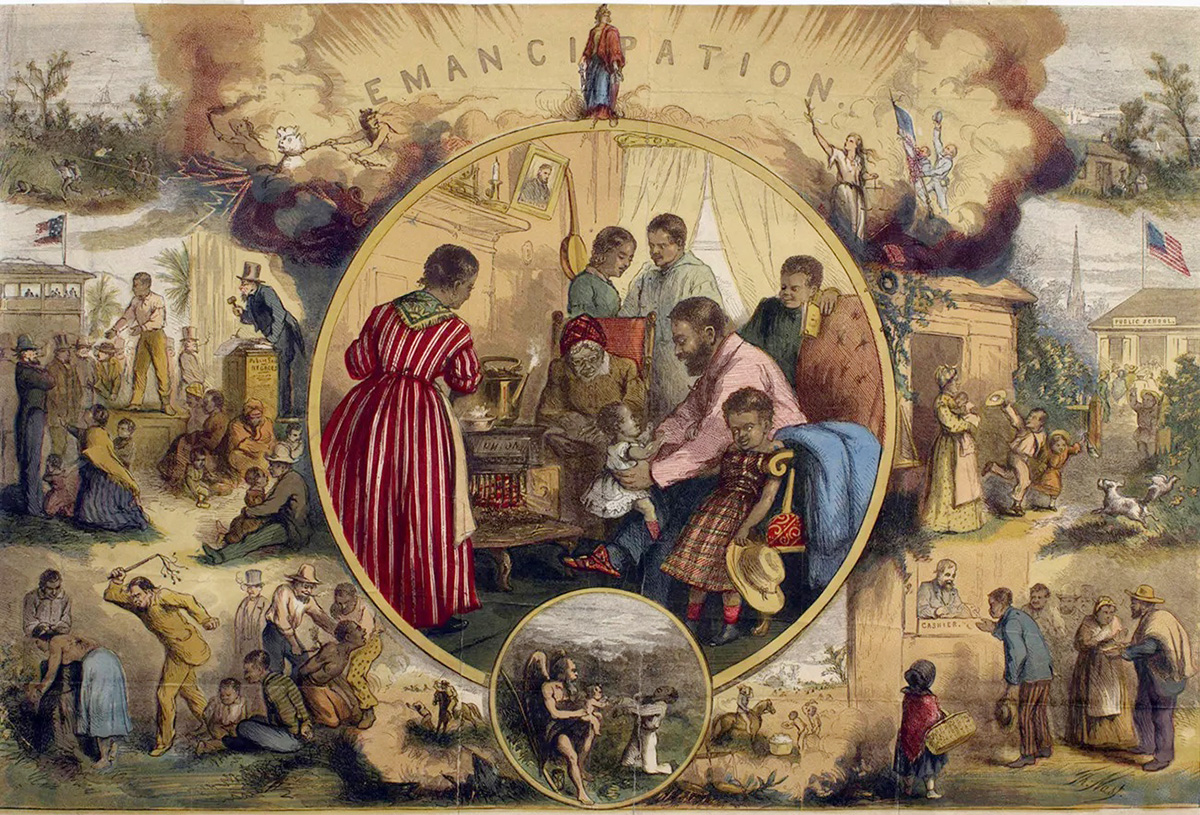
“Emancipation,” illustration by German-born American artist Thomas Nast for the January 24, 1863, issue of Harper’s Weekly. This color version was subsequently produced by Philadelphia printer King & Baird, which added the title “The Past and the Future” outside the frame. In the center, a Black family enjoys a quiet evening together; below, a baby, representing the New Year, frees an enslaved man. To the left are horrors associated with slavery; to the right are promises for a better future: education, wages, and a home. (Library Company of Philadelphia)
In April 1864, the Thirteenth Amendment, which would abolish slavery and involuntary servitude, passed the Senate, but in June it stalled in the House after falling thirteen votes short of the required two-thirds for approval. During the following year, attitudes toward the amendment shifted after Union Army victories in the South and Abraham Lincoln’s resounding victory over Democratic candidate General George McClellan in the presidential election. Although initially ambivalent about the amendment, Lincoln and members of his Cabinet eventually became concerned that the Emancipation Proclamation might not survive judicial challenges or a subsequent administration and ultimately pushed for its passage. Lincoln told one crowd that future authorities might argue that the proclamation “only aided those who came into our lines, and that it was inoperative as to those who did not give themselves up; or that it would have no effect upon the children of the slaves born hereafter; in fact, it would be urged that it did not meet the evil. But this amendment is a king’s cure for all evils. It winds the whole thing up.”

By mid-January 1865, Republicans were worried they still did not have enough votes. Tensions were high in the packed House chamber on January 31, when the amendment was again considered. After the vote was tallied, House Speaker Schuyler Colfax “in a trembling voice” announced the final count as 119 in favor, 56 opposed: “The constitutional majority of two thirds having voted in the affirmative, the Joint Resolution has passed.” Noah Brooks, a journalist from Sacramento, described what happened next:
For a moment there was a pause of utter silence, as if the voices of the dense mass of spectators were choked by strong emotion. Then there was an explosion, a storm of cheers, the like of which probably no Congress of the United States ever heard before. Strong men embraced each other with tears. The galleries and aisles were bristling with standing, cheering crowds. The air was stirred with a cloud of women's handkerchiefs waving and floating; hands were shaking; men threw their arms about each other's necks, and cheer after cheer, and burst after burst followed.
In the gallery, Henry Highland Garnet cheered and celebrated along with friends and strangers alike. “Oh what a pepper and salt mixture it was,” he later recalled. During his quarter century in abolitionist circles, he often despaired that this day would never come—and he certainly didn’t anticipate that less than two weeks later he would be back in the House chamber as the first African American to speak before Congress.

Garnet had escaped from slavery when he was nine years old. Under the pretense of going to a funeral, his mother and father fled with Henry, his sister, and seven relatives from his uncle’s family into the woods and swamps of Maryland. When they reached Wilmington, Delaware, they secured safe passage via the underground railroad to New York City. Garnet enrolled at the African Free School in Manhattan, an education interrupted by two years at sea as a cabin boy and cook. When he returned at the age of 14, he learned that his family had relocated after slave catchers found them; his sister had even been captured and arrested but was released when supporters fabricated proof she had been in New York at the time she was allegedly enslaved.

Friends found employment for Garnet as a servant on Long Island, away from the dangers of discovery, but he was incapacitated by an accident that resulted in a serious injury to his leg. He resumed his education and graduated from the Oneida Institute in Whitesboro, New York, in 1839. His leg, which had caused him considerable pain and increasing hardship, was amputated sometime during the following year, around the time he became pastor of the Liberty Street Presbyterian Church in Troy, New York.

Garnet first came to widespread prominence in August 1843 at the National Convention of Colored Citizens in Buffalo, New York. He delivered a speech entitled “An Address to the Slaves of the United States of America,” a passionate call for open and, if necessary, violent resistance:
However much you and all of us may desire it, there is not much hope of Redemption without the shedding of blood. If you must bleed, let it all come at once—rather, die freemen, than live to be slaves. . . . and by all that life is worth, let it no longer be a debateable question, whether it is better to choose LIBERTY or DEATH! . . . Let your motto be RESISTANCE! RESISTANCE! RESISTANCE!—No oppressed people have ever secured their liberty without resistance.
Frederick Douglass and other Black abolitionists, wary of provoking Southern fears of a slave insurrection, defeated Garnet’s attempt to persuade the convention to underwrite the publication of the address. Nevertheless, Garnet made an impression, and William Wells Brown, who sided with Douglass that day, diplomatically wrote in a later biographical essay, “None but those who heard that speech have the slightest idea of the tremendous influence which he exercised over the assembly.”

After an extraordinary two-decade career as a teacher, activist, speaker (in England), missionary (in Jamaica), and religious leader, Garnet became the pastor of the Fifteenth Street Presbyterian Church in Washington, D.C., which is where William Henry Channing, the chaplain of the House of Representatives, found him in early February 1865. In commemoration of the passage of the Thirteenth Amendment, Channing, with the support of several Congress members, asked Garnet to deliver a sermon to the House on Sunday, February 12. The choir from Garnet’s church was also invited.

When Garnet delivered his sermon at noon on that Sunday, the floor and galleries were filled to capacity. William J. Wilson, a local resident who had recently moved from Brooklyn and who was a congregant of Garnet’s church, recorded that “it was a strange sight, I say, to see this little band of vocalists, stand up in places where but one year ago only white persons were allowed to stand, and there chant up hymns of praise to God for his goodness and his wonderful works to the children of men; and it was a sight stranger still to see this colored divine stand up in the dignity of his high office as a priest of the Most High in that Speaker's desk.”

Garnet opened his hour-long sermon with the scriptural text he had selected, Matthew 23:4, in which Jesus censures the Scribes and Pharisees for their hypocrisy: “For they bind heavy burdens, and grievous to be borne, and lay them on men's shoulders, but they themselves will not move them with one of their fingers.” Garnet then proceeded to a rebuke of the hypocrisy of leaders who defended or permitted slavery, a recapitulation of the barbarity of the Middle Passage and the inhumanity of the American plantation, and a sequence of antislavery quotes by great thinkers from biblical times to the modern era. The final portion of his sermon, which we present below, celebrates the end of slavery and looks to the future.

Notes: Although Delaware, Kentucky, New Jersey, and Mississippi will vote against ratification, the Thirteenth Amendment will be approved by twenty-seven states, included eight former members of the Confederacy, by December 6, 1865, and on December 18 Secretary of State William H. Seward will declare its ratification complete.

The eight lines of poetry are from John Greenleaf Whittier’s “Expostulation” (1834); the two lines of poetry later in the address are from William Cowper’s “Human Frailty” (1782).

*   *   *
For this week’s selection, we depart from the usual format and reproduce the excerpt from Garnet’s sermon below. You may also download it as a PDF or view it in Google Docs.

“Let Slavery Die”
(from) A Memorial Discourse

With all the moral attributes of God on our side, cheered as we are by the voices of universal human nature,—in view of the best interests of the present and future generations—animated with the noble desire to furnish the nations of the earth with a worthy example, let the verdict of death which has been brought in against slavery, by the Thirty-Eighth Congress, be affirmed and executed by the people. Let the gigantic monster perish. Yes, perish now, and perish forever!

      “Down let the shrine of Moloch sink,
            And leave no traces where it stood;
      No longer let its idol drink,
            His daily cup of human blood.
      But rear another altar there,
            To truth, and love, and mercy given,
      And freedom’s gift and freedom’s prayer,
            Shall call an answer down from heaven.”

It is often asked when and where will the demands of the reformers of this and coming ages end? It is a fair question, and I will answer.

When all unjust and heavy burdens shall be removed from every man in the land. When all invidious and proscriptive distinctions shall be blotted out from our laws, whether they be constitutional, statute, or municipal laws. When emancipation shall be followed by enfranchisement, and all men holding allegiance to the government shall enjoy every right of American citizenship. When our brave and gallant soldiers shall have justice done unto them. When the men who endure the sufferings and perils of the battle-field in the defence of their country, and in order to keep our rulers in their places, shall enjoy the well-earned privilege of voting for them. When in the army and navy, and in every legitimate and honorable occupation, promotion shall smile upon merit without the slightest regard to the complexion of a man’s face. When there shall be no more class-legislation, and no more trouble concerning the black man and his rights, than there is in regard to other American citizens. When, in every respect, he shall be equal before the law, and shall be left to make his own way in the social walks of life.

We ask, and only ask, that when our poor frail barks are launched on life’s ocean—

      “Bound on a voyage of awful length
            And dangers little known,”

that, in common with others, we may be furnished with rudder, helm, and sails, and charts, and compass. Give us good pilots to conduct us to the open seas; lift no false lights along the dangerous coasts, and if it shall please God to send us propitious winds, or fearful gales, we shall survive or perish as our energies or neglect shall determine. We ask no special favors, but we plead for justice. While we scorn unmanly dependence; in the name of God, the universal Father, we demand the right to live, and labor, and to enjoy the fruits of our toil. The good work which God has assigned for the ages to come, will be finished, when our national literature shall be so purified as to reflect a faithful and a just light upon the character and social habits of our race, and the brush, and pencil, and chisel, and Lyre of Art, shall refuse to lend their aid to scoff at the afflictions of the poor, or to caricature, or ridicule a long-suffering people. When caste and prejudice in Christian churches shall be utterly destroyed, and shall be regarded as totally unworthy of Christians, and at variance with the principles of the gospel. When the blessings of the Christian religion, and of sound, religious education, shall be freely offered to all, then, and not till then, shall the effectual labors of God’s people and God’s instruments cease.

If slavery has been destroyed merely from necessity, let every class be enfranchised at the dictation of justice. Then we shall have a Constitution that shall be reverenced by all: rulers who shall be honored, and revered, and a Union that shall be sincerely loved by a brave and patriotic people, and which can never be severed.

Great sacrifices have been made by the people; yet, greater still are demanded ere atonement can be made for our national sins. Eternal justice holds heavy mortgages against us, and will require the payment of the last farthing. We have involved ourselves in the sin of unrighteous gain, stimulated by luxury, and pride, and the love of power and oppression; and prosperity and peace can be purchased only by blood, and with tears of repentance. We have paid some of the fearful installments, but there are other heavy obligations to be met.

The great day of the nation’s judgment has come, and who shall be able to stand? Even we, whose ancestors have suffered the afflictions which are inseparable from a condition of slavery, for the period of two centuries and a half, now pity our land and weep with those who weep.

Upon the total and complete destruction of this accursed sin depends the safety and perpetuity of our Republic and its excellent institutions.

Let slavery die. It has had a long and fair trial. God himself has pleaded against it. The enlightened nations of the earth have condemned it. Its death warrant is signed by God and man. Do not commute its sentence. Give it no respite, but let it be ignominiously executed.

Honorable Senators and Representatives! illustrious rulers of this great nation! I cannot refrain this day from invoking upon you, in God’s name, the blessings of millions who were ready to perish, but to whom a new and better life has been opened by your humanity, justice, and patriotism. You have said, “Let the Constitution of the country be so amended that slavery and involuntary servitude shall no longer exist in the United States, except in punishment for crime.” Surely, an act so sublime could not escape Divine notice; and doubtless the deed has been recorded in the archives of heaven. Volumes may be appropriated to your praise and renown in the history of the world. Genius and art may perpetuate the glorious act on canvass and in marble, but certain and more lasting monuments in commemoration of your decision are already erected in the hearts and memories of a grateful people.

The nation has begun its exodus from worse than Egyptian bondage; and I beseech you that you say to the people, “that they go forward.” With the assurance of God’s favor in all things done in obedience to his righteous will, and guided by day and by night by the pillars of cloud and fire, let us not pause until we have reached the other and safe side of the stormy and crimson sea. Let freemen and patriots mete out complete and equal justice to all men, and thus prove to mankind the superiority of our Democratic, Republican Government.

Favored men, and honored of God as his instruments, speedily finish the work which he has given you to do. Emancipate, Enfranchise, Educate, and give the blessings of the gospel to every American citizen.

From A Memorial Discourse (1865).

Saturday, May 27, 2023

“A Horrid, Hellish Dream”

George E. Chamberlin (1838–1864)
From The Civil War: The Final Year Told by Those Who Lived It

“Bomb-Proof Rifle-Pit in Front of Petersburg,” sketch by American artist Andrew W. Warren (1823–1873) for Harper's Weekly Magazine, November 5, 1864. Between June 1864 and April 1865 Union troops camped outside Petersburg, Virginia, and constructed trench lines thirty miles long from which they conducted attacks in the area around the city. Image via Son of the South.
“Has father told you about my war fever? What does mother think of it?” George Chamberlin wrote to his sister Mary in June 1862. He had just graduated from Harvard Law School and in less than a month he would turn 24; his prospects were uncertain because of the ongoing war. “I wonder I did not go long ago. There is every reason for my going, and no sound ones why I should not. I have been thinking all the spring that if opportunity offered, I should try for a commission. It is a hard time to commence in business, and probably I should not be able to support myself at law for some time to come.”

Chamberlin was commissioned in August as a major in the 11th Vermont Volunteer Infantry (renamed the 1st Vermont Heavy Artillery later that year), and he served in the fortifications defending Washington, D.C. A year later, during the summer of 1863, he fell in love with 23-year-old Adelia (“Delie”) Gardiner; she was visiting her older brother, Aleck, who was stationed nearby. George and Delie were married on October 1. The following spring, she returned to her home in New York when the 1st Vermont became one of several heavy artillery regiments sent from the capital to reinforce the Army of the Potomac. Chamberlin’s regiment reached Spotsylvania on May 15 and came under fire for the first time three days later. On June 1, during the Battle of Cold Harbor, 119 men were killed or wounded, and on June 18 the regiment arrived outside of Petersburg, Virginia.

The fighting at Petersburg during the previous four days had captured several defensive positions but, despite the Union Army’s superior numbers, it had failed to take the city itself. General Ulysses S. Grant decided not to stage any further frontal assaults on the city; instead, Union troops began to entrench to the east and southeast. For the next nine months Grant would launch attacks in the area around Petersburg, and eventually the Union forces constructed trench lines that extended over 30 miles. Toward the end of June, Chamberlin wrote to his father about the experience of “trench life,” and we reprint that letter below as our Story of the Week selection.

“What can this mean, I hear you exclaim,” George wrote to Delie in a letter sent unexpectedly from Washington in early July. His regiment had rushed to the capital to help defend against a raid led by Confederate lieutenant general Jubal A. Early. On July 25, Chamberlin announced in a letter to his family in Vermont that he had recently been promoted to lieutenant colonel. Since he expected to be stationed in the city for a while, he sent a separate letter to Delie and suggested she return “to join the defences of Washington.” She excitedly agreed and began to make preparations, but barely a week later his regiment was sent across the Potomac in pursuit of raiders who were continuing their attacks around the city, and he hurriedly dispatched a telegram telling her to remain in New York.

By August 7, Chamberlin and his troops had reached Harpers Ferry, West Virginia, when he unexpectedly ran into a familiar face. “I have seen dear Aleck,” he wrote to Delie. “Is not this good, if we must be in the war at all, that we can be together?” Positioned within a half-mile of each other, the brothers-in-law were able to meet on several occasions while they waited in their respective camps for orders. On August 21, George wrote a hurriedly scribbled letter to Elie when an attack seemed imminent. “Darling, we are in God's hands, and His will is better and wiser than our will; we will love and trust Him, and be satisfied — orders to strike tents and pack up immediately — picket firing in front is quite sharp — increasing for the last half hour — and it seems nearer as though our pickets were falling back. Good-bye.” George was shot during a skirmish south of Charles Town. He was moved to a bed in a home near the town but, because Union forces had been ordered to fall back to Harpers Ferry, and despite the severity of his wounds, he was carried during the night to an army hospital at Sandy Hook, Maryland. Lieutenant Colonel George E. Chamberlin died the following morning.

A week later, Aleck wrote his sister with regret that he had not learned of George’s wounds until it was too late; he was only minutes away from the scene. “Standing yesterday upon the spot where he fell, I could see plainly to the left the ground where I rode and sat during that afternoon.”
He told me one evening, not a dozen miles from here, that when he entered the army he did so with a full understanding of the danger attending it; that he did not expect to escape, and was prepared to meet whatever fate be fell him, but since his marriage he had felt differently; that he wanted to live; that he felt it his duty to take care of himself for his wife’s sake.
On September 19, three weeks after sending this letter, Aleck was shot on the field at the Third Battle of Winchester. Colonel Alexander Gardiner, 31 years old, died of his wounds on October 7, leaving behind a wife of five years and their two children.

Notes: Lieutenant Colonel Reuben C. Benton resigned after contracting a malarial fever. Colonel James M. Warner was wounded at Spotsylvania on May 18 and sent home to convalesce. The Garton Branch and Petersburg Railroad was more commonly known as the Weldon Railroad. Captain M. was Edwin J. Morrill of St. Johnsbury, who had enlisted in August 1862; he was taken prisoner, wounded while trying to escape on June 29, and died the following day. Lieutenant-Colonel P. was Samuel E. Pingree of the 3rd Vermont Infantry. As the corps officer of the day, Pingree commanded the advance detachments that formed the brigade skirmish line on June 23. Pingree escaped capture and was mustered out on July 27. He later served as governor of Vermont, 1884–86. Major F. was Charles K. Fleming, who was captured on June 23, and held in a military prison in Columbia, South Carolina, before being paroled on February 28, 1865. Lieutenant R. was Lieutenant Lester S. Richards, who was paroled on March 1, 1865. Totten and Lincoln were forts in the Washington area. Carrie was Chamberlin’s younger sister, Caroline.

*   *   *
For this week’s selection, we depart from the usual format and reproduce Chamberlin’s letter, in its entirety, below. You may also download it as a PDF or view it in Google Docs.

“A Horrid, Hellish Dream”

HEADQUARTERS 1ST ART’Y, 11TH VT. VOLS., June 27, 1864.

My Dear Father:

How often, in the midst of all these dangers and privations, my mind turns back to that delightful home where I once lived so joyfully, so peacefully with my father, my mother, and brother and sisters. What blessed days, when the country was at peace; what awful days these, of blood, and carnage, and hate. The realities of war, you who have never been on the battlefield can never know or even imagine. To me, who have seen it, it seems more like a horrid, hellish dream, rather than a fact. There will be a fearful reckoning with those who are responsible for all this. Ours is the right side, but we have hard work before us. God will give us the victory sometime, and will surely put our wicked enemies to shame and confusion.

I wish I could write you oftener, but it has been impossible. To Delie I have written very frequently, but beyond this have done no writing, except what was required in my official capacity. I think I have written you only once before since leaving Washington. The campaign has been intensely active and laborious. The night work has been particularly severe, the greater part of the marching having been done by night. At dark, on the evening of June 12th, we left Cold Harbor, and marched all night and all the next day. At evening we rested on the right bank of the Chickahominy, and I was laying my blankets preparing for a good night’s sleep, when an order came, detailing me as division officer of the day, and I was on picket line all night without sleep, and marched the greater part of next day. Fatigues, that at home would be thought terrible, entirely too much for flesh and blood to endure, are an every week’s occurrence here, and we learn to bear them very naturally.

Delie has written you often, and through her you have been made acquainted with the items of news from time to time. I have been in command of the regiment for about two weeks. Lieutenant-Colonel Benton has resigned and gone home. Colonel Warner is at his home still.

On the 23d, the regiment met with a very great misfortune. We were in line of battle, facing the Garton Branch and Petersburg railroad. A report came in that a party of sharpshooters had pushed forward and taken the road, and wanted support. Two hundred men from our regiment were called for, and immediately sent under charge of Captain M., to be reported to Lieutenant-Colonel P., corps officer of the day. Soon after, I was called on for more men, and sent out Major F. with his battalion. Four hundred of our men were now out. In the afternoon the enemy moved two brigades rapidly down the railroad, formed as a skirmish line, and advanced on our skirmish line, which, not being properly supported, was finally driven back, and a portion of it captured. In that part of the line were our noble boys, and we have lost the greater part of them. Our total loss on that day was twenty-four killed and wounded, and two hundred and seventy-five prisoners. Of these, one officer was killed (Second-Lieutenant Sherman, a fine man and officer) and eighteen captured. My old company, A, is among the unfortunate. Captain M. and Lieutenant R. will know the beauties of a Southern prison. The batteries captured are F, L, K, H and A. A and K were my Totten companies, and L was with me at Lincoln. The greater part of the Fourth Vermont was taken at the same time. The fault was with the corps commander in not ordering proper supports. Our officers and men did their whole duty.

We have had a good deal of trench life during the campaign at Cold Harbor and at Petersburg. We dig up into the very teeth of the enemy, and then watch him. It is not safe to expose one’s head above the embankment, as a few sharpshooters keep up their murderous work through little loopholes in the parapet; otherwise there is not much firing. Living under ground is very dirty work, as you can imagine. One night, I remember to have been awakened by something on my neck, which I discovered to be a medium sized toad. Bugs and worms crawl over us promiscuously. What a sad sight, in this enlightened age, to see the sections of this civilized nation fighting each other with such insatiable fury. How much more congenial to our tastes, and how much more consonant with all our christian feelings and impulses, is peace, harmony, brotherly love. God deliver the nation soon from the chastisement of fire and blood which He has seen fit to send upon us.

How soon Carrie will graduate—day after to-morrow. It is probably an occasion of as much interest to her as mine was to me, nearly four years ago. Do any of you go to Troy? Delie wrote that mother would not go. I hope some of you will be there to see her take her honors. I well remember my gratification at seeing you all at Hanover. Delie, I think, has decided to go to Vermont. This I am very glad of, and have advised it all the time. How she will enjoy a visit there! You must drive away her sadness. She is very anxious for me, and I fear it is wearing upon her severely. I hope the Green Mountain air, and the many dear friends she will find there, will cause her to rally, and be as cheerful and healthy as ever. A husband and wife who love each other as we do, have no business to be separated as we are. You will all take good, tender care of her, won’t you? Cheer her up and comfort her by every means in your power. If you knew how kind, attentive and devoted she has always been to me, you could not help loving her for my sake. And you do know all about it, and you do love her for my sake, and for herself too. You have seen her, and you know that nobody has a better wife than I. How I wish I might be there with you. All will be there but the “boys.” You will miss us. How happy we should be together around that home circle again. I should be happier than ever to be there with my new companion, and you would be happier to see me with her than alone, for I know you joy in my joy. God has blessed me with the kindest of friends always, and I pray for a life long enough to show them that I am grateful. We were very sorry you did not return via Washington with Mary. I have had an intimation that you would remove West this fall. Is it so? I want to hear all about it. By the way, why haven’t I heard from any of you? I think I have not had a single letter since the campaign commenced. That isn’t right. My address is 1st Artillery, 11th Vt. Vols., 2d Brig., 2d Division, 6th Corps, Washington. The weather is very hot. The army is comparatively quiet, and will remain so, probably, until after muster day, the 30th.

Much love to my dear mother and sisters, and also to Edward, when you write. How dear is each and every one to me! Let me hear soon.
Your affectionate son.

From Letters of George E. Chamberlin, Who Fell in the Service of His Country near Charlestown, Va., August 21st, 1864 (1883).

Sunday, October 2, 2022

An Affair of Outposts

Ambrose Bierce (1842–1914?)
From Ambrose Bierce: The Devil’s Dictionary, Tales, & Memoirs

Battle of Shiloh, April 6–7, 1862, by American illustrator Thure de Thulstrup (1848–1930). Chromolithograph published by L. Prang & Co., Boston, 1888. Library of Congress.
“For fifteen hours we had been wet to the skin,” wrote Ambrose Bierce in 1881, recalling the day two decades earlier, near the end of fighting at Pittsburg Landing in Tennessee. “Chilled, sleepy, hungry and disappointed—profoundly disgusted with the inglorious part to which they had been condemned—the men of my regiment did everything doggedly. The spirit had gone quite out of them.” It was the afternoon of April 7, and the Ninth Indiana Regiment had arrived the previous evening in the midst of the Battle of Shiloh. That morning, when some Union officers believed that the enemy, outnumbered and outgunned, had abandoned the field and fled 20 miles south to the Confederate camp in Corinth, Mississippi, Sergeant Bierce led his men right into an ambush:
Then—I can’t describe it—the forest seemed all at once to flame up and disappear with a crash like that of a great wave upon the beach—a crash that expired in hot hissings, and the sickening “spat” of lead against flesh. A dozen of my brave fellows tumbled over like ten-pins. Some struggled to their feet, only to go down again, and yet again.
The Ninth Indiana Regiment would lose 170 men at Shiloh—its worst casualty count of the war. During the two-day battle, more than one in five of the 110,000 soldiers were killed or wounded. “Shiloh’s casualties eclipsed the total of the Revolutionary War, the War of 1812, and Mexican War combined,” writes Ron Chernow. Although the battle was and is considered a Union victory, the casualties were so horrific that some contemporary journalists and observers blamed Generals Ulysses Grant and Benjamin Prentiss (the latter taken prisoner after surrendering his division) for not anticipating the Confederate attack. The lieutenant governor of Ohio visited the field after the battle and found among the surviving soldiers “a general feeling among the most intelligent men that Grant and Prentiss ought to be court-martialed or shot”—a sentiment shared by Bierce. For the rest of his life, Bierce attributed the meager Union victory at Shiloh to the last-minute arrival of reinforcements commanded by General Don Carlos Buell and minimized Grant’s successes during the war—an argument he reiterated in several essays and stories, including “An Affair of Outposts.”

A year earlier, in April 1861, eighteen-year-old Ambrose Bierce had enlisted in Indiana just seven days after Confederate troops had attacked Fort Sumter. In late May, the regiment departed for the front, sent off with a formal review conducted by General George McClellan and a rousing speech delivered by Governor Oliver P. Morton. Shortly after the Battle of Shiloh, Morton traveled to Tennessee to check in on the young men he had dispatched the previous year. Morton was generally popular among Union troops and would have the steadfast support of veterans after the war, but one might guess what the exhausted, filthy soldiers thought of the intrusion onto the field of the governor and his well-dressed retinue. In “An Affair of Outposts,” however, Bierce doesn’t leave it to our imagination: “The bedraggled soldier looked up from his trench as they passed, leaned upon his spade and audibly damned them to signify his sense of their ornamental irrelevance to the austerities of his trade.” Although Bierce’s story was written a full thirty-five years later, in 1897, long after Morton’s death, there is no mistaking that the flabby, faint-hearted politician in the tale is a merciless caricature of the former governor.

Roy Morris Jr., in his 1999 biography of Bierce, regards “An Affair of Outposts,” as one of his strongest stories, “a bitter denunciation of both romantic betrayal and fatuous patriotism. Its unusual mixture of the two can be read on one level as an old soldier’s disgusted farewell to arms, his hard-earned realization that impassioned appeals to patriotism are in a way the ultimate seduction. . . . It is a theme that Bierce would reiterate in several of his stories.”

Notes: The quotations by Bierce in the above introduction are from his essay “What I Saw of Shiloh.” The “unwritten law” in the story refers to the supposed right of an individual to avenge moral offenses committed against members of his family; here, the right of a husband to kill his wife’s lover. The phrase “excursions and alarums” are the sounds of war and battle, used as a stage direction in Elizabethan plays for moving soldiers across the stage. Bierce’s description of “the unstrained quality of this military humor dropped not as the gentle rain from heaven” echoes Shakespeare’s The Merchant of Venice: “The quality of mercy is not strained; / It droppeth as the gentle rain from heaven / Upon the place beneath.”

*   *   *
Two men sat in conversation. One was the Governor of the State. . . . If you don't see the full selection below, click here (PDF) or click here (Google Docs) to read it—free!

This selection may be photocopied and distributed for classroom or educational use.

Sunday, June 12, 2022

Building a School

Harriet Ann Jacobs (1813–1897) & Louisa M. Jacobs (1833–1917)
From The Civil War: The Final Year Told by Those Who Lived It

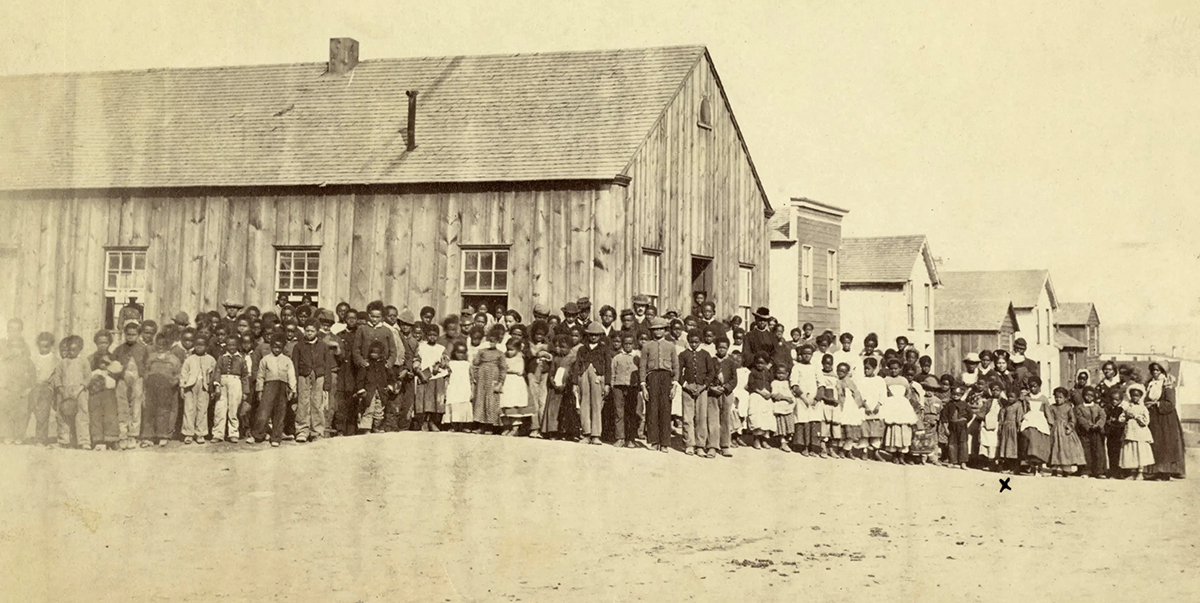
Photograph of students and teachers at the Jacobs Free School, 1864. Harriet Jacobs is indicated with a small X beneath her. The image was distributed to Northern supporters who helped fund the school. (Stuart A. Rose Library, Emory University, via Wikimedia)
In the memoir Incidents in the Life of a Slave Girl, Harriet Ann Jacobs recalls an older Black man, also living in slavery, whose “most earnest desire” was to be able to read. “He came to me, and begged me to teach him. He said he could not pay me, for he had no money, but he would bring me nice fruit when the season for it came.” She reminded him that it was against the law and that they would be “whipped and imprisoned” if they were caught. When his face showed his disappointment, she quickly added, “I have no thoughts of refusing to teach you. I only told you of the law, that you might know the danger, and be on your guard.” In conclusion, she told readers, “There are thousands, who, like good uncle Fred, are thirsting for the water of life; but the law forbids it, and the churches withhold it. They send the Bible to heathen abroad, and neglect the heathen at home.” This episode from Jacobs’s past proved to be a hint of her future career, during which she would work to open schools for hundreds of adults and children who had been freed from slavery.

In the summer of 1862, the year after her book was anonymously published, she traveled to Washington, D.C., on assignment for William Lloyd Garrison’s newspaper, The Liberator. Later in the summer she traveled to Alexandria, Virginia, which had become the temporary home to thousands of refugees, wounded soldiers, and prisoners, and in the months ahead she engaged in Quaker-sponsored relief work among the “contrabands”—enslaved men, women, and children who had escaped to areas under Union control. Before the war, Alexandria had been second only to New Orleans as a slave market; Jacobs visited the notorious slave pen owned by James Birch soon after her arrival in the city. “This place forms a singular contrast with what it was two years ago,” she wrote in her report. “The habitable part of the building is filled with contrabands, the old jail is filled with secesh prisoners—all within speaking distance of each other. Many a compliment is passed between them on the change in their positions.”

Within months after the refugees had begun to arrive, she noted in her article, schools were being established unsystematically among the camps and shanty towns. “It is pleasant to see that eager group of old and young, striving to learn their A, B, C, and Scripture sentences. Their great desire is to learn to read.” Near the end of the following year, Jacobs traveled north to arrange funds for a school; she returned with her daughter, Louisa, who had attended Young Ladies’ Domestic Seminary in Clinton, New York, and had taken teacher education courses in Boston. They discovered that, while Jacobs was away, white missionaries had insinuated themselves into the school and planned to manage it themselves. With the help of one of the trustees, Jacobs and her daughter wrested back control of the establishment. The Jacobs Free School opened its doors to seventy-five students in January 1864, with Louisa Jacobs in charge and Virginia Lawton, a friend from Boston, as a second teacher.

In March 1864 Harriet Jacobs sent a letter from both her and her daughter to Lydia Maria Child, the author and abolitionist who had edited Incidents in the Life and helped get it published. The Jacobses updated Child with news about the school and their need for help in funding it. The letter ended with a report of Harriet’s involvement in an event that had occurred the previous week: on March 20, the relief ship Marcia Day had returned to Alexandria from Haiti with nearly 300 destitute passengers. Fourteen months earlier, on New Year’s Eve 1862, President Lincoln had signed a contract with a cotton trader who proposed to transport 5,000 freedmen to Île à Vache, a small uninhabited island off the coast of Haiti. A total of 453 persons migrated to found the colony, but their attempts to establish a cotton plantation failed; 88 died of hunger and disease and 73 fled to the Haitian mainland before the remainder were rescued and brought back to the States.

Child forwarded the Jacobses’ letter to the abolitionist Oliver Johnson, editor of the National Anti-Slavery Standard, and in a cover note she wrote, “I am sure your readers will feel gratified, as I do, to see these two highly intelligent women laboring so zealously and faithfully for the good of their long-oppressed people; and also because the account they give of the conduct of the freedmen is so cheering.” Johnson reprinted the letter in the newspaper in mid-April.

Notes: In 1856, Senator Charles Sumner (R-MA), a steadfast opponent of slavery, delivered a philippic against the Kansas-Nebraska Act on the House floor; two days later he was attacked by Congressman Preston S. Brooks (D-SC) so severely that he fell unconscious to the floor. His injuries would prevent him from returning to the Senate for more than three years. The vote to abolish slavery in Virginia occurred on March 10, 1864, during a constitutional convention called by the Unionist “Restored Government” that met in Alexandria. Massachusetts governor John A. Andrew commissioned Sergeant Stephen A. Swails of the 54th Massachusetts Infantry as a second lieutenant on March 11, 1864. The first African American soldier promoted to commissioned rank, Swails was not mustered in as an officer until January 17, 1865, because of opposition from the War Department. “A man’s a man for a’ that” is from Robert Burns’s poem, “For A’ That and A’ That” (1795). The 5th Massachusetts Cavalry was a Black regiment. George T. Downing of Rhode Island and Charles L. Remond of Massachusetts were prominent Black abolitionists.

*   *   *
When I went to the North, last Fall, the Freedmen here were building a schoolhouse, and I expected it would have been finished by the time I returned. . . . If you don't see the full selection below, click here (PDF) or click here (Google Docs) to read it—free!

This selection may be photocopied and distributed for classroom or educational use.

Sunday, May 29, 2022

Death of a Pennsylvania Soldier

Walt Whitman (1819–1892)
From The Civil War: The Final Year Told by Those Who Lived It

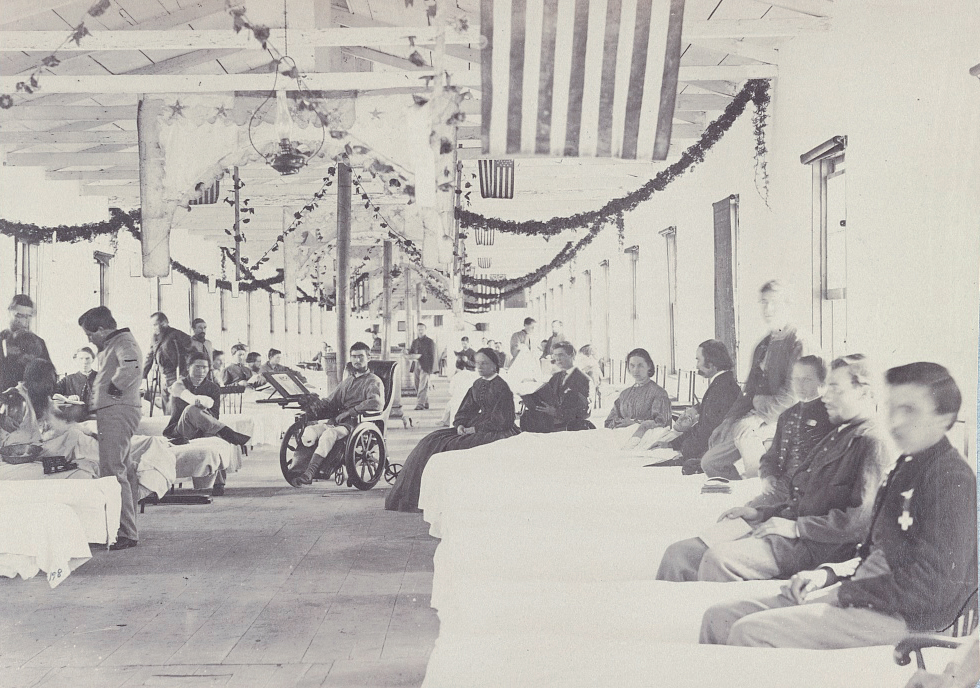
Photograph of a ward in Armory Square Hospital, Washington, D.C., c. 1862–65. Frank H. Irvin was admitted to this hospital after being wounded in Virginia. (Library of Congress)
The following introduction is adapted from headnotes that appear in The Civil War: The Second Year (edited by Stephen W. Sears) and The Civil War: The Final Year (edited by Aaron Sheehan-Dean).

Walt Whitman was living in Brooklyn and working as a freelance journalist when he learned that his brother George, a captain with the 51st New York Infantry, had been wounded at Fredericksburg. Whitman traveled to Falmouth, across the Rappahannock from the battlefield, and discovered that his brother’s wound was slight. After visiting army hospitals and camps around Falmouth, he accompanied a group of wounded soldiers as they were evacuated to Washington by train and steamboat. Whitman would remain in the capital for the next eighteen months, visiting military hospitals while working as a government clerk. He described his time with the Army of the Potomac in Specimen Days (1882), drawing on accounts he had previously published in The New York Times in 1864; in “’Tis But Ten Years Since,” a series of six articles that appeared in the New York Weekly Graphic in 1874; and in Memoranda During the War (1875).

In one passage from Specimen Days, Whitman wrote about the fatally wounded soldiers who never reached hospitals and were never buried in marked graves:
No history ever—no poem sings, no music sounds, those bravest men of all—those deeds. No formal general’s report, nor book in the library, nor column in the paper, embalms the bravest, north or south, east or west. Unnamed, unknown, remain, and still remain, the bravest soldiers. Our manliest—our boys—our hardy darlings; no picture gives them. Likely, the typic one of them (standing, no doubt, for hundreds, thousands,) crawls aside to some bush-clump, or ferny tuft, on receiving his death-shot—there sheltering a little while, soaking roots, grass and soil, with red blood—the battle advances, retreats, flits from the scene, sweeps by—and there, haply with pain and suffering (yet less, far less, than is supposed,) the last lethargy winds like a serpent round him—the eyes glaze in death—none recks—perhaps the burial-squads, in truce, a week afterwards, search not the secluded spot—and there, at last, the Bravest Soldier crumbles in mother earth, unburied and unknown.
Whitman also included in his book a letter he sent to the mother of a 22-year-old Union soldier who had been wounded near Petersburg in the last weeks of the war, and we reprint that letter below as our Story of the Week selection for Memorial Day.

Notes: Frank H. Irvin (spelled Irwin by Whitman), of New Alexandria, Pennsylvania, enlisted on September 26, 1864, was wounded on March 25, 1865, and died on May 2 (rather than May 1, as Whitman has it); his mother, Margaret Tweedy, a widow, received a military pension of $8 a month. See the Whitman's Memory website, which has additional details of soldiers memorialized by the poet.

Fort Fisher was a large Union earthwork south of Petersburg, Virginia, built after the battle of Peebles Farm, September 30–October 2, 1864. D. Willard Bliss was the chief surgeon of Armory Square Hospital, 1862–65.

*   *   *
For this week’s selection, we depart from the usual format and reproduce Whitman’s letter, in its entirety, below. You may also download it as a PDF or view it in Google Docs.

Death of a Pennsylvania Soldier

Frank H. Irwin, company E, 93d Pennsylvania — died May 1, ’65 — My letter to his mother. —Dear madam: No doubt you and Frank’s friends have heard the sad fact of his death in hospital here, through his uncle, or the lady from Baltimore, who took his things. (I have not seen them, only heard of them visiting Frank.) I will write you a few lines—as a casual friend that sat by his death-bed. Your son, corporal Frank H. Irwin, was wounded near fort Fisher, Virginia, March 25th, 1865—the wound was in the left knee, pretty bad. He was sent up to Washington, was receiv’d in ward C, Armory-square hospital, March 28th—the wound became worse, and on the 4th of April the leg was amputated a little above the knee—the operation was perform’d by Dr. Bliss, one of the best surgeons in the army—he did the whole operation himself—there was a good deal of bad matter gather’d—the bullet was found in the knee. For a couple of weeks afterwards he was doing pretty well. I visited and sat by him frequently, as he was fond of having me. The last ten or twelve days of April I saw that his case was critical. He previously had some fever, with cold spells. The last week in April he was much of the time flighty—but always mild and gentle. He died first of May. The actual cause of death was pyæmia, (the absorption of the matter in the system instead of its discharge.) Frank, as far as I saw, had everything requisite in surgical treatment, nursing, &c. He had watches much of the time. He was so good and well-behaved and affectionate, I myself liked him very much. I was in the habit of coming in afternoons and sitting by him, and soothing him, and he liked to have me—liked to put his arm out and lay his hand on my knee—would keep it so a long while. Toward the last he was more restless and flighty at night—often fancied himself with his regiment—by his talk sometimes seem’d as if his feelings were hurt by being blamed by his officers for something he was entirely innocent of—said, “I never in my life was thought capable of such a thing, and never was.” At other times he would fancy himself talking as it seem’d to children or such like, his relatives I suppose, and giving them good advice; would talk to them a long while. All the time he was out of his head not one single bad word or idea escaped him. It was remark’d that many a man’s conversation in his senses was not half as good as Frank’s delirium. He seem’d quite willing to die—he had become very weak and had suffer’d a good deal, and was perfectly resign’d, poor boy. I do not know his past life, but I feel as if it must have been good. At any rate what I saw of him here, under the most trying circumstances, with a painful wound, and among strangers, I can say that he behaved so brave, so composed, and so sweet and affectionate, it could not be surpass’d. And now like many other noble and good men, after serving his country as a soldier, he has yielded up his young life at the very outset in her service. Such things are gloomy—yet there is a text, “God doeth all things well”—the meaning of which, after due time, appears to the soul.

I thought perhaps a few words, though from a stranger, about your son, from one who was with him at the last, might be worth while—for I loved the young man, though I but saw him immediately to lose him. I am merely a friend visiting the hospitals occasionally to cheer the wounded and sick.
W. W.

From Specimen Days & Collect (1882–83).

Sunday, February 9, 2020

Eulogy for Abraham Lincoln

Frederick Douglass (1818–1895)

Lincoln funeral procession at the corner of Broadway and Union Square in New York City, April 25, 1865. Photograph by Robert N. Dennis. The two children visible in the window at the upper left are believed to be six-year-old Theodore Roosevelt and his brother Elliott, watching from their grandfather’s house. The exclusion of African Americans from the procession led to the planning of a separate memorial organized by black leaders, to which Frederick Douglass was invited to speak. Photo courtesy of the Theodore Roosevelt Birthplace National Historic Site.
Frederick Douglass was spending the Saturday of Easter weekend at home in Rochester, New York, when news of the assassination of President Lincoln by John Wilkes Booth reached the city. The mayor called for a public gathering at 3:00 and stunned citizens congregated at City Hall as the city’s bells tolled. Hundreds were unable to enter the packed building to hear speakers mourn the president, and Douglass was among those in the crowd at the very back of the room. Another person in attendance who knew him later related to a biographer that “he told me he should not speak because he was not invited,” but soon “his name burst upon the air from every side, and filled the house.” Douglass acceded to the calls of his neighbors and went to the platform.

“It is a day for silence and meditation; for grief and tears,” he lamented in relatively brief comments, which were reported in the next issue of the Rochester Daily Democrat. He recounted for his audience his visit to the White House after the second inauguration only a few weeks before. (He didn’t mention, however, that Lincoln had to intervene personally when his own guards refused to admit Douglass because he was black.) He denounced the treasonous “spirit that gave birth” to the assassin and predicted the act would only encourage the victorious Union even more to “exact ample security for the future.” Douglass’s neighbor concluded his recollection of the afternoon with praise: “I have heard Webster and Clay in their best moments; Channing and Beecher in their highest inspirations; I never heard truer eloquence! I never saw profounder impression. When he finished the meeting was done.” As Douglass reminisced in his autobiography Life and Times, the event was a turning point in his relationship with the townspeople:
I had resided long in Rochester, and had made many speeches there which had more or less touched the hearts of my hearers, but never till this day was I brought into such close accord with them. We shared in common a terrible calamity, and this “touch of nature made us” more than countrymen, it made us “kin.”
The camaraderie in Rochester was a far cry from what was occurring three hundred miles to the southeast. New York City was still haunted by memories of the draft riots two years earlier, when as many as 120 people had been killed, including at least eleven African American men lynched by white mobs, and the Colored Orphans Asylum had been looted and torched. In the period following the riots, ostensibly to maintain order, black participants had been banned from several public events and parades. Similarly, the City Council announced its decision to exclude African Americans from Lincoln’s funeral procession. The New-York Tribune mocked the ban, noting the irony of excluding black participants from a “pageant devised and engineered by men who always opposed and never even professed to honor and respect our late President until they were quite sure he was dead.” The outraged editor of The Anglo-African pointed out that three thousand black troops marched safely and without incident in the funeral procession in Washington and that significant contingents had also taken part in the pageants in Baltimore and Philadelphia.

In response to the council’s action, a group of black leaders announced their own event commemorating Lincoln’s life and death, and Frederick Douglass agreed to be the featured speaker. The New York Times reported that the oration, held at Cooper Union on June 1 (which had been declared a National Day of Mourning by Congress), “drew an immense mixed audience, persons of color predominating. Every seat was filled, and several hundred persons were compelled to stand.” The occasion was widely reported, and summaries of the much-heralded speech were printed in both the Times and the Tribune. Yet in the century and a half after the event, the speech had never been reprinted in full, even though Douglass’s manuscript has been among his papers in the Library of Congress, seen only by a small number of scholars and biographers. Five years ago, however, it was carefully transcribed and reprinted in the Library of America collection President Lincoln Assassinated!!, edited by Harold Holzer, and we present it here as this week’s selection.

Notes: The attempted assassination mentioned on page 317 refers to the infamous incident on the floor of the Senate on May 22, 1856, when Democratic congressman Preston Brooks of South Carolina attacked Senator Charles Sumner of Massachusetts with a cane, nearly killing him in retaliation for a speech criticizing one of Brooks’s relatives and other slaveholders. On the next page, Douglass lists several people by their last names. Pierre Gustave Toutant-Beauregard left the U.S. Army to become the first prominent general of the Confederate Army; William Payne rose through the Confederate ranks to become a brigadier general. George Andrew Atzerodt (spelled Adzerot by Douglass) was one of John Wilkes Booth’s co-conspirators; he was assigned to kill Vice President Andrew Johnson but spent the night drinking and lost his nerve. John C. Breckinridge was Vice President during the Buchanan administration; he enrolled in the Confederate Army when the war broke out, eventually becoming the Confederate secretary of war..

*   *   *
I come before you this evening with much diffidence: The rarest gifts, the best eloquence, the highest order of genius to which the nation has given birth, might well be employed here and now, and yet fail of justice to the dignity. . . . If you don't see the full selection below, click here (PDF) or click here (Google Docs) to read it—free!

This selection may be photocopied and distributed for classroom or educational use.