Showing posts with label Lydia Maria Francis Child. Show all posts

Sunday, June 12, 2022

Building a School

Harriet Ann Jacobs (1813–1897) & Louisa M. Jacobs (1833–1917)
From The Civil War: The Final Year Told by Those Who Lived It

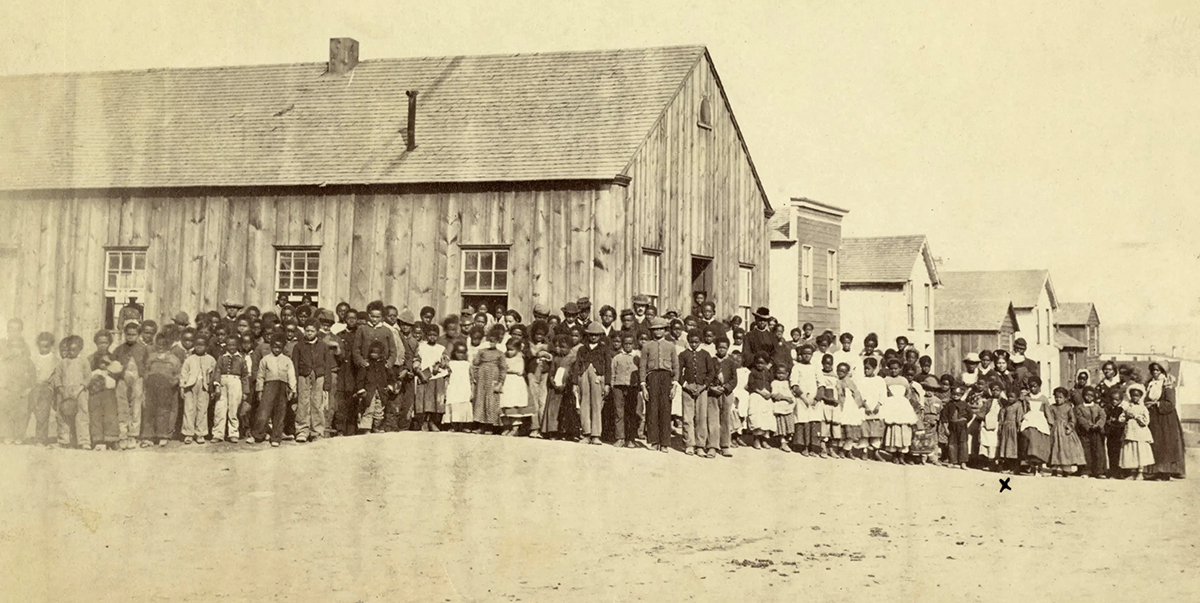
Photograph of students and teachers at the Jacobs Free School, 1864. Harriet Jacobs is indicated with a small X beneath her. The image was distributed to Northern supporters who helped fund the school. (Stuart A. Rose Library, Emory University, via Wikimedia)
In the memoir Incidents in the Life of a Slave Girl, Harriet Ann Jacobs recalls an older Black man, also living in slavery, whose “most earnest desire” was to be able to read. “He came to me, and begged me to teach him. He said he could not pay me, for he had no money, but he would bring me nice fruit when the season for it came.” She reminded him that it was against the law and that they would be “whipped and imprisoned” if they were caught. When his face showed his disappointment, she quickly added, “I have no thoughts of refusing to teach you. I only told you of the law, that you might know the danger, and be on your guard.” In conclusion, she told readers, “There are thousands, who, like good uncle Fred, are thirsting for the water of life; but the law forbids it, and the churches withhold it. They send the Bible to heathen abroad, and neglect the heathen at home.” This episode from Jacobs’s past proved to be a hint of her future career, during which she would work to open schools for hundreds of adults and children who had been freed from slavery.

In the summer of 1862, the year after her book was anonymously published, she traveled to Washington, D.C., on assignment for William Lloyd Garrison’s newspaper, The Liberator. Later in the summer she traveled to Alexandria, Virginia, which had become the temporary home to thousands of refugees, wounded soldiers, and prisoners, and in the months ahead she engaged in Quaker-sponsored relief work among the “contrabands”—enslaved men, women, and children who had escaped to areas under Union control. Before the war, Alexandria had been second only to New Orleans as a slave market; Jacobs visited the notorious slave pen owned by James Birch soon after her arrival in the city. “This place forms a singular contrast with what it was two years ago,” she wrote in her report. “The habitable part of the building is filled with contrabands, the old jail is filled with secesh prisoners—all within speaking distance of each other. Many a compliment is passed between them on the change in their positions.”

Within months after the refugees had begun to arrive, she noted in her article, schools were being established unsystematically among the camps and shanty towns. “It is pleasant to see that eager group of old and young, striving to learn their A, B, C, and Scripture sentences. Their great desire is to learn to read.” Near the end of the following year, Jacobs traveled north to arrange funds for a school; she returned with her daughter, Louisa, who had attended Young Ladies’ Domestic Seminary in Clinton, New York, and had taken teacher education courses in Boston. They discovered that, while Jacobs was away, white missionaries had insinuated themselves into the school and planned to manage it themselves. With the help of one of the trustees, Jacobs and her daughter wrested back control of the establishment. The Jacobs Free School opened its doors to seventy-five students in January 1864, with Louisa Jacobs in charge and Virginia Lawton, a friend from Boston, as a second teacher.

In March 1864 Harriet Jacobs sent a letter from both her and her daughter to Lydia Maria Child, the author and abolitionist who had edited Incidents in the Life and helped get it published. The Jacobses updated Child with news about the school and their need for help in funding it. The letter ended with a report of Harriet’s involvement in an event that had occurred the previous week: on March 20, the relief ship Marcia Day had returned to Alexandria from Haiti with nearly 300 destitute passengers. Fourteen months earlier, on New Year’s Eve 1862, President Lincoln had signed a contract with a cotton trader who proposed to transport 5,000 freedmen to Île à Vache, a small uninhabited island off the coast of Haiti. A total of 453 persons migrated to found the colony, but their attempts to establish a cotton plantation failed; 88 died of hunger and disease and 73 fled to the Haitian mainland before the remainder were rescued and brought back to the States.

Child forwarded the Jacobses’ letter to the abolitionist Oliver Johnson, editor of the National Anti-Slavery Standard, and in a cover note she wrote, “I am sure your readers will feel gratified, as I do, to see these two highly intelligent women laboring so zealously and faithfully for the good of their long-oppressed people; and also because the account they give of the conduct of the freedmen is so cheering.” Johnson reprinted the letter in the newspaper in mid-April.

Notes: In 1856, Senator Charles Sumner (R-MA), a steadfast opponent of slavery, delivered a philippic against the Kansas-Nebraska Act on the House floor; two days later he was attacked by Congressman Preston S. Brooks (D-SC) so severely that he fell unconscious to the floor. His injuries would prevent him from returning to the Senate for more than three years. The vote to abolish slavery in Virginia occurred on March 10, 1864, during a constitutional convention called by the Unionist “Restored Government” that met in Alexandria. Massachusetts governor John A. Andrew commissioned Sergeant Stephen A. Swails of the 54th Massachusetts Infantry as a second lieutenant on March 11, 1864. The first African American soldier promoted to commissioned rank, Swails was not mustered in as an officer until January 17, 1865, because of opposition from the War Department. “A man’s a man for a’ that” is from Robert Burns’s poem, “For A’ That and A’ That” (1795). The 5th Massachusetts Cavalry was a Black regiment. George T. Downing of Rhode Island and Charles L. Remond of Massachusetts were prominent Black abolitionists.

*   *   *
When I went to the North, last Fall, the Freedmen here were building a schoolhouse, and I expected it would have been finished by the time I returned. . . . If you don't see the full selection below, click here (PDF) or click here (Google Docs) to read it—free!

This selection may be photocopied and distributed for classroom or educational use.
Friday, October 4, 2013

Slavery’s Pleasant Homes

Lydia Maria Francis Child (1802–1880)
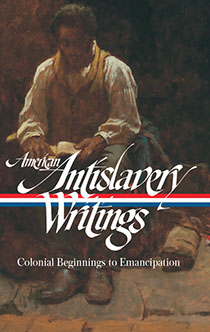
From American Antislavery Writings: Colonial Beginnings to Emancipation

Frontispiece from Lydia Child’s 1833 political tract, An Appeal in Favor of That Class of Americans Called Africans.
Every year schoolchildren learn “The New-England Boy’s Song about Thanksgiving Day,” with its well-known first line, “Over the river, and through the wood / To grandfather’s house we go.” Yet most Americans probably don’t realize that the poem’s author, Lydia Maria Francis Child, was famous during her lifetime as a novelist, historian, children’s literature editor, journalist, and (above all) author of antislavery fiction and essays. In 1826, after publishing two moderately successful historical novels, she founded and edited the popular bimonthly Juvenile Miscellany, one of the first American periodicals aimed at children. Seven years later, she issued An Appeal in Favor of That Class of Americans Called Africans, a tract that motivated many of its readers (including Boston lawyer Wendell Phillips and future Massachusetts senator Charles Sumner) to join the abolitionist cause. But the booklet’s unstinting arguments in favor of full citizenship for African Americans—and particularly the author’s support of interracial marriage—caused many of the readers of her children’s magazine to cancel their subscriptions, resulting in its bankruptcy.

This setback did not discourage her in the least, however, and she continued to write antislavery fiction and essays alongside her other work for the next forty years. (Story of the Week readers may recall that Child edited Harriet Ann Jacob’s Incidents in the Life of a Slave Girl in 1860–61, and for more than a century most people, including scholars, assumed that she had written it.) In 1840 she and her husband became the founding co-editors of The National Anti-Slavery Standard, the official weekly newspaper of the American Anti-Slavery Society. In 1843, just before she ended her tenure at the Standard, she wrote the ironically titled “Slavery’s Pleasant Homes” for The Liberty Bell, an annual gift book published by abolitionist William Lloyd Garrison.

“An intricate work of fiction, it is at once a love story and a murder mystery,” writes James G. Basker in his introductory note for “Slavery’s Pleasant Homes,” included in last year’s Library of America anthology of antislavery writings. The story’s emotional impact is intensified by the complex relationships of the slaves Rosa and George to their owners. Rosa’s mother is the “foster-mother” of Rosa’s future mistress, Marion, and the two girls had been raised almost as if they were sisters, while George is actually the half-brother of his master, Frederic.

In addition, Lydia Child’s biographer Carolyn L. Karcher explains how the story incorporates real-life elements to give it “a ring of authenticity.” For example, the two “fictionalized” newspaper articles quoted at the end are paraphrases of items that appeared during the 1830s, one in a Georgia newspaper and the other in Garrison’s anti-slavery weekly, The Liberator. Similarly, some of the story’s particulars were adapted from a tragedy that occurred on a plantation owned by a Bostonian on the island of Santa Cruz (now Saint Croix of the U.S. Virgin Islands). Child had previously questioned the official account of the incident in her antislavery essays, and her short story imagines a plausible truth behind what was reported by the papers. “Whenever she read of the barbarities committed by either blacks or Indians,” writes Karcher, “she always asked herself: ‘What was their side of the story?’ ”

Note: The epigraph is an excerpt from “The Yankee Girl” (1835), by John Greenleaf Whittier.

*   *   *
When Frederic Dalcho brought his young bride from New-Orleans to her Georgian home, there were great demonstra¬tions of joy among the slaves of the establishment. . . . If you don't see the full selection below, click here (PDF) or click here (Google Docs) to read it—free!

This selection may be photocopied and distributed for classroom or educational use.

Friday, April 5, 2013

The Lover

Harriet Ann Jacobs (1813–1897)
From American Antislavery Writings: Colonial Beginnings to Emancipation

Advertisement offering a reward for
the capture of Harriet Jacobs. American
Beacon
, Norfolk, Virginia, July 4, 1835.
Jacobs was in fact hiding in an attic,
where she remained for seven years.
She finally escaped to the North in 1842.
Image courtesy of The North
Carolina History Project
.
This year marks the bicentennial of the birth of Harriet Ann Jacobs. We will probably never know the date she was born; February 11, 1815, is engraved on her tombstone, but contemporary evidence (including a will in 1825 that transferred ownership of a “negro girl Harriet”) places her birth with near-certainty in 1813—probably during the late summer. Her mother died when she was six years old and, as was the case for many orphan-slaves of the era, the circumstances of her birth and childhood are hazy.

She was taught to read and write by her first mistress, who died when she was twelve—an event that changed the rest of her youth into an unending nightmare. The will left her to a three-year-old relative, whose parents became her new masters in a household that introduced her to the true barbarities of slavery. During the course of her subsequent captivity, other members of her family fled to the North. Her uncle Joseph Sawyer (Benjamin, in her account) attempted to escape, only to be captured, severely whipped, chained, and solitarily imprisoned “as an example to the rest of [the] slaves.” His second escape attempt succeeded. Harriet’s brother John (referred to as William in the narrative) also fled.

Jacobs herself eventually escaped to the North in 1842, the year before she turned thirty, and a decade later she began to float the idea of publishing her memoir. She first approached Harriet Beecher Stowe, who wanted to appropriate Jacobs’s story for a soon-to-be published collection of documents called A Key to Uncle Tom’s Cabin. Jacobs instead began including passages from her story in correspondence and publishing episodes in various newspapers, including Horace Greeley’s New-York Tribune, and she finally completed the manuscript in 1860. She then enlisted the aid of best-selling author Lydia Maria Child (primarily known to us today as the author of “Over the River and Through the Wood”), who copyedited the book, rearranged some of the sections, and deleted a final chapter about John Brown’s rebellion, which Child felt was superfluous to the story. Incidents in the Life of a Slave Girl appeared in 1861 under the pseudonym Linda Brent and with a foreword by Child, who assured her readers several times that she had added nothing to the story (“Reader, be assured this narrative is no fiction”). The book and its author enjoyed a limited celebrity among Northerners immediately after publication, but the memoir soon faded from view, its urgency and shocking content probably overwhelmed by the war and later by emancipation.

For over a century, Incidents was largely forgotten. Most academics concluded that the book had really been written by Child, perhaps based loosely on Jacobs’s life but “too melodramatic” (in the words of John Blassingame, one of the many unconvinced scholars) to be an actual slave narrative. In 1971 the historian Jean Fagan Yellin, having just finished her dissertation, embarked on three decades of extraordinary literary detective work that solved the mystery of authorship once and for all. She first located dozens of letters written by Jacobs, the style and content of which proved that the “novel” was indeed written by the former slave. Then, with the help of several archivists across the country, Yellin uncovered numerous historical documents identifying many of the people in the book and verifying the major events and many minor details. Professor Yellin then published her findings in 1987 in a new edition of Incidents—with the full support of the formerly skeptical Professor Blassingame. In 2004, having subsequently unearthed even more documentation confirming the truthfulness of Jacobs’s memoir, Yellin updated her research in an award-winning biography.

Note: The stanza of poetry on the first page is from Byron’s “The Lament of Tass” (1817).

*   *   *
Why does the slave ever love? Why allow the tendrils of the heart to twine around objects which may at any moment be wrenched away by the hand of violence? When separations come by the hand of death, the pious soul can bow in resignation, and say, “Not my will, but thine be done, O Lord!” . . . If you don't see the full selection below, click here (PDF) or click here (Google Docs) to read it—free!

This selection may be photocopied and distributed for classroom or educational use.