From The Complete Earthsea
Interesting Links
“David Mitchell on Earthsea—A Rival to Tolkien and George RR Martin” (The Guardian)
Video: “Ursula K. Le Guin on Creating the World of Earthsea” (Arwen Curry & John Plotz, Literary Hub)
Previous Story of the Week selections • “The Day Before the Revolution,” Ursula K. Le Guin
• “The Dead Valley,” Ralph Adams Cram
• “A Game of Vlet,” Joanna Russ
• “If Ever I Should Leave You,” Pamela Sargent
Buy the book
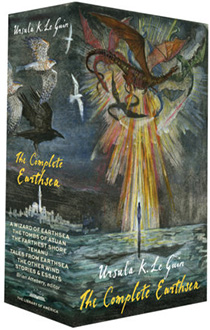 The Complete Earthsea
A Wizard of Earthsea | The Tombs of Atuan | The Farthest Shore | Tehanu | Tales from Earthsea | The Other Wind | four stories | six essays
Two-volume boxed set
Clothbound | 1,257 pages
List price: $80.00
Web Store price: $68.00
“David Mitchell on Earthsea—A Rival to Tolkien and George RR Martin” (The Guardian)
Video: “Ursula K. Le Guin on Creating the World of Earthsea” (Arwen Curry & John Plotz, Literary Hub)
Previous Story of the Week selections • “The Day Before the Revolution,” Ursula K. Le Guin
• “The Dead Valley,” Ralph Adams Cram
• “A Game of Vlet,” Joanna Russ
• “If Ever I Should Leave You,” Pamela Sargent
Buy the book
The Complete EarthseaA Wizard of Earthsea | The Tombs of Atuan | The Farthest Shore | Tehanu | Tales from Earthsea | The Other Wind | four stories | six essays
Two-volume boxed set
Clothbound | 1,257 pages
List price: $80.00
Web Store price: $68.00
 |
| An illustrated version of the map of Earthsea by Olivia Lomenech Gill, based on the original map by Ursula K. Le Guin and included in The Complete Earthsea. Click to view a larger image. (Map copyright © The Ursula K. Le Guin Literary Trust) |
It was the idea of writing with a specific audience in mind or a specific age of reader that scared me off. I’d published fantasy and science fiction, but I was interested in the form itself, not in who read it or how old they were.At the time, Le Guin had published three science fiction novels with Ace Books. She initially demurred, but then, as you might have guessed, she had second thoughts and began to think about wizards. “Back then, in 1967, wizards were all, more or less, Merlin and Gandalf. Old men, peaked hats, white beards. But this was to be a book for young people. Well, Merlin and Gandalf must have been young once, right? And when they were young, when they were fool kids, how did they learn to be wizards?”
But maybe my real problem was that I’d spent so many years writing novels, sending them to publishers, and having them come back with a dull thud on the doormat that I had trouble comprehending that an actual publisher had really asked me to write a book.
Three years earlier, Le Guin had published two stories set in an archipelago peopled by dragons and wizards: “The Word of Unbinding” and “The Rule of Names.” Years later, when she included these two tales in the collection The Wind’s Twelve Quarters, she explained, “I didn’t know much about the place at first, and readers familiar with the trilogy will notice that trolls became extinct in Earthsea at some point.”
In addition, an unpublished short story she worked on in 1965 or 1966, “about a prince who travels down through the archipelago from its central island, Havnor, in search of the Ultimate,” was also set in that world, to which Le Guin decided to return for her novel about a young man learning to be a wizard. Le Guin worked on the book for much of 1967, first drawing a map of the world that she would call Earthsea.
The original map was on a very large sheet—probably butcher paper, which I had rolls of for my kids to draw on. That big map vanished years ago, but I’d made a careful copy on a smaller, handier scale. . . . And that provided the model for the many professional illustrators of various editions of the books in many countries to draw as carefully and more skillfully than I.As she admitted, one of the challenges was how she would go about writing a book specifically for teenagers. Yet the wellspring of fantasy literature, she later wrote, is a “confluence of folk and fairy tale, classical epic, medieval and Renaissance and Eastern romance, romantic ballad, Victorian imaginative tale, and twentieth-century book of fantastic adventure such as T. H. White’s Arthurian cycle and Tolkien’s great book. Most of this marvelous flood of literature was written for adults, but modernist literary ideology shunted it all to children.” The six Earthsea books met the challenge by embracing this tradition and they have in turn been embraced by readers of all ages.
When she reprinted “The Word of Unbinding,” the story that started it all, Le Guin pointed out that it “foreshadows the end of the last book of the [first] trilogy, The Farthest Shore, in its imagery of the world of the dead. It also reveals a certain obsession with trees, which, once you notice them, keep cropping up throughout my work. I think I am definitely the most arboreal science fiction writer. It’s all right for the rest of you who climbed down, and developed opposable thumbs, and erect posture, and all that. There’s a few of us still up here swinging.”
* * *
Where was he? The floor was hard and slimy, the airblack and stinking, and that was all there was. Except a headache. . . . If you don't see the full selection below, click here (PDF) or click here (Google Docs) to read it—free!This selection is used by permission.
To photocopy and distribute this selection for classroom use, please contact the Copyright Clearance Center.
To photocopy and distribute this selection for classroom use, please contact the Copyright Clearance Center.