Showing posts with label Ursula K. Le Guin. Show all posts

Sunday, September 13, 2026

The Word of Unbinding

Ursula K. Le Guin (1929–2018)
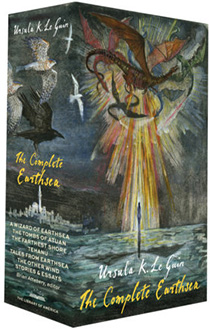
From The Complete Earthsea

An illustrated version of the map of Earthsea by Olivia Lomenech Gill, based on the original map by Ursula K. Le Guin and included in The Complete Earthsea. Click to view a larger image. (Map copyright © The Ursula K. Le Guin Literary Trust)
“Once upon a time,” Ursula K. Le Guin recalled in 2012, “a publisher asked me if I’d write a novel for teenagers. ‘Oh, no!’ I said. ‘No, thanks very much, but I couldn’t!’” The year was 1967 and Herman Schein of Parnassus Press, which had published two children’s books by Le Guin’s mother, Theodora Kroeber, wrote to Le Guin to ask if she would write a book for younger readers and suggested that it might be fantasy.
It was the idea of writing with a specific audience in mind or a specific age of reader that scared me off. I’d published fantasy and science fiction, but I was interested in the form itself, not in who read it or how old they were.

But maybe my real problem was that I’d spent so many years writing novels, sending them to publishers, and having them come back with a dull thud on the doormat that I had trouble comprehending that an actual publisher had really asked me to write a book.
At the time, Le Guin had published three science fiction novels with Ace Books. She initially demurred, but then, as you might have guessed, she had second thoughts and began to think about wizards. “Back then, in 1967, wizards were all, more or less, Merlin and Gandalf. Old men, peaked hats, white beards. But this was to be a book for young people. Well, Merlin and Gandalf must have been young once, right? And when they were young, when they were fool kids, how did they learn to be wizards?”

Three years earlier, Le Guin had published two stories set in an archipelago peopled by dragons and wizards: “The Word of Unbinding” and “The Rule of Names.” Years later, when she included these two tales in the collection The Wind’s Twelve Quarters, she explained, “I didn’t know much about the place at first, and readers familiar with the trilogy will notice that trolls became extinct in Earthsea at some point.”

In addition, an unpublished short story she worked on in 1965 or 1966, “about a prince who travels down through the archipelago from its central island, Havnor, in search of the Ultimate,” was also set in that world, to which Le Guin decided to return for her novel about a young man learning to be a wizard. Le Guin worked on the book for much of 1967, first drawing a map of the world that she would call Earthsea.
The original map was on a very large sheet—probably butcher paper, which I had rolls of for my kids to draw on. That big map vanished years ago, but I’d made a careful copy on a smaller, handier scale. . . . And that provided the model for the many professional illustrators of various editions of the books in many countries to draw as carefully and more skillfully than I.
As she admitted, one of the challenges was how she would go about writing a book specifically for teenagers. Yet the wellspring of fantasy literature, she later wrote, is a “confluence of folk and fairy tale, classical epic, medieval and Renaissance and Eastern romance, romantic ballad, Victorian imaginative tale, and twentieth-century book of fantastic adventure such as T. H. White’s Arthurian cycle and Tolkien’s great book. Most of this marvelous flood of literature was written for adults, but modernist literary ideology shunted it all to children.” The six Earthsea books met the challenge by embracing this tradition and they have in turn been embraced by readers of all ages.

When she reprinted “The Word of Unbinding,” the story that started it all, Le Guin pointed out that it “foreshadows the end of the last book of the [first] trilogy, The Farthest Shore, in its imagery of the world of the dead. It also reveals a certain obsession with trees, which, once you notice them, keep cropping up throughout my work. I think I am definitely the most arboreal science fiction writer. It’s all right for the rest of you who climbed down, and developed opposable thumbs, and erect posture, and all that. There’s a few of us still up here swinging.”

*   *   *
Where was he? The floor was hard and slimy, the airblack and stinking, and that was all there was. Except a headache. . . . If you don't see the full selection below, click here (PDF) or click here (Google Docs) to read it—free!

This selection is used by permission.
To photocopy and distribute this selection for classroom use, please contact the Copyright Clearance Center.

Sunday, October 5, 2025

The Ship Ahoy

Ursula K. Le Guin (1929–2018)
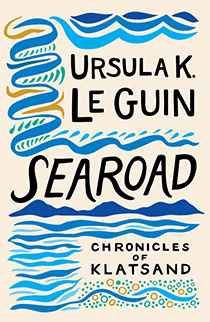
From Searoad: Chronicles of Klatsand

View of the Needles and Haystack Rock from the Oregon Coast Highway, late 1930s. Photograph by postcard manufacturer Wesley Andrews (1875–1950), Portland, Oregon. (eBay)
“Poor Leonard Nimoy—nobody believes he has round ears,” Ursula K. Le Guin joked while being interviewed in 1995 by William Walsh for The Kenyon Review. They were discussing how publishers, editors, and critics pigeonhole writers. Just as the multi-talented Nimoy was forever typecast as a half-human, half-Vulcan science fiction character, Le Guin had been categorized as an SF writer. “There is something very strange about the whole process,” she said. “I’ve always written realistic fiction, science fiction, fantasy, and books for kids, but the category that sticks is science fiction.”
Walsh: If you had your voice in the matter, instead of being defined by critics as a science fiction writer, how would you like to be defined?

Le Guin: Novelist, short story writer, and poet, because I do write in different forms. Then if they want to say realism, science fiction, fantasy, children’s literature, that’s fine—so long as the terms are used descriptively and not just judgmentally. Yes, I write science fiction. No, I’m not only “a science fiction writer.” Don’t box me in! However, I will get provocative and say I am “a western writer” because we need to redefine that category. Then they say, so you write westerns? and I say no. I am a western writer. I was born in the West and lived most of my life here. I write as a westerner. And I will say yes, I am a woman writer. I finally learned how to say that when I was in my fifties.
When Le Guin sent Searoad: Chronicles of Klatsand to her publisher, the sales and marketing teams seemed perplexed. “People didn’t know what to do with it,” she recalled. “It didn’t fit any particular category.” The imaginary setting she had used for this suite of stories couldn’t be sold as science fiction, or fantasy, or historical fiction, or children’s literature, or poetry—as was done with each of her previous works. Yet the differences between the “realism” of Searoad and the themes and subjects of Le Guin’s other works may not be as sharp as they initially seem; the ability to invent new places and imaginary communities was what drew Le Guin to science fiction and fantasy in the first place, as she herself often pointed out.

Searoad resulted from the purchase of a new house. Le Guin and her husband, Charles, had lived in Portland, Oregon, since 1960, and in the mid-1980s they purchased a summer home in Cannon Beach, a resort community in the state’s northwest corner with a population of about 1,500. The town has enjoyed a reputation as a haven for artists since the 1950s and has remained a destination for vacationers who visit Haystack Rock and the Needles and attend the annual Sandcastle Contest. Over the next half decade, Le Guin wrote the novella and eleven tales that make up Searoad, a “story suite” about moments in the lives of various women (and a few men) living or staying in a resort town. “Searoad was a response to becoming a part-time citizen of a small Oregon coastal town,” she told SF critic Carl Freedman in 2008. “Klatsand is a composite/extract of several towns on the north Oregon coast. The book is exploration, satire, and homage.” Klatsand, with its tiny population of 250, may be fictional, but “between Gearhart and Garibaldi, you’d find it,” she assured Studs Terkel in 1991.

Critics and readers have remarked on the irony that what powers the interconnected stories of Searoad is the missed connections between the characters. “Nobody really connects,” Michael Cadden writes in Ursula K. Le Guin Beyond Genre. “The irony of missed opportunity is more common and almost palpable in this story-suite. Each tale gives us access to the consciousness of one or more characters as a way to reinforce the fact that those in Klatsand share place but not personal space.” Similarly, Dean Flower, in his appraisal of the book for The Hudson Review, commended the collection for its stories portraying “the more isolated and marginal figures of the town, people who are just passing through, or managing a failing business, or hiding from something in the past, holing up emotionally.”

One of those characters is Rosemarie, the owner of a rundown motel called the Ship Ahoy, who anticipates the needs and shortcomings of the guests but avoids interacting with them. Instead, she takes refuge in one of the rooms to read science fiction novels in her downtime. In an analysis of this story, Cadden writes, “It is the feeling, here and throughout, that reaching out beyond a tentative gesture is actually beyond the emotional capabilities of the characters.”

*   *   *
The White Gull was the really nice motel in town. . . . If you don't see the full selection below, click here (PDF) or click here (Google Docs) to read it—free!

This selection is used by permission.
To photocopy and distribute this selection for classroom use, please contact the Copyright Clearance Center.

Sunday, February 25, 2024

Quoits

Ursula K. Le Guin (1929–2018)
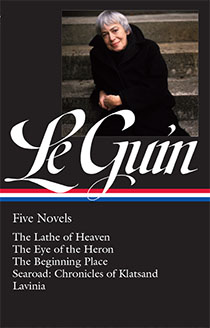
From Ursula K. Le Guin: Five Novels

Chûn Quoit, in western Cornwall, England. Originally covered by a barrow of dirt and rocks measuring about 35 feet across, this burial site was built around 2400 BC. The capstone measures 10 feet in diameter. Photograph by Jim Champion (treehouse1977, Flickr, CC BY-SA 2.0).
Ursula K. Le Guin finished the manuscript for Searoad: Chronicles of Klatsand in 1991 and sent it off to Marion S. (Buz) Wyeth, Jr. “I’ve been incredibly fortunate in having Buz Wyeth as my editor,” she said during an interview at the time. “What I do, Buz will take. And he’s never said, ‘Do another this or that.’” Yet Wyeth, his colleagues at HarperCollins, and many American critics apparently did not know what to make of this new book by one of world’s most famous writers of science fiction and fantasy. A collection of interconnected stories, Searoad focused on moments in the lives of various women (and a few men) living in a small town in northwest Oregon, without so much as a hint of dragon-taming wizards, otherworldly dystopias, or space travel. “People didn’t know what to do with it,” she said. “It didn’t fit any particular category.”

During an interview with William Walsh published in the Kenyon Review in 1995, she recalled the challenges that confronted her:
If men are at the center of the book it’s considered to be of general interest to the reader. If women are at the center of the book, it is considered to be of interest to women. Searoad—the book you have with you—I had to fight my own publisher from saying it was a book about women for women, and only women could possibly be interested in it. I said, “My God, my sales are generally pretty good. Shall we not try to cut them in half by saying stay away from this book, boys, you’ll hate it?” In Searoad there are women who don’t seem able to keep men in their lives or don’t have very good luck with men, women who live alone. I think that’s what some of the reviewers and my editor homed in on, and why they said this is all about women. So what?
In the three decades since its publication, Searoad has attracted a coterie of discerning readers who laud it as an overlooked gem. Among them is science fiction critic Carl Freedman, who interviewed Le Guin in 2008 and remarked on how her imagined Oregon town was “not a utopia, but perhaps it could be called a ‘topia,’ because the sense of place is very strong and very important for the overall effect of the book.” Comparing it to previous American story cycles, including Sherwood Anderson’s Winesburg, Ohio, Ernest Hemingway’s In Our Time, and William Faulkner’s Go Down, Moses, he asked what opportunities the format presented to the writer. Le Guin responded with a description of how the book (a “story suite, as I have come to call it”) evolved:
[A] perfect example of a topia is the (very British) Victorian story cycle Cranford by Elizabeth Gaskell, which probably helped Sarah Orne Jewett in Maine write her Country of the Pointed Firs. Because these books are important to me, I had in fact thought of the story cycle as probably being predominantly a feminine form. (I know the Anderson and admire it, but am ignorant of the Hemingway and Faulkner.) . . .

My experience is this: As I began to write them, the stories were connected only by place, or by certain characters. But as I went on writing them the stories began consciously to interconnect and inter-implicate, forming by the end something that is unmistakably a whole thing: not exactly a novel, yet achieving very much what the novel achieves, by a slightly different method. (I should guess that this is how Cranford and Country of the Pointed Firs were written, too.)

This is how Searoad came to be, and by the third story at latest I was fully conscious that I was writing not just a story but part of a book. . . .
Brian Attebery, the editor of the Library of America’s multivolume edition of Le Guin’s fiction, recently remarked, “In Le Guin’s hands, characterization is a form of world-building, even in a more-or-less realistic work like Searoad. The coastal village of that novel turns out to be a kind of multiverse. Characters interact across gulfs of difference. Conversations between neighbors might as well be conducted via Le Guin’s invented interstellar communication device, the ansible.” Or, as Le Guin told Freedman, “I don’t feel that writing sf is in any important way different from writing fantasy, nor from writing realistic fiction, for that matter. You have to construct, sort out, select your fictional world, whether it is a made-up planet, a fantasy kingdom, a utopia, Russia in 1812, or a contemporary town on the Oregon coast. The process is much the same. The degree of invention may vary somewhat, but after all we do not literally invent; we can only recombine.”

Searoad is included in Five Novels, the latest volume in the LOA Le Guin edition. One of the stories in the suite that (judging from comments in online forums) seems to have resonated most strongly with readers is “Quoits,” which we present below.

Notes: MacNeill and Lacey is Le Guin’s wry conflation of the detective series Cagney and Lacey with the PBS news show The MacNeil/Lehrer NewsHour. The final scene of Romeo and Juliet takes place in the Capulet family tomb; by the end, Romeo, Juliet, and Juliet’s vengeful cousin, Tybalt, all lie dead. Black Elk Speaks is a book published in 1932 by American poet and amateur ethnographer John G. Neihardt and is loosely based on his conversations with Oglala Lakota spiritual leader Black Elk; it became widely read by New Age groups. The two italicized lines of poetry (Out of her grave . . . and They twined into a true lovers’ knot . . .) are from a stanza found in some versions of the traditional folk song “Barbara Allen.” In 1989, the Conservative government of England, led by Margaret Thatcher, sold off public water systems to corporations. In Ebenezer Scrooge’s vision of his own funeral in Dickens’s A Christmas Carol (1843), two women sell his bed sheets in a rag-and-bone shop. Off Our Backs was an American feminist periodical that ran from 1970 to 2008. The American poet Adrienne Rich was a classmate of Le Guin’s at Radcliffe College.

*   *   *
The days after Barbara ’s death had not been a period of time but a place of a certain shape, a place where Shirley had to crouch down and hold still because it was the only thing to do . . . If you don't see the full selection below, click here (PDF) or click here (Google Docs) to read it—free!

This selection is used by permission.
To photocopy and distribute this selection for classroom use, please contact the Copyright Clearance Center.

Sunday, April 5, 2020

The Night the Bed Fell

James Thurber (1894–1961)
From James Thurber: Writings & Drawings

“He came to the conclusion that he was suffocating.”
© 1933 James Thurber. Image reproduced by arrangement with Rosemary A. Thurber c/o The Barbara Hogenson Agency.
Just as the effects of the Great Depression were intensifying in the American Midwest, Charles Thurber was dismissed from his longtime position as assistant to Columbus mayor James Thomas, who, like many Republican officials in the early 1930s, lost his reelection bid. For the next few years Charles did piecemeal work for politicians and campaigns and took on other temporary jobs. At the end of 1933 he and his oldest son Robert decided to drive to upstate New York to sell ideas for promotional contests and puzzles to newspaper editors.

James, the middle Thurber son, had just published My Life and Hard Times, a fictionalized memoir of growing up in a family home where “there was a three-ring circus in progress all the time,” as one visitor described it. The episodes first appeared in The New Yorker in eight installments during the summer of 1933 and then as a book in November. Without notifying James in advance, his father and brother drove to Manhattan, showed up at the offices of the magazine, wandered uninvited through the halls of the editorial department, and ended up outside the door of fiction editor Katharine White. James had not yet arrived for work, and White was perplexed as to what to do with two men she knew only from Thurber’s stories. “We felt as if we’d been caught robbing the place,” Robert later told biographer Harrison Kinney. “It occurred to me later maybe she thought we’d sneaked in to blow up the place for revenge.”

Long before he set down on paper the installments of My Life and Hard Times, Thurber had been telling them—or, more accurately, performing them—in the homes of friends and in Manhattan bars and social clubs. “I first heard Thurber tell me these stories at Martin & Mino’s speakeasy,” Elinor Gibbs, wife of New Yorker editor Wolcott Gibbs, recalled to Kinney. St. Clair McKelway, a writer at the magazine, described a typical Thurber performance: “One after another, and sometimes more or less simultaneously, he would play the parts of his mother, his father, his grandfather (offstage), his brothers . . . and a dog . . . in addition to playing himself.”
Cover of July 9, 1951, issue of Time,
with Thurber's self-portrait, the last
drawing he created for publication.

Most of the chapters in My Life and Hard Times had a kernel of truth in them, a bit of family history or a funny incident that would inspire Thurber to conjure an over-the-top farce. For example, certain details of the book’s opening chapter, “The Night the Bed Fell,” were later confirmed by various family members. “My father frequently slept in the attic,” Robert told Kinney, “to get away from any possible uproar or undue noise.” Yet, to enhance the comedy, Thurber would switch around the roles of the characters, invent additional outlandish incidents, and exaggerate or revise what really did happen. As Kinney explains, it was not James but rather his older brother, William (Herman, in the story), who fell out of a cot and launched the night’s non-catastrophe. It was a boarder, not one of his aunts, who—thinking a thief was in the house—hurled a shoe through a transom window, shattering the glass. (His mother, too, was known for throwing shoes in the night at imagined burglars.) As for much of the rest: “Jamie always did exaggerate. You mustn’t believe a thing he says,” his mother, Mame, told a Time reporter for a July 9, 1951, cover story.

“When it comes to his past, however—to his family, his childhood, his life in Columbus—he’s never nasty,” Robert Gottlieb pointed out in a 2003 appraisal of Thurber. “This is the material that seems closest to his heart, and he returns to it lovingly again and again.” Yet his parents and two brothers had mixed feelings about being the involuntary performers in Thurber’s carnival. Another biographer, Burton Bernstein, relates an anecdote told years later by someone who ran into Charles Thurber and congratulated him on the book’s success. His irritated response “scared the squirrels over in the State House yard.” Eventually, however, Charles seems to have come around; when a reporter for the Columbus Citizen asked about his portrayal in the book (and particularly in “The Night the Bed Fell”), he “grinned” and responded, “Jamie is a great hand to enlarge on those little things that used to happen when he was a kid.”

Thurber’s mother, too, was initially appalled by some of the incidents attributed to her; some of the funniest parts, Thurber later admitted, would have been expunged “if Mama had got her hands” on the proofs. But Mame, too, learned to enjoy the resulting celebrity, and she unhesitatingly—and frequently, it seems—boasted of being his mother to complete strangers. Once, when she was returning home from New York, she requested a ticket to Columbus and the clerk commented, “James Thurber’s hometown,” to which she insisted proudly, “I’m his mother.” Family lore has it that the clerk alerted the conductor to the delusional woman boarding his train and advised him to keep an eye on her.

Thurber’s stories about his quirky family have fascinated readers young and old for generations. In 1940 (or thenabouts) a ten-year-old girl read My Life and Hard Times for the first time and more than sixty years later she remembered the experience:
I knew they were funny, that grown-ups laughed aloud reading them, but they didn’t make me laugh. Thurber’s stories were wonderful, mysterious tales of human behavior, like all the folktales and stories in which people did the amazing, terrifying, inexplicable things that grown-ups do. The various night wanderings of the Thurber family in “The Night the Bed Fell” were no more and no less strange to me than the behavior of the Reed family in the first chapter of Jane Eyre. . . .

When I did laugh at Thurber was when he played with words. . . . The story is the way the story is told.
The young girl was Ursula Kroeber, whom our readers will know as Ursula K. Le Guin.

*   *   *
Most of the above biographical details and the quotes from Thurber’s friends and family members are from Harrison Kinney’s biography, James Thurber: His Life and Times.

Note: Crotchets, as Thurber uses it in the story, is an archaic word for “whims.”

Video: In 2010, in honor of his recently deceased father, Keith Olbermann concluded his Friday night broadcasts of the news program Countdown with readings of Thurber’s stories. Now, a decade later, he has resumed his readings for audiences stuck at home during the pandemic—this time nightly on Twitter. The second episode features Olbermann reading “The Night The Bed Fell” and “The Moth And The Star”; the video is available here. (Note: You do not need a Twitter account to view the video. Past and future episodes can be viewed on Olbermann’s Twitter feed @KeithOlbermann.)

*   *   *
I suppose that the high-water mark of my youth in Columbus, Ohio, was the night the bed fell on my father. . . . If you don't see the full selection below, click here (PDF) or click here (Google Docs) to read it—free!

This selection is used by permission.
To photocopy and distribute this selection for classroom use, please contact the Copyright Clearance Center.

Friday, August 18, 2017

The Day Before the Revolution

Ursula K. Le Guin (1929–2018)
From Ursula K. Le Guin: The Hainish Novels & Stories

Fred Winkowski’s jacket design for the first American edition of The Dispossessed, Harper & Row, 1974. More of Winkowski’s artwork can be seen at his website Moons, Machines, and Martians.
Throughout Ursula K. Le Guin’s 1974 multiple-award-winning novel The Dispossessed, the philosopher and revolutionary Laia Asieo Odo is a magisterial presence—even though she lived on a different planet and died several generations before the period in which the novel is set. She did not even live to see the revolution she instigated, but her life and writings became the inspiration for Odonianism. The year after the novel appeared, Le Guin explained what she meant by the term:
Odonianism is anarchism. Not the bomb-in-the-pocket stuff, which is terrorism, whatever name it tries to dignify itself with; not the social-Darwinist economic “libertarianism” of the far right; but anarchism as5 prefigured in early Taoist thought, and expounded by Shelley and Kropotkin, Goldman and Goodman. Anarchism’s principal target is the authoritarian State (capitalist or socialist); its principal moral-practical theme is cooperation (solidarity, mutual aid). It is the most idealistic, and to me the most interesting, of all political theories.
When Le Guin had finished writing the novel, she felt “lost, exiled—a displaced person.” Yet while the novel was being prepared for publication, “Odo came out of the shadows and across the gulf of Probability, and wanted a story written, not about the world she made, but about herself.” That story, “The Day Before the Revolution,” was published three months after the novel appeared and went on to win the Nebula Award for Best Short Story the same year that The Dispossessed captured the prize in the Best Novel category. (The Dispossessed also won the Hugo, science fiction’s other major book award.)

Both the novel and the story belong to a group of seven novels and sixteen stories set in Le Guin’s Hainish universe. Those works have been gathered together for the first time in a two-volume Library of America edition edited by Brian Attebery with Le Guin’s cooperation. In her introduction to the first volume the author explains further how the idea of “The Day Before the Revolution” came to her.
I’d wondered who the founder of that way of life, Odo, was—could I imagine my way into the head of a political philosopher, a fearless demagogue, an active revolutionary, a woman so different from myself? Only through the back door, as it were, to that mind: the way of illness, weakness, old age. Yang claims; yin shares. I could share in Odo’s being as a mortal coming to her death.
While The Dispossessed wrestles with the ethical, philosophical, and political challenges confronting its “ambiguous utopia,” the companion story looks inward at the end-of-life preoccupations of an individual. “Utterly unremarkable but unutterably significant, she is one of the characters around whom great fiction is built,” observes Attebery, “like the Mrs. Brown whom Virginia Woolf spotted in the corner of a railway car.” In a study of Le Guin’s writings George Edgar Slusser remarks that “except for its setting, [the story] is hardly science fiction at all. It is simply an account of the last day in the life of a sick old woman. . . . She meets her fate not laughing, but with wry irony.”

Note: When Le Guin collected the essay for her story collection The Wind’s Twelve Quarters, she dedicated it to the memory of social critic and anarchist philosopher Paul Goodman, whose essay “A Young Pacifist”—a eulogy to his son killed in a mountain expedition—is a previous Story of the Week selection.

*   *   *
The speaker’s voice was as loud as empty beer-trucks in a stone street, and the people at the meeting were jammed up close, cobblestones, that great voice booming over them. . . . If you don't see the full selection below, click here (PDF) or click here (Google Docs) to read it—free!

This selection is used by permission.
To photocopy and distribute this selection for classroom use, please contact the Copyright Clearance Center.

Friday, September 2, 2016

Imaginary Countries

Ursula K. Le Guin (1929–2018)
From Ursula K. Le Guin: The Complete Orsinia

Two Children on Their Way to the Fairytale Forest, 1901–02, casein and oil on canvas by Norwegian artist Edvard Munch (1863–1944). Image: The Athenaeum.
During her college years in the early 1950s, Ursula Kroeber began working on her first novel. She later recalled that the Soviet takeover of Czechoslovakia and subsequent events had “roused the political spirit in me,” but she hadn’t yet visited the countries of Eastern Europe and didn’t feel comfortable writing about them. She explains:
I was twenty years old, working at one of the dining tables about midnight, when I got the first glimpse of my other country. An unimportant country of middle Europe. One of those Hitler had trashed and Stalin was now trashing. . . . I see the river, the Molsen, running through an open, sunny countryside to the old capital, Krasnoy (krasniy, Slavic, “beautiful”). Krasnoy on its three hills: the Palace, the University, the Cathedral. The Cathedral of St Theodora, an egregiously unsaintly saint, my mother’s name. . . . I begin to find my way about, to feel myself at home, here in Orsenya, matrya miya, my motherland. I can live here, and find out who else lives here and what they do, and tell stories about it [from the Introduction, The Complete Orsinia].
It’s not a coincidence that the name of this imaginary country (Orsinia) and her own name both stem from Latin words for a female bear (orsa in Italian, from ursa in Latin). As Ursula K. Le Guin (she married in 1953) explained to James W. Bittner, “It’s my country so it bears my name”—and presumably the pun was intended.

Le Guin’s first published story, which appeared in 1961, was about a musician in a backwater province of this invented region. During the next three decades she wrote and published a total of thirteen stories and one novel set in Orsinia, and the tales span in chronology from the twelfth century to the late 1980s. “For years I felt as if I were a transmitter of some kind, that would be suddenly activated by an urgent message from Orsinia, from one century or another and from various persons.”

Eleven of those stories appeared in 1976 as Orsinian Tales, and the story that closes the collection is, appropriately enough, “Imaginary Countries.” Set during the last days of summer in 1935, it describes the Egideskar family as they end another year at “Asgard,” their vacation home. The three children—Stanislas, Paul, and Zida—have been spending the summer exploring the environs, mapping the trails, and envisioning make-believe realms, often based on Norse mythology, while their father and Josef, his research assistant, have been working on a history of medieval Orsinia, also known as “The Ten Provinces.”

As Bittner points out, both Ursula and Zida were six years old in 1935, so the story is, “among other things, a portrait of the artist as a young girl. Le Guin has written a tale about the family of a professor who is writing a history of Orsinia, a country she invented.” As she reminisced to an interviewer in 1988, the young Ursula and her brother “played narrative games with stuffed animals, with toy soldiers, or acting out parts ourselves,” and her vast reading that informed this recreation included science fiction stories and Norse myths. In addition, like the Egideskars, the Kroebers spent summers during the 1930s at a family getaway, a Napa Valley ranch named “Kishamish” (from a myth invented by Ursula’s brother). During those summers Ursula’s father, Alfred L. Kroeber, worked on what would become his monumental study in comparative cultural anthropology, Configurations of Culture Growth.

Still, in spite of the parallels with Le Guin’s own childhood, the story is very much a work of fiction. As she recently admitted, “Nothing and no one in it much resembles anywhere or anyone in my life, but all the same, it’s about as autobiographical as I ever got.”

Notes: The name of the Egideskars’ summer home, Asgard, is the realm of the high gods (the Aesir) in Norse mythology. The children incorporate numerous other references to Norse myths in their play. Yggdrasil is the World Tree, an enormous ash whose roots and branches connect the human home of Midgard (Middle Earth) with other realms, including Asgard. The half-giant Loki turned against his divine companions and was punished by being chained to a rock; one tradition places his prison under a grove of hot springs. In yet another myth, Baldur, the Norse god of light, is doomed by prophecy to die young. To forestall his death, his mother asks all things not to harm Baldur, but fails to ask the mistletoe. Since nothing will harm him, he is essentially invulnerable, and it becomes a game among the gods to aim missiles at him. His blind brother Hodur is left out of the game, but Loki makes an arrow out of the mistletoe and helps Hodur aim the bow, killing his brother. Finally, Ragnarök is the Twilight of the Gods, when everything will be destroyed and a new creation brought into being

Note also that the date at the end, 1935, refers to the year in which the story is set.

*   *   *
“We can’t drive to the river on Sunday,” the baron said, “because we’re leaving on Friday.” . . . If you don't see the full selection below, click here (PDF) or click here (Google Docs) to read it—free!

This selection is used by permission.
To photocopy and distribute this selection for classroom use, please contact the Copyright Clearance Center.


Friday, July 8, 2016

Sisters and Science Fiction

Karl Kroeber (1926–2009)
From Ursula K. Le Guin: The Complete Orsinia

“Mariner 10 Approaching Mercury,” by American artist Chesley Bonestell (1888–1986), for the cover of the October 1976 issue of The Magazine of Fantasy and Science Fiction. (Click on the image to see the full cover.) The issue included Ursula K. Le Guin’s twelfth-century Orsinian tale, “The Barrow.”
Many—perhaps most—readers have long associated Ursula K. Le Guin with the genres of speculative fiction. As a result, in the 1970s, when she began publishing various fictional excursions in an imaginary East European country, fans and critics assumed that the new stories were “Le Guin's attempt to extend the range of her talents beyond the boundaries of fantasy and science fiction.” But, notes James W. Bittner, “If anything, the opposite is the case.”

In fact, many of Le Guin’s earliest works were set in Europe from the twelfth century through the twentieth. In an introduction written for the first volume of the Library of America edition of her fiction, Le Guin writes, “Most of what I read drew me to write about Europe; but I knew it was foolhardy to write fiction set in Europe if I’d never been there. At last it occurred to me that I might get away with it by writing about a part of Europe where nobody had been but me.”

Thus was born the country of Orsinia. Her first published poem (1959) was “Folk Song from the Montayna Province.” Her first published short story, “An die Musik,” also set in Orsinia, appeared in the Western Humanities Review in 1961. But a decade earlier, in 1951, while in Paris with her brother Karl Kroeber, she had begun writing A Descendance, a novel set in Orsinia. She sent it to Alfred Knopf, who somewhat reluctantly but (in Le Guin’s reckoning) wisely rejected “the crazy damn thing.” After the story collection Orsinian Tales (a finalist for the National Book Award) appeared in 1976, Le Guin finished a second Orsinian novel on which she been working intermittently since 1952, and it was published at last as Malafrena.

When one of the Orsinian tales (“Brothers and Sisters”) was included in a special double issue of The Little Magazine in the spring of 1976, Kroeber, a literary scholar, was invited to contribute an introduction, which has been reprinted in the LOA edition and is presented here as our Story of the Week selection. Kroeber, who died in 2009 at the age of eighty-two, taught at Columbia University for nearly four decades, during which he published a dozen books on such varied topics as English Romantic poetry and American Indian literature (not to mention his 1988 monograph Romantic Fantasy and Science Fiction). His wide-ranging interests are very much on display in the piece he wrote to accompany his sister’s story. “He was very interested in soaking up as much as he could about new ways of thinking, new kinds of things to think about,” his colleague Jenny Davidson told the Columbia Spectator. “He wanted to know what people in their teens or twenties or thirties were reading and finding exciting, and then he would go and read those things.”

One of Le Guin’s Orsinian tales will appear as a Story of the Week selection later this summer.

Notes: Birdboot is a character in Tom Stoppard’s satirical play The Real Inspector Hound, a theater critic who becomes enmeshed in the play he is supposed to be reviewing. Child psychologist Bruno Bettelheim, in his book On Learning to Read and in subsequent books and interviews, disparaged the popular Dick-and-Jane stories for young readers and argued that traditional fairy tales, with their dark motifs and subjects, were better for developing both reading skills and emotional growth. Zembla is a fictional northern European country in Nabokov’s Pale Fire; Graustark, an eastern European country in several novels by George Barr McCutcheon. The Woodlanders (1887) is a novel by Thomas Hardy set in a small English village. The end of Kroeber’s essay quotes lines from Marianne Moore’s 1921 poem “Poetry.”

*   *   *
For this week’s selection, we depart from the usual format and reproduce Kroeber’s essay, in its entirety, below.
You may also download it as a PDF or view it in Google Docs.


Sisters and Science Fiction
When the editors of The Little Magazine asked me for a fraternal comment on “Brothers and Sisters” they couldn’t understand how far beyond mere sibling rivalry they were pressing me to go. Since my father was a distinguished scientist, my first years in academia were dominated by a question to which the answer was, “Yes, he is my father.” Scarcely had he died than my mother became famous as an author, and I found myself saying, “Yes, she is my mother.” About the time mother turned from public acclaim to a new and exciting marriage, my sister won the National Book Award, and I found a third variant for my identifying phrase. I’m convinced that should my sister disappear (squashed by a malfunctioning UFO?) one of my children would instantly win a Nobel Prize, or kidnap F. Lee Bailey. My remarks, therefore, must be taken as those of a familial Birdboot.

I remark first that my sister’s writing has convinced me that (as I had long suspected) literary biography is useless for understanding literature. Boswell on Johnson and Bell on Woolf are delightful, but not helpful. I believe I know where both the general conceptions and many of the details in “Brothers and Sisters” originate. Every story of my sister’s is full of references to things and events and relationships I recognize. But to know these sources is to know nothing of significance about the stories as stories. Bad stories often are raw biography. Literary art consists in transforming one kind of reality, that of physical experience, into another kind of reality, that of literary experience. Imagining, the process of transforming, is illuminated dimly, if at all, only by the magic of criticism. Writers are often complex people and fascinating subjects for psychological analysis, but a writer is a person to whom writing happens. As Winnie the Pooh put it, “Poetry and Hums aren’t things which you get, they’re things which get you. And all you can do is to go where they can find you.”

Jacket for Malafrena (Berkeley, 1979),
Le Guin’s novel set in the fictional
eastern European country of Orsinia
Especially disadvantageous for biographers are people like my sister who never become writers but who always are writers. I can’t remember a time when my sister wasn’t writing. I doubt that she can. For such a person writing is a mode of being, like talking for most of us, and making melodies for Mozart. Interestingly, not all the best writers are born writers—Shakespeare may not have been: he seems to have begun lazily and quit early, though commendably active in his middle years. But for those who lisp in numbers, the lisp is the significant biographical fact pointing to the mysterious truth that writers in writing about nothing but their own experience produce works not much illuminated by their experience. Writing is like alchemy—only the process of transmutation matters.

So little for biography, now less for genre, because my sister is not a “science fiction writer.” She is an imaginative author whose early work has followed the pattern of “science fiction,” the best (perhaps the only) mode open to an honest fantast unperturbed by the whims of the New York Literary Establishment. “Fantasy” derives from the Greek for “boaster,” it in turn deriving from a verb “to make visible.” Forms such as science fiction are a natural outlet for the “ostentatious,” that is, impudent, risk-taking writer. Critics, of course, prefer safe experimentalists. But the critical establishment’s power needn’t be overrated, since it is primarily negative. Occasionally it supports talent, seldom if ever does it permanently prevent a genuine artist from succeeding. When I saw the first advertisement for my sister’s work in the New York Review, I predicted a review of her by my colleague Michael Wood within a year. I underestimated Michael’s sensitivity to popular trends by four months.

The national popularity of science fiction, vampire stories, Gothic romances, and the like is impressive. If Bruno Bettelheim is right, this phenomenon might be called THE REVENGE OF DICK AND JANE. It is at least appropriate that a culture which has exorcized from children’s reading all that is genuinely fearful and romantic should be blessed by the high art and moral profundity of The Exorcist. Surely Sendak’s Where The Wild Things Are is charming. “Bluebeard” is distinctly not charming, a sign that Grimm’s monsters are real. So real that thousands of psychiatrists every year make thousands of dollars fighting them. Bettelheim’s suggestion that our culture impoverishes children’s fantasy life deserves practical recognition. His claim that fairy stories enable children to confront, rather than to escape from or be defeated by, fundamental human predicaments—loneliness, jealousy, death—is attractive to anyone who believes that, on a higher level and in a more complex fashion, fine literature is analogously didactic. By imaginatively living through the course of a novel or play one learns useful truths of human existence. The bizarre, absurd, and surreal elements so prevalent in our “serious” fiction too often are but cheap disguises for imaginative poverty of writer and reader. The popularity in our novels of the monologue form seems likewise symptomatic of an enfeeblement of fictionalizing energy, which does not recount but transmutes so that a strong reader (as Bloom would call her) may enjoy re-transforming.

Cover of the first paperback edition
of Orsinian Tales (Bantam, 1977)
To me, science fiction is best when it exuberantly pretends freakishness to work back toward the essential nature of fiction. One of my sister’s early novels treated a planet where “winter” lasted many years. She has never lived in an extremely cold climate, and anyone who has might notice her unfamiliarity with the details of existence dominated by the sub-zero. Yet her descriptions are fictionally effective, for fiction only seems to remind us of actual existence. It invents possibilities of experience which, if we give ourselves to them, that is, respond imaginatively to them, enable us to return to actuality as more competent human (e.g., moral) organisms. So I would urge the fifteen graduate students who doubtless are busy writing dissertations on Le Guin not to seek in Bulgaria for the setting of “Brothers and Sisters.” The curious growthless plain of limestone quarries is not East of the Sun and West of the Moon, just a little south of Zembla and north of Graustark.

Similar coordinates are needed to locate the following description.

They went noiselessly over mats of starry moss, rustled through interspersed tracts of leaves, skirted trunks with spreading roots whose mossed rinds made them like hands wearing green gloves; elbowed old elms and ashes with great forks, in which stood pools of water that overflowed on rainy days and ran down their stems in green cascades. On older trees still than these huge lobes of fungi grew like lungs. Here, as everywhere, the Unfulfilled Intention, which makes life what it is, was as obvious as it could be among the depraved crowds of a city slum. The leaf was deformed, the curve was crippled, the taper was interrupted; the lichen ate the vigor of the stalk, and the ivy slowly strangled to death the promising sapling.

A pilgrim looking for this landscape in southern England is farther off the track than an enthusiast finding prototypes for Theodore Sturgeon. The Woodlanders wouldn’t be worth reading if it only reported what a dope with a camera could photograph. “Brothers and Sisters” isn’t, I think, essentially different from Le Guinian star treks, though its superficial “realism” may indicate my sister’s growing confidence that her readers can be trusted to use their imaginations, to appreciate that fictional reality is fantasy.

I hope so, for such confidence would imply a reviving sense for the utility of literature. Here I can call on the testimony of a fellow immigrant to Brooklyn (unimaginative people come from Brooklyn):  “these things are important not because a/ high-sounding interpretation can be put on them but because they are/ useful.” Miss Moore, like Pooh, referred to poetry, but her words are equally applicable to the transformations of prose. As when, talking baseball, she said she was impressed at how the Dodgers’ catcher “could throw the ball all the way to second base with just one hand.”

In an unambiguous utopia, all novels would be written that way.

Originally published in The Little Magazine (Summer 1976). Reprinted in Ursula K. Le Guin: The Complete Orsinia (Library of America, 2016), pages 586–88. Copyright © 1976 by Karl Kroeber. Published by arrangement with Jean T. Kroeber. All rights reserved.

This selection is used by permission. To photocopy and distribute this selection for classroom use, please contact the Copyright Clearance Center.