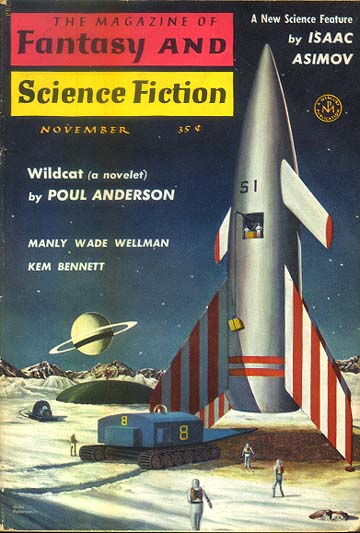
Showing posts with label science fiction. Show all posts

Sunday, October 8, 2023

A Game of Vlet

Joanna Russ (1937–2011)
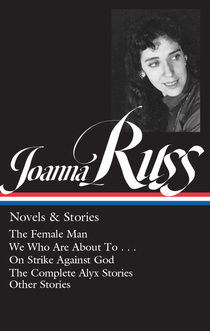
From Joanna Russ: Novels & Stories

Three Joanna Russ books: Her first novel, Picnic on Paradise (Ace Books, 1968), with cover art by Diane and Leo Dillon; the 1983 edition of The Adventures of Alyx (Timescape / Pocket Books), with cover illustration by Kevin Eugene Johnson; and the story collection The Zanzibar Cat (Arkham House, 1983), with cover illustration by James C. Christensen.
If imitation is the sincerest form of flattery, inspiration is surely a close second. In 1974, when Joanna Russ published a new sword-and-sorcery tale in the pages of The Magazine of Fantasy & Science Fiction, she could not have imagined that the 4,000-word story would play a significant role in the creation of a suite of books by Samuel R. Delany. Russ’s influence was obvious early in his 1976 science fiction novel, Trouble on Triton, in which several characters play vlet, a complex chess-like board game. As Delany later explained in an interview:
The name comes from a story by Joanna Russ, “A Game of Vlet.” It’s part—or almost a part—of her “Alyx” series. The game in her story is not quite so complicated as mine; but in Russ’s tale, at one point, you realize that the world of the story is actually controlled by the game: you can’t really tell where the game ends and the world takes up. The three books I’ve written since Triton, set in ancient Nevèrÿon, are basically the game of vlet writ large.
Delany informed Russ of his appropriation “and she said it was all right.” He returned the favor the same year Triton was published. The first five Alyx episodes, including the novel Picnic on Paradise, were gathered under the title Alyx in a Gregg Press limited edition, and Delany wrote the introduction, in which he examined how Russ’s series transcends and subverts the traditions of the fantasy genre:
The opening two tales are the swordiest of sword and sorcery; the third is only a few dials and traveling spotlights away from the most sorcerous; and, despite its dials, lights, and the world “machine,” it certainly doesn’t feel like science fiction. In the novel, when our pre-civilised heroine is transported into the future, we have a tale that does feel like science fiction; and the closing novella, while its surface demands to be taken as science fiction, keeps evoking feelings that tend to veer our reading of it toward a psychological fantasy. . . .
He adds, “The largest break with the sword and sorcery tradition is, of course, that there are women in Russ’s tales. . . . Possibly an even larger break is that there is, at least, one—and this is what sword and sorcery banishes entirely from its landscape—husband in the series.”

“Those stories were a breakthrough for me,” Russ told interviewer Larry McCaffery in 1986.
. . . up until that point I had pretty much been following the usual cultural scenario by writing action stories with men as main characters and love stories with women protagonists; naturally, in the action stories the men usually won, while in the love stories the women lost. When I got to Alyx, for the first time I realized I had stumbled upon the chance to create a new story—really a whole series of stories—that could counter those gender stereotypes. One of the most exciting things about working in SF for me, a woman, is that SF is so open-ended—it’s perfectly possible to imagine a world where sexism doesn’t exist, or in which women can be presented in the context of new myths that women can admire or learn from.
In the mid-1980s, the Alyx stories were reprinted (sans Delany’s introduction) as a mass-market paperback with the title The Adventures of Alyx, yet readers will find “A Game of Velt” in neither collection—which is why Delany refers to it as “almost a part” of the Alyx series. The story appeared instead in Russ’s 1983 story collection, The Zanzibar Cat. Just as Delany had borrowed an idea from her story, she too had adapted an element from an earlier work, as she acknowledged in a headnote:
This story was inspired by the fine piece of medieval magic Vergil Magus performs in Avram Davidson’s wonderful The Phoenix and the Mirror [1969]. It’s also the last story I ever wrote about my character Alyx, the last, the last, the last. I’m sorry, readers who want more of her, but there just ain’t no more.
*   *   *
In Ourdh, near the sea, on a summer’s night so hot and still that the marble blocks of the Governor’s mansion sweated as if the earth itself were respiring through the stone—which is exactly what certain wise men maintain to be the case—the Governor’s palace guard caught an assassin trying to enter the Governor’s palace through a secret passage too many unfortunates have thought they alone knew. . . . If you don't see the full selection below, click here (PDF) or click here (Google Docs) to read it—free!

This selection is used by permission.
To photocopy and distribute this selection for classroom use, please contact the Copyright Clearance Center.

Sunday, March 5, 2023

Frog Pond

Chelsea Quinn Yarbro (1942–2025)
From The Future Is Female! More Classic Science Fiction Stories by Women

Left: The title page of Chelsea Quinn Yarbro’s second story, “Frog Pond,” which appeared in the March 1971 issue of Galaxy Science Fiction. Right: Front jacket for Yarbro’s first story collection, Cautionary Tales (1978), designed by Bob Silverman.
Chelsea Quinn Yarbro had been writing science fiction for nearly a decade when her first story collection, Cautionary Tales, appeared—one of three books she published in 1978, an extraordinary accomplishment for someone who had published her debut novel only two years earlier. The collection featured an introduction by a friend, the award-winning SF author James Tiptree, Jr. Earlier that year, Tiptree had been revealed to readers (as well as editors and fellow authors) as Alice Sheldon, an experimental psychologist and former CIA intelligence officer who had adopted the pseudonym to shield her academic reputation. “A male name seemed like good camouflage,” she told interviewer Charles Platt in 1983. “I had the feeling that a man would slip by less observed. I’ve had too many experiences in my life of being the first woman in some damned occupation.”

In Cautionary Tales, Tiptree opened her prefatory remarks with a sort of cautionary note:
It seems to be the fashion, when introducing Quinn Yarbro, to exclaim over the fact that these stories with fangs and claws issue from a young person of gentle and beguiling aspect. One editor went so far as to call her “cuddly.” Now it seems to me that we must have passed the stage of assuming that the view of a writers outside bears some necessary resemblance to the fires burning within. So I am not going into what a darling, dauntless person Quinn is, nor even into the extraordinary life she marshals. I am going into the stories, and they are not—repeat, not—cuddly.
Indeed, one of the other two books Yarbro published that year was Hotel Transylvania, the first in the series of more than thirty books for which she is perhaps best known: horror novels featuring the vampire Count Saint-Germain, a character loosely based on the historical French adventurer Comte de Saint Germain.

Yarbro’s third book of 1978 was a science fiction novel, False Dawn, featuring Thea and Evan, a couple struggling to survive in a postapocalyptic California landscape poisoned by a series of environmental catastrophes. In a way, the novel had been in the works for nearly eight years. Its first chapter had originally appeared in 1972 as a short story, also titled “False Dawn,” and was later included in Women of Wonder, the 1976 anthology edited by Pamela Sargent (and described more fully in the introduction to our previous Story of the Week selection). Even earlier, in 1971, the character of Thea made her debut in Yarbro’s second published story, “Frog Pond,” which Tiptree referred to as the “surprise” of Cautionary Tales: “the only merry, even charming tale of After the Holocaust that I can recall.”

In her collection, Yarbro added a postscript to “Frog Pond” that expressed her displeasure in the attempts at scholarly exegeses of her stories:
About a year ago I had the dubious pleasure of reading a paper about “Frog Pond” that had been published in a small, very academic magazine. It was full of comments on “developing parallel imagery” and the “equation of contaminated water with the contamination of the world” and so forth. The earnest young Ph.D. discussed at length the strange feeling of this far future setting. But “Frog Pond" takes place roughly around the year 2000, which is relatively near future.
She also noted that the study included a detailed analysis of the “ironic significance of the place names in the story”—even though every one of those locations could be easily found on a map in 1971.

“I’m not a dogmatic writer,” she told the editors of Frontiers: A Journal of Women Studies in 1977, when they asked how feminism informs her fiction and if there is a difference between feminist fiction and SF written by women. “I don’t write stories to do anything other than entertain my reader—and entertainment to me is not an offensive word. Because I am a feminist, I tend to tell stories about women, but how those women function is up to the character and the story. Quite often my characters, even sympathetic ones, do things I would not do.”

Among Yarbro’s many honors are the Bram Stoker Award for Lifetime Achievement (2008) and the World Fantasy Award for Lifetime Achievement (2014). A founding member of the Horror Writers’ Association and its first woman president (1988–90), Yarbro lives in the San Francisco Bay Area.

*   *   *
No matter what Mr. Thompson said, it was a good day for frogging and fishing. . . . If you don't see the full selection below, click here (PDF) or click here (Google Docs) to read it—free!

This selection is used by permission.
To photocopy and distribute this selection for classroom use, please contact the Copyright Clearance Center.
Sunday, February 26, 2023

If Ever I Should Leave You

Pamela Sargent (b. 1948)
From The Future Is Female! More Classic Science Fiction Stories by Women

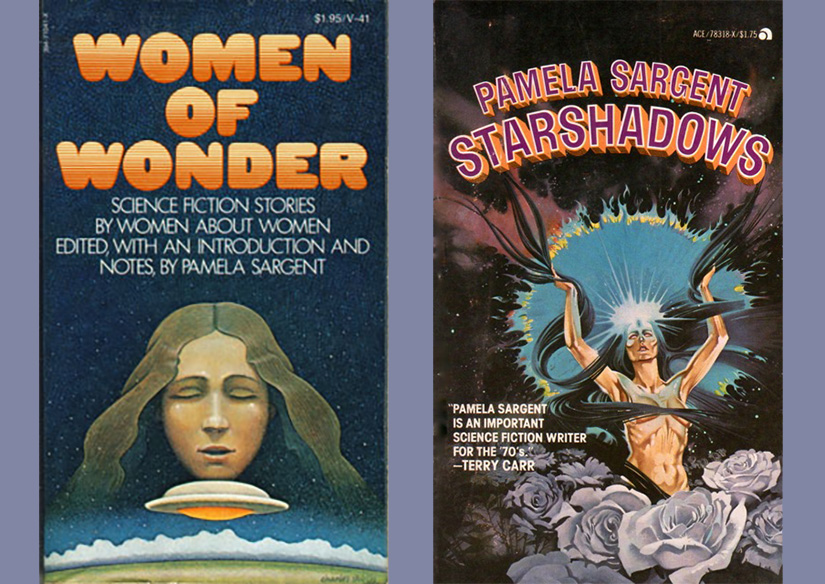
Left: Front cover of Women of Wonder (Vintage Books, 1975), with art by American graphic designer Charles Shields (1944–2020). Right: Sargent’s first story collection, Starshadows (Ace, 1977), which contains the unaltered version of “If Ever I Should Leave You.” The cover art is by American illustrator Paul Alexander (1937–2021).
In the introduction to the 1975 anthology Women of Wonder: Science-Fiction Stories by Women about Women, Pamela Sargent questioned “why a literature that prides itself on exploring alternatives or assumptions counter to what we normally believe has not been more concerned with the roles of women in the future.” For the collection, Sargent selected a dozen of the best SF stories written by women during the previous quarter century—a shortlist that includes such still-renowned authors as Joanna Russ, Vonda N. McIntyre, Anne McCaffrey, and Ursula K. Le Guin. The book’s success spawned two follow-ups, one in 1976 and a third volume in 1978, yet when Sargent initially peddled the idea to publishers, she met with resistance, as she recounts to SF critic James Nicoll:
In fairness, part of that might have been because I was a novice writer of only a few published stories, but it was also because some editors, as they admitted, didn’t think such an anthology would sell. I was asked by a couple of editors if there were enough good stories to fill an anthology of sf by women. One editor said that such a book would appeal only to a “minor” part of the audience for sf. . . .
Sargent’s break came when McIntyre wrote to the editorial team at Vintage Books and asked why there had been several SF anthologies with exclusively male writers but not one containing only women. When an editor agreed to consider such a proposal, McIntyre put Sargent in touch with the Vintage staff.
Women of Wonder remained in print for over a decade, so clearly there was an audience for such a book and for two more WoW volumes. . . . For years afterwards, I would encounter people, mostly but not all women, who had thought there was nothing of interest in sf for them until they saw Women of Wonder in a bookstore or library.
Twenty years later, in the mid-1990s, Sargent compiled two more Women of Wonder anthologies for Harcourt Brace.

During the period she was assembling the first anthology, Sargent was also dealing with a bit of a nightmare; her story “If Ever I Should Leave You” had appeared in the January–February 1974 issue of the SF magazine Worlds of If, and it had been altered almost beyond recognition under the heavy-handed direction of editor-in-chief Ejler Jakobsson and a new managing editor, Albert Dytch. In 1991, Sargent recalled:
I glanced at the story after it was published, and it was horrifying—all these dumb lines I hadn’t written. The story was told in the first person by a nameless protagonist, but apparently some dufus at If—not the editor, as far as I could tell—decided my narrator should have a name. The name he decided on was Nanette. And the other changes were worse—clumsy bits of exposition that were wrong, details that made no sense. I spent months fighting with them about it, and one of the publisher’s potentates even had the gall to make veiled threats about suing me if I didn’t shut up about my grievances.
Sargent’s story was not the only victim of unwelcome modification by Jakobsson and Dytch in the pages of Worlds of If and its sister publication, Galaxy Science Fiction. As Michael Ashley reports in his book Gateways to Forever: The Story of the Science-Fiction Magazines from 1970 to 1980, the serial version of Christopher Priest’s The Inverted World had undergone what its author disparaged as “a multitude of petty re-wording” and “an orgy of rewriting towards the end.” Similarly, not only was Harlan Ellison’s story “Cold Friend” heavily revised, but the editors even changed the title—despite a prior agreement that not a single word would be changed. Ellison found out about the alterations as the magazine was going to press, and he forced the editors to claw back the changes with only partial success.

Editor and author Barry Malzberg told Ashley: “Jake’s meddling with manuscripts was notorious. He was not only an interfering editor of the worst sort but a terrible writer who screwed up work. [Sargent’s] story was destroyed by him.” As the months passed, both Jakobsson and Dytch were replaced and, in December 1974, If published its last number and was folded into Galaxy. The first issue after the merger included a letter from Sargent: “A writer’s name is his or her stock in trade. If I am to stand or fall by what is published under that name, let it be by my own words and not those of a nameless collaborator. I must therefore disassociate myself from the story as it was published in If.” The magazine’s new editor, Jim Baen, simply responded, “Ms. Sargent has the right of it.”

In 1977, “If Ever I Should Leave You” finally appeared as its author intended in Starshadows, her first story collection—and, of course, that is the version that has appeared in anthologies since and that is the version we present below. The same year, Sargent was among eight women asked by the editors of Frontiers: A Journal of Women Studies about why and how they “use the genre” for their fiction, and she responded in part:
The writer of science fiction or fantasy is not as limited as the writer of other kinds of fiction. . . . Within the context of most human activities to date, women of strength and achievement are exceptions to the rule. This is reflected in novels about the past or present. Science fiction and fantasy, on the other hand, allow one to imagine and write about worlds where strong independent women are the rule, or to construct a society whose features can illuminate the workings of our own.

. . . Science fiction writers are limited only by human potential, not human actualities. SF can serve to show women, and men, how large that potential can be.
Since selling her first story to The Magazine of Fantasy and Science Fiction in 1970, Sargent has published fourteen novels and several story collections, and she collaborated with George Zebrowski on four Star Trek novels. She currently lives in Albany, New York.

*   *   *
When Yuri walked away from the Time Station for the last time, his face was pale marble, his body only bones barely held together by skin and the weak muscles he had left. . . . If you don't see the full selection below, click here (PDF) or click here (Google Docs) to read it—free!

This selection is used by permission.
To photocopy and distribute this selection for classroom use, please contact the Copyright Clearance Center.
Sunday, January 8, 2023

A Scarab in the City of Time

Marta Randall (b. 1948)
From The Future Is Female! More Classic Science Fiction Stories by Women

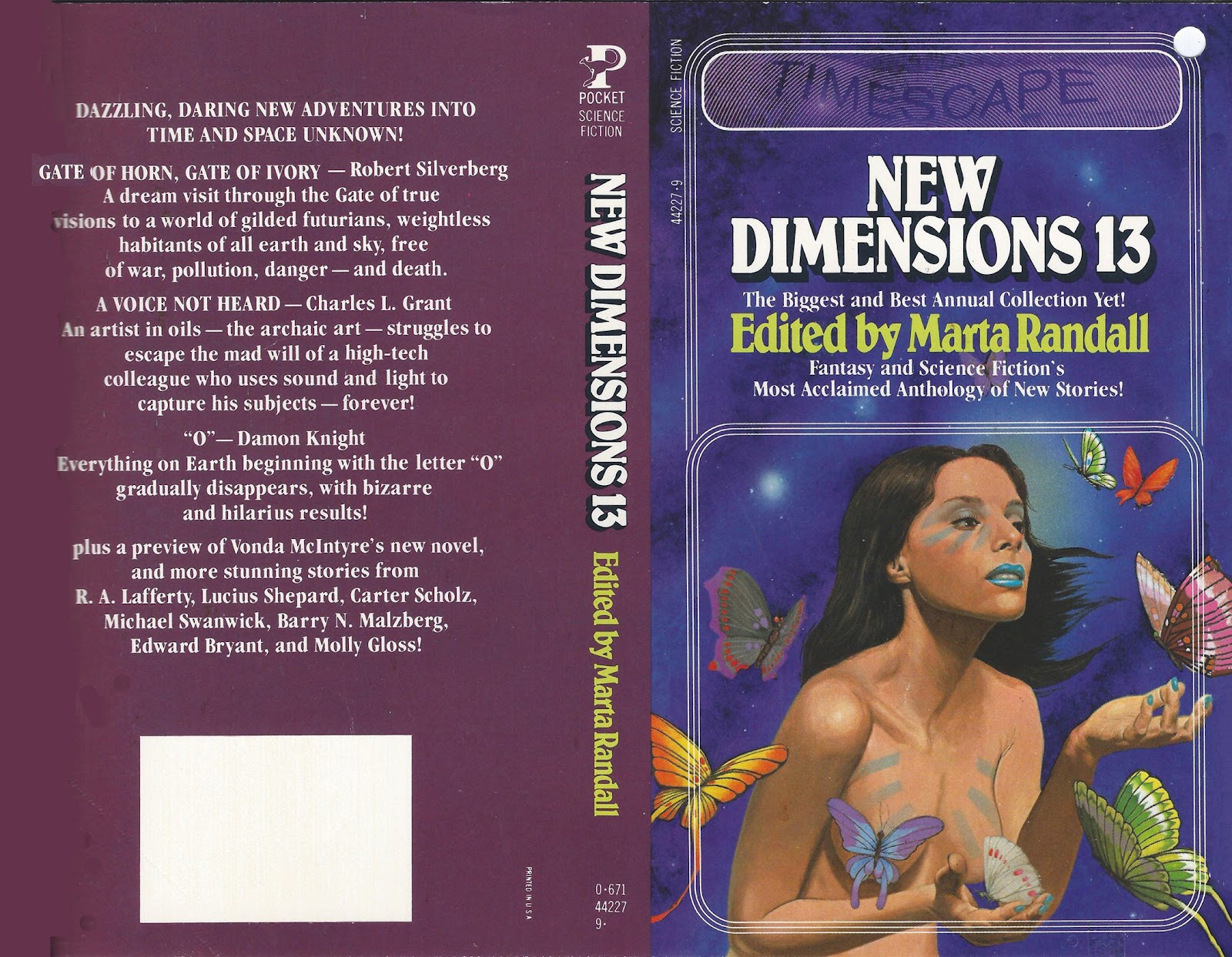
Cover of New Dimensions 13, scheduled for publication in 1982 but cancelled at the last minute by the publisher. Illustration by American artist Carl Lundgren (b. 1947).

“I wasn’t going to be the one stuck at home baking cookies,” Marta Randall tells readers on her website. “I was going to be the one balancing on the raft in the lashing seas, gripping the mast with one hand while the other held on to the cookies somebody else had baked.”

Fifty years ago, in 1973, Randall published her first story in New Worlds Quarterly 5, a paperback series edited during the 1970s by British science fiction writer Michael Moorcock. (Despite its name, the “quarterly” came out only once or twice a year.) That summer, she attended a science fiction convention in San Francisco and met Robert Silverberg, whose novel A Time of Changes had recently won the Nebula Award. The two authors had a friendly argument about short stories; as Silverberg remembered it, she “preferred the sort of stories with an identifiable beginning, middle, and end,” and he responded that he did as well—but he didn’t “necessarily require that they happen in that order.” He wrote, “As is usual in such debates, neither of us held as extreme a position as it might have seemed to the other.” Six months later, Randall shared with him, “with some trepidation,” her second piece of fiction; “I read it on the spot and rather to her surprise accepted it then and there.” The story, “A Scarab in the City of Time,” was published the following year in the fifth issue of New Dimensions, an annual publication that Silverberg edited between 1971 and 1981.

“Trepidation is no longer a Marta Randall characteristic,” Silverberg later noted. Neither author could have guessed that at the end of the decade Randall would coedit two volumes of New Dimensions with Silverberg, who informed readers that both collections were “largely the work of Marta Randall.” Nor, for that matter, would they have predicted that New Dimensions 11 and 12 would be the last two issues of the series. A thirteenth volume, edited solely by Randall with Silverberg’s support (and including his latest story), was prepared for press and scheduled for publication in the summer of 1982, but the publisher, claiming that SF anthologies no longer sold, cancelled it after advance copies had been sent to reviewers. It would have been a landmark volume: all seventeen stories from the collection were published elsewhere, and five of them were selected to appear in The Year’s Best Science Fiction. That same year, Randall became the first female president of the Science Fiction Writers of America (now the Science Fiction and Fantasy Writers Association).

In 1988, when Randall was asked to comment on her work to date, she wrote:
I find it difficult to speak about my own fiction—primarily, I think, because of a conviction that stories must stand by themselves, and the hopes, opinions, or beliefs of their authors are ultimately irrelevant. I view science fiction as a tool, as a useful series of conventions with which to deal with a storyteller’s basic task, that is, the exploration not of ideas, but of people. By using the devices of the genre the writer can pare away anything not relevant to the characters and their dilemmas, can, in effect, create a crucible in which to toss the characters and view their reactions. Lest that sound pompous, I believe it equally important that science fiction remain, far more than general mainstream fiction, a genre in which one can tell stories, present adventures, write for the simple joy of creating wonderful things. My principal goal as a science-fiction writer is to meld these two approaches to the genre. It is a goal which I hope to be chasing for the rest of my professional life.
A lifelong resident of California, Marta Randall was born in Mexico City to Richard Baleme Randall, an American teacher, and Nelly (Amador y Spat) Randall, a native of Yucatán. At the age of two she moved with her parents to Berkeley. She wrote seven novels and two dozen stories while pursuing a career as a legal assistant and paralegal specializing in trademarks, interrupted by a six-year stint in the 1980s as a freelance writer for a video-game developer. She retired in 2013, moved to Hawaii, and has since published a fantasy duology and several short stories.

*   *   *
I skulk in a forgotten alley while they scurry by outside, searching for me. . . . If you don't see the full selection below, click here (PDF) or click here (Google Docs) to read it—free!

This selection is used by permission.
To photocopy and distribute this selection for classroom use, please contact the Copyright Clearance Center.
Sunday, November 6, 2022

When It Changed

Joanna Russ (1937–2011)
From The Future Is Female! More Classic Science Fiction Stories by Women

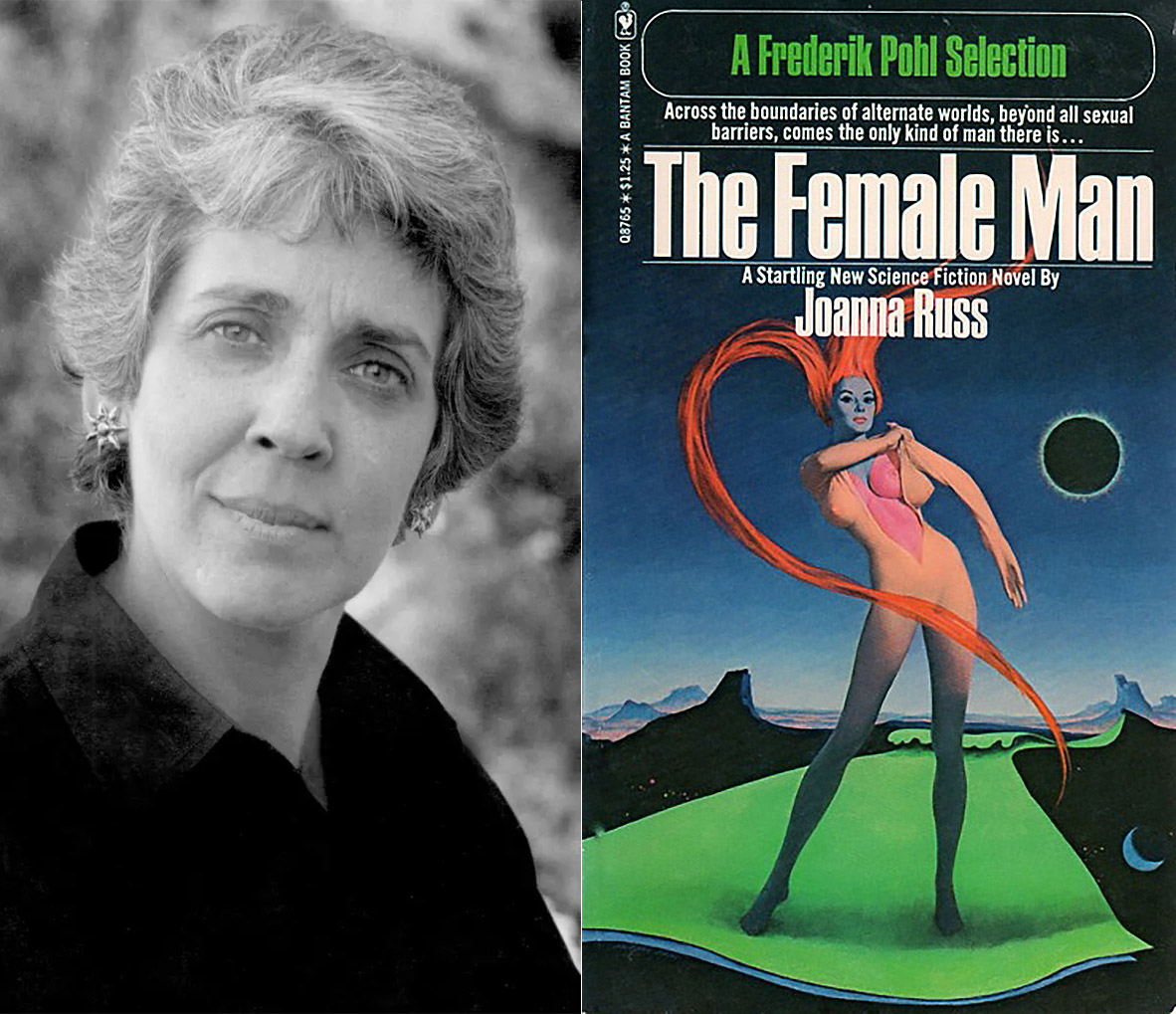
Photograph of Joanna Russ, 1984, by Ileen Weber (Wikipedia). First American edition of Russ’s The Female Man (Bantam, 1975) with a cover illustration by American artist Morgan Kane (1916–2014). “When It Changed” and parts of The Female Man are set on the planet Whileaway.
“There are plenty of images of women in science fiction. There are hardly any women.”

So concludes Joanna Russ’s often-reprinted essay, “The Image of Women in Science Fiction,” which first appeared in 1970 in the seventh and last issue of Red Clay Reader, a relatively obscure literary annual. Three years earlier, Russ had published her debut book, the sword-and-sorcery space adventure Picnic on Paradise, which was a finalist for the Nebula Award and a notable break from the conventions and stereotypes common in science fiction and fantasy during the previous decades. “Long before I became a feminist in any explicit way,” Russ told an interviewer in 1975, “I had turned from writing love stories about women in which women were the losers, and adventure stories about men in which men were winners, to writing adventure stories about a woman in which the woman won.”

Born and raised in the Bronx, Joanna Ruth Russ demonstrated early aptitude in the sciences and became one of the top ten finalists in the national 1953 Westinghouse Science Talent Search for her project “Growth of Certain Fungi Under Colored Light and in Darkness.” She turned to literature at Cornell, where she studied with Vladimir Nabokov (to whom she dedicated her second novel, And Chaos Died) and then earned an MFA in Playwriting from the Yale School of Drama before beginning a career as a college English professor. She sold her first science fiction story, “Nor Custom Stale,” while still in graduate school, and by the late 1960s she had established herself as a leading voice in science fiction’s New Wave. In a recent interview with Russ biographer Gwyneth Jones, Kathryn Cramer, a prominent SF editor, recalled Russ’s place in the academic and SF worlds:
Her life consisted of playing to various audiences that were difficult to reconcile. She wanted to be respected as fully as her colleagues in the English Department, even though she wrote SF. She wanted to be respected by the Radical Women for her feminist SF for which they had no use. And at the same time she wanted the respect of major figures in science fiction even though she was a woman, a lesbian, a feminist, and a socialist. She held her own there through rigor, but rigor plus depression made her a harsher critic than she wanted to be, so she eventually gave up reviewing.
Russ often pointed out how frontiers had been crossed by SF in every direction: outer space and interplanetary travel, other dimensions and extraterrestrial civilizations, technological advances and human-made catastrophes, political organizations and economic systems, and even various parasciences (ESP and the like)—yet speculations on future social arrangements and the domestic sphere had been limited. “Most science fiction is set far in the future, some of it very far in the future, hundreds of thousands of years sometimes,” she wrote in her 1970 essay. “One would think that by then human society, family life, personal relations, child-bearing, in fact anything one can name, would have altered beyond recognition.” Instead, most science fiction had either carried “today’s standards and values into its future” or returned to “an idealized and exaggerated past.”
Many recent stories do show a two-sexed world in which women, as well as men, work competently and well. But this is a reflection of present reality, not genuine speculation. And what is most striking about these stories is what they leave out: the characters’ personal and erotic relations are not described; child-rearing arrangements (to my knowledge) are never described; and the women who appear in these stories are either young and childless or middle-aged, with their children safely grown up.
As for the matriarchy motif that occasionally showed up in speculative fiction:
There is something about matriarchy that makes science fiction writers think of two things: biological engineering and social insects; whether women are considered naturally chitinous or the softness of the female body is equated with the softness of the “soft” sciences I don't know, but the point is often made that “women are conservative by nature” and from there it seems an easy jump to bees or ants. . . .
Russ’s initial attempts to address the genre’s shortcomings are evident in two pieces of fiction she was working on at the time she wrote her essay: the Nebula Award–winning short story “When It Changed” and her pioneering masterpiece, The Female Man. Both works depict a world named Whileaway, which is populated entirely by women. When the short story appeared in Harlan Ellison’s second anthology, Again, Dangerous Visions (1972), Russ wrote in an afterword that she had read “SF stories about manless worlds before; they are either full of busty girls in wisps of chiffon who slink about writing with lust, . . . or the women have set up a static, beelike society in imitation of some presumed primitive matriarchy.” She adds, “Of SF attempts to depict real matriarchies (‘He will be my concubine for tonight,’ said the Empress of Zar coldly) it is better not to speak.”

Lisa Yaszek, who selected “When It Changed” for the just-published second volume of The Future Is Female!, points out that the story pays homage to the fictional all-female societies depicted in Mizora (1880–81) by Mary Bradley Lane and in Herland (1915) by Charlotte Perkins Gilman—that is, to “the dream of a separate space for women outside the constraints of a culture where ‘men hog the good things.’” When the poet and playwright Jewelle Gomez reviewed Russ’s 1983 collection The Zanzibar Cat, which included the story, she wrote about how “When It Changed” both defies any attempt at summarization and overcomes the wariness of some readers: “In outline this story has all the classic (i.e., dull), politically correct potential: a group of women in an independent utopia about to do battle with the enemy. On the page it is a funny, touching tale of two women who confront the problems of how to raise their children so they are not destroyed by the earth-men’s idea of sexual equality, and how their own marriage can survive.”

Notes: Parts of the above paragraph on Joanna Russ’s early life are from the biographical note in The Future Is Female!

I.C. is the abbreviation for internal combustion. Verweile doch, du bist so schoen!: “Stay a while, you are so beautiful!,” from Part 1 of Johann Wolfgang von Goethe’s Faust (1808).

*   *   *
Katy drives like a maniac; we must have been doing over 120 km/hr on those turns. She’s good, though, extremely good, and I’ve seen her take the whole car apart and put it together again in a day. . . . If you don't see the full selection below, click here (PDF) or click here (Google Docs) to read it—free!

This selection is used by permission.
To photocopy and distribute this selection for classroom use, please contact the Copyright Clearance Center.

Sunday, January 31, 2021

Positive Obsession

Octavia E. Butler (1947–2006)
From Octavia E. Butler: Kindred, Fledgling, Collected Stories

Jacket art by American artist Laurence Schwinger (b. 1941) for the first edition of Octavia E. Butler’s Kindred (1979). Click on image to see entire front cover. Image courtesy of Laurence Schwinger’s website.
Among the items in the archive of Octavia E. Butler’s papers and manuscripts is a commonplace book in which she wrote notes to herself, including self-motivational goals and advice like:
I shall be a bestselling writer. After Imago, each of my books will be on the bestseller lists of LAT, NYT, PW, WP, etc.* My novels will go onto the above lists whether publishers push them hard or not, whether I’m paid a high advance or not, whether I ever win another award or not.

This is my life. I write bestselling novels. My novels go onto the bestseller lists on or shortly after publication. My novels each travel up to the top of the bestseller lists and they reach the top and they stay on top for months. Each of my novels does this.

So be it! I will find the way to do this. . . .
Butler, who died in February 2006 at the age of 58 following a fall outside her Seattle home, never realized this ambition. This past September, however, her novel Parable of the Sower, first published in 1993, finally made it to the New York Times Best Sellers lists. Abby Aguirre, describing in The New Yorker how the novel and its sequel (Parable of the Talents) eerily foretold aspects of current events, writes that Butler “extrapolated her vision of a near-future dystopia from what she read in the news, forecasting what kind of collapse might result if the forces of late-stage capitalism, climate change, mass incarceration, big pharma, gun violence, and the tech industry continued unhampered.” At a 1998 conference, Butler addressed early questions about the book’s canny prescience: “This was a cautionary tale, although people have told me it was prophecy. All I have to say to that is ‘I certainly hope not.’”

Parable of the Sower sold an astonishing 200,000 print copies in various editions during the past two decades (over half of them in the last two years), but it is still outpaced by her best-known novel, Kindred (1979), which sold well over half a million copies through retailers during the same period. The irony is that the most popular novel by one of America’s most famous and influential science fiction writers isn’t science fiction at all but is instead a historical fantasy. The plot features an African American woman and her white husband who somehow travel through time between the 1970s and the early 1800s, but “there's no science in Kindred,” she pointed out in a conversation with the novelist Randall Kenan. “I mean, if I was told that something was science fiction, I would expect to find something dealing with science in it.” Yet, not surprisingly, the book gets shelved with her other books in stores. As she joked in an interview with Stephen Harper. “I have a feeling that if I wrote a biography about my mother, it would wind up in the science fiction section.”

The history behind the fantasy of Kindred revolves around the lives of people, either real or realistically imagined, in the early years of the nineteenth century. In a pivotal scene, the main character, Dana, slips frighteningly back to antebellum America, where she realizes that she must keep secret some of her twentieth-century knowledge or lives would be endangered. Among the historical figures she recalls are “two important slave children right here in Maryland. The older one, living here in Talbot County, would be called Frederick Douglass after a name change or two. The second, growing up a few miles south in Dorchester County, was Harriet Ross, eventually to be Harriet Tubman.” On other occasions, Dana indicates that, in her life during the 1970s, she has read Narrative of the Life of Frederick Douglass. She is glad to see, for example, children eating with the older slaves in the cookhouse because “she’d read about kids their age being rounded up and fed from troughs like pigs,” an unmistakable reference to this passage in Douglass’s book:
The children were then called, like so many pigs, and like so many pigs they would come and devour the mush; some with oyster-shells, others with pieces of shingle, some with naked hands, and none with spoons. He that ate fastest got most; he that was strongest secured the best place; and few left the trough satisfied.
While she was writing her novel, Butler stayed in the Maryland region where Douglass lived. Her research, particularly her extensive reading of some of the lesser-known slave narratives, convinced her that she would need to moderate the horror of plantation life in her novel. As she explained to Kenan:
It’s not pleasure reading. As a matter of fact, one of the things I realized when I was reading the slave narrative—I think I had gotten to one by a man who was explaining how he had been sold to a doctor who used him for medical experiments [probably Slave Life in Georgia: A Narrative of the Life, Sufferings, and Escape of John Brown, 1855]—was that I was not going to be able to come anywhere near presenting slavery as it was. I was going to have to do a somewhat cleaned-up version of slavery, or no one would be willing to read it. I think that’s what most fiction writers do. They almost have to.
A decade after she published Kindred, as her standing in the literary world continued to rise, Octavia Butler wrote for Essence magazine a remarkably compelling essay outlining the path of her career, from early childhood in the 1950s to her status as a full-time writer in the 1980s. We present her life story as our Story of the Week selection.

* Los Angeles Times, The New York Times, Publisher Weekly, The Washington Post

*   *   *
My mother read me bedtime stories until I was six years old. It was a sneak attack on her part. . . . If you don't see the full selection below, click here (PDF) or click here (Google Docs) to read it—free!

This selection is used by permission.
To photocopy and distribute this selection for classroom use, please contact the Copyright Clearance Center.

Sunday, September 20, 2020

The Miracle of the Lily

Clare Winger Harris (1891–1968)
From The Future Is Female! 25 Classic Science Fiction Stories by Women

Full-page illustration [uncredited] for “The Miracle of the Lily” in the April 1928 issue of Amazing Stories. (Click on image to see the full drawing.)
The back section of the August 1931 issue of Wonder Stories includes a letter from Clare Winger Harris, one of the more popular authors to appear regularly in the various pulp magazines edited by Hugo Gernsback, for whom the Hugo Awards are named. Noting the dearth of science fiction movies (and acknowledging they might be expensive to make), she encouraged readers to write to Hollywood producers and urge them to make films that are not limited to “wild west, sex drama, or gangster stuff.” In addition, responding to the canard that there were only five or six SF plots, she offered an expanded list:
1. Interplanetary space travel.
2. Adventures on other worlds.
3. Adventures in other dimensions.
4. Adventures in the micro- or macro-cosmos.
5. Gigantic insects.
6. Gigantic man-eating plants.
7. Time travel, past or future.
8. Monstrous forms of unfamiliar life.
9. The creation of super machines.
10. The creation of synthetic life.
11. Mental telepathy and mental aberration.
12. Invisibility.
13. Ray and vibration stories.
14. Unexplored portions of the globe: submarine, subterranean, etc.
15. Super intelligence.
16. Natural cataclysms: extra-terrestrial or confined to the earth.

The extremes of diabolism and Utopianism are frequent themes, but these are social topics that use one of the above mentioned methods as mere vehicles for the expression of an ideal. . . .
Her list, of course, shows the preoccupations of readers and the limitations of available technologies of the period. Nevertheless, British science fiction author Doris V. Sutherland (after spending some time slogging through pulp magazines of the 1920s), calls it “a pretty accurate summary of the main themes of SF literature as it existed at the time.” In her introduction for The Future Is Female, Lisa Yaszek notes that, living up to their reputation as “pulpy,” Harris’s own stories were based on several of these plots; they are “less interested in sentence-by-sentence literariness than in big what if questions and the seemingly boundless imaginative possibilities of futures to come.”

Credited as the first woman to publish fiction under her own name in the SF magazines of the 1920s, Harris was born Clare M. Winger in Freeport, Illinois, the granddaughter of the town’s richest man (inventor and industrialist D. C. Stover, founder of Stover Engine Works). Her father, Frank S. Winger, was an electrical contractor who in 1917 self-published an early SF novel, The Wizard of the Island; or, The Vindication of Prof. Waldinger. As a child, Harris favored the stories of Jules Verne and H. G. Wells over more conventional girls’ fare. In 1910 she entered Smith College but married before completing her degree.

In the early 1920s, after moving to Fairfield, Iowa, with her husband and three sons, she wrote a historical novel, Persephone of Eleusis: A Romance of Ancient Greece, published in 1923 by the Stratford Company, a relatively small firm in Boston with a diverse list, including such authors as W.E.B. Du Bois and Isaac Goldberg, as well as books on science and religion. Two years later, in a neat stroke of coincidence, Stratford published the book edition of Gernsback’s debut novel, Ralph 124C 41+, which had been serialized fourteen years earlier in Modern Electrics magazine.

Harris’s first science fiction story, “A Runaway World,” appeared in the July 1926 issue of Weird Tales. Her second story, “The Fate of the Poseidonia,” earned Harris third place (and $100) in a contest organized by Gernsback, who published it in the June 1927 issue of Amazing Stories. “That the third prize winner should prove to be a woman was one of the surprises of the contest,” he wrote in the pages of the magazine, “for, as a rule, women do not make good scientifiction writers, because their education and general tendencies on scientific matters are usually limited.” Her last story in the pulps, “The Ape Cycle,” appeared in the Spring 1930 issue of Science Wonder Quarterly, yet another Gernsback publication.

There the story of her career as an author of science fiction would have ended but for a fascinating coda. In 1933 a high school student in Cleveland, Ohio, wrote her a fan letter and asked if she might contribute a new story to the mimeographed magazine that he and his best friend published for SF fans in their area. Whatever was in that letter must have impressed Harris, because she sent them her last known story, “The Vibrometer.” The teens, Jerry Siegel and Joe Schuster, included it in their fifth (and last) issue of Science Fiction. During the next five years the two young men would develop, in fits and starts, the comic-book hero Superman.

“The Miracle of the Lily,” perhaps her most popular and most anthologized story, surprised readers of her era by turning the “gigantic insects” plot (#5, above) on its head with what would now be regarded as a Twilight Zone–style twist. After the story appeared, she responded to fan mail in the pages of Amazing Stories and, addressing one reader who questioned how an eradicated species could suddenly reappear, she offered her view of how good speculative fiction should leave some of the speculating to readers:
If you recall, my last chapter was entitled “Ex Terrano,” which indicates “out of the ground.” However, I did not really want this point to be any too clear, for I merely wished to convey an idea and preferred not to garb it in too concrete language. The theme I wished to be left with the reader was that, after all man’s struggle to attain a definite objective . . . , and just when he has apparently reached his goal, he discovers that he has to do it all over again. . . . Personally, I do not like a story to be too explicit. It is often desirable to have something left to the imagination.
*   *   *

Note: Much of the above biographical information is adapted from The Future Is Female, edited by Lisa Yaszek.

*   *   *
Since the comparatively recent resumé of the ancient order of agriculture I, Nathano, have been asked to set down the extraordinary events of the past two thousand years. . . . If you don't see the full selection below, click here (PDF) or click here (Google Docs) to read it—free!

This selection may be photocopied and distributed for classroom or educational use.

Saturday, September 7, 2019

Mr. Sakrison’s Halt

Mildred Clingerman (1918–1997)
From The Future Is Female! 25 Classic Science Fiction Stories by Women


“The Katy Flyer,” 1911, painting commissioned for a chromolithographic postcard printed in England as part of Raphael Tuck & Sons’ “Railways of the World” series. “Katy” was the common nickname for the Missouri, Kansas, and Texas Railroad.
During the last couple of decades the name Mildred Clingerman has popped up in prominent spots around the science fiction universe. Her works have been included in several significant anthologies and even in textbooks; indeed, her story “Wild Wood” is one of the more memorable entries in the late David G. Hartwell’s landmark collection of Christmas fantasy tales. In 2014 she received a posthumous Cordwainer Smith Rediscovery Award, joining such previous honorees as R. A. Lafferty, Leigh Brackett, and the collaborative team Henry Kuttner and C. L. Moore. And two years ago her family assembled The Clingerman Files, a book collecting most of the science fiction stories that appeared during her lifetime, along with two dozen unpublished tales found in her papers.

Largely forgotten when she died of heart failure at seventy-eight, Clingerman published just seventeen science fiction stories between 1952 and 1962—most in The Magazine of Fantasy and Science Fiction, with three in the slick magazines Collier’s and Ladies Home Companion. They were collected in her only book publication, A Cupful of Space, and after a gap of thirteen years two more stories appeared in F&SF in 1975.

Yet her influence on the genre was far greater than the amount of her output. As Hartwell observed the year she died, Clingerman “was one of a notable group of women writers, including Judith Merril, Margaret St. Clair, and Shirley Jackson, who helped give fantasy and science fiction a special aspect in that decade and beyond. I would describe that flavor, with the benefit of four decades of hindsight, as a Twilight Zone flavor.” Her stories, he added, focus on ordinary women experiencing something extraordinary—all written within a literary genre that had, during the 1950s, become devoted primarily to extraordinary men. Literary scholar Lisa Yaszek points out another notable aspect of these works: “Clingerman uses SF’s ‘encounter with the alien other’ story to show how the most alien of all encounters are those that occur between humans.”

Born in Allen, Oklahoma, Clingerman was raised in Iowa, California, Texas, and New Mexico, before she and her mother settled in Tucson, Arizona, when she was eleven years old. She married in 1937, and later said, “My only work outside home was during World War II, when I kept flight-time records at a Ryan flight-training school, while Stuart was a paratrooper in the army.” When she wasn’t writing fantasy or science fiction, she contributed occasional nongenre fiction to publications ranging from The Philadelphia Inquirer to Good Housekeeping, but she regarded all her writing as “secondary to other joys. An avocation, really.” After submitting her last two SF stories in 1975, she more or less retired from her career as a writer.

Published in 1956, “Mr. Sakrison’s Halt” was selected by Yaszek for inclusion in The Future Is Female, the anthology of science fiction stories she recently edited for Library of America. The protagonist, Miss Mattie Compton, is a Southern belle who has spent forty years regretting a brief moment of racist anger that alienated her from her fiancé. Told from the point of view of a young girl whose many encounters with the eccentric woman occur mostly on a train, the story conjures what Yaszek describes as “a magical, alternative America that the narrator glimpses but can never find for herself again.”

*   *   *
In those days the old Katy local was the magic carpet that transported me from one world to another. . . . If you don't see the full selection below, click here (PDF) or click here (Google Docs) to read it—free!

This selection is used by permission.
To photocopy and distribute this selection for classroom use, please contact the Copyright Clearance Center.

Saturday, May 18, 2019

The New You

Kit Reed (1932–2017)
From The Future Is Female! 25 Classic Science Fiction Stories by Women

Advertisements from the late 1950s and early 1960s suggesting that women could become slimmer by consuming (from left to right) Domino’s Sugar, Diet Delight canned fruit, and Post Grape Nuts. Images from Flickr and Advertising Archives (UK).
Fifteen years ago Kit Reed published her twenty-second novel, the darkly satirical Thinner than Thou, which imagined a near future when a new religion has formed around weight loss and body consciousness. The advance notices, most of them filled with praise, prepared readers for a disturbing read. “Unsettling, sometimes appalling: satire edging remorselessly toward reality,” concluded the notice in Kirkus Reviews. The starred review in Booklist agreed that “Reed’s visionary tale is brilliant, though at times painful to read.” When an interviewer at Axxón, an Argentinian fan site dedicated mainly to speculative fiction, asked Reed what inspired her to write such a novel, she responded:
. . . it became obvious to me that with people more and more body-conscious, diet and exercise and fitness had become a kind of religion. For many in the American society, it has replaced religion. It supplies them with a guilt-and-atonement component that may be missing from their lives. Fitness is equated with virtue, at least for body-image snobs.
Thinner than Thou more specifically takes aim at the gym craze that arose before and after the turn of this century, but the subjects of body-image and weight—particularly for women—have pervaded Reed’s writings throughout her entire career. “I had a brief fat period as a kid, i.e. weighed 20 pounds more than I do now,” she explained to the British SF novelist Gwyneth Jones. “Once you get past it you think about it every day; if you don’t, it sneaks back up on you and pounces.” In 1974 she edited the anthology Fat, which gathered stories and essays about compulsive eating. Among her best-known works from the 1960s are such quirky stories as “The Food Farm” and the “The New You,” the latter of which we present as our Story of the Week selection.

Born in 1932, Kit Reed published her earliest-known science fiction story, “Space Traveler,” in the Sunday magazine of the St. Petersburg Times in July 1955. “The Wait,” in the April 1958 Magazine of Fantasy and Science Fiction, set her on a professional writing career that ultimately included almost a dozen story collections and thirty novels, as well as occasional nonfiction. Principally known as a writer of speculative fiction, she published works in a variety of genres, including the comic novel Mother Isn’t Dead, She’s Only Sleeping (1961), psychological thrillers under the pseudonym Kit Craig, and the horror novel Blood Fever (1986, as Shelley Hyde). She died two years ago in Los Angeles at the age of eighty-five.

Reed avoided the familiar science fiction terrains of extraterrestrial species and space travel and instead created domestic dystopias and cynical fantasias. “She told stories about beauty pageants, illicit adoptions, eating disorders, a violent high school built like a maximum-security prison, the sudden vanishing of an island’s population, a monkey who writes best sellers using a story-writing app, and a woman who becomes obsessed with a fantasy island that she discovers online,” summarized The New York Times in its obituary for her. Reed’s fiction often defied categories (she often proclaimed herself as “trans-genred”). “For a lot of publishers and readers, they’re useful marketing tools,” she told John DeNardo of SF Signal. “For some writers, too. Genre gives them a set of ground rules. Unfortunately, I’ve never been able to play by the rules.”

*   *   *
“Now—the New You,” the ad said. It was a two- page spread in one of the glossier fashion magazines, and it was accompanied by a shadowed, grainy art photograph that hinted at the possibility of a miraculous transformation. . . . If you don't see the full selection below, click here (PDF) or click here (Google Docs) to read it—free!

This selection is used by permission.
To photocopy and distribute this selection for classroom use, please contact the Copyright Clearance Center.

Saturday, February 9, 2019

Pelt

Carol Emshwiller (1921–2019)
From The Future Is Female! 25 Classic Science Fiction Stories by Women

Bottom half of the cover illustration by John Pederson Jr. for the November 1958 issue of The Magazine of Fantasy and Science Fiction, in which “Pelt” first appeared. Click here to see the full cover.
Carol Emshwiller, the revered author of countless works of science fiction, fantasy, avant-garde literature, and magic realism, died last weekend, on February 2. She was 97 years old.

Born in Ann Arbor, Michigan, Agnes Carolyn Fries was one of five children, including a half-sister from her father’s previous marriage. (It was “one of those old-fashioned Victorian secrets,” she recalled. “I didn't find out she was my half-sister until I was thirteen.”) Her three younger brothers, she told an interviewer, were “a big (!) influence” when she was growing up. “I always thought of myself as one of the boys, though a defective one.” In a biographical essay she contributed to Contemporary Authors, she wrote:
I was never called Agnes. (When I started college I changed my name from Carolyn to Carol so as to be more like a boy . . . more like my brothers. I don't feel that way anymore but it's too late to change back and I'm used to being Carol now.)
As a teenager, she spent several years shuttling between Michigan and France or Germany when her father, a professor of English and linguistics, was on sabbatical. “Mine was an arguing family. Dad always used the Socratic method when trying to convince us of anything.” Her father offered her advice that she would ultimately take as a challenge:
On my sixteenth birthday my father told me no woman had ever done anything significant. A woman could be the inspiration for deeds by men, she could be the woman behind the throne, but women weren't capable of doing anything original themselves. I'm sure he thought he was doing me a favor telling me this so I wouldn't waste my time trying to be something.
Graduating from the University of Michigan with a BA in music in 1945, she joined the Red Cross, aiding U.S. troops in postwar Italy, then returned to Ann Arbor for art school. She married fellow art student Ed Emshwiller in 1949. Together, they attended the École Nationale Supérieure des Beaux-Arts, toured Europe on a motorcycle, and eventually settled in Levittown, New York, where they had three children.

Carol Emshwiller in a 1957 portrait
by her husband Ed Emshwiller.
Emshwiller began publishing science fiction in the mid-1950s, after being introduced to editors and authors by her husband, who became one of the principal genre artists of the era. (We used one of Ed’s iconic illustrations to accompany “Baby, You Were Great,” a previous Story of the Week selection.) During the 1960s, Emshwiller and her husband expanded their circle to include avant-garde musicians, painters, poets, and filmmakers—as she put it, “we were enmeshed. Embedded. Passionate about that sixties world and nothing else.” Not surprisingly, her experimental stories were often associated with SF’s New Wave.

In 1974 Emshwiller became an adjunct assistant professor at New York University and published her first story collection, Joy in Our Cause. At the age of sixty-seven, she finished her first novel Carmen Dog (1988), followed by The Mount (2002), Mister Boots (2005), and The Secret City (2007), as well as two Westerns, Ledoyt (1995) and Leaping Man Hill (1999). Emshwiller won one World Fantasy Award, one Philip K. Dick Award, two Nebula Awards, and, in 2005, the World Fantasy Award for Lifetime Achievement.

One of the best-known of the 150-plus stories Emshwiller published between 1954 and 2016, is the often-anthologized “Pelt,” which was most recently reprinted in the Library of America collection, The Future Is Female! Describing the trek of a trophy hunter accompanied by his dog on a distant planet; the story is told from the dog’s point of view—one of Emshwiller’s numerous tales that explore the interactions of predators and prey or that adopt a non-human perspective. “I took several classes in prey animal psychology, which actually were classes on the psychology of everything,” she explained in her Contemporary Authors essay. “About how we, being predators and having predators such as cats and dogs around us all the time, understand predators, but know very little about prey animals.”

When Jeff and Ann VanderMeer included the story in The Big Book of Science Fiction, they wrote, “At the time of its publication, ‘Pelt’ was considered to exemplify a strand of ‘literary’ science fiction that bridged the gap between mainstream realism and core science fiction.” Sixty-five years later, “as a story that deals with issues of the environment and how humans view other species, [it] has become only more relevant, and better, with the passage of time.”

*   *   *
She was a white dog with a wide face and eager eyes, and this was the planet, Jaxa, in winter. . . . If you don't see the full selection below, click here (PDF) or click here (Google Docs) to read it—free!

This selection is used by permission.
To photocopy and distribute this selection for classroom use, please contact the Copyright Clearance Center.

Saturday, December 8, 2018

Space Episode

Leslie Perri (1920–1970)
From The Future Is Female! 25 Classic Science Fiction Stories by Women

Depiction of an astronaut by American artist Malcolm H. Smith (1910–1966) for the cover of the June 1953 issue of Universe Science Fiction.
During the fall of 1941 two relatively new pulp magazines, Science Fiction and Future Fiction, merged under the decidedly clunky title Future, combined with Science Fiction. Edited by Robert A. W. Lowndes, the second number of the joint magazine ignited a small tempest of controversy with the publication of Leslie Perri’s “Space Episode.” Readers’ scores indicated it was the lowest-rated selection of the issue; one angry letter writer wrote, “Of all the hacky, sour, limping stories, this tops them all. Bah! Triple bah!” The story was not without its fans, however: “Call it loyalty to my sex or what you will but I still like it best.”

The short story that set off a small-scale battle of the sexes among science fiction fans featured an astronaut who comes to the rescue of her fellow space travelers—both of them men who freeze up when faced with a lethal catastrophe. Perhaps predictably, women found the story, with its sardonic comments about heroes and heroism, compelling and realistic while male readers dismissed it as sour grapes. Lowndes considered the story a success because “it served to show, if nothing else, that quite a few girls read Future.”* Moreover, unlike any of the other selections in the issue, the story has been reprinted several times in the eight decades since it appeared, first in the May 1954 issue of Space Fact and Fiction, later in the landmark 1994 anthology New Eves, and most recently in the new Library of America collection The Future Is Female!

Leslie Perri was born Doris Marie Claire (“Doë”) Baumgardt to German immigrants in Brooklyn, New York. In May 1937, while in high school, she met the future novelist Frederik Pohl, and the two seventeen-year-olds began dating. As Pohl later recalled, Baumgardt was “strikingly intelligent in a sulky, humorous, deprecatory way that matched well with most of the people I admired.” Pohl shared his enthusiasm for science fiction with Baumbardt, and she soon went with him to a meeting of the Greater New York Science Fiction Club. When the organization split in two, she became a central figure in the Futurian Society, whose members wanted to incorporate a stronger political perspective in its appreciation of science fiction. The society’s membership, in addition to Pohl and Lowndes, was a roster of future prominent writers and editors, including Isaac Asimov, James Blish, Virginia Kidd, Damon Knight, Cyril M. Kornbluth, and Judith Merril.

Baumgardt soon became familiar to readers and associates as Leslie Perri, the pseudonym she adopted when she began editing, illustrating, and writing for various fanzines. She was well known (and, by many accounts, well liked) within New York’s science fiction community. In 1939, when the organizers of the first World Science Fiction Convention barred the presence of the Futurians, Baumbardt was one of only five allowed into the event. (Asimov was another.) While at the convention, she tried—but failed—to convince the organizers to open up the event to all fans.

Pohl and Baumgardt married in 1940 but divorced two years later; during their period together, she edited (and reportedly wrote most of) the short-lived pulp magazine Movie Love Stories. It was also when she wrote “Space Episode,” her first short story. She published only two others more than a decade later, both in science fiction magazines. Baumgardt had a daughter by her second husband, the painter Thomas Owens, and a son by her third, the former Futurian Richard Wilson, and she worked intermittently as a journalist while raising her children. She died of cancer in 1970 at the age of 49.

* The quotes from Lowndes and both letter writers are from Sisters of Tomorrow: The First Women of Science Fiction, edited by Lisa Yaszek and Patrick R. Sharp.

*   *   *
She stared at her two companions for a moment and then a sickening revulsion replaced fear, the fear that held each of the three in a terrible grip of inertia. . . . If you don't see the full selection below, click here (PDF) or click here (Google Docs) to read it—free!

This selection may be photocopied and distributed for classroom or educational use.