From The Future Is Female! More Classic Science Fiction Stories by Women
Interesting Links
“Back to the Hugos: Dreamsnake by Vonda N. McIntyre” (Sam Jordison, The Guardian)
“Obituary: Vonda McIntyre” (Jeremy Sim, Clarion West)
Previous Story of the Week selections
• “Positive Obsession,” Octavia E. Butler
• “When It Changed,” Joanna Russ
• “If Ever I Should Leave You,” Pamela Sargent
• “The Day Before the Revolution,” Ursula K. Le Guin
Buy the book
 The Future Is Female! More Classic Science Fiction Stories by Women
522 pages
List price: $27.95
Web store price: $20.95
“Back to the Hugos: Dreamsnake by Vonda N. McIntyre” (Sam Jordison, The Guardian)
“Obituary: Vonda McIntyre” (Jeremy Sim, Clarion West)
Previous Story of the Week selections
• “Positive Obsession,” Octavia E. Butler
• “When It Changed,” Joanna Russ
• “If Ever I Should Leave You,” Pamela Sargent
• “The Day Before the Revolution,” Ursula K. Le Guin
Buy the book
The Future Is Female! More Classic Science Fiction Stories by Women522 pages
List price: $27.95
Web store price: $20.95
 |
| The title page of “Of Mist, and Grass, and Sand,” with an illustration by Leo Summers, in the October 1978 issue of Analog Science Fiction and Fact, and the dust jacket for the first edition of Dreamsnake, featuring artwork by Stephen Alexander. |
During the summer between, however, she traveled to Clarion State College in Pennsylvania to participate in the third annual Clarion Science Fiction Writers’ Workshop. Each week of the six-week course was conducted by a different science fiction writer; the instructors that year were Joanna Russ, Samuel R. Delany, Harlan Ellison, Fritz Leiber, Kate Wilhelm, and Damon Knight. During those six weeks McIntyre lived next door to another student, twenty-three-year-old Octavia E. Butler, who became a lifelong friend and (decades later) a fellow Seattleite. At the workshop, McIntyre finished her second published story, “Only at Night,” which appeared in the Dell paperback anthology gathering the best stories by both students and instructors from the Clarion workshops.
The director of the summer sessions, Robin Scott Wilson, left Clarion for other another academic position and, with his blessing, McIntyre worked with colleagues at the University of Washington to establish the Clarion West Writers Workshop, which from 1971 to 1973 hosted such well-known authors as Frank Herbert, Ursula K. Le Guin, and Robert Silverberg, as well as Russ, Ellison, and Delany. Even though McIntyre was neither an instructor nor a student for the workshops, she would occasionally participate in the classroom exercises. And, as she later recalled, that’s how her most famous story came to be:
I know where I got the idea: Avram Davidson’s exercise at the 1972 Clarion Writers’ Workshop. Avram made up two lists of words, one pastoral, one technological. Each of us drew a word from each list. We were to write a story using both words. We went off to lunch, moaning piteously about the ridiculous assignment. How could you write a story based on Alpha Centauri and laughter, or psychoanalysis and lizard, or snake and cow?She finished the story before the six-week session was over, and the result, “Of Mist, and Grass, and Sand,” was published the following year in Analog Science Fiction and Fact. It was honored with the Nebula Award for Best Novelette (a category for stories between 7,500 and 17,500 words), and it was the runner-up for both the Hugo and Locus awards.
How did I end up with snake and cow? Maybe the slips got mixed up. Maybe Avram didn’t consider snakes pastoral. Maybe it was a joke. In any event, I thought life was hard.
“Why don’t you name your main character Snake?” said one of the other students. . . .
I was stymied. What was I to do with the wretched cow?
Somewhere around midnight the secondary meaning of cow, the verb form, wandered in out of left field (or possibly the back forty), and I wrote, “The little boy was frightened . . .”
Over the next couple of years, McIntyre abandoned her graduate studies to become a full-time writer, and she realized there was more to say about the adventures of Snake. “I hadn’t planned to expand the story, but the characters didn’t like being left, figuratively, hanging by their thumbs,” she later wrote. “A writer’s character will walk into the writer’s mind and start talking. When this happens, any smart writer doesn’t ask where the ideas came from—she’ll shut up and take dictation from her characters about their lives.” Her award-winning story became the first chapter of the work many readers and critics consider to be McIntyre’s masterpiece, Dreamsnake, which was published in 1978 and went on to make a clean sweep of all three SF awards—Hugo, Nebula, and Locus—for best novel.
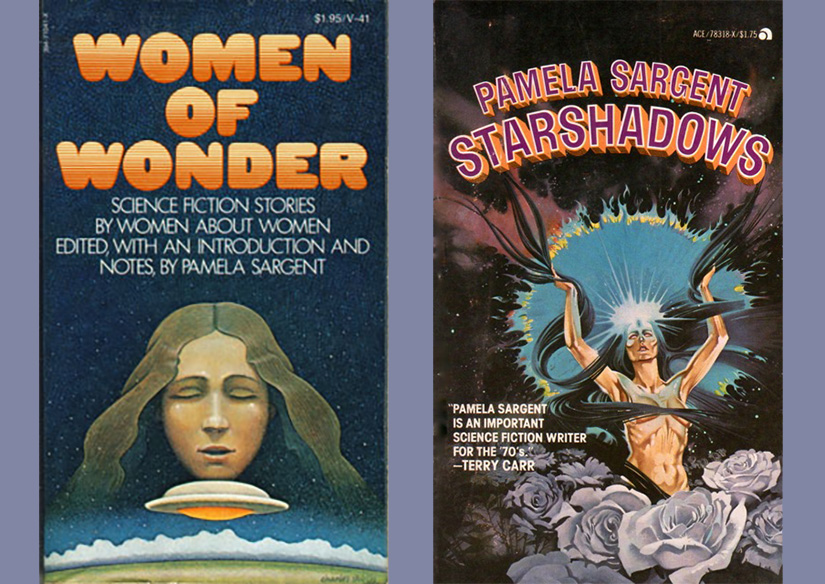
In a 2010 interview, McIntyre credited her success to the previous generation of women science fiction writers, including Wilhelm, Russ, and Le Guin, who “kicked down doors in their generation that people in my generation got to walk through. I don’t think I would have existed as the writer I am now if it weren’t for those writers. . . . And the time frame is actually kind of short, but there was a huge difference between publishing in the early 1970s and publishing in the 1960s.” McIntyre was instrumental in the publication of the first all-female science fiction anthologies: she connected Pamela Sargent with the company that published Sargent’s Women of Wonder anthology in 1975, and in 1976, with Susan Janice Anderson, coedited her own anthology, Aurora: Beyond Equality.
Over the course of her career, McIntyre published sixteen novels (including the novelizations of the second, third, and fourth Star Trek movies), over three dozen short stories, and numerous essays. She died at home in Seattle of pancreatic cancer in 2019; she left her literary estate to the Clarion West foundation, the successor to the workshops she had established a half century earlier.
McIntyre’s remarks above, concerning the development of her story and novel, are excerpted from an afterword included in recent printings of Dreamsnake.
* * *
The little boy was frightened. Gently, Snake touched his hot forehead. . . . If you don't see the full selection below, click here (PDF) or click here (Google Docs) to read it—free!This selection is used by permission.
To photocopy and distribute this selection for classroom use, please contact the Copyright Clearance Center.
To photocopy and distribute this selection for classroom use, please contact the Copyright Clearance Center.