Showing posts with label Frederick Douglass. Show all posts

Sunday, February 22, 2026

Letter from Paris

Frederick Douglass (1818–1895)
From Americans in Paris: A Literary Anthology

Monument to Alexandre Dumas, Paris, France, in the 1890s. At the base, a man, a woman, and a student are reading a copy of The Three Musketeers. Photochrom print, one of a series of more than five hundred images of sites in France produced in 1905 by the Detroit Publishing Company. (Library of Congress)

Before Gustave Doré died in January 1883, he finished his last major work, a bronze statue of Alexandre Dumas. Installation of the statue in La Place du Général Catroux was completed three months after his death and there it still stands today. As described in the letter reprinted here, when Frederick Douglass visited Paris in 1886, he was intent on seeing this prominent tribute to a writer of African descent. A year later he recalled “the bushy head and African features” of Dumas’s bronze figure and called it “one of the finest monuments in Paris and in the most aristocratic part of it.” Douglass’s high opinion of the author was diminished, however, by a conversation with the famous French abolitionist Victor Schoelcher, who claimed Dumas “never said one word for his race.” While Dumas may not have been active in abolitionist circles, he did write Georges, an antislavery novel about a slave rebellion with a mixed-race hero. It was published in 1842—the year before The Three Musketeers catapulted him to international fame and six years before slavery was banned in the French colonies.
While Frederick Douglass was on a lecture tour in England and Scotland in 1860, he planned to fulfill a long-cherished desire to see Paris. “The attempt upon the life of Napoleon III about that time, and the suspicion that the conspiracy against him had been hatched in England, made the French government very strict in the enforcement of its passport system,” he wrote in his memoir Life and Times. So, to obtain a passport, he wrote to George M. Dallas, formerly Vice President during the Polk administration and now the American minister in England. “But,” Douglass wrote, “true to the traditions of the Democratic party—true to the slaveholding policy of his country—true to the decision of the United States supreme court, and true, perhaps, to the petty meanness of his own nature,” Dallas refused to issue the passport “on the ground that I was not a citizen of the United States.” Upon learning of this, the French minister at Newcastle immediately stepped in and furnished the required documents.

Unfortunately, almost as soon as this diplomatic imbroglio had been settled, Douglass received word of the death of his daughter Annie, and he took the first available steamer back to Portland, Maine. Another twenty-six years would pass before he was able to fulfill his dream of seeing Paris.

In September 1886, seven months after he ended a five-year tenure as the recorder of deeds for the District of Columbia, Douglass sailed with his wife, Helen Pitts Douglass, for an eleven-month tour of Europe and the Middle East. After spending a month seeing old acquaintances and friends in England, they left for Paris. The train to Dover, the crossing across the English Channel, and the second train trip from Calais to Paris flew by, interrupted only by a stop in the Customs House. “They overhauled my luggage and underhauled it, and handled it somewhat recklessly and rudely, but happily for me nothing of a dynamite, contraband, incendiary, or suspicious character was found,” he recalled to an audience a year later when he was back in Washington. “Soon we were whirling away with a speed unknown to ordinary railroad travel in America, to the great city of Paris—the city of the dreams and visions of my boyhood—and which then I had not hoped ever to see.”

Arriving on October 20, the Douglasses ended up staying in Paris for more than two and half months. The American journalist Theodore Stanton, son of the women’s rights activist Elizabeth Cady Stanton, served as their guide for much of their visit. Stanton arranged for Douglass to meet Victor Schoelcher, who led the campaign that resulted in the abolition of slavery in the French colonies in 1848. He also secured an invitation to attend a session of the French Chamber of Deputies.

Although early in his trip Douglass was disconcerted when he encountered advertising for minstrel shows imported from the United States, he was largely impressed and often overawed by Paris and Parisians. Reflecting on the treatment accorded him, as an African American man with a white wife, he told the audience in D.C. the following year:
I hardly need repeat here a fact so well known, and one which I have so often had occasion to state elsewhere, that I met in Paris no manifestation against men on account of race or color. I am not bound to account for this, but I think it is in part because the negro has never been seen there as a degraded slave, but often as a gentleman and a scholar, for men hate those whom they injure. Perhaps also , the absence of race prejudice may in some measure be due to the presence and prevalence of the Roman Catholic religion. For whatever may be its other faults and defects, the Roman Catholic church welcomes to its altar and communion men of all races and colors, and would contradict its assumption of being the universal church if it did otherwise.
For whatever reason, Douglass did not write entries in his journal during his entire stay in Paris, and his immediate impressions survive in the scattered newspaper articles by observers tracking his adventures across Europe and in a handful of his surviving letters, one of which we reprint below. It is addressed to two friends in Boston, one of whom is likely Lewis Hayden, whom Douglass had known since the 1840s. As Adam Gopnik noted when the letter was reprinted in the Library of America anthology Americans in Paris, it serves as “a kind of cornerstone for the approaching twentieth-century black American fascination with Paris as a potential paradise—a place where, as James Weldon Johnson would later write, a black man could have ‘the sense of just being a human being.’”

Notes: Josiah C. Nott and George Gliddon coauthored Types of Mankind (1854) and Indigenous Races of the Earth (1857), works that promoted polygenism, the belief that various races developed separately, as distinct species, and did not share a common ancestor.

Former President Chester A. Arthur died on November 18, 1886, the day before Douglass wrote this letter. Although Douglass had been appointed as the recorder of deeds of the District of Columbia by President James A. Garfield—the first appointment of an African American to a federal office requiring Senate confirmation—he continued in the position in the Arthur administration after Garfield’s assassination. Douglass then held the office for the first year of Grover Cleveland’s term—even though Douglass was a Republican and Cleveland a Democrat. Douglass’s relationship with Arthur was fraught at best; the President avoided Douglass and never requested his presence at official occasions and ceremonies. Cleveland, on the other hand, nearly always invited both Douglass and his wife to state functions at the White House.

Founded in 1872, the Wendell Phillips Club (named in honor of the white abolitionist and civil rights activist who died in 1884) was a social fraternity for prominent Black men in Boston. On September 11, 1886, the club hosted a dinner in Douglass's honor and Lewis Hayden, a member and the likely recipient of this letter, escorted him there.

*   *   *

This week’s selection appears in its entirety below.
You may also download it as a PDF or view it in Google Docs.


Letter from Paris

Hotel Britanique.
Avenue Victoria.
Paris: November 19, 1886

Dear Friends Hayden and Watson

I do not forget that I promised on parting with you in Boston to let you have a line from me during my stay abroad. Nothing has occurred during my absence thus far which could be of special interest to you or to my American friends. I have everywhere been received in this country and in England with civility, courtesy and kindness and as a man among men as I expected to be. I have felt however that my presence here even in silence, has a good influence in respect of the standing of the Colored race before the world. The lepros distilment of american prejudice against the negro is not confined to the United States. America has her missionaries abroad in the shape of Ethiopean singers, who disfigure and distort the features of the negro and burlesque his language and manners in a way to make him appear to thousands as more akin to apes than to men. This mode of warfare is purely american and is carried on here in Paris, as it is in the great cities of England and in the States. So that to many minds, as no good was thought to come out of Nazireth so no good is expected of the Negro. In addition to these Ethiopian Buffoons and serinaders who presume to represent us abroad, there are malicious american writers who take pleasure in assailing us, as an inferior and good for nothing race of which it is impossible to make anything. These influences are very bountiful and not only tend to avert from us the sympathy of civilized Europians, but to bring us under the lash and sting of the world’s contempt. I have thus far done little to counteract this tendency in public—but I have never failed to bear my testimony when confronted with it in private—with pen and tongue. When I shall return to England, as I hope to do, in the spring—I shall probably make a few speeches in that country in vindication of the cause and the character of the colored race in america in which I hope to do justice to their progress and make known some of the difficulties with which as a people they have had to contend. Notwithstanding what I have said of the malign influences I mentioned the masses of the people both in France and in England are sound in their convictions and feelings concerning the colored race. The best elements of both countries are just and charitable towards us. I had the great pleasure yesterday of an interview with a member I may say a venerable and highly distinguished member of the French senate, M. Schoelcher, the man who in the final hours of the Revolution of 1848 drew up the decree and carried through the measure of Emancipation to the slaves in all the French Colonies. Senator Schoelcher is now over eighty years old, but like many other Europian statesmen is still able to work. He attends the Senate daily and in addition to his other labors he is now writing the life of Toussaint, the hero of Haytian Independence and liberty. A splended testimonial of the gratitude of the Emancipated people of the French Colonies is seen in his house in the shape of a figure of Liberty in Bronze breaking the chains of the slave. The house of this venerable and philanthropic senator has in it many of the relics of slaveholding barbarism and cruelty. Besides broken fetters and chains which had once gulled the limbs of slaves, he showed me one more collar with four huge prongs placed upon the necks of refracting slaves designed to entangle and impede them in the bushes, if they should attempt to run away. I had seen the same hellish equipment in the States—but did not know until I saw them here, that they were also used in the French Islands. Monsieur Schoelcher spoke much in praise of Thomas Jefferson—but blamed Washington. The latter could have, (he said), abolished slavery and that it was his fault that slavery was fastened upon the american Republic. I spoke to him of Alexander Dumas. He said he was a clever writer, but that he was nothing in morals or politics—he never said one word for his race. So have nothing to thank Dumas for.

Victor Hugo the whiteman could speak for us, but this brilliant colored man, who could have let down sheets of fire upon the heads of tyrants and carried freedom to his enslaved people, had no word in behalf of liberty or the enslaved. I have not yet seen his statue here in Paris. I shall go to see it, as it is an acknowledgement of the genius of a colored man, but not because I honor the character of the man himself.

I have seen much here in Paris in the way of ancient and modern sculpture and painting which deeply interested me. The Louvre and the Luxombourgh abound in them. I have long been interested in Ethnology—especially of the North African races. I have wanted the evidence of greatness under a colored skin to meet and beat back the charge of natural, original and permanent inferiority of the colored races of men. Could I have seen forty years ago, what I have now seen, I should have been much better fortified to meet the Notts and Gliddens of america in their arguments against the negro as a part of the great african race. Knowledge on this subject comes to me late, but I hope not too late to be of some services—for the battle at this point is not yet fought out and the victory is not yet. Yesterday through the kind offices of Mr. Theodore Stanton who procured tickets for us, I had the pleasure with him and Mrs. Douglass of sitting in a favored part of the gallery of the French house of Deputies and listening to the deliberations of that august body. Answering to our house of Representatives but with powers more enlarged. It presents a fine appearance and though somewhat noisy it was in point of manners an improvement on our house of Representatives. I saw no one squirting tobacco, smoking, or his feet above the level of his head as is sometimes seen in our National Legislature.

Colored faces are scarce in Paris. I sometimes get sight of one or two in the course of a day’s ramble. They are mostly from Hayti and the French Colonies. They are here as students and make a very respectable appearance. I met the other day at the house of Pere Hyacinthe a Mr. Janveir of Hayti a young man of the color of our well remembered friend Samuel R. Ward who is one of the finest scholars and most refined Gentlemen in Paris. I was very much delighted to find such a noble specimen of the possibilities of the colored race and to find him so highly appreciated by cultivated ladies and gentlemen of Paris. If a race can produce one such man it can produce many.

I am not ignorant of what is transpiring in the states. To days cable gram tells of the Death of Ex President Arthur an able man and while it must be regretted that he has fallen in the midst of his years, there is nothing in his career as President of the U.S. that proves him to have had any sympathy with the oppressed colored people of the south. I see that Mr. Blaine is likely to be the Republican Candidate in 1888. All I have to say is that whether he or another shall be chosen as our standard-bearer I see nothing better for us then to follow the Republican flag. We have not gained all that we had a right to expect under it, but under it we gained all that we have.

Please remember me kindly to the Wendell Phillips Club. I shall not soon forget the pleasant Evening and the happy send off the members of that Club gave me on the 11th Sept.

With kindest regards to yourselves and your families.

Always truly yours
Frederick Douglass

This transcripton was published in the August 1985 issue of Amistad.

Sunday, February 11, 2024

The Final Struggle

Frederick Douglass (1818–1895)
From Frederick Douglass: Speeches & Writings

Attendees at the Fugitive Slave Convention, Cazenovia, New York, August 20–21, 1850, daguerreotype by American photographer Ezra Greenleaf Weld (1801–1874). Frederick Douglass is seated with his elbow on the table; behind him is Gerrit Smith, standing at center; Mary Edmonson is at Smith's fingertips, wearing a shawl; her sister Emily Edmonson, also in a shawl, stands to the left of Smith. (National Abolition Hall of Fame and Museum)
    Born into slavery in Maryland (as was Douglass), the Edmonson sisters became nationally known when the teenagers were among 76 fugitives captured during an escape attempt arranged and financed by Smith and others. The two sisters were sold to traders in New Orleans, sent back to Alexandria for hire, and then emancipated with funds raised by Henry Ward Beecher’s congregation.
Philip S. Foner, in his 1969 biography of Frederick Douglass, reminded his readers of the importance of the Liberty Party, not only to Douglass’s pre–Civil War career but also to American political history.
The vast majority of American historians have underestimated the Liberty Party since it never carried a state, or even came close to carrying it, in any election. Yet the significance of this party cannot be estimated from the number of votes cast for its candidates at any given time. Its newspapers and propaganda went into the homes of Whigs and Democrats alike; its lecturers spoke to hundreds of people whose sense of party loyalty prevented them from voting the Liberty Party ticket. The Liberty Party men helped to shape the principles, forge the arguments, and train the leaders who in 1854 formed the Republican Party.
Among those leaders were future Chief Justice Salmon P. Chase (who would also serve as Lincoln’s Secretary of the Treasury), the social reformer Lucretia Mott, and the poet John Greenleaf Whittier. The organization was also the first political party that numbered African Americans among its ranks, including the educator and minister Henry Highland Garnet and the prominent Presbyterian minister Theodore S. Wright.

Founded in New York State in 1840, the Liberty Party aimed to divorce the institutions of the federal government from slavery. The party’s members believed that the Constitution was inherently antislavery in spirit and that it already granted the federal government the power to limit slavery to only those states where it had already existed at the time it was adopted. Therefore, abolitionists had a moral obligation to enter the political fray and challenge and reform the government. They were opposed by other abolitionists, especially the members of the ‎American Anti-Slavery Society led by William Lloyd Garrison, who maintained that the Constitution was fundamentally corrupted by slavery, that any political action under its system was morally compromised, and that Americans could be persuaded of the wrongness of slavery though peaceful, nonpolitical resistance, or “moral suasion.”

Douglass, however, came late to the Liberty Party. By the time he publicly announced his support, in 1851, many of its adherents had switched to the new antislavery (but not abolitionist) Free Soil Party, and the remaining Liberty leaders had split into two factions. “From the hour that the old Liberty Party was swallowed up by the Van Buren Free Soil party in ’48,” he acknowledged a few years later, “the work of deterioration began, and has been continued until now. Instead of going upward, the political Anti-Slavery sentiment has been going downward.”

Initially, as a loyal follower of Garrison, Douglass was opposed to the principles of the Liberty Party. In June 1848, however, the remnants of one faction hosted a convention in Buffalo, close enough to his new home in Rochester, and he attended. He ended up debating with several attendees and strongly defended the Garrisonian directive for moral suasion over political action. While somewhat impressed with the proceedings, he remained convinced “that the only true ground for an American Abolitionist is, No Union with Slaveholders,” as he told the readers of his newspaper The North Star. Many of his allies in the Garrison camp, however, protested that he had bestowed legitimacy on the Liberty Party by appearing in Buffalo at all.

Over the next three years, frustrated in part by the lack of progress (much less action) in the abolitionist movement, Douglass inched toward accommodation with the Liberty Party’s position. He became friends with one of the party’s founders, the wealthy New York businessman Gerrit Smith, whose estate in the small town of Peterboro was a significant stop for the underground railroad. “I am sick and tired of argueing on the slaveholder side of this question although they are doubtless right so far as the intentions of the framers of the constitution are concerned,” Douglass admitted to Smith in January 1851. “But these intentions you fling to the winds—your legal rules of interpretation override all speculations as to the opinions of the constitution makers and these rules may be sound and I confess I know not how to meet or refute them on legal grounds.”

That spring, Smith arranged with Douglass to merge The North Star, which had more than 4,000 subscribers, with the Liberty Party Paper, struggling for survival with a circulation of 700. Smith provided the funding for the new publication, retitled Frederick Douglass’ Paper. In a letter to Smith, Douglass worried, correctly, that he would be accused of selling out: “The war will be waged not against opinions, but motives.” He publicly announced the merger in May at the annual meeting of the American Anti-Slavery Society, and his statement in Garrison’s newspaper The Liberator argued that because slavery is incompatible with “the noble purposes avowed” in the preamble to the Constitution, the document should be interpreted as an antislavery instrument and “wielded in behalf of Emancipation.” His call to use political as well as moral power in their efforts to overthrow slavery alienated him from Garrison, and the subsequent exchange became so vitriolic and personal that—despite an attempt by Harriet Beecher Stowe to broker a peace—Douglass left the Society at the end of 1853.

By April 1856, the Liberty Party was a shell of its former self and a new group—the Republican Party—was on the rise. Douglass was skeptical: “That the National Republican party, around whose standard Abolitionists are now called upon to rally, does not occupy this high Anti-Slavery ground, (and what is worse, does not mean to occupy it,) is most painfully evident.” Rather than supporting the Republicans, Douglass stumped for the Radical Abolition Party—a small group of old Liberty Party men, led in part by Gerrit Smith. After the Republican Party held its convention in June, he dismissively summarized the party’s position, which was limited to its opposition to the expansion of slavery into Kansas and Nebraska:
Nothing said of the Fugitive Slave Bill—nothing said of Slavery in the District of Columbia—nothing said of the slave trade between States—nothing said of giving the dignity of the nation to Liberty—nothing said of securing the rights of citizens, from the Northern States, in the constitutional right to enter and transact business in the slave States. There is not a single warm and living position, taken by the Republican party, except freedom for Kansas.
Yet Douglass bowed to the reality of the political situation, and in August he endorsed the Republican ticket of John C. Frémont and William L. Dayton “because there is no chance whatever in the present context of electing better men than they.” As David W. Blight concluded in his recent Pulitzer Prize–winning biography: “More than from any other single issue before the war, Douglass derived his sense of political pragmatism from coming to grips with the Republican Party, the odd assemblage of former Whigs, antislavery Democrats, Liberty Party men, and even nativists who all coalesced around stopping the expansion of slavery. His reactions ranged from vehement opposition to cautious support.”

In the middle of this maelstrom of oppositional forces within the antislavery movement, Douglass found hope and strength in his continuing belief that the conflict over slavery “will not, cannot, last for ever” and that even the “disintegration of the once powerful political Parties, is a cheering and significant sign of the times.” In August 1855 he published the following editorial, presciently expressing his confidence that the “final struggle” was at hand.

Portions of the above introduction have been drawn from the Chronology and Notes in Frederick Douglass: Speeches & Writings, edited by David W. Blight.

*   *   *

For this week’s selection, we depart from the usual format and reproduce the selection, in its entirety, below. You may also download it as a PDF or view it in Google Docs


The Final Struggle

Among the varied and multitudinous array of opposition to the anti-slavery movement, no Abolitionist should abate his zeal, or relax his energy, but rather redouble his diligence, and resolve, if need be, to die upon the battle field, struggling for the victory. There is some consolation in the reflection, that the conflict will not, cannot, last for ever. The hour which shall witness the final struggle, is on the wing. Already we hear the booming of the bell which shall yet toll the death knell of human slavery.

Liberty and Slavery cannot dwell together forever in the same country. There is not one iota of affinity existing between them. They hate each other, with a hatred which is unto Death. They ever have been, and they ever must remain, in a state of irreconcilable hostility. Before a union can be effected between them, the laws which govern the moral universe must be repealed. It is absurd in any one to expect to witness the spirit of Liberty being led, by the demon of Slavery, to the hymeneal altar.—As well expect the pains and sorrows of hell, to mingle, in happy unison, with the pleasures and the joys of heaven; the spirits of just men made perfect, with the spirits of the lost.

It is useless, then, to attempt to effect a union between them. No compromise can effect it. No legislation can change the inflexible law of adaptation, the eternal fitness of things. No compact can make that Right, which is wrong from its first principles to its crowning assumptions.

It is, then, perfectly apparent to every reflecting mind, that a crisis more critical than any which has preceded it, is pending. This crisis cannot much longer be delayed. It must come to pass as the legitimate result of the past and the present struggle for the mastery in which we behold these deadly enemies engaged. We may attempt to bind up the wounds of the respective hostile parties, with mollifying ointment, but this will not avert the impending hour. It must come, as sure as the laws of God cannot be trampled upon with impunity.

Then, as a nation, if we are wise, we will prepare for the last conflict, for that final struggle in which the enemy of Freedom must capitulate. Instead of indulging in delusive dreams of safety, the Slave Power should prepare for the era of its disastrous doom; it will be wise and consider its latter end.

The motto to be inscribed upon the banner of Freedom, in the last conflict is not, “No more Slave States,” nor “No Slavery outside of the Slave States”; but no Slavery where it does exist; no Slavery in the Republic. We shall not be burdened or annoyed by unhallowed compromises, we shall make no contracts with the perfidious enemy. Not one word of concession or compromise, shall escape our lips, not one syllable of apology. Truth and Error, Liberty and Slavery, in a hand-to-hand conflict. This is what we want; this is what we will have. The utter extinction of Slavery, everywhere in our national domain; the subversion of the Black Power, wherever, in all our widespread territory, it dare lift its defiant head toward Heaven.

Again; in the final struggle, in order to be successful, there must exist a thorough organization of freemen, with the single issue presented, Liberty everywhere, Slavery nowhere; there must be unity of effort; every man who loves freedom, must array himself in her defence, whatever may have been his past political predilections. The magnet of Human Freedom, must be held high above the din of party tumult, and every man who is willing to peril his life, his fortune, and his sacred honor, in its defence, will ultimately be attracted to the magnet, whether Whig, or Democrat, or Freesoiler, or Abolitionist. This will form the great Abolition Party of the land. In fact, there must be, and there will be, but two Parties in the country; these will be known not as Whigs, nor as Democrats, nor as Republicans, so far as party names are concerned, but simply as the Anti-Slavery, and Pro-Slavery parties of the country. All who are desirous of maintaining a sort of assumed neutrality on the question, as well as the most inveterate haters of the Abolition movement, will constitute the Pro-Slavery Party. Neither of these parties, in the last conflict, will be wheedled from the arena, by the presentation of incidental issues. Each party, forming a unit, and rallying under its own banner, will fight for the triumph of its respective Principles.

We do not fear the result of such a struggle. The sooner the last battle shall be fought, the sooner victory will perch upon the standard of the free. The Principles which form the basis of the Abolition movement, are as unchanging and as undying as their Eternal Author. They must triumph, for Heaven has nowhere promised to delegate his power to another. Let us then prepare for the battle, and for victory. Already are the masses moving. The disintegration of the once powerful political Parties, is a cheering and significant sign of the times. The throne of the despot is trembling to its deep foundations. There is a good time coming. We yet shall make the welkin ring with the mighty hallelujahs of the free.

From Frederick Douglass’ Paper, November 16, 1855

Note: The phrase “his life, his fortune, and his sacred honor” evokes the closing line of the Declaration of Independence: “And for the support of this Declaration, with a firm reliance on the protection of divine Providence, we mutually pledge to each other our Lives, our Fortunes and our sacred Honor.”

Sunday, October 9, 2022

I Have Come to Tell You Something About Slavery

Frederick Douglass (1818–1895)
From Frederick Douglass: Speeches & Writings

Portrait of Frederick Douglass, c. 1845. Oil on canvas, artist unknown. National Portrait Gallery, Smithsonian Institution. This painting is believed to be based on the engraving that appears as a frontispiece in Douglass’s first book, Narrative of the Life of Frederick Douglass, An American Slave (1845). Click on image to see full painting.
In August 1841, Nantucket hosted the island’s first antislavery convention— an event that would permanently alter Frederick Douglass’s life as a freed man. He was then living with his wife and two children in New Bedford, Massachusetts, where he was employed variously by a whale-oil refinery, at a shipyard, or in a brass foundry. He was also licensed to preach by the African Methodist Episcopal Zion Church and frequently spoke from the pulpit.

“Mr. William C. Coffin, a prominent abolitionist in those days of trial, had heard me speaking to my colored friends in the little school-house on Second street, where we worshiped,” Douglass recalled in his Life and Times. “He sought me out in the crowd and invited me to say a few words to the convention.” A “few words” somehow became a speech to the entire gathering—well over five hundred people, most of them white—on the last night of the three-day event. Years later, the abolitionist and reformer Samuel J. May recalled when Douglass took the stage:
To his great confusion, he was called upon and urged to address the convention. A number were present from New Bedford who had heard his exhortations in the Methodist church, and they would not allow his plea of inability to speak. After much hesitation he rose, and, notwithstanding his embarrassment, he gave evidence of such intellectual power—wisdom as well as wit—that all present were astonished.
A correspondent for The National Anti-Slavery Standard, then edited by Lydia Maria Child, was in attendance and, unable to recall the reluctant speaker’s name, reported later that month:
One, recently from the house of bondage, spoke with great power. Flinty hearts were pierced, and cold ones melted by his eloquence. Our best pleaders for the slave held their breath for fear of interrupting him. . . . It seemed almost miraculous how he had been prepared to tell his story with so much power.
The reporter ended the article by noting that the closing session—scheduled to end at nine o’clock—held the audience spellbound until nearly ten because Douglass’s speech inspired William Lloyd Garrison to deliver a rousing, extemporaneous stemwinder “taking me as his text,” as Douglass put it.

What is clear from numerous surviving accounts and memoirs is that no one who witnessed Douglass’s “debut,” as it were, ever forgot it. Years later, however, the speaker himself could barely remember that night:
It was with the utmost difficulty that I could stand erect, or that I could command and articulate two words without hesitation and stammering. I trembled in every limb. I am not sure that my embarrassment was not the most effective part of my speech, if speech it could be called. At any rate, this is about the only part of my performance that I now distinctly remember. The audience sympathized with me at once, and from having been remarkably quiet, became much excited.
Although many eyewitnesses later remembered how his initial embarrassment gradually became confidence and “dignity” and how he shared stories of his years of bondage, no record has survived indicating the specifics of what Douglass said that night.

Before Douglass returned home, John A. Collins, an agent of the Massachusetts Anti-Slavery Society, offered him a paid position for a three-month trial period, during which he would travel with other abolitionists to speak at county meetings and attract subscribers for The National Anti-Slavery Standard and Garrison’s newspaper, The Liberator. “I was reluctant to take the proffered position,” wrote Douglass, who was still legally a fugitive. “I had not been quite three years from slavery and was honestly distrustful of my ability, and I wished to be excused. Besides, publicity might discover me to my master, and many other objections presented themselves.” Yet, in the end, Douglass accepted: “Here opened for me a new life—a life for which I had had no preparation. Mr. Collins used to say when introducing me to an audience, I was a ‘graduate from the peculiar institution, with my diploma written on my back.’”

In October 1841, the abolitionist Edward M. Davis, who was visiting from Philadelphia, witnessed Douglass speaking in Lynn, Massachusetts, during his “trial period.” (Douglass and his family would move to Lynn the following spring.) The speech by “the runaway slave,” Davis wrote, “was delivered with energy, and evidently from one unaccustomed to make speeches, yet it came so spontaneously that it thrilled through every one present, and compelled them to feel for the Wrongs he endured.” Impressed and awed, Davis had the presence of mind to write down the gist and “in some parts the language” of Douglass’s speech, and he published it in the The Pennsylvania Freeman. It is the earliest record of Frederick Douglass’s oratory and so it is the opening piece in the just-published Library of America volume collecting more than one hundred of his speeches and works of journalism. We present it below as our Story of the Week selection.

Notes: The man Douglass refers to as “my master” is Thomas Auld. For more on Auld, as well as the public letter Douglass addressed to him in 1848, see “Letter to His Old Master.” The “young female slave” was Douglass’s cousin Henny Bailey, who had been severely burnt in a childhood accident and lost the use of her hands. Douglass recounts Auld’s “most brutal” beating of “this lame and maimed woman” in My Bondage and My Freedom. Though not an abolitionist himself, John Quincy Adams during his post-presidential career as a member of the U.S. House of Representatives, 1831–48, became an outspoken advocate for the right of citizens to petition the government to restrict slavery.

*   *   *

For this week’s selection, we depart from the usual format and reproduce the selection, in its entirety, below. You may also download it as a PDF or view it in Google Docs


I Have Come to Tell You Something About Slavery: An Address

I feel greatly embarrassed when I attempt to address an audience of white people. I am not used to speak to them, and it makes me tremble when I do so, because I have always looked up to them with fear. My friends, I have come to tell you something about slavery—what I know of it, as I have felt it. When I came North, I was astonished to find that the abolitionists knew so much about it, that they were acquainted with its deadly effects as well as if they had lived in its midst. But though they can give you its history—though they can depict its horrors, they cannot speak as I can from experience; they cannot refer you to a back covered with scars, as I can; for I have felt these wounds; I have suffered under the lash without the power of resisting. Yes, my blood has sprung out as the lash embedded itself in my flesh. And yet my master has the reputation of being a pious man and a good Christian. He was a class leader in the Methodist church. I have seen this pious class leader cross and tie the hands of one of his young female slaves, and lash her on the bare skin and justify the deed by the quotation from the Bible, “he who knoweth his master’s will and doeth it not, shall be beaten with many stripes.”

Our masters do not hesitate to prove from the Bible that slavery is right, and ministers of the Gospel tell us that we were born to be slaves:—to look at our hard hands, and see how wisely Providence has adapted them to do the labor; and then tell us, holding up their delicate white hands, that theirs are not fit to work. Some of us know very well that we have not time to cease from labor, or ours would get soft too; but I have heard the superstitious ones exclaim—and ignorant people are always superstitious—that “if ever a man told the truth, that one did.”

A large portion of the slaves know that they have a right to their liberty.—It is often talked about and read of, for some of us know how to read, although all our knowledge is gained in secret.

I well remember getting possession of a speech by John Quincy Adams, made in Congress about slavery and freedom, and reading it to my fellow slaves. Oh! what joy and gladness it produced to know that so great, so good a man was pleading for us, and further, to know that there was a large and growing class of people in the north called abolitionists, who were moving for our freedom. This is known all through the south, and cherished with gratitude. It has increased the slaves’ hope for liberty. Without it his heart would faint within him; his patience would be exhausted. On the agitation of this subject he has built his highest hopes. My friends let it not be quieted, for upon you the slaves look for help. There will be no outbreaks, no insurrections, whilst you continue this excitement: let it cease, and the crimes that would follow cannot be told.

Emancipation, my friends, is that cure for slavery and its evils. It alone will give to the south peace and quietness. It will blot out the insults we have borne, will heal the wounds we have endured, and are even now groaning under, will pacify the resentment which would kindle to a blaze were it not for your exertions and, though it may never unite the many kindred and dear friends which slavery has torn asunder, it will be received with gratitude and a forgiving spirit. Ah! how the slave yearns for it, that he may be secure from the lash, that he may enjoy his family, and no more be tortured with the worst feature of slavery, the separation of friends and families. The whip we can bear without a murmur, compared to the idea of separation. Oh, my friends, you cannot feel the slave’s misery, when he is separated from his kindred. The agony of the mother when parting from her children cannot be told. There is nothing we so much dread as to be sold farther south. My friends, we are not taught from books; there is a law against teaching us, although I have heard some folks say we could not learn if we had a chance. The northern people say so, but the south do not believe it, or they would not have laws with heavy penalties to prevent it. The northern people think that if slavery were abolished, we would all come north. They may be more afraid of the free colored people and the runaway slaves going South. We would all seek our home and our friends, but, more than all, to escape from northern prejudice, would we go to the south. Prejudice against color is stronger north than south; it hangs around my neck like a heavy weight. It presses me out from among my fellow men, and, although I have met it at every step the three years I have been out of southern slavery, I have been able, in spite of its influence, “to take good care of myself.”

Originally published in The Pennsylvania Freeman, October 20, 1841. Reprinted from The Frederick Douglass Papers, volume 1 (1979). Copyright © 1979 by Yale University Press. Reprinted by permission.

Sunday, February 20, 2022

Reconstruction

Frederick Douglass (1818–1895)
From Reconstruction: Voices from America’s First Great Struggle for Racial Equality

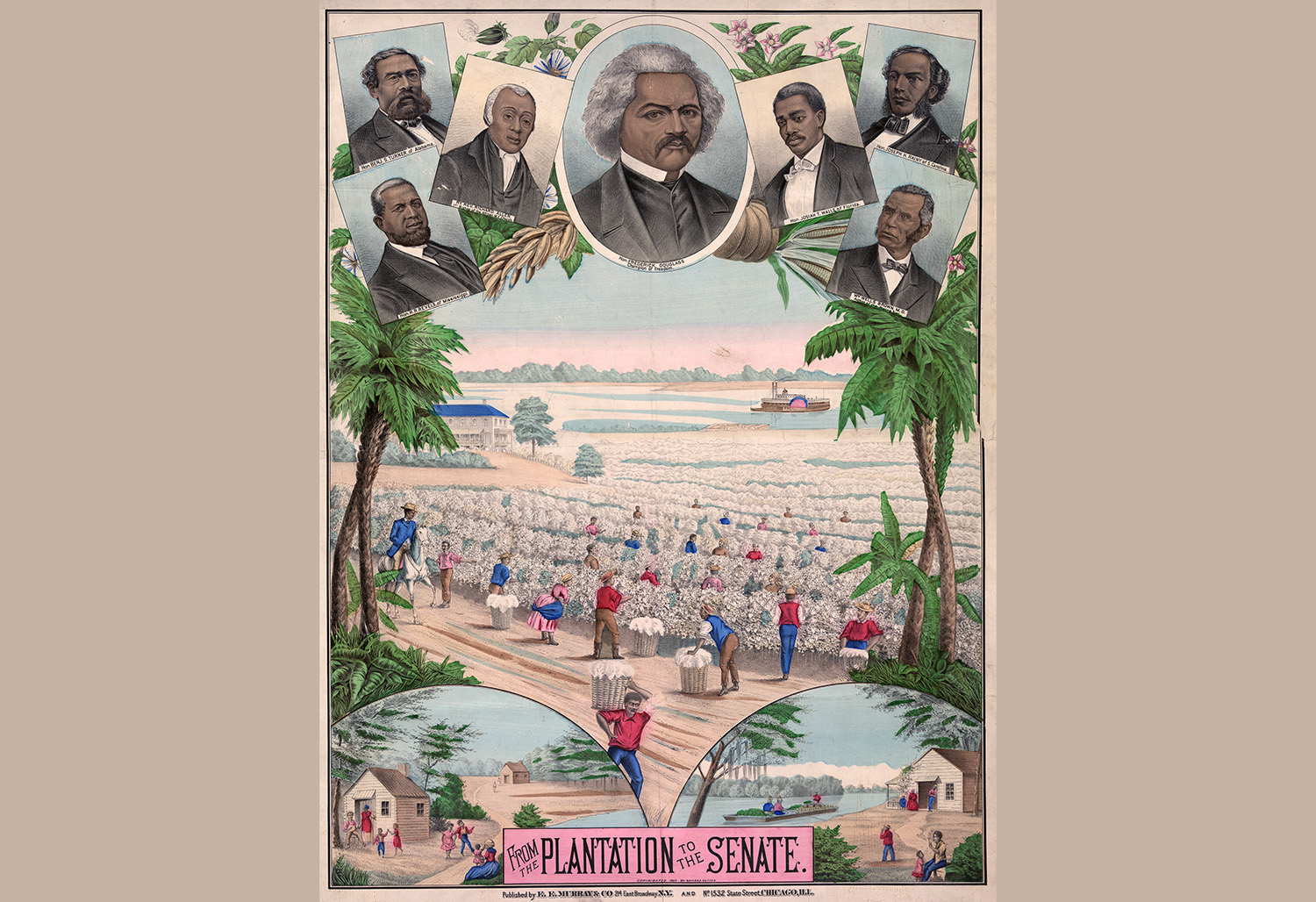
“From the Plantation to the Senate,” 1883. Hand-colored lithograph by American engraver Gaylord Watson (1833–1896). Click on image for a larger version. Along the top are portraits of Alabama Representative Benjamin S. Turner, African Methodist Episcopal Church founding bishop Rev. Richard Allen, Mississippi Senator Hiram Rhodes Revels, Frederick Douglass, Florida Representative Josiah T. Walls, South Carolina Representative Joseph H. Rainey, and author William Wells Brown. Library of Congress.
Barely a year after the end of the Civil War and the assassination of Lincoln, President Andrew Johnson all but declared that the work of reconstruction and “restoration” (his preferred term) was complete. After issuing a proclamation restricting the vote to those white citizens eligible under pre-secession laws, he fostered and then recognized new state governments in the defeated Confederacy. The former slave states adopted a series of “Black Codes” that prohibited African Americans from bearing arms, serving on juries, and testifying against whites and that banned other activities, including the nebulously defined offense of “vagrancy.” Johnson vetoed the bill extending the life of the Freedmen’s Bureau, which helped establish schools, settled labor disputes, and provided relief to those who had been enslaved. Johnson also vetoed the Civil Rights Bill, and in the spring of 1866, he issued a proclamation declaring an end to the rebellion in every former Confederate state except Texas, which received its own proclamation in August.

Through it all, Johnson faced opposition from Congress, which refused to seat senators and representatives sent by any of the new state governments, overrode his vetoes of both the Freemen’s Bureau extension and the Civil Rights Bill, and established a Joint Committee on Reconstruction to investigate conditions in the South and make recommendations concerning readmission. Hoping to turn public opinion in his favor and make electoral gains in the midterm elections, Johnson embarked on a national tour, circling the country to support congressional candidates who endorsed his agenda.

The trip started out promisingly enough: flanked by Union heroes General Ulysses S. Grant and Admiral David G. Farragut, he was cheered by tens of thousands in Baltimore and Wilmington and received a standing ovation in New York City. Things soon took a turn for the worse, however, when the party began to encounter crowds with a less favorable view of Johnson’s postwar program of pardons and reconciliation. As the number of hecklers increased, Johnson’s remarks became more ill-mannered; his extemporaneous speeches often deteriorated into shouting matches during which he denounced his opponents as traitors and compared himself to both Jesus Christ and Lincoln. “Who has suffered more for you and for this Union than Andrew Johnson?” mocked cartoonist Thomas Nast in a caricature depicting a sour-faced President with arms meekly fold across his chest and a halo over his head. Johnson’s bizarre defense against critics who accused him of betraying the Union was headlined “The President’s Trip from Springfield to St. Louis: He Denies That He Is Judas Iscariot” by The New-York Herald Tribune. “I am disgusted with this trip,” Grant told a journalist. “I am disgusted at hearing a man make speeches on the way to his funeral.” Dubbed “The Swing Around the Circle,” the tour—with the media frenzy and ridicule that resulted from it—was a complete debacle, and Republicans easily secured veto-proof majorities in both houses of Congress that fall.

By the end of 1866, then, Congress was ready to undo everything Johnson had done and adopt its own program of reconstruction. Frederick Douglass hoped to persuade legislators—and the public—to remake the South in a manner that would protect and assist the newly freed Black population. Events that year underscored the continuing necessity of a substantial federal presence. In May, 49 people were killed when a mob attacked the homes of Black veterans in Memphis. Two months later, 34 African Americans were killed in New Orleans by opponents of the new state constitution. A small group of Confederate veterans in Tennessee—Johnson’s home state—founded the Ku Klux Klan. “Johnson discounted such acts of violence or blamed them on his opponents,” writes historian Brooks D. Simpson.

Earlier that year, Douglass had endured his own run-in with Johnson—an “interview” during which he barely got in a word while Johnson, who had no interested in listening, harangued his listeners with condescension and bluster. Like many Americans, Douglass had given up on the President. He took to the pages of The Atlantic Monthly to offer to the new Congress his recommendations for a course of action. In the December 1866 issue, he published “Reconstruction,” which summarized the events of the past year and offered a way forward; we present that article—still astonishing for its prescience—as our Story of the Week selection. “Douglass saw Reconstruction and its unprecedented challenges as a continuation of the purpose of the war, a sacred responsibility to the Union dead and to four million freed slaves,” writes David W. Blight in his recent biography.

A follow-up article, “An Appeal to Congress for Impartial Suffrage,” appeared in the next month’s issue and narrowed the focus to an explanation of why expanding the franchise and extending civil rights to Black Americans were the essential components for any reconstruction program. “The South does not now ask for slavery,” he wrote. “It only asks for a large degraded caste, which shall have no political rights.” He warned against the moral shortcomings and dangers of creating such a caste and of restricting the vote to white citizens:
It is no less a crime against the manhood of a man, to declare that he shall not share in the making and directing of the government under which he lives, than to say that he shall not acquire property and education. . . . If black men have no rights in the eyes of white men, of course the whites can have none in the eyes of the blacks. The result is a war of races, and the annihilation of all proper human relations.
*   *   *

Notes: The Second Session of the Thirty-ninth Congress began on December 3, 1866. Lord John Russell, 1st Earl Russell, served as British foreign secretary, 1859–65, and as prime minister, 1865–66.

*   *   *

The assembling of the Second Session of the Thirty-ninth Congress may very properly be made the occasion of a few earnest words on the already much-worn topic of reconstruction. . . . If you don't see the full selection below, click here (PDF) or click here (Google Docs) to read it—free!
This selection may be photocopied and distributed for classroom or educational use.

Sunday, February 9, 2020

Eulogy for Abraham Lincoln

Frederick Douglass (1818–1895)

Lincoln funeral procession at the corner of Broadway and Union Square in New York City, April 25, 1865. Photograph by Robert N. Dennis. The two children visible in the window at the upper left are believed to be six-year-old Theodore Roosevelt and his brother Elliott, watching from their grandfather’s house. The exclusion of African Americans from the procession led to the planning of a separate memorial organized by black leaders, to which Frederick Douglass was invited to speak. Photo courtesy of the Theodore Roosevelt Birthplace National Historic Site.
Frederick Douglass was spending the Saturday of Easter weekend at home in Rochester, New York, when news of the assassination of President Lincoln by John Wilkes Booth reached the city. The mayor called for a public gathering at 3:00 and stunned citizens congregated at City Hall as the city’s bells tolled. Hundreds were unable to enter the packed building to hear speakers mourn the president, and Douglass was among those in the crowd at the very back of the room. Another person in attendance who knew him later related to a biographer that “he told me he should not speak because he was not invited,” but soon “his name burst upon the air from every side, and filled the house.” Douglass acceded to the calls of his neighbors and went to the platform.

“It is a day for silence and meditation; for grief and tears,” he lamented in relatively brief comments, which were reported in the next issue of the Rochester Daily Democrat. He recounted for his audience his visit to the White House after the second inauguration only a few weeks before. (He didn’t mention, however, that Lincoln had to intervene personally when his own guards refused to admit Douglass because he was black.) He denounced the treasonous “spirit that gave birth” to the assassin and predicted the act would only encourage the victorious Union even more to “exact ample security for the future.” Douglass’s neighbor concluded his recollection of the afternoon with praise: “I have heard Webster and Clay in their best moments; Channing and Beecher in their highest inspirations; I never heard truer eloquence! I never saw profounder impression. When he finished the meeting was done.” As Douglass reminisced in his autobiography Life and Times, the event was a turning point in his relationship with the townspeople:
I had resided long in Rochester, and had made many speeches there which had more or less touched the hearts of my hearers, but never till this day was I brought into such close accord with them. We shared in common a terrible calamity, and this “touch of nature made us” more than countrymen, it made us “kin.”
The camaraderie in Rochester was a far cry from what was occurring three hundred miles to the southeast. New York City was still haunted by memories of the draft riots two years earlier, when as many as 120 people had been killed, including at least eleven African American men lynched by white mobs, and the Colored Orphans Asylum had been looted and torched. In the period following the riots, ostensibly to maintain order, black participants had been banned from several public events and parades. Similarly, the City Council announced its decision to exclude African Americans from Lincoln’s funeral procession. The New-York Tribune mocked the ban, noting the irony of excluding black participants from a “pageant devised and engineered by men who always opposed and never even professed to honor and respect our late President until they were quite sure he was dead.” The outraged editor of The Anglo-African pointed out that three thousand black troops marched safely and without incident in the funeral procession in Washington and that significant contingents had also taken part in the pageants in Baltimore and Philadelphia.

In response to the council’s action, a group of black leaders announced their own event commemorating Lincoln’s life and death, and Frederick Douglass agreed to be the featured speaker. The New York Times reported that the oration, held at Cooper Union on June 1 (which had been declared a National Day of Mourning by Congress), “drew an immense mixed audience, persons of color predominating. Every seat was filled, and several hundred persons were compelled to stand.” The occasion was widely reported, and summaries of the much-heralded speech were printed in both the Times and the Tribune. Yet in the century and a half after the event, the speech had never been reprinted in full, even though Douglass’s manuscript has been among his papers in the Library of Congress, seen only by a small number of scholars and biographers. Five years ago, however, it was carefully transcribed and reprinted in the Library of America collection President Lincoln Assassinated!!, edited by Harold Holzer, and we present it here as this week’s selection.

Notes: The attempted assassination mentioned on page 317 refers to the infamous incident on the floor of the Senate on May 22, 1856, when Democratic congressman Preston Brooks of South Carolina attacked Senator Charles Sumner of Massachusetts with a cane, nearly killing him in retaliation for a speech criticizing one of Brooks’s relatives and other slaveholders. On the next page, Douglass lists several people by their last names. Pierre Gustave Toutant-Beauregard left the U.S. Army to become the first prominent general of the Confederate Army; William Payne rose through the Confederate ranks to become a brigadier general. George Andrew Atzerodt (spelled Adzerot by Douglass) was one of John Wilkes Booth’s co-conspirators; he was assigned to kill Vice President Andrew Johnson but spent the night drinking and lost his nerve. John C. Breckinridge was Vice President during the Buchanan administration; he enrolled in the Confederate Army when the war broke out, eventually becoming the Confederate secretary of war..

*   *   *
I come before you this evening with much diffidence: The rarest gifts, the best eloquence, the highest order of genius to which the nation has given birth, might well be employed here and now, and yet fail of justice to the dignity. . . . If you don't see the full selection below, click here (PDF) or click here (Google Docs) to read it—free!

This selection may be photocopied and distributed for classroom or educational use.

Friday, August 3, 2018

The Work Before Us

Frederick Douglass (1818–1895)
From Reconstruction: Voices from America’s First Great Struggle for Racial Equality

Detail from “The First Vote,” hand-colored wood engraving drawn by A. R. Waud and published on the cover of Harper's Weekly (November 16, 1867). See the full cover at the Object of History website, hosted by the Smithsonian National Museum of American History.
During the two years after the end of the Civil War, Southern States enacted Black Codes, which imposed restrictions on the activities of freedmen, such as owning property or operating businesses. One of the central features of the new legislation was to use vagrancy laws to arrest unemployed black men and punish them with forced labor. To avoid being arrested as vagrants, freedmen were coerced into year-long contracts with local plantations. Life for many black men became, to use the phrase popularized by Douglas A. Blackmon in his recent Pulitzer Prize–winning best seller, “slavery under another name.”

In February 1866 African American leaders gathered in Washington to protest these new laws. The convention sent a delegation of eleven men, including Frederick Douglass, to the White House to discuss their concerns with President Andrew Johnson, as well as to urge him to support suffrage for black men. According to a transcript of the meeting that appeared the next day in the press, Johnson (a former slaveholder) was defensive, belligerent, and angry from the outset: “Practically, so far as my connection with slaves has gone, I have been their slave instead of their being mine,” he claimed. “For the colored race my means, my time, my all has been perilled.”

Toward the end of the “conversation,” which was dominated by Johnson’s condescending harangues, Douglass and Johnson had a remarkable exchange. The President suggested that if former slaves felt they could “live and advance in civilization” in locations other than the South, then they should pick up and move elsewhere.
      Mr. Douglass. But the masters have the making of the laws, and we cannot get away from the plantations.
      The President. What prevents you?
      Mr. Douglass. We have not the single right of locomotion through the Southern States now.
      The President. Why not; the government furnishes you with every facility.
      Mr. Douglass. There are six days in the year that the negro is free in the South now, and his master then decides for him where he shall go, where he shall work, how much he shall work—in fact, he is divested of all political power. He is absolutely in the hands of those men.
      The President. If the master now controls him or his action, would he not control him in his vote?
      Mr. Douglass. Let the negro once understand that he has an organic right to vote, and he will raise up a party in the Southern States among the poor, who will rally with him. There is this conflict that you speak of between the wealthy slaveholder and the poor man.
      The President. You touch right upon the point there. There is this conflict, and hence I suggest emigration. If he cannot get employment in the South, he has it where he can get it.
The meeting, unsurprisingly, had no effect on Johnson’s future actions. The following January he vetoed a bill that granted the vote to black men in the District of Columbia; Congress overrode his veto and two days later extended the vote to black men in federal territorial elections as well. Two months later Republicans passed, over yet another veto, the Reconstruction Act, which stipulated that in order to be readmitted into the Union, former Confederate states would have to adopt constitutions that provided for black male suffrage.

By the 1868 presidential election seven Southern states ratified new constitutions and elected Republican governors. The votes of black Americans, then, would be a factor in the contest, and Douglass endorsed—and stumped for—the Republican candidate, Ulysses S. Grant, over the Democratic opponent Horatio Seymour, a former governor of New York. For Douglass, “there was but one choice,” writes historian Philip S. Foner. “A vote for Seymour meant a vote for the overthrow of these constitutions; it meant Negro disenfranchisement. . . . A victory for the Republican Party meant the continuance of the new southern governments; it meant the recognition of Negro suffrage.”

Although Douglass modestly claimed to a fellow activist that he was “not much of a stumper,” his energetic speeches always attracted large crowds. For our Story of the Week selection, we present the text of his stump speech—with its no-holds-barred denunciation of Johnson, Seymour, and the Democrats—as it was printed in a New York newspaper.

Notes: In the opening paragraph, Douglass refers to Lord Granby’s character. John Manners, marquess of Granby, served as commander-in-chief of the British forces, 1766–70. When an anonymous political writer attacked Granby’s temperament, a reply by his friend Sir William Draper unwittingly confirmed the gist of the accusation and thereby exacerbated the scandal for Granby. Later in the paragraph, Douglass mentions Seymour’s efforts to resist the drafts; when Seymour was the governor of New York in 1863–64, he repeatedly criticized the draft as unconstitutional. Chief Justice Salmon P. Chase, who favored black suffrage, sought the Democratic presidential nomination in 1868 but received no more than four votes during the balloting. Among the Confederate generals listed by Douglass on page 355 is Nathan Bedford Forrest, who had become the first grand wizard of the Ku Klux Klan the previous year. Both Forrest and Wade Hampton were delegates to the 1868 Democratic national convention. The Union army occupied the Virginia estate on Arlington Heights on May 24, 1861, and established the now-famous national cemetery on its grounds in 1864. Speaker of the House Schuyler Colfax (R-IN) became vice president of the United States during the first Grant administration.

*   *   *
It is eminently creditable to the sagacity, if not to the honesty, of the Democratic leaders that they prefer to limit discussion of the merits of their party, . . . If you don't see the full selection below, click here (PDF) or click here (Google Docs) to read it—free!
This selection may be photocopied and distributed for classroom or educational use.

Friday, February 9, 2018

What the Black Man Wants

Frederick Douglass (1818–1895)
From Reconstruction: Voices from America’s First Great Struggle for Racial Equality

“Heroes of the colored race,” chromolithograph print published by J. Hoover (Philadelphia, 1881–1883). Frederick Douglass is flanked by U.S. Senators Blanche Kelso Bruce and Hiram Rhodes Revels and surrounded by scenes of African American life and portraits of John Roy Lynch, Abraham Lincoln, James A. Garfield, Ulysses S. Grant, Joseph H. Rainey, Charles E. Nash, John Brown, and Robert Smalls. Revels was the first African American elected to the Senate, to fill a partial term in 1871; Bruce was the first African American to serve a full term, beginning in 1875; both men represented Mississippi. Image courtesy of Library of Congress Prints and Photographs Division.
Frederick Douglass didn't know when he was born. “I have no accurate knowledge of my age, never having seen any authentic record containing it,” he wrote in Narrative of the Life of Frederick Douglass, an American Slave. “By far the larger part of the slaves know as little of their ages as horses know of theirs, and it is the wish of most masters within my knowledge to keep their slaves thus ignorant.” Subsequent research confirmed that Douglass was born in February 1818, but (barring an unlikely future discovery) the precise date will forever remain a mystery, but he celebrated his birthday on February 14. For the entire month of February 2018, then, our nation is celebrating Douglass’s bicentennial, with events clustering around Valentine’s Day.

After the publication of his Narrative, “the inevitable charge appeared that a slave boy could not have written the book,” writes historian William S. McFeely. “But anyone who had heard Douglass—and by 1845 thousands of people had—knew that the language of the Narrative was the same as that of the man who so passionately told his tale from the platform.” The same skepticism about authorship appeared when Harriet Jacobs published her own narrative in 1861. And, in fact, the novelist Lydia Maria Child was accused of being the “real” author of both Jacobs’s and Douglass’s memoirs. By the time of the Civil War, however, over one hundred slave narratives had been published during the previous century, and it was becoming increasingly difficult for critics to question their authenticity.

Douglass was, without doubt, the most famous African American during the 1800s; he was also the most photographed American of the century, an advocate of “picture-making” as a “might power” that could be used to combat racist stereotypes. He wrote and published three memoirs (including the Narrative), one short novel (The Heroic Slave, based on the life of Madison Washington), and thousands of speeches and essays. Yet for most of his life he was best known as an orator: “He was considered by many the art’s exemplar, better than Lincoln and other statesmen,” writes John Stauffer (author of Giants: The Parallel Lives of Frederick Douglass and Abraham Lincoln), “and by the 1850s he commanded among the highest speaking fees in the country.” Douglass published many of his speeches in his own magazines and newspapers; at various times during his fifty-year career as a writer, he owned and edited four different periodicals (The North Star, Frederick Douglass' Paper, Douglass’ Monthly, The New National Era).

Early in 1862, in the pages of Douglass’ Monthly, he addressed the question, “What Shall Be Done with the Slaves If Emancipated?”
Our answer is, do nothing with them; mind your business, and let them mind theirs. Your doing with them is their greatest misfortune. They have been undone by your doings, and all they now ask, and really have need of at your hands, is just to let them alone.
As the Civil War was ending, Douglass reiterated this entreaty in various speeches and essays, including an address delivered at the thirty-second annual meeting of the Massachusetts Anti-Slavery Society, held in Boston on January 26, 1865. The speech, which argued that African Americans must have the right to vote, was subsequently published by the society with the title, “What the Black Man Wants.” Douglass also addressed an urgent and immediate concern: the insidious practice of accusing just-freed slaves of vagrancy and then punishing them with hard labor or forcing them to sign contracts as plantation workers. Like the society’s new president, Wendell Phillips, Douglass was particularly critical of Major General Nathaniel P. Banks, a former Massachusetts governor who, as the Union military commander in Louisiana from 1862 to 1864, instituted a system that compelled freed people to work on plantations for one-year terms in return for wages, food, and shelter. He concludes his speech by responding to the question he posed at the start of the war, “What shall we do with the negro?”: “Do nothing with us!”

Notes: When Douglass mentions in the opening paragraph that he lives “out West,” he is referring to Rochester, New York, his home from 1848 to 1870. Robert Toombs (page 8) had commanded a brigade in the Confederate army and served as inspector general of Georgia militia in 1864; Alexander H. Stephens was vice president of the Confederacy. Douglass claims that African Americans had the right to vote in “eleven States out of the old thirteen” (page 11). In 1787 black men were explicitly enfranchised in four states (New York, New Jersey, Pennsylvania, and North Carolina); those freed before 1783 could vote in Maryland; blacks were not explicitly prevented by law from voting in five states (Massachusetts, New Hampshire, Connecticut, Rhode Island, and Delaware). Only three states (Virginia, Georgia, and South Carolina) explicitly prohibited African Americans from voting. In 1814, during the War of 1812, General Andrew Jackson referred to white officers as “fellow-citizens” of the free people of color in Louisiana he asked to help defend the state against British invasion. Edmund Quincy, mentioned on the last page, was vice president of the Massachusetts Anti-Slavery Society from 1848 to 1860.

*   *   *
I came here, as I come always to the meetings in New England, as a listener, and not as a speaker; and one of the reasons why I have not been more frequently to the meetings of this society, has been because of the disposition on the part of some of my friends to call me out upon the platform. . . . If you don't see the full selection below, click here (PDF) or click here (Google Docs) to read it—free!

This selection may be photocopied and distributed for classroom or educational use.

Friday, June 5, 2015

Letter to His Old Master

Frederick Douglass (1818–1895)
From Frederick Douglass: Autobiographies

Daguerreotype of Frederick Douglass in 1848, the
year he wrote his open letter to his former master.
Albert Cook Myers Collection, Chester County
Historical Society. Image courtesy of
ExplorePAHistory.com
.
In September 1848, ten years after he had escaped from slavery and two years after he had purchased his freedom for roughly $1,250, Frederick Douglass printed in North Star, the abolitionist newspaper he had founded the previous year, an open letter to his former master Thomas Auld. The document “is one of the strangest pieces in the literature of American slavery,” acknowledges biographer William S. McFeely, who points out that some of the actions attributed to Auld personally were actually committed by relatives, overseers, or nearby plantation owners. In Douglass’s letter, “Auld is made to stand in for all slaveholders.”

The Aulds appear to have closely followed the career of the most famous person ever to have lived in their household. “One of the most interesting items in the Maryland State Archive,” McFeely adds, “is a copy of Narrative of the Life of Frederick Douglass with marginal comments—more perplexed than angry—written by a member of the Auld family who went through that book noting where it errs as to fact.” Thus, it is nearly certain that Douglass’s open letter, later reprinted in 1855 as an appendix to his best-selling My Bondage and My Freedom, made its way to the target.

In October 1859, after giving a lecture in National Hall (Philadelphia), Douglass received a message revealing that Amanda Sears, the daughter of Thomas Auld, had been in the audience. Included was the address of her husband’s business in West Philadelphia. As Douglass later recounted in his Life and Times, the two men soon met, but John Sears was reluctant to allow a reunion with his wife because the former slave “had done his father-in-law injustice, for he was really a kind-hearted man, and a good master.” Douglass responded “that there must be two sides to the relation of master and slave, and what was deemed kind and just to the one was the opposite to the other.” After a lengthy conversation, Sears agreed to host him at home the next day. Although Douglass had not seen Amanda Auld Sears since she was a child of six or seven, he recognized her immediately in the crowd gathered in the family parlor, whereupon “Amanda made haste to tell me that she agreed with me about slavery, and that she had freed all her slaves as they had become of age.” They both reminisced about her mother, who had died while she was a child and whom Douglass always recalled fondly in his writings. Douglass and Amanda Sears kept in touch, seeing each other on at least two more occasions before her death in 1878.

Soon after that first meeting, Thomas Auld visited Philadelphia, learned of the reunion, and told John Sears “he had done right” in welcoming Douglass to his house. And finally, in June 1877, after his appointment to the position of U.S. Marshal of the District of Columbia, Douglass traveled to Baltimore and his old home of St. Michaels. Once there he received an invitation from his “old master,” now infirm and eighty-two years old. Composing himself after both men had become “excited by deep emotion,” Auld said, "Frederick, I always knew you were too smart to be a slave, and had I been in your place I should have done as you did." For his part, Douglass apologized for his error (included in the open letter and elsewhere) in blaming Auld for the treatment of his grandmother. Auld responded, “I never owned your grandmother; she in the division of the slaves was awarded to my brother-in-law, Andrew Anthony; but [after he learned about her condition from Douglass’s writings] I brought her down here and took care of her as long as she lived.” The entire meeting between former slave and former master lasted only twenty minutes.

Thomas Auld lived another three years, and his death was noted in the Baltimore Sun. As Leigh Fought, author of a forthcoming volume on Douglass, has written, “Thomas Auld may be one of the few former slaveholders whose obituary named one of his former slaves and indicates that he, the owner, was renowned for owning that particular slave.”

*   *   *
SIR—The long and intimate, though by no means friendly, relation which unhappily subsisted between you and myself, leads me to hope that you will easily account for the great liberty which I now take in addressing you in this open and public manner. . . . If you don't see the full selection below, click here (PDF) or click here (Google Docs) to read it—free!

This selection may be photocopied and distributed for classroom or educational use.