Showing posts with label Reconstruction. Show all posts

Sunday, January 19, 2025

“The Enjoyment of Public Rights”

John R. Lynch (1847–1939)
From Reconstruction: Voices from America’s First Great Struggle for Racial Equality

“To Thine Own Self Be True,” political cartoon by Thomas Nast for Harper’s Weekly, April 24, 1875, commemorating the passage of the Civil Rights Act earlier that year. The act is passed to a Black hand by Columbia, a representation of the United States; the top is inscribed “The Equality of Men Before the Law. Civil Rights Bill. It is the duty of the Government in its dealings with the people to mete out equal and exact justice to all, of whatever nativity, race, color, or persuasion, religious or political. Signed by the President. U. S. Grant.” (New York Public Library Digital Collections)
John R. Lynch arrived by train in St. Louis at three o’clock in the morning during the summer of 1873. Only twenty-five years old, he had been elected to the U.S. Congress the prior November. He had spent the previous four years in the Mississippi State House of Representatives—including a year as its Speaker—and numerous accounts and records indicate he was both a popular leader of the Republican majority and a successful legislator who earned the respect of many of his Democratic opponents. He was in St. Louis for a convention of Southern and Western officials to discuss the idea of moving the national capital from Washington to the Mississippi Valley. Such meetings had been occurring for several years; although the idea never gained much traction, many Easterners were alarmed in 1868 when a bill supporting the move to St. Louis failed in the U.S. House of Representatives by only 20 votes.

When Lynch checked in at the Planters House, where many of the attendees were staying, he was told there had been a change, that the Mississippi delegation had been moved to the St. Nicholas Hotel. After arriving at the St. Nicholas, however, he was informed there had been no change; the Mississippi visitors were all at the Planters House. “I then realized for the first time the actual situation,” he recalled in his autobiography. “When I returned to the bus from the office of the St. Nicholas and informed the driver that I had to go elsewhere, he exhibited impatience, stating that he could not be driving me all over the city, especially at that hour.” Since the next train did not leave until the following night, Lynch went to the Southern Hotel, with the hope they would let him sit in the reception area for the day. The owner of the hotel instead offered him a room, free of charge, for all three days of the convention—provided Lynch would take his meals in his room and not show himself in any of the hotel’s public areas. Nevertheless, a day later, “the newspapers had a full account of the whole affair, attention being called to the fact that I was the first colored man that had ever been allowed to be a guest at any one of the first-class hotels of that city.” The experience permanently soured him on “the idea that St. Louis was a desirable place for the national capital.”

Lynch was one of three sons born to Patrick Lynch, an Irish immigrant who was the overseer of the Tacony Plantation in Louisiana, and Catherine White, an enslaved woman who was herself the daughter of an enslaved woman and a white man. Patrick planned to move to New Orleans to earn enough cash to purchase his family’s freedom, but he died when John was only two years old. The three surviving members of the Lynch family (one of the boys had died in infancy) were instead sold to a plantation owner in Natchez, Mississippi, and they were not freed until after the issuance of the Emancipation Proclamation and the arrival of the Union Army in Natchez, when John was fifteen. After the war, friends of his father helped him get a job in a photographer’s studio, where he soon rose to the position of manager while taking night classes and teaching himself to read. He became active in Republican Party politics, and in 1869, the year he turned twenty-two, he was appointed a justice of the peace in Natchez and elected to the Mississippi House.

Lynch’s experiences from the humiliating obstacles that lay repeatedly in his path, culminating in his inability to check into a hotel even while a member of Congress, fueled the powerful speech he gave in favor of the passage of a civil rights bill, and we present that speech below as our Story of the Week selection. On May 22, 1874, the Senate passed an amended version of a bill proposed four years earlier by Senator Charles Sumner who had died two months earlier. The version of the bill before the House on February 3, 1875, when Lynch delivered his speech, omitted Sumner’s requirement to integrate public schools and instead included a clause allowing authorities to “establish and maintain separate schools and institutions, giving equal educational advantages in all respects, for different classes of persons.” Even this “schools clause” compromise faced opposition, however, so the House voted to strip out any mention of schools and then approved a final version, 162–100, on February 4. The Senate adopted the House bill, 38–26, on February 27, and it was signed by President Ulysses Grant on March 1. The final bill stipulated “that all persons within the jurisdiction of the United States shall be entitled to the full and equal enjoyment of the accommodations, advantages, facilities, and privileges of inns, public conveyances on land or water, theaters, and other places of public amusement,” regardless of “race and color,” and included a section forbidding the disqualification of citizens from federal or state jury service on racial grounds.

Eight years later, on October 15, 1883, the provisions regarding public accommodations, conveyances, and places of amusement were declared unconstitutional by the U.S. Supreme Court in an 8–1 decision (The Civil Rights Cases). In his majority opinion, Justice Joseph P. Bradley ruled that the power given to Congress by the Fourteenth Amendment to correct racially discriminatory actions by the states did not extend to discriminatory acts by private individuals. Bradley also declared that racial discrimination by individuals was not a “badge of servitude” prohibited by the Thirteenth Amendment.

In a strongly worded dissent, Justice John Marshall Harlan—a former slaveholder who had in the past opposed the Emancipation Proclamation, the Thirteenth Amendment, and even the Civil Rights Act itself—wrote that racially discriminatory acts by accommodation, transportation, and amusement facilities operating under state licenses were public, not private, actions and therefore subject to congressional prohibition under the Fourteenth Amendment. Harlan also contended that since slavery was based upon the supposed racial inferiority of black people, acts of racial discrimination were clearly “badges of servitude” prohibited by the Thirteenth Amendment. With the addition of those two amendments, Harlan argued, the Constitution decrees that “no authority shall be exercised in this country upon the basis of discrimination, in respect of civil rights, against freemen and citizens because of their race, color, or previous condition of servitude. To that decree—for the due enforcement of which, by appropriate legislation, Congress has been invested with express power—everyone must bow.”

Lynch served two terms in Congress before losing in 1876, when Democrats regained the majority in the state legislature, redrew the boundaries of his district, and successfully suppressed or ignored the ballots of Black voters. He ran again in 1880 in a race that, because of fraud, was decided in his favor by Congressional vote only after more than half the term was over. After his final loss in 1882, he studied law, passed the Mississippi bar, and opened an office in Washington, D.C. At the turn of the century, in his fifties, he enlisted in the Army and was appointed paymaster by the McKinley administration; his decade of service included postings in Cuba and the Philippines. Perhaps Lynch’s most enduring legacy after his career as a legislator was the publication of his book, The Facts of Reconstruction (1914), a point by point rebuttal to the arguments of the Dunning school of historians, whose revisionism denied the accomplishments of Reconstruction, reimagined the era as one of misrule by Blacks and Northerners, and minimized or ignored the treatment and achievements of Black citizens. He died in Chicago at the age of 92 in 1939.

*   *   *

I will now endeavor to answer the arguments of those who have been contending that the passage of this bill is an effort to bring about social equality between the races. . . . If you don't see the full selection below, click here (PDF) or click here (Google Docs) to read it—free!

This selection may be photocopied and distributed for classroom or educational use.

Sunday, April 9, 2023

The Colfax Massacre Trial

Levi Nelson and Benjamin Brim
From Reconstruction: Voices from America’s First Great Struggle for Racial Equality

“The Louisiana Murders—Gathering the Dead and Wounded,” from the May 10, 1873, issue of Harper’s Weekly. Courtesy New York Public Library.
Tensions had been rising across the state of Louisiana during the months following the election of 1872. Two candidates declared victory in the governor’s race: John McEnery, supported by a “Fusion” ticket of Democrats and conservative Republicans, and William Pitt Kellogg, the Republican nominee. Both parties held inauguration ceremonies on January 14 and established rival state governments and legislatures, although President Ulysses S. Grant recognized Kellogg as the legitimate governor. “It has been bitterly and persistently alleged that Kellogg was not elected,” Grant wrote two years later. “Whether he was or not is not altogether certain, nor is it any more certain that his competitor, McEnery, was chosen. The election was a gigantic fraud, and there are no reliable returns of its result.” The tensions reached a climax with the Battle of Liberty Place in September 1874, when five thousand members and supporters of the Crescent City White League attempted a coup against Kellogg’s government in New Orleans and held the city for three days, disbanding only when federal troops were dispatched to the city.

During the two years leading up to the skirmish, similar actions occurred across the state, as local factions vied for control. Grant Parish, which had been formed in 1869 in north-central Louisiana out of portions of two existing parishes, was named after the recently inaugurated president; its seat was named after Grant’s vice president, Schuyler Colfax. Black citizens outnumbered white, yet in January 1873 the two Confederate veterans who ran on the Fusionist ticket for sheriff and judge assumed control. During the night of March 25, however, the Republican candidates took possession of the courthouse in Colfax and established as guards an improvised militia of Black citizens. Brawls and arguments continued over the next two weeks and attempts to negotiate a peaceful resolution were shattered on April 5, when Jesse McKinney, a Black farmer, was shot by white men on horseback in front of his wife and six-year-old son. His murder caused hundreds of African American men, women, and children to flee to the Colfax courthouse for safety.

Christopher Columbus Nash, the ousted Fusionist sheriff, formed a posse to retake the courthouse, and entered Colfax on Easter Sunday, April 13, 1873. What happened next is perhaps best summarized by U.S. Attorney James R. Beckwith, who had sent a representative to the town after hearing what turned out to be false reports of an earlier “riot” by Black residents. Beckwith’s telegram to the Attorney General on April 17 was soon published in newspapers throughout the country:
Deputy Marshal DeKlyne has returned from Colfax. He arrived there the day after the massacre. The details are horrible. The democrats (white) of Grant parish attempted to oust the incumbant parish officers and failed, and the sheriff protecting the officers with a colored posse. Several days afterward recruits from other parishes, to the number of 300, came to the assistance of the assailants, when they demanded the surrender of the colored posse. This was refused. An attack was made and the negroes were driven into the court house, the court house fired, and the negroes killed as they left the burning building. After resistance ceased, 65 negroes terribly mutilated, were found dead near the ruins of the court house, and 30 known to have been taken prisoners, are said to have been shot after they surrendered and thrown into the river. Two [of] the assailants wounded. The slaughter is greater than in the riot of 1866 in this city [New Orleans]. I will send a full report by mail.
At least seventy and probably more than a hundred Black men were murdered in the confrontation and the subsequent massacre. According to the judge’s summary at the trial the following year, the corpses were left where they were until Tuesday, when they were “buried by a deputy marshal [DeKlyne] and an officer of the militia from New Orleans. These persons found fifty-nine dead bodies. They showed pistol-shot wounds, the great majority in the head, and most of them in the back of the head.” Other charred remains were found near the courthouse, and six other bodies were discovered under a warehouse. Three members of the white posse also died from their wounds; two of them—including James Hadnot, the state representative from the parish—appear to have been struck by fire from their own men.

Beckwith indicted more than one hundred men for the massacre but was unable to arrest most of them because of local resistance. He ended up bringing nine of the ringleaders to trial in New Orleans on February 23, 1874, and charged them with conspiring to violate the Enforcement Act of 1870, a federal statute passed to prevent attacks by state officials and by organizations like the Ku Klux Klan. Among the survivors who testified were Levi Nelson and Benjamin Brim, and their testimonies are presented below as our Story of the Week selection.

The trial ended with the acquittal of one man, but the fate of the remaining defendants was delayed by a hung jury. Beckwith retried the case from May 18 to June 10, and won convictions against three of the defendants, who faced possible sentences of ten years in prison. William B. Woods, the federal circuit court judge who tried the case, rejected motions for a new trial, but Joseph P. Bradley, the U.S. Supreme Court justice assigned to the Fifth Circuit, overturned the verdicts. The case, United States v. Cruikshank, went on appeal to the full court, which unanimously upheld Bradley’s decision on March 27, 1876, and the perpetrators were never punished for their crimes.

In his opinion for the Court, Chief Justice Morrison R. Waite severely limited the reach of the Enforcement Act, ruling that the Fourteenth Amendment did not enable the Federal government to protect the right to assemble, to bear arms, or to vote. “Sovereignty, for this purpose, rests alone with the State,” concluded Waite. “It is no more the duty or within the power of the United States to punish for a conspiracy to falsely imprison or murder within a State, than it would be to punish for false imprisonment or murder itself.” Similarly, Waite contended, the Fourteenth Amendment did not protect citizens against the criminal acts of private individuals: it merely “prohibits a State from depriving any person of life, liberty, or property, without due process of law; but this adds nothing to the rights of one citizen as against another.” The Cruikshank decision effectively eviscerated federal post–Civil War civil rights acts, led to the rule of “Jim Crow” in the South, and inhibited prosecutions of white supremacist terrorism cases for ninety years.

*   *   *

Notes: The nine defendants were William Cruikshank, Austin P. Gibbons, John Hadnot (brother of James Hadnot, who had been killed during the massacre), Tom Hickman, Bill Irwin, Alfred Lewis, Donas Lemoine, Prudhomme Lemoine, and Clement Penn. All but Gibbons are mentioned in the testimony reprinted below. Lewis was the sole defendant aquitted in the first trial.

Alexander Tillman, a Black farmer, was one of the leaders of the courthouse defenders. Daniel Wesley Shaw, the white Republican sheriff of Grant Parish who had helped wrest control of the courthouse from the Fusionists in late March, ended up testifying as a defense witness, claiming implausibly that he had been held prisoner by the Black defenders of the courthouse and denying that he had authorized them to act as guards or as a posse against the intruders. After the massacre, both Shaw and Robert A. Register, the Republican who had been installed in March as judge, retained their positions. .

*   *   *

Fifth day’s proceedings in the trial of J. P. Hadnot and others, charged with conspiracy and murder in Grant parish, in April of last year. . . . If you don't see the full selection below, click here (PDF) or click here (Google Docs) to read it—free!
This selection may be photocopied and distributed for classroom or educational use.

Sunday, February 20, 2022

Reconstruction

Frederick Douglass (1818–1895)
From Reconstruction: Voices from America’s First Great Struggle for Racial Equality

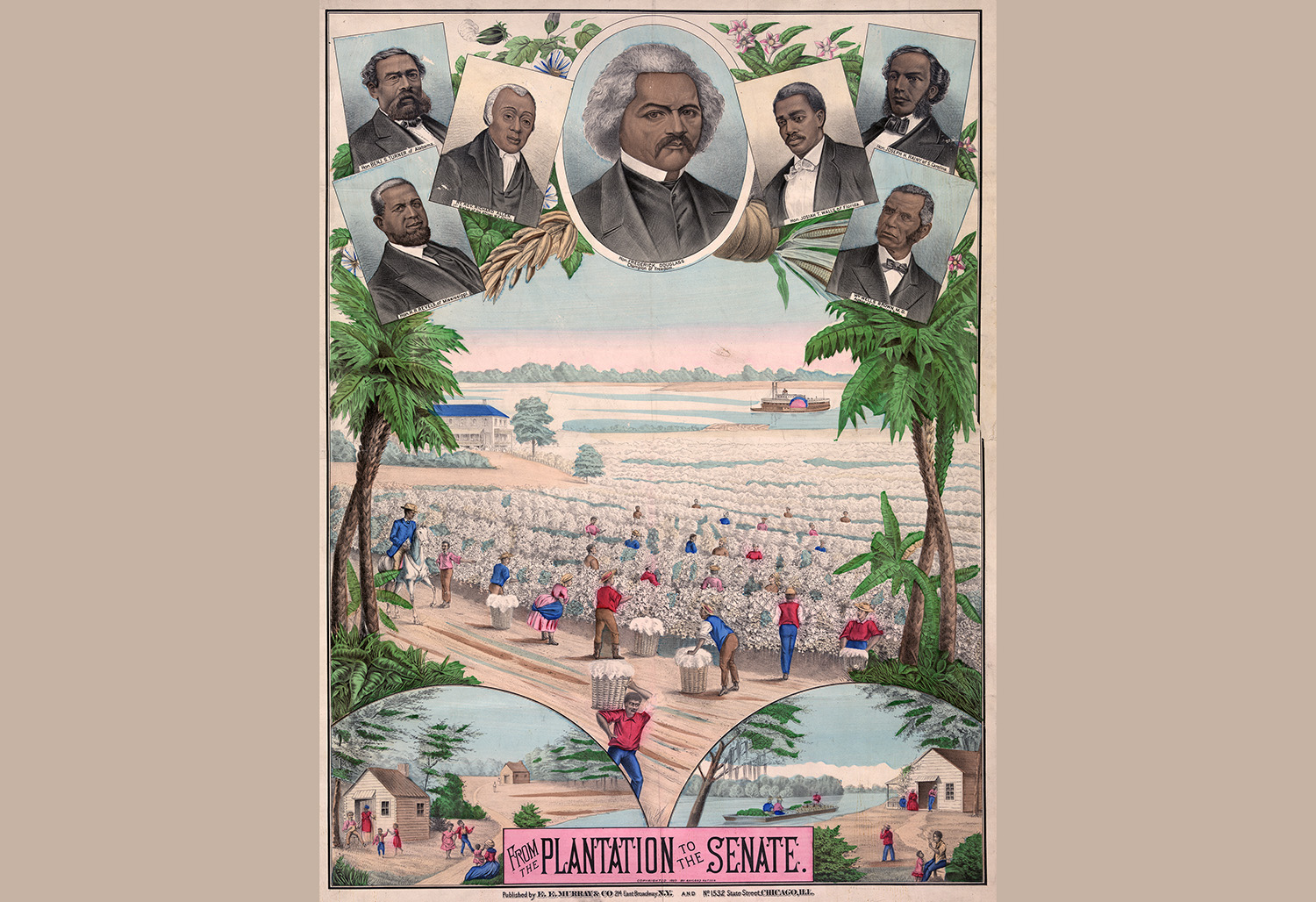
“From the Plantation to the Senate,” 1883. Hand-colored lithograph by American engraver Gaylord Watson (1833–1896). Click on image for a larger version. Along the top are portraits of Alabama Representative Benjamin S. Turner, African Methodist Episcopal Church founding bishop Rev. Richard Allen, Mississippi Senator Hiram Rhodes Revels, Frederick Douglass, Florida Representative Josiah T. Walls, South Carolina Representative Joseph H. Rainey, and author William Wells Brown. Library of Congress.
Barely a year after the end of the Civil War and the assassination of Lincoln, President Andrew Johnson all but declared that the work of reconstruction and “restoration” (his preferred term) was complete. After issuing a proclamation restricting the vote to those white citizens eligible under pre-secession laws, he fostered and then recognized new state governments in the defeated Confederacy. The former slave states adopted a series of “Black Codes” that prohibited African Americans from bearing arms, serving on juries, and testifying against whites and that banned other activities, including the nebulously defined offense of “vagrancy.” Johnson vetoed the bill extending the life of the Freedmen’s Bureau, which helped establish schools, settled labor disputes, and provided relief to those who had been enslaved. Johnson also vetoed the Civil Rights Bill, and in the spring of 1866, he issued a proclamation declaring an end to the rebellion in every former Confederate state except Texas, which received its own proclamation in August.

Through it all, Johnson faced opposition from Congress, which refused to seat senators and representatives sent by any of the new state governments, overrode his vetoes of both the Freemen’s Bureau extension and the Civil Rights Bill, and established a Joint Committee on Reconstruction to investigate conditions in the South and make recommendations concerning readmission. Hoping to turn public opinion in his favor and make electoral gains in the midterm elections, Johnson embarked on a national tour, circling the country to support congressional candidates who endorsed his agenda.

The trip started out promisingly enough: flanked by Union heroes General Ulysses S. Grant and Admiral David G. Farragut, he was cheered by tens of thousands in Baltimore and Wilmington and received a standing ovation in New York City. Things soon took a turn for the worse, however, when the party began to encounter crowds with a less favorable view of Johnson’s postwar program of pardons and reconciliation. As the number of hecklers increased, Johnson’s remarks became more ill-mannered; his extemporaneous speeches often deteriorated into shouting matches during which he denounced his opponents as traitors and compared himself to both Jesus Christ and Lincoln. “Who has suffered more for you and for this Union than Andrew Johnson?” mocked cartoonist Thomas Nast in a caricature depicting a sour-faced President with arms meekly fold across his chest and a halo over his head. Johnson’s bizarre defense against critics who accused him of betraying the Union was headlined “The President’s Trip from Springfield to St. Louis: He Denies That He Is Judas Iscariot” by The New-York Herald Tribune. “I am disgusted with this trip,” Grant told a journalist. “I am disgusted at hearing a man make speeches on the way to his funeral.” Dubbed “The Swing Around the Circle,” the tour—with the media frenzy and ridicule that resulted from it—was a complete debacle, and Republicans easily secured veto-proof majorities in both houses of Congress that fall.

By the end of 1866, then, Congress was ready to undo everything Johnson had done and adopt its own program of reconstruction. Frederick Douglass hoped to persuade legislators—and the public—to remake the South in a manner that would protect and assist the newly freed Black population. Events that year underscored the continuing necessity of a substantial federal presence. In May, 49 people were killed when a mob attacked the homes of Black veterans in Memphis. Two months later, 34 African Americans were killed in New Orleans by opponents of the new state constitution. A small group of Confederate veterans in Tennessee—Johnson’s home state—founded the Ku Klux Klan. “Johnson discounted such acts of violence or blamed them on his opponents,” writes historian Brooks D. Simpson.

Earlier that year, Douglass had endured his own run-in with Johnson—an “interview” during which he barely got in a word while Johnson, who had no interested in listening, harangued his listeners with condescension and bluster. Like many Americans, Douglass had given up on the President. He took to the pages of The Atlantic Monthly to offer to the new Congress his recommendations for a course of action. In the December 1866 issue, he published “Reconstruction,” which summarized the events of the past year and offered a way forward; we present that article—still astonishing for its prescience—as our Story of the Week selection. “Douglass saw Reconstruction and its unprecedented challenges as a continuation of the purpose of the war, a sacred responsibility to the Union dead and to four million freed slaves,” writes David W. Blight in his recent biography.

A follow-up article, “An Appeal to Congress for Impartial Suffrage,” appeared in the next month’s issue and narrowed the focus to an explanation of why expanding the franchise and extending civil rights to Black Americans were the essential components for any reconstruction program. “The South does not now ask for slavery,” he wrote. “It only asks for a large degraded caste, which shall have no political rights.” He warned against the moral shortcomings and dangers of creating such a caste and of restricting the vote to white citizens:
It is no less a crime against the manhood of a man, to declare that he shall not share in the making and directing of the government under which he lives, than to say that he shall not acquire property and education. . . . If black men have no rights in the eyes of white men, of course the whites can have none in the eyes of the blacks. The result is a war of races, and the annihilation of all proper human relations.
*   *   *

Notes: The Second Session of the Thirty-ninth Congress began on December 3, 1866. Lord John Russell, 1st Earl Russell, served as British foreign secretary, 1859–65, and as prime minister, 1865–66.

*   *   *

The assembling of the Second Session of the Thirty-ninth Congress may very properly be made the occasion of a few earnest words on the already much-worn topic of reconstruction. . . . If you don't see the full selection below, click here (PDF) or click here (Google Docs) to read it—free!
This selection may be photocopied and distributed for classroom or educational use.
Sunday, January 16, 2022

The Experts

W.E.B. Du Bois (1868–1963)
From W.E.B. Du Bois: Black Reconstruction

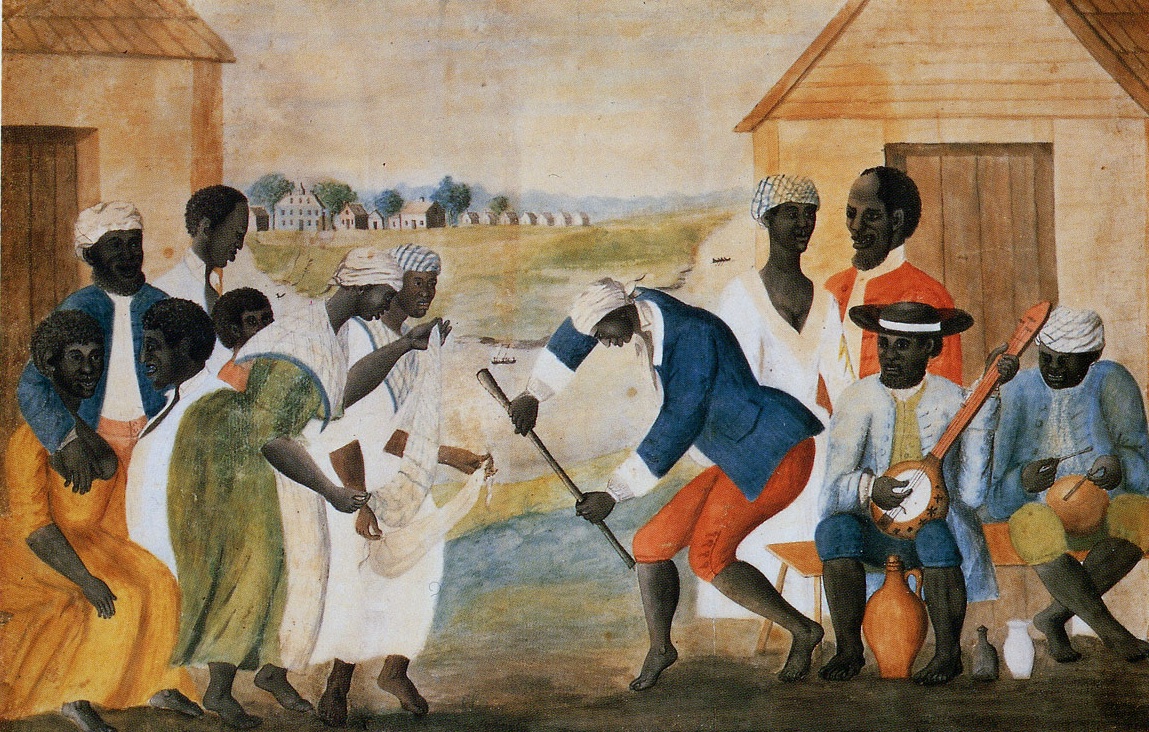
“The Old Plantation,” c. 1780s, artist unknown. Wikimedia Commons. Virginia: History, Government, Geography, the statewide history textbook for middle schools from 1957 to 1970, reprinted this piece of folk art with the caption, “When the day’s work was over, the plantation Negroes enjoyed themselves.” The accompanying text read, “The amusements of the adult slaves were very much like the amusements of the masters. The white people danced to the music of fiddles in ballrooms lighted by many candles. And the Negroes in the nearby slave quarters danced by the light of pine flares to the twang of the banjoes.”
A few years ago, the historians Blain Roberts and Ethan J. Kytle wrote in The New York Times about a disconcerting resurgence among prominent Americans of the belief that slavery was a largely benign institution, one of bonhomie between plantation owners and the people they enslaved. This “romanticized interpretation of slavery [is] indebted to a book published 100 years ago,” the authors point out. “In the spring of 1918, the historian Ulrich Bonnell Phillips published his seminal study, American Negro Slavery, which framed the institution as a benevolent labor agreement between indulgent masters and happy slaves. No other book, no monument, no movie—save, perhaps, for Gone with the Wind, itself beholden to Phillips’s work—has been more influential in shaping how many Americans have viewed slavery.”

When it first appeared, Phillips’s book was widely praised by white historians and critics, but it was excoriated by African American scholars—chief among them W.E.B. Du Bois, who pulled few punches in a review published by the genteelly academic American Political Science Review:
[Phillips] has made wide use of southern newspapers and pamphlets and some manuscript materials, but had done little with any Negro sources, most of which he regards as “of dubious value.” . . . This intrigues the reader, for a history of slavery would ordinarily deal largely with slaves and their point of view, while this book deals chiefly with the economics of slaveholders and is without exception from their point of view. . . .

Life among Negro slaves “promoted, and wellnigh necessitated the blending of foresight and firmness with kindliness and patience.” In fact the slave system was “analogous in kind and in consequence to the domestication of the beasts of the held.” With such masters, Mr. Phillips finds the treatment of slaves on the whole excellent. He notes the “interest of the master in the future of his workers.” The surviving vestiges of slave quarters prove how comfortably they were housed. . . .

It is a defense of American slavery—a defense of an institution which was at best a mistake and at worst a crime—made in a day when we need sharp and implacable judgment against collective wrongdoing by cultured and courteous men.
More recently, John David Smith, an expert on Phillips and his influence on historians, notes that “American Negro Slavery contained a virtual catalog of what even in Phillips’s day must have been considered derogatory remarks concerning blacks. Insensitive to Negroes as humans, he portrayed them as ‘impulsive and inconstant, sociable and amorous, voluble, dilatory, and negligent, but robust, amiable, obedient and contented.’”

Born and raised in Georgia, Phillips received his doctorate at Columbia University in 1902. He was one of numerous young men who studied nineteenth-century American history under William Archibald Dunning. “Southern graduate students like Phillips found Dunning’s seminar congenial to their social philosophies and racial attitudes,” notes Smith. In the same manner that the “Dunning School” warped Americans’ views of the Reconstruction era, so too would the “Phillips School” recast public opinion on the realities of slavery. As the historian John Blassingame acknowledged six years after he published his influential book, The Slave Community (1972), “The ghost of U. B. Phillips haunts all of us. Nineteenth-century racism haunts all of us.”

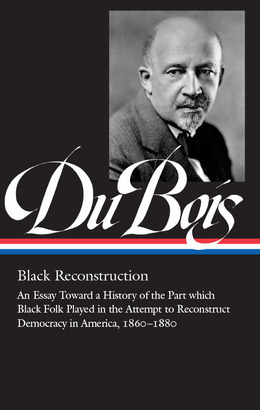
The book review was not the first time Du Bois criticized Phillips—nor would it be the last. Five years earlier, in 1913, he published a short comment under the title “The Experts” in the pages of the NAACP’s journal The Crisis, a magazine he edited. Freed from the constraints of writing for a scholarly journal, Du Bois let loose with devastating mockery of the reasoning in Phillips’s analysis of “Negro efficiency.” Du Bois’s target in these attacks, Smith argues, was not only Phillips’s rose-colored view of slavery but also at “what the Georgian represented—Jim Crowism, racism, and proscription.” Biographer David Levering Lewis notes how Du Bois’s criticisms “anticipated ‘The Propaganda of History,’ his jeremiad at the end of Black Reconstruction,” which challenged Dunning and his students for their omission of Black voices in their revisionist history of the postbellum American South. “One fact and one alone explains the attitude of most recent writers toward Reconstruction,” Du Bois wrote in the book. “They cannot conceive Negroes as men.”

Notes: Mississippi lawyer, public official, cotton planter, and author Alfred Holt Stone defended slavery as it had existed in the antebellum South and the plantation system; he published his racist and pro-segregation views in books such as Studies in the American Race Problem (1910). Massachusetts-born William H. Baldwin Jr. was president of the Long Island Rail Road until his death in 1905; he was actively involved in efforts to educate African Americans, including serving as a trustee at the Tuskegee Institute.

“The Experts” is reprinted in the just-published Library of America edition of Black Reconstruction, in an appendix of related essays by Du Bois.

*   *   *
For this week’s selection, we depart from the usual format and reproduce the selection, in its entirety, below.


The Experts

For deep insight and superb brain power commend us to Dr. Ulrich B. Phillips, of the University of Michigan.

Phillips is white and Southern, but he has a Northern job and he knows all about the Negro. He has recently been talking to the students of the University of Virginia, and he disclosed some powerful reasoning faculties. Consider this, for instance:

“To compare Negro efficiency in cotton production before and since the war, it is necessary to select districts where no great economic change has occurred except the abolition of slavery—where there has been no large introduction of commercial fertilizers, for example, and no great ravages by the bollweevil. A typical area for our purpose is the Yazoo delta in Northwestern Mississippi. In four typical counties there—Tunica, Coahoma, Bolivar and Issaquena—in which the Negro population numbers about 90 per cent. of the whole, the per capita output of cotton in 1860 was two and one-third bales of 500 pounds each, while in 1910 and other average recent years it was only one and one-half bales per capita. That is to say, the efficiency of the Negroes has declined 35 per cent. A great number of other black-belt counties indicate a similar decline.

“On the other hand, the white districts throughout the cotton belt, and especially in Texas, Oklahoma and Western Arkansas, have so greatly increased their cotton output that more than half of the American cotton crop is now clearly produced by white labor. Other data of wide variety confirm this view of Negro industrial decadence and white industrial progress.”

We are delighted to learn all this, for in the dark days of our college economics we were taught that it was labor and land, together, that made a crop; and that worn-out land and good labor would make an even poorer crop than rich land and poor labor. It seems that we were grievously in error. This is apparently true only of white labor. If you wish to judge white labor, judge it by the results on rich Texas and Oklahoma prairies, with fertilizers and modern methods; if, on the other hand, you would judge Negro labor, slink into the slavery-cursed Mississippi bottoms where the soil has been raped for a century; and be careful even there; pick out counties where there has been “no large introduction of commercial fertilizers,” and where debt peonage is firmly planted under the benevolent guardianship of Alfred H. Stone and his kind. Then, rolling your eyes and lifting protesting hands, point out that, whereas the slave drivers of 1860 wrung 1,200 pounds of cotton from the protesting earth, the lazy blacks are able (“with no large introduction of commercial fertilizers”) to get but 700 pounds for their present white masters. Hence a decline in efficiency of “35 per cent.” Why, pray, 35 per cent.? Why not 50 or 75 per cent.? And why again are these particular counties so attractive to this expert? Is it because Issaquena County, for instance, spends $1 a year to educate each colored child enrolled in its schools, and enrolls about half its black children in schools of three months’ duration or less?

Astute? Why, we confidently expect to see Phillips at the head of the Department of Agriculture if he keeps on at this rapid rate. Not that it takes brains to head our Department of Agriculture (perish the assumption!), but that it does call for adroitness in bolstering up bad cases.

And the bad case which the South is bolstering to-day must make the gods scream. Take this same State of Mississippi, for instance, where Negroes are so futile and inefficient: the property which they own and rent was worth $86,000,000 in 1900. In 1910 it was worth $187,000,000!

“That, of course,” says the Manufacturers’ Record, of Baltimore, being strong put to it to nullify such ugly figures, “is a merely flat statement and takes no account of the character of the holdings, whether burdened with mortgages or otherwise, and no account of what is being done with the holdings, especially land.”

And then this masterly sheet bewails the fact that “Intrusion, in the guise of special care for the Negroes, of influences bitterly hostile to the whites of the South, loosened the ties of sympathy and interest of the Southern whites and the Negroes and alienated the second generation of both races from each other. In that the Negroes lost much of the advantages their fathers had had in close contact with the directing minds of the South, and the results must be considered in studying Negro progress.”

The late William H. Baldwin, Jr., used to affirm that a few more generations of that “close contact with the directing minds of the South” would have left the whole South mulatto! But the Record ends with this master stroke:

“Another point to be borne in mind in measuring progress is the fact that the property of nearly 12,000,000 Negroes in the United States to-day has a value less than half the value that 3,954,000 of them in slavery, or 90 per cent. of their total number in the country, represented in 1860, at an average value of $600 each.”

Frankly, can you beat that?

Originally published in the March 1913 issue of The Crisis.

Sunday, May 9, 2021

The Murder of John Walthall

Maria Carter (1844–?)
From Reconstruction: Voices from America’s First Great Struggle for Racial Equality

“Visit of the Ku-Klux,” illustration by American artist Frank Bellew (1828–1888) for Harper’s Weekly, February 24, 1872. Library of Congress.
Twenty-one-year-old Tilda Walthall was called to testify in front of a congressional subcommittee in Georgia in October 1871 and asked to describe the horrific night she had experienced the previous spring. “They came and hallooed to open the door; my husband got up and got out of the house; he crawled in under the house,” she recalled. “Then they came around and went into the garden and pulled off a plank, and he was lying there; and they shot him. . . . He lived until the next night about dusk, when he died. They beat him after they shot him.” John and Tilda Walthall had been married for less than six months.

The Walthall couple was one of dozens of households terrorized by the Ku Klux Klan in Haralson County, Georgia, during the months of April and May of 1871. The organization’s steady rise across the South during the previous five years motivated Congress to form the Joint Select Committee on the Condition of Affairs in the Late Insurrectionary States. The committee’s task was complicated by the unwillingness of many potential witnesses to appear, and even those who did were frightened by the risks. “We are now all afraid to go home,” one white farmer told the subcommittee assigned to conduct interviews in Georgia, “because they know that we have come here. I was summoned and brought here. I know that the whole crowd who are with me are afraid they will be killed. They threatened that if anybody ever reported on them they would kill them.” Another witness declared, “I am not going back. There is not a thing in my house now; I rented out my place before I left.”

John Walthall first ran afoul of local white citizens when he quit his “job” after working for more than a year without receiving any wages from Duncan Monroe, a man described by one former sheriff as “a leading Democrat in that county” and universally regarded as among the region’s wealthiest landowners. When Walthall insisted upon receiving the wages due to him for his months of work, Monroe claimed not to owe anything because he hadn’t worked his “full time.” Monroe had a reputation for corralling men freed from slavery with the promise of a substantial payout after an vaguely defined period of employment; he became equally notorious for never paying a dime of it. As more of his unpaid workers quit, Monroe turned to threats and eventually to violence. Two other witnesses reported experiences similar to Monroe’s treatment of Walthall; neither received the wages due for more than eighteen months of work in the field. When one of the men quit, he demanded his pay and told Monroe he planned to attend school. Monroe refused to pay him his back wages. “He said that if I went off to school with the other negroes, the first thing I knew the Ku-Klux would have me.” The second man was told he wasn’t owed anything because he hadn’t worked long enough and was likewise warned that the Klan would be after him for being no longer employed.

After Walthall left the Monroe farm, he apparently lived for a short period in a house with several white women, who may or may not have been prostitutes, with clients primarily among local landowners and other dignitaries. Rumors began to spread that Walthall was sleeping with one of the women, although, as one man testified, “I never heard anybody say anything about running after women—only Monroe and his son-in-law; I never heard anybody accuse him [Walthall] of anything.” But the rumors had their effect, and Walthall ignored the advice of friends who urged him to leave the county. As Eric Foner writes in his landmark book on Reconstruction, “Those most certain to suffer abuse were interracial couples in which the male was black,” and he cites the example of another Georgian, Marion Bellups, whose pregnant white wife had been brutally whipped by Klansmen. She and her child from a previous marriage were then jailed.

According to the testimony, Monroe and at least one of his sons led the large gang that shot, whipped, and killed his former employee. The band of men broke up into groups that terrorized the neighbors: driving them out of bed, beating them with hickory sticks and additional weapons, and destroying furniture and other property. The terror continued during random nights over a period of weeks, and the families of men who had quit their nonpaying jobs were particularly targeted. The Klansmen wore “something over their bodies similar to gowns,” said one white farmer who was whipped for supporting the Republican Party. “I have a cap here with me that was found there. This is it [showing a covering for the head, made of calico]. There was a stick placed in the hind part of this cap in order to make it stand up straight. And there are holes here, as you can see, for the eyes, mouth, and nose, marked with some red stuff.” Some of the disguised marauders were identified by various witnesses because they occasionally removed the cumbersome hoods to see what was going on around them. Yet, as was the case with most of the Klan’s acts of terror, none of the perpetrators had been indicted or punished for John Walthall’s murder or the subsequent violence in Haralson County.

The congressional committee submitted its reports on February 19, 1872, along with twelve volumes of testimony taken in North and South Carolina, Georgia, Florida, Alabama, and Mississippi. The hearings and the reports reinforced the implementation and enforcement of the Ku Klux Klan Act of 1871, which led—in the short term—to the organization’s demise. “By 1872,” Foner writes, “the federal government’s evident willingness to bring its legal and coercive authority to bear had broken the Klan’s back and produced a dramatic decline in violence throughout the South,” but it wasn’t enough to prevent the formation later in the decade of white militias and other supremacist groups.

The congressional subcommittee dispatched to Atlanta for the hearing in Georgia in the fall of 1871 was chaired by Representative Horace Maynard, a Republican from Tennessee. Among the eyewitnesses of the events during the night of the murder of John Walthall was his neighbor Maria Carter, whose vivid testimony we present below. Thomas F. Bayard, a Democratic senator from Delaware, also asked questions during the proceeding.

*   *   *
If you don't see the full selection below, click here (PDF) or click here (Google Docs) to read it—free!
This selection may be photocopied and distributed for classroom or educational use.
Sunday, January 10, 2021

“The Destruction of a Free Ballot”

Joseph H. Rainey (1832–1887)
From Reconstruction: Voices from America’s First Great Struggle for Racial Equality

Portrait of Joseph Hayne Rainey, 2004, oil on canvas by American artist Simmie Knox (b. 1935), who set the scene in House Connecting Corridor on the second floor of the Capitol. Rainey is seated in a distinctive House Chamber chair designed in 1857. The half-finished Washington Monument is visible through the window, both situating the scene historically and representing the nation’s incomplete journey toward equality. Image and caption courtesy of the Collection of the U.S. House of Representatives.
During the summer and fall of 1876, Democrats organized “rifle clubs” to intimidate and terrorize Republican voters across the state of South Carolina and on July 8, in the town of Hamburg, six black men were killed. Upon hearing of the incident, Ulysses S. Grant wrote the state’s Republican governor Daniel H. Chamberlain: “The scene at Hamburg, as cruel, bloodthirsty, wanton, unprovoked, and as uncalled for as it was, is only a repetition of the course that has been pursued in other Southern States within the last few years—notably in Mississippi and Louisiana—Mississippi is governed today by officials chosen through fraud and violence, such as would scarcely be accredited to savages, much less to a civilized and christian people.” In September, after thirty African Americans were killed in an even more brazen incident in Ellenton, Grant sent troops to the state to help ensure a free and fair election.

The presidential election that year, between Democrat Samuel Tilden and Republican Rutherford Hayes, proved to be a debacle, resulting in disputed electoral counts from conflicting returns in South Carolina and other states. In January Republicans introduced a bill, passed by Congress and signed by Grant, to create a fifteen-member electoral commission. Made up of three Republican and two Democratic senators, three Democratic and two Republican representatives, and five associate justices of the Supreme Court, the commission issued a series of 8–7 rulings that reflected the partisan affiliations of its members and awarded all the disputed electoral votes to Hayes, giving him a majority of one, 185–184. A joint session of Congress declared Hayes the victor on March 2 and he was sworn in the next day, followed by a public inauguration on March 5.

For several years, the presence of federal troops at the polls had been anathema to white southerners. A series of three Enforcement Acts passed by Congress and signed by Grant in 1870 and 1871 made the denial of suffrage on racial grounds through force, fraud, bribery, and intimidation a federal offense; established federal supervision over congressional elections in cities with more than 20,000 people; authorized prosecution in federal court of individuals who conspired to deprive citizens of their rights under the Fourteenth and Fifteenth Amendments; and gave the president the power to call out federal troops to protect the franchise. In opposition to these laws, Democrats argued that it was the responsibilities of the states, not the federal government, to protect the constitutional rights of individuals. In response, Benjamin Butler, a Republican congressman from Massachusetts, asked, “If the Federal Government cannot pass laws to protect the rights, liberty, and lives of citizens of the United States in the States, why were guarantees of those fundamental rights put in the Constitution at all?” During the floor debate over the third of the Enforcement Acts, commonly known as the Ku Klux Klan Act, South Carolina congressman Joseph H. Rainey (who had become the first African American member of the House of Representatives only months earlier) told his colleagues, “I desire that so broad and liberal a construction be placed upon its provisions as will insure protection to the humblest citizen, without regard to rank, creed, or color. Tell me nothing of a constitution which fails to shelter beneath its rightful power the people of a country!”

Rainey was born into slavery in 1832 in Georgetown, South Carolina. His father, a barber, saved enough to buy his family’s freedom in the early 1840s, and Rainey learned the trade and during the 1850s became a successful barber at the 180-room Mills House Hotel in Charleston. During the Civil War, he fled to Bermuda with his family. Returning after the war, he became a delegate to the state constitutional convention in 1868 and then a state senator. In 1870, following the resignation of a congressman accused of selling appointments, Rainey was nominated to fill the remainder of the term in the House of Representatives, and that fall he won landslide victories in both the special election to fill the partial term and the regular election to fill the following full term. Six years later, thanks in no small part to the federal troops that protected black citizens while they voted, Rainey won a fourth full term in Congress in 1876, defeating the Democratic candidate John S. Richardson with 52% of the vote.

Because of the chaos and outcome of the presidential and gubernatorial elections, however, Rainey’s final election victory proved bittersweet. As Brook D. Simpson notes in the anthology Reconstruction, “The resolution of the disputed Hayes-Tilden Presidential contest through the series of agreements styled the Compromise of 1877 marked the end of an era in Reconstruction policy, while the restoration of home rule to white southerners paved the way for the era of disenfranchisement, Jim Crow segregation, and widespread lynching.” The effects were immediate. In the weeks following the disputed 1876 election, South Carolina Republicans and Democrats established rival state governments. On April 10, five weeks after he became president, Hayes ordered the withdrawal of federal troops from the South Carolina statehouse in Columbia and Governor Chamberlain surrendered his office. The Democrat, Wade Hampton, a former Confederate lieutenant general, became governor the next day.

“It had always been Hayes’s intention,” Simpson notes, “to adopt a new approach to Reconstruction that shelved federal intervention in favor of encouraging cooperation between southern whites and blacks. This optimistic vision proved a flat failure.” Hayes himself admitted defeat in a diary entry shortly after the mid-term election in November 1878: “By state legislation, by frauds, by intimidation, and by violence of the most atrocious character, colored citizens have been deprived of the right of suffrage—a right guaranteed by the Constitution, and to the protection of which the people of those States have been solemnly pledged.” Hamstrung by a Congress now controlled by Democrats, Hayes could do—and did—nothing.

One of the targets of the southern campaign of voter suppression and intimidation in 1878 was Rainey, who lost his rematch against Richardson. On the final day of his congressional career, March 3, 1879, Rainey obtained leave from the House to have his remarks on his election loss printed in the record, and we present them here as our Story of the Week selection.

Notes: The gentleman from Louisiana quoted by Rainey is Ezekiel J. Ellis, a Democratic congressman, whose statement is from the majority report of the Committee on Elections, May 18, 1878. The reference to Zulus fighting in Africa is to the Anglo-Zulu War, January–July 1879, which ended in the defeat of the Zulus. At the end of the speech Rainey refers favorably to a “colleague,” John H. Evins, a freshman Democratic congressman from South Carolina during Rainey’s last term.

Portions of the above introduction were adapted from the Chronology and Notes sections of Reconstruction, edited by Brooks D. Simpson.

*   *   *
MR. SPEAKER, much has been said on this floor regarding the presence of soldiers at or near the polls on election day, . . . If you don't see the full selection below, click here (PDF) or click here (Google Docs) to read it—free!

This selection may be photocopied and distributed for classroom or educational use.

Sunday, June 7, 2020

The Assassination of Senator Charles Caldwell

Margaret Ann Caldwell
From Reconstruction: Voices from America’s First Great Struggle for Racial Equality

The top half of a photographic montage showing portraits of members of the Mississippi State Legislature for the 1874–75 session. Senators are on the left, with about half the Republican members of the House on the right. Charles Caldwell is pictured in the bottom row of Senators, two photos to the left of Miss Adie Ball, the postmistress.
The editorial that appeared in the August 4, 1875, issue of the Hinds County Gazette sounded an ominous note for African American residents of Clinton and Raymond, two towns a few miles west of Jackson, Mississippi:
. . . Scoundrels, white and black, have obtained full control over the deluded and duped negroes, and have used them as tools—as the potter uses the clay in his hands—for the robbery of the people, for the exhaltation to office of thieves and rascals—and for the disgrace and ruin of the country. . . .

There are those who think that the leaders of the Radical party have carried this system of fraud and falsehood just far enough in Hinds county, and that the time has come when it should be stopped—peaceably if possible, forcibly if necessary. . . .

Desperate cases require desperate remedies. . . . We must use remedies equal to the emergency of the case, if we desire to arrest the disease.
The writer, presumably George W. Harper, a prominent local Democrat in Raymond who owned the newspaper, proposed that “committees” of “anti-Radical” men be formed to show up at Republican events and stop the leaders from presenting “falsehoods, and deceptions, and misrepresentations” to black audiences.

A month to the day after the editorial appeared, about 2,000 African Americans, along with 75 or so white allies, attended a Republican political rally and barbecue at Moss Hill, an abandoned plantation outside Clinton. “I suspicioned there was going to be some trouble about an hour before the meeting assembled,” Green Tapley, a local barber, later told a U.S. Senate committee. “Every store in Clinton was closed up.” He ran into a group of people from Raymond and “judged from that that this was a portion of this committee recommended by the Raymond Gazette.”

One organizer of the picnic recalled that Charles Caldwell, a freedman and successful blacksmith who had been the local State Senator for five years, “thought it would be conducive of good feeling to give the opposite party an opportunity to say what they might have to say, and that we could very well afford to hear them, because it would give us an opportunity probably of speaking to Democrats.” The Republicans thus invited the opposition candidate for State Senate, who opened the event with a speech that lasted about an hour and who afterward admitted to one of the organizers that “he was never listened to more attentively in all the days of his life.” But the moment a former Union Army officer representing Republican Governor Adelbert Ames began to speak, a group of eighteen men from Raymond moved to disrupt the rally. Caldwell tried to intervene to keep the peace, but gunfire broke out and Lewis Hargraves, a freedman, was shot in the forehead and killed instantly. “The thing opened just like lightning, and the shot rained in there just like rain from heaven,” said one witness. Three white men and at least five black attendees (including two children) were killed as hundreds of families fled the scene. As many as thirty people were wounded, some seriously.

Unfounded rumors spread through white communities that a mob of freedmen were amassing for an attack on Clinton. In reality, more than five hundred African American men fled to Jackson to be near the protection of the U.S. Army, while others went into hiding in the surrounding swamps and woods. During the next two days, September 5–6, several hundred members of the “White Line” militia moved unopposed through Hinds County and murdered between thirty and fifty African Americans, dragging many of them out of their homes and shooting them on the spot. Homes that were empty were looted for valuables.

Governor Ames wrote to President Ulysses S. Grant on September 8 and asked for federal assistance. Edwards Pierrepont, the Attorney General (who was, at best, indifferent toward the administration’s Reconstruction efforts), asked Ames if the “insurrection” could simply be put down with state forces. Ames replied that attempting to use white militia against the “White Liners” would be ineffectual and organizing a black militia risked “a war of races” that would spread through the South. Pierrepont forwarded the correspondence to Grant, along with several dispatches from Mississippi, including a message from the chairman of the Democratic-Conservative state committee claiming that “perfect peace prevails throughout the State.”

“The whole public are tired out with these annual, autumnal outbreaks in the South,” Grant responded, admitting his reluctance to get involved and advising Pierrepont to suggest to Ames that “he strengthen his position by exhausting his own resources” before resorting to federal assistance. “But,” he added, “Governor Ames, and his advisors, can be made perfectly secure. As many of the troops now in Miss. as he deems necessary may be sent to Jackson.” Pierrepont, however, selectively quoted from the president’s letter in his reply to Ames on September 14, encouraged him to suppress disorders with the state militia, and promised federal intervention only in the event of a rebellion against the state government itself. Ames received Pierrepont’s letter shortly before it appeared in various newspapers, which effectively announced to Mississippi residents that the federal government would not interfere. Sarah A. Dickey, a white educator who had just established a college for black women in Clinton, wrote angrily to Grant: “Whoever says to you that our troubles in Miss. are slight and that we do not need assistance from the Federal Government is an enemy to the colored people and sanctions their slaughter.” She added that she had been at the barbecue earlier that month, “I saw enough with my own eyes to convince any honest person that the republicans went there for nothing but peace, profit and pleasure, and that the democrats, who were on the ground, went there for the express purpose of creating a disturbance and of killing as many as they could.”

Ames began to organize and deploy black militia units, placing Senator Caldwell in charge of two companies based in Jackson. Caldwell took a small group of militiamen to deliver arms to another company in Edwards—an act which fanned fears of a race war. Bowing to the anger of white Mississippians, Ames acceded to a “peace conference” with Democratic leaders on October 13, at which he agreed to stand down the militia in return for a promise that White Line violence would cease. The militia was disbanded but the attacks on Republicans did not stop, and on November 2 the Democrats won control of the state legislature when many African American voters stayed home out of fear.

On December 30, 1875, the Thursday of Christmas week, Senator Caldwell went into town to investigate why his nephew, David Washington, had been taunted and harassed by a group of local white men. Upon his arrival, a white acquaintance, Buck Cabell, insisted that Caldwell share a Christmas drink—a ploy for the ambush that followed. Caldwell’s brother, Sam, was also murdered. The following summer, a five-member Select Committee of the U.S. Senate was appointed to investigate the events around the Mississippi election; during the hearings Senator Caldwell’s widow was questioned about the day her husband was killed, and we present her testimony below as our Story of the Week selection.

Notes: Among the area residents mentioned by Margaret Ann Caldwell during her testimony are: George Washington, a blacksmith (and probably a relative) whose shop David Washington was visiting when he was harassed by the group of white men; Waddy Rice, a black man wounded at the Clinton Riot with a gunshot through his hand; Edwin W. Cabaniss, chancery judge of Hinds County and a friend of Senator Caldwell’s, who was at the scene of the assassination and whom Mrs. Caldwell accused of being a participant; Professor Walter Hillman, president of the Central Female Institute, a school for white women in Clinton; William P. Haffa, a white schoolteacher from Pennsylvania who served as a justice of the peace and who was murdered by “White Line” insurgents on September 6.

“Murdocs” were white men who named themselves after the Modoc Indians, who had fought the U.S. Army in northern California and southern Oregon, 1872–73.

Portions of the above introduction were adapted from the Chronology and Notes sections of Reconstruction, edited by Brooks D. Simpson.

*   *   *
If you don't see the full selection below, click here (PDF) or click here (Google Docs) to read it—free!
This selection may be photocopied and distributed for classroom or educational use.

Sunday, January 19, 2020

“A Nation of Croakers”

Richard Harvey Cain (1825–1887)
From Reconstruction: Voices from America’s First Great Struggle for Racial Equality

“Hon. Robert B. Elliott, of South Carolina, delivering his great speech on ‘Civil Rights’ in the House of Representatives, January 6, 1874.” Panel from The Shackle Broken by the Genius of Freedom, hand-colored lithograph on paper, 1874, published by E. Sachse & Co., Baltimore.
On January 5, 1874, John T. Harris, a Democratic congressman from Virginia, asserted during his speech against the civil rights bill under debate, “I say there is not one gentleman upon this floor who can honestly say he really believes that the colored man is created his equal.” Alonzo J. Ransier, a black congressman from South Carolina, called out, “I can,” to which Harris replied: “Of course you can; but I am speaking to the white men of the House; and, Mr. Speaker, I do not wish to be interrupted again by him.”

Later, Harris asked “every gentleman on the other side of the House” to admit they were bound to respect the prejudice “that the colored man was inferior to the white.” Ransier again objected, saying “I deny that,” and Harris responded: “I do not allow you to interrupt me. Sit down; I am talking to white men; I am talking to gentlemen.”

The next day, during his own speech in favor of the bill, Robert Brown Elliot, another African American representative from South Carolina, responded to Harris:
To the diatribe of the gentleman from Virginia, [Mr. HARRIS,] who spoke on yesterday, and who so far transcended the limits of decency and propriety as to announce upon this floor that his remarks were addressed to white men alone, I shall have no word of reply. Let him feel that a negro was not only too magnanimous to smite him in his weakness, but was even charitable enough to grant him the mercy of his silence. [Laughter and applause on the floor and in the galleries.] I shall, sir, leave to others less charitable the unenviable and fatiguing task of sifting out of that mass of chaff the few grains of sense that may, perchance, deserve notice. Assuring the gentleman that the negro in this country aims at a higher degree of intellect than that exhibited by him in this debate, I cheerfully commend him to the commiseration of all intelligent men the world over—black men as well as white men.
Before Ransier and Elliot became members of Congress in 1870 and 1871, respectively, they worked for Rev. Richard Harvey Cain, who had established the South Carolina Leader newspaper in 1866 (renamed the Missionary Record two years later). Cain had hired the two men as associate editors, and in 1873 he joined his former employees in Congress after he won election for South Carolina’s newly created fifth House seat, receiving 71% of the votes—38,000 more than the second-place candidate, a white Democrat. The trio were three of seven black representatives in the 43rd U.S. Congress, four of whom were in the delegation from South Carolina. A recent arrival to the state, Cain had been an African Methodist Episcopal Church pastor in Brooklyn, New York, when he was installed as pastor of the Emanuel Church in Charleston. His tenure was an extraordinary success; within seven years, the congregation had become the largest in the state.

Cain delivered four significant speeches on the civil rights bill during the year it was hotly debated: two in January 1874, after the bill had been introduced in the House, and two in the days before its passage in early February 1875. (It was approved by the Senate on February 27 and signed by President Ulysses S. Grant four days later.) Cain’s speeches are particularly notable for his vigorous defense of the bill’s most controversial provision, prohibiting discrimination because “of race, color, or previous condition of servitude . . . by trustees, commissioners, superintendents, teachers, and other officers of common schools and public institutions of learning.” In order to get the bill through Congress, however, Cain and his associates ultimately agreed to drop the insistence on public school desegregation.

The final, much-weakened Civil Rights Act of 1875 prohibited discrimination in “inns, public conveyances on land or water, theaters, and other places of public amusement”; an additional section barred disqualification on the basis of race for service on a state or federal jury. The law, which required a wronged individual to initiate a lawsuit, was virtually ignored by the Grant and Hayes administrations, and in 1883 the Supreme Court declared the major sections of the act unconstitutional, with Justice John Marshall Harlan writing the lone dissent. The Court held that the Equal Protection Clause of the Fourteenth Amendment gave the federal government the power to prohibit discrimination by state and local governments (e.g., jury service), but not by individuals and businesses or other privately held entities (hotels, trains, theaters, etc.). A century later, the Civil Rights Acts of 1964 and 1968 would be written to rely instead upon Congress’s powers under the Commerce Clause of Article One of the Constitution.

At the end of Cain’s first term, his seat was eliminated by reapportionment. Because his home district was represented by a friend and ally, Joseph Rainey (the fourth black member in the South Carolina delegation in 1874), Cain declined to run again and returned his attention to his ministry and local politics for two years. In November 1876 he ran for the House seat in an inland district adjacent to Charleston and received 62 percent of the vote. His white opponent, Democratic state legislator Michael O’Connor, contested Cain’s victory—twice—on the grounds of improperly filed credentials and the bias of vote tallying officials, but he was rebuffed decidedly both times by Congress. In 1878, with the end of Reconstruction, Cain was swept out of office along with all other black members of the House; this time, O’Connor defeated the white Republican candidate in a close election. Only one African American remained in Congress: Senator Blanche Kelso Bruce, of Mississippi.

For our Story of the Week selection, we present the second speech that Cain delivered in January 1874. Like his colleagues, he not only argued for the proposed legislation but was also obliged to defend himself, as well as all black citizens, against insults and hostility from various Democratic congressmen—and he did so with the grace and pointed humor that endeared him to his Republican colleagues as well as his congregation in Charleston.

Notes: Cain’s speech was delivered primarily in response to Robert B. Vance, a Democratic congressman from North Carolina, who spoken against the bill two weeks earlier. Also mentioned are William M. Robbins, Democrat from North Carolina, and Samuel S. Cox, Democrat from New York. Cain’s mocking reference to crows and croaking, from which this speech gets its title, refers to an address given earlier that day by Robbins, who denounced “the leveling spirit” of “so-called universal equality men” and sarcastically suggested that the eagle be replaced as the national emblem by the crow, whose “plumage is of the favorite color, so popular with the dominant party.”

Cain mentions achievements by black soldiers in Sherman’s army, including the regiments among the Union troops that occupied Charleston, South Carolina, on February 18, 1865, and Richmond on April 3, 1865. “Missa Douglas” (Margaret Crittenden Douglass), a white woman born in Washington, D.C., and raised in South Carolina, opened a school for free black children in Norfolk, Virginia, in June 1852. Douglass was arrested in May 1853 and charged with violating the state law against assembling African Americans, free or enslaved, for the purpose of teaching them to read and write; she was sentenced to one month in jail. On pages 482–83, Cain cites statistics on “ignorance” among poor white and black residents; as is clear from many of his other speeches, the figures refer to surveys of illiteracy and school attendance rates.

*   *   *
MR. SPEAKER, I had supposed “this cruel war was over,” and that we had entered upon an era of peace, prosperity, and future success as a nation. . . . If you don't see the full selection below, click here (PDF) or click here (Google Docs) to read it—free!
This selection may be photocopied and distributed for classroom or educational use.

Friday, August 3, 2018

The Work Before Us

Frederick Douglass (1818–1895)
From Reconstruction: Voices from America’s First Great Struggle for Racial Equality

Detail from “The First Vote,” hand-colored wood engraving drawn by A. R. Waud and published on the cover of Harper's Weekly (November 16, 1867). See the full cover at the Object of History website, hosted by the Smithsonian National Museum of American History.
During the two years after the end of the Civil War, Southern States enacted Black Codes, which imposed restrictions on the activities of freedmen, such as owning property or operating businesses. One of the central features of the new legislation was to use vagrancy laws to arrest unemployed black men and punish them with forced labor. To avoid being arrested as vagrants, freedmen were coerced into year-long contracts with local plantations. Life for many black men became, to use the phrase popularized by Douglas A. Blackmon in his recent Pulitzer Prize–winning best seller, “slavery under another name.”

In February 1866 African American leaders gathered in Washington to protest these new laws. The convention sent a delegation of eleven men, including Frederick Douglass, to the White House to discuss their concerns with President Andrew Johnson, as well as to urge him to support suffrage for black men. According to a transcript of the meeting that appeared the next day in the press, Johnson (a former slaveholder) was defensive, belligerent, and angry from the outset: “Practically, so far as my connection with slaves has gone, I have been their slave instead of their being mine,” he claimed. “For the colored race my means, my time, my all has been perilled.”

Toward the end of the “conversation,” which was dominated by Johnson’s condescending harangues, Douglass and Johnson had a remarkable exchange. The President suggested that if former slaves felt they could “live and advance in civilization” in locations other than the South, then they should pick up and move elsewhere.
      Mr. Douglass. But the masters have the making of the laws, and we cannot get away from the plantations.
      The President. What prevents you?
      Mr. Douglass. We have not the single right of locomotion through the Southern States now.
      The President. Why not; the government furnishes you with every facility.
      Mr. Douglass. There are six days in the year that the negro is free in the South now, and his master then decides for him where he shall go, where he shall work, how much he shall work—in fact, he is divested of all political power. He is absolutely in the hands of those men.
      The President. If the master now controls him or his action, would he not control him in his vote?
      Mr. Douglass. Let the negro once understand that he has an organic right to vote, and he will raise up a party in the Southern States among the poor, who will rally with him. There is this conflict that you speak of between the wealthy slaveholder and the poor man.
      The President. You touch right upon the point there. There is this conflict, and hence I suggest emigration. If he cannot get employment in the South, he has it where he can get it.
The meeting, unsurprisingly, had no effect on Johnson’s future actions. The following January he vetoed a bill that granted the vote to black men in the District of Columbia; Congress overrode his veto and two days later extended the vote to black men in federal territorial elections as well. Two months later Republicans passed, over yet another veto, the Reconstruction Act, which stipulated that in order to be readmitted into the Union, former Confederate states would have to adopt constitutions that provided for black male suffrage.

By the 1868 presidential election seven Southern states ratified new constitutions and elected Republican governors. The votes of black Americans, then, would be a factor in the contest, and Douglass endorsed—and stumped for—the Republican candidate, Ulysses S. Grant, over the Democratic opponent Horatio Seymour, a former governor of New York. For Douglass, “there was but one choice,” writes historian Philip S. Foner. “A vote for Seymour meant a vote for the overthrow of these constitutions; it meant Negro disenfranchisement. . . . A victory for the Republican Party meant the continuance of the new southern governments; it meant the recognition of Negro suffrage.”

Although Douglass modestly claimed to a fellow activist that he was “not much of a stumper,” his energetic speeches always attracted large crowds. For our Story of the Week selection, we present the text of his stump speech—with its no-holds-barred denunciation of Johnson, Seymour, and the Democrats—as it was printed in a New York newspaper.

Notes: In the opening paragraph, Douglass refers to Lord Granby’s character. John Manners, marquess of Granby, served as commander-in-chief of the British forces, 1766–70. When an anonymous political writer attacked Granby’s temperament, a reply by his friend Sir William Draper unwittingly confirmed the gist of the accusation and thereby exacerbated the scandal for Granby. Later in the paragraph, Douglass mentions Seymour’s efforts to resist the drafts; when Seymour was the governor of New York in 1863–64, he repeatedly criticized the draft as unconstitutional. Chief Justice Salmon P. Chase, who favored black suffrage, sought the Democratic presidential nomination in 1868 but received no more than four votes during the balloting. Among the Confederate generals listed by Douglass on page 355 is Nathan Bedford Forrest, who had become the first grand wizard of the Ku Klux Klan the previous year. Both Forrest and Wade Hampton were delegates to the 1868 Democratic national convention. The Union army occupied the Virginia estate on Arlington Heights on May 24, 1861, and established the now-famous national cemetery on its grounds in 1864. Speaker of the House Schuyler Colfax (R-IN) became vice president of the United States during the first Grant administration.

*   *   *
It is eminently creditable to the sagacity, if not to the honesty, of the Democratic leaders that they prefer to limit discussion of the merits of their party, . . . If you don't see the full selection below, click here (PDF) or click here (Google Docs) to read it—free!
This selection may be photocopied and distributed for classroom or educational use.