From Helen Keller: Autobiographies & Other Writings
Interesting Links
“All Ideas Are Second-Hand: Mark Twain’s Magnificent Letter to Helen Keller About the Myth of Originality” (Maria Popova, The Marginalian)
“Rethinking disability representation on-screen” (Kristen Lopez, American Masters)
Previous Story of the Week selections
• “The Power of Touch,” Helen Keller
• “Eve’s Diary,” Mark Twain
• “An Interview with Mark Twain,” Rudyard Kipling
Buy the book
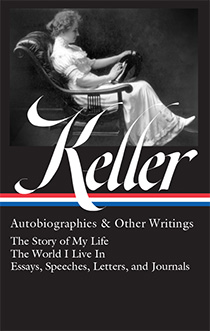 Helen Keller: Autobiographies & Other Writings
List price: $40.00
Web store price: $28.50
“All Ideas Are Second-Hand: Mark Twain’s Magnificent Letter to Helen Keller About the Myth of Originality” (Maria Popova, The Marginalian)
“Rethinking disability representation on-screen” (Kristen Lopez, American Masters)
Previous Story of the Week selections
• “The Power of Touch,” Helen Keller
• “Eve’s Diary,” Mark Twain
• “An Interview with Mark Twain,” Rudyard Kipling
Buy the book
Helen Keller: Autobiographies & Other WritingsList price: $40.00
Web store price: $28.50
 |
| Helen Keller poses for a snapshot with Samuel L. Clemens during a visit to Stormfield, his house in Redding, Connecticut, on January 10, 1909. They stand side by side, arms touching, he in a white suit and she in a dark, full-length dress with a high lace collar. Pipe and glasses in hand, he holds one arm out in an expansive gesture. Photo by Mark Twain’s secretary, Isabel Lyon. Courtesy of The New York Public Library. |
I must steal half a moment from my work to say how glad I am to have your book and how highly I value it, both for its own sake and as a remembrance of an affectionate friendship which has subsisted between us for nine years without a break and without a single act of violence that I can call to mind. I suppose there is nothing like it in heaven; and not likely to be, until we get there and show off. I often think of it with longing, and how they’ll say, “there they come—sit down in front.” I am practicing with a tin halo. You do the same.When Keller was a teenager attending Wright-Humason School for the Deaf in New York City, she met Clemens, along with William Dean Howells, at the home of a mutual acquaintance, the writer and editor Laurence Hutton. Clemens and Keller became friends and pen pals, and both would recount the occasion of their first meeting numerous times in writings and conversations. Keller was already a fan of Mark Twain’s works and soon after she and her teacher, Anne Sullivan, met him she wrote excitedly to her mother:
Teacher and I spent the afternoon at Mr. Hutton’s, and had a most delightful time! . . . We met Mr. Clemens and Mr. Howells there! I had known about them for a long time; but I had never thought that I should see them, and talk to them; and I can scarcely realize now that this great pleasure has been mine! But, much as I wonder that I, only a little girl of fourteen, should come in contact with so many distinguished people, I do realize that I am a very happy child, and very grateful for the many beautiful privileges I have enjoyed. The two distinguished authors were very gentle and kind, and I could not tell which of them I loved best. Mr. Clemens told us many entertaining stories, and made us laugh till we cried. I only wish you could have seen and heard him! He told us that he would go to Europe in a few days to bring his wife and his daughter, Jeanne, back to America, because Jeanne, who is studying in Paris, has learned so much in three years and a half that if he did not bring her home, she would soon know more than he did. I think Mark Twain is a very appropriate nom de plume for Mr. Clemens because it has a funny and quaint sound, and goes well with his amusing writings, and its nautical significance suggests the deep and beautiful things that he has written.Twain, for his part, detailed their first encounter in his autobiography:
I remember the first time I ever had the privilege of seeing her. She was fourteen years old then. She was to be at Laurence Hutton’s house on a Sunday afternoon, and twelve or fifteen men and women had been invited to come and see her. [Standard Oil magnate] Henry Rogers and I went together. The company had all assembled and had been waiting a while. The wonderful child arrived now, with her about equally wonderful teacher, Miss Sullivan. The girl began to deliver happy ejaculations, in her broken speech. Without touching anything, and without seeing anything, of course, and without hearing anything, she seemed to quite well recognize the character of her surroundings. She said “Oh the books, the books, so many, many books. How lovely!”Although he was dealing with his own financial troubles at the time, Clemens used his influence with Rogers to make it possible for the young student to go to college; Henry and his wife paid for Keller’s expenses at Radcliffe.
The guests were brought one after another and introduced to her. As she shook hands with each she took her hand away and laid her fingers lightly against Miss Sullivan’s lips, who spoke against them the person’s name. When a name was difficult, Miss Sullivan not only spoke it against Helen’s fingers but spelled it upon Helen’s hand with her own fingers—stenographically, apparently, for the swiftness of the operation was suggestive of that.
Mr. Howells seated himself by Helen on the sofa and she put her fingers against his lips and he told her a story of considerable length, and you could see each detail of it pass into her mind and strike fire there and throw the flash of it into her face. Then I told her a long story, which she interrupted all along and in the right places, with cackles, chuckles, and care-free bursts of laughter. Then Miss Sullivan put one of Helen’s hands against her lips and spoke against it the question “What is Mr. Clemens distinguished for?” Helen answered, in her crippled speech, “For his humor.” I spoke up modestly and said “And for his wisdom.” Helen said the same words instantly—“And for his wisdom.” I suppose it was a case of mental telegraphy, since there was no way for her to know what it was I had said.
As Shelley Fisher Fishkin has noted, Twain’s opposition to his country’s imperialist military exploits had been largely forgotten by Americans by 1929, when Keller published the following tribute under the title “Mark Twain as Revealed by Himself to Helen Keller” for the two million readers of The American Magazine. Later that year, it appeared as a chapter in her third memoir, Midstream: My Later Life. In the essay, Keller reminds her audience that Twain “fought injustice wherever he saw it in the relations between man and man—in politics, in wars, in outrages against the natives of the Philippines, the Congo, and Panama,” and she adds, “I loved his views on public affairs, they were so often the same as my own.”
Notes: When she wasn’t enrolled in school, Helen Keller often stayed in Wrentham, Massachusetts, from 1897 until 1903, the year she and her teacher and lifelong companion, Anne Sullivan, bought a nearby seventeen-room house they shared until 1917. Between 1893 and 1915, American humorist Finley Peter Dunne created for many of his newspaper columns the dialect-filled musings of Mr. Dooley, a fictional Irish immigrant bartender who loquaciously offered his opinions on news and politics of the day. Emilio Aguinaldo, Filipino revolutionary leader, was captured by U.S. forces on March 23, 1901. Olivia Louise Clemens (“Livy”), who died in 1904, was Clemens’s wife; and Olivia Susan Clemens (“Susie”), who died in 1896, was his daughter; the lines he engraved on Livy’s tombstone were adapted from “Annette” (1893), a poem by Australian author Robert Richardson.
In 1905 Sullivan married John Albert Macy, who joined the Wrentham household; he accompanied Keller and his wife when they visited Clemens at Stormfield in 1909. Albert Bigelow Paine, a close friend who jokingly referred to himself as Clemens’s “resident billiardist,” later attributed the wealth of material he had gathered for his biography of Mark Twain to the hours and days they spent playing together. Both Clemens and Keller were fascinated by W. S. Booth’s 1909 book, Some Acrostic Signatures of Francis Bacon, which argued that encoded messages hidden in Bacon’s writings suggested that Bacon had written Shakespeare’s plays. Twain wrote the book-length essay Is Shakespeare Dead? in response, while Keller wrote “A Concealed Poet Disclosed” but was unable to find a publisher for it. “Eve’s Diary” is one of Mark Twain’s better-known late stories, first published in Harper’s Monthly Magazine in December 1905.
In 1905 Sullivan married John Albert Macy, who joined the Wrentham household; he accompanied Keller and his wife when they visited Clemens at Stormfield in 1909. Albert Bigelow Paine, a close friend who jokingly referred to himself as Clemens’s “resident billiardist,” later attributed the wealth of material he had gathered for his biography of Mark Twain to the hours and days they spent playing together. Both Clemens and Keller were fascinated by W. S. Booth’s 1909 book, Some Acrostic Signatures of Francis Bacon, which argued that encoded messages hidden in Bacon’s writings suggested that Bacon had written Shakespeare’s plays. Twain wrote the book-length essay Is Shakespeare Dead? in response, while Keller wrote “A Concealed Poet Disclosed” but was unable to find a publisher for it. “Eve’s Diary” is one of Mark Twain’s better-known late stories, first published in Harper’s Monthly Magazine in December 1905.
* * *
One of the most memorable events of our Wrentham years was our visit to Mark Twain. . . . If you don't see the full selection below, click here (PDF) or click here (Google Docs) to read it—free!This selection may be photocopied and distributed for classroom or educational use.