Showing posts with label Mark Twain. Show all posts

Sunday, June 21, 2026

Our Mark Twain

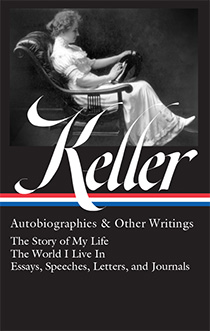
Helen Keller (1880–1968)
From Helen Keller: Autobiographies & Other Writings

Helen Keller poses for a snapshot with Samuel L. Clemens during a visit to Stormfield, his house in Redding, Connecticut, on January 10, 1909. They stand side by side, arms touching, he in a white suit and she in a dark, full-length dress with a high lace collar. Pipe and glasses in hand, he holds one arm out in an expansive gesture. Photo by Mark Twain’s secretary, Isabel Lyon. Courtesy of The New York Public Library.
On St. Patrick’s Day 1903, Samuel Langhorne Clemens (aka Mark Twain) wrote to 22-year-old Helen Keller, who recently sent him a copy of her just-published memoir, The Story of My Life. True to form, he began the letter by irreverently imagining the two of them in the afterlife:
I must steal half a moment from my work to say how glad I am to have your book and how highly I value it, both for its own sake and as a remembrance of an affectionate friendship which has subsisted between us for nine years without a break and without a single act of violence that I can call to mind. I suppose there is nothing like it in heaven; and not likely to be, until we get there and show off. I often think of it with longing, and how they’ll say, “there they come—sit down in front.” I am practicing with a tin halo. You do the same.
When Keller was a teenager attending Wright-Humason School for the Deaf in New York City, she met Clemens, along with William Dean Howells, at the home of a mutual acquaintance, the writer and editor Laurence Hutton. Clemens and Keller became friends and pen pals, and both would recount the occasion of their first meeting numerous times in writings and conversations. Keller was already a fan of Mark Twain’s works and soon after she and her teacher, Anne Sullivan, met him she wrote excitedly to her mother:
Teacher and I spent the afternoon at Mr. Hutton’s, and had a most delightful time! . . . We met Mr. Clemens and Mr. Howells there! I had known about them for a long time; but I had never thought that I should see them, and talk to them; and I can scarcely realize now that this great pleasure has been mine! But, much as I wonder that I, only a little girl of fourteen, should come in contact with so many distinguished people, I do realize that I am a very happy child, and very grateful for the many beautiful privileges I have enjoyed. The two distinguished authors were very gentle and kind, and I could not tell which of them I loved best. Mr. Clemens told us many entertaining stories, and made us laugh till we cried. I only wish you could have seen and heard him! He told us that he would go to Europe in a few days to bring his wife and his daughter, Jeanne, back to America, because Jeanne, who is studying in Paris, has learned so much in three years and a half that if he did not bring her home, she would soon know more than he did. I think Mark Twain is a very appropriate nom de plume for Mr. Clemens because it has a funny and quaint sound, and goes well with his amusing writings, and its nautical significance suggests the deep and beautiful things that he has written.
Twain, for his part, detailed their first encounter in his autobiography:
I remember the first time I ever had the privilege of seeing her. She was fourteen years old then. She was to be at Laurence Hutton’s house on a Sunday afternoon, and twelve or fifteen men and women had been invited to come and see her. [Standard Oil magnate] Henry Rogers and I went together. The company had all assembled and had been waiting a while. The wonderful child arrived now, with her about equally wonderful teacher, Miss Sullivan. The girl began to deliver happy ejaculations, in her broken speech. Without touching anything, and without seeing anything, of course, and without hearing anything, she seemed to quite well recognize the character of her surroundings. She said “Oh the books, the books, so many, many books. How lovely!”

The guests were brought one after another and introduced to her. As she shook hands with each she took her hand away and laid her fingers lightly against Miss Sullivan’s lips, who spoke against them the person’s name. When a name was difficult, Miss Sullivan not only spoke it against Helen’s fingers but spelled it upon Helen’s hand with her own fingers—stenographically, apparently, for the swiftness of the operation was suggestive of that.

Mr. Howells seated himself by Helen on the sofa and she put her fingers against his lips and he told her a story of considerable length, and you could see each detail of it pass into her mind and strike fire there and throw the flash of it into her face. Then I told her a long story, which she interrupted all along and in the right places, with cackles, chuckles, and care-free bursts of laughter. Then Miss Sullivan put one of Helen’s hands against her lips and spoke against it the question “What is Mr. Clemens distinguished for?” Helen answered, in her crippled speech, “For his humor.” I spoke up modestly and said “And for his wisdom.” Helen said the same words instantly—“And for his wisdom.” I suppose it was a case of mental telegraphy, since there was no way for her to know what it was I had said.
Although he was dealing with his own financial troubles at the time, Clemens used his influence with Rogers to make it possible for the young student to go to college; Henry and his wife paid for Keller’s expenses at Radcliffe.

As Shelley Fisher Fishkin has noted, Twain’s opposition to his country’s imperialist military exploits had been largely forgotten by Americans by 1929, when Keller published the following tribute under the title “Mark Twain as Revealed by Himself to Helen Keller” for the two million readers of The American Magazine. Later that year, it appeared as a chapter in her third memoir, Midstream: My Later Life. In the essay, Keller reminds her audience that Twain “fought injustice wherever he saw it in the relations between man and man—in politics, in wars, in outrages against the natives of the Philippines, the Congo, and Panama,” and she adds, “I loved his views on public affairs, they were so often the same as my own.”

Notes: When she wasn’t enrolled in school, Helen Keller often stayed in Wrentham, Massachusetts, from 1897 until 1903, the year she and her teacher and lifelong companion, Anne Sullivan, bought a nearby seventeen-room house they shared until 1917. Between 1893 and 1915, American humorist Finley Peter Dunne created for many of his newspaper columns the dialect-filled musings of Mr. Dooley, a fictional Irish immigrant bartender who loquaciously offered his opinions on news and politics of the day. Emilio Aguinaldo, Filipino revolutionary leader, was captured by U.S. forces on March 23, 1901. Olivia Louise Clemens (“Livy”), who died in 1904, was Clemens’s wife; and Olivia Susan Clemens (“Susie”), who died in 1896, was his daughter; the lines he engraved on Livy’s tombstone were adapted from “Annette” (1893), a poem by Australian author Robert Richardson.

In 1905 Sullivan married John Albert Macy, who joined the Wrentham household; he accompanied Keller and his wife when they visited Clemens at Stormfield in 1909. Albert Bigelow Paine, a close friend who jokingly referred to himself as Clemens’s “resident billiardist,” later attributed the wealth of material he had gathered for his biography of Mark Twain to the hours and days they spent playing together. Both Clemens and Keller were fascinated by W. S. Booth’s 1909 book, Some Acrostic Signatures of Francis Bacon, which argued that encoded messages hidden in Bacon’s writings suggested that Bacon had written Shakespeare’s plays. Twain wrote the book-length essay Is Shakespeare Dead? in response, while Keller wrote “A Concealed Poet Disclosed” but was unable to find a publisher for it. Eve’s Diary is one of Mark Twain’s better-known late stories, first published in Harper’s Monthly Magazine in December 1905.

*   *   *
One of the most memorable events of our Wrentham years was our visit to Mark Twain. . . . If you don't see the full selection below, click here (PDF) or click here (Google Docs) to read it—free!

This selection may be photocopied and distributed for classroom or educational use.

Sunday, November 23, 2025

Hunting the Deceitful Turkey

Mark Twain (1835–1910)
From Mark Twain: Collected Tales, Sketches, Speeches, & Essays 1891–1910

“Wild Turkey,” plate 6 in The Birds of America (1827–38), hand-colored engraving and aquatint on paper by French American ornithologist John James Audubon (1785–1851). (North Carolina Museum of Art)
During the last five years of his life, Mark Twain dictated to three typists, primarily to stenographer Josephine S. Hobby, more than half a million words’ worth of material for his autobiography. The sessions “produced not a conventional narrative marching inexorably toward the grave, but rather a series of spontaneous recollections and comments on the present as well as the past, arranged simply in the order of their creation,” as Harriet Elinor Smith summarized the massive typescript in the introduction to the authoritative three-volume edition published a century after his death. Or, as biographer Jerome Loving put it, Twain’s plan for the book, such as it was, “was to avoid talking with absolute candor about himself and instead to talk about others. Whenever he tired of one subject, he would simply switch to a different one.”

During one session in May 1907, Twain described the clash earlier in the decade between, on the one hand, William J. Long and other “nature fakers” and, on the other, his friends Theodore Roosevelt and the naturalist John Burroughs. Long, a Congregationalist minister, published several books specifically for schoolchildren, and he was heavily criticized by scientists for anthropomorphizing animal behavior and for “observing” feats that defied common sense. In one of his more infamous anecdotes, Long claimed to have witnessed, twenty years earlier, a woodcock that seemed to have “a broken leg and had deliberately put it into a clay cast to hold the broken bones in place until they should knit together again.” Other naturalists mocked Long’s “proofs” and deductions and disdainfully pointed out that twenty years earlier, when the woodcock incident allegedly occurred, Long was fifteen years old. “They are all the inventions of Mr. Long,” Burroughs wrote in a thorough takedown of the phenomena recounted in one book. “Of the real secrets of wild life, I do not find a trace in his volume.”

Both the self-healing woodcock and the ensuing debate were tempting morsels Twain couldn’t resist, and he responded during one dictation with an even more preposterous tale of his own:
I know of a turkey-hen that tried during several weeks to hatch out a porcelain egg, then the gobbler took the job and sat on that egg two entire summers and at last hatched it. He hatched out of it a doll’s tea-set of fourteen pieces, and all perfect, except that the tea-pot had no spout, on account of the material running out. I know this to be true, of my own personal knowledge, and I do as Mr. Roosevelt and Mr. Burroughs and Jonah and Aristotle, and all the other naturalists do—that is to say, I merely make assertions and back them up with just my say-so, offering no other evidence of any kind. I personally know that that unusual thing happened; I knew the turkey; I furnished the egg, and I have got the crockery. It establishes, once and for all, the validity of Mr. Long’s statement about his bird—because it is twice as remarkable as that bird’s performance and yet it happened.
Tall tales about turkeys might have been on Mark Twain’s mind that spring because he had just published—twice—an altogether different yarn about a turkey with anthropomorphic qualities.

Twain had written the tale years earlier, when he was in Vienna for the winter of 1897–98. He and his family were still reeling from his personal bankruptcy two years earlier and the death of his daughter Susy in August 1896. “I do not come up out of my misery and desolation in the least degree yet; but presently I shall submerge myself and my troubles in my work,” he wrote to his close friend Henry Tuttleston Rogers, a Standard Oil executive who helped Twain rehabilitate his financial situation.

At the end of 1897 Twain confided to William Dean Howells:
I couldn't get along without work now. I bury myself in it up to the ears. Long hours—8 and 9 on a stretch, sometimes. And all the days, Sundays included. It isn't all for print, by any means, for much of it fails to suit me; 50,000 words of it in the past year. It was because of the deadness which invaded me when Susy died.
Among the surviving works from his winter in Vienna is a 90-page unfinished manuscript titled “My Autobiography [Random Extracts from It],” a loose collection of vignettes and reminiscences grounded on boyhood experiences. The latter half of the work recalls summers he spent on the Florida, Missouri, farm of his uncle John A. Quarles, whose eight children included Benjamin and James (nine and eight years older than Mark, respectively) and William Frederick, who was two years older.
I remember the squirrel-hunts, and prairie-chicken hunts, and wild turkey hunts, and all that; and how we turned out, mornings, while it was still dark, to go on these expeditions, and how chilly and dismal it was, and how often I regretted that I was well enough to go. A toot on a tin horn brought twice as many dogs as were needed, and in their happiness they raced and scampered about, and knocked small people down, and made no end of unnecessary noise. At the word, they vanished away toward the woods, and we drifted silently after them in the melancholy gloom. But presently the gray dawn stole over the world, the birds piped up, then the sun rose and poured light and comfort all around, everything was fresh and dewy and fragrant, and life was a boon again. After three hours of tramping we arrived back wholesomely tired, overladen with game, very hungry, and just in time for breakfast.
Although Twain had been telling friends, publishers, and journalists that the autobiography would not be published until well after his death, in the summer of 1906 he decided to allow George Harvey, the editor of the North American Review, to assemble bits and pieces from among the 250,000-plus words of material written or dictated thus far, excluding material that might prove too political or controversial or that revealed personal or sensitive information about people. Harvey published twenty-five installments of “Chapters from My Autobiography” in consecutive issues of the journal from September 1906 to December 1907. The material from Twain’s Vienna manuscript about summers on his uncle’s farm appeared as the thirteenth chapter in the March 1 issue and concluded with a much-embellished recollection of an entire day spent chasing one worldly-wise turkey. Three months earlier, however, this final section had also been published as a story, “Hunting the Deceitful Turkey,” in the Christmas 1906 number of Harper’s Monthly Magazine, and that is the version of Twain's turkey tale that we present below.

*   *   *

For this week’s selection, we depart from the usual format and reproduce the selection, in its entirety, below. You may also download it as a PDF or view it in Google Docs


Hunting the Deceitful Turkey

When I was a boy my uncle and his big boys hunted with the rifle, the youngest boy Fred and I with a shotgun—a small single-barrelled shotgun which was properly suited to our size and strength; it was not much heavier than a broom. We carried it turn about, half an hour at a time. I was not able to hit anything with it, but I liked to try. Fred and I hunted feathered small game, the others hunted deer, squirrels, wild turkeys, and such things. My uncle and the big boys were good shots. They killed hawks and wild geese and such like on the wing; and they didn’t wound or kill squirrels, they stunned them. When the dogs treed a squirrel, the squirrel would scamper aloft and run out on a limb and flatten himself along it, hoping to make himself invisible in that way—and not quite succeeding. You could see his wee little ears sticking up. You couldn’t see his nose, but you knew where it was. Then the hunter, despising a “rest” for his rifle, stood up and took offhand aim at the limb and sent a bullet into it immediately under the squirrel’s nose, and down tumbled the animal, unwounded, but unconscious; the dogs gave him a shake and he was dead. Sometimes when the distance was great and the wind not accurately allowed for, the bullet would hit the squirrel’s head; the dogs could do as they pleased with that one—the hunter’s pride was hurt, and he wouldn’t allow it to go into the gamebag.

In the first faint gray of the dawn the stately wild turkeys would be stalking around in great flocks, and ready to be sociable and answer invitations to come and converse with other excursionists of their kind. The hunter concealed himself and imitated the turkey-call by sucking the air through the leg-bone of a turkey which had previously answered a call like that and lived only just long enough to regret it. There is nothing that furnishes a perfect turkey-call except that bone. Another of Nature’s treacheries, you see. She is full of them; half the time she doesn’t know which she likes best—to betray her child or protect it. In the case of the turkey she is badly mixed: she gives it a bone to be used in getting it into trouble, and she also furnishes it with a trick for getting itself out of the trouble again. When a mamma-turkey answers an invitation and finds she has made a mistake in accepting it, she does as the mamma-partridge does—remembers a previous engagement—and goes limping and scrambling away, pretending to be very lame; and at the same time she is saying to her not-visible children, “Lie low, keep still, don’t expose yourselves; I shall be back as soon as I have beguiled this shabby swindler out of the country.”

When a person is ignorant and confiding, this immoral device can have tiresome results. I followed an ostensibly lame turkey over a considerable part of the United States one morning, because I believed in her and could not think she would deceive a mere boy, and one who was trusting her and considering her honest. I had the single-barrelled shotgun, but my idea was to catch her alive. I often got within rushing distance of her, and then made my rush; but always, just as I made my final plunge and put my hand down where her back had been, it wasn’t there; it was only two or three inches from there and I brushed the tail-feathers as I landed on my stomach—a very close call, but still not quite close enough; that is, not close enough for success, but just close enough to convince me that I could do it next time. She always waited for me, a little piece away, and let on to be resting and greatly fatigued; which was a lie, but I believed it, for I still thought her honest long after I ought to have begun to doubt her, suspecting that this was no way for a high-minded bird to be acting. I followed, and followed, and followed, making my periodical rushes, and getting up and brushing the dust off, and resuming the voyage with patient confidence; indeed, with a confidence which grew, for I could see by the change of climate and vegetation that we were getting up into the high latitudes, and as she always looked a little tireder and a little more discouraged after each rush, I judged that I was safe to win, in the end, the competition being purely a matter of staying power and the advantage lying with me from the start because she was lame.

Along in the afternoon I began to feel fatigued myself. Neither of us had had any rest since we first started on the excursion, which was upwards of ten hours before, though latterly we had paused awhile after rushes, I letting on to be thinking about something else; but neither of us sincere, and both of us waiting for the other to call game but in no real hurry about it, for indeed those little evanescent snatches of rest were very grateful to the feelings of us both; it would naturally be so, skirmishing along like that ever since dawn and not a bite in the mean time; at least for me, though sometimes as she lay on her side fanning herself with a wing and praying for strength to get out of this difficulty a grasshopper happened along whose time had come, and that was well for her, and fortunate, but I had nothing—nothing the whole day.

More than once, after I was very tired, I gave up taking her alive, and was going to shoot her, but I never did it, although it was my right, for I did not believe I could hit her; and besides, she always stopped and posed, when I raised the gun, and this made me suspicious that she knew about me and my marksmanship, and so I did not care to expose myself to remarks.

I did not get her, at all. When she got tired of the game at last, she rose from almost under my hand and flew aloft with the rush and whir of a shell and lit on the highest limb of a great tree and sat down and crossed her legs and smiled down at me, and seemed gratified to see me so astonished.

I was ashamed, and also lost; and it was while wandering the woods hunting for myself that I found a deserted log cabin and had one of the best meals there that in my life-days I have eaten. The weed-grown garden was full of ripe tomatoes, and I ate them ravenously, though I had never liked them before. Not more than two or three times since have I tasted anything that was so delicious as those tomatoes. I surfeited myself with them, and did not taste another one until I was in middle life. I can eat them now, but I do not like the look of them. I suppose we have all experienced a surfeit at one time or another. Once, in stress of circumstances, I ate part of a barrel of sardines, there being nothing else at hand, but since then I have always been able to get along without sardines.

Originally published in the December 1906 issue of Harper's Monthly Magazine

Sunday, November 24, 2024

An Encounter with an Interviewer

Mark Twain (1835–1910)
From Mark Twain: Collected Tales, Sketches, Speeches, & Essays 1852–1890

Autochrome of Mark Twain, 1908, by British American photographer Alvin Langdon Coburn (1882–1966). Published as a frontispiece in Archibald Henderson’s literary biography Mark Twain (London, 1911).
It is a “pest,” The New York Times insisted in 1873, “an evil that has existed for some years in our midst, and which, we regret to say, is getting constantly worse.” The editors at The Nation condemned it as “a means of getting attention,” a technique “as inefficacious as the revelations of spiritual mediums.” The New York World denounced it as “a modern and American Inquisition.”

They were complaining about the latest journalistic fad: the interview.

Four years earlier, in 1869, the campaign against interviews had been launched by The Nation:
In short, the “interview,” as at present managed, is generally the joint production of some humbug of a hack politician and another humbug of a newspaper reporter. The one lives by being notorious and the other seeking out notorieties and being “spicy”—by stringing together personalities about them. . . .

When it merely serves to make some politician clumsily ridiculous in the eyes of all discerning people, the interview is bad enough; . . . The lesson that there are limits to people's endurance of printed impudence is one that should be taught the conductors of the press by their own sense of moral responsibility for all the damage done by anything to which they give publicity. It is because “interviewing” helps to establish the curious device of looking on the correspondent, whether interviewer or not, as a person who may be disgusting, to be sure, but who is his own keeper fortunately, and not at all under editorial control, that it is chiefly to be condemned.
There continues to be disagreement among historians over when the interview was “invented.” Some cite James Gordon Bennett's conversation with a brothel owner while he was reporting on the Helen Jewett murder in 1836; others award the honor to Horace Greeley, who transcribed his talk with Brigham Young in 1859. Joseph “Mack” McCullagh, the Washington correspondent for the Cincinnati Commercial, probably wrote the earliest journalistic interviews as we now think of the form: first, he recorded former Confederate vice president Alexander H. Stephens’s criticism of Jefferson Davis in 1867 and he then published Andrew Johnson’s self-serving defense during the impeachment trial the following year. (In the latter case, Johnson himself invited McCullagh to the White House and thus became the first President interviewed by a reporter for publication.) Virtually everyone agrees that the on-the-record interview is an American invention—and one of the nation’s unsung exports. In any event, the traditionalists were swept aside, and by the end of the century interviews were ubiquitous in the press—including most of the magazines and newspapers that had earlier condemned them.

Mark Twain rarely passed up the opportunity to latch onto the latest novelty. In 1869, when he lived in upstate New York, he published in the Buffalo Express a short fictional sketch entitled “The Wild Man Interviewed,” in which a “member of the press” goes west to wrangle an exclusive conversation with an ape-like man “living in the woods like a wild beast.” In 1874, soon after Twain and his family moved into their new home in Hartford, he wrote a parody, “An Encounter with an Interviewer,” and contributed it to a fundraising volume for the Lotos Club, an arts and literature society that had been founded in 1870 (and that still exists). He reprinted it in two of his collections, Punch, Brothers, Punch! and Other Sketches (1878) and The Stolen White Elephant Etc. (1882). In at least one printing of Punch, Brothers, Punch!, Twain added a postscript to the selection: “I thought I could make this interview as unreliable and incoherent as the average newspaper interview. But that was another of my mistakes.”

The story became a staple of Twain’s speaking engagements, and it was part of the program when he went with George Washington Cable on the “Twins of Genius” tour in 1884. “Mark is on the stage reading (reciting) his ‘Desperate Encounter with an Interviewer,’ and the roars of laughter fall as regularly as a surf,” Cable wrote to his wife during one performance. “I think it’s a great thing to be able to hold my own with so wonderful a platform figure.”

In Europe, Twain’s short piece took on a life of its own. A newspaper in Paris at the end of the nineteenth century referred to the “famous legend” about how Twain thwarted a nosy interviewer; a French critic seven decades later included it in a shortlist of Twain’s best-known works in France. The late Twain scholar Louis J. Budd, intrigued by such remarks, hunted through European books and periodicals and discovered that “the foreign printings of ‘Encounter’ I have managed to find are impressive for their number and spread.”

Many of Twain’s contemporaries who reprinted or discussed the piece assumed it was an account of an actual incident or, at the very least, that it was inspired by his own experiences with interviewers. When he wrote the piece, however, he was not yet the kind of celebrity that might have attracted the journalists practicing this new-fangled method of reporting. Although nearly three hundred interviews with Twain would be published during his career, none of them had yet to see print. As it happens, his first known full-fledged interview occurred the month the “Encounter” parody was published. In November 1874, he and his friend J. H. Twitchell, a local minister, got the idea of walking from Hartford to Boston by the old stage road—a trip of more than 100 miles—ending with a dinner party hosted by William Dean Howells. The walk seems to have been designed as a publicity stunt, both for Twain’s debut that month in The Atlantic Monthly, which Howells edited, and for Twain’s new play, Colonel Sellers, which had become a surprise hit in New York and would go on to earn him well over $100,000 as it toured the country. The newspapers learned of the adventure and began to report it, but on the second day Twain’s knee began to swell up. Having completed less than forty miles, the pair caught a train at North Ashford to Boston. The celebratory dinner was held anyway, and an enterprising, unnamed Hartford Times journalist scored an interview with Twain about the aborted “feat.”

Twain’s attitude toward interviews and interviewers would change over the remainder of his career. “Mark Twain usually hated them,” writes Mark Scharnhorst, who compiled a collection of 258 Twain interviews. “Often he required interviewers to paraphrase his comments rather than quote him directly because, as a professional author, he preferred to sell his words rather than give them away. . . . Still, Twain understood the utility of interviews for purposes of self-promotion.” He was often disappointed with the results, sometimes bitterly so, and would turn his dealings with journalists into subjects for ridicule. When a St. Louis Dispatch reporter asked him in 1882 if he disliked “the interviewer” as much as he seemed to, Twain responded, “I have never yet met a man who attempted to interview me whose report of the process did not try very hard to make me out an idiot, and did not amply succeed, in my mind, in making him a thorough one.”

Much of the information and several of the sources quoted in the above introduction are gleaned from “Mark Twain’s ‘An Encounter with an Interviewer’: The Height (or Depth) of Nonsense,” Nineteenth-Century Literature (September 2000), by Louis J. Budd (1921–2010), who edited both Library of America volumes collecting Mark Twain’s shorter works.

*   *   *
The nervous, dapper, “peart” young man took the chair I offered him, and said he was connected with the Daily Thunderstorm, and added,—

“Hoping it ’s no harm, I ’ve come to interview you.” . . . If you don't see the full selection below, click here (PDF) or click here (Google Docs) to read it—free!

This selection may be photocopied and distributed for classroom or educational use.

Sunday, November 26, 2023

Cannibalism in the Cars

Mark Twain (1835–1910)
From Mark Twain: Collected Tales, Sketches, Speeches, & Essays 1852–1890

Title illustration for “Cannibalism in the Cars” by American artist Truman W. "True" Williams (1839–1897), in the 1875 edition of Mark Twain’s Sketches, New and Old.
In the spring of 1868, Samuel Clemens, who had begun writing stories and articles as “Mark Twain” five years earlier, went to the West Coast via steamship, taking the usual route across Panama and arriving in San Francisco. In late April he went to Nevada to visit his old haunts and to give a lecture in Carson City, and after he returned to San Francisco on May 5, he wrote to his mother:
I have had the hardest trip over the Sierras. Steamboat to Sacramento (balmy summer weather & peaches all in bloom)—railway to the summit (snow thirty feet deep on level ground & 100 in the drifts)—6-horse sleighs to Donner Lake—mail coaches to Coburn’s—railway to Hunter’s—stage coaches to Virginia—all in the space of 24 hours. Distance 150 miles. Coming back last night in a snowstorm, the two & a half hours’ sleighing (part of the time clear weather & superb moonlight,) was something magnificent. . . .
Although Clemens had made the trip on several previous occasions when he lived in Carson City and Virginia City, any passage across the summit would conjure in the minds of the travelers the tragic Donner Party two decades earlier. Weeks before Clemens arrived in California, 20-year-old Frances Boyd made that same trip from New York, across Panama, and to San Francisco before braving the summit in the middle of winter to join her husband in Nevada. Decades later, she wrote in her memoir:
We had supped at Donner Lake, a beautiful spot in the very heart of the mountains, made famous by the frightful sufferings of the Donner party. . . . It proved an unfortunate prelude to our eventful night; for in the midst of our own suffering we were compelled to think of what might befall us if we, like that ill-fated party, should be left to the mercy of those grand but cruel mountains, which already seemed so relentless in their embrace that although haste meant torture yet we long to see the last of them.
Frances’s husband, Orsemus B. Boyd, was stationed at the Camp Halleck outpost, established to protect the workers constructing the Central Pacific railroad. In June of that year, soon after Frances Boyd and Samuel Clemens made their respective trips, the last section of railway track across Donner Summit was completed, enabling travel between Sacramento and Reno in only ten hours. Few would ever again have to pass over the summit in a stagecoach or sleigh.

In July, Clemens returned to New York, and later that year his farcical story “Cannibalism in the Cars” appeared in the November number of a transatlantic magazine issued by London publisher George Routledge & Sons, which had an office in Manhattan. It’s unknown when that year Clemens began the story or when he finished it, so how his own trek across the summit that year might have inspired the tale is a matter of speculation. Another influence could have been an item that appeared in February 1855 in the Muscatine Journal, the newspaper managed by his brother, who published a number of Clemens’s early pieces from 1853 to 1855. The account, a diary excerpt, described the travails of three hundred people, including a group of state legislators, trapped on a snowbound train between Chicago and Springfield for an entire week. They managed to survive by sharing the scanty provisions found in the freight car and burning train seats to keep warm. One of the more sensational reports published in St. Louis claimed that the passengers “were compelled by the bitter necessities of their Condition to eat dogs to keep from starving”—an unfounded rumor ridiculed by other newspapers.

At the time, Clemens did not think much of the transcontinental railroad. In a dispatch from St. Louis that appeared in the Alta California in 1867, he bemoaned the destruction the railroad left in its wake, both to the towns it bypassed and the towns it went through:
I went up to Hannibal, Quincy and Keokuk, on the Upper Mississippi. The first and the last named are enjoying a season of rest, but not refreshment—the railroads have stricken them dead for a year or two, and I cannot help fearing for Quincy also, now that she is going to build a bridge and let her trade cross the Mississippi, and go through without stopping. St. Louis is doing the same, and somebody has got to suffer for it some day, no doubt. . . . A railroad is like a lie—you have to keep building to it to make it stand. A railroad is a ravenous destroyer of towns, unless those towns are put at the end of it and a sea beyond, so that you can't go further and find another terminus.
As it happens, Clemens was in Washington, D.C., when the act that created the transcontinental railroad was working its way through the Senate. In February 1854, when he was 18 years old, he visited the Capitol and observed the debate over the Kansas-Nebraska Act, a bill sponsored by Illinois senator Stephen Douglas that settled the question of where to build the railroad, allowing it to traverse northern states in exchange for permitting new territories to decide through “popular sovereignty” whether to ban slavery or not—thus repealing the Missouri Compromise. In effect, the act built the railroad but hastened the Civil War; or as Mark Twain scholar John H. Davis puts it, “The Transcontinental Railroad, meant to unite the country, geographically and figuratively split it North and South.”

Fourteen years later, from the end of 1867 through the early months of 1868, Clemens served consecutively as a private secretary to each of Nevada’s senators, William M. Stewart and James Nye. As Samuel Clemens, he was an unreliable and mischievous aide who caused some embarrassment for his superiors, but as Mark Twain, he wrote a series of “Letters from Washington” for the Virginia City Territorial Enterprise, beginning with a dispatch in December that recalled his earlier trip to Washington:
I was here fourteen years ago, and remember what I saw then, perfectly well. I saw in the House Mr. Douglas and a few other great men. The mass of the remainder seemed to be a mob of empty headed whipper-snappers that had come to Congress to make incessant motions, propose eternal amendments, and rise to everlasting points of order. They glanced at the galleries oftener than they looked at the Speaker; they put their feet in their desks as if they were in a beer-mill; they made more racket than a rookery, and let on to know more than any body of men did know or ever could know by any possibility whatsoever.
Another piece, published in The New York Herald in February, decried the boys-club atmosphere that pervaded the Capitol and hinted at activities that would destroy reputations if known to the public:
Congressmen are a somewhat eccentric class of moralists. A large proportion of them prefer to have their families remain at home, that they may better enjoy their freedom here; for in some respects Washington is a free and easy place and never more so than when Congress is in session. A favorite mode of life for the bachelors and temporarily emancipated benedicts is to take apartments, and trust to a first class hotel or restaurant for the sustenance that is essential to the proximity of soul and body. Nothing can exceed this for comfort and convenience, nor is there anything to interrupt the enjoyment save an occasional angry remonstrance from the proprietor of the apartments against some curious discoveries that are calculated to scandalize the establishment.
In “Cannibalism in the Cars,” Mark Twain brings together his contempt for Congress and his misgivings about the railroad, and he sets his satirical story during a wintry trip that evokes the public’s fascination with the Donner Party and similar ill-fated journeys. Mirroring the timing of Clemens’s visits to Washington in 1854 and 1867–68, a stranger tells the narrator his story about a calamity that occurred fourteen years earlier—that is, before and after the Civil War, an event that might itself be described as an act of cannibalism.

Notes: Astute readers at the time of the story’s publication might have realized something was amiss with the stranger’s tale because the town of Weldon, while between St. Louis and Chicago, is not on a railroad line connecting them. Similarly, although the stranger states at the outset that there are only twenty-four passengers on the trip, nearly forty are identified by name.

Clemens’s primary purpose for making the trip to California in 1868 was to secure the rights to his own work from the Alta California newspaper, which controlled the copyright to his dispatches from an American tourist excursion through the Mediterranean on the steamship Quaker City in the fall of 1867. He planned to incorporate some of the pieces in his next book, The Innocents Abroad. Three close friends he made during that voyage appear as characters in “Cannibalism”: his cabin-mate, Daniel Slote; John A. Van Nostrand; and his future brother-in-law, Charles J. Langford. In fact, most of the train’s passengers are named after friends of the author.

*   *   *
I visited St. Louis lately, and on my way west, after changing cars at Terre Haute, Indiana, a mild, benevolent-looking gentleman of about forty-five, or may be fifty, came in at one of the way-stations and sat down beside me. . . . If you don't see the full selection below, click here (PDF) or click here (Google Docs) to read it—free!

This selection may be photocopied and distributed for classroom or educational use.

Sunday, November 27, 2022

Eve’s Diary

Mark Twain (1835–1910)
From Mark Twain: Collected Tales, Sketches, Speeches, & Essays 1891–1910

Three of the 55 illustrations created by American artist Lester Ralph (1876–1927) for the book publication of Eve’s Diary. The first two show Adam and Eve in Eden; the third shows Adam at the end of the story, after the Fall. The Charlton Library in Worcester, Massachusetts, banned the book from its shelves because, as The New York Times drolly put it in a front-page article, the images “represent Eve in summer costume. Her dresses are all cut Garden of Eden style.”
In 1909, the year before he died, Mark Twain published his last book, Is Shakespeare Dead?: From My Autobiography, which argues that Francis Bacon wrote Shakespeare’s plays and (as the subtitle suggests) includes anecdotes from his own life to examine the relevance of “literary celebrity” in history. In an early chapter of this slim book, Twain begins a recollection from his own childhood:
When I was a Sunday-school scholar something more than sixty years ago, I became interested in Satan, and wanted to find out all I could about him. I began to ask questions, but my class-teacher, Mr. Barclay the stone-mason, was reluctant about answering them, it seemed to me. I was anxious to be praised for turning my thoughts to serious subjects when there wasn’t another boy in the village who could be hired to do such a thing. I was greatly interested in the incident of Eve and the serpent, and thought Eve’s calmness was perfectly noble. I asked Mr. Barclay if he had ever heard of another woman who, being approached by a serpent, would not excuse herself and break for the nearest timber. He did not answer my question, but rebuked me for inquiring into matters above my age and comprehension. . . .
Even if Twain’s boyhood anecdote is fabricated (quite possible) or embellished (almost certain), we do know that throughout his life he was both fascinated by and skeptical of the accounts in the Book of Genesis—and this obsession led him to write more than a dozen sketches and satires inspired by them, most of which remained unpublished at his death. These efforts at biblical storytelling began as early as 1866, when he lit on the idea of a “conversation between the carpenters of Noah’s Ark.” Instead, this initial work took the form of a diary written by Shem, one of Noah’s sons. Twain made several attempts to work on the project during the 1870s—and picked it up again in 1909—but nothing came of it, and among his papers there are only a few surviving fragments of “diaries” by Shem and by Noah’s grandfather Methuselah.

The idea of using the journal format to portray biblical characters eventually bore fruit, however. In late 1892, Twain wrote “Extracts from Adam’s Diary.” Unable to find a magazine willing to publish it, he agreed to sell it the following year to a friend who was assembling a volume to promote Niagara Falls to travelers attending the World's Columbian Exposition in Chicago. Twain revised the story for this publication, relocated Eden in the Niagara region, and described Adam going over the Falls in a barrel—additions Twain would later regret and try, unsuccessfully, to get removed when the story was included in future collections. The Niagara Book was reprinted when Buffalo hosted the Pan-American Exposition in 1901, and the story appeared that year in Harper’s Magazine, reaching a national audience for the first time. (During the Buffalo fair, in a curious case of life imitating art, Annie Edson Taylor, a 63-year-old schoolteacher, became the first person to strap herself in a barrel and take the trip over the Niagara Falls.)

Twain’s story opens with Adam perplexed and annoyed by the appearance of the “new creature with the long hair. . . . I wish it would not talk; it is always talking.” But by the tale’s end, ten years after their exile from Eden, he admits, “I see that I was mistaken about Eve in the beginning; it is better to live outside the Garden with her than inside it without her. At first I thought she talked too much; but now I should be sorry to have that voice fall silent and pass out of my life.”

Mark Twain had long questioned, both humorously and seriously, whether Adam and Eve were to blame for the Fall and often suggested that, given their naivete and human nature, failure must have been part of the plan. “If God had told [Adam] to help himself,” he wrote to the industrialist Henry Huttleston Rogers in 1898, “the crop would have rotted on the trees; but as soon as He loaded the apples up with extra-territorial royalties and other wanton exactions and obstructions, Adam was bound to sample the orchard if it cost him his shirt-tail.” Similarly, one of the maxims that open the chapters of Pudd’nhead Wilson reads:
Adam was but human—this explains it all. He did not want the apple for the apple’s sake, he wanted it only because it was forbidden. The mistake was in not forbidding the serpent; then he would have eaten the serpent.
Around the time the Adam story was reprinted in Harper’s, Twain began toying with the idea of imagining it from Eve’s point of view. At one point he had a 75-page manuscript tentatively titled “Autobiography of Eve,” a far more cynical account that follows Eve until her death in the year 920. Not satisfied with what he’d written, he set it aside, unfinished, and parts of it were posthumously published as “Eve Speaks” and “That Day in Eden.”

In June 1904, Olivia, Mark Twain’s beloved wife of 34 years, died after an extended illness while the family was in Florence, Italy. Shattered with grief, their daughter Clara broke down and, after their return to the U.S., admitted herself to rest-cure facilities for more than a year. The following May, afflicted with gout, dyspepsia, and chronic bronchitis, Twain traveled with this daughter Jean to a hideaway in Dublin, New Hampshire. During his first month there, in part to distract himself from grief and illness, he churned out “an intolerable pile of manuscript,” including the start of a new version of The Mysterious Stranger and an odd fantasy titled “3,000 Years Among the Microbes” (imagining the world from the point of view of a cholera bacteria living in the body of a tramp). Finding himself at an impasse with both novel-length works, he took some time off. “Since I stopped work I have had a two months holiday,” he wrote to Frederick A. Duneka, the secretary of Harper & Brothers. “The summer has been my working time for 35 years. To have a holiday in it (in America) is new for me.”

During his “holiday,” in mid-July, he reported to Duneka that he had completed “Eve’s Diary,” which uses “Adam’s Diary as her (unwitting and unconscious) text, of course, since to use any other text would have been an imbecility.” He added, “Eve’s Diary is Eve’s Love-Story, but we will not name it that.” The new tale parallels the events of the earlier story but the emotional stance is altogether different; as one contemporary reviewer put it, it is a “tribute from the widowed author to his lost partner of many years.”

Only days after Olivia Clemens died, Twain had written to her brother, “I am a man without a country. Wherever Livy was, that was my country.”—a line echoed in the final entry of “Eve’s Diary.” In the words of Twain’s first biographer, Albert Bigelow Paine, “Adam’s single comment at the end . . . holds the full tale of Mark Twain’s love and sorrow, and is perhaps the most beautiful line he ever wrote.”

*   *   *
Saturday. — I am almost a whole day old, now. — I arrived yesterday. That is as it seems to me. And it must be so, for if there was a day-before-yesterday I was not there when it happened, or I should remember it. . . . If you don't see the full selection below, click here (PDF) or click here (Google Docs) to read it—free!

This selection may be photocopied and distributed for classroom or educational use.

Sunday, November 28, 2021

How I Escaped Being Killed in a Duel

Mark Twain (1835–1910)
From Mark Twain: Collected Tales, Sketches, Speeches, & Essays 1852–1890

Photograph of Samuel Clemens (center) with A. J. Simmons, Speaker of the Nevada Territory Legislature, and state legislator William H. Clagett, January 1864. Image from Turner Auctions, via BidSquare.
When Samuel Langhorne Clemens, aka Mark Twain, was twenty-eight years old, he endured a self-inflicted scandal that one historian has called “the single most damaging incident of his Nevada career.” Two weeks after he published a pair of articles in consecutive issues of the Virginia City Daily Territorial Enterprise, Clemens fled the Washoe region of Nevada, ostensibly to avoid arrest for challenging the editor of a rival newspaper to a duel.

The Enterprise’s publisher, Joseph Goodman, was away from town in May 1864 and left Clemens in charge of the newspaper. At the time, Reuel Gridley, a storekeeper in Austin, Nevada, and coincidentally one of Clemens’s friends from Hannibal, Missouri, was traveling from town to town, auctioning a sack of flour to raise funds for the Sanitary Commission of St. Louis, an organization that provided aid to disabled Union soldiers. The flour was never actually purchased; the winner donated it back to Gridley, who auctioned it off again and again and ultimately raised upwards of a quarter of a million dollars. Clemens met up with Gridley in Virginia City and helped him raise $22,000 in a series of auctions in the county. One reason for Gridley’s success was his ability to fuel competition between rival businesses and community leaders to outbid each other for the flour as a display of public-spiritedness.

Gridley wasn’t the only party in Nevada raising money for wounded soldiers. Fifteen miles to the northeast, a group of women in Carson City organized a charity ball. The titular head of the fundraising effort was Samuel’s older brother Orion Clemens, the Nevada Territorial Secretary (and acting governor when James W. Nye was away, which was often). Orion’s wife, Mollie, was one of the prominent women on the committee. The group debated whether to send the money to the Sanitary Commission in New York rather than the commission in St. Louis, because several women on the committee had objected that the St. Louis organization used some of its proceeds to fund the Freedmen's Aid Society, which provided education and housing for those who had been formerly enslaved.

As an occasional reporter for the Enterprise for nearly two years, Clemens had a reputation as a purveyor of hoaxes and satires, and some of his news items were written more for their comic potential than for the facts. He learned about the dispute among the women of the committee and wrote an unsigned item suggesting that the flour sack would not be auctioned in Carson City because “the money raised at the Sanitary Fancy Dress Ball, recently held in Carson for the St. Louis Fair, had been diverted from its legitimate course, and was to be sent to aid a Miscegenation Society* somewhere in the East,” adding ambiguously that this rumor “was a hoax, but not all a hoax, for an effort is being made to divert those funds from their proper course.” The following day, after the Enterprise had been outbid for the flour sack by its rival, the Virginia Daily Union, Clemens published another unsigned piece falsely accusing the Union of rescinding its bid.

Historians and biographers have spent a century and a half reconstructing what happened over the next two weeks, a task complicated by conflicting accounts, by later embellishments and fabrications, and by recollections softened in the years after Mark Twain became an international idol. Mollie Clemens was apparently ostracized by the other women of the committee, and Samuel sent her a half-apologetic, half-defensive letter admitting he had been drunk when he wrote the piece about the charity ball. After another editor convinced him not to print it, he had inadvertently left the manuscript in the pressroom where it ended up in the paper anyway. “Since it has made the ladies angry,” he wrote to his sister-in-law, “I am sorry the thing occurred, & that is all I can do, for you will see yourself that their communication [a letter responding to the “libel” and demanding publication of the author’s name] is altogether unanswerable. I cannot publish that, & explain it by saying the affair was a silly joke, & that I & all concerned were drunk. No—I’ll die first.”

As for the item claiming that the Union had reneged on their bid for the flour sack, the rival paper responded with an editorial denouncing Clemens and his “unmanly public journalism.” In the ensuing exchange of letters and articles Clemens was called “an unmitigated liar, a poltroon and a puppy,” while Union editor James Laird was condemned as (among other insults) a “cowardly sneak,” a “craven carcass,” and an “abject coward.” As the condemnations and accusations escalated, Clemens published the exchange of private letters between the two editors, and Laird published, on three consecutive days, the Carson City committee’s letter that Clemens had refused to print. At least three challenges to duels were issued: Clemens repeatedly tried to goad Laird into dueling him, Union printer J. W. Wilmington sent a challenge to Clemens, and William K. Cutler, the husband of one of the women on the committee, also demanded a faceoff with Clemens.

In the end, nothing happened. Laird steadfastly ignored Clemens’s blustering invitations to combat, Clemens refused to answer Wilmington, and Cutler abandoned his challenge. At the end of May, Clemens left town for San Francisco with Enterprise journalist Stephen Gillis, the man who would have been his second in a duel. Not a shot was fired—not even, apparently, in practice. The only thing harmed by the entire ordeal was the budding reputation of “Mark Twain,” the moniker Clemens had begun using the previous year. It’s not even clear that Clemens fled town to avoid arrest, because the law against dueling, passed in 1861, had been rarely (if ever) enforced—as Joseph Goodman, his own employer, could attest, having crippled a man in a duel months earlier. “We are not afraid of the grand jury,” he wrote to Orion, “but Washoe has long since grown irksome to us, & we want to leave it anyhow.”

Eight years later, Clemens sanitized and inflated the episode in “How I Escaped Being Killed in a Duel,” a farcical tale that erases his ignominious behavior and drunkenness, omits any reference to the squabble over the auction or the libel against the Carson City women (not to mention the inflammatory racism of his “joke”), and merely mocks himself for buffoonery and misplaced pride. He had told a similar story to audiences the previous year while on the Roughing It prepublication lecture tour, but aside from a passing reference to challenges to “six duels” he had received as editor, the incident didn’t make it into the book. He would tell the story again with a few more details in the autobiography he dictated during the years before his death. As Twain scholar Leland Krauth argues, “the differences between the duel and the later tales of it illuminate the processes whereby Mark Twain characteristically purged through his art that which was painful and humiliating in Sam Clemens’s past. For Clemens’s real fight was not with Laird but with recollections of his own conduct.”

* The term miscegenation was coined only a few months earlier, in December 1863, when the pamphlet Miscegenation: The Theory of the Blending of Races, Applied to the White Man and the Negro appeared. Allegedly the work of an abolitionist who supported Lincoln and the Republicans, it was revealed after the 1864 election as a hoax written by two New York Democrats. During the campaign the word spread rapidly across the country and became a bludgeon used by Democrats against supporters of both Lincoln and emancipation.

*   *   *
The only merit I claim for the following narrative is that it is a true story. . . . If you don't see the full selection below, click here (PDF) or click here (Google Docs) to read it—free!

This selection may be photocopied and distributed for classroom or educational use.

Sunday, April 18, 2021

The Killing of Julius Cæsar “Localized”

Mark Twain (1835–1910)
From Shakespeare in America: An Anthology from the Revolution to Now

Vue de San Francisco / Vista de San-Francisco, c. 1860, hand-colored lithograph printed in Paris by French painter and printmaker Isador Laurent Deroy (1797–1886). Library of Congress.
The following introduction is adapted and expanded from James Shapiro’s headnote to the selection in Shakespeare in America: An Anthology from the Revolution to Now.

At the end of 1863, Samuel Langhorne Clemens (who had just that year used his pen name, Mark Twain, for the first time) was a 28-year-old journalist working as the Nevada correspondent for a San Francisco newspaper, The Morning Call. The following May he moved to San Francisco and ended up being the paper’s only full-time reporter for over four months, on a salary of forty dollars a week. “It was fearful drudgery—soulless drudgery—and almost destitute of interest,” he later recalled.

During this same period, the humorist and poet Charles Henry Webb was the most prominent contributor to a local magazine, The Golden Era, to which Clemens was an occasional contributor. In the summer of 1864, Webb joined forces with a rising star of the Bay Area literary scene, Bret Harte, to start a rival magazine, and the two men hired the reporter from The Morning Call to write for the new publication at the leisurely pace of once a week. Twain quit his job at the paper, and as he recalled in Roughing It:
C. H. Webb had established a very excellent literary weekly called the Californian, but high merit was no guaranty of success; it languished, and he sold out to three printers, and Bret Harte became editor at $20 a week, and I was employed to contribute an article a week at $12. But the journal still languished, and the printers sold out to Captain Ogden, a rich man and a pleasant gentleman who chose to amuse himself with such an expensive luxury without much caring about the cost of it. When he grew tired of the novelty, he re-sold to the printers, the paper presently died a peaceful death, and I was out of work again. I would not mention these things but for the fact that they so aptly illustrate the ups and downs that characterize life on the Pacific coast. A man could hardly stumble into such a variety of queer vicissitudes in any other country.
Mark Twain’s seventh contribution to The Californian, “The Killing of Julius Caesar ‘Localized,’” ran on November 12, 1864, and he liked the story well enough to reprint it three years later in his first book, The Celebrated Jumping Frog of Calaveras County, and Other Sketches. A Boston reviewer of that collection singled out the story and punningly praised it as “a capital rendering” of Caesar’s death.

Twain’s parody cuts two ways: knocking Shakespeare down to size and at the same time imitating the kind of sensationalist newspaper coverage of murders so popular at the time (and to which he himself had contributed when writing for The Morning Call). Twain had been toying with Shakespeare parodies from the outset of his writing career. One of his earliest publications (which appeared in the Keokuk Saturday Post on October 18, 1856) was a burlesque of Julius Caesar, written from the perspective of a country bumpkin, under the name “Thomas Jefferson Snodgrass.” While in London in 1873, Twain had seen the American actor Edwin Booth play Hamlet, and spoke with him after the performance, suggesting that Hamlet be updated for the times by adding a modern-day comic commentator. Twain soon tried his hand at this addition to Shakespeare’s play, didn’t like what he had written, and burned it. In 1881 he tried again, making his way through Act I and part of Act II. But this too remained unpublished in his lifetime. His most memorable and accomplished Shakespeare parody is the pastiche of the soliloquies of Hamlet and Macbeth that appeared in Chapters 21 and 22 of his Adventures of Huckleberry Finn in 1885.

*   *   *
Nothing in the world affords a newspaper reporter so much satisfaction as gathering up the details of a bloody and mysterious murder, and writing them up with aggravated circumstantiality. . . . If you don't see the full selection below, click here (PDF) or click here (Google Docs) to read it—free!

This selection may be photocopied and distributed for classroom or educational use.

Sunday, November 29, 2020

The £1,000,000 Bank-Note

Mark Twain (1835–1910)
From Mark Twain: Collected Tales, Sketches, Speeches, & Essays 1891–1910

Left: “Change, please.” Illustration by American artist James Allen St. John (1872–1957) for “The £1,000,000 Bank-Note” when it was reprinted in The American Claimant and Other Stories and Sketches, volume 21 of the 22-volume uniform edition of Mark Twain’s works issued in various formats during 1899–1900. (An additional three volumes were published between 1904 and 1907.) Right: The same scene as depicted in The Million Pound Note (1954; released in the U.S. as The Man with a Million), directed by Ronald Neame, with Gregory Peck as Henry Adams and George Devine as the restaurant proprietor.
In 1879 Mark Twain scribbled in his notebook an idea he had for a story: “Case of a tramp who was loaned £1000,000 note for 30 days & he got rich on it because nobody could change it.” In subsequent years, he occasionally resurrected the notion, jotting down the title as a reminder or outlining a related idea, but nothing came of it.

A decade later, financial problems at Charles Webster & Co., the publishing firm founded and owned by Twain, had become acute. The company’s balance sheet was devastated by ongoing investment in a newfangled and ultimately hopeless typesetting machine and by the disappointing sales of such titles as an authorized biography of the current pope, Leo XIII (based on “an authentic memoir furnished by his order”), which Twain expected to be a blockbuster, and an exorbitantly produced 11-volume anthology grandly named A Library of American Literature. To keep the company afloat, he had to reinvest the royalties from his own books. Matters weren’t helped by a bookkeeper who embezzled a small fortune or by his penchant for sinking money in patents and schemes that ultimately failed. “There are two times in a man’s life when he should not speculate: when he can’t afford it and when he can,” he acknowledged in Following The Equator (1897), but the self-awareness of his gullible nature and his public acknowledgment that he was “bad in business” did not prevent him from gambling on too-good-to-be-true ventures right up until his death.

In the summer of 1891, worried by the twin terrors of dwindling income and rising debts, Mark Twain and his family closed up their expensive mansion, sold the horses, laid off their servants (although they found new positions for all of them), and took off for Europe so that the internationally celebrated author could cash in on his fame abroad. In addition to writing travel essays for McClure’s Magazine and the New York newspaper The Sun, Twain earned money by giving readings in Berlin and Dresden and, later, in various Italian cities. He met with the American minister in Germany and enjoyed a private dinner with Kaiser Wilhelm II. On a promenade in the spa town of Bad Homburg, he ran into Albert Edward, Prince of Wales (later, King Edward VII), who recognized him and “took Mark Twain’s arm and the two marched up and down, talking earnestly together,” according to a traveling companion who related the day’s events to biographer Albert Bigelow Paine.

Traveling lavishly in Europe, dining with royalty and ministers, enjoying the widespread attention of the media, being recognized everywhere he went—and all the while Samuel Clemens, the man behind the personality known as Mark Twain, was utterly impoverished; the future that awaited him included the closure of his publishing firm and personal bankruptcy. As a virtually penniless man everyone assumed was rich, he doubtlessly realized the absurdity of his situation and feared the inevitable public exposure, and the time must have seemed ripe for taking that skeletal idea of a million-pound note and turning it into a tall tale about the nebulous nature of wealth. The very concept of such a banknote may have even been a bit of wishful thinking—a way for Mark Twain to fantasize his way out of the impending doom. He finished the story while in Florence during the fall of 1892, sent it off to the editors of Century Magazine, and chose it as the title selection for his next book.

In the Critical Companion to Mark Twain, Alex Feerst notes that “The £1,000,000 Bank-Note” takes the uniquely American rags-to-riches tale popularized by Horatio Alger and other writers and flips it on its head. “Whereas Alger emphasized the importance of hard work and delay of gratification, Clemens’s story offers a version of financial bootstrapping in which luck, fame, connections, and access to capital are the essential elements of attaining worldly success. During his 30-day trial, Henry Adams does not actually work a day. . . .” The irony of the story was not lost on Twain’s contemporaries. A critic in the American journal The Review of Reviews wrote that the tale “illustrates a curious economic truth—that a man with a reputation for wealth doesn’t need the actual possession of it.”

Notes: Hospodar is a title used by Ottoman governors and tributary princes of Walachia and Moldavia. Bohun was the name of an English family prominent in the thirteenth and fourteenth centuries. The Conqueror is a reference to William the Conqueror, who became the first Norman king of England in 1066.

*   *   *
When I was twenty-seven years old, I was a mining-broker's clerk in San Francisco, and an expert in all the details of stock traffic. . . . If you don't see the full selection below, click here (PDF) or click here (Google Docs) to read it—free!

This selection may be photocopied and distributed for classroom or educational use.

Saturday, November 23, 2019

Plymouth Rock and the Pilgrims

Mark Twain (1835–1910)
From Mark Twain: Collected Tales, Sketches, Speeches, & Essays 1852–1890

“The Dinner at Delmonico’s in Honor of Mark Twain’s Seventieth Birthday.” Drawing by illustrator Sydney Adamson (fl. 1892–1914) for Harper’s Weekly. A 32-page supplement in the December 23, 1905, issue of the magazine included, along with a two-page spread of Adamson’s illustration, the texts of the speeches and full-page photographs of the guests at the event.
Until 1941, when President Franklin Delano Roosevelt signed legislation establishing the celebration of Thanksgiving on the fourth Thursday of each November, Americans marked the holiday on the last Thursday of November, in accordance with a proclamation issued by Abraham Lincoln in 1863. Thus, on Thursday, November 30, 1905, Mark Twain’s seventieth birthday coincided with Thanksgiving. It was a quiet day for the author; he had lunch with his friends Emile and Henry Rogers—the latter a famous industrialist who built up Standard Oil with John D. Rockefeller and who boasted descent from the Mayflower Pilgrims. Twain spent the rest of his birthday in his Fifth Avenue townhouse preparing a speech for the upcoming dinner that would make headlines in newspapers across the nation—an event that, because of the holiday, celebrated the seventieth birthday of America’s most famous writer five days after the fact.

When Colonel George Harvey, Twain’s editor and the president of Harper & Brothers, first suggested a birthday celebration, Twain imagined a small gathering of friends, perhaps in a nearby tavern or beer hall. Instead, Harvey planned a feast at New York’s most prestigious restaurant, Delmonico’s, and (as biographer Albert Bigelow Paine put it), “invitations were sent out to practically every writer of any distinction in America, and to many abroad. Of these nearly two hundred accepted, while such as could not come sent pathetic regrets.”

For his autobiography Twain spun a fanciful yarn concerning how the dinner came to be held on December 5 rather than on his actual birthday:
[Colonel Harvey] had made much preparation for a banquet to be given to me on that day in celebration of the fact that it marked my seventieth escape from the gallows, according to his idea—a fact which he regarded with favor and contemplated with pleasure, because he is my publisher and commercially interested. He went to Washington to try to get the President to select another day for the national Thanksgiving, and I furnished him with arguments to use which I thought persuasive and convincing, arguments which ought to persuade him even to put off Thanksgiving Day a whole year—on the ground that nothing had happened during the previous twelvemonth except several vicious and inexcusable wars, and King Leopold of Belgium’s usual annual slaughters and robberies in the Congo State, together with the insurance revelations in New York, which seemed to establish the fact that if there was an honest man left in the United States, there was only one, and we wanted to celebrate his seventieth birthday. But the colonel came back unsuccessful, and put my birthday celebration off to the 5th of December.
Twain's autobiography also presents his mordant view of Thanksgiving as a commemoration of New England colonists “exterminating their neighbors, the Indians, during the previous twelve months instead of getting exterminated by their neighbors the Indians.”
Thanksgiving Day became a habit, for the reason that in the course of time, as the years drifted on, it was perceived that the exterminating had ceased to be mutual and was all on the white man's side, consequently on the Lord's side; hence it was proper to thank the Lord for it and extend the usual annual compliments. The original reason for a Thanksgiving Day has long ago ceased to exist the Indians have long ago been comprehensively and satisfactorily exterminated and the account closed with Heaven, with the thanks due. But, from old habit, Thanksgiving Day has remained with us, and every year the President of the United States and the Governors of all the several States and the territories set themselves the task, every November, to advertise for something to be thankful for, and then they put those thanks into a few crisp and reverent phrases, in the form of a Proclamation, and this is read from all the pulpits in the land, the national conscience is wiped clean with one swipe, and sin is resumed at the old stand.
A reader new to Mark Twain’s politics and satire might be tempted to dismiss such sentiments as the contrarianism of an old curmudgeon—but he had been making similar statements for decades. “The observance of Thanksgiving Day—as a function—has become general of late years,” he wrote in Following the Equator (1897). “The Thankfulness is not so general. . . . Two-thirds of the nation have always had hard luck and a hard time during the year, and this has a calming effect upon their enthusiasm.”

Even earlier, in 1881, he agreed to give a speech at the newly formed New England Society of Philadelphia. Organizations for the descendants of European settlers had been springing up in various American cities; the New England societies all held annual dinners on December 22 (the anniversary of the landing of the Pilgrims at Plymouth Rock), and they often found common cause opposing the influx of more recent immigrants of other ethnic groups. The organizers must have known what they would be getting when they asked Mark Twain to be their featured speaker; he was already infamous for his irreverence. The president of the society jokingly explained Twain’s presence with the acknowledgment that, although the evening’s guest lived in Connecticut, “he was never exactly born in New England, nor, perhaps, were any of his ancestors.”
He is not technically, therefore, of New England descent. Under the painful circumstances in which he has found himself, however, he has done the best he could—he has had all his children born there, and has made of himself a New England ancestor. He is a self-made man. More than this, and better even, in cheerful, hopeful, helpful literature he is of New England ascent.
And then came the speech, which we present in full below. Twain spoke last, “after a number of other toasts to New England and the ‘sons’ who had gathered to pay homage to the legacy of the ‘fathers,’” writes Stephen Railton (the scholar responsible for the invaluable Mark Twain in His Times website). In addition to poking fun at both the society’s existence and the dinner’s purpose, “Twain's speech was the only one to notice all the other native sons and daughters who had been excluded from the Society’s version of America: native Americans, slaves, women, and other ‘Others.’ . . . As humor, this ‘protest’ shocked and entertained its audience—at the same time.”

Notes: William Robinson and Marmaduke Stephenson were Quakers who came to Boston in 1639 to preach in defiance of a Massachusetts Bay Colony law that made such activities punishable by death. They were imprisoned, Robinson was whipped, and they were banished from the colony. Ignoring the order, they continued to preach in and around the Boston area and were hanged in 1659. Elizabeth Hooton, another Quaker, came to Massachusetts in 1661; she was twice imprisoned and expelled from the colony. She returned a third time the next year with a license from the king permitting her to settle, but she was imprisoned again for preaching, then whipped and expelled. In subsequent years she endured the same treatment once in Rhode Island and at least seven more times in Massachusetts, imprisoned, punished and expelled on each occasion.

*   *   *
I rise to protest. I have kept still for years, but really I think there is no sufficient justification for this sort of thing. . . . If you don't see the full selection below, click here (PDF) or click here (Google Docs) to read it—free!

This selection may be photocopied and distributed for classroom or educational use.