Showing posts with label Shakespeare. Show all posts

Sunday, March 26, 2023

Stratford-on-Avon

Washington Irving (1783–1859)
From Shakespeare in America: An Anthology from the Revolution to Now

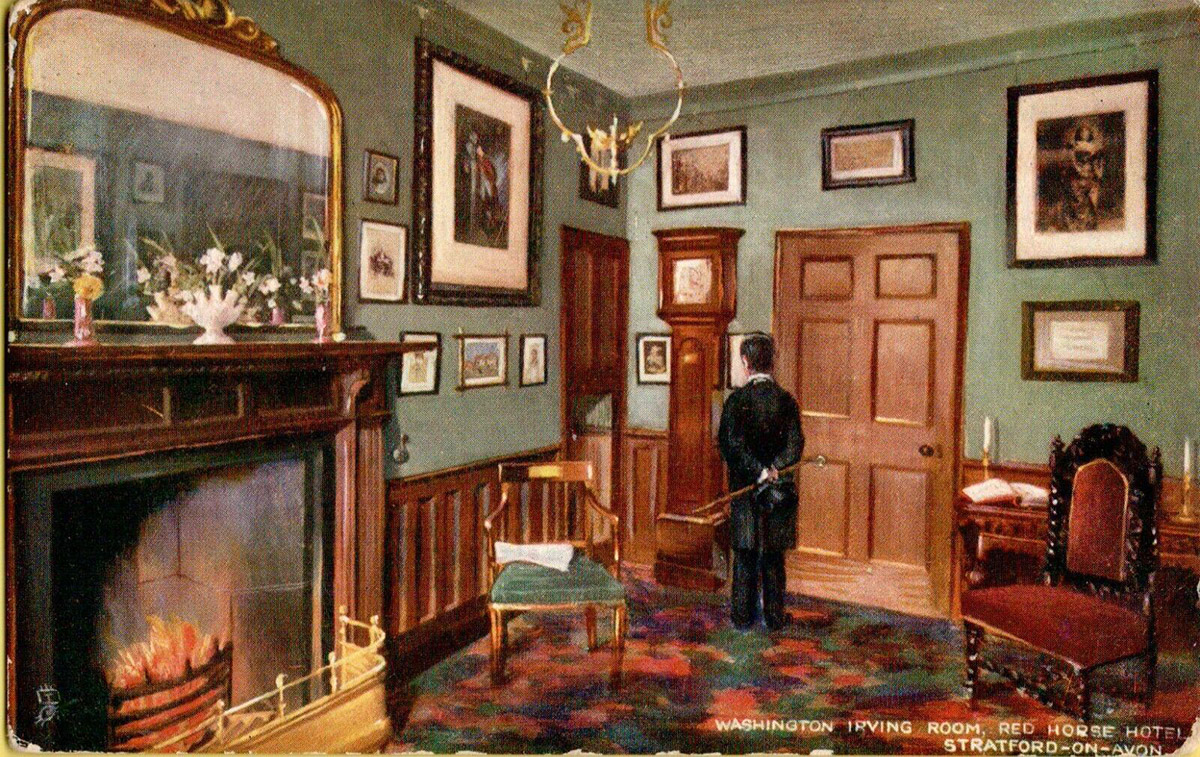
“Washington Irving Room, Red Horse Hotel, Stratford-on-Avon,” c. 1910, postcard printed by Raphael Tuck & Sons, London. Other than the addition of the man in the middle, the arrangement of elements in the painting is virtually identical to that of a photograph included in A. Van Doren Honeyman’s illustrated guidebook Bright Days in Merrie England (1901). Image: eBay.
In September 1831 Martin Van Buren, the newly appointed British minister, arrived in London, where Washington Irving had worked for the previous two years as a secretary at the American legation. Irving had planned to resign his position that year and return to the States in order to focus on his writing and on the family business, but he agreed to serve as chargé d'affaires until the new minister arrived. Before Irving went home, however, he took Van Buren and his son on a three-week excursion through England, including an obligatory stop at Stratford-upon-Avon, the hometown of William Shakespeare.

A decade earlier, in The Sketch Book of Geoffrey Crayon, Esq., Irving had written about his first visit to Stratford in July 1815. His essay mentioned a memorable stay at the Red Horse Inn, where, for the weary tourist, “The arm chair is his throne; the poker his sceptre, and the little parlour of some twelve feet square, his undisputed empire.” He was in for quite a surprise upon his return, though, as he related to his sister Catherine:
We next passed a night and part of the next day at Stratford-on-Avon, visiting the house where Shakspeare was born and the church where he lies buried. We were quartered at the little inn of the Red Horse, where I found the same obliging little landlady that kept it at the time of the visit recorded in the Sketch Book. You cannot imagine what a fuss the little woman made when she found out who I was. She showed me the room I had occupied, in which she had hung up my engraved likeness, and she produced a poker which was locked up in the archives of her house, on which she had caused to be engraved, “Geoffrey Crayon’s Sceptre.”
Although literary tourists had been making pilgrimages to Stratford ever since the actor David Garrick had hosted the Shakespeare Jubilee in 1769, Washington Irving’s little essay in The Sketch Book exponentially increased the flood of visitors to the small market town. “Americans, in particular, followed the tourist trail set out by Irving,” writes Julia Thomas in Shakespeare’s Shrine, “and, as they did so, appropriated or laid claim to Stratford-upon-Avon, transforming this quintessentially English site of pilgrimage into a curiously American one.” Tourists visited the home where Shakespeare was born and lived, with its ever-increasing accumulation of dubious “relics” (ranging from the playwright’s tobacco box to the little chair used by his son, Hamnet, who had died as a boy), and the gravesite and funerary monument in Holy Trinity Church. Those willing to stay an extra day could travel to the estate of Sir Thomas Lucy, who allegedly had Shakespeare arrested and punished for poaching deer and who was believed to have been the inspiration for the character of Justice Shallow in The Merry Wives of Windsor. (There is little evidence for any aspect of this tale.) Much to Irving’s dismay, however, another destination had been added: the Red Horse Inn parlor and the room in which Irving had slept in 1815 had been turned into lucrative shrines of their own.

Four years later, in 1835, the journalist Nathaniel Parker Willis, an overseas correspondent for the New York Mirror, came to Stratford. “I had stipulated with the hostess that my baggage should be put into the chamber occupied by Washington Irving,” he reported to readers of the newspaper. Willis met with Mrs. Gardiner, the same proprietor who had hosted Irving:
“I have brought up, mem,” she said, producing a well-polished poker from under her black apron, before she took the chair set for her at the table—“I have brought up a relic for you to see, that no money would buy from me.”

She turned it over in my hand, and I read on one of the flat sides at the bottom—“GEOFFREY CRAYON’S SCEPTRE.”
When Willis and his companion inquired how she knew that this poker was the same poker used by Irving, she responded:
“Why, sir, you see there’s a Mr. Vincent that comes here sometimes, and he says to me one day—‘So, Mrs. Gardiner, you’re finely immortalized. Read that.’ So the minnit I read it, I remembered who it was, and all about it, and I runs and gets the number three poker, and locks it up safe and sound, and by-and-by I sends it to Brummagem, and has his name engraved on it, and here you see it, sir—and I wouldn’t take no money for it.”
“Among all my many loiterings in many lands, I remember none more intellectually pure and gratifying, than this at Stratford-on-Avon,” Willis concluded. “My sleep in the little bed consecrated by the slumbers of the immortal Geoffrey, was sweet and light; and I write myself his debtor for a large share of the pleasure which genius like his lavishes on the world.”

The number of accounts by nineteenth-century literary figures about their own pilgrimages to the Red Horse Inn could be extended infinitely. “At Stratford I handled, too, the poker used to such good purpose by Geoffrey Crayon,” reported New-York Tribune correspondent Margaret Fuller in 1846. “The muse had fled, the fire was out, and the poker rusty, yet a pleasant influence lingered even in that cold little room, and seemed to lend a transient glow to the poker under the influence of sympathy.” Even the usually skeptical Ambrose Bierce paid homage when he, “by the merest accident, blundered into the famous ‘Red Horse Inn. . . . I took my meals in the ‘Irving Parlor,’ seated in the ‘Irving Chair’ (duly labelled with a brass plate), stirred my fire with the ‘Irving Poker’ (‘Geoffrey Crayon’s sceptre’), and gazed my fill at Irving in every style hanging against the papered walls.” Bierce was particularly impressed that, unlike other overpriced English tourist sites, he was presented with “a most moderate bill for most comfortable and gentlemanly accommodations.” The British novelist Mary Elizabeth Braddon opens Asphodel (1881) during "the season of American tourists doing Stratford and its environs, guide book in hand, and crowding in to The Red Horse parlour, after luncheon, to see the veritable chair in which Washington Irving used to sit.” By the end of the century, Thomas notes, the glorified poker “was wrapped up in an American flag and only brought out on special occasions.”

Both the chair and the poker seem to have vanished from public view by the mid-1930s. Today, the building that housed the Red Horse Inn is a Marks & Spencer department store. Irving’s essay, however, remains in print and we present it below.

Notes: The town of Stratford-upon-Avon is in the district of Stratford-on-Avon, but the names were often used interchangeably in nineteenth-century sources.

The Santa Casa of Loretto [Loreto], in Italy, is said to be the house in which the Virgin Mary lived at the time of the Annunciation, miraculously transported to the spot by angels at the end of the thirteenth century, just before Christian forces were expelled from the Holy Land. British engraver and author Samuel Ireland published his Picturesque Views on the Warwickshire Avon in 1795. The book’s anecdotes about Shakespeare and his times (including those quoted by Irving) are local traditions and legends, but shortly before publishing the book, Ireland fell victim to a series of Shakespearean forgeries, ranging from deeds, letters, and manuscripts to two complete plays, all fabricated by Ireland’s 19-year-old son and many of which initially fooled numerous “experts.” Reginald Scot, a member of Parliament during the 1580s, published The Discoverie of Witchcraft in 1584, a skeptical treatise exposing the charlatanism behind conjuring and similar practices.

In his footnote describing country gentlemen in the decades after Shakespeare, Irving quotes English cleric (later bishop) John Earle, who in 1628 anonymously published the humorous work Microcosmographie, or a Peece of the World discovered, in Essayes and Characters, poking fun at contemporary society and manners. Irving’s next quote, about “Mr. Hastings,” is from Remarks on Forest Scenery, and Other Woodland Views (1791) by English cleric and travel writer William Gilpin, although Gilpin was quoting a passage from John Hutchins’s History and Antiquities of Dorset (1784). .

*   *   *
To a homeless man, who has no spot on this wide world which he can truly call his own, there is a momentary feeling of something like independence and territorial consequence, when, after a weary day’s travel, he kicks off his boots, thrusts his feet into slippers, and stretches himself before an inn fire. . . .
If you don't see the full selection below, click here (PDF) or click here (Google Docs) to read it—free!

This selection may be photocopied and distributed for classroom or educational use.

Sunday, April 18, 2021

The Killing of Julius Cæsar “Localized”

Mark Twain (1835–1910)
From Shakespeare in America: An Anthology from the Revolution to Now

Vue de San Francisco / Vista de San-Francisco, c. 1860, hand-colored lithograph printed in Paris by French painter and printmaker Isador Laurent Deroy (1797–1886). Library of Congress.
The following introduction is adapted and expanded from James Shapiro’s headnote to the selection in Shakespeare in America: An Anthology from the Revolution to Now.

At the end of 1863, Samuel Langhorne Clemens (who had just that year used his pen name, Mark Twain, for the first time) was a 28-year-old journalist working as the Nevada correspondent for a San Francisco newspaper, The Morning Call. The following May he moved to San Francisco and ended up being the paper’s only full-time reporter for over four months, on a salary of forty dollars a week. “It was fearful drudgery—soulless drudgery—and almost destitute of interest,” he later recalled.

During this same period, the humorist and poet Charles Henry Webb was the most prominent contributor to a local magazine, The Golden Era, to which Clemens was an occasional contributor. In the summer of 1864, Webb joined forces with a rising star of the Bay Area literary scene, Bret Harte, to start a rival magazine, and the two men hired the reporter from The Morning Call to write for the new publication at the leisurely pace of once a week. Twain quit his job at the paper, and as he recalled in Roughing It:
C. H. Webb had established a very excellent literary weekly called the Californian, but high merit was no guaranty of success; it languished, and he sold out to three printers, and Bret Harte became editor at $20 a week, and I was employed to contribute an article a week at $12. But the journal still languished, and the printers sold out to Captain Ogden, a rich man and a pleasant gentleman who chose to amuse himself with such an expensive luxury without much caring about the cost of it. When he grew tired of the novelty, he re-sold to the printers, the paper presently died a peaceful death, and I was out of work again. I would not mention these things but for the fact that they so aptly illustrate the ups and downs that characterize life on the Pacific coast. A man could hardly stumble into such a variety of queer vicissitudes in any other country.
Mark Twain’s seventh contribution to The Californian, “The Killing of Julius Caesar ‘Localized,’” ran on November 12, 1864, and he liked the story well enough to reprint it three years later in his first book, The Celebrated Jumping Frog of Calaveras County, and Other Sketches. A Boston reviewer of that collection singled out the story and punningly praised it as “a capital rendering” of Caesar’s death.

Twain’s parody cuts two ways: knocking Shakespeare down to size and at the same time imitating the kind of sensationalist newspaper coverage of murders so popular at the time (and to which he himself had contributed when writing for The Morning Call). Twain had been toying with Shakespeare parodies from the outset of his writing career. One of his earliest publications (which appeared in the Keokuk Saturday Post on October 18, 1856) was a burlesque of Julius Caesar, written from the perspective of a country bumpkin, under the name “Thomas Jefferson Snodgrass.” While in London in 1873, Twain had seen the American actor Edwin Booth play Hamlet, and spoke with him after the performance, suggesting that Hamlet be updated for the times by adding a modern-day comic commentator. Twain soon tried his hand at this addition to Shakespeare’s play, didn’t like what he had written, and burned it. In 1881 he tried again, making his way through Act I and part of Act II. But this too remained unpublished in his lifetime. His most memorable and accomplished Shakespeare parody is the pastiche of the soliloquies of Hamlet and Macbeth that appeared in Chapters 21 and 22 of his Adventures of Huckleberry Finn in 1885.

*   *   *
Nothing in the world affords a newspaper reporter so much satisfaction as gathering up the details of a bloody and mysterious murder, and writing them up with aggravated circumstantiality. . . . If you don't see the full selection below, click here (PDF) or click here (Google Docs) to read it—free!

This selection may be photocopied and distributed for classroom or educational use.

Sunday, December 6, 2020

Ira Aldridge

William Wells Brown (1814–1884)
From Shakespeare in America: An Anthology from the Revolution to Now

Portrait of Ira Aldridge dressed as Othello, c. 1830, oil on canvas by Henry Perronet Briggs (c. 1791–1844). National Portrait Gallery, Smithsonian Institution. Click on image to see full painting.
This week’s introduction is James Shapiro’s headnote to the selection in Shakespeare in America: An Anthology from the Revolution to Now.
 
Born into slavery in Kentucky in 1814, William Wells Brown escaped to freedom at age twenty and went on to become a leading abolitionist, historian, travel writer, and novelist (his Clotel was the first novel published by an African American). Brown traveled to Britain in 1849 and, after the passage of the Fugitive Slave Law the following year, which put him at risk of capture and re-enslavement, remained there writing and lecturing until 1854 (when his freedom was purchased). While there, he saw the great black actor, Ira Aldridge, play both Othello and Hamlet. Brown recalled that experience a decade later in The Black Man, His Antecedents, His Genius, and His Achievements (1862).

Aldridge, who was born and educated in New York City, left for England as a teenager to pursue opportunities denied to black actors in America. He thought it useful there to promote himself as African-born (a fabrication, along with a few other invented biographical anecdotes that appeared in Aldridge’s ghostwritten Memoir and are repeated in Brown’s sketch). Aldridge first played Othello on the London stage in 1825. Some British critics had difficulty with the idea of a black man playing Shakespeare (a reviewer for the Times complained that it was “utterly impossible” for Aldridge to pronounce the language correctly “owing to the shape of his lips,” while one for the Athenaeum objected to a white Desdemona “being pawed about” onstage by a black actor). Aldridge soon established himself as a popular Shakespeare actor in Britain and on the Continent, adding to his repertory the parts of Richard III, King Lear, Macbeth, and Shylock (which, a Russian critic noted, he performed sympathetically as “an exploited, despised Jew” who was “the bearer of the sorrow and tragedy of his hunted people”).

Aldridge died in 1867, shortly before he was to return to the United States and finally play Othello there.

Notes: Brown’s The Black Man, His Antecedents, His Genius, and His Achievements contains fifty-six other biographical profiles of such prominent figures as Toussaint L’Ouverture, Alexandre Dumas, Phillis Wheatley, and Frederick Douglass. His account of the mutineer Madison Washington was a previous Story of the Week selection.

Roscius was a notably popular Roman comic actor in the first century BCE, whose name became an epithet for many successful actors. The British actor Edmund Kean, mentioned by Brown, was long remembered for his Drury Lane debut in 1814 as a more villainous and less comic Shylock in Shakespeare’s The Merchant of Venice. His son, Charles, was also a noted Shakespearean actor.
This selection may be photocopied and distributed for classroom or educational use.

*   *   *
For this week’s selection, we depart from the usual format and reproduce the selection, in its entirety, below.
You may also download it as a PDF or view it in Google Docs.

Ira Aldridge

On looking over the columns of The Times, one morning, I saw it announced under the head of “Amusements,” that “Ira Aldridge, the African Roscius,” was to appear in the character of Othello, in Shakspeare’s celebrated tragedy of that name, and, having long wished to see my sable countryman, I resolved at once to attend. Though the doors had been open but a short time when I reached the Royal Haymarket, the theatre where the performance was to take place, the house was well filled, and among the audience I recognized the faces of several distinguished persons of the nobility, the most noted of whom was Sir Edward Bulwer Lytton, the renowned novelist—his figure neat, trim, hair done up in the latest fashion—looking as if he had just come out of a band-box. He is a great lover of the drama, and has a private theatre at one of his country seats, to which he often invites his friends, and presses them into the different characters.

As the time approached for the curtain to rise, it was evident that the house was to be “jammed.” Stuart, the best Iago since the days of Young, in company with Roderigo, came upon the stage as soon as the green curtain went up. Iago looked the villain, and acted it to the highest conception of the character. The scene is changed, all eyes are turned to the right door, and thunders of applause greet the appearance of Othello. Mr. Aldridge is of the middle size, and appeared to be about three quarters African; has a pleasant countenance, frame well knit, and seemed to me the best Othello that I had ever seen. As Iago began to work upon his feelings, the Moor’s eyes flashed fire, and, further on in the play, he looked the very demon of despair. When he seized the deceiver by the throat, and exclaimed, “Villain! be sure thou prove my love false: be sure of it—give me the ocular proof—or, by the worth of my eternal soul, thou hadst better have been born a dog, Iago, than answer my waked wrath,” the audience, with one impulse, rose to their feet amid the wildest enthusiasm. At the end of the third act, Othello was called before the curtain, and received the applause of the delighted multitude. I watched the countenance and every motion of Bulwer Lytton with almost as much interest as I did that of the Moor of Venice, and saw that none appeared to be better pleased than he. The following evening I went to witness his Hamlet, and was surprised to find him as perfect in that as he had been in Othello; for I had been led to believe that the latter was his greatest character. The whole court of Denmark was before us; but till the words, “’Tis not alone my inky cloak, good mother,” fell from the lips of Mr. Aldridge, was the general ear charmed, or the general tongue arrested. The voice was so low, and sad, and sweet, the modulation so tender, the dignity so natural, the grace so consummate, that all yielded themselves silently to the delicious enchantment. When Horatio told him that he had come to see his father’s funeral, the deep melancholy that took possession of his face showed the great dramatic power of Mr. Aldridge. “I pray thee do not mock me, fellow-student,” seemed to come from his inmost soul. The animation with which his countenance was lighted up, during Horatio’s recital of the visits that the ghost had paid him and his companions, was beyond description. “Angels and ministers of grace defend us,” as the ghost appeared in the fourth scene, sent a thrill through the whole assembly. His rendering of the “Soliloquy on Death,” which Edmund Kean, Charles Kemble, and William C. Macready have reaped such unfading laurels from, was one of his best efforts. He read it infinitely better than Charles Kean, whom I had heard at the “Princess,” but a few nights previous. The vigorous starts of thought, which in the midst of his personal sorrows rise with such beautiful and striking suddenness from the ever-wakeful mind of the humanitarian philosopher, are delivered with that varying emphasis that characterizes the truthful delineator, when he exclaims, “Frailty, thy name is woman!” In the second scene of the second act, when revealing to Guildenstern the melancholy which preys upon his mind, the beautiful and powerful words in which Hamlet explains his feelings are made very effective in Mr. Aldridge’s rendering: “This most excellent canopy, the air, the brave o’erchanging firmament, this majestical roof fretted with golden fire. . . . What a piece of work is a man! How noble in reason! how infinite in faculties! in form and moving how express and admirable! in action how like an angel! in apprehension how like a God!” In the last scene of the second act, when Hamlet’s imagination, influenced by the interview with the actors, suggests to his rich mind so many eloquent reflections, Mr. Aldridge enters fully into the spirit of the scene, warms up, and when he exclaims, “He would drown the stage with tears, and cleave the general ear with horrid speech,—make mad the guilty, and appall the free,” he is very effective; and when this warmth mounts into a paroxysm of rage, and he calls the King “Bloody, bawdy villain! Remorseless, treacherous, lecherous, kindless villain!” he sweeps the audience with him, and brings down deserved applause. The fervent soul and restless imagination, which are ever stirring at the bottom of the fountain, and sending bright bubbles to the top, find a glowing reflection on the animated surface of Mr. Aldridge’s colored face. I thought Hamlet one of his best characters, though I saw him afterwards in several others. Mr. Aldridge is a native of Senegal, in Africa. His forefathers were princes of the Foulah tribe, whose dominions were in Senegal, on the banks of the river of that name, on the west coast of Africa. To this shore one of our early missionaries found his way, and took charge of Ira’s father, Daniel Aldridge, in order to qualify him for the work of civilizing and evangelizing his countrymen. Daniel’s father, the reigning prince, was more enlightened than his subjects, probably through the instruction of the missionary, and proposed that his prisoners taken in battle should be exchanged, and not, as was the custom, sold as slaves. This wish interfered with the notions and perquisites of his tribe, especially his principal chiefs; and a civil war raged among the people. During these differences, Daniel, then a promising youth, was brought to the United States by the missionary, and sent to Schenectady College to receive the advantages of a Christian education. Three days after his departure, the revolutionary storm, which was brewing, broke out openly, and the reigning prince, the advocate of humanity, was killed.

Daniel Aldridge remained in America till the death of the rebellious chief, who had headed the conspiracy, and reigned instead of the murdered prince. During the interval, Daniel had become a minister of the gospel, and was regarded by all classes as a man of uncommon abilities. He was, however, desirous to establish himself at the head of his tribe, possess himself of his birthright, and advance the cause of Christianity among his countrymen. For this purpose he returned to his native country, taking with him a young wife, one of his own color, whom he had but just married in America. Daniel no sooner appeared among the people of his slaughtered father, than old disagreements revived, civil war broke out, the enlightened African was defeated, barely escaping from the scene of strife with his life, and for some time unable to quit the country, which was watched by numerous enemies anxious for his capture. Nine years elapsed before the proscribed family escaped to America, during the whole of which time they were concealed in the neighborhood of their foes, enduring vicissitudes and hardships that can well be imagined, but need not be described.

Ira Aldridge was born soon after his father’s arrival in Senegal, and on their return to America, was intended by the latter for the church. Many a white parent has “chalked out” in vain for his son a similar calling, and the best intentions have been thwarted by an early predilection quite in an opposite direction. We can well account for the father’s choice in this instance, as in keeping with his own aspirations; and we can easily imagine his disappointment upon abandoning all hope of seeing one of his blood and color following specially in the service of his great Master. The son, however, began betimes to show his early preference and ultimate passion. At school he was awarded prizes for declamation, in which he excelled; and there his curiosity was excited by what he heard of theatrical representations, which he was told embodied all the fine ideas shadowed forth in the language he read and committed to memory. It became the wish of his heart to witness one of these performances, and that wish he soon contrived to gratify, and finally he became a candidate for histrionic fame.

Notwithstanding the progress Ira had made in learning, no qualities of the mind could compensate, in the eyes of the Americans, for the dark hue of his skin. The prevailing prejudice, so strong among all classes, was against him. This induced his removal to England, where he entered at the Glasgow University, and, under Professor Sandford, obtained several premiums, and the medal for Latin composition.

On leaving college, Mr. Aldridge at once commenced preparing for the stage, and shortly after appeared in a number of Shaksperian characters, in Edinburgh, Glasgow, Manchester, and other provincial cities, and soon after appeared on the boards of Drury Lane and Covent Garden, where he was stamped the “African Roscius.” The London Weekly Times said of him, “Mr. Ira Aldridge is a dark mulatto, with woolly hair. His features are capable of great expression, his action is unrestrained and picturesque, and his voice clear, full, and resonant. His powers of energetic declamation are very marked, and the whole of his acting appears impulsed by a current of feeling of no inconsiderable weight and vigor, yet controlled and guided in a manner that clearly shows the actor to be a person of much study and great stage ability.” The Morning Chronicle recorded his “Shylock” as among the “finest pieces of acting that a London audience had witnessed since the days of the elder Kean.”

Originally published in The Black Man, His Antecedents, His Genius, and His Achievements (1862).

Friday, April 15, 2016

The Hiartville Shakespeare Club

Belle Marshall Locke (1867–1933)
From Shakespeare in America: An Anthology from the Revolution to Now

Abilene Shakespeare Club, 1910. Image courtesy of the Grace Museum of Abilene, TX.
The July 23, 1898, issue of The New York Times, published a reply to a previous query about “how to conduct a Shakespeare Club.” The author of the response, Henry Perkins Goddard, was a Civil War veteran, former journalist, and insurance executive, and—as the president of the Shakespeare Club of Baltimore for twelve years—he offered these words of advice:
We took care that at least half the members were unmarried and that the men were bright and brainy and the women pretty and intelligent. We met fortnightly at each other’s houses and made it an invariable rule to read at least one act of a Shakespeare play and then a paper upon a play or upon some other Shakespeare subject. . . . The secret of our success, to my thinking, lay in the insistence upon the reading of the play, for altogether too many people talk about Shakespeare without reading him, and upon our having refreshments after the literary exercises, no matter of how simple a nature. Here in Baltimore, as one of our lady members said, “It would be impossible to run a flirtation club of two, much less a Shakespeare club of forty without something to eat.”
There were hundreds of Shakespeare clubs formed in the United States from the 1880s to the 1930s. Unlike the group in Baltimore, however, most were established by and for women. Although contemporary academics often scorned women’s reading groups and similar organizations, literary scholar Katherine West Scheil avers in a recent book that “such tensions seem relatively nonexistent for Shakespeare clubs”; she notes that Harvard professor Francis James Child and Shakespeare editor William J. Rolfe, among others, “actually encouraged women’s study of Shakespeare through editions, works of criticism, and even sometimes club lectures.”

Amateur theater groups of all stripes, however well intended, have long been a target of parodists—and the Shakespeare clubs proved to be no exception. In 1896, shortly after completing a stint as the instructor of the Dartmouth Dramatic Club, acting coach Belle Marshall Locke wrote The Hiartville Shakespeare Club: A Farce in One Act for Girls. It proved to be a small-scale hit; Locke’s skit was a staple of community theater and school thespian groups for more than four decades, and the script went through several editions and printings. Additional information about Locke and about the rise of Shakespeare clubs can be found in James Shapiro’s headnote on the first page of this week’s selection.

*   *   *
If you don't see the full selection below, click here (PDF) or click here (Google Docs) to read it—free!

This selection may be photocopied and distributed for classroom or educational use.

Friday, August 8, 2014

Japanese Hamlet

Toshio Mori (1910–1980)
From Shakespeare in America: An Anthology from the Revolution to Now

“Telegraph Avenue, Oakland, CA” (c. 1940). Serial #6771, printed by E. C. Kropp Co. Image courtesy of CraigBaxter.net
During the 1930s Toshio Mori persistently wrote short stories and submitted them to mainstream national magazines, which just as persistently rejected them. Finally, in 1938, two stories were accepted for publication by the small magazine Coast, and one of them (“He Who Has the Laughing Face”) was reprinted in the influential annual, New Directions in Prose & Poetry. By 1941 his stories had appeared in a number of other literary periodicals and, more important, had come to the attention of William Saroyan. The small press Caxton Printers accepted his first book collection, Yokohama, California, the editors scheduled it for publication in early 1942, and Saroyan agreed to write the introduction—and then the attack on Pearl Harbor occurred. Because of the subsequent anti-Japanese sentiment in the U.S., the book’s publication was cancelled.

Caxton did finally publish Yokohama, California, with Saroyan’s introduction, in 1949—when it quickly vanished into oblivion. For the next three decades, Mori managed a nursery or sold flowers for a wholesaler, yet he continued working on his craft until, in the 1970s, his debut collection was rediscovered by a new generation of Asian American writers and critics. During the last two years of his life, a novel (Woman from Hiroshima, 1978) and a second story collection (The Chauvinist, 1979) appeared.

One of the selections in Mori’s final book is “Japanese Hamlet,” which was actually written some forty years earlier. Literary scholar David Palumbo-Liu notes that, while the story “seems to offer a very simple message,” it masks an underlying tension from “a faith in the power of Art to transcend race, ethnicity, and history.” With the conspicuous exception of its title, however, the story does not even mention race or ethnicity as an issue. Nevertheless, Palumbo-Liu elaborates, “In a world of racial difference, to be Hamlet, Tom cannot be Japanese; to be Japanese, Tom cannot be Hamlet. Yet the myth of universal art denies that there is any contradiction since, in being an artist, Tom can do both.” In a sense, the hero of the story is much like Mori himself: an artist who perseveres, in spite of seemingly insurmountable obstacles, in the hope of reaching a wide American audience.

(The first page of this week’s selection includes additional introductory remarks by James Shapiro, editor of Shakespeare in America: An Anthology from the Revolution to Now.)

*   *   *
He used to come to the house and ask me to hear him recite. Each time he handed me a volume of The Complete Works of William Shakespeare. . . . If you don't see the full selection below, click here (PDF) or click here (Google Docs) to read it—free!

This selection may be photocopied and distributed for classroom or educational use.

Saturday, June 14, 2014

General Macbeth

Mary McCarthy (1912–1989)
From Shakespeare in America: An Anthology from the Revolution to Now

Orson Welles starring as Macbeth in the 1948 feature film, which he also directed. Image from the Folger Shakespeare Library website.
Throughout her career Mary McCarthy wrote a series of contrarian and confrontational essays that reinforced her reputation as a feisty curmudgeon. For example, J. D. Salinger’s Franny and Zooey, first published in The New Yorker before appearing as a book in 1961, received its share of bad reviews, but virtually none of them was as blistering as McCarthy’s attack in England’s Observer Weekend Review, which included the notorious lines: “In Hemingway’s work there was never anybody but Hemingway in a series of disguises, but at least there was only one Papa per book. To be confronted with the seven faces of Salinger, all wise and lovable and simple, is to gaze into a terrifying narcissus pool.” Soon after the review’s appearance, a friend wrote to her, “Your Observer piece on Salinger must have shaken The New Yorker from the 19th Floor to the basement.” William Maxwell, the magazine’s fiction editor, complained to a colleague, “That piece is totally unjust. . . . I can’t say what prompted it. All I can say is that the water’s full of blood.”

In June 1962, the same month the Salinger critique appeared, McCarthy published another article that was perhaps on safer ground, since the author under review had been dead for nearly 350 years—although the essay to this day riles more than a few Shakespearean aficionados. “With ‘General Macbeth,’” writes her biographer Frances Kiernan, “she was merely providing a totally unexpected reading for a classic so familiar to theatergoers that there seemed to be nothing new to say on the subject—turning the Thane of Cawdor into a second-rate Eisenhower Republican.”

(The first page of this week’s selection features additional introductory remarks about the essay by James Shapiro, editor of Shakespeare in America: An Anthology from the Revolution to Now.)

Note: In the opening paragraph of her essay McCarthy makes a reference to Babbitt, the eponymous anti-hero of Sinclair Lewis’s 1922 satirical novel whose name became a synonym for a narrow-minded and self-satisfied middle-class businessman.

*   *   *
He is a general and has just won a battle; he enters the scene making a remark about the weather. “So foul and fair a day I have not seen.” On this flat note Macbeth’s character tone is set. . . . If you don't see the full selection below, click here (PDF) or click here (Google Docs) to read it—free!

This selection is used by permission.
To photocopy and distribute this selection for classroom use, please contact the Copyright Clearance Center.

Friday, April 4, 2014

Shakespeare

William Dean Howells (1837–1920)
From Shakespeare in America: An Anthology from the Revolution to Now

Detail from Scene from The Tempest, c. 1850, oil on canvas American painter William Trost Richards (1833–1905).
In 1895 the eminent novelist, critic, and editor William Dean Howells (known widely as “the Dean of American Letters”) published the memoir My Literary Passions, which detailed those authors and books that had influenced him in his younger years. Willa Cather, then a college senior writing reviews (often exacting and harsh) of books and of local theater productions for the daily Nebraska State Journal, panned the book. “Certainly now in his old age [he was fifty-eight] Mr. Howells is selecting queer titles for his books. ‘Passions,’ literary or otherwise, were never Mr. Howells’ forte.”

Although Cather’s opinion of Howells was in part shaped by her preference for Romanticism over the new American realism, her impression of the book also seems to have been influenced by her distaste for where it had appeared in serial form the previous year, “strung out in the Ladies’ Home Journal along with those thrilling articles about how Henry Ward Beecher tied his necktie and what kind of coffee Mrs. Hall Cain likes.” A few months later Cather expanded her loathing for the magazine into an entire essay: “The standards of popular journalism in this sweet land of liberty have always been a little bit peculiar, but the Ladies’ Home Journal can certainly claim the honor of having first reached the line of complete literary emancipation.”

Cather’s opinion of Howells (and, more significantly, of realism) softened considerably as she got older. She was delighted to be a guest at his 75th birthday gala in New York in 1912, and she received the 1930 William Dean Howells Medal, awarded only once every five years, for her novel Death Comes for the Archbishop. And the capstone irony is that, in 1932, when she was fifty-eight, each of the last three short stories Cather published during her lifetime  appeared in the Ladies’ Home Journal.

Howells devoted an entire month’s installment from the magazine series to recalling his youthful “passion” for Shakespeare. In the 1840s, as a small boy browsing in his parents’ library, Howells was entranced by the volume of Shakespeare “in green cloth and cruelly fine print, which overawed me in like manner with its wood-cuts.” Like so many other American boys and girls of the nineteenth century—indeed, like the undergraduate critic Willa Cather two generations later—Howells became obsessed with the plays, both in print and on the stage. Presented below, the selection is preceded by a biographical note written by James Shapiro, editor of The Library of America’s just-published Shakespeare in America: An Anthology from the Revolution to Now.

*   *   *
The establishment of our paper in the village where there had been none before, and its enlargement from four to eight pages, were events so filling that they left little room for any other excitement but that of getting acquainted with the young people of the village, and going to parties, and sleigh rides, and walks, and drives, and picnics, and dances, and all the other pleasures which that community seemed to indulge beyond any other we had known. . . . If you don't see the full selection below, click here (PDF) or click here (Google Docs) to read it—free!

This selection may be photocopied and distributed for classroom or educational use.