Showing posts with label Washington Irving. Show all posts

Sunday, March 30, 2025

The Devil and Tom Walker

Washington Irving (1783–1859)
From Washington Irving: Bracebridge Hall, Tales of a Traveller, The Alhambra

The Devil and Tom Walker, 1856. Oil on canvas by American artist John Quidor (1801–1881). The Cleveland Museum of Art.
“Long before this reaches you, you will have had my last work, the Tales of a Traveller,” Washington Irving wrote his sister Catharine Paris in September 1824. “I am happy to hear that it sells rapidly in England. I do not know how it may please you, as it is written in a different mood from my late works. . . . For my own part, I think there are in it some of the best things I have ever written.”

The book did indeed sell well. Yet, after waiting three years for the long-promised new work from America’s most famous author, most critics and some readers were underwhelmed. As Judith Giblin Haig remarks in an edition of Tales of a Traveller published in 1987, “Irving's public expected a sketch book based on his yearlong odyssey in Germany; he gave them instead a four-part miscellany of short fiction, his most extensive specimen of the genre in which American literary historians would regard him as a pioneer.” The disappointment was clear from the earliest reviews, one of which appeared in Blackwood’s Edinburgh Magazine: “[Irving] has been not only all over Germany, but all over Italy too; and he has produced a book, which, for aught I see, might have been written, not in three years, but in three months, without stirring out of a garret in London. . . . There is nothing German in here at all, except that the preface is dated Mertz.” It was a complaint that would appear again and again in subsequent notices.

In addition, many of the legends and anecdotes in Irving’s new book had already been told (and retold) by previous writers—the type of thing Nathaniel Hawthorne would later make famous as “twice-told tales.” The more conservative reviewers disapproved of the book’s metafictional comedy and “revolting” anecdotes, as well as Irving’s often satirical and self-referential takes on storytelling itself. “He displays a levity and sometimes stoops to a vulgarity, which must pain a serious and disgust a delicate mind,” griped one anonymous critic. “If Mr. Irving believes in the existence of Tom Walker's master we can hardly conceive how he can so earnestly jest about him.” Even the painter Gilbert Stuart Newton, Irving’s friend and fellow lodger in England, confided in a letter that he worried that the book suffered from a common malady afflicting popular writers: “They give the world a work, however well executed, but resembling in its nature what they have already done.” Nevertheless, he acknowledged that the section entitled “The Money-Diggers” was “told amazingly well.”

The sequence admired by Newton includes “The Devil and Tom Walker,” which remains the best-known piece in the book. A retelling of the story of Faust, Irving’s darkly comic tale in turn inspired a number of works, including Stephen Vincent Benét’s The Devil and Daniel Webster. In both Irving’s and Benét’s stories, the devil goes by the name of “Old Scratch” (probably from the Old Norse scrat, or goblin), an epithet also used in works by writers such as Dickens, Trollope, and Kipling and transformed into Scratchy Wilson, the outlaw drunkard in Stephen Crane’s “The Bride Comes to Yellow Sky.”

Irving prefaces “The Devil and Tom Walker” with a short biographical sketch of Captain William Kidd, the real-life British privateer turned pirate who was convicted and hanged in London in 1701. Rumors spread that Kidd had buried his ill-gotten booty somewhere along the coast of the northeastern United States. Irving’s narrator concludes his profile of Kidd with frustration that he had been unable to uncover any specifics regarding the missing treasure. “All these rumors, however, were extremely vague, and for a long time tantalized without gratifying my curiosity. There is nothing in this world so hard to get at as truth, and there is nothing in this world but truth that I care for.”

The narrator of the account of Captain Kidd is on a fishing trip off Manhattan when one of his companions reels in from the river “a long pistol of very curious and outlandish fashion.” The group speculates it might well have belonged to one of the “buccaneers of old times,” which leads “an iron faced Cape Cod whaler” to recount a story he had heard about Kidd’s buried treasure. That tale is “The Devil and Tom Walker,” and it is reprinted below as our Story of the Week selection.

Although Irving’s story is set “about the year 1727,” seven years after the financial crash from the South Sea Bubble, the historical details describing the collapse refer more specifically to the circumstances of the Land Bank scheme of 1739–40, which occurred toward the end of the administration of colonial governor Jonathan Belcher. Given Irving’s painful, personal bankruptcy after the War of 1812, it’s surely not a coincidence that Tom Walker’s chosen profession in evildoing is financial wizardry—accumulating bonds and mortgages and forcing foreclosures and bankruptcies during the “hard times” following a speculative real estate bubble gone bust. Despite the tale’s many comic and satiric elements, the bleak background and moralizing tone (“Let all griping money brokers lay this story to heart”) make for what biographer Andrew Burstein calls “perhaps Irving’s most pessimistic tale.”

*   *   *
A few miles from Boston, in Massachusetts, there is a deep inlet winding several miles into the interior of the country from Charles Bay, and terminating in a thickly wooded swamp, or morass. . . . If you don't see the full selection below, click here (PDF) or click here (Google Docs) to read it—free!

This selection may be photocopied and distributed for classroom or educational use.

Sunday, June 2, 2024

The Adventure of the Popkins Family

Washington Irving (1783–1859)
From Washington Irving: Bracebridge Hall, Tales of a Traveller, The Alhambra

Italian Brigands Surprised by Papal Troops, 1831, oil on canvas by French artist Horace Vernet (1789–1863). In this scene, papal troops intercept brigands who are looting a coach and carrying off its passengers. During the nineteenth century, banditti posed a real threat to travelers in rural areas of the Italian states, but they were also idealized as daring outlaws. Image and caption courtesy of The Walters Art Museum.
His finances dwindling, Washington Irving was increasingly anxious during the opening weeks of 1824. In December he had promised his English publisher that the manuscript of his next book would arrive by the spring. Yet on February 12 he confided to his journal, “Feel intolerably triste — cannot bring myself to write on my work — tho’ near six weeks have elapsed without writing.” Two days later he was still “very much out of spirits.”

He had finished very little of the book. “I have a Dutch Story written,” Irving wrote to a friend, the English painter Charles Robert Leslie. “I think you would like it — I have determined also to introduce my history of an author — breaking it into parts, and distributing it through the two volumes. . . . I have a few other articles sketched out of minor importance.” The “Dutch story” concerns Wolfert Webber, a burgher of old New York who obsesses over buried treasure; the “history of an author” features Buckthorne, a semi-autobiographical and satirical account of a young writer originally conceived as a standalone novel. The items he had finished to date lacked the necessary coherence, much less the page count, for the book-length collection that would succeed his two previous best sellers, The Sketch Book of Geoffrey Crayon and Bracebridge Hall.

In search of inspiration, Irving visited his good friend Thomas Medwin, a cousin of Percy Bysshe Shelley and a friend of Lord Byron. Irving recorded in his notebook that Medwin read to Irving from the “journal of a painter while prisoner of the robbers near Rome.” He woke early the next morning, “full of uneasy thoughts,” and at breakfast began to talk about “the Italian story.” He met up with another painter, William Foy, who had just traveled through Italy, to “converse with him on the subject — he relates an anecdote or two which excite me.” Finally, on February 17, he reports: “resume my pen and write all day at the Italian story — finish the introduction & commence the tale — write 28 pages this day.”

During the following weeks, Irving imagined a new design for his next book: some thirty tales divided into four parts. For the second and fourth sections he expanded and revised material from his abandoned novel about Buckthorne and a series of tales about pirates and buried treasure, including the “Dutch story.” For the book’s opening section, “the stout gentleman,” a character from Bracebridge Hall many readers believed was the novelist Sir Walter Scott, would initiate a series of ghost stories, concluding with the “Italian story” about a young man’s crime of passion. For the third section, Irving assembled various stories he heard from friends about the banditti plaguing the roads between Naples and Rome. Set in four different locations—an English country house, a London literary club, an inn in the Italian seaside town of Terracina, a boat anchored off the coast of eighteenth-century Manhattan—the selections were linked by their framework: groups of men sharing stories they had heard, each tale leading to (or interrupted by) yet another story. Tales of a Traveler was not only a collection of stories but also a book about storytelling.

Irving drafted and assembled the third part, “The Italian Banditti,” last. It opens with a courier riding into Terracina wearing nothing but his underwear—having been robbed of his “bran new” leather breeches by highwaymen. The brazen act appalls and excites a group of travelers, and they launch into a series of stories they’ve heard about the attacks and crimes conducted by such robbers—encounters that progress from the farcical to the horrifying.

The European reputation of highwaymen had been largely shaped by Friedrich Schiller’s 1781 play The Robbers (Die Räuber), in which a young man disinherited because of his brother’s duplicity becomes the leader of a band of outlaws with a sense of honor and nobility. This melodramatic work inspired other plays and numerous novels that added a romantic veneer to criminal life. Twenty years earlier, while traveling through Italy, 21-year-old Washington Irving had seen for himself how these outlaws had captured the public imagination when he witnessed the execution of the popular thief Joseph Musso in Genoa.

“Most of the travelers depicted in Part III prefer to wrap the possibility of an encounter with [the outlaws] in some sort of illusion,” wrote William L. Hedges in his study of Irving’s fiction. “They see ‘banditti’ instead of bandits, the Italian word carrying delicious romantic connotations. The sentimental view is that bandits are noblemen in disguise, noble at least in spirit if not by title.” The satiric and comic tone of Irving’s highwaymen adventures is shattered, however, by the concluding tale, “The Story of the Young Robber.” The romantic veneer is stripped away, and the bandits are shown for what they are: rapists and murderers.

“The Italian Banditti” proved to be the section of the book that faced objections from Irving’s publisher and vitriolic criticism from reviewers. His publisher insisted that he tone down the mockery of aristocratic British society and characters—particularly of the “English Nobleman” staying at the inn in Terracina. Although Irving objected at length to the censorship, he ended up capitulating, and the nobleman became simply “the Englishman.” More serious was the post-publication reaction to “The Story of the Young Robber,” in which “a scene the most revolting to humanity is twice unnecessarily forced on the reader’s imagination,” as one contemporary reviewer complained. The influential critic John Neal, in Blackwood’s Magazine, objected that women and children would be exposed to the material: “He knew this. He knew that any book with his name to it, would be permitted by fathers, husbands, brothers, to pass without examination: that it would be read aloud in family circles, all over our country.”

Despite the objections of critics, Tales of a Traveller has remained in print, and its stories frequently anthologized, during most of the two hundred years since it was published. Of the tales comprising the “Italian Banditti” section, “The Adventure of the Popkins Family” is perhaps most effective at mocking the many novels and plays glamorizing the banditti—while also poking fun at the readers in England naïve enough to believe them—and we present it below as our Story of the Week selection.

Notes: Twenty years after the publication of Tales of a Traveller, Irving wrote “Popkins was a name which I chose without remembering that a lady was then residing in Paris with the euphonious epithet, at whose hospitable house I had once been presented.” He cannot have been entirely truthful here. His first visit to the Popkins home occurred less than a month before he wrote the story, and he encountered members of the family at least twice during the following year; it is unlikely he had forgotten their name. Irving added that when Mrs. Popkins met him again in 1831, she told him that “it had been an unlucky hour for her when first I crossed her threshold and that her late husband besides had never been an alderman.”

Throgmorton Street bordered the block that housed the London Stock Exchange at Capel Court. The Popkins daughters are familiar with the romances of Mrs. Radcliffe—the English novelist Ann Radcliffe, a writer of Gothic novels and, and most relevantly here, The Italian, which Irving read around the time of his visit to Terracina in 1804. Thomas Moore’s “Love of the Angels” (1823) is a poem about three fallen angels who fall in love with mortal women; Moore, a close friend of Irving’s, offered considerable advice during the writing of Tales of a Traveler.

*   *   *
It would be tedious to follow the devious course of the conversation as it wound through a maze of stories of the kind. . . . If you don't see the full selection below, click here (PDF) or click here (Google Docs) to read it—free!

This selection may be photocopied and distributed for classroom or educational use.

Sunday, March 26, 2023

Stratford-on-Avon

Washington Irving (1783–1859)
From Shakespeare in America: An Anthology from the Revolution to Now

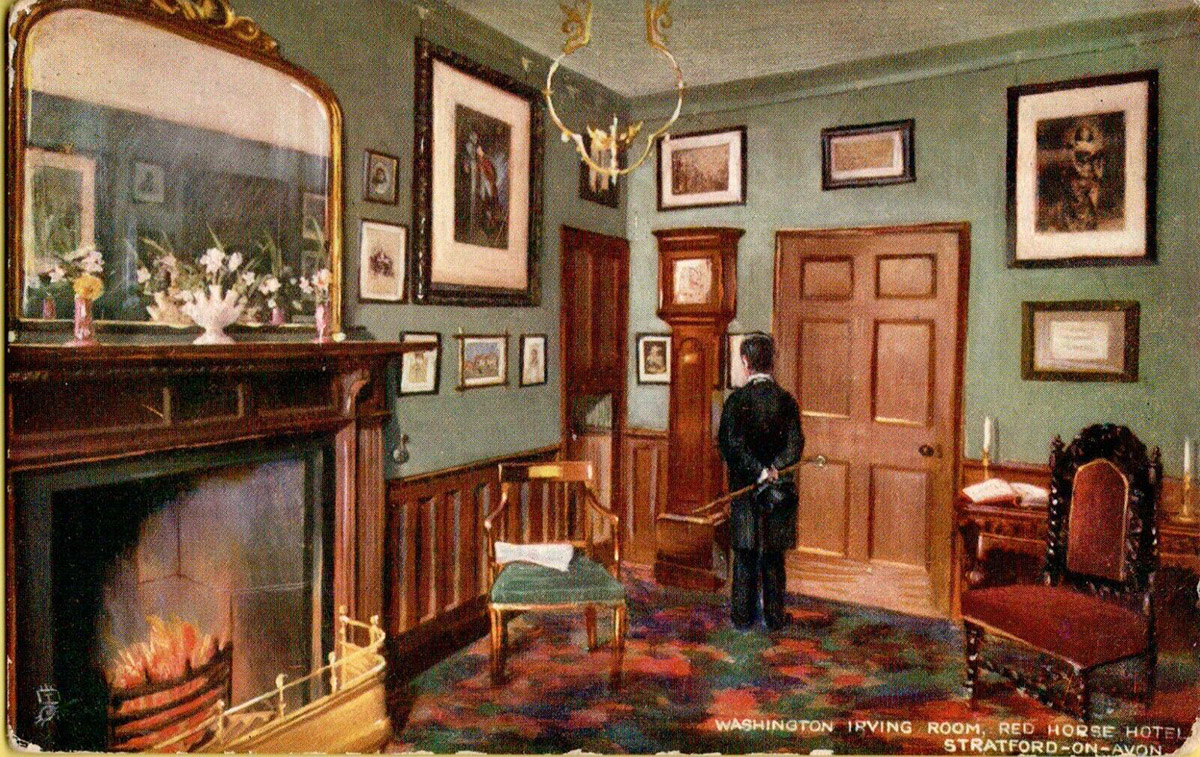
“Washington Irving Room, Red Horse Hotel, Stratford-on-Avon,” c. 1910, postcard printed by Raphael Tuck & Sons, London. Other than the addition of the man in the middle, the arrangement of elements in the painting is virtually identical to that of a photograph included in A. Van Doren Honeyman’s illustrated guidebook Bright Days in Merrie England (1901). Image: eBay.
In September 1831 Martin Van Buren, the newly appointed British minister, arrived in London, where Washington Irving had worked for the previous two years as a secretary at the American legation. Irving had planned to resign his position that year and return to the States in order to focus on his writing and on the family business, but he agreed to serve as chargé d'affaires until the new minister arrived. Before Irving went home, however, he took Van Buren and his son on a three-week excursion through England, including an obligatory stop at Stratford-upon-Avon, the hometown of William Shakespeare.

A decade earlier, in The Sketch Book of Geoffrey Crayon, Esq., Irving had written about his first visit to Stratford in July 1815. His essay mentioned a memorable stay at the Red Horse Inn, where, for the weary tourist, “The arm chair is his throne; the poker his sceptre, and the little parlour of some twelve feet square, his undisputed empire.” He was in for quite a surprise upon his return, though, as he related to his sister Catherine:
We next passed a night and part of the next day at Stratford-on-Avon, visiting the house where Shakspeare was born and the church where he lies buried. We were quartered at the little inn of the Red Horse, where I found the same obliging little landlady that kept it at the time of the visit recorded in the Sketch Book. You cannot imagine what a fuss the little woman made when she found out who I was. She showed me the room I had occupied, in which she had hung up my engraved likeness, and she produced a poker which was locked up in the archives of her house, on which she had caused to be engraved, “Geoffrey Crayon’s Sceptre.”
Although literary tourists had been making pilgrimages to Stratford ever since the actor David Garrick had hosted the Shakespeare Jubilee in 1769, Washington Irving’s little essay in The Sketch Book exponentially increased the flood of visitors to the small market town. “Americans, in particular, followed the tourist trail set out by Irving,” writes Julia Thomas in Shakespeare’s Shrine, “and, as they did so, appropriated or laid claim to Stratford-upon-Avon, transforming this quintessentially English site of pilgrimage into a curiously American one.” Tourists visited the home where Shakespeare was born and lived, with its ever-increasing accumulation of dubious “relics” (ranging from the playwright’s tobacco box to the little chair used by his son, Hamnet, who had died as a boy), and the gravesite and funerary monument in Holy Trinity Church. Those willing to stay an extra day could travel to the estate of Sir Thomas Lucy, who allegedly had Shakespeare arrested and punished for poaching deer and who was believed to have been the inspiration for the character of Justice Shallow in The Merry Wives of Windsor. (There is little evidence for any aspect of this tale.) Much to Irving’s dismay, however, another destination had been added: the Red Horse Inn parlor and the room in which Irving had slept in 1815 had been turned into lucrative shrines of their own.

Four years later, in 1835, the journalist Nathaniel Parker Willis, an overseas correspondent for the New York Mirror, came to Stratford. “I had stipulated with the hostess that my baggage should be put into the chamber occupied by Washington Irving,” he reported to readers of the newspaper. Willis met with Mrs. Gardiner, the same proprietor who had hosted Irving:
“I have brought up, mem,” she said, producing a well-polished poker from under her black apron, before she took the chair set for her at the table—“I have brought up a relic for you to see, that no money would buy from me.”

She turned it over in my hand, and I read on one of the flat sides at the bottom—“GEOFFREY CRAYON’S SCEPTRE.”
When Willis and his companion inquired how she knew that this poker was the same poker used by Irving, she responded:
“Why, sir, you see there’s a Mr. Vincent that comes here sometimes, and he says to me one day—‘So, Mrs. Gardiner, you’re finely immortalized. Read that.’ So the minnit I read it, I remembered who it was, and all about it, and I runs and gets the number three poker, and locks it up safe and sound, and by-and-by I sends it to Brummagem, and has his name engraved on it, and here you see it, sir—and I wouldn’t take no money for it.”
“Among all my many loiterings in many lands, I remember none more intellectually pure and gratifying, than this at Stratford-on-Avon,” Willis concluded. “My sleep in the little bed consecrated by the slumbers of the immortal Geoffrey, was sweet and light; and I write myself his debtor for a large share of the pleasure which genius like his lavishes on the world.”

The number of accounts by nineteenth-century literary figures about their own pilgrimages to the Red Horse Inn could be extended infinitely. “At Stratford I handled, too, the poker used to such good purpose by Geoffrey Crayon,” reported New-York Tribune correspondent Margaret Fuller in 1846. “The muse had fled, the fire was out, and the poker rusty, yet a pleasant influence lingered even in that cold little room, and seemed to lend a transient glow to the poker under the influence of sympathy.” Even the usually skeptical Ambrose Bierce paid homage when he, “by the merest accident, blundered into the famous ‘Red Horse Inn. . . . I took my meals in the ‘Irving Parlor,’ seated in the ‘Irving Chair’ (duly labelled with a brass plate), stirred my fire with the ‘Irving Poker’ (‘Geoffrey Crayon’s sceptre’), and gazed my fill at Irving in every style hanging against the papered walls.” Bierce was particularly impressed that, unlike other overpriced English tourist sites, he was presented with “a most moderate bill for most comfortable and gentlemanly accommodations.” The British novelist Mary Elizabeth Braddon opens Asphodel (1881) during "the season of American tourists doing Stratford and its environs, guide book in hand, and crowding in to The Red Horse parlour, after luncheon, to see the veritable chair in which Washington Irving used to sit.” By the end of the century, Thomas notes, the glorified poker “was wrapped up in an American flag and only brought out on special occasions.”

Both the chair and the poker seem to have vanished from public view by the mid-1930s. Today, the building that housed the Red Horse Inn is a Marks & Spencer department store. Irving’s essay, however, remains in print and we present it below.

Notes: The town of Stratford-upon-Avon is in the district of Stratford-on-Avon, but the names were often used interchangeably in nineteenth-century sources.

The Santa Casa of Loretto [Loreto], in Italy, is said to be the house in which the Virgin Mary lived at the time of the Annunciation, miraculously transported to the spot by angels at the end of the thirteenth century, just before Christian forces were expelled from the Holy Land. British engraver and author Samuel Ireland published his Picturesque Views on the Warwickshire Avon in 1795. The book’s anecdotes about Shakespeare and his times (including those quoted by Irving) are local traditions and legends, but shortly before publishing the book, Ireland fell victim to a series of Shakespearean forgeries, ranging from deeds, letters, and manuscripts to two complete plays, all fabricated by Ireland’s 19-year-old son and many of which initially fooled numerous “experts.” Reginald Scot, a member of Parliament during the 1580s, published The Discoverie of Witchcraft in 1584, a skeptical treatise exposing the charlatanism behind conjuring and similar practices.

In his footnote describing country gentlemen in the decades after Shakespeare, Irving quotes English cleric (later bishop) John Earle, who in 1628 anonymously published the humorous work Microcosmographie, or a Peece of the World discovered, in Essayes and Characters, poking fun at contemporary society and manners. Irving’s next quote, about “Mr. Hastings,” is from Remarks on Forest Scenery, and Other Woodland Views (1791) by English cleric and travel writer William Gilpin, although Gilpin was quoting a passage from John Hutchins’s History and Antiquities of Dorset (1784). .

*   *   *
To a homeless man, who has no spot on this wide world which he can truly call his own, there is a momentary feeling of something like independence and territorial consequence, when, after a weary day’s travel, he kicks off his boots, thrusts his feet into slippers, and stretches himself before an inn fire. . . .
If you don't see the full selection below, click here (PDF) or click here (Google Docs) to read it—free!

This selection may be photocopied and distributed for classroom or educational use.
Sunday, January 23, 2022

The Legend of the Enchanted Soldier

Washington Irving (1783–1859)
From Washington Irving: Bracebridge Hall, Tales of a Traveller, The Alhambra

The Fortress of the Alhambra, Granada, 1836, oil on canvas by Scottish artist David Roberts (1796–1864). Wikimedia Commons.
After spending two years in Madrid, Washington Irving went on a tour of southern Spain with two Russian diplomats he had befriended. His novelistic biography A History of the Life and Voyages of Christopher Columbus had just been published, and he intended to visit locations essential to the follow-up book, Chronicle of the Conquest of Granada. The dusty roads of Andalusia were notorious for its robbers, so the three travelers ended up hiring escorts who were themselves alleged to be former ladrones. In March 1818 he wrote to Antoinette Bollviller, the niece of the Russian minister in Spain, and complained, “I am now so surrounded by dirt and villainy of all kinds that I am almost ashamed to dispatch a letter to your pure hands from so scoundrel a place.”

But Irving’s attitude changed when the party came within view of the Alhambra. “Granada, bellissima Granada! think what must have been our delight, when, after passing the famous bridge of Pinos, . . . we turned a promontory of the arid mountains of Elvira, and Granada, with its towers, its Alhambra, and its snowy mountains, burst upon our sight,” he wrote. “The evening sun shone gloriously upon its red towers as we approached it, and gave a mellow tone to the rich scenery of the vega. It was like the magic glow which poetry and romance have shed over this enchanting place.” He spent a full day exploring the dilapidated towers of the fortress “in quest of the portal by which the unfortunate King Boabdil sallied forth” after surrendering Granada to Ferdinand and Isabella in 1492. According to legend, the gate had been walled up ever since, and Irving found it with the help of nearby residents, who seemed to have only a vague idea of its whereabouts. The Bāb al-Ghudūr, or Gate of the Wells, later known as the Gate of the Seven Floors, was indeed impassable—because of rubble from its destruction by Napoleon’s retreating troops in 1812.

In Irving’s letter to Bollviller, one can detect the new book forming in his mind:
For several days past we have been incessantly occupied traversing the city and its environs; but the Alhambra and Generalife have most excited our enthusiasm. The more I contemplate these places the more my admiration is awakened of the elegant habits and delicate taste of the Moorish monarchs. . . .

. . . I received from my poor devil guide many most curious particulars of the superstitions which circulate among the poor people inhabiting the Alhambra respecting its old, mouldering towers. I have noted down these amusing little anecdotes, and he has promised to furnish me with others. They generally relate to the Moors and the treasures they have buried in the Alhambra, and the apparitions of their troubled spirits about the towers and ruins where their gold lies hidden. When I have more time and paper, I may recount you some of these traditions, as I know you have a great relish for the marvellous.
The “poor devil guide” was seventeen-year-old Mateo Ximenez (Jiménez), whose family had made the Alhambra their home for generations, and he would assume a starring role in the book that emerged from Irving’s travels. Not only did this young helpmate attend to Irving during his visits to the fortress, he and his social circle relayed some of the local lore, which Irving would blend with his readings from Spanish sources and transform into “legends.”

The group spent ten days in the environs of Granada before moving on to the other cities in Andalusia. The following year, Irving made a first stab at drafting material for a book; he noted in his diary on January 3 that he wrote part of the “Story of the Enchanted Soldier of the Alhambra,” although four days later he indicated that he finished it “in a lame way.” He completed a second story before putting the project aside until May, when Irving returned to the Alhambra with another of the Russian diplomats, Prince Dimitri Dolgorukov. The prince would depart after a few days, but Irving established himself on the grounds and gathered additional material until the end of July, when he received the unexpected news that Secretary of State Martin Van Buren had appointed him as secretary of legation at the American embassy in England. The book was ultimately written in fits and starts during his tenure as a diplomat in London.

When The Alhambra—part travel sketches, part local tales—finally appeared in 1832, neither he nor his publishers anticipated either its immediate success or its enduring appeal. Yet the first edition bears only a partial resemblance to the collection published in dozens of editions and translations for the last 170 years. “The Legend of the Enchanted Soldier,” for example, did not even appear in the 1832 edition; Irving was apparently unable to shape that first tale into satisfactory form. Two decades later, Irving reviewed his notes from both his visits, rearranged the contents, expanded and revised several of the existing pieces, and added new material. The expanded edition of The Alhambra appeared in 1851 as the final book of the fifteen-volume Works of Washington Irving, which would sell an astonishing 350,000 copies. What had been a random assortment of sketches and tales became a far more thematically coherent travelogue, and the new collection included a publication-worthy version of “The Enchanted Soldier,” which became a staple of secondary school textbooks by the end of the century. The historian Richard L. Kagan, in his recent book The Spanish Craze, concludes that the international success of The Alhambra in both its forms almost singlehandedly replaced “the prevalent Anglo-American view of Spain as a dark, sinister, almost gothic country ruled by tyrannical monarchs and fanatical priests” with an image of a sunny land that was “charming, hospitable, and, most important, relentlessly romantic and picturesque.”

Notes: Carvajal is an old town on the main road from Malaga to Cadiz. According to legend, the architect Trophonius was swallowed into the earth after asking the gods to reward him for building Apollo's temple at Delphi, and thereafter he gave oracles in a cave at Lebadea. The seventeenth-century German Jesuit scholar Athanasius Kircher published works on hieroglyphics, archaeology, biology, physics, math, and Asian languages.

*   *   *
Every body has heard of the Cave of St. Cyprian at Salamanca, where in old times judicial astronomy, necromancy, chiromancy, and other dark and damnable arts were secretly taught by an ancient sacristan; or, as some will have it, by the devil himself, in that disguise. . . . If you don't see the full selection below, click here (PDF) or click here (Google Docs) to read it—free!

This selection may be photocopied and distributed for classroom or educational use.

Sunday, November 8, 2020

The Poor Devil Author

Washington Irving (1783–1859)
From Washington Irving: Bracebridge Hall, Tales of a Traveller, The Alhambra

The Poor Author and the Rich Bookseller, 1811, oil on canvas by American painter Washington Allston (1779–1843). Museum of Fine Arts, Boston. Click on image to see full painting.

Allston was Washington Irving’s closest American friend in London from 1815 to 1818 (when Allston returned to the United States). Although an episode in “The Poor Devil Author” seems to evoke the above scene, it is not known if Irving had ever seen the painting or if perhaps Allston had described it to him.
After the extraordinary success of The Sketch Book, with its world-famous stories “Rip Van Winkle” and “The Legend of Sleepy Hollow,” Washington Irving struggled to write a follow-up. In 1821 the Irish poet Thomas Moore suggested that he might bring back the resident bachelor of Bracebridge Hall featured in the first volume and expand upon his “remarks and sketches of human manners and feelings.” Ten days later, Irving had dashed off 130 manuscript pages and, as biographer Stanley T. Williams puts it, “Moore’s penalty for his ingenuity was to hear Irving read these aloud. This the author did, sitting on the grass at La Butte,” an estate outside Paris where Moore and his family were living and where Irving was wearing out his welcome as a guest. Moore noted in his journal that he found the material “amusing,” but that it would “I fear, much disappoint the expectations his Sketches have raised.”

Moore especially liked one of the new pieces, titled “Buckthorne,” which was an autobiographical tale of literary life. The descriptions were so faithful to his and Irving’s social circle, however, that he wrote, “I very much fear my friends in Paternoster Row will know themselves in the picture.” Moore and his associates were spared the infamy when Charles Robert Leslie, an English artist who had befriended Irving (and had painted a well-known portrait of him), convinced the author to remove the piece from Bracebridge Hall and instead turn it into a novel. During the next two years, as Irving moved variously among London, Paris, Vienna, Dresden, Prague, and other spots in Europe, he would occasionally remove the excised selection from his trunk, with the goal of turning it into the debut novel that he very much wanted to write and that he tentatively named “History of an Author.”

The debut-to-be was a fictionalized portrait of a young writer whose social circle had given up careers to live in the service of art—much as Irving had done. In a letter to his brother sent in March 1819, Irving defended his decision to turn down the offer of a steady-paying job as a clerk in the Navy Department and instead dedicate himself to writing:
. . . I find my declining the situation at Washington has given you chagrin. The fact is, that situation would have given me barely a genteel subsistence. It would have led to no higher situations, for I am quite unfitted for political life. My talents are merely literary, and all my habits of thinking, reading, etc., have been in a different direction from that required for the active politician. It is a mistake also to suppose I would fill an office there, and devote myself at the same time to literature. I require much leisure and a mind entirely abstracted from other cares and occupations, if I would write much or write well. . . . If I ever get any solid credit with the public, it must be in the quiet and assiduous operations of my pen, under the mere guidance of fancy or feeling.
As he added to his fictional portrait of Buckthorne, he worked in revised passages from journals and letters written during the initial years of his career, but his earlier defensive attitude concerning literary life increasingly became one of satire and gentle mockery.

After the publication of Bracebridge Hall, Irving collected materials for a third “sketch book,” this one primarily containing tales adapted from old Germanic legends. Writer’s block, a dashed love affair with his 18-year-old French tutor, the distraction of theater productions, and a recurring illness conspired to keep him from finishing either the new collection or the Buckthorne novel. Finally, financial necessity broke through all obstacles and he finished assembling his next book by binge-writing a number of tales and then simply combining the two projects. The first, third, and fourth parts of Tales of a Traveller were devoted to stories about (respectively) ghosts, “banditti,” and pirates while the second part contained, incongruously, the comic material he had written for his now-abandoned novel, which he retitled “Buckthorne and His Friends.” Irving would, in fact, never publish a novel.

In its final form, the “Buckthorne” section portrays a group of young artists living in London. In one of the sketches, the narrator and Buckthorne visit the Club of Queer Fellows (“a great resort of the small wits, third-rate actors, and newspaper critics of the theatres”) and encounter a patron whose quips have the assemblage repeatedly bursting out in laughter. The man turns out to be Thomas Dribble, who “had been the prime wit and great wag of the school in their boyish days, and one of those unlucky urchins denominated bright geniuses.” A few days later, they visit Dribble in his lodgings and a hear “a brief outline of his literary career,” which Irving presents as a separate tale.

Dribble begins by recalling when he wrote his first supposed masterpiece. He had been inspired by the “Pleasure poems” of the seventeenth century, a series of works by multiple authors launched by Mark Akenside’s “Pleasures of Imagination” that became all the rage with the reading public. Dribble abandons a legal career to write his own version, “Pleasures of Melancholy.” Convinced by his friends of its brilliance, he heads for London in search of a publisher—and the subsequent humiliations are detailed in “The Poor Devil Author.”

Notes: The term blues is short for bluestockings. The first pages of the story mention numerous eighteenth-century British literary figures of varying fame. Lady Mary Wortley Montagu was a noted letter writer. Bernard Lintot was a prominent printer whose uncouth appearance was mocked by Alexander Pope in The Dunciad. Richard Steele was an Irish writer and the co-founder, with Joseph Addison, of the magazine The Spectator. Cockney pastorals were poems by Leigh Hunt and others, who were derided as the “Cockney School of Poetry,” largely because they were writers of “low birth.” 

Jack Straw’s Castle was a pub on Hampstead Heath, named for a leader of the Peasants’ Revolt of 1381, although Straw’s “council of war” recalled by Dribble was not held there. Allan a’Dale (Alan-a-Dale) was one of Robin Hood’s legendary band of outlaws. The son of a Hampstead innkeeper, Dick Turpin was a notorious criminal who was hanged for his crimes in 1739. Knights of the Post are perjurers, so-called because their “knighthood” often involves the whipping post. The term yellow boys refers to gold pieces. The original Newgate Calendar, named for the famous London prison, is a record of notorious crimes from 1700 to 1774; continuations were published through 1826. Lalla Rookh: An Oriental Romance was a book of four tales in verse by Irving’s friend Thomas Moore. The Bow Street Office was the principal London police court and headquarters of the Bow Street Runners, a police force organized in 1753 by magistrate and novelist Henry Fielding and his half-brother John.

*   *   *
I began life unluckily by being the wag and bright fellow at school; and I had the further misfortune of becoming the great genius of my native village. . . . If you don't see the full selection below, click here (PDF) or click here (Google Docs) to read it—free!

This selection may be photocopied and distributed for classroom or educational use.

Saturday, January 11, 2020

William Wilson

Edgar Allan Poe (1809–1849)
From Selected Tales, with The Narrative of Arthur Gordon Pym

“A masquerade in the palazzo of the Neapolitan Duke di Broglio.” Frontispiece illustration by British artist Byam Shaw (1872–1919) for Selected Tales of Mystery by Edgar Allan Poe (London, 1909). Click on image to see full painting. Via the Internet Archive.
In October 1839 thirty-year-old Edgar Allan Poe sent Washington Irving a copy of the latest issue of Burton’s Gentleman’s Magazine, a literary periodical published in Philadelphia. William Burton had hired Poe as his assistant editor only a few months earlier and the October number included Poe’s latest tale, “William Wilson.” Poe enclosed a cover letter with the issue, ostensibly to disclose that the story was based on Irving’s “An Unwritten Drama of Lord Byron” (1836). But he also had an ulterior motive: Poe wanted a blurb.
[If] I could be permitted to add even a word or two from yourself, in relation to the tale of “William Wilson” (which I consider my best effort) my fortune would be made. I do not say this unadvisedly—for I am deliberately convinced that your good opinion, thus permitted to be expressed, would ensure me that public attention which would carry me on to fortune hereafter, by ensuring me fame at once.
Since returning from Europe in 1832, Irving had done much to help younger American writers, and he responded without hesitation as soon as the letter reached him at his home in Tarrytown. “I have read your little tale of ‘William Wilson’ with much pleasure,” Irving wrote. “It is managed in a highly picturesque style, and the singular and mysterious interest is well sustained throughout. . . . I cannot but think a series of articles of like style and merit would be extremely well received by the public.” Irving added that he much preferred this new work over Poe’s previous story in the magazine, which suffered from “too much coloring.” (That tale, incidentally, was “The Fall of the House of Usher.”) While the endorsement might seem somewhat equivocal, Poe boasted to one editor that Irving’s support represented “a complete triumph over those little critics who would endeavor to put me down by raising hue and cry of exaggeration in style, of Germanism & such twaddle.” The quote from Irving was featured prominently in publicity for Poe’s new book, Tales of the Grotesque and Arabesque.

Three years later, Poe published a review of Nathaniel Hawthorne’s Twice-Told Tales, which appeared in two volumes in 1837 and 1842, and he was effusive in his praise: “Mr. Hawthorne’s distinctive trait is invention, creation, imagination, originality—a trait which, in the literature of fiction, is positively worth all the rest.” Yet, in spite of the acknowledgment of Hawthorne’s originality, Poe found echoes of his own work in one of the selections in the second volume. “In ‘Howe’s Masquerade’ we observe something which resembles a plagiarism—but which may be a very flattering coincidence of thought.” The ghostly doppelgänger, the climactic scene at a masquerade, the quarrel, the revealing items dropped on the floor—Poe notes that all these elements in Hawthorne’s story also appear near the end of “William Wilson.” "We have not only the same idea, but the same idea similarly presented in several respects.”

The half-hearted suggestion of “plagiarism” is nonsense, particularly because “Howe’s Masquerade” originally appeared in a magazine more than a year before the publication of Poe’s story. In the 1930s the poet Horace Thorner examined the evidence and determined that Hawthorne, too, had almost certainly based his story on Irving’s “Unwritten Drama,” and the common elements in all three tales can be found in literary works and legends dating back to the seventeenth century. In a recent scholarly essay Meghan A. Freeman suggests a likely motive for Poe’s pointing out the similarities between his and Hawthorne’s tales. “By drawing attention to their stories about doppelgängers, Poe is encouraging the reader to see the two authors as doppelgängers, notwithstanding surface distinctions, styles, and interests.”

“William Wilson” is unique among Poe’s short stories for its semi-autobiographical depiction of boyhood and the setting of its first half at an English boarding school—an institution very much like the Manor House School north of London, which young Poe attended for three years. Poe even uses the name of the head of the real school, Rev. John Bransby, for his fictional schoolmaster. Poe’s self-identification as the “original” of the young William Wilson is cemented by the fact that the story’s protagonist shares Poe’s birthday, “the nineteen of January.” Furthermore, in subsequent printings of the story Poe changed Wilson’s year of birth from 1809 to 1811 to 1813, exactly as Poe advanced the year of his own birth by two, then four years—or two years after his mother’s death. As Poe (or Burton, or both of them working together) noted in an unsigned section of miscellaneous items in Burton’s magazine, “The infirmity of falsifying our age is at least as old as the time of Cicero, who, hearing one of his contemporaries attempting to make out that he was ten years younger than he really was, very drily remarked, ‘Then, at the time you and I were at school together, you were not born.’”

Notes: The story’s epigraph is supposedly from William Chamberlayne’s verse romance Pharonnida (published in 1659; Poe misspells both title and author), but the lines are not to be found in the poem. Scholars cite vaguely similar lines (“Conscience waits on me, like the frightening shades / Of ghosts when ghastly messengers of death”) in Chamberlayne’s play Love’s Victory (1658) and speculate that Poe, writing from memory, had misremembered both quote and source. Elah-Gabalus (Elagabalus, or Heliogabalus), named after the sun god Elah-Gabal, was a third-century Roman emperor with a reputation for decadence and lasciviousness during a tumultuous four-year reign that concluded with his assassination at the age of eighteen by his own guards. Peine fort et dure (mentioned on page 77) was a form of torture, used as late as 1692, during the “Salem witchcraft” episode, in which the victim was slowly pressed to death. “Oh, le bon temps, que ce siècle de fer!” (page 78) translates as “That age of iron—how good it really was!” Born to a notably wealthy Greek family at the beginning of the second century, Herodes Atticus (page 87) became a Roman senator and consul. Known as a patron of the arts and of buildings (including the Herodion in Athens), he oversaw the education of future emperors Marcus Aurelius and Lucius Verus.

*   *   *
Let me call myself, for the present, William Wilson. The fair page now lying before me need not be sullied with my real appellation. . . . If you don't see the full selection below, click here (PDF) or click here (Google Docs) to read it—free!

This selection may be photocopied and distributed for classroom or educational use.

Saturday, June 22, 2019

Rip Van Winkle

Washington Irving (1783–1859)
From Washington Irving: History, Tales and Sketches

The Return of Rip Van Winkle, 1849, oil on canvas by American painter John Quidor (1801–1881). Quidor's painting “accurately sets the scene in the Catskills and shows brick houses with step-gabled, Dutch roofs.” Image and description courtesy National Gallery of Art.
Found among Washington Irving’s papers are fragments of what might have been notes for a memoir, scribbled down in spare moments during either 1843 or 1845 (the date is hard to decipher), when he was the American minister to Spain under President John Tyler. In one entry he describes the genesis of his most famous story:
When I first wrote the Legend of Rip van Winkle my thought had been for some time turned towards giving a colour of romance and tradition to interesting points of our national scenery which is so deficient generally in our country. My friends endeavored to dissuade me from it and I half doubted my own foresight when it was first published from the account of the small demand made for that number, but subsequent letters brought news of its success and of the lucky hit I had made. The idea was taken from an old tradition I picked up among the Harz Mountains.*
Two hundred years ago, on June 23, 1819, the first paperbound number of Irving’s The Sketch Book of Geoffrey Crayon, Gent. was printed in four American cities by the coincidentally named publisher Cornelius S. Van Winkle. The entire work, a miscellany of stories and essays, appeared in seven parts over the course of the next fifteen months. The last piece in the first issue was “Rip Van Winkle,” advertised as a newly discovered work by the late Diedrich Knickerbocker, the elderly (and wholly fictitious) author of Irving’s previous book, A History of New York. Living in London at the time, Irving then arranged for a British edition of The Sketch Book to be printed at his expense, but the publisher went bankrupt. At the urging of Walter Scott (whose immensely popular novel Ivanhoe had appeared only months earlier), another printer bought the inventory for Irving’s book and brought it out instead. The story—indeed, The Sketch Book as a whole—became a huge success on both sides of the Atlantic and made Irving an international celebrity.

The idea for “Rip van Winkle” first came to Irving in June 1818, when he was visiting his sister in Birmingham. He had just finalized bankruptcy proceedings after the business he operated with his brothers failed, and he was determined to try to make a go of it as a writer. He and his brother-in-law were having an after-dinner chat, recalling nostalgically younger days in the Hudson River valley when, family lore has it, Irving had a flash of inspiration, shut himself in his room, and rushed out a draft, which he then read to the household the next day. The basis for his story was a folk tale, “Peter Klaus the Goatherd,” in the collection Volkssagen (1800), one of the books Irving read while he was studying German. Set in the Harz Mountains of northern Germany (where Irving had not yet been), the old tale provided him with the basic plot and several details. Irving moved the action to the period before and after the American Revolution and changed the location to the Catskills—where he had also never been, having only viewed their slopes from a distance.

“The borrowings are obvious,” writes historian Andrew Burstein in his 2007 biography The Original Knickerbocker: The Life of Washington Irving. “The strange silent men and their bowling game, the alcohol-induced twenty-year sleep in the mountains, the grown-up daughter who acknowledges her father. Irving’s genius lies in the hypnotic charm his simple story holds, for he makes Rip a more sympathetic being than Peter Klaus.” Literary scholar Walter Evans likewise contends that, in spite of Irving’s thorough appropriation of an old legend, the story’s importance to the history of literature can not be overstated. By combining two traditions—the essay-sketch and the tale—Irving introduced readers to the genre of the short story as we know it. Furthermore, the addition of Diedrich Knickerbocker as narrator in the story’s metafictional frame “helps make ‘Rip Van Winkle’ more than Western civilization's first significant short story and more than one of the best ever written. After generations of readers the story still seems to be one of the most modern.”

* The fragments were first published in Barbara D. Simison, “Some Autobiographical Notes of Washington Irving,” The Yale University Library Gazette (July 1963).

Notes: A volume of black letter mentioned in the introduction to the story refers to an old book set with a heavy Gothic typeface. A Waterloo medal was a commemorative silver medal presented to all British soldiers who served against Napoleon in the battle on June 16–18, 1815. Queen Anne farthings, coined late in her reign, were not intended for circulation but eventually became used as money. The epigraph that opens the main story is from The Ordinary, a comedy written in the 1630s by British playwright William Cartwright. A red night cap was the Phrygian cap that became a symbol of liberty during the Revolutionary era
.

*   *   *
The following Tale was found among the papers of the late Diedrich Knickerbocker, an old gentleman of New York, who was very curious in the Dutch history of the province, and the manners of the descendants from its primitive settlers. . . . If you don't see the full selection below, click here (PDF) or click here (Google Docs) to read it—free!

This selection may be photocopied and distributed for classroom or educational use.

Sunday, March 31, 2019

The Spectre Bridegroom

Washington Irving (1783–1859)
From Washington Irving: History, Tales and Sketches

Detail from La Ballade de Lénore ou les Morts vont vite [The Ballad of Lenore, or The Dead Travel Fast], 1839, oil on canvas by French artist Horace Vernet (1789-1863). Courtesy of The Athenaeum. Click on the image to see the entire painting.
First published in seven paperback numbers in New York (and simultaneously in Boston, Philadelphia, and Baltimore) in 1819 and 1820, Washington Irving’s The Sketch Book of Geoffrey Crayon, Gent. contains more than thirty selections: short stories, travel pieces, historical accounts, sketches of British town and country life, literary essays, and portraits of vanishing traditions, including five chapters describing an old-fashioned Christmas celebration at an English estate. Narrated by Irving’s fictitious alter ego, Geoffrey Crayon, the collection became the first American literary work to enjoy success in Europe, instantly making the 37-year-old author a celebrity abroad.

The Sketch Book includes Irving’s two most famous works, “Rip Van Winkle” and “The Legend of Sleepy Hollow,” both set in America but inspired by German folk tales. If we were asked to name the collection’s third most popular entry, we would probably point to “The Spectre Bridegroom.” In fact, during the last two centuries various book publishers have extracted this particular trio of stories and reprinted them either individually or together, often with illustrations.

Like his two more famous stories, “The Spectre Bridegroom” was inspired by German legends, but this time Irving retained the location and period of the original material. The most obvious source is Gottfried August Bürger’s Lenore (1774), which Irving mentions in passing within the story itself. Bürger’s ballad depicts a young woman whisked away from her home on horseback by an apparition that resembles her lost fiancé, who had gone missing in action on the battlefield. The poem was first introduced to English readers in 1796, when the still-unknown Walter Scott published a loose translation with the title “William and Helen.” Irving, almost certainly familiar with the original German ballad, turns the tale on its head and presents a ghost story that is more burlesque than Gothic.

Preceding “The Spectre Bridegroom” in The Sketch Book is “The Inn Kitchen,” one of the short framing interludes chronicling Geoffrey Crayon’s travels. While staying in a small Flemish village inn, Crayon hears laughter emanating from the kitchen, where he finds a group of travelers and local “hangers on” sharing stories, “some very extravagant, and most very dull.” The only tale Crayon remembers is the one presented here as our Story of the Week selection, but before sharing it with his readers he describes the man who told it:
He was a corpulent old Swiss, who had the look of a veteran traveller. . . . He was interrupted more than once by the arrival of guests, or the remarks of his auditors; and paused now and then to replenish his pipe; at which times he had generally a roguish leer, and a sly joke for the buxom kitchen-maid.

I wish my readers could imagine the old fellow lolling in a huge arm chair, one arm akimbo, the other holding a curiously twisted tobacco pipe, formed of genuine écume de mer [meerschaum], decorated with silver chain and silken tassel—his head cocked on one side, and a whimsical cut of the eye occasionally, as he related the following story.

Notes: Irving’s epigraph is from the Middle English romance The History of Sir Eger, Sir Grahame, and Sir Gray-Steele. The earliest extant copy is a Glasgow edition from 1669. The Heldenbuch (“Book of Heroes”) is a collection of fourteenth-century German epic poetry. Minne-lieders are love songs sung by medieval German troubadours. The great Heidelberg tun is an enormous cask for wine in the castle of Heidelberg. The first one was built in 1591. Saus und Braus are revelry and riotous living.

*   *   *
On the summit of one of the heights of the Odenwald, a wild and romantic tract of Upper Germany, that lies not far from the confluence of the Main and the Rhine, there stood, many, many years since, the castle of the Baron Von Landshort. . . . If you don't see the full selection below, click here (PDF) or click here (Google Docs) to read it—free!

This selection may be photocopied and distributed for classroom or educational use.

Friday, March 30, 2018

The Bold Dragoon, or the Adventure of My Grandfather

Washington Irving (1783–1859)
From Washington Irving: Bracebridge Hall, Tales of a Traveller, The Alhambra

“The Bold Dragoon,” illustration by American artist F. O. C. Darley (1822–1888) for Irving Vignettes: Vignette Illustrations of the Writings of Washington Irving (1858).
Flush from the twin successes of The Sketch Book and Bracebridge Hall, Washington Irving planned an excursion through the European continent in 1822, on the lookout for material for his next book. “I mean to get into the confidence of every old woman I meet with in Germany and get from her, her budget of wonderful stories,” he wrote to a friend. His enjoyment of the trip reached a pinnacle at the end of the year upon his arrival in Dresden, where he received the kind of reception usually reserved for an internationally famous dignitary.

As the new year dawned, however, he was confronted with an unexpected challenge: writer’s block. In addition, his productivity was hardly helped by several distractions. He fell in love with 18-year-old Emily Foster, who was teaching him French and who would soon marry someone else. He also became enamored by the theater, working with little compensation on a series of stage productions and the translations of two German operas into English. And throughout the period he suffered from recurring inflammation of his legs and ankles. Finally, at the beginning of 1824, he wrote to friends and admitted that his increasingly dismal financial situation had forced the issue: “I shall run low in purse before I can get a work ready for publication.”

Over the next few months he appealed to his European acquaintances for anecdotes, legends, and stories. The resulting volume—Tales of a Traveller—is quite unlike his previous two best sellers, each of which resembles a leisurely tour of England punctuated by literary discussion and a scattering of stories. “Tales was destined to disappoint,” writes Irving scholar Judith Giblin Haig. “Irving’s public expected a sketch book based on his year-long odyssey in Germany; he gave them instead a four-part miscellany of short fiction, his most extensive specimen of the genre in which American literary historians would regard him as a pioneer.” Sales were anemic and reviews were mixed, and the volume has slid into obscurity since its publication. Yet several of the stories have long been held in high regard, perhaps most famously Irving’s retelling of the Faust legend, “The Devil and Tom Walker.” Another story from the collection, “The Bold Dragoon,” found a new audience when in 1930 it was chosen as the title selection in a popular volume of Irving’s fantasy stories edited by prominent children’s librarian Anne Carroll Moore and illustrated by modernist painter James Daugherty.

Irving included “The Bold Dragoon” in Tales’s first section, “Strange Stories by a Nervous Gentleman,” a series of stories shared at a hunting dinner hosted by a Baronet and attended by a group of bachelors, including an Irish captain of dragoons, an “inquisitive” gentleman, and the “nervous” gentleman who serves as the narrator. “The Bold Dragoon” is the last in a short sequence of comic pieces featuring ghosts (or the possibility of ghosts), and it concludes with the promise that the next tale abandons this “burlesque tendency” for a story “of a very grave and singular nature.” That subsequent selection, “The Adventure of the German Student,” has previously appeared as a Story of the Week selection, should intrigued readers want to keep going after they’ve finished this week’s selection.

Note: Among the Dutch words used in the story are ya vrouws (juffrouws, or maidens) and die duyvel (that devil). The legend on the sign (page 412) translates, “Good drink sold here.” Ally Croaker (page 414) was a popular eighteenth-century Irish song.

*   *   *
“But I don’t see, after all,” said the inquisitive gentleman, “that there was any ghost in this last story.” . . . If you don't see the full selection below, click here (PDF) or click here (Google Docs) to read it—free!

This selection may be photocopied and distributed for classroom or educational use.

Saturday, December 9, 2017

Thurlow’s Christmas Story

John Kendrick Bangs (1862–1922)
From American Fantastic Tales: Terror and the Uncanny from Poe to the Pulps

“Face to Face,” “The Demon Vanished,” and “Look at Your So-Called Story and See.” Three drawings by American illustrator Arthur Burdett Frost (1851–1928) that accompanied “Thurlow’s Christmas Story” when it appeared in the 1894 Christmas issue of Harper’s Weekly.
For most of the nineteenth century—and in some places well into the twentieth—Christmas was the occasion for telling scary tales. “No one quite knows why winter, and Christmas more specifically, became the time of ghost stories,” writes Judith Flanders in her just-published book, Christmas: A Biography. The prevailing belief is that the combination was a natural outgrowth of the long winter nights and the pagan rituals linked to the winter solstice. As Prince Mamillius announces in Shakespeare’s A Winter’s Tale, “A sad tale’s best for winter; I have one / Of sprites and goblins.” The novelist Paul Theroux describes the tradition as “a revolt against sanctimony—Christmas pulls one way, pagan skepticism the other, and the result is frequently a blend of the pious and supernatural.”

The most famous Christmas ghost story is, of course, Charles Dickens’s A Christmas Carol (1842), but the custom of telling such tales at Christmas—and of writing supernatural Christmas stories—predates Ebenezer Scrooge by centuries. Jon Kaneko-James, a researcher specializing on supernatural topics in literature, summarizes the frequent mention of revenants at Christmastime in medieval Icelandic sagas. Flanders identifies a book from 1658 (the snappily titled An history of apparitions, oracles, prophecies, and predictions with dreams, visions, and revelations and the cunning delusions of the devil, to strengthen the idolatry of the gentiles, and the worshipping of saints departed) that “includes five tales that link ghosts and ghostly happenings to the holidays.” The late David Parker, who was the curator of the Charles Dickens Museum, claimed that the first book devoted entirely to supernatural Christmas tales may have been the popular Round about Our Coal-Fire: or, Christmas Entertainments (c. 1730), which went through several editions in the decade it first appeared and which featured tales about ghosts and ogres, including “The Story of Jack Spriggins and the Enchanted Bean,” an early version of Jack and the Beanstalk.

In 1820 Washington Irving described in “The Christmas Dinner” the festivities at the “old-fashioned” Bracebridge Hall in the English countryside. After a lavish meal and children’s games, the parson sits in “a high-backed oaken chair” in the drawing room and relates “strange accounts of popular superstitions and legends of the surrounding country.” Most of the tales shared by the parson and by others in the company concern a crusader whose crypt is in the nearby church; “the gold and jewels buried in the tomb, over which the spectre kept watch”; and “all kinds of ghosts, goblins, and fairies” associated with his legend.

By the end of the nineteenth century the Christmas ghost story had become so ubiquitous that in 1891 the British humorist Jerome K. Jerome would grouse:
Whenever five or six English-speaking people meet around a fire on Christmas Eve, they start telling each other ghost stories. Nothing satisfies us on Christmas Eve but to hear each other tell authentic anecdotes about spectres. It is a genial, festive season, and we love to muse upon graves, and dead bodies, and murders and blood.
And so in 1894, when John Kendrick Bangs, the humor editor at Harper’s Weekly, had to write a piece for the magazine’s Christmas number, he slyly submitted “Thurlow’s Christmas Story,” about a writer haunted by phantasmal visions while struggling to come up with “the usual ghostly tale with a dash of the Christmas flavor thrown in here and there.” As the deadline for the story looms, a mysterious visitor arrives and presents a Faustian opportunity to publish the masterpiece that will ensure the writer’s literary reputation long after his death. Bangs himself never seemed to suffer from writer’s block; during a career lasting four decades, he published dozens of books and hundreds of stories and sketches. Virtually everything he wrote is now forgotten, and his name has become an arcane footnote for his creation of “Bangsian fantasies,” a subgenre in which famous figures from literature and history are characters in an otherworldly afterlife. Although (as far as we know) Bangs made no Faustian bargain when he wrote “Thurlow’s Christmas Story,” it seems fitting that out of his entire oeuvre this frequently anthologized tale is the work for which he is most remembered a century after his death.

Note: On page 171, Bangs namechecks a quartet of nineteenth-century authors who inspired many of his own stories, as well as the “masterpiece” written by the visitor in this story. In addition to Edgar Allan Poe, he mentions E.T.A. Hoffmann, a Prussian writer of Gothic horror; Friedrich de la Motte Fouqué, the German writer most famous for his fairy tale Undine; and Fitz James O’Brien, an Irish American story writer and poet whose various fantastic tales are regarded by literary historians as important precursors to science fiction.

*   *   *
I have always maintained, my dear Currier, that if a man wishes to be considered sane, and has any particular regard for his reputation as a truth-teller, he would better keep silent as to the singular experiences that enter into his life. . . . If you don't see the full selection below, click here (PDF) or click here (Google Docs) to read it—free!

This selection may be photocopied and distributed for classroom or educational use.