Showing posts with label Nathaniel Hawthorne. Show all posts

Sunday, April 14, 2024

The Romance of Certain Old Clothes

Henry James (1843–1916)
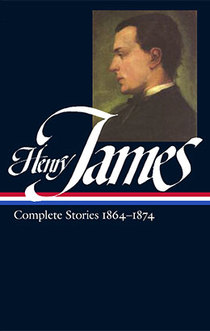
From Henry James: Complete Stories 1864–1874

Detail from The Bride, 1856, oil on canvas by English painter Abraham Solomon (1823–1862). (WikiCommons)
When Henry James was twenty-two years old, he published in the pages of The Nation a review of Aurora Floyd, the latest novel by Mary Elizabeth Braddon, an English author who three years earlier had published the extraordinarily popular Lady Audley's Secret. James criticized the excesses of Braddon’s “sensation novels,” as they were called: “Bigamy, murder, and arson are exceptional. Miss Braddon distributes these materials with a generous hand, and attracts the attention of her public.” He compared Braddon’s novels with other sensational romances and made a comment in passing that would inform all future discussions of his later novella The Turn of the Screw:
A good ghost story, to be half as terrible as a good murder-story, must be connected at a hundred points with the common objects of life. The best ghost story probably ever written—a tale published some years ago in Blackwood's Magazine—was constructed with an admirable understanding of this principle.
The unnamed tale praised by James, as many of his readers would have known, is Edward Bulwer-Lytton’s “The Haunted and the Haunters” (1859), in which its narrator enunciates the author’s view “that the Supernatural is the Impossible, and that what is called supernatural is only a something in the laws of nature of which we have been hitherto ignorant.” The implication, then, is that a tale of the inexplicable, to be successful, needed to have its basis in reality.

When James wrote his review, he had published only two of his 112 stories and novellas. Three years later, he published “The Romance of Certain Old Clothes,” his eighth work of short fiction—and the first of eighteen tales of a genre James referred to as “quasi-supernatural” or “gruesome,” ten of which are often categorized as ghost stories. While one can find in this ghostly tale subdued hints of his readings of sensational literature, the most obvious influence is the Gothic fiction of Nathaniel Hawthorne.

Four years earlier, when Hawthorne died at the age of 59, James was devastated: “I sit on my belated bed, I say, and yield to the pang that made me positively and loyally cry,” he recalled in his memoir Notes of a Son and Brother. For much of his career James would seem both to incorporate and to resist Hawthorne’s influence. “If you have a mind to, you can see Nathaniel Hawthorne in Henry James’s work at the very beginning, in the middle years, and perhaps most impressively in the last masterpieces,” the literary scholar Peter Buitenhuis more than half a century ago. “Everywhere you look in James you find Hawthorne.”

In 1879 James published Hawthorne, a book-length work of literary criticism, in which he expressed his mixed feelings about the stories and novels by the idol of his youth. “There is in all of them something cold and light and thin, something belonging to the imagination alone, which indicates a man but little disposed to multiply his relations, his points of contact, with society.” This lack of connection to the world outside Hawthorne’s door was, in James’s view, displaced by the confines of the imagination—and even the fantastic:
Hawthorne was a man of fancy, and I suppose that in speaking of him it is inevitable that we should feel ourselves confronted with the familiar problem of the difference between the fancy and the imagination. . . . I am often struck, especially in the shorter tales, of which I am now chiefly speaking, with a kind of small ingenuity, a taste for conceits and analogies, which bears more particularly what is called the fanciful stamp.
James had foreshadowed this criticism in various places, included an 1874 review of one of the melodramatic novels of Hawthorne’s son:
Mr. Julian Hawthorne, who is doubtless weary of being contrasted with his father, has not the latter’s profundity or delicacy; but he looks at things in the same way—from the imagination, and not from observation—and he is equally fond of symbolisms and fanciful analogies.
“The Romance of Certain Old Clothes” was James’s first attempt to bridge the chasm between the real world and the imaginative one. Set in colonial Massachusetts, this Hawthorne-like story about sibling rivalry ends with an unambiguously supernatural element. Unlike most of James’s earliest stories, it was revised and reprinted in his story collections, once in 1875 and again in 1885. Yet the story fell short of the standards he later developed for himself—the supernatural twist is sudden, sensational, and explicit—and he excluded it from the 26-volume New York edition published between 1907 and 1909. As T. J. Lustig writes in Henry James and the Ghostly, “Opening the Pandora’s box of romance, James discovers that in practice there is a contradiction, or at least an incompatibility, between realism and the ghost story.”

Nevertheless, the story still has many fans: it has often been included in anthologies of Gothic and horror fiction (including American Gothic Tales, edited by Joyce Carol Oates), and it was recently one of several Henry James stories adapted as an episode of the acclaimed Netflix series The Haunting of Bly Manor.

Notes: The father of the Willoughby sisters names them after Shakespearean characters: Viola is the lead character of Twelfth Night, and Perdita (“the lost one”) is the daughter of the King of Sicily in The Winter’s Tale. The French expression belle jeunesse means “beautiful youth”; empressement translates as “alacrity.” The Vicar of Wakefield (1766), a novel by Oliver Goldsmith, tells the story of the burdens endured by the title character’s family after the bankruptcy of the firm in which much of his fortune is invested.

*   *   *
Toward the middle of the eighteenth century there lived in the Province of Massachusetts a widowed gentlewoman, the mother of three children. . . . If you don't see the full story below, click here (PDF) or click here (Google Docs) to read it—free!

This selection may be photocopied and distributed for classroom or educational use.

Saturday, October 10, 2020

The Masque of the Red Death

Edgar Allan Poe (1809–1849)
From Selected Tales, with The Narrative of Arthur Gordon Pym

"The dagger dropped gleaming upon the sable carpet." Illustration (cropped) by Irish artist Harry Clarke (1889–1931) for an edition of Edgar Allan Poe’s Tales of Mystery and Imagination (London, 1919). Click on image to see entire illustration.
“I am sure you will pardon me for my seeming neglect in not replying to your last when you learn what has been the cause of the delay,” wrote Edgar Allan Poe wrote to his close friend Frederick W. Thomas on February 3, 1842. “My dear little wife has been dangerously ill. About a fortnight since, in singing, she ruptured a blood-vessel, and it was only on yesterday that the physicians gave me any hope of her recovery.”

That hope, however, was soon dashed when it became apparent that nineteen-year-old Virginia Poe was suffering from “consumption,” or—to give it the name coined just three years earlier—tuberculosis. “The renewed and hopeless illness of my wife, ill health on my own part, and pecuniary embarrassments have nearly driven me to distraction,” he wrote to another friend later in the year. “Mrs Poe is again dangerously ill with hemorrhage from the lungs. It is folly to hope.” She would be dead within five years.

In April Poe resigned from his editorship at Graham's Lady's and Gentleman's Magazine; “the namby-pamby character of the Magazine” frustrated him (he despised the fashion articles and illustrations) and the “salary, moreover, did not pay me for the labor which I was forced to bestow.” Before he left, however, he completed one of his shortest tales, “The Mask of the Red Death,” for the May issue—the last he edited. (When Poe reprinted the story three years later, he changed “Mask” to “Masque,” which is both an archaic spelling of mask and a type of drama performed by masked actors.) Virginia’s illness was obviously on his mind when he wrote the story, but he drew inspiration from other sources and experiences, including the cholera epidemic he had lived through in Baltimore in 1831. Poe scholar Robert Benton has identified a probable source that inspired the costume described in the story. A decade earlier Nathaniel Parker Willis (who would later publish Poe’s “The Raven”) had written for The New York Mirror a series of travel pieces from Europe that would make him one of the most famous journalists in America, and in 1835 the columns were collected in a volume, Pencillings by the Way, which went through several printings and editions. In one letter sent from Paris in 1832, Willis described a masquerade he attended during a cholera epidemic:
There were some two thousand people, I should think, in fancy dresses; most of them grotesque and satirical; and the ball was kept up till seven in the morning, with all the extravagant gaiety, noise and fun with which the French people manage such matters. There was a cholera-waltz and a cholera-galopade; and one man, immensely tall, dressed as a personification of the Cholera, with skeleton armour and blood-shot eyes, and other horrible appurtenances of a walking pestilence. It was the burden of all the jokes, and all the cries of the hawkers, and all the conversation. And yet, probably, nineteen out of twenty of those present lived in the quarters most ravaged by the disease, and most of them had seen it face to face, and knew perfectly its deadly character.
Another scholar, Robert Regan, has pointed to a review of Nathaniel Hawthorne’s Twice-Told Tales by Poe, who coyly noted similarities between the story “Howe’s Masquerade” (one of Hawthorne’s four “Legends of the Province House”) and his own story “William Wilson.” As it happens, Poe’s story first appeared in print more than one year later than Hawthorne’s—which makes his suggestion of plagiarism ridiculous. Yet, Regan argues, the story that resembles “Howe’s Masquerade” even more closely is “The Mask of the Red Death,” which appeared alongside the review in that last issue of Graham’s edited by Poe. Both stories “tell of noblemen who immure themselves and their followers in palaces in order to seek safety from a threatening adversary.” In Hawthorne’s version, General William Howe hosts a masquerade for his officers while Boston is under siege by George Washington’s army; Poe’s story features a prince hosting a masquerade in a castle under siege by a plague.

Other striking similarities between Poe’s tale and Hawthorne’s other “Legends of the Province House,” such as an outbreak of the “red flag of pestilence” (smallpox) in “Lady Eleanore’s Mantle,” have convinced a number of scholars that Poe had cleverly borrowed from Hawthorne to create a new story to appear alongside his review of Hawthorne. “More than any other American writer, Poe has left us puzzles to unravel, mysteries to solve,” write Regan, who sees the pairing of the story and review as a conglomerate of “hoax and banter and satire,” or yet another of Poe’s many parodies and cryptographic fictions. “He invites the reader—the very careful reader—to see ‘The Mask of the Red Death’ as a critical exercise which out-Hawthornes Hawthorne.”

Poe’s six-page story has inspired easily more than six hundred pages of discussion among puzzle-solvers who, like Benton and Regan, look for clues in the “coded treasure maps” he left for readers. “This masterpiece is unsurpassed, perhaps unequaled, among Poe’s very short stories,” Thomas Mabbott wrote a half century ago in his scholarly edition before cutting to the chase about what he thinks was Poe’s primary message. “Critics have differed widely in interpreting the tale, but I see in it a clear moral that one cannot run away from responsibility.”

Note: Poe compares the spectacle of the masquerade to French author Victor Hugo’s popular drama, Hernani, which was first staged in 1830.

*   *   *
The “Red Death” had long devastated the country. No pestilence had ever been so fatal, or so hideous. . . . If you don't see the full selection below, click here (PDF) or click here (Google Docs) to read it—free!

This selection may be photocopied and distributed for classroom or educational use.

Saturday, January 11, 2020

William Wilson

Edgar Allan Poe (1809–1849)
From Selected Tales, with The Narrative of Arthur Gordon Pym

“A masquerade in the palazzo of the Neapolitan Duke di Broglio.” Frontispiece illustration by British artist Byam Shaw (1872–1919) for Selected Tales of Mystery by Edgar Allan Poe (London, 1909). Click on image to see full painting. Via the Internet Archive.
In October 1839 thirty-year-old Edgar Allan Poe sent Washington Irving a copy of the latest issue of Burton’s Gentleman’s Magazine, a literary periodical published in Philadelphia. William Burton had hired Poe as his assistant editor only a few months earlier and the October number included Poe’s latest tale, “William Wilson.” Poe enclosed a cover letter with the issue, ostensibly to disclose that the story was based on Irving’s “An Unwritten Drama of Lord Byron” (1836). But he also had an ulterior motive: Poe wanted a blurb.
[If] I could be permitted to add even a word or two from yourself, in relation to the tale of “William Wilson” (which I consider my best effort) my fortune would be made. I do not say this unadvisedly—for I am deliberately convinced that your good opinion, thus permitted to be expressed, would ensure me that public attention which would carry me on to fortune hereafter, by ensuring me fame at once.
Since returning from Europe in 1832, Irving had done much to help younger American writers, and he responded without hesitation as soon as the letter reached him at his home in Tarrytown. “I have read your little tale of ‘William Wilson’ with much pleasure,” Irving wrote. “It is managed in a highly picturesque style, and the singular and mysterious interest is well sustained throughout. . . . I cannot but think a series of articles of like style and merit would be extremely well received by the public.” Irving added that he much preferred this new work over Poe’s previous story in the magazine, which suffered from “too much coloring.” (That tale, incidentally, was “The Fall of the House of Usher.”) While the endorsement might seem somewhat equivocal, Poe boasted to one editor that Irving’s support represented “a complete triumph over those little critics who would endeavor to put me down by raising hue and cry of exaggeration in style, of Germanism & such twaddle.” The quote from Irving was featured prominently in publicity for Poe’s new book, Tales of the Grotesque and Arabesque.

Three years later, Poe published a review of Nathaniel Hawthorne’s Twice-Told Tales, which appeared in two volumes in 1837 and 1842, and he was effusive in his praise: “Mr. Hawthorne’s distinctive trait is invention, creation, imagination, originality—a trait which, in the literature of fiction, is positively worth all the rest.” Yet, in spite of the acknowledgment of Hawthorne’s originality, Poe found echoes of his own work in one of the selections in the second volume. “In ‘Howe’s Masquerade’ we observe something which resembles a plagiarism—but which may be a very flattering coincidence of thought.” The ghostly doppelgänger, the climactic scene at a masquerade, the quarrel, the revealing items dropped on the floor—Poe notes that all these elements in Hawthorne’s story also appear near the end of “William Wilson.” "We have not only the same idea, but the same idea similarly presented in several respects.”

The half-hearted suggestion of “plagiarism” is nonsense, particularly because “Howe’s Masquerade” originally appeared in a magazine more than a year before the publication of Poe’s story. In the 1930s the poet Horace Thorner examined the evidence and determined that Hawthorne, too, had almost certainly based his story on Irving’s “Unwritten Drama,” and the common elements in all three tales can be found in literary works and legends dating back to the seventeenth century. In a recent scholarly essay Meghan A. Freeman suggests a likely motive for Poe’s pointing out the similarities between his and Hawthorne’s tales. “By drawing attention to their stories about doppelgängers, Poe is encouraging the reader to see the two authors as doppelgängers, notwithstanding surface distinctions, styles, and interests.”

“William Wilson” is unique among Poe’s short stories for its semi-autobiographical depiction of boyhood and the setting of its first half at an English boarding school—an institution very much like the Manor House School north of London, which young Poe attended for three years. Poe even uses the name of the head of the real school, Rev. John Bransby, for his fictional schoolmaster. Poe’s self-identification as the “original” of the young William Wilson is cemented by the fact that the story’s protagonist shares Poe’s birthday, “the nineteen of January.” Furthermore, in subsequent printings of the story Poe changed Wilson’s year of birth from 1809 to 1811 to 1813, exactly as Poe advanced the year of his own birth by two, then four years—or two years after his mother’s death. As Poe (or Burton, or both of them working together) noted in an unsigned section of miscellaneous items in Burton’s magazine, “The infirmity of falsifying our age is at least as old as the time of Cicero, who, hearing one of his contemporaries attempting to make out that he was ten years younger than he really was, very drily remarked, ‘Then, at the time you and I were at school together, you were not born.’”

Notes: The story’s epigraph is supposedly from William Chamberlayne’s verse romance Pharonnida (published in 1659; Poe misspells both title and author), but the lines are not to be found in the poem. Scholars cite vaguely similar lines (“Conscience waits on me, like the frightening shades / Of ghosts when ghastly messengers of death”) in Chamberlayne’s play Love’s Victory (1658) and speculate that Poe, writing from memory, had misremembered both quote and source. Elah-Gabalus (Elagabalus, or Heliogabalus), named after the sun god Elah-Gabal, was a third-century Roman emperor with a reputation for decadence and lasciviousness during a tumultuous four-year reign that concluded with his assassination at the age of eighteen by his own guards. Peine fort et dure (mentioned on page 77) was a form of torture, used as late as 1692, during the “Salem witchcraft” episode, in which the victim was slowly pressed to death. “Oh, le bon temps, que ce siècle de fer!” (page 78) translates as “That age of iron—how good it really was!” Born to a notably wealthy Greek family at the beginning of the second century, Herodes Atticus (page 87) became a Roman senator and consul. Known as a patron of the arts and of buildings (including the Herodion in Athens), he oversaw the education of future emperors Marcus Aurelius and Lucius Verus.

*   *   *
Let me call myself, for the present, William Wilson. The fair page now lying before me need not be sullied with my real appellation. . . . If you don't see the full selection below, click here (PDF) or click here (Google Docs) to read it—free!

This selection may be photocopied and distributed for classroom or educational use.

Saturday, June 29, 2019

“A show of wax-figures”

Nathaniel Hawthorne (1804–1864)
From True Crime: An American Anthology

R. P. Robinson, The “Innocent Boy” (1836). Illustration by John T. Bowen (c. 1801–c. 1856); designed and drawn on stone by Alfred M. Hoffy (1790–1860). Helen Jewett, a prostitute, was murdered with a sharp object, probably an axe, and the killer then set fire to the bed. Nineteen-year-old Richard P. Robinson, one of her clients, was charged with the crime but, since the witnesses were all prostitutes, the judge ordered the jury to disregard their testimony “unless their testimony is corroborated by others,” and Robinson was acquitted. Courtesy Museum of the City of New York.
The following introduction has been expanded slightly from Harold Schechter’s headnote for the Hawthorne selection in True Crime: An American Anthology (2008):

On his birthday, July 4, 1838, thirty-four-year-old Nathaniel Hawthorne enjoyed an excursion through Salem on the “hot, bright, sunny day; town much thronged; booths on the Common.” One of the sideshows set up in the town park was “a collection of pirates, murderers, and the like, in wax,” that toured New England during the late 1830s. In a journal entry dated July 13, Hawthorne wrote in detail about either this visit to the exhibition or a subsequent trip.

Waxwork effigies of notorious killers, displayed in dime museums and traveling exhibitions, were a popular attraction in nineteenth-century America. That Hawthorne would be drawn to such lurid fare is not surprising in light of his lifelong fascination with true crime. Scholar David Reynolds writes that one of Hawthorne’s favorite childhood books was the seventeenth-century crime collection The Triumphe of God’s Revenge Against the Crying and Execrable Sin of Murther, a volume he read so often that he damaged its binding. Later he drew inspiration for his fiction from the 1834 anthology The Record of Crimes in the United States. One of the last memories Hawthorne’s son Julian had of his father was of the ailing man “sedulously leafing through an enormous volume of trial reports.”

Of the crimes Hawthorne refers to in his journal entry, the Helen (or Ellen) Jewett murder remains the best known. A former servant girl, born Dorcas Doyen from August, Maine, Jewett was killed with an axe in a stylish Manhattan brothel in the spring of 1836. One of her regular clients, a young, well-bred clerk named Richard P. Robinson, was arrested, tried, and ultimately acquitted, despite overwhelming evidence of his guilt.

The others have faded from public memory, though they were equally infamous in Hawthorne’s day. Charles Gibbs was an American pirate who prowled the Caribbean and the Gulf of Mexico in the 1820s. On one occasion, he and his cohorts captured a Dutch ship and slaughtered all its passengers and crew, except for a seventeen-year-old girl who, as Gibbs later recounted, “was kept on board for some time” before being killed. After a trip to North Africa to join the Barbary corsairs, Gibbs returned to the United States and, in 1830, signed on as a seaman aboard a brig bound from New Orleans to Philadelphia. Learning that the ship held a cargo of silver coins, Gibbs and other crewmembers, including the steward Thomas Wansley, staged a mutiny. After killing the captain and the mate, they steered the vessel for Long Island, scuttled it and set it ablaze, then took to the boats and made for the beach. A number of mutineers drowned in the rough sea. Gibbs and Wansley made it ashore but were eventually convicted and hanged.

Ephraim K. Avery, another figure represented in the waxworks exhibit, was a Methodist minister from Bristol, Rhode Island. A married man with several children, he was accused of hanging his pregnant mistress, a factory girl named Sarah Cornell, and staging the death to look like a suicide. Despite the mass of circumstantial evidence against him, he was acquitted at his 1833 trial.

The “Strang” mentioned by Hawthorne was Jesse Strang, a besotted young man who, at the instigation of his married paramour Elsie Whipple, shot and killed her elderly husband. Strang’s hanging in 1827 was the last public execution held in Albany, New York.

*   *   *
For this week’s selection, we depart from the usual format and reproduce the selection, in its entirety, below.
You may also download it as a PDF or view it in Google Docs.

“A show of wax-figures”
Friday, July 13th, 1838
A show of wax-figures, consisting almost wholly of murderers and their victims,—Gibbs and Wansley, the pirates, and the Dutch girl whom Gibbs murdered. Gibbs and Wansley were admirably done, as natural as life; and many people who had known Gibbs would not, according to the showman, be convinced that this wax-figure was not his skin stuffed. The two pirates were represented with halters round their necks, just ready to be turned off; and the sheriff stood behind them, with his watch, waiting for the moment. The clothes, halter, and Gibbs’s hair were authentic. E. K. Avery and Cornell,—the former a figure in black, leaning on the back of a chair, in the attitude of a clergyman about to pray; an ugly devil, said to be a good likeness. Ellen Jewett and R. P. Robinson, she dressed richly, in extreme fashion, and very pretty; he awkward and stiff, it being difficult to stuff a figure to look like a gentleman. The showman seemed very proud of Ellen Jewett, and spoke of her somewhat as if this wax-figure were a real creation. Strang and Mrs. Whipple, who together murdered the husband of the latter. Lastly the Siamese twins. The showman is careful to call his exhibition the “Statuary.” He walks to and fro before the figures, talking of the history of the persons, the moral lessons to be drawn therefrom, and especially of the excellence of the wax-work. He has for sale printed histories of the personages. He is a friendly, easy-mannered sort of a half-genteel character, whose talk has been moulded by the persons who most frequent such a show; an air of superiority of information, a moral instructor, with a great deal of real knowledge of the world. He invites his departing guests to call again and bring their friends, desiring to know whether they are pleased; telling that he had a thousand people on the 4th of July, and that they were all perfectly satisfied. He talks with the female visitors, remarking on Ellen Jewett’s person and dress to them, he having “spared no expense in dressing her; and all the ladies say that a dress never set better, and he thinks he never knew a handsomer female.” He goes to and fro, snuffing the candles, and now and then holding one to the face of a favorite figure. Ever and anon, hearing steps upon the staircase, he goes to admit a new visitor. The visitors,—a half bumpkin, half country-squirelike man, who has something of a knowing air, and yet looks and listens with a good deal of simplicity and faith, smiling between whiles; a mechanic of the town; several decent-looking girls and women, who eye Ellen herself with more interest than the other figures,—women having much curiosity about such ladies; a gentlemanly sort of person, who looks somewhat ashamed of himself for being there, and glances at me knowingly, as if to intimate that he was conscious of being out of place; a boy or two, and myself, who examine wax faces and faces of flesh with equal interest. A political or other satire might be made by describing a show of wax-figures of the prominent public men; and, by the remarks of the showman and the spectators, their characters and public standing might be expressed. And the incident of Judge Tyler as related by E—— might be introduced.

First published in Passages from the American Note-Books (1868)

Addendum: Hawthorne never developed the idea for the satire outlined at the end of his journal entry. The Judge Tyler mentioned in the last sentence is Royall Tyler, who was chief justice of the Vermont Supreme Court from 1807 to 1812, while E—— is probably his future sister-in-law Elizabeth Peabody, whose mother, Elizabeth (“Eliza”) Palmer Peabody, knew Judge Tyler all too well because he boarded with the Palmer family when she was a young girl. In 1833 Eliza anonymously published an article about an unnamed man, understood to be the late Judge Tyler, and his scandalous relations forty years earlier with various women, including both Eliza’s mother and her teenage sister (and Tyler’s eventual wife) Mary Palmer. Tyler may have served as a model for Judge Jaffrey Pyncheon, the vain and brutish villain in Hawthorne’s The House of the Seven Gables. For more on Tyler and his connection to the extended Hawthorne and Peabody families, see this essay.

Friday, May 18, 2018

The Great Carbuncle

Nathaniel Hawthorne (1804–1864)
From Nathaniel Hawthorne: Tales & Sketches

Detail from The Great Carbuncle, undated, oil on canvas by British artist William Sidney Goodwin (1833–1916). Click on image to see full painting. Image courtesy of The Athenaeum.
“When a new star rises in the heavens, people gaze after it for a season with the naked eye, and with such telescopes as they may find,” exclaimed the critic who published an unsigned early review of Twice-Told Tales, the debut collection from Nathaniel Hawthorne, in 1837. “In the stream of thought, which flows so peacefully deep and clear, through the pages of this book, we see the bright reflection of a spiritual star.” The book, the reviewer continued, “comes from the hand of a man of genius.”

The author of this rave notice was Henry Wadsworth Longfellow—and it is not a coincidence that he had been one of Hawthorne’s classmates at Bowdoin College. A sterling student and prodigy from one of New England’s leading blueblood families, Longfellow was three years younger than Hawthorne, who in contrast was the first of his family to go to college and who (as Rita K. Gollin reminds us) “incurred fines for cutting classes or playing cards or skipping compulsory prayers or declamations.” The two students never really got to know each other—even though there were only thirty-eight men in the class that graduated in 1825.

Yet when Twice-Told Tales was published twelve years later, Hawthorne sent a copy to Longfellow, who had just published his own first book and joined the faculty at Harvard. In the cover note Hawthorne admitted, “We were not, it is true, so well acquainted at college that I can plead an absolute right to inflict my twice-told tediousness upon you; but I have often regretted that we were not better known to each other, and have been glad of your success in literature and in more important matters.” Longfellow had in fact already read many of Hawthorne’s tales when they were “first told” in the pages of various magazines, and he promised to review the collection soon in the North American Review, the influential journal to which he was a frequent contributor.

When the review appeared, Hawthorne was ecstatic by Longfellow’s glowing critique and wrote immediately to him. “Whether or no the public will agree to the praise which you bestow on me, there are at least five persons who think you the most sagacious critic on earth; viz., my mother and two sisters, my old maiden aunt, and finally, the sturdiest believer of the whole five,—my own self.” The exchange of letters—not to mention the review itself—resulted in a lasting friendship between the two authors.

In the review Longfellow selected several of the stories for individual attention, but he cited “The Great Carbuncle” as “our especial favorite among them all.” One of the story’s themes echoed his own critical view: “the heaven of poetry and romance still lies around us and within us. . . . If people would but lay aside their ‘abominable spectacles,’ the light of The Great Carbuncle would flash upon their sight with astonishing brightness.”

A number of other critics agreed with Longfellow about “The Great Carbuncle,” but none of them was more important to Hawthorne’s biography than Elizabeth Palmer Peabody. She wrote in The New-Yorker (a weekly newspaper) that the story “combines the wild imagination of Germany, and its allegoric spirit, with the common sense that the English claim as their characteristic; and these diverse elements are harmonized by the reliance on natural sentiment which we love to believe will prove in the end to be the true American character.” If Longfellow’s review gave Hawthorne a lifelong friend, though, Peabody’s review probably helped him meet his wife. She was already a fan when, not long before her notice appeared, Hawthorne visited the Peabody home. When he arrived, she ran upstairs to her invalid sister, Sophia, and reportedly exclaimed, “You never saw anything so splendid as he is—he is handsomer than Lord Byron!” Sophia stayed put and was said to have retorted, “If he has come once he will come again.” Nathaniel returned to the Peabody home after Elizabeth’s review appeared and eventually did meet Sophia. They were married in July 1842.

So it is perhaps appropriate—if entirely coincidental—that the two main characters of “The Great Carbuncle” are newlyweds setting off “to realize their dreams.” On a bit of lark for their honeymoon, they have joined a motley crew of travel-worn adventurers who seek to find the legendary gem that that is said to be hidden in the White Mountains of New Hampshire.

* Although it may not be immediately apparent to readers, the story takes place in the middle of the seventeenth century—after 1652, when the Puritan John Norton became co-pastor of the First Church in Boston, and before the Great Fire of London in 1666. The location is between Ammonoosuc [Amonoosuck] River to the north and the valley of the Saco River to the south—the two waterways straddling Crawford Notch, the site of another great Hawthorne story, “The Ambitious Guest.”

*   *   *
At nightfall, once, in the olden time, on the rugged side of one of the Crystal Hills, a party of adventurers were refreshing themselves, after a toilsome and fruitless quest for the Great Carbuncle. . . . If you don't see the full selection below, click here (PDF) or click here (Google Docs) to read it—free!

This selection may be photocopied and distributed for classroom or educational use.

Friday, July 7, 2017

A Walk to Wachusett

Henry David Thoreau (1817–1862)
From Thoreau: Collected Essays & Poems

View of Wachusett from Harvard, undated, oil on canvas by American painter George Frank Higgins (1850–1885).
Twenty-five-year-old Henry David Thoreau had been writing essays and poems for half a decade and had published a few pieces in The Dial, the small journal edited by Margaret Fuller. Yet, at the start of 1843, he had not yet earned a penny from his writing. One might expect, then, that “A Walk to Wachusett” was “a triumph of sorts for Thoreau,” as historian Robert Kuhn McGregor suggests. It was to be “the first sustained essay for which he received monetary payment—except that the Boston Miscellany never paid him.” Alas, the short-lived Boston magazine “of Literature and Fashion” folded after the very next issue.

“A Walk to Wachusett” details a four-day trek (some fifty miles round trip) that Thoreau undertook in July 1842 with Richard Fuller, Margaret’s younger brother. The essay had its genesis at least a year earlier, however. In a May 1841 journal entry Thoreau addressed an ode to the various hills he could see from Concord, where he had just begun living in Ralph Waldo Emerson’s home as a handyman and gardener. The poem opens with these lines:
Especial I remember thee,
Wachusett, who like me
Standest alone without society. . . .
Margaret Fuller rejected a subsequent version of this poem when Thoreau submitted it to The Dial. She leveled overall criticisms (“Thought lies too detached, truth is seen too much in detail”) and made suggestions for revision, although she did offer several encouraging comments. “Its merits to me are, a noble recognition of nature, two or three manly thoughts, and, in one place, a plaintive music.” A later version of the poem takes up most of the first three pages of his Mount Wachusett travel essay, and Thoreau would again revise and expand the poem for inclusion in his first book, A Week on the Concord and Merrimack Rivers (1849).

The young writer was already gaining a reputation for his eccentricities. A few weeks after the hike to Wachusett, on August 31, he met and befriended Nathaniel Hawthorne, who had just married Sophia Peabody. The older writer recorded the event in his journal:
Mr. Thoreau dined with us yesterday. He is a singular character—a young man with much of wild original nature still remaining in him; and so far as he is sophisticated, it is in a way and method of his own. He is as ugly as sin, long-nosed, queer-mouthed, and with uncouth and somewhat rustic, although courteous manners, corresponding very well with such an exterior. But his ugliness is of an honest and agreeable fashion, and becomes him much better than beauty. . . . [For] two or three years back, he has repudiated all regular modes of getting a living, and seems inclined to lead a sort of Indian life among civilized men—an Indian life, I mean, as respects the absence of any systematic effort for a livelihood. . . . Mr. Thoreau is a keen and delicate observer of nature—a genuine observer—which, I suspect, is almost as rare a character as even an original poet; and Nature, in return for his love, seems to adopt him as her especial child, and shows him secrets which few others are allowed to witness.
By the time he dined with the Hawthornes, Thoreau had begun a draft of his travel essay—and, in fact, it was almost certainly Hawthorne who suggested he submit the piece to Boston Miscellany, which boasted a much larger audience than The Dial. Even though he never was paid for it, the essay marked a turning point for Thoreau. “What is new in ‘A Walk to Wachusett,’” writes biographer Robert D. Richardson, “is the clear trip narrative and the gentle, sociable one of the familiar essay, combining to make a miniature version of the travel book. . . . [The essay] is only a beginning, but it is the first fully characteristic Thoreauvian excursion.”

Notes: The epigraph is Thoreau’s own composition, a two-line poem originally titled “Westward, Ho!” in his journal. On page 44, Rasselas refers to the hero of Samuel Johnson’s The History of Rasselas, Prince of Abissinia (1759), whose home is the Happy Valley. A rifle (page 45) is a piece of wood used by mowers to sharpen their scythes. On page 46, Thoreau jokes that he and Fuller “could get no further” than “atque altæ moenia Romæ,” which is only the seventh line of Virgil’s Aeneid. The lines of verse later in the page are from Virgil’s Georgics. The wars of the neighboring Lancaster refers to King Philip’s War (1675–76). The Latin phrase gelidæ valles (page 47) means “cold valleys.”

The lines of poetry on page 47 are all from William Collins’s poem, “Hassan; or the Camel-Driver” (1742), while the excerpt in the middle of page 50 is from Wordsworth’s Peter Bell (1798). Helvellyn is a mountain in the Lake District in England. The poem at the bottom of page 50 is Thoreau’s own composition. On page 51, Thoreau quotes the last two lines of Virgil’s first eclogue.

On page 54, Thoreau and Fuller travel to the scene of Mrs. Rowlandson’s capture. On February 10, 1676, during King Philip’s War, Mary Rowlandson was captured during a Narrangansett raid on Lancaster and held prisoner for 82 days. She later wrote of her captivity in The Sovereignty & Goodness of God, Together with the Faithfulness of His Promises Displayed. On the next page, he refers to several participants in the war: Paugus, a Pequawket war-chief, as well as Captain Benjamin Church, and John Lovewell (Lovell), prominent soldiers fighting for the Puritans. Myles Standish was a military leader in Plymouth Colony earlier in the century

*   *   *
Summer and winter our eyes had rested on the dim outline of the mountains, to which distance and indistinctness lent a grandeur not their own, so that they served equally to interpret all the allusions of poets and travelers. . . . If you don't see the full selection below, click here (PDF) or click here (Google Docs) to read it—free!

This selection may be photocopied and distributed for classroom or educational use.

Friday, March 3, 2017

The Birth-mark

Nathaniel Hawthorne (1804–1864)
From Nathaniel Hawthorne: Tales & Sketches

Detail from The Laboratory, 1895, oil on canvas by British artist John Maler Collier (1850–1934). Image courtesy of The Athenaeum.
The latest edition of The Encyclopedia of Science Fiction includes an entry for Nathaniel Hawthorne that discusses the themes in his work common to science fiction and acknowledges his influence on the genre. “His extensive notebooks outline dozens of projected science fiction works—some of which he was able to complete, while others he worked on unsuccessfully until his death—featuring a long line of doctors, chemists, botanists, mesmerists, physicists and inventors, who parade their creative and destructive skills through his fiction.” The fraught relationship between scientific experimentation and human ambition is the focus of many of Hawthorne’s works, including several that “stand as masterpieces of the genre”: “The Artist of the Beautiful,” featuring a robotic butterfly; "Rappaccini's Daughter," about a botanist whose daughter develops an immunity to poisonous plants yet becomes toxic herself; the comic “Dr. Heidegger’s Experiment,” in which a scientist concocts an elixir of youth; and “The Birth-mark,” the story we present as this week’s selection.

From his earliest days as a writer, Hawthorne was troubled by the deceptive attractiveness of the artificial. He wrote in his journal in October 1837:
Man’s finest workmanship, the closer you observe it, the more imperfections it shows; as in a piece of polished steel a microscope will discover a rough surface. Whereas, what may look coarse and rough in Nature’s workmanship will show an infinitely minute perfection, the closer you look into it. The reason of the minute superiority of Nature’s work over man’s is, that the former works from the innermost germ, while the latter works merely superficially.
A few days later he jotted down a story idea based on the human struggle for synthetic perfection: “A person to spend all his life and splendid talents in trying to achieve something naturally impossible,—as to make a conquest over Nature.” This is the first hint of the themes and characters that would appear in several of his stories. He had previously toyed with a more specific plot idea: bachelors looking for wives who “would take none of Nature’s ready-made works, but want a woman manufactured particularly to their order.” These thoughts together formed the kernel of what would become “The Birth-mark.”

Hawthorne’s tale deals with surprisingly modern themes; it may well be the first American story tackling the subject of cosmetic surgery. The actress Lili Taylor referred to it when explaining her refusal to undergo rhytidectomy. The story also became news in January 2002 when the principles posed by Hawthorne were the focus of a meeting of the President’s Council on Bioethics. The council’s chairman opened the session with these comments:
[“The Birth-mark”] does deal with certain important driving forces behind the growth and appreciation of modern biology and medicine, our human aspiration to eliminate defects and to pursue some kind of perfection. Goals to which science and technology more and more have been put into service. But it also invites us to think about the human meaning of a birth-mark, being marked at birth. Therefore, it enables us to start talking about bioethics by locating our current concerns in relation to certain enduring matters and questions.
In Hawthorne’s story, a scientist, Alymer, has married a beautiful wife but soon becomes so distracted by a small hand-shaped birthmark on her face that it becomes “a frightful object, causing him more trouble and horror than ever Georgiana’s beauty, whether of soul or sense, had given him delight.” His frequent, disturbing “gaze” upon her cheek soon affects Georgiana herself—to the point that she becomes willing to take whatever cure he can devise. In The Cambridge Introduction to Nathaniel Hawthorne, Leland S. Person writes, “From an artistic point of view, Aylmer also represents a Pygmalion or modern-day plastic surgeon, creating or re-creating a woman as if she were a statue he is sculpting.” Similarly, notes the literary scholar Judith Fetterley, the tale is actually a “brilliant analysis of the sexual politics of idealization and a brilliant exposure of the mechanism whereby hatred can be disguised as love, neurosis can be disguised as science, . . . and success can be disguised as failure.”

Notes: On page 765, Hawthorne mentions the Eve of Powers, a then-famous statue of Eve by sculptor Hiram Powers. On page 774, the friar who created the prophetic Brazen Head is a reference to a legend in which the thirteenth-century philosopher and scientist Roger Bacon constructed a head that would speak to him about the progress of his projects.

*   *   *
In the latter part of the last century, there lived a man of science—an eminent proficient in every branch of natural philosophy—who not long before our story opens, had made experience of a spiritual affinity, more attractive than any chemical one. . . . If you don't see the full selection below, click here (PDF) or click here (Google Docs) to read it—free!

This selection may be photocopied and distributed for classroom or educational use.

Saturday, October 29, 2016

Absolute Evil

Julian Hawthorne (1846–1934)
From American Fantastic Tales: Terror and the Uncanny from Poe to the Pulps

Girl in Moonlight, 1910, oil on heavy board by American artist Louis Michel Eilshemius (1864–1941). Courtesy of Mead Art Museum at Amherst College.
The “Business Pointers” section of the September 1910 issue of Medical Council warned its readers about a new investment opportunity circulating widely among physicians:
Many of our subscribers have sent us the flamboyant literature of the Julian Hawthorne Company. It is a great pity that a man with the literary ability and honored name of Mr. Hawthorne should lend both to the flotation of such a scheme. The Hawthorne Company professes to own certain mines in Canada. There is a list of directors of quite respectable business men but we hardly know how Hawthorne managed to get them to lend their names to this scheme. The prime mover in the concern is Albert Freeman, a financial derelict, who started on the Consolidated Exchange, made a bad failure which resulted in the loss of some $80,000 to investors then went into bankruptcy.
The editors then detailed a number of Freeman’s other scams before revealing, “We have definite information from the land where the mines are supposed to be located.” A local official in Canada had informed them, “It is not the practice of the Department to advise for or against the purchase of shares in any particular mining company, but in this case I may say that there are grave misstatements of fact contained in the printed documents enclosed in your letter. If you or your friends have any thought of serious investment it might be well for you or them to investigate on the ground.”

Within two years, four officers of the company were indicted for mail fraud, and in October 1913 Julian Hawthorne, the only son of the famous novelist Nathaniel Hawthorne, was found guilty of taking part in a conspiracy to sell millions of shares in Canadian silver mines that didn’t even exist. He spent a year in the dreaded “dungeons” of the Atlanta Federal Penitentiary—although, as a celebrity prisoner, Hawthorne was treated far better than his fellow inmates. Freeman, the mastermind of the operation, had his conviction overturned on appeal.

It was an inglorious capstone to the career of the 69-year-old Hawthorne, who had reached such a level of fame that “son of the famous novelist” was no longer required to identify him. He published a total of nineteen novels and over 150 short stories—and that, points out his recent biographer Gary Scharnhorst, was “only a small fraction of his oeuvre” of over 3,000 discrete pieces. His output included book and theater reviews; interviews with such dignitaries as William Jennings Bryan, Thomas Edison, Jack London, and Louis Brandeis; biographical accounts of his father and famous family friends; travel books and nature essays; a History of the United States; and—after his release from the penitentiary—essays on prison conditions and reform that he collected as The Subterranean Brotherhood. He was a founding contributor to such magazines as Cosmopolitan, Collier’s Weekly, and Smart Set and, for a time, sports editor of the New York American. He also covered the Spanish-American War for the New York Journal. He received six hundred dollars from the Universal Film Company for a film idea that was never produced, and he wrote a screen adaptation of The Scarlet Letter, also never filmed.

His early works of fiction were Gothic melodramas, and toward the end of his career he was writing for the pulps: detective stories, fantasies, westerns, and even science fiction. Among the latter were tales about journeys to Mars and traveling between dimensions, as well as a serialized novel considered by The Encyclopedia of Science Fiction as one of the earliest space operas: The Cosmic Courtship, set in 2001 on the planet Saturn, where humanity has achieved sexual equality and the wealthy own personal flying apparatuses (and, naturally, ray guns). He also wrote a trio of longer stories featuring Martha Klemm, the independent, revolver-wielding “spinster” introduced in “Absolute Evil,” which appeared the year after he was released from prison.

Yet nearly all this writing is out of print and forgotten, and much of it is hack work, the daily production of a “professional writer” struggling to support his wife and seven children. “Julian Hawthorne would have been a public intellectual had he been an intellectual,” Scharnhorst admits. Still, during his life, his better works had fans among the literati: Williams James admired his “powerful yet sinister” debut Bressant; William Dean Howells praised the “constantly interesting” biography Hawthorne and His Circle, a valuable work still consulted by scholars; and Wilkie Collins (with many other reviewers) extolled the novella Archibald Malmaison, which Michael Dirda recently recommended to readers in a review.

It had long perplexed scholars why such a well-known and respected author so readily believed in and lent his name to Freeman’s transparently preposterous get-rich scheme. When Scharnhorst was researching his biography, he uncovered an unexpected explanation: Hawthorne secretly had a second family and needed the additional funds to support a mistress and two illegitimate daughters. After his release from prison, Hawthorne moved to California and lived another two decades, but he found his ability to cash in on the family name and to sell his writings vastly diminished. He spent the last eleven years of his life writing a weekly column for the Pasadena Star-News, and many of his later works of fiction were never published.

Notes: Perdita (Latin for “lost one"), the little girl in the story who mysteriously survives a shipwreck, was also the name Julian and his wife Mary gave to their last child, who died shortly after birth in 1890. The Edmund Spencer quote on page 463 is from “A Hymn in Honour of Beauty” (1596) and the George Herbert quote on the following page is from “Virtue” (1633). Alexander Selkirk (p. 465) was a Scottish sailor who spent more than four years (1704–09) marooned on an uninhabited island in the South Pacific Ocean. In Greek mythology, the hunter Actæon (p. 489) was transformed into a stag and devoured by his own hounds after spying on Diana at her bath. The French term à outrance means “to the death” or “to the very end.”

*   *   *
I was half-way between twenty and thirty when I joined the Pleasances’ house-boat party on their adventure to Thirteen-Mile Beach. . . . If you don't see the full selection below, click here (PDF) or click here (Google Docs) to read it—free!

This selection may be photocopied and distributed for classroom or educational use.

Saturday, May 30, 2015

The Man of Adamant

Nathaniel Hawthorne (1804–1864)
From Nathaniel Hawthorne: Tales & Sketches

The Hermit, c. 1883, oil on board, by American artist George Inness (1825–1894). Image courtesy of The Athenaeum.
During the early fall of 1835 Nathaniel Hawthorne jotted down in two notebook entries several sentences outlining the idea for a story:
The story of a man, cold and hard-hearted, and acknowledging no brotherhood with mankind. . . . Then the body would petrify; and he having died in some characteristic act and expression, he would seem, through endless ages of death, to repel society as in life, and no one would be buried in that tomb forever.

It might be stated, as the closing circumstance of a tale, that the body of one of the characters had been petrified, and still existed in that state.
Hawthorne transformed this vague notion into “The Man of Adamant”—although readers will find it changed a bit from his original concept—and it appeared in the 1837 holiday gift annual The Token and Atlantic Souvenir, for which he had been writing tales for several years. That year’s collection actually contained eight selections by Hawthorne—and he received a mere $108 for the entire lot.

For five years, in The Token and elsewhere, Hawthorne’s stories had been published anonymously, and a number of them began to bring this young author to the attention of readers. New selections would simply identify him as the “Author of The Wives of the Dead” or the “Author of the Gentle Boy”—or not at all. In her biography of Hawthorne, Brenda Wineapple details how his identity was finally revealed. Hawthorne wrote to his friend Horatio Bridge, a fellow Bowdoin College alumnus who was both a confidante and one of his earliest champions, and admitted that he was thinking of publishing a book-length collection. Bridge enthusiastically replied, “What is the plan of operations? who the publishers, and when the time that you will be known by name as well as your writings are? I hope to God that you will put your name upon the title-page, and come before the world at once and on your own responsibility.”

About this time, however, the apparently frustrated Bridge simply decided to force Hawthorne into the limelight. Writing for the Boston Post, he reviewed the 1837 issue of The Token and revealed his friend’s identity. “It is a singular fact that, of the few American writers by profession, one of the very best is a gentleman whose name has never yet been made public, though his writings are extensively and favorably known. We refer to Nathaniel Hawthorne, Esq., of Salem. . . .” Another of Hawthorne’s friends likewise gave away the secret in pages of the American Monthly: “He does not even cover himself with the same anonymous shield at all times; but liberally gives the praise which, concentrated on one, would be great, to several unknowns.”

In the small room where he had been living since graduating from college, Hawthorne tersely indicated in his notebook his ambivalent reaction to the disclosures: “In this dismal and squalid chamber, FAME was won.”

Notes: There are several biblical references in the story. Kedar is the name for a nomadic confederation of Arab tribes mentioned in several books of the Old Testament. To “dwell in the tents of Kedar” was to be isolated from the worship of God (see Psalms 120:5). Elijah's cave at Horeb refers to his hideaway after Jezebel threatened revenge for killing the prophets of Baal (1 Kings 19:1–8). Abraham’s sepulchral cave at Machpelah, also known as the Cave of the Patriarchs, is the famed subterranean burial plot in Hebron (Genesis 23:17–19).

*   *   *
In the old times of religious gloom and intolerance, lived Richard Digby, the gloomiest and most intolerant of a stern brotherhood. . . . If you don't see the full selection below, click here (PDF) or click here (Google Docs) to read it—free!

This selection may be photocopied and distributed for classroom or educational use.

Friday, November 22, 2013

John Inglefield’s Thanksgiving

Nathaniel Hawthorne (1804–1864)
From Nathaniel Hawthorne: Tales and Sketches

“Thanksgiving Day—The Dinner,” illustration by American artist Winslow Homer (1836–1910) for the November 1858 issue of Harper's Weekly.
During his last year at Bowdoin College, in November 1824, twenty-year-old Nathaniel Hawthorne took a break from his studies to write to his aunt:
The weather has lately been very cold, and there is now snow enough to make some sleighing. I keep excellent fires, and do not stir from them, unless when it is absolutely necessary. I wish that I could be at home to Thanksgiving, as I really think that your puddings and pies and turkeys are superior to anybody’s else. But the term does not close till about the first of January.
Two decades later, in 1842, a few months after he married Sophia Peabody, he wrote in his journal:
This is Thanksgiving Day—a good old festival; and my wife and I have kept it with our hearts, and besides have made good cheer upon our turkey, and pudding, and pies, and custards, although none sat at our board but our two selves. There was a new and livelier sense, I think, that we have at last found a home, and that a new family has been gathered since the last Thanksgiving Day.
Thanksgiving was a big deal in New England in Hawthorne’s day. In her 2001 book, The Salem World of Nathaniel Hawthorne, Margaret B. Moore notes that only the Fourth of July approached the grandeur of the Thanksgiving festival, which in Hawthorne’s hometown was a weeklong celebration.

In spite of Hawthorne’s love of the holiday, his story “John Inglefield’s Thanksgiving” is surprisingly dark. A century ago, when Asa Don Dickinson compiled an anthology of “good cheer” Thanksgiving stories for children, he made an exception to his theme and included Hawthorne’s tale, noting that it “reminds us that the Puritans, although they originated our Thanksgiving festival, were after all a sombre people, seldom free from a realizing sense of the imminence of sin.”

“It is a strange story by any standard; for a Thanksgiving story it is stranger still,” acknowledges Morgan Meis in the online magazine The Smart Set. “But Hawthorne was committed to that strangeness in everything he wrote. He wanted to produce an American literature that was deeply moral without being moralistic. It would show human beings as the inscrutable creatures that they are, struggling to make decisions in situations they can never fully comprehend.”

*   *   *
On the evening of Thanksgiving day, John Inglefield, the blacksmith, sat in his elbow-chair, among those who had been keeping festival at his board. . . . If you don't see the full selection below, click here (PDF) or click here (Google Docs) to read it—free!

This selection may be photocopied and distributed for classroom or educational use.

Friday, August 10, 2012

Feathertop: A Moralized Legend

Nathaniel Hawthorne (1804–1864)
From Nathaniel Hawthorne: Tales & Sketches

Hawthorne’s home in Concord, The Wayside, which he purchased from the Alcotts in March 1852, soon after “Feathertop” was first published. Color photomechanical print by the Detroit Photographic Company, ca. 1900. Courtesy of the Library of Congress.
In 1840 Nathaniel Hawthorne sketched out an idea in his notebooks, “To make a story out of a scarecrow, giving it odd attributes. From different points of view it should appear to change—now an old man, now an old woman—a gunner, a farmer, or Old Nick.” It would take more than a decade for Hawthorne to finish the tale, which would be the last piece of short fiction he published—and the scarecrow is the only aspect of this early outline that remains in the final version.

Although “Feathertop” may seem at first blush to be “one of Hawthorne’s more whimsical tales,” writes Massachusetts high school teacher David Donavel, “it is nevertheless larded with wry observations about both the act of artistic creation and the shallow values of those who occupy the top rungs of society.” Hawthorne compares Mother Rigby’s scarecrow to the “somewhat lukewarm and abortive characters [that] have so over-peopled the world of fiction” (including, the author himself confesses, his own tales). As for “shallow” social values, Hawthorne saves his choicest comments until the ending of the story—which we dare not give away to our readers.

None other than the best-selling literary critic Harold Bloom makes the case that Hawthorne’s scarecrow story ranks among his best works:
Hawthorne's highest achievement is not in The Scarlet Letter and The Marble Faun, distinguished as they are, but in the best of his tales and sketches. The last of these, the extraordinary “Feathertop,” sub-titled “A Moralized Legend,” is as uncanny a story as Kafka’s “Country Doctor” or “Hunter Gracchus,” and has about it the dark aura of Hawthorne’s valediction, his farewell to his own art. . . .

Feathertop is closer to most of us than we are to Hester Prynne. [The story’s] final dismissal of heroism is Hawthorne’s ultimate legacy, glowing on still in the romances of Nathanael West and Thomas Pynchon.
This week’s selection was suggested to us (via Twitter!) by writer, actor, and comedian William Yurkas of Stamford, CT, who was one of the contributing bloggers at The Brutal Circle, a site “dedicated to discussing the craft of storytelling, and whatever else we find interesting as writers.”

*   *   *
“Dickon,” cried Mother Rigby, “a coal for my pipe!”

The pipe was in the old dame’s mouth, when she said these words. She had thrust it there after filling it with tobacco, but without stooping to light it at the hearth; where, indeed, there was no appearance of a fire having been kindled, that morning. . . . If you don't see the full story below, click here (PDF) or click here (Google Docs) to read it—free!

This selection may be photocopied and distributed for classroom or educational use.