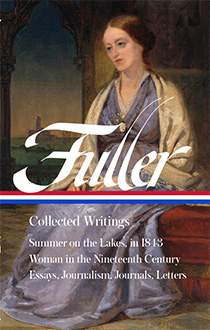
Showing posts with label Margaret Fuller. Show all posts

Sunday, May 17, 2026

The Magnolia of Lake Pontchartrain

Margaret Fuller (1810–1850)
From Margaret Fuller: Collected Writings

Lake Pontchartrain, Louisiana, 1880, oil on canvas by American artist Joseph Rusling Meeker (1827–1889). Margaret Fuller never traveled to Louisiana, but during the winter she wrote “The Magnolia of Lake Pontchartrain” her mother was visiting Margaret’s two brothers in New Orleans. Image: Artvee.
In September 1839, the Transcendental Club held two meetings in Boston at the home of recently ordained Unitarian pastor Cyrus Bartol, during which they explored the possibility of publishing a periodical. One of the attendees, A. Bronson Alcott, recorded in his diary, “We discussed the subject of a journal designed as the organ of views more in accordance with the Soul. . . . A good deal was said about our journal, but no definite action taken upon it. Its idea and plan are not defined.” Or, as Ralph Waldo Emerson later wrote to Margaret Fuller, “I think we all feel much alike in regard to this journal. We all wish it to be, but do not wish to be in any way personally responsible for it.”

The following month, Fuller—the only woman in attendance at both meetings—visited Emerson in Concord, and he encouraged her to take on the job nobody wanted, having suggested to her that “if your labors shall introduce a new Age, they will also mould our opinions & we shall think what you think.” Promised an annual salary of $200, she agreed to become editor of The Dial, as the new quarterly would be called. Fuller held the position for two years, but the journal never turned a profit and she was never paid for her efforts.

By the spring of 1840, Fuller was soliciting pieces for the first issue. In a letter to William Henry Channing, a potential contributor who was then pastor of a church in Cincinnati, she described her vision for the journal and expressed doubts over the support she would receive:
A perfectly free organ is to be offered for the expression of individual thought and character. There are no party measures to be carried, no particular standard to be set up. A fair, calm tone, a recognition of universal principles, will, I hope pervade the essays in every form. I hope there will neither be a spirit of dogmatism nor of compromise. That this periodical will not aim at leading public opinion, but at stimulating each man to think for himself, to think more deeply and more nobly, by letting him see how some minds are kept alive by a wise self-trust. I am not sanguine as to the amount of talent which will be brought to bear on this publication. I find all concerned rather indifferent, and see no great promise for the present.
The first issue of The Dial was published in July 1840 and boasted, in addition to works by Fuller and Emerson, contributions from such prominent members of the Transcendentalist circle as James Russell Lowell, Henry David Thoreau, Elizabeth Peabody, Theodore Parker, and Bronson Alcott, whose mystical “Orphic Sayings” became the subject of parody and ridicule and would prove detrimental to the magazine’s reputation and circulation.

For the third issue of the journal, published January 1841, Fuller wrote the allegorical tale “The Magnolia of Lake Pontchartrain,” the first of her writings on woman’s position in society. The story was prompted by an anecdote told by a neighbor, William Eustis. Years later, a local historian remembered Eustis as a man “educated for the profession of a physician, but being of a sensitive temperament, and also predisposed to insanity, . . . he never followed his profession. Instead, however, he devoted much attention to horticulture [and] built a fine greenhouse.” In his mid-40s, Eustis often called on Fuller and her mother at their home in Jamaica Plain, and she described his latest visit in a letter to Channing:
Generally I go out of the room when he comes, for his great excitability makes me nervous, and his fondness for detail is wearisome. But to-night I was too much fatigued to do anything else, and did not like to leave mother; so I lay on the sofa while she talked with him.

My mind often wandered, yet ever and anon, as I listened again to him, I was struck with admiration at the compensations of Nature. Here is a man, isolated from his kind beyond any I know, of an ambitious temper and without an object, of tender affections and without a love or a friend. I don’t suppose any mortal, unless it be his aged mother, cares more for him than we do,—scarce any value him so much. The disease, which has left him, in the eyes of men, a scathed and blighted tree, has driven him back to Nature, and she has not refused him sympathy. I was surprised by the refinement of his observations on the animals, his pets. He has carried his intercourse with them to a degree of perfection we rarely attain with our human friends. There is no misunderstanding between him and his dogs and birds; and how rich has been the acquaintance in suggestion! Then the flowers! I liked to hear him, for he recorded all their pretty ways,—not like a botanist, but a lover. His interview with the Magnolia of Lake Pontchartrain was most romantic. . . .
In a subsequent letter, Fuller explained that Dr. Eustis’s anecdote made much of the magnolia’s odor, which “was so exquisite it was unlike that of any other Magnolia.” The story might have been of particular interest to Mrs. Fuller, who was leaving soon to spend the winter in Louisiana with her two oldest sons, Eugene and William Henry, both of whom had recently married and established businesses in New Orleans.

The tale initially stumped Emerson. “I like the new Dial very well, & think the good public ought to be humbly thankful to you,” he wrote to Fuller, but he could not “settle the authorship of the Magnolia.” A letter from a mutual friend, Caroline Sturgis, revealed that Margaret was indeed the author, and Emerson read the piece more carefully before responding to Sturgis that he “found beauty & wit in it. . . . The piece is written, I think, with greatly more than her usual spirit & elegance.” To Margaret, he wrote cryptically, “I discern with added pleasure the public merits of these pieces, but be it known unto you O woman of little faith that I can read affectionately.” He then commented on the tale’s “fervid Southern eloquence that makes me wonder as often before how you fell into the Massachusetts. It is rich and sad—sad it should not be—if one could only show why not!—but the piece will have a permanent value.”

Emerson seemed both enchanted and disturbed by the unfamiliar nature of Fuller’s genius; he “was forced to admit that it contained an emotional intensity that could not be completely reconciled with his intellectual categories,” writes literary scholar Jeffrey Steele in an analysis of the work. “Despite his ongoing effort to assimilate Fuller to his vision, casting a role for her as his double, he was left with a strong sense of her otherness.” Steele adds, “On a biographical level, the confrontation between male Rider and Magnolia allegorizes the Emerson-Fuller relationship, shifting the terms of their epistolary debate onto a fictional plane.”

Notes: “He was fulfilled of all nobleness” is an expression found in Walter Scott’s novel Kenilworth (1821).

The six lines of Italian poetry are from Torquato Tasso’s Gerusalemme Liberata (Jerusalem Delivered, 1581), canto 10. This epic poem was frequently translated in the eighteenth and nineteenth centuries. Fuller changed the words slightly from the original Italian. The 1901 English translation by Henry Morley of these lines:

Unknown, unseen, disguised, travelled he,
By desert paths and ways but used by few,
And rode revolving in his troubled thought
What course to take, and yet resolved on naught. . . .

But when the night cast up her shade aloft
And all earth’s colors strange in sables dyed, . . .

The stanza that begins “O that I were an orange tree” is from “Employment” (1633) by George Herbert. Fuller changed Herbert’s “dressed” to the archaic “dresseth.”

*   *   *
For this week’s selection, we depart from the usual format and reproduce the entire text of Fuller’s article below. You may also download it as a PDF or view it in Google Docs, and this selection may be photocopied and distributed for classroom or educational use.

The Magnolia of Lake Pontchartrain

The stars tell all their secrets to the flowers, and, if we only knew how to look around us, we should not need to look above. But man is a plant of slow growth, and great heat is required to bring out his leaves. He must be promised a boundless futurity, to induce him to use aright the present hour. In youth, fixing his eyes on those distant worlds of light, he promises himself to attain them, and there find the answer to all his wishes. His eye grows keener as he gazes, a voice from the earth calls it downward, and he finds all at his feet.

I was riding on the shore of Lake Pontchartrain, musing on an old English expression, which I had only lately learned to interpret. “He was fulfilled of all nobleness.” Words so significant charm us like a spell long before we know their meaning. This I had now learned to interpret. Life had ripened from the green bud, and I had seen the difference, wide as from earth to heaven, between nobleness, and the fulfilment of nobleness.

A fragrance beyond anything I had ever known came suddenly upon the air and interrupted my meditation. I looked around me, but saw no flower from which it could proceed. There is no word for it; exquisite and delicious have lost all meaning now. It was of a full and penetrating sweetness, too keen and delicate to be cloying. Unable to trace it, I rode on, but the remembrance of it pursued me. I had a feeling that I must forever regret my loss, my want, if I did not return and find the poet of the lake, which could utter such a voice. In earlier days I might have disregarded such a feeling; but now I have learned to prize the monitions of my nature as they deserve, and learn sometimes what is not for sale in the market-place. So I turned back and rode to and fro at the risk of abandoning the object of my ride.

I found her at last, the Queen of the South, singing to herself in her lonely bower. Such should a sovereign be, most regal when alone; for then there is no disturbance to prevent the full consciousness of power. All occasions limit, a kingdom is but an occasion, and no sun ever saw itself adequately reflected on sea or land.

Nothing at the south had affected me like the Magnolia. Sickness and sorrow, which have separated me from my kind, have requited my loss by making known to me the loveliest dialect of the divine language. “Flowers,” it has been truly said, “are the only positive present made us by nature.” Man has not been ungrateful, but consecrated the gift to adorn the darkest and brightest hours. If it is ever perverted, it is to be used as a medicine, and even this vexes me. But no matter for that. We have pure intercourse with these purest creations; we love them for their own sake, for their beauty’s sake. As we grow beautiful and pure, we understand them better. With me knowledge of them is a circumstance, a habit of my life, rather than a merit. I have lived with them, and with them almost alone, till I have learned to interpret the slightest signs by which they manifest their fair thoughts. There is not a flower in my native region, which has not for me a tale, to which every year is adding new incidents, yet the growths of this new climate brought me new and sweet emotions, and, above all others, was the Magnolia a revelation. When I first beheld her, a stately tower of verdure, each cup, an imperial vestal, full-displayed to the eye of day, yet guarded from the too hasty touch even of the wind by its graceful decorums of firm, glistening, broad, green leaves, I stood astonished as might a lover of music, who after hearing in all his youth only the harp or the bugle, should be saluted on entering some vast cathedral by the full peal of its organ.

After I had recovered from my first surprise, I became acquainted with the flower, and found all its life in harmony. Its fragrance, less enchanting than that of the rose, excited a pleasure more full of life, and which could longer be enjoyed without satiety. Its blossoms, if plucked from their home, refused to retain their dazzling hue, but drooped and grew sallow, like princesses captive in the prison of a barbarous foe.

But there was something quite peculiar in the fragrance of this tree; so much so, that I had not at first recognised the Magnolia. Thinking it must be of a species I had never yet seen, I alighted, and leaving my horse, drew near to question it with eyes of reverent love.

“Be not surprised,” replied those lips of untouched purity, “stranger, who alone hast known to hear in my voice a tone more deep and full than that of my beautiful sisters. Sit down, and listen to my tale, nor fear, that I will overpower thee by too much sweetness. I am indeed of the race you love, but in it I stand alone. In my family I have no sister of the heart, and though my root is the same as that of the other virgins of our royal house, I bear not the same blossom, nor can I unite my voice with theirs in the forest choir. Therefore I dwell here alone, nor did I ever expect to tell the secret of my loneliness. But to all that ask there is an answer, and I speak to thee.

“Indeed, we have met before, as that secret feeling of home, which makes delight so tender, must inform thee. The spirit that I utter once inhabited the glory of the most glorious climates. I dwelt once in the orange tree.”

“Ah?” said I! “then I did not mistake. It is the same voice I heard in the saddest season of my youth, a time described by the prophetic bard.

‘Sconosciuto pur cammina avanti
Per quella via ch’è piu deserta e sola,
E rivolgendo in se quel che far deggia,
In gran tempesta di pensieri on deggia.’

“I stood one evening on a high terrace in another land, the land where ‘the plant man has grown to greatest size.’ It was an evening, whose unrivalled splendor demanded perfection in man, answering to that he found in nature, a sky ‘black-blue,’ deep as eternity, stars of holiest hope, a breeze promising rapture in every breath. To all I might have answered, applying still farther the prophecy,

‘Una ombra oscura al mondo toglie.
I varj aspetti e i color tinge in negro.’

“I could not long endure this discord between myself and such beauty, I retired within my window, and lit the lamp. Its rays fell on an orange tree, full clad in its golden fruit and bridal blossoms. How did we talk together then, fairest friend; thou didst tell me all; and yet thou knowest, that even then, had I asked any part of thy dower, it would have been to bear the sweet fruit, rather than the sweeter blossoms. My wish had been expressed by another.

‘O that I were an orange tree,
That busy plant!
Then should I ever laden be
And never want
Some fruit for him that dresseth me.’

“Thou didst seem to me the happiest of all spirits in wealth of nature, in fulness of utterance. How is it that I find thee now in another habitation?”

“How is it, Man, that thou art now content that thy life bears no golden fruit?”

“It is,” I replied, “that I have at last, through privation, been initiated into the secret of peace. Blighted without, unable to find myself in other forms of nature, I was driven back upon the centre of my being, and there found all being. For the wise, the obedient child from one point can draw all lines, and in one germ read all the possible disclosures of successive life.”

“Even so,” replied the flower, “and ever for that reason am I trying to simplify my being. How happy I was in the ‘spirit’s dower when first it was wed,’ I told thee in that earlier day. But after a while I grew weary of that fulness of speech, I felt a shame at telling all I knew and challenging all sympathies. I was never silent. I was never alone. I had a voice for every season, for day and night. On me the merchant counted, the bride looked to me for her garland, the nobleman for the chief ornament of his princely hall, and the poor man for his wealth. All sang my praises, all extolled my beauty, all blessed my beneficence. And, for a while, my heart swelled with pride and pleasure. But as years passed, my mood changed. The lonely moon rebuked me as she hid from the wishes of man, nor would return till her due change was passed. The inaccessible sun looked on me with the same ray as on all others; my endless profusion could not bribe him to one smile sacred to me alone. The mysterious wind passed me by to tell its secret to the solemn pine. And the nightingale sang to the rose, rather than me, though she was often silent, and buried herself yearly in the dark earth.

“I had no mine or thine, I belonged to all, I could never rest, I was never at one. Painfully I felt this want, and from every blossom sighed entreaties for some being to come and satisfy it. With every bud I implored an answer, but each bud only produced—an orange.

“At last this feeling grew more painful and thrilled my very root. The earth trembled at the touch with a pulse so sympathetic, that ever and anon it seemed, could I but retire and hide in that silent bosom for one calm winter, all would be told me, and tranquillity, deep as my desire, be mine. But the law of my being was on me, and man and nature seconded it. Ceaselessly they called on me for my beautiful gifts; they decked themselves with them, nor cared to know the saddened heart of the giver. O how cruel they seemed at last, as they visited and despoiled me, yet never sought to aid me, or even paused to think that I might need their aid; yet I would not hate them. I saw it was my seeming riches that bereft me of sympathy. I saw they could not know what was hid beneath the perpetual veil of glowing life. I ceased to expect aught from them, and turned my eyes to the distant stars. I thought, could I but hoard from the daily expenditure of my juices, till I grew tall enough, I might reach those distant spheres, which looked so silent and consecrated, and there pause a while from these weary joys of endless life, and in the lap of winter, find my spring.

“But not so was my hope to be fulfilled. One starlight night I was looking, hoping, when a sudden breeze came up. It touched me, I thought, as if it were a cold white beam from those stranger worlds. The cold gained upon my heart, every blossom trembled, every leaf grew brittle, and the fruit began to seem unconnected with the stem. Soon I lost all feeling, and morning found the pride of the garden black, stiff, and powerless.

“As the rays of the morning sun touched me, consciousness returned, and I strove to speak, but in vain. Sealed were my fountains and all my heart-beats still. I felt that I had been that beauteous tree, but now only was—what—I knew not; yet I was, and the voices of men said, It is dead; cast it forth and plant another in the costly vase. A mystic shudder of pale joy then separated me wholly from my former abode.

“A moment more and I was before the queen and guardian of the flowers. Of this being I cannot speak to thee in any language now possible betwixt us. For this is a being of another order from thee, an order whose presence thou mayst feel, nay, approach step by step, but which cannot be known till thou art it, nor seen nor spoken of till thou hast passed through it.

“Suffice it to say, that it is not such a being as men love to paint, a fairy,—like them, only lesser and more exquisite than they, a goddess, larger and of statelier proportion, an angel,—like still, only with an added power. Man never creates, he only recombines the lines and colors of his own existence; only a deific fancy could evolve from the elements the form that took me home.

“Secret, radiant, profound ever, and never to be known, was she; many forms indicate and none declare her. Like all such beings she was feminine. All the secret powers are ‘Mothers.’ There is but one paternal power.

“She had heard my wish while I looked at the stars, and in the silence of fate prepared its fulfilment. ‘Child of my most communicative hour,’ said she, ‘the full pause must not follow such a burst of melody. Obey the gradations of nature, nor seek to retire at once into her utmost purity of silence. The vehemence of thy desire at once promises and forbids its gratification. Thou wert the keystone of the arch and bound together the circling year; thou canst not at once become the base of the arch, the centre of the circle. Take a step inward, forget a voice, lose a power; no longer a bounteous sovereign, become a vestal priestess and bide thy time in the Magnolia.’

“Such is my history, friend of my earlier day. Others of my family, that you have met, were formerly the religious lily, the lonely dahlia, fearless decking the cold autumn, and answering the shortest visits of the sun with the brightest hues, the narcissus, so wrapt in self-contemplation, that it could not abide the usual changes of a life. Some of these have perfume, others not, according to the habit of their earlier state, for as spirits change, they still bear some trace, a faint reminder of their latest step upwards or inwards. I still speak with somewhat of my former exuberance, and over-ready tenderness to the dwellers on this shore, but each star sees me purer, of deeper thought, and more capable of retirement into my own heart. Nor shall I again detain a wanderer, luring him from afar, nor shall I again subject myself to be questioned by an alien spirit to tell the tale of my being in words that divide it from itself. Farewell stranger, and believe that nothing strange can meet me more. I have atoned by confession; further penance needs not, and I feel the Infinite possess me more and more. Farewell, to meet again in prayer, in destiny, in harmony, in elemental power.”

The Magnolia left me, I left not her, but must abide forever in the thought to which the clue was found in the margin of that lake of the South.


Originally published in the January 1841 issue of The Dial.

Sunday, March 9, 2025

Prevalent Idea That Politeness Is Too Great a Luxury to Be Given to the Poor

Margaret Fuller (1810–1850)
From Margaret Fuller: Collected Writings

“Turtle Bay, East River, N.Y. 1853.” Drawn by Benson John Lossing (1813–1891) and printed for the 1858 edition of D. T. Valentine’s Manual of the Corporation of the City of New York (Courtesy New York Public Library). When Margaret Fuller first arrived in New York at the end of 1844, she moved in with Horace Greeley, his wife, and their infant son at their home in Turtle Bay and soon wrote to a friend back in Boston:

“On both sides of the house are beautiful trees, standing fair, full-grown, and clear. Passing through a wide hall, you come out upon a piazza stretching the whole length of the house, where one can walk in all weathers; and thence, by a step or two, on a lawn, with picturesque masses of rocks, shrubs, and trees, overlooking the East River. Gravel-paths lead, by several turns, down the steep bank to the water’s edge, where, round the rocky point, a small bay curves, in which boats are lying; and, owing to the currents and the set of the tide, the sails glide sidelong, seeming to greet the house as they sweep by.”
“Newspaper writing is next door to conversation, and should be conducted on the same principles,” wrote Margaret Fuller in an 1846 essay on the state of American literature. “It has this advantage: we address, not our neighbour, who forces us to remember his limitations and prejudices, but the ideal presence of human nature as we feel it ought to be and trust it will be. We address America rather than Americans.”

Fuller had just completed twenty months as the literary editor for the New-York Tribune, for which she wrote some 250 reviews and articles. Two years earlier, in September 1844, the Tribune’s publisher and editor, Horace Greeley, traveled to Cambridge, Massachusetts, to convince her to take the position. She arrived in Manhattan in November and became the only woman on the staff.

Halfway through her first year on the job, she received a letter from James Freeman Clarke, a friend back in Cambridge, who had been reading her articles regularly. “They seem to me to be better written than anything of yours I have read. There is more ease, grace, freedom and point to them. . . . I am extremely glad that you have such an excellent organ through which to speak to the public.” Fuller responded with gratitude:
I was pleased with your sympathy about The Tribune. I do not find much among my old friends. They think I ought to produce something excellent, while I am well content for the present to aid in the great work of mutual education in this way. I never regarded literature merely as a collection of exquisite products, but as a means of mutual interpretation. Feeling that many are reached and in some degree aided the thoughts of every day seem worth noting, though in a form that does not inspire me.
Among her “old friends” who seemed to have doubts about her career move was Ralph Waldo Emerson, her collaborator and mentor while she was editor of The Dial, the short-lived but influential periodical of the Transcendentalists. Emerson regarded the penny press with skepticism—as a distracting trend robbing the world of artists. In 1838, he complained that the poet William Cullen Bryant, who had become the editor of the New-York Evening Post, was wasting his talents: “He suffers, I think, manifestly, from want of culture, has no time for books or thoughts but must welter all day in the foaming foolishness of newspapers.”

Emerson’s attitudes toward the Tribune were more complicated, however. Not only was Greeley a close friend, but the newspaper heavily promoted Emerson’s essays and lectures and often reprinted or discussed items originally published in The Dial. Greeley, for his part, regarded The Dial as “the most original and thoughtful periodical ever published in this country,” and in the years after the journal folded in April 1844, he hired or published many of its contributors. To Emerson, the Tribune at its best might aspire to his ideal of the journalistic enterprise. “That is the theory of the newspaper—to supersede official by intellectual influence,” he later wrote, but all too often “theory” in the press gave way to partisanship, sensationalism, and hack writing.

In fact, Emerson had initially helped both Fuller and her brother-in-law William Ellery Channing get their positions at the Tribune. Yet, in 1845, after hearing that Channing had had a rough start at the paper, Emerson groused,
Our landscape at present mourns its poet, for Ellery, as you know, struggles as he can with certain hateful elements in the Tribune in N.Y. and seems really to have resisted a crisis of spleen, & to have made up his mind to much endurance. . . . The Tribune office may be good treatment for some of his local distempers, but it seems a very poor use to put a wise man & a genius, to. Is it any better with Margaret? The muses have feet, to be sure, but it is an odd arrangement that selects them for the treadmill.
The following year he wrote about Fuller to Thomas Carlyle, “This employment was made acceptable to her by good pay, great local and personal conveniences of all kinds, and unbounded confidence and respect from Greeley himself. . . . [Her] work as critic of all new books, critics of the drama, of music; and good arts in New York, has been honorable to her. Still this employment is not satisfactory to me.”

During her first year at the Tribune, Fuller lived with the Greeleys—Horace, his wife, and their infant son—in their Turtle Bay home, about three miles north of the downtown area. In March 1845, a few months after her arrival, she wrote to her brother:
As to a home the place where we live is old and dilapidated but in a situation of great natural loveliness. When there, I am perfectly secluded, yet every one I wish to see comes to see me, and I can get to the centre of the city in half an hour. . . . My room is delightful; how I wish you could sit at its window with me and see the sails glide by!

As to the public part; that is entirely satisfactory. I do just as I please, and as much or little as I please, and the Editors express themselves perfectly satisfied, and others say that my pieces tell to a degree I could not expect. I think, too, I shall do better and better. I am truly interested in this great field which opens before me and it is pleasant to be sure of a chance at half a hundred thousand readers.

Mr Greeley I like, nay more, love. He is, in his habits, a slattern and plebeian, and in his heart, a nobleman. His abilities, in his own way, are great. He believes in mine to a surprizing extent. We are true friends.
As Megan Marshall writes in her biography of Fuller: “The trek from Turtle Bay to the New-York Tribune offices was a long one, and Margaret sometimes preferred to write at home when reviewing books. But her material was the city itself, and points beyond. Even so slight an incident as a wealthy woman’s officious treatment of an Irish boy on an East River ferry could make a column.” That article, “Prevalent Idea That Politeness Is Too Great a Luxury to Be Given to the Poor,” is reprinted below as our Story of the Week selection.

“While her essays in The Dial are more elaborate and ambitious,” Greeley wrote two years after Fuller’s death, “her reviews in the Tribune are far better adapted to win the favor and sway the judgment of the great majority of readers. But, one characteristic of her writings I feel bound to commend,—their absolute truthfulness. She never asked how this would sound, nor whether that would do, nor what would be the effect of saying anything; but simply, ‘Is it the truth? Is it such as the public should know?’ And if her judgment answered, ‘Yes,’ she uttered it; no matter what turmoil it might excite, nor what odium it might draw down on her own head.”

Note: In lieu of a byline, Fuller added an asterisk to the end of most of her contributions in the Tribune.

*   *   *
For this week’s selection, we depart from the usual format and reproduce the entire text of Fuller’s article below. You may also download it as a PDF or view it in Google Docs, and this selection may be photocopied and distributed for classroom or educational use.

Prevalent Idea That Politeness Is Too Great a Luxury to Be Given to the Poor

A few days ago, a lady, crossing in one of the ferry boats that ply from this city, saw a young boy, poorly dressed, sitting with an infant in his arms on one of the benches. She observed that the child looked sickly and coughed. This, as the day was raw, made her anxious in its behalf, and she went to the boy and asked whether he was alone there with the baby, and if he did not think the cold breeze dangerous for it. He replied that he was sent out with the child to take care of it, and that his father said the fresh air from the water would do it good.

While he made this simple answer, a number of persons had collected around to listen, and one of them, a well-dressed woman, addressed the boy in a string of such questions and remarks as these:

“What is your name? Where do you live? Are you telling us the truth? It’s a shame to have that baby out in such weather; you’ll be the death of it. (To the bystanders:) I would go and see his mother and tell her about it, if I was sure he had told us the truth about where he lived. How do you expect to get back? Here, (in the rudest voice,) somebody says you have not told the truth as to where you live.”

The child, whose only offence consisted in taking care of the little one in public, and answering when he was spoken to, began to shed tears at the accusations thus grossly preferred against him. The bystanders stared at both; but among them all there was not one with sufficiently clear notions of propriety and moral energy to say to this impudent questioner, “ Woman! do you suppose, because you wear a handsome shawl, and that boy a patched jacket, that you have any right to speak to him at all, unless he wishes it, far less to prefer against him those rude accusations. Your vulgarity is unendurable; leave the place or alter your manner.”

Many such instances have we seen of insolent rudeness or more insolent affability founded on no apparent grounds, except an apparent difference in pecuniary position, for no one can suppose in such cases the offending party has really enjoyed the benefit of refined education and society, but all present let them pass as matters of course. It was sad to see how the poor would endure—mortifying to see how the purse-proud dared offend. An excellent man who was, in his early years, a missionary to the poor, used to speak afterwards with great shame of the manner in which he had conducted himself towards them.—“When I recollect,” said he, “the freedom with which I entered their houses, inquired into all their affairs, commented on their conduct and disputed their statements I wonder I was never horse whipped and feel that I ought to have been; it would have done me good, for I needed as severe a lesson on the universal obligations of politeness in its only genuine form of respect for man as man, and delicate sympathy with each in his peculiar position.”

Charles Lamb, who was indeed worthy to be called a human being from those refined sympathies, said, “You call him a gentleman: does his washer woman find him so?” We may say, if she did so, she found him a man, neither treating her with vulgar abruptness, nor giving himself airs of condescending liveliness, but treating her with that genuine respect which a feeling of equality inspires.

To doubt the veracity of another is an insult which in most civilized communities must in the so-called higher classes be atoned for by blood, but, in those same communities, the same men will, with the utmost lightness, doubt the truth of one who wears a ragged coat, and thus do all they can to injure and degrade him by assailing his self-respect, and breaking the feeling of personal honor—a wound to which hurts a man as a wound to its bark does a tree.

Then how rudely are favors conferred, just as a bone is thrown to a dog. A gentleman indeed will not do that without accompanying signs of sympathy and regard. Just as this woman said, “If you have told the truth I will go and see your mother,” are many acts performed on which the actors pride themselves as kind and charitable.

All men might learn from the French in these matters. That people, whatever be their faults, are really well-bred, and many acts might be quoted from their romantic annals, where gifts were given from rich to poor with a graceful courtesy, equally honorable and delightful to the giver and the receiver.

In Catholic countries there is more courtesy, for charity is there a duty, and must be done for God’s sake; there is less room for a man to give himself the Pharisaical tone about it. A rich man is not so surprised to find himself in contact with a poor one; nor is the custom of kneeling on the open pavement, the silk robe close to the beggar’s rags, without profit. The separation by pews, even on the day when all meet nearest, is as bad for the manners as the soul.

Blessed be he or she who has passed through this world, not only with an open purse and willingness to render the aid of mere outward benefits, but with an open eye and open heart, ready to cheer the downcast, and enlighten the dull by words of comfort and looks of love. The wayside charities are the most valuable both as to sustaining hope and diffusing knowledge, and none can render them who has not an expansive nature, a heart alive to affection, and some true notion, however imperfectly developed, of the nature of human brotherhood.

Such an one can never sauce the given meat with taunts, freeze the bread by a cold glance of doubt, or plunge the man who asked for his hand deeper back into the mud by any kind of rudeness.

In the little instance with which we begun, no help was asked, unless by the sight of the timid little boy’s old jacket. But the license which this seemed to the well-clothed woman to give to rudeness was so characteristic of a deep fault now existing, that a volume of comments might follow and a host of anecdotes be drawn from almost any one’s experience in exposition of it. Those few words, perhaps, may awaken thought in those who have drawn tears from others’ eyes through an ignorance brutal, but not hopelessly so, if they are willing to rise above it. *


Originally published in the May 31, 1845, issue of the New-York Tribune.

Friday, November 17, 2017

Our City Charities

Margaret Fuller (1810–1850)
From Writing New York: A Literary Anthology

“Dancing by Lunatics. Ball Given to the Patients of the Insane Asylum on Blackwell’s Island, New York, November 6, 1865,” sketch by W. H. Davenport for Harper’s Weekly, December 2, 1865.
During the nineteenth century orphanages, almshouses, hospitals, asylums, and prisons were must-see destinations for many North American tourists. In Hartford, “the Orphan Asylum is delightfully situated on an eminence, and consists of handsome and spacious edifices, well managed,” recommends Willis Pope Hazard’s American Guide Book, Being a Hand-book for Tourists and Travellers. At Sing Sing, only “33 miles from the city [New York] . . . is the celebrated State Prison, an object of great interest for visiting, with cells for upwards of 1000 prisoners,” touts The New World in 1859: Being the United States and Canada. In one of his travelogues globetrotter Alexander Marjoribanks describes the sentries “with loaded guns” and the impossibility of escape from the penitentiary in Ontario and proclaims that “no one who visits Kingston should omit seeing it.” A guide to St. Louis published in 1888 boasts of the city’s asylum, which accommodated 800 patients. “Almost every form of insanity may be witnessed where the number is so great. The patients are afforded a variety of amusements such as theatricals balls etc. The balls occur every Friday night to which visitors are invited. Visitors are shown through during the day.” In his book Theaters of Madness (2008), Benjamin Reiss observes that the “New York Lunatic Asylum at Utica averaged 2,700 visitors a year, outstripping Mammoth Cave in Kentucky.”

As a journalist and social reformer, Margaret Fuller disdained the gawking presence of guidebook authors, local reporters, and vacationing tourists and instead visited private and public institutions as an advocate and activist. In late 1844 she accepted a job offer from Horace Greeley to become a columnist for the New-York Tribune; of the more than 250 pieces Fuller wrote over the next two years, a good number of the longer articles were investigations of the plight and treatment of the city’s underclass, especially women "from the lowest haunts of vice." In a letter sent to a friend soon after her arrival in New York, she described one of her first journalistic projects.
Just as I was beginning to visit the institutions here, of a remedial and benevolent kind, I was stopped by influenza. So soon as I am quite well I shall resume the survey. I do not expect to do much, practically, for the suffering, but having such an organ of expression as the Tribune, any suggestions that are well grounded may be of use. I have always felt great interest for those women who are trampled in the mud to gratify the brute appetites of men, and I wished I might be brought, naturally, into contact with them.
A remarkable series of columns chronicled Fuller’s excursions to the various hospitals, prisons, and poorhouses of New York City and its environs. In October 1844 Fuller went to Sing Sing prison to meet with women who had been incarcerated for prostitution and public drunkenness. She returned to the facility on Christmas Day and spoke at the services held in the prison’s chapel; her column about the holiday excursion solicited funds to help women prisoners. This appeal and her other fundraising efforts on behalf of the Women’s Prison Association helped bring about the establishment during the following summer of the Home for Discharged Female Convicts—perhaps the world’s first halfway house for women.

Another column, “St. Valentine’s Day,” detailed in mostly positive terms her visit in February 1845 to the Bloomingdale Asylum for the Insane (on land currently occupied by Columbia University).* A month later, in March, she continued her “survey” with the essay “Our City Charities,” describing, with increasing displeasure, her trips to the poorhouse at Bellevue (now a medical center), to a “farm school” for orphans and children from impoverished families, and to the new asylum and the penitentiary, both on Blackwell’s Island (now Roosevelt Island).

In late 1846 Fuller became the America’s first female foreign correspondent and set sail for Europe. Over the next four years she sent dispatches to the Tribune on European politics and culture, and while in Italy she covered the 1848 revolutions and met (and secretly married) the Marquess Giovanni Ossoli. In May 1850 the couple, with their 22-month-old son, returned to America on the freighter Elizabeth, which was loaded with blocks of Carrara marble, silks, paintings, and other valuable cargo. Encountering a severe summer squall, an ill-trained first mate, who had assumed command when the captain died of smallpox early in the voyage, ran the ship aground on a sandbar just off the shore of Fire Island, New York, at four in the morning of July 19. For the next twelve hours wind and waves, aided by blocks of marble, battered the ship while spectators on the shore plundered the cargo as it floated away from the wreck. Seven men were later arrested and charged with looting, and a surviving crew member complained to Henry David Thoreau, “The men on shore had not courage enough to launch the lifeboat—they might have launched it without risk of life.” As the boat disintegrated, eight people were swept into the sea and drowned, including all three members of the Fuller-Ossoli family.

Learning of the tragedy, Ralph Waldo Emerson asked Thoreau to go to the scene and search for the bodies and personal belongings. Joined by the poet Ellery Channing, Thoreau found only some garments and Fuller’s desk, which held a few letters and a short journal from early 1849. The manuscript for Fuller’s just-finished book on the Italian revolutions and the short-lived Roman Republic was lost. The infant’s body, which had been crated and buried in the dunes by local residents, was later located and removed to Cambridge, but the bodies of Fuller and her husband were never recovered.

* By the end of the decade the Bloomingdale Asylum had become a victim of its success, as the city—with the complicity of the asylum’s board of governors—used the center as a dumping ground for the disorderly and the incurable, with the inevitable overcrowding and insufficient supervision. In 1851 social reformer Dorothea Dix, who like Fuller had approved of the asylum’s performance early in the 1840s, prepared a scathing evaluation for the facility’s administrators.

Notes: The selection includes a short headnote by Phillip Lopate. Anastatic printing was a type of transfer lithography for the rapid printing of facsimiles. Edgar Allan Poe wrote an essay in 1845 on this new, if short-lived, innovation—and the potential for its abuse by copyright pirates. Opthalmia (or, correctly, ophthalmia) is inflammation of the eye; usually the sign of such conditions as conjunctivitis or trachoma. The Tombs was the common name for Manhattan’s Halls of Justice, built in 1838. The block is currently the location of the Collect Pond Park. In 1842 former City Inspector John H. Griscom, a physician, issued a critical report on sanitary conditions in the city.

*   *   *
The aspect of Nature was sad; what is worse, it was dull and dubious, when we set forth on these visits. . . . If you don't see the full selection below, click here (PDF) or click here (Google Docs) to read it—free!

This selection may be photocopied and distributed for classroom or educational use.

Friday, July 7, 2017

A Walk to Wachusett

Henry David Thoreau (1817–1862)
From Thoreau: Collected Essays & Poems

View of Wachusett from Harvard, undated, oil on canvas by American painter George Frank Higgins (1850–1885).
Twenty-five-year-old Henry David Thoreau had been writing essays and poems for half a decade and had published a few pieces in The Dial, the small journal edited by Margaret Fuller. Yet, at the start of 1843, he had not yet earned a penny from his writing. One might expect, then, that “A Walk to Wachusett” was “a triumph of sorts for Thoreau,” as historian Robert Kuhn McGregor suggests. It was to be “the first sustained essay for which he received monetary payment—except that the Boston Miscellany never paid him.” Alas, the short-lived Boston magazine “of Literature and Fashion” folded after the very next issue.

“A Walk to Wachusett” details a four-day trek (some fifty miles round trip) that Thoreau undertook in July 1842 with Richard Fuller, Margaret’s younger brother. The essay had its genesis at least a year earlier, however. In a May 1841 journal entry Thoreau addressed an ode to the various hills he could see from Concord, where he had just begun living in Ralph Waldo Emerson’s home as a handyman and gardener. The poem opens with these lines:
Especial I remember thee,
Wachusett, who like me
Standest alone without society. . . .
Margaret Fuller rejected a subsequent version of this poem when Thoreau submitted it to The Dial. She leveled overall criticisms (“Thought lies too detached, truth is seen too much in detail”) and made suggestions for revision, although she did offer several encouraging comments. “Its merits to me are, a noble recognition of nature, two or three manly thoughts, and, in one place, a plaintive music.” A later version of the poem takes up most of the first three pages of his Mount Wachusett travel essay, and Thoreau would again revise and expand the poem for inclusion in his first book, A Week on the Concord and Merrimack Rivers (1849).

The young writer was already gaining a reputation for his eccentricities. A few weeks after the hike to Wachusett, on August 31, he met and befriended Nathaniel Hawthorne, who had just married Sophia Peabody. The older writer recorded the event in his journal:
Mr. Thoreau dined with us yesterday. He is a singular character—a young man with much of wild original nature still remaining in him; and so far as he is sophisticated, it is in a way and method of his own. He is as ugly as sin, long-nosed, queer-mouthed, and with uncouth and somewhat rustic, although courteous manners, corresponding very well with such an exterior. But his ugliness is of an honest and agreeable fashion, and becomes him much better than beauty. . . . [For] two or three years back, he has repudiated all regular modes of getting a living, and seems inclined to lead a sort of Indian life among civilized men—an Indian life, I mean, as respects the absence of any systematic effort for a livelihood. . . . Mr. Thoreau is a keen and delicate observer of nature—a genuine observer—which, I suspect, is almost as rare a character as even an original poet; and Nature, in return for his love, seems to adopt him as her especial child, and shows him secrets which few others are allowed to witness.
By the time he dined with the Hawthornes, Thoreau had begun a draft of his travel essay—and, in fact, it was almost certainly Hawthorne who suggested he submit the piece to Boston Miscellany, which boasted a much larger audience than The Dial. Even though he never was paid for it, the essay marked a turning point for Thoreau. “What is new in ‘A Walk to Wachusett,’” writes biographer Robert D. Richardson, “is the clear trip narrative and the gentle, sociable one of the familiar essay, combining to make a miniature version of the travel book. . . . [The essay] is only a beginning, but it is the first fully characteristic Thoreauvian excursion.”

Notes: The epigraph is Thoreau’s own composition, a two-line poem originally titled “Westward, Ho!” in his journal. On page 44, Rasselas refers to the hero of Samuel Johnson’s The History of Rasselas, Prince of Abissinia (1759), whose home is the Happy Valley. A rifle (page 45) is a piece of wood used by mowers to sharpen their scythes. On page 46, Thoreau jokes that he and Fuller “could get no further” than “atque altæ moenia Romæ,” which is only the seventh line of Virgil’s Aeneid. The lines of verse later in the page are from Virgil’s Georgics. The wars of the neighboring Lancaster refers to King Philip’s War (1675–76). The Latin phrase gelidæ valles (page 47) means “cold valleys.”

The lines of poetry on page 47 are all from William Collins’s poem, “Hassan; or the Camel-Driver” (1742), while the excerpt in the middle of page 50 is from Wordsworth’s Peter Bell (1798). Helvellyn is a mountain in the Lake District in England. The poem at the bottom of page 50 is Thoreau’s own composition. On page 51, Thoreau quotes the last two lines of Virgil’s first eclogue.

On page 54, Thoreau and Fuller travel to the scene of Mrs. Rowlandson’s capture. On February 10, 1676, during King Philip’s War, Mary Rowlandson was captured during a Narrangansett raid on Lancaster and held prisoner for 82 days. She later wrote of her captivity in The Sovereignty & Goodness of God, Together with the Faithfulness of His Promises Displayed. On the next page, he refers to several participants in the war: Paugus, a Pequawket war-chief, as well as Captain Benjamin Church, and John Lovewell (Lovell), prominent soldiers fighting for the Puritans. Myles Standish was a military leader in Plymouth Colony earlier in the century

*   *   *
Summer and winter our eyes had rested on the dim outline of the mountains, to which distance and indistinctness lent a grandeur not their own, so that they served equally to interpret all the allusions of poets and travelers. . . . If you don't see the full selection below, click here (PDF) or click here (Google Docs) to read it—free!

This selection may be photocopied and distributed for classroom or educational use.