Showing posts with label Henry David Thoreau. Show all posts

Saturday, July 11, 2026

Bread

Henry David Thoreau (1817–1862)
From American Food Writing: An Anthology With Classic Recipes

“Walden Pond from Emerson’s Cliff,” hand-colored lantern slide created c. 1917 from a photograph taken in 1899 by Herbert Wendell Gleason (1855–1937). Courtesy of the William Munroe Special Collections at the Concord Free Public Library.
Two decades ago, Library of America published the anthology American Food Writing, which included a passage on bread from Walden by Henry David Thoreau. The late Molly O’Neill (1952–2019), the book’s editor, introduced the selection with the following headnote:

In his classic Walden (1854), Henry David Thoreau investigates the possibilities of a self-sufficient mode of life—a life in harmony with nature, free from the system of entanglements, compromises, and sacrifices commonly known as civilization. Having first obtained for himself a rudimentary shelter near Walden Pond, he turned of course to the question of what to eat. And here, as in most things in Walden, he found ample satisfaction in bare essentials: purslane, a weed he gathered in the local cornfields, made a good dinner simply “boiled and salted.”

Even bread—one of the most basic and elemental parts of an everyday diet, as the proverb would have it—he realized he could simplify. A well-puffed loaf, it was conventionally believed, was the only healthy and wholesome kind. But Thoreau challenges his readers to see such claims for what they may be—propaganda for costly yeast and wheat flour—and to consider the moral superiority of an unleavened bread made of rough-ground, native corn. His notes on watermelon likewise affirm his underlying credo: “Our diet . . . must answer to the season.”

A major spiritual ancestor of many today who look for locally grown, organic foods, Thoreau seems not, however, to have been especially motivated by a concern for flavor—for the better taste of natural fare. To critics who questioned his austerities, he had a simple answer: “I can live on board nails.”

Thoreau began his stay at Walden Pond on July 4, 1845, a week shy of his 28th birthday, and remained for over two years, until September 6, 1847. The section in Walden on bread follows his famous admission that, during his first months of self-sustenance, he spent under $9.00 (about $350 in today’s dollars) on food he was unable to raise or gather himself. He itemized “the expense of food for eight months, namely, from July 4th to March 1st, the time when these estimates were made,” and he divided the list into two groups, foodstuffs that proved essential or appreciated and those that “failed,” which appear to be items he regretted or were not worth the expense:
Rice, .......... $ 1.73½
Molasses, .......... 1.73     Cheapest form of the saccharine.
Rye meal, .......... 1.04¾
Indian meal, .......... 0.99¾     Cheaper than rye.
Pork, .......... 0.22

All experiments which failed:
Flour, .......... 0.88     Costs more than Indian meal [cornmeal], both money and trouble.
Sugar, .......... 0.80
Lard, .......... 0.65
Apples, .......... 0.25
Dried apple, .......... 0.22
Sweet potatoes, .......... 0.10
One pumpkin, .......... 0.06
One watermelon, .......... 0.02
Salt, .......... 0.03
“Yes, I did eat $8.74, all told,” he concluded, “but I should not thus unblushingly publish my guilt, if I did not know that most of my readers were equally guilty with myself, and that their deeds would look no better in print.”

Notes: Primarily used today as a household cleanser, sal soda, or sodium carbonate, was formerly used in tiny amounts as a leavening agent. (Sodium bicarbonate, or baking soda, was not readily available in the U.S. until shortly after Thoreau’s trip to Walden.) The instructions for making bread by Marcus Porcius Cato (aka Cato the Elder) are from De Agri Cultura (On Agriculture), written about 160 BCE. The two lines about making “liquor to sweeten our lips” are from “New England Annoyances,” an anonymously written song from the early seventeenth century.

*   *   *
For this week’s selection, we depart from the usual format and reproduce Thoreau’s text below. You may also download it as a PDF or view it in Google Docs, and this selection may be photocopied and distributed for classroom or educational use.

Bread

I learned from my two years’ experience that it would cost incredibly little trouble to obtain one’s necessary food, even in this latitude; that a man may use as simple a diet as the animals, and yet retain health and strength. I have made a satisfactory dinner, satisfactory on several accounts, simply off a dish of purslane (Portulaca oleracea) which I gathered in my cornfield, boiled and salted. I give the Latin on account of the savoriness of the trivial name. And pray what more can a reasonable man desire, in peaceful times, in ordinary noons, than a sufficient number of ears of green sweet-corn boiled, with the addition of salt? Even the little variety which I used was a yielding to the demands of appetite, and not of health. Yet men have come to such a pass that they frequently starve, not for want of necessaries, but for want of luxuries; and I know a good woman who thinks that her son lost his life because he took to drinking water only.

The reader will perceive that I am treating the subject rather from an economic than a dietetic point of view, and he will not venture to put my abstemiousness to the test unless he has a well-stocked larder.

Bread I at first made of pure Indian meal and salt, genuine hoe-cakes, which I baked before my fire out of doors on a shingle or the end of a stick of timber sawed off in building my house; but it was wont to get smoked and to have a piny flavor. I tried flour also; but have at last found a mixture of rye and Indian meal most convenient and agreeable. In cold weather it was no little amusement to bake several small loaves of this in succession, tending and turning them as carefully as an Egyptian his hatching eggs. They were a real cereal fruit which I ripened, and they had to my senses a fragrance like that of other noble fruits, which I kept in as long as possible by wrapping them in cloths. I made a study of the ancient and indispensable art of bread-making, consulting such authorities as offered, going back to the primitive days and first invention of the unleavened kind, when from the wildness of nuts and meats men first reached the mildness and refinement of this diet, and travelling gradually down in my studies through that accidental souring of the dough which, it is supposed, taught the leavening process, and through the various fermentations thereafter, till I came to “good, sweet, wholesome bread,” the staff of life. Leaven, which some deem the soul of bread, the spiritus which fills its cellular tissue, which is religiously preserved like the vestal fire,— some precious bottle-full, I suppose, first brought over in the Mayflower, did the business for America, and its influence is still rising, swelling, spreading, in cerealian billows over the land,— this seed I regularly and faithfully procured from the village, till at length one morning I forgot the rules, and scalded my yeast; by which accident I discovered that even this was not indispensable,— for my discoveries were not by the synthetic but analytic process,— and I have gladly omitted it since, though most housewives earnestly assured me that safe and wholesome bread without yeast might not be, and elderly people prophesied a speedy decay of the vital forces. Yet I find it not to be an essential ingredient, and after going without it for a year am still in the land of the living; and I am glad to escape the trivialness of carrying a bottle-full in my pocket, which would sometimes pop and discharge its contents to my discomfiture.

It is simpler and more respectable to omit it. Man is an animal who more than any other can adapt himself to all climates and circumstances. Neither did I put any sal soda, or other acid or alkali, into my bread. It would seem that I made it according to the recipe which Marcus Porcius Cato gave about two centuries before Christ. “Panem depsticium sic facito. Manus mortariumque bene lavato. Farinam in mortarium indito, aquæ paulatim addito, subigitoque pulchre. Ubi bene subegeris, defingito, coquitoque sub testu.” Which I take to mean— “Make kneaded bread thus. Wash your hands and trough well. Put the meal into the trough, add water gradually, and knead it thoroughly. When you have kneaded it well, mould it, and bake it under a cover,” that is, in a baking-kettle. Not a word about leaven. But I did not always use this staff of life. At one time, owing to the emptiness of my purse, I saw none of it for more than a month.

Every New Englander might easily raise all his own breadstuffs in this land of rye and Indian corn, and not depend on distant and fluctuating markets for them. Yet so far are we from simplicity and independence that, in Concord, fresh and sweet meal is rarely sold in the shops, and hominy and corn in a still coarser form are hardly used by any. For the most part the farmer gives to his cattle and hogs the grain of his own producing, and buys flour, which is at least no more wholesome, at a greater cost, at the store. I saw that I could easily raise my bushel or two of rye and Indian corn, for the former will grow on the poorest land, and the latter does not require the best, and grind them in a hand-mill, and so do without rice and pork; and if I must have some concentrated sweet, I found by experiment that I could make a very good molasses either of pumpkins or beets, and I knew that I needed only to set out a few maples to obtain it more easily still, and while these were growing I could use various substitutes beside those which I have named, “For,” as the Forefathers sang,—

“we can make liquor to sweeten our lips
Of pumpkins and parsnips and walnut-tree chips.”

Finally, as for salt, that grossest of groceries, to obtain this might be a fit occasion for a visit to the seashore, or, if I did without it altogether, I should probably drink the less water. I do not learn that the Indians ever troubled themselves to go after it.

Thus I could avoid all trade and barter, so far as my food was concerned, and having a shelter already, it would only remain to get clothing and fuel. The pantaloons which I now wear were woven in a farmer’s family,— thank Heaven there is so much virtue still in man; for I think the fall from the farmer to the operative as great and memorable as that from the man to the farmer;— and in a new country fuel is an encumbrance. As for a habitat, if I were not permitted still to squat, I might purchase one acre at the same price for which the land I cultivated was sold— namely, eight dollars and eight cents. But as it was, I considered that I enhanced the value of the land by squatting on it.

There is a certain class of unbelievers who sometimes ask me such questions as, if I think that I can live on vegetable food alone; and to strike at the root of the matter at once,— for the root is faith,— I am accustomed to answer such, that I can live on board nails. If they cannot understand that, they cannot understand much that I have to say. For my part, I am glad to hear of experiments of this kind being tried; as that a young man tried for a fortnight to live on hard, raw corn on the ear, using his teeth for all mortar. The squirrel tribe tried the same and succeeded. The human race is interested in these experiments, though a few old women who are incapacitated for them, or who own their thirds in mills, may be alarmed.

Originally published in Walden; or, Life in the Woods, 1854.
Sunday, March 12, 2023

The Landlord

Henry David Thoreau (1817–1862)
From Henry David Thoreau: Walden, The Maine Woods, Collected Essays & Poems

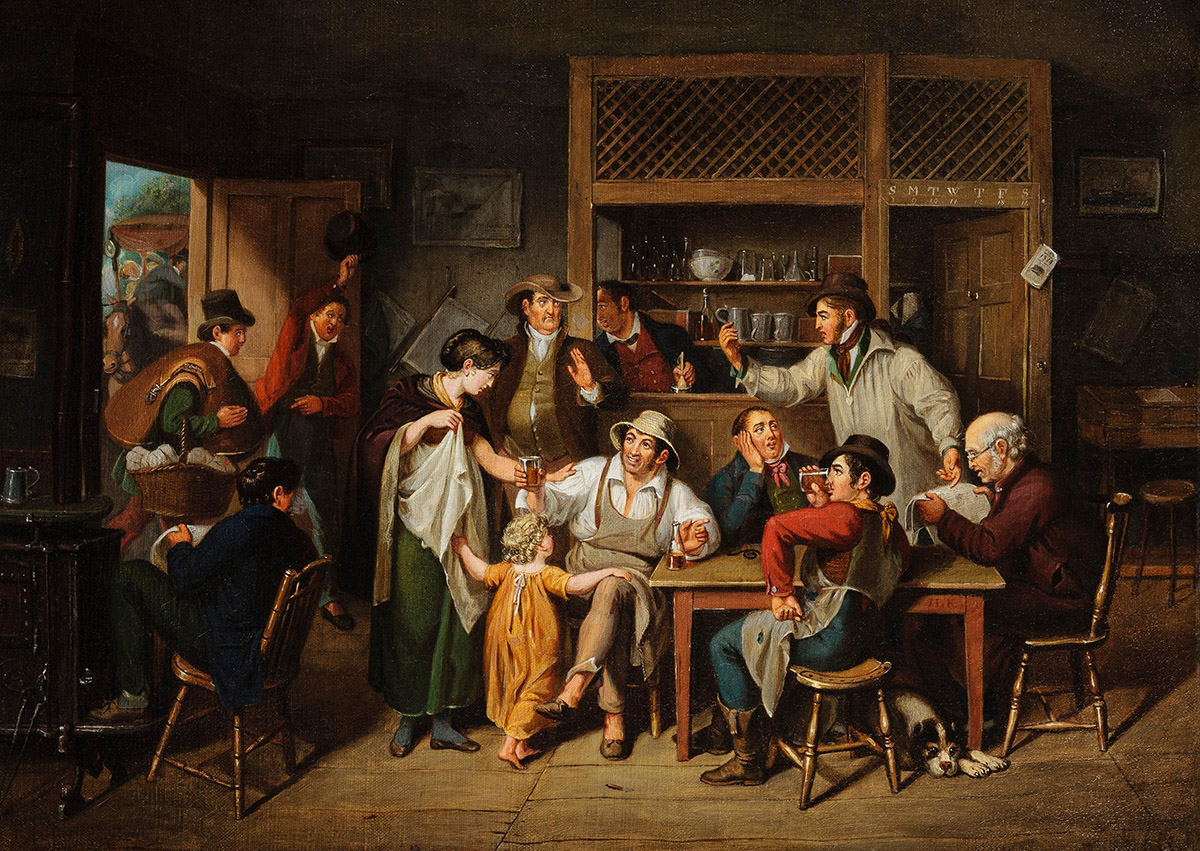
Village Tavern, 1813–14, oil on canvas by German American painter John Lewis Krimmel (1786–1821). Courtesy Toledo Museum of Art.
For two years Henry David Thoreau lived in the Concord, Massachusetts, home of Ralph Waldo Emerson. Having worked as the gardener and handyman, as tutor and babysitter for the Emerson children, and as the resident junior scholar, the 25-year-old decided it was time to move on with his life. “I find myself better than I have been,” he wrote in February 1843 to Emerson, who was visiting his brother William on Staten Island, “and am meditating some other method of paying debts than by lectures and writing, which will only do to talk about. If anything of that ‘other’ sort should come to your ears in New York, will you remember it for me?”

The Emerson brothers discussed the matter and came up with the idea of allowing Henry to stay on Staten Island for a while, earning his keep by tutoring William’s eight-year-old son. “I expect to leave Concord, which is my Rome, and its people, who are my Romans, in May, and go to New York,” Thoreau wrote to his friend, Richard Fuller, a student at Harvard (and brother of editor and essayist Margaret Fuller). “So I will bid you good-by till I see you or hear from you again.”

Thoreau spent half a year in New York, from May through November of 1843, and would often take the ferry to Manhattan. Although he enjoyed the farm country and beaches of Staten Island, he scorned the city, condemning it within a month after his arrival:
I don’t like the city better, the more I see it, but worse. I am ashamed of my eyes that behold it. It is a thousand times meaner than I could have imagined. It will be something to hate, — that ’s the advantage it will be to me: and even the best people in it are a part of it, and talk coolly about it. The pigs in the street are the most respectable part of the population. When will the world learn that a million men are of no importance compared with one man?
Thoreau was not in New York simply to teach William Emerson’s son and to sightsee; he also hoped to meet with editors of the better-paying New York magazines and convince them to publish his work. Earlier that year, while still in Concord, Thoreau met John O’Sullivan, the founding publisher of The United States Magazine and Democratic Review and a close friend of Nathaniel Hawthorne, who lived less than a mile away from the Emersons. In a letter to Emerson, who was traveling at the time, Thoreau reported:
Mr. O’Sullivan was here three days. I met him at the Atheneum [a recently formed association that had a reading room], and went to Hawthorne’s to tea with him. He expressed a great deal of interest in your poems, and wished me to give him a list of them, which I did; he saying he did not know but he should notice them. He is a rather puny-looking man, and did not strike me. We had nothing to say to one another, and therefore we said a great deal! He, however, made a point of asking me to write for his Review, which I shall be glad to do.
After arriving in New York, Thoreau wrote to his parents that “it is ‘quite a day’s training’ to make a few calls in different parts of the city.” The round trip between Staten Island and Manhattan, including the walk to the ferry and the walk from the Battery to wherever in the city he needed to go, often took up more than half a day, leaving little time for appointments. In addition to visiting O’Sullivan in the offices of the Democratic Review, he met several friends of the Emersons, including a few literary notables who would prove instrumental for his future career. In June Thoreau visited the theologian Henry James, Sr. (whose second son, the future novelist Henry James, had been born just two months earlier) and found him “a refreshing, forward-looking and forward-moving man, and he has naturalized and humanized New York for me.” He also met Horace Greeley, the powerful publisher and editor of the New-York Tribune who would later act as Thoreau’s de facto literary agent.

Overall, however, Thoreau was discouraged, frustrated by the lack of interest in his writing. “Literature comes to a poor market here; and even the little that I write is more than will sell,” he complained to Emerson. He also worried that, often ill and distracted, he wasn’t fulfilling his obligations to his hosts: “I do not feel myself especially serviceable to the good people with whom I live, except as inflictions are sanctified to the righteous.”

Worse, O’Sullivan rejected his first submission to the Democratic Review, which Thoreau regarded as his best prospect. Emerson had suggested that Thoreau write a review of The Paradise within the Reach of All Men, without Labor, by Powers of Nature and Machinery, by the German American engineer John Adolphus Etzler, whose booklet presents a ten-year plan for creating a paradise that would eliminate the need for labor by using technological advances powered with wind, solar, and hydro energy. A dabbler in utopian idealism, O’Sullivan expected a serious and considered discussion of Etzler’s vision; what he received instead was “Paradise (To Be) Regained,” Thoreau’s critique skewering technological utopianism and mocking Etzler’s essay—often by simply quoting at length a few of the sections Thoreau regarded as risible.

Although O’Sullivan told Thoreau he could not publish the piece as it was written, he invited him to submit another essay. Desperately homesick and anxious for some modicum of success to show for his stay in New York, Thoreau quickly wrote “The Landlord,” a somewhat whimsical familiar essay extoling the merits of innkeepers who provide hospitality and a semblance of home to weary travelers. He admitted to his mother that “they have printed a short piece that I wrote to sell.” Robert D. Richardson calls it “surely the least characteristic piece Thoreau ever allowed into print.” The Emerson scholar Sherman Paul, however, argues that “The Landlord” displays “how Thoreau, who was never a popular writer, faced the major problem of audience,” an accommodation that became essential for the brilliance of his later travel writing. “He experimented with tone and humor, refusing to forsake his serious themes or make them subserve narrative.”

John O’Sullivan apparently felt the same way and accepted the essay immediately; “The Landlord” appeared in the October number of the Democratic Review. Surprisingly, he also surrendered to Thoreau’s refusal to tone down the critique of Etzler’s book, and the review appeared in the following month’s issue without alteration.

*   *   *
Under the one word, house, are included the school house, the alms house, the jail, the tavern, the dwelling house; and the meanest shed or cave in which men live, contains the elements of all these. . . . If you don't see the full selection below, click here (PDF) or click here (Google Docs) to read it—free!

This selection may be photocopied and distributed for classroom or educational use.

Saturday, July 27, 2019

The Rise

Wendell Berry (1934–2026)
From What I Stand On: The Collected Essays of Wendell Berry 1969–2017

Fur Traders Descending the Missouri, 1845, oil on canvas by American artist George Caleb Bingham. Image courtesy of The Metropolitan Museum of Art. (Click on image to see full painting.) Wendell Berry discusses the painting in “The Rise”: “The painter’s eye, there, is very near the water, and so he sees the river as the trappers see it from their dugout—all the space coming down to that vast level. One feels the force, the aliveness, of the water under the boat, close under the feet of the men. And there they are, isolated in the midst of it, with their box of cargo and their pet fox—men and boat and box and animal all so strangely and poignantly coherent on the wild plain of the water, a sort of island.”
The title essay of Wendell Berry’s first nonfiction collection, The Long-Legged House, is a history of “the Camp,” his nickname for the cabin on the Kentucky River built by his great-uncle Curran Mathews and used as a family retreat since the 1920s. “There wasn’t enough elbow room in that cabin for more than a change of clothes, if you could find berth enough between the bed and everything else to get into them,” James Baker Hall, Berry’s fellow student at the University of Kentucky, recalled fifty years later. “For [Wendell’s wife] Tanya it was something quite other, a crash course in just what she’d signed up for, until death do them part.”

The Berrys began spending summers there after they married in May 1957, and the setting provided him with an inducement to read and write.
I have never been able to work with any pleasure facing a wall, or in any other way fenced off from things. I need to be in the presence of the world. I need a window or a porch, or even the open outdoors. I have always had a lively sympathy for Thoreau’s idea of a hypaethral book, a roofless book. Why should I shut myself up to write? Why not write and live at the same time?

There on the porch of the Camp that summer I wrote the first poetry that I still feel represented by—a long poem rather ostentatiously titled “Diagon,” about a river—and did some of the most important reading I have ever done.
Thoreau’s idea of a roofless book can be found in his June 29, 1851, journal entry, in which he characterized A Week on the Concord and Merrimack Rivers as “a hypaethral or unroofed book, lying open under the ether and permeated by it, open to all weathers, not easy to be kept on a shelf.” Berry found similar inspiration from the Camp; he began commuting to this getaway each weekend to work on his writing. In 1964 the Berrys purchased Lanes Landing, a twelve-acre hillside farm adjacent to the Camp, where he and his wife would live year-round and where he has since written most of his essays, stories, and novels.

“The farm that my wife and I have is in every way marginal,” Berry admitted during an interview in 2014. “Every foot of it is either steep, which is most of it, or it floods.” In “The Rise,” Berry describes the latter, when the river was “up maybe twenty feet,” and recounts how he went six miles upstream and canoed back home during the flood. The essay was first published in 1968 as a signed edition of 100 hand-produced casebound books by the University of Kentucky Library Press and the following year it was included in The Long-Legged House. It has most recently been reprinted in the new two-volume Library of America edition of Berry’s collected essays, and we present it here as our Story of the Week selection.

*   *   *
We put the canoe in about six miles up the Kentucky River from my house. . . . If you don't see the full selection below, click here (PDF) or click here (Google Docs) to read it—free!

This selection is used by permission.
To photocopy and distribute this selection for classroom use, please contact the Copyright Clearance Center.

Friday, July 7, 2017

A Walk to Wachusett

Henry David Thoreau (1817–1862)
From Thoreau: Collected Essays & Poems

View of Wachusett from Harvard, undated, oil on canvas by American painter George Frank Higgins (1850–1885).
Twenty-five-year-old Henry David Thoreau had been writing essays and poems for half a decade and had published a few pieces in The Dial, the small journal edited by Margaret Fuller. Yet, at the start of 1843, he had not yet earned a penny from his writing. One might expect, then, that “A Walk to Wachusett” was “a triumph of sorts for Thoreau,” as historian Robert Kuhn McGregor suggests. It was to be “the first sustained essay for which he received monetary payment—except that the Boston Miscellany never paid him.” Alas, the short-lived Boston magazine “of Literature and Fashion” folded after the very next issue.

“A Walk to Wachusett” details a four-day trek (some fifty miles round trip) that Thoreau undertook in July 1842 with Richard Fuller, Margaret’s younger brother. The essay had its genesis at least a year earlier, however. In a May 1841 journal entry Thoreau addressed an ode to the various hills he could see from Concord, where he had just begun living in Ralph Waldo Emerson’s home as a handyman and gardener. The poem opens with these lines:
Especial I remember thee,
Wachusett, who like me
Standest alone without society. . . .
Margaret Fuller rejected a subsequent version of this poem when Thoreau submitted it to The Dial. She leveled overall criticisms (“Thought lies too detached, truth is seen too much in detail”) and made suggestions for revision, although she did offer several encouraging comments. “Its merits to me are, a noble recognition of nature, two or three manly thoughts, and, in one place, a plaintive music.” A later version of the poem takes up most of the first three pages of his Mount Wachusett travel essay, and Thoreau would again revise and expand the poem for inclusion in his first book, A Week on the Concord and Merrimack Rivers (1849).

The young writer was already gaining a reputation for his eccentricities. A few weeks after the hike to Wachusett, on August 31, he met and befriended Nathaniel Hawthorne, who had just married Sophia Peabody. The older writer recorded the event in his journal:
Mr. Thoreau dined with us yesterday. He is a singular character—a young man with much of wild original nature still remaining in him; and so far as he is sophisticated, it is in a way and method of his own. He is as ugly as sin, long-nosed, queer-mouthed, and with uncouth and somewhat rustic, although courteous manners, corresponding very well with such an exterior. But his ugliness is of an honest and agreeable fashion, and becomes him much better than beauty. . . . [For] two or three years back, he has repudiated all regular modes of getting a living, and seems inclined to lead a sort of Indian life among civilized men—an Indian life, I mean, as respects the absence of any systematic effort for a livelihood. . . . Mr. Thoreau is a keen and delicate observer of nature—a genuine observer—which, I suspect, is almost as rare a character as even an original poet; and Nature, in return for his love, seems to adopt him as her especial child, and shows him secrets which few others are allowed to witness.
By the time he dined with the Hawthornes, Thoreau had begun a draft of his travel essay—and, in fact, it was almost certainly Hawthorne who suggested he submit the piece to Boston Miscellany, which boasted a much larger audience than The Dial. Even though he never was paid for it, the essay marked a turning point for Thoreau. “What is new in ‘A Walk to Wachusett,’” writes biographer Robert D. Richardson, “is the clear trip narrative and the gentle, sociable one of the familiar essay, combining to make a miniature version of the travel book. . . . [The essay] is only a beginning, but it is the first fully characteristic Thoreauvian excursion.”

Notes: The epigraph is Thoreau’s own composition, a two-line poem originally titled “Westward, Ho!” in his journal. On page 44, Rasselas refers to the hero of Samuel Johnson’s The History of Rasselas, Prince of Abissinia (1759), whose home is the Happy Valley. A rifle (page 45) is a piece of wood used by mowers to sharpen their scythes. On page 46, Thoreau jokes that he and Fuller “could get no further” than “atque altæ moenia Romæ,” which is only the seventh line of Virgil’s Aeneid. The lines of verse later in the page are from Virgil’s Georgics. The wars of the neighboring Lancaster refers to King Philip’s War (1675–76). The Latin phrase gelidæ valles (page 47) means “cold valleys.”

The lines of poetry on page 47 are all from William Collins’s poem, “Hassan; or the Camel-Driver” (1742), while the excerpt in the middle of page 50 is from Wordsworth’s Peter Bell (1798). Helvellyn is a mountain in the Lake District in England. The poem at the bottom of page 50 is Thoreau’s own composition. On page 51, Thoreau quotes the last two lines of Virgil’s first eclogue.

On page 54, Thoreau and Fuller travel to the scene of Mrs. Rowlandson’s capture. On February 10, 1676, during King Philip’s War, Mary Rowlandson was captured during a Narrangansett raid on Lancaster and held prisoner for 82 days. She later wrote of her captivity in The Sovereignty & Goodness of God, Together with the Faithfulness of His Promises Displayed. On the next page, he refers to several participants in the war: Paugus, a Pequawket war-chief, as well as Captain Benjamin Church, and John Lovewell (Lovell), prominent soldiers fighting for the Puritans. Myles Standish was a military leader in Plymouth Colony earlier in the century

*   *   *
Summer and winter our eyes had rested on the dim outline of the mountains, to which distance and indistinctness lent a grandeur not their own, so that they served equally to interpret all the allusions of poets and travelers. . . . If you don't see the full selection below, click here (PDF) or click here (Google Docs) to read it—free!

This selection may be photocopied and distributed for classroom or educational use.

Friday, December 16, 2011

A Winter Walk

Henry David Thoreau (1817–1862)
From Thoreau: Collected Essays and Poems

Henry David Thoreau took up writing the year after Ellen Sewall turned down his proposal of marriage. His early essays and poems began appearing regularly in The Dial, a journal founded in 1840 by Ralph Waldo Emerson and Margaret Fuller. The magazine’s undeniable impact on American literary history belies the length of its existence; it folded four years later, but it was a cornerstone for the group of writers who had come to be known (at first, pejoratively) as the Transcendentalists. By the time Thoreau published “A Winter Walk” in 1843, he had developed “his naturalistic writing in the direction it later took in Walden,” as one source summarizes. “Although these early essays can be read as somewhat romantic literary descriptions, Thoreau has already begun to inject a philosophical edge into his writing.”

Thoreau often incorporated poetry into his prose, and here you’ll find two of his poems: “The sluggish smoke curls up from some deep dell” and “When Winter fringes every bough.” But also included are unattributed excerpts of verse not written by Thoreau (on pages 97 and 106, as well as the closing lines). These are instead by James Thomson, who died almost a century earlier. Not often read today, Thomson’s verse would have been immediately familiar to readers in Thoreau’s time. (Thomson’s one enduring poem is “Rule Britannia,” which was set to music by Thomas Arne.) As Michael Schmidt writes in his masterful Lives of the Poets:
One of the most successful British poets of all time . . . is James Thomson, the man who momentarily reinvented pastoral and is now read primarily by scholars who prefer dust to living dirt and by students puzzled by the reputed tedium of the eighteenth century. . . . Once he was the poetic equivalent of the Gideon Bible; his poems were to be found in every inn and cottage in the land.
In 1726, at the age of twenty-five, Thomson published Winter, his debut book, which became the first part of (naturally) The Seasons, a tome he expanded and revised and polished until his death in 1748. The three excerpts from Winter in “A Winter Walk” enhance Thoreau’s description of a dawn-to-dusk stroll “through the powdery snow, warmed by an inward heat,” and their inclusion supports Schmidt’s contention that Thomson’s major literary contribution “was to show how landscape might be used for emotional projection, to reveal an observer’s mind as much as the thing observed.”

Notes: On page 97, Thoreau refers to several groups of inhabitants of Canadian and Arctic regions: Esquimaux (Eskimos, or Inuit–Yupik), Knistenaux (more commonly, Knisteneaux, or Cree), Dog-ribbed Indians (Dogrib), Novazemblaires (of Nova Zembla island), and Spitzbergeners (of Spitsbergen island, north of Norway). The latter two islands were actually uninhabited during Thoreau’s lifetime. Plicipennes is a name for the caddis fly.

On page 98, there are references to the ruins of Palmyra, an ancient city in Syria, and Hecatompolis, the capital of the Arsacid Empire in Persia around the end of the third century BCE. Abu Musa (p. 100) was a medieval Arab alchemist and mystic.

The two explorers mentioned at the bottom of page 102 are Sir William Edward Parry, who in 1827 attempted to reach the North Pole, and Sir John Franklin, who attempted three Arctic expeditions between 1819 and 1823. Both were still alive when Thoreau wrote his essay, although Franklin, along with 24 officers and 105 men, would perish four years later while attempting to navigate the Northwest Passage. “The mower whet his scythe” (p. 103) is a quote from Milton’s “L’Allegro.” A hortus siccus (p. 104) is a herbarium or, literally, a “dry garden.”

*   *   *
The wind has gently murmured through the blinds, or puffed with feathery softness against the windows, and occasionally sighed like a summer zephyr lifting the leaves along, the livelong night. . . . If you don't see the full story below, click here (PDF) or click here (Google Docs) to read it—free!

This selection may be photocopied and distributed for classroom or educational use.