Showing posts with label nature writing. Show all posts

Sunday, April 19, 2026

Anecdotes of an American Crow

William Bartram (1739–1823)
From William Bartram: Travels & Other Writings

Detail from “American Crow. Corvus Americanus. Male. Black walnut.” Drawn by John James Audubon (1785–1851). Plate 156 from Audubon's Birds of America, 1822. Engraved, printed & colored by Robert Havell (1793–1878). Boston Public Library.
“Poor Billy hath had the greatest misfortunes in trade that could be & gone thro the most grievous disappointments & is now absconded I know not whither,” John Bartram, the Royal Botanist of North America, wrote worriedly to John Fothergill, a physician and amateur botanist in London, in September 1770. Bartram’s 31-year-old son, William, had fled Philadelphia, pursued by various creditors, particularly by one who had made him fear for his life.

The previous decade had not been an auspicious start to William’s business career. His teen years had shown promise; he accompanied his father on various plant and seed collecting expeditions in New York and Connecticut, and the boy earned a reputation for meticulously rendered drawings of plants and birds. His sketches of two species of turtles were published in London’s Gentleman’s Magazine with annotations by the prestigious British gardener Peter Collinson. The year William turned 17, Benjamin Franklin, a family friend, offered him a printing apprenticeship, but his father intervened, convinced of the difficulties of making money in the printing trade. Instead, William spent five years as a mercantile apprentice before establishing himself in 1761 as a merchant on the Cape Fear River in North Carolina.

When his father was appointed a royal botanist by King George III in 1765, William sold his stock and closed shop to accompany him on an expedition to Florida. From October through March, the two men explored the region around St. Augustine and traveled as far as they could up the St. John’s River. “I have left my son Billy in Florida,” John wrote to Collinson after he returned. “Nothing will do with him now but he will be a planter upon St Johns River about 24 mile from Augustine.” William’s plans to establish a rice and indigo plantation were dashed, however, when he became so ill with fever that he proved unable to clear or plant the land. In August, Henry Laurens (who would later serve as president of the Continental Congress) visited the farm and wrote to William’s father, “no colouring can do justice to the forlorn state of poor Billy Baldwin.” William abandoned the plantation later that year.

He was back in Philadelphia by the fall of 1767. At first he worked as an agricultural laborer and then resumed work as a merchant. His lack of success is what led him to be chased out of town without a word to his family; he fled to his uncle’s home in Ashford, North Carolina. When John finally heard from his son months later, he responded that William’s brother-in-law had stepped in and paid off the creditors, including “that troublesome man who threatened thee on his own account I think the day before thee went away.”

William spent the next two years in North Carolina and, during this time, he apparently came across the letters by the late Alexander Pope written fifty years earlier to the poet Lady Cowper (Judith Madan), which had been published as a book in 1769 and excerpted in The London Magazine. One passage in particular struck him, and he copied it verbatim into his commonplace book:
I determine to retreat within myself to the only business I was born for, and which I am only good for (If I am intitled to use that phrase for any thing). It is great folly to sacrifice oneself, one’s time, one’s quiet (the very life of life itself) to forms, complaisances, and amusements which do not inwardly please me, and only please a sort of people who regard me no farther than a mere instrument of their present idleness or vanity.
“Is it not much more wisely if we live to ourselves & of ourselves,” William added rhetorically.

And so, having decided to follow his own aims, in the summer of 1772 he wrote to his father and outlined his intention to abandon his mercantile business and return to Florida to draw and study nature. John Bartram’s response was immediate and outraged. “We are surprised at thy wild notion of going to Augustine. . . . I don’t intend to have any more of my estate spent there or to the southward upon any pretense whatever. I think it much better for thee to come home and dwell amongst thy relatives & friends who I doubt not will endeavour to put thee in a way of profitable business.”

Confronted by this implacable opposition, William appealed to Fothergill in England, who in turn wrote to John: “A few weeks ago I received a letter and some drawings from thy Son William in Carolina. For his sake as well as thine, I should be glad to assist him. He draws neatly, has such a strong relish for natural History and it is pity that such a genius should sink under distress.” Faced with his friend’s enthusiasm for his son’s work, John relented; William would receive a stipend and expenses from Fothergill in exchange for sending him specimens and drawings, first from Florida and perhaps later from Canada. The owner of an 80-acre botanical garden, Fothergill was especially keen on getting seeds and live cuttings, because he wanted “to introduce into this country the more hardy American plants, such as will bear our winters without much shelter.” Although live cuttings and seeds for Fothergill’s garden were slow in coming, between 1774 and 1776 William sent a total of 209 dried plant specimens and 59 zoological and botanical drawings, as well as a two-part report on his travels that remained unpublished until 1943. (Fothergill’s collection of Bartram’s specimens is now in the British Natural History Museum.) The flow of samples to England was halted by the outbreak of the American Revolution, Bartram never made it to Canada, and Fothergill died in 1780.

More important for the history of nature writing, William’s years of roaming through the South resulted in the publication, fifteen years later, of Travels through North and South Carolina, Georgia, East and West Florida, a work that would be published widely and translated into French, German, and Dutch. Wordsworth and Coleridge (whose “Kubla Khan” evokes the lush imagery described in Travels) owned copies of the second London edition, and the work would inspire such American writers as Cooper, Thoreau, and Emerson.

Partially blinded by an infection that might have been caused by poison ivy, Wiliam Bartram returned to Philadelphia at the beginning of 1777; his father died later that year. The estate passed to his brother John, but William remained at the family home for the rest of his life, tending his father’s botanical garden (which survives to this day). In 1797, when the novelist Charles Brockden Brown and playwright William Dunlap visited Bartram’s garden—which had already become something of a tourist destination—Dunlap wrote in his diary:
Arrived at the Botanist’s Garden, we approached an old man who, with a rake in his hand, was breaking the clods of earth in a tulip-bed. His hat was old, and flapped over his face; his coarse shirt was seen near his neck, as he wore no cravat nor kerchief; his waistcoat and breeches were both of leather, and his shoes were tied with leather strings. We approached and accosted him. He ceased his work, and entered into conversation with the ease and politeness of nature's nobleman. His countenance was expressive of benignity and happiness. This was the botanist, traveller and philosopher we had come to see.
Bartram’s literary legacy rests almost entirely on his Travels; he published little else during his eighty-four years. Among the handful of essays that did appear is an amusing piece he published in 1804 about his pet crow, and we reprint that story below.

Much of the above is adapted from the Chronology in William Bartram: Travels & Other Writing (edited by Thomas P. Slaughter).

*   *   *
For this week’s selection, we depart from the usual format and reproduce the selection, in its entirety, below.
You may also download it as a PDF or view it in Google Docs.


Anecdotes of an American Crow

It is a difficult task to give a history of our Crow. And I hesitate not to aver, that it would require the pen of a very able biographer to do justice to his talents.

Before I enter on this subject minutely, it may be necessary to remark, that we do not here speak of the crow, collectively, as giving an account of the whole race (since I am convinced, that these birds differ as widely as men do from each other, in point of talents and acquirements), but of a particular bird of that species, which I reared from the nest.

He was, for a long time, comparatively a helpless, dependent creature, having a very small degree of activity or vivacity, every sense seeming to be asleep, or in embryo, until he had nearly attained his finished dimensions, and figure, and the use of all his members. Then, we were surprised, and daily amused with the progressive development of his senses, expanding and maturating as the wings of the youthful phalaena, when disengaged from its nympha-shell.

These senses, however, seemed, as in man, to be only the organs or instruments of his intellectual powers, and of their effects, as directed towards the accomplishment of various designs, and the gratification of the passions.

This was a bird of a happy temper, and good disposition. He was tractable and benevolent, docile and humble, whilst his genius demonstrated extraordinary acuteness, and lively sensations. All these good qualities were greatly in his favour, for they procured him friends and patrons, even among men, whose society and regard contributed to illustrate the powers of his understanding. But what appeared most extraordinary, he seemed to have the wit to select and treasure up in his mind, and the sagacity to practise, that kind of knowledge which procured him the most advantage and profit.

He had great talents, and a strong propensity to imitation. When I was engaged in weeding in the garden, he would often fly to me, and, after very attentively observing me in pulling up the small weeds and grass, he would fall to work, and with his strong beak, pluck up the grass; and the more so, when I complimented him with encouraging expressions. He enjoyed great pleasure and amusement in seeing me write, and would attempt to take the pen out of my hand, and my spectacles from my nose. The latter article he was so pleased with, that I found it necessary to put them out of his reach, when I had done using them. But, one time, in particular, having left them a moment, the crow being then out of my sight, recollecting the bird’s mischievous tricks, I returned quickly, and found him upon the table, rifling my inkstand, books, and paper. When he saw me coming, he took up my spectacles, and flew off with them. I found it vain to pretend to overtake him; but standing to observe his operations with my spectacles, I saw him settle down at the root of an apple-tree, where, after amusing himself, for awhile, I observed, that he was hiding them in the grass, and covering them with chips and sticks, often looking round about, to see whether I was watching him. When he thought he had sufficiently secreted them, he turned about, advancing towards me, at my call. When he had come near me, I ran towards the tree, to regain my property. But he, judging of my intentions, by my actions, flew, and arriving there before me, picked them up again, and flew off with them, into another apple-tree. I now almost despaired of ever getting them again. However, I returned back to a house, a little distance off, and there secreting myself, I had a full view of him, and waited to see the event. After some time had elapsed, during which I heard a great noise and talk from him, of which I understood not a word, he left the tree, with my spectacles dangling in his mouth, and alighted, with them, on the ground. After some time, and a great deal of caution and contrivance in choosing and rejecting different places, he hid them again, as he thought very effectually, in the grass, carrying and placing over them chips, dry leaves, &c., and often pushing them down with his bill. After he had finished this work, he flew up into a tree, hard by, and there continued a long time, talking to himself, and making much noise; bragging, as I supposed, of his achievements. At last, he returned to the house, where not finding me, he betook himself to other amusements. Having noted the place, where he had hid my spectacles, I hastened thither, and after some time recovered them.

This bird had an excellent memory. He soon learned the name which we had given him, which was Tom; and would commonly come when he was called, unless engaged in some favourite amusement, or soon after correction: for when he had run to great lengths in mischief, I was under the necessity of whipping him; which I did with a little switch. He would, in general, bear correction with wonderful patience and humility, supplicating with piteous and penitent cries and actions. But sometimes, when chastisement became intolerable, he would suddenly start off, and take refuge in the next tree. Here he would console himself with chattering, and adjusting his feathers, if he was not lucky enough to carry off with him some of my property, such as a pen-knife, or a piece of paper; in this case, he would boast and brag very loudly. At other times, he would soon return, and with every token of penitence and submission, approach me for forgiveness and reconciliation. On these occasions, he would sometimes return, and settle on the ground, near my feet, and diffidently advance, with soft-soothing expressions, and a sort of circumlocution; and sit silently by me for a considerable time. At other times, he would confidently come and settle upon my shoulder, and there solicit my favour and pardon, with soothing expressions, and caressing gesticulations; not omitting to tickle me about the neck, ears, &c.

Tom appeared to be influenced by a lively sense of domination (an attribute prevalent in the animal creation): but, nevertheless, his ambition, in this respect, seemed to be moderated by a degree of reason, or reflection. He was, certainly, by no means tyrannical, or cruel. It must be confessed, however, that he aimed to be master of every animal around him, in order to secure his independence and his self-preservation, and for the acquisition and defence of his natural rights. Yet, in general, he was peaceable and social with all the animals about him.

He was the most troublesome and teazing to a large dog, whom he could never conquer. This old dog, from natural fidelity, and a particular attachment, commonly lay down near me, when I was at rest, reading or writing under the shade of a pear-tree, in the garden, near the house. Tom (I believe from a passion of jealousy) would approach me, with his usual caresses, and flattery, and after securing my notice and regard, he would address the dog in some degree of complaisance, and by words and actions; and, if he could obtain access to him, would tickle him with his bill, jump upon him, and compose himself, for a little while. It was evident, however, that this seeming sociability was mere artifice to gain an opportunity to practise some mischievous trick; for no sooner did he observe the old dog to be dozing, than he would be sure to pinch his lips, and pluck his beard. At length, however, these bold and hazardous achievements had nearly cost him his life: for, one time, the dog being highly provoked, he made so sudden and fierce a snap, that the crow narrowly escaped with his head. After this, Tom was wary, and used every caution and deliberation in his approaches, examining the dog’s eyes and movements, to be sure that he was really asleep, and at last would not venture nearer than his tail, and then by slow, silent, and wary steps, in a sideways, or oblique manner, spreading his legs, and reaching forward. In this position, he would pluck the long hairs of the dog’s tail. But he would always take care to place his feet in such a manner as to be ready to start off, when the dog was roused and snapped at him.

It would be endless (observes my ingenious friend, in the conclusion of his entertaining account of the crow) to recount instances of this bird’s understanding, cunning, and operations, which, certainly, exhibited incontestible demonstrations of a regular combination of ideas, premeditation, reflection, and contrivance, which influenced his operations.

Originally published in the Philadelphia Medical and Physical Journal (1804).

Sunday, April 5, 2026

The Grist of the Gods

John Burroughs (1837–1921)
From American Earth: Environmental Writing Since Thoreau

Detail from a hand-colored photograph of John Burroughs sitting on the steps of his cabin, Slabsides, from a photographic postcard printed c.1907–09 by Valentine & Sons Co., London, UK. (eBay)
The following introduction is Bill McKibben’s headnote to “The Grist of the Gods” and other selections by John Burroughs included in American Earth: Environmental Writing Since Thoreau:

Of all the writers gathered in American Earth, none came close to being as popular in their day as John Burroughs, the man who reintroduced reading America to the natural world at the turn of the century. For several decades he may have been the most popular writer of any kind in the country—when he and President Theodore Roosevelt traveled across the U.S. by train in 1903, observers said the writer often drew more admirers at their whistle stops than the politician.

Burroughs was born in the sidehill farm country of the picturesque Catskills, where most of his best essays would be set. In 1863 he went to work in Washington as a clerk at the Currency Bureau, and during his decade in the capital he formed a close friendship with Walt Whitman, whose work he would herald throughout his life. He published his first collection of nature essays, Wake-Robin, in 1871; its success eventually let him move home to the Catskills, where he wrote many more of the charming pastoral pieces that earned him his following. They fit the tenor of their place—if John Muir was the craggy champion of the rugged West, John Burroughs is the lower-key bard of the lower-key, lower-elevation eastern mountains, the patron saint of the weekend cottage in the Berkshires.

His gift for close observation and large meaning launched the nature essay as we know it, and his example launched a million people with knapsacks out into meadow and forest. Burroughs is not a sentimentalist, however—he was an indefatigable champion of both Whitman and Darwin, and his writing has slipped into undeserved obscurity in recent decades. Its quietness works quite powerfully in our over-amplified moment, his natural and fluent grace an implicit rebuke to an awful lot of more overheated prose.

*   *   *
Signifying Burroughs’s late-in-life interest in geology, “The Grist of the Gods” first appeared under the title “Mother Earth” in Putnam’s Monthly and was included in his 1908 collection Leaf and Tendril. “Geology to Burroughs,” writes biographer Perry D. Westbrook, “was the key to man’s understanding of his home, the earth; and it thus served the general function which he always demanded of science—that of aiding man in knowing himself.” Although published nearly 120 years ago, the essay remains surprisingly relevant—and even prescient.

Note: Thomas Henry Huxley (1825–1895) was an English biologist and anthropologist who became famous for his advocacy of Charles Darwin's theory of evolution. The HMS Challenger Expedition (1872–76) was a scientific voyage made under the auspices of the Royal Society of London that circumnavigated the globe, gathered deep-sea samples, and identified thousands of previously unknown species. The sentence by Huxley quoted by Burroughs is from Huxley’s 1875 paper, “On Some of the Results of the Expedition of H.M.S. Challenger.” The phrase “wreck of matter and the crush of worlds” is a line from the Act 5 of Joseph Addison’s play, Cato, A Tragedy (1713). The stanza by Walt Whitman is from the third section of Song of Myself (1892 version).

*   *   *
About all we have in mind when we think of the earth is this thin pellicle of soil with which the granite framework of the globe is clothed. . . . If you don't see the full selection below, click here (PDF) or click here (Google Docs) to read it—free!

This selection may be photocopied and distributed for classroom or educational use.

Sunday, April 21, 2024

Orion Rises on the Dunes

Henry Beston (1888–1968)
From American Earth: Environmental Writing Since Thoreau

Undated photograph from a postcard showing Henry Beston’s cottage in the dunes of the Cape Cod seashore. (National Park Service via Facebook)

“I drew the home-made plans for it myself and it was built for me by a neighbour and his carpenters,” wrote Beston in The Outermost House. “When I began to build, I had no notion whatever of using the house as a dwelling place. I simply wanted a place to come to in the summer, one cosy enough to be visited in winter could I manage to get down. I called it the Fo’castle. It consisted of two rooms, a bedroom and a kitchen–living room, and its dimensions over all were but twenty by sixteen.”
When Henry Beston graduated from Harvard in 1909, a classmate sketched in Beston’s copy of the yearbook a line drawing of his tombstone inscribed with the prophetic epitaph “He Hated Machines.” Two decades later, in The Outermost House: A Year of Life on the Great Beach of Cape Cod, his best-known work, Beston wrote about how modernity and technology were destroying our ability to live in the natural world, and he was particularly troubled by how urbanization and electricity have removed the human experience of night:
Are modern folk, perhaps, afraid of night? Do they fear that vast serenity, the mystery of infinite space, the austerity of stars? Having made themselves at home in a civilization obsessed with power, which explains its whole world in terms of energy, do they fear at night for their dull acquiescence and the pattern of their beliefs? Be the answer what it will, to-day’s civilization is full of people who have not the slightest notion of the character or the poetry of night, who have never even seen night. Yet to live thus, to know only artificial night, is as absurd and evil as to know only artificial day.

Night is very beautiful on this great beach. It is the true other half of the day’s tremendous wheel; no lights without meaning stab or trouble it; it is beauty, it is fulfilment, it is rest. Thin clouds float in these heavens, islands of obscurity in a splendour of space and stars: the Milky Way bridges earth and ocean; the beach resolves itself into a unity of form, its summer lagoons, its slopes and uplands merging; against the western sky and the falling bow of sun rise the silent and superb undulations of the dunes.
A native of Quincy, Massachusetts, Henry Beston Sheahan went through several careers before he became one of the better-known American nature writers. His mother, who died at the age of 41 when he was 12, was an immigrant from Paris, and after his graduation from Harvard he spent several years in France, where he taught English at the University of Lyons. In 1915 he joined the American section of the French ambulance corps for ten months. Published under the name Henry Sheahan, the book A Volunteer Poilu (1916) chronicled for American readers his harrowing experiences at the Battle of Verdun. In one chapter, he recalled discussing the “sinister” quality of the landscape with a French artist serving in the medical section. “Nature as Nature is never sinister,” responded the artist. “It is when there is a disturbance of the relations between Nature and human life that you have the sinister. . . . Here Man is making Nature unlivable for Man.” In 1917, he became a correspondent for the U.S. Navy and collected his journalistic accounts in Full Speed Ahead (1919), as Henry Beston, the name by which he would be known for the rest of his life. (Beston was his paternal grandmother’s maiden name.)

After the war, he returned to the U.S. and became editor of The Living Age, a weekly magazine that reprinted English-language articles from around the world. He then published four books for children: two collections of fairy tales, a book containing short biographies of several “gallant vagabonds” (such as Edward John Trelawny and Arthur Rimbaud), and a short narrative recording an oral legend of the Wampanoag tribe. “They were written to get the war out of his mind,” recalled his wife, Elizabeth Coatsworth, herself an award-winning author of books for children.

In September 1926, when he was 38, Beston hired a local resident to build a small cottage facing the Atlantic on Cape Cod’s Nauset Beach. He planned an initial trip for two weeks but instead lingered for “a year in outer nature,” and produced the book described by Bill McKibben in American Earth as “a singularly spare and beautiful account of a place with few people and much sky, much sea, much life.” His pile of disparate essays, journal entries, and notes cohered into something publishable only after Coatsworth told him, “No book, no marriage.” The Outermost House was published in the fall of 1928; Beston and Coatsworth married the following year. In “Orion Rises on the Dunes,” the final piece in the book, Beston concludes his year-long stay with a night spent “on the open beach under the stars.” We present that account below as our Story of the Week selection.

Beston’s gravestone bears a sentence from The Outermost House: “Creation is still going on, the creative forces are as great and as active to-day as they have ever been, and to-morrow’s morning will be as heroic as any of the world.” Four years before his death, the cottage was designated a National Literary Landmark but was swept out to sea during the Blizzard of ’78.


*   *   *
For this week’s selection, we depart from the usual format and reproduce the selection, in its entirety, below.
You may also download it as a PDF or view it in Google Docs.

Orion Rises on the Dunes

So came August to its close, ending its last day with a night so luminous and still that a mood came over me to sleep out on the open beach under the stars. There are nights in summer when darkness and ebbing tide quiet the universal wind, and this August night was full of that quiet of absence, and the sky was clear. South of my house, between the bold fan of a dune and the wall of a plateau, a sheltered hollow opens seaward, and to this nook I went, shouldering my blankets sailorwise. In the star-shine the hollow was darker than the immense and solitary beach, and its floor was still pleasantly warm with the overflow of day.

I fell asleep uneasily, and woke again as one wakes out-of-doors. The vague walls about me breathed a pleasant smell of sand, there was no sound, and the broken circle of grass above was as motionless as something in a house. Waking again, hours afterward, I felt the air grown colder and heard a little advancing noise of waves. It was still night. Sleep gone and past recapture, I drew on my clothes and went to the beach. In the luminous east, two great stars aslant were rising clear of the exhalations of darkness gathered at the rim of night and ocean—Betelgeuse and Bellatrix, the shoulders of Orion. Autumn had come, and the Giant stood again at the horizon of day and the ebbing year, his belt still hidden in the bank of cloud, his feet in the deeps of space and the far surges of the sea.

My year upon the beach had come full circle; it was time to close my door. Seeing the great suns, I thought of the last time I marked them in the spring, in the April west above the moors, dying into the light and sinking. I saw them of old above the iron waves of black December, sparkling afar. Now, once again, the Hunter rose to drive summer south before him, once again autumn followed on his steps. I had seen the ritual of the sun; I had shared the elemental world. Wraiths of memories began to take shape. I saw the sleet of the great storm slanting down again into the grass under the thin seepage of moon, the blue-white spill of an immense billow on the outer bar, the swans in the high October sky, the sunset madness and splendour of the year’s terns over the dunes, the clouds of beach birds arriving, the eagle solitary in the blue. And because I had known this outer and secret world, and been able to live as I had lived, reverence and gratitude greater and deeper than ever possessed me, sweeping every emotion else aside, and space and silence an instant closed together over life. Then time gathered again like a cloud, and presently the stars began to pale over an ocean still dark with remembered night.

During the months that have passed since that September morning some have asked me what understanding of Nature one shapes from so strange a year? I would answer that one’s first appreciation is a sense that the creation is still going on, that the creative forces are as great and as active to-day as they have ever been, and that to-morrow’s morning will be as heroic as any of the world. Creation is here and now. So near is man to the creative pageant, so much a part is he of the endless and incredible experiment, that any glimpse he may have will be but the revelation of a moment, a solitary note heard in a symphony thundering through debatable existences of time. Poetry is as necessary to comprehension as science. It is as impossible to live without reverence as it is without joy.

And what of Nature itself, you say—that callous and cruel engine, red in tooth and fang? Well, it is not so much of an engine as you think. As for “red in tooth and fang,” whenever I hear the phrase or its intellectual echoes I know that some passer-by has been getting life from books. It is true that there are grim arrangements. Beware of judging them by whatever human values are in style. As well expect Nature to answer to your human values as to come into your house and sit in a chair. The economy of nature, its checks and balances, its measurements of competing life—all this is its great marvel and has an ethic of its own. Live in Nature, and you will soon see that for all its non-human rhythm, it is no cave of pain. As I write I think of my beloved birds of the great beach, and of their beauty and their zest of living. And if there are fears, know also that Nature has its unexpected and unappreciated mercies.

Whatever attitude to human existence you fashion for yourself, know that it is valid only if it be the shadow of an attitude to Nature. A human life, so often likened to a spectacle upon a stage, is more justly a ritual. The ancient values of dignity, beauty, and poetry which sustain it are of Nature’s inspiration; they are born of the mystery and beauty of the world. Do no dishonour to the earth lest you dishonour the spirit of man. Hold your hands out over the earth as over a flame. To all who love her, who open to her the doors of their veins, she gives of her strength, sustaining them with her own measureless tremor of dark life. Touch the earth, love the earth, honour the earth, her plains, her valleys, her hills, and her seas; rest your spirit in her solitary places. For the gifts of life are the earth’s and they are given to all, and they are the songs of birds at daybreak, Orion and the Bear, and dawn seen over ocean from the beach.

Originally published in The Outermost House (1928)

Sunday, April 2, 2023

A Wind-Storm in the Forests

John Muir (1838–1914)
From John Muir: Nature Writings

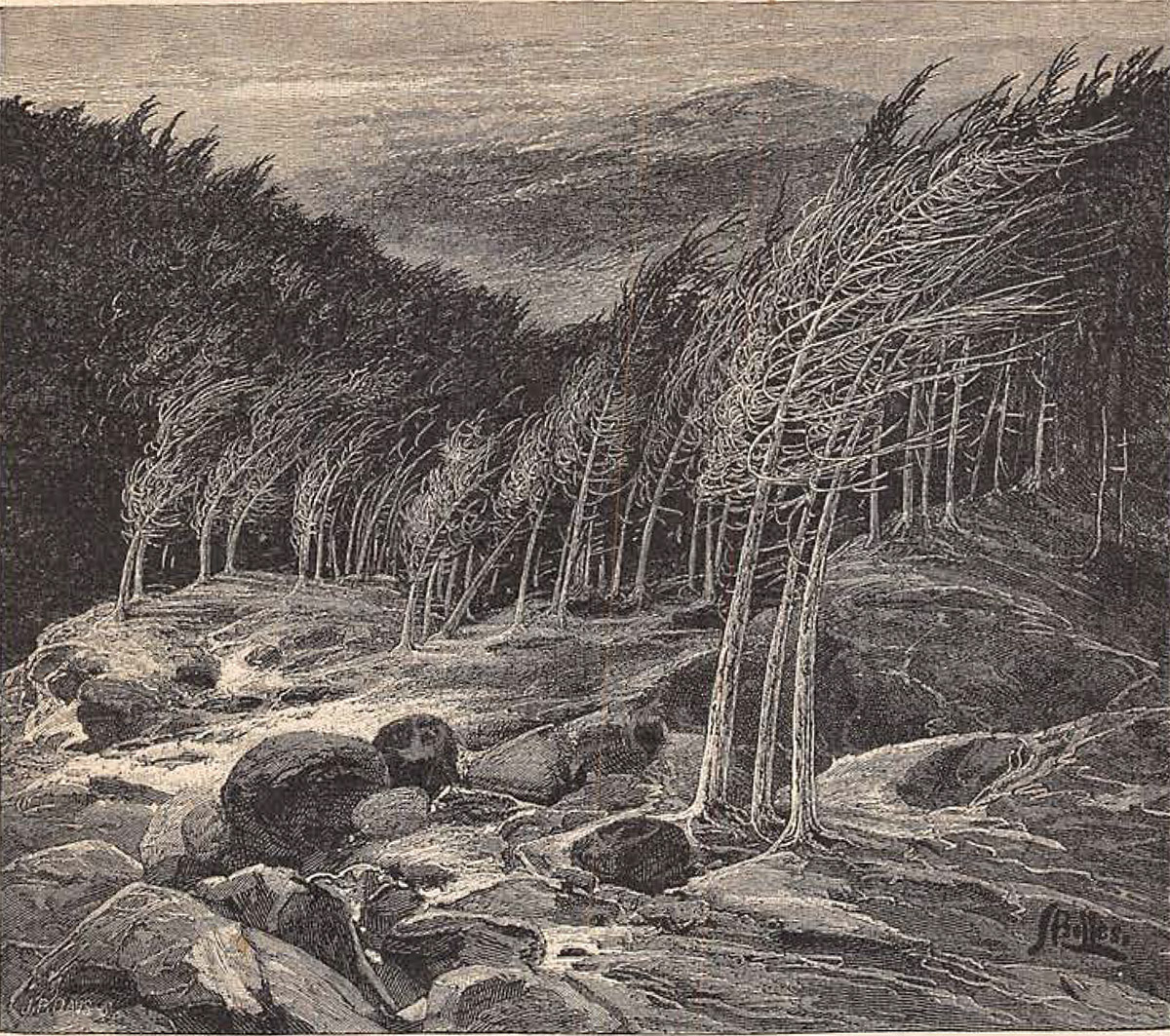
Illustration by American artist John W. Bolles (1860–1927) based on sketch by John Muir for “A Wind Storm in the Forests of the Yuba,” from the November 1878 issue of Scribner’s Monthly.
When “A Wind-Storm in the Forests” was included in the Library of America anthology American Earth: Environmental Writing Since Thoreau (2008), the volume editor, Bill McKibben, provided an introduction, which we reprint below, followed by additional background about the selection.

John Muir was the next great figure after Thoreau in the parade of American environmentalists. He is most celebrated for his practical achievements: founding the Sierra Club (he served as its president for 22 years until his death) and preserving Yosemite. But he is a literary hero as well. Beyond its pragmatic force, Muir’s prose introduced an ecstatic new grammar and vocabulary of wildness into the American imagination: in some sense, every national park on the planet owes its existence to the spell he cast.

Muir was born in Scotland, but moved to a Wisconsin homestead at the age of 11. His father was abusive, working his son long hours and beating him until he had memorized most of the Bible. He rebelled by becoming a vagabond, and by asking powerful questions about the orthodoxies of his day and ours, especially the notion that people stood at the center of the universe. His A Thousand-Mile Walk to the Gulf, written in 1867, is especially trenchant in its sympathetic portrait of the alligator: “Honorable representatives of the great saurians of an older creation, may you long enjoy your lilies and rushes, and be blessed now and then with a mouthful of terror-stricken man by way of dainty!” Muir’s evident pleasure in the prospect of an occasional successful alligator attack foreshadows current ideas about “anthropocentrism” among deep ecologists. His writings also anticipate the ecologist’s sense of interconnectedness: “When we try to pick out anything by itself,” he wrote in My First Summer in the Sierra (1911), “we find it hitched to everything else in the universe.”

Muir’s wanderings eventually led him to California, and then Yosemite, where he helped Louis Agassiz prove his controversial theories about glaciation. But he was more and more disgusted by the way that flocks of sheep were trashing the backcountry, and so he began writing a series of articles that led to the creation of the Sierra Club and the further protection of Yosemite. He was a friend of Theodore Roosevelt, but a sworn enemy of Roosevelt’s chief forester, Gifford Pinchot, who had no use for pristine wilderness.

His later years were saddened by the losing fight to save Yosemite’s Hetch Hetchy Valley, which San Francisco dammed as a water source. But his long treks across the granite fastness of the Sierra had doubtless left him with joy enough for one lifetime: “This grand show is eternal. It is always sunrise somewhere; the dew is never all dried at once; a shower is forever falling; vapor is ever rising. Eternal sunrise, eternal sunset, eternal dawn and gloaming, on seas and continents and islands, each in its turn, as the round earth rolls.”

Additional background about this selection: In 1878, when Muir had just begun to publish essays in the nation’s leading magazines, he captured readers’ imagination with “A Wind Storm in the Forests of the Yuba,” which appeared in Scribner’s Monthly Magazine. His account of riding a tree in the middle of a storm generated much feedback from readers, including a fan letter sent in 1885 from the Helen Hunt Jackson, author of Ramona: “I believe I know every word you have written. I never wished myself a man but once—that was when I read how it seemed to be rocked in the top of a pine tree in a gale.” The Scribner brothers wrote to Muir after the article appeared in their magazine:
We have read with much interest your paper in the November number of Scribner’s entitled “A Wind Storm in the Forests of the Yuba.” We understand that it is the first of a series of articles that have been arranged for publication in the magazine. We write particularly to say that should you intend hereafter bringing these papers together in a volume together with other articles that have appeared elsewhere (in Harper’s Magazine etc) we hope that you will without fail confer with us on the subject. We feel sure that you must have at your disposal an abundance of good material for a capital book.
In the end, however, the Scribners would not publish Muir’s collection of essays. In 1881 Scribner’s Monthly was sold to a new publisher and became The Century Illustrated Monthly Magazine. Right around this time, Muir got married, settled down on his farm, and stopped writing for publication. In 1889, Robert Underwood Johnson, an associate editor who had moved from Scribner’s to Century and who encouraged Muir to write again (“Have you abandoned literature altogether?”), traveled to California and met Muir in person for the first time. During the trip, Johnson and Muir agreed to launch an effort to make Yosemite a national park, and Muir wrote two articles for Century Magazine in support of the idea. Muir’s role in the successful campaign reinvigorated both his public profile and his literary career, and he signed a contract with the Century Company to publish his first book (not counting Picturesque California, an 1888 anthology he edited that gathered some 1,500 illustrations and accompanying texts by various artists and writers). With Johnson’s help, Muir reworked essays he had written between 1875 and 1881 and published the collection in 1894 as The Mountains of California. The book includes his famous “tree ride” essay under the simplified title “A Wind-Storm in the Forests,” and that is the version we present below.

*   *   *
The mountain winds, like the dew and rain, sunshine and snow, are measured and bestowed with love on the forests to develop their strength and beauty. . . . If you don't see the full story below, click here (PDF) or click here (Google Docs) to read it—free!

This selection may be photocopied and distributed for classroom or educational use.

Sunday, November 7, 2021

Yosemite Valley in Flood

John Muir (1838–1914)
From John Muir: Nature Writings

Sentinel Rock, Yosemite, 1872, oil on canvas by Scottish American painter William Keith (1838–1911). Wikimedia Commons. Both Keith and John Muir were born in Scotland the same year; the two men met for the first time when Keith traveled to Yosemite in 1872 and Muir took the visitor on one of his tours of the valley. They became close friends, occasionally traveling together in the Sierra Nevada range during the subsequent four decades, and Muir owned several of Keith’s paintings. In an 1875 article in The Overland Monthly, Keith criticized the accuracy of previous paintings of Yosemite by Albert Bierstadt and Thomas Hill: “The cliffs are neither red nor yellow, but an indescribable shifting gray, changing and shifting even as you look.”
A month before his twenty-ninth birthday, John Muir was fixing the belt system in an Indianapolis factory that manufactured wagon parts when he lost his grip and a sharp-pointed file pierced his right eye. The damage was serious enough to affect the vision in both eyes and he was unable to see for several weeks. While recuperating during the summer of 1867, he decided that if he fully regained his sight, he would take a trip “sufficient to lighten and brighten my after life in the gloom and hunger of civilization’s defrauding duties.” His sight in both eyes did return, and he planned to travel to the Amazon to focus on his botanical studies—but he didn’t make it that far. Instead, he took a train to Louisville and chose to walk to the Gulf of Mexico (via Savannah)—a trip of nearly a thousand miles. He then traveled to Cuba before heading north to New York City, where he decided to go to California—by way of Panama, the closest he got to South America.

Arriving in San Francisco in the spring of 1868, Muir took a job later in the year tending 1,800 sheep in the Central Valley. The following spring, he led his flock into the Sierra Nevada mountains and to the Yosemite Valley—and his fate was sealed. After quitting his shepherding job, he began working at a sawmill in Yosemite, and spent Sundays exploring the valley. Years earlier, as a student at the University of Wisconsin, he had studied geology as well as botany under Ezra S. Carr (now teaching, as it happened, at the University of California), and Muir quickly became convinced that glaciers had carved out the area’s landscape. Jeanne Carr, Ezra’s wife, began sending dignitaries, scientists, and artists to Yosemite with notes to Muir asking him to guide them through the valley.

Muir’s voluntary duties as tour guide won numerous converts to his belief in Yosemite’s glacial origins, and during the summer of 1871 Muir left the sawmill to devote more time to search for evidence to support the theory. And that’s when he struck “gold,” as it were. During one hike, he found a muddy stream that carried silt “entirely mineral of composition” and that issued from what he believed to be a moraine. As he recalled the following year:
When I had scrambled to the top of the moraine, I saw what seemed to be a huge snow-bank, four or five hundred yards in length, by half a mile in width. Imbedded in its stained and furrowed surface were stones and dirt like that of which the moraine was built. Dirt-stained lines curved across the snow-bank from side to side, and when I observed that these curved lines coincided with the curved moraine, and that the stones and dirt were most abundant near the bottom of the bank, I shouted, “A living glacier!”
He determined that the glacier was “several hundred feet in depth,” and during subsequent weeks he measured its slow movement (about an inch per day) across the landscape. During the following years, he would identify a total of 65 glaciers in the Sierra Nevada. Many of them, including the first ice sheet identified by Muir as a “living glacier,” have completely melted away in recent decades.

Encouraged by Clinton L. Merriam (a New York congressman interested in geology) and John Daniel Runkle (president of Massachusetts Institute of Technology) to publish his findings, Muir adapted several of the letters he had written about glaciers and other natural phenomena into article form. His first published essay, “Yosemite Glaciers,” appeared in the New-York Tribune in December, for which he was paid $200—a princely sum at the time. Realizing he could earn a living as a writer, he began publishing a series of articles describing his adventures in Yosemite in The Overland Monthly, a California literary magazine. By 1875, he was writing about his investigations to a national audience; an article in Harper’s Monthly Magazine began, “The Sierra Nevada of California may be regarded as one grand wrinkled sheet of glacial records.”

All of this was a direct challenge to Josiah Whitney, the famed Harvard geologist and chief of the California Geological Survey, which in 1864 had named the state’s tallest mountain after him. The year Muir arrived in California, Whitney published The Yosemite Guide-Book, which posited his own theory on how Yosemite was formed—by a massive earthquake, a cataclysmic event during which “the bottom of the Valley sank down.” He preemptively dismissed speculation that glacial activity might have been involved: “A more absurd theory was never advanced than that by which it was sought to ascribe to glaciers the sawing out of these vertical walls and the rounding of the domes.” He furthermore insisted that there was no evidence that glaciers ever even existed in the region. After Muir’s findings convinced many geologists (including, most notably, Joseph Le Conte), Whitney doubled down, protesting in 1882 that “it seems surprising that a theory so utterly averse to the facts should have ever gained currency, and it is almost humiliating to be obliged to enter into an argument to prove that the Yosemite Valley was not dug out of the solid granite by ice.” He reaffirmed his belief that “there are no glaciers at all in the Sierra Nevada” and none even in the Rocky Mountains south of Idaho or Wyoming. Muir’s findings prevailed, of course, although Whitney insisted on the primacy of his “subsidence” theory until his death in 1896.*

In 1911, Muir wrote to a friend, “Have I forgotten the Amazon, Earth’s greatest river? Never, never, never. It has been burning in me half a century, and will burn forever.” That August, at the age of 71, Muir—alone, and over the objections of nearly everyone he knew—embarked on a steamer and finally fulfilled his dream of visiting the Amazon delta. His voyage took him throughout South America, as well as around the entire continent of Africa, through the Suez Canal, and into the Mediterranean. He returned to New York in March 1912, two and a half years before his death on Christmas Eve 1914.

For our Story of the Week selection, we present one of the articles Muir wrote in the 1870s for The Overland Monthly, describing a spectacular and torrential storm in late autumn.

* In most biographies of Muir, as well as in Yosemite guidebooks and online essays, Josiah Whitney is quoted as referring to Muir as “a mere sheep herder, an ignoramus” (or some similarly worded phrase). Geophysicist Craig H. Jones, in his book The Mountains That Remade America (2017), questions whether Whitney ever said anything of the sort about Muir—although, he admits, “this does sound like Whitney.” The word ignoramus was certainly in Whitney’s armory of insults; we found an 1851 letter in which he used it to describe a high school teacher peddling an inaccurate geological chart for academic use. But the earliest source for the quote we could locate—and the one cited by several subsequent authors—is Linnie Marsh Wolfe’s 1945 biography of Muir, Son of the Wilderness, published a full half century after Whitney’s death. Wolfe does not identify her source, however, and (as Jones points out) it does not appear that Whitney ever directly mentioned Muir, either in his published works or in his extant letters. Seven years earlier, in 1938, the geologist François E. Matthes wrote a laudatory profile for radio broadcast on the occasion of Muir’s centenary and reprinted it in the Sierra Club Bulletin, in which he stated, “His views were assailed, ridiculed, and belittled as the wild fantasies of an ignorant shepherd”—but Matthes did not attach this epithet to Whitney or any other individual. In sum, in the absence of any contemporaneous evidence, the attribution of the quote to Whitney should be considered apocryphal.

Notes: Hutching’s and Black’s were two hotels operating in the Yosemite Valley. Thomas Hill, who emigrated from England in 1840, painted dozens of Yosemite landscapes. It is not clear which of his paintings Muir refers to in his essay.

*   *   *
Many a joyful stream is born in the Sierras, but not one can sing like the Merced. . . . If you don't see the full story below, click here (PDF) or click here (Google Docs) to read it—free!

This selection may be photocopied and distributed for classroom or educational use.

Saturday, September 25, 2021

A Magic Kingdom

Edward O. Wilson (1929–2021)
From Edward O. Wilson: Biophilia, The Diversity of Life, Naturalist

Chrysaora quinquecirrha, photograph from the National Oceanic and Atmospheric Administration, via WikiMedia Commons. “I stand in the shallows off Paradise Beach, staring down at a huge jellyfish in water so still and clear that its every detail is revealed as though it were trapped in glass,” recalls Edward O. Wilson. “The jellyfish, I know now, was a sea nettle, formal scientific name Chrysaora quinquecirrha, a scyphozoan, a medusa, a member of the pelagic fauna that drifted in from the Gulf of Mexico and paused in the place I found it.”
“Paradise Beach was paradise truly named for a little boy,” writes E. O. Wilson in his memoir Naturalist. “Each morning after breakfast I left the small shorefront house to wander alone in search of treasures along the strand.”

During the summer of 1936 seven-year-old Edward Wilson boarded with a family in Paradise Beach, on the coast of Perdido Bay near Pensacola, Florida. His parents sent him there while they tried to work through the marital difficulties that would lead to their divorce the following year. One day he went fishing from a dock, “jerking pinfish out of the water as soon as they struck the bait,” he recalls. “The species, Lagodon rhomboides, is small, perchlike, and voracious. It carries ten needlelike spines that stick straight up in the membrane of the dorsal fin when it is threatened. I carelessly yanked too hard when one of the fish pulled on my line. It flew out of the water and into my face. One of its spines pierced the pupil of my right eye.” Left untreated, his eye developed a traumatic cataract several months later and he underwent surgery at Pensacola Hospital, partially losing his sight. “I was left with full sight in the left eye only. Fortunately, that vision proved to be more acute at close range than average— 20/10 on the ophthalmologist’s chart—and has remained so all my life.”

By the time he was in high school, Wilson had decided to become a biologist. But then he lost most of his hearing in the upper registers from a cause that was never determined. “So when I set out later as a teenager with Roger Tory Peterson’s Field Guide to the Birds and binoculars in hand, as all true naturalists in America must at one time or other, I proved to be a wretched birdwatcher. I couldn’t hear birds; I couldn’t locate them unless they obligingly fluttered past in clear view; even one bird singing in a tree close by was invisible unless someone pointed a finger straight at it. The same was true of frogs.”

These two childhood events shaped his fate: “I am blind in one eye and cannot hear high-frequency sounds; therefore I am an entomologist.” More specifically, Edward O. Wilson became a myrmecologist (a scientist who studies ants), not to mention one of the best-selling and most popular science writers of recent decades.

The spring after his trip to Paradise Beach, Wilson attended the Gulf Coast Military Academy near Gulfport, Mississippi, for one term, “a carefully planned nightmare engineered for the betterment of the untutored and undisciplined,” as he later described it. “I hated the place then but came to love it later, savoring it ever more in memory as the years passed and recollections of my distress faded. I stayed just long enough to be transformed in certain qualities of mind.” Because his parents lived separately and his father changed his job and moved frequently, Edward lived a peripatetic life for the remainder of his youth. Over the next eleven years, he attended more than a dozen different public schools throughout the South. The frequent disruptions in his social life ended up reinforcing his early selection for a career. “A nomadic existence made Nature my companion of choice, because the outdoors was the one part of my world I perceived to hold rock steady.”

In a recent interview, the science writer David Quammen discusses the importance of why Wilson chose Naturalist and not Biologist for the title of his coming-of-age chronicle: “That choice reflects his awareness of the fact, still true, that a life devoted to the study, understanding, and appreciation of non-human life in all its forms is not likely to begin in a classroom. It’s not likely to arise merely from books, let alone screens. It’s a sort of devotion, an instinct like morality, that grows from green shoots. Not every great biologist begins as a kid with a butterfly net and a desire to turn over rocks in clear-running brooks to see whether the miracle of a salamander might lie underneath. But many of them do.”

In 2006 Wilson noted that over the course of his career as a myrmecologist, he “had separated and diagnosed 624 species, including 337 new to science, which at that time composed 19 percent of all the known ant species of the Western Hemisphere and 6 percent of all the ant species of the world.” In “A Magic Kingdom,” a chapter from Naturalist, Wilson remembers his childhood explorations of Nature and his early forays into the realm of ants. “Most children have a bug period,” he writes, “and I never grew out of mine.”

*   *   *
Come back with me to October 1935, to Pensacola, for a walk up Palafox Street. Let’s start by peeking over the seawall that closes the south end of the street. . . . If you don't see the full selection below, click here (PDF) or click here (Google Docs) to read it—free!

This selection is used by permission. To photocopy and distribute this selection for classroom use, please contact the Copyright Clearance Center.

Sunday, February 28, 2021

Krakatau

Edward O. Wilson (1929–2021)
From Edward O. Wilson: Biophilia, The Diversity of Life, Naturalist

“View of Krakatoa during the Earlier State of the Eruption, from a photograph taken on Sunday, the 27th of May, 1883.” Parker and Coward, lithographers. Chromolithographic plate from The eruption of Krakatoa, and subsequent phenomena, 1888, edited by George James Symonds and published by the Royal Society, Great Britain. Click on image to see the full plate. Houghton Library via WikiCommons.
While he was writing his 1994 memoir Naturalist, Edward O. Wilson found in his “dusty files” a letter sent on February 2, 1940, from his fifth-grade teacher to his parents. “Ed has genuine writing ability, and when he combines this with his great knowledge of insects, he produces fine results.” David Quammen, in his introduction to the Library of America volume collecting three of Wilson’s books, remarks, “That’s probably far more prophetic than anything your fifth-grade teacher or mine ever said about us.”

It didn’t take long for the prophecy to be fulfilled. Within two years, only twelve years old yet already determined to become an entomologist, Wilson was watching and collecting ants in a vacant lot next to his home in Mobile, Alabama. Among the species he observed was one that (he would later learn) had been accidentally imported from South America through the port of Mobile only a few years earlier and that would subsequently cause billions of dollars in damages to both rural and urban areas, from livestock and soybean fields to driveway pavements and electrical wiring. His early observations of the red imported fire ant, as the notorious pest came to be known, would prove to be among the first in the United States. “I was later to publish it as a datum in a technical article, my first scientific observation,” he noted, referring to “A Report on the Imported Fire Ant Solenopsis saevissima var. richteri in Alabama,” which he cowrote for the Alabama Department of Conservation in 1949, when he was a still an undergraduate.

“Wilson has delivered staggering insights on the average of one a decade,” wrote Bill McKibben in 2008, when he included one of the naturalist’s essays in the anthology American Earth:
In the 1960s, he and Robert MacArthur coined the phrase “island biogeography” to explain the effects of habitat size and isolation on extinction rates, work that is now a key tool in conservation planning. In the 1970s, he coined the term “sociobiology” to argue for a strong genetic role in human behavior, an idea that offended left-wing orthodoxies of the time (his classes at Harvard were routinely interrupted by protesters), but that won him the Pulitzer Prize for On Human Nature (1979). In 1984 his book Biophilia proposed that humans had an innate affection for other living systems, deeply rooted in our biology. . . . As his academic fame grew, he used it tirelessly to advocate for conservation, especially a strategy for protecting “hotspots” around the tropics that were particularly rich in diverse species. And in recent years he has worked hard to bridge the divide between science and religion, arguing for a common interest in the protection of creation.
One of the locations that played an outsized role in the development of Wilson and MacArthur’s “theory of island biogeography” was the island of Krakatau (commonly known as Krakatoa). The two scientists had come up with a model to estimate the number of species and the extinction rate of an isolated habitat based on its size and distance from other habitats, and they realized that Krakatua could provide them with the first test. After the island famously self-destructed from volcanic eruption in 1883, Dutch scientific expeditions gathered data from the ash-covered remnant for half a century, and in the 1960s the two biologists used the data to confirm their findings. “We got Krakatoa’s area and fitted it on our own curve relating area to species,” Wilson recalls in his 1984 book Biophilia. “Krakatoa should have 30 bird species at equilibrium. The Dutch surveys indicated that it reached about 90 percent of that number in 30 years.” The old reports also confirmed a high extinction rate as new species arrived and took over—although not as high as Wilson and MacArthur’s calculations had forecast.

Wilson then decided to find—and ultimately to create—a “series of little Krakataus” where he could expand upon and refine the findings; later, other scientists began to develop more elaborate models for lakes, coral reefs, and even parks. “It was all very exciting,” he writes, “but the first models that MacArthur and I had fashioned were too crude to fit these additional cases.” Before long the field, “which continues to broaden and shift each year,” moved beyond the work of their original models and the “surviving fragments” have been absorbed into the work of subsequent generations of biologists. “That is the way of science,” write Wilson. “The scientist may think like a poet, but the products of his imagination are seldom preserved in their original state.”

In the fascinating chapter on Krakatau in The Diversity of Life (1992), which we present as our Story of the Week selection, Wilson sets aside the island’s role in his own groundbreaking research and instead presents a history of the 1883 eruption and of the reappearance of life on both the remnant island Rakata and the “new” island Anak Krakatau, which emerged from the sea in 1930.

*   *   *
Krakatau, earlier misnamed Krakatoa, an island the size of Manhattan located midway in the Sunda Strait between Sumatra and Java, came to an end on Monday morning, August 27, 1883. . . . If you don't see the full selection below, click here (PDF) or click here (Google Docs) to read it—free!

This selection is used by permission. To photocopy and distribute this selection for classroom use, please contact the Copyright Clearance Center.

Saturday, January 23, 2021

The Last Passenger Pigeon

Gene Stratton-Porter (1863–1924)
From American Earth: Environmental Writing Since Thoreau

“Winter Sport in Northern Louisiana — Hunting Wild Pigeons” Hand-colored engraving by American illustrator Smith W. Bennett (1846–1907). From the July 3, 1875, issue of The Illustrated Shooting and Dramatic News. Via Wikimedia Commons
Two centuries ago, in 1823, James Fenimore Cooper published The Pioneers, the first of the five novels known as The Leatherstocking Tales. In one of the book’s most memorable passages Natty Bumppo—the main character also known as Leatherstocking, Deerslayer, Pathfinder, and Hawkeye—witnesses the entire town of Templeton gathering to assault an incoming flock of passenger pigeons:
So prodigious was the number of the birds, that the scattering fire of the guns, with the hurling of missiles, and the cries of the boys, had no other effect than to break off small flocks from the immense masses that continued to dart along the valley, as if the whole of the feathered tribe were pouring through that one pass. None pretended to collect the game, which lay scattered over the fields in such profusion as to cover the very ground with fluttering victims.

Leather-stocking was a silent, but uneasy spectator of all these proceedings, but was able to keep his sentiments to himself until he saw the introduction of the swivel into the sports.

“This comes of settling a country!” he said—“here have I known the pigeon to fly for forty long years, and, till you made your clearings, there was nobody to skear or to hurt them. I loved to see them come into the woods, for they were company to a body, hurting nothing; being, as it was, as harmless as a garter-snake. But now it gives me some thoughts when I hear the frighty things whizzing through the air, for I know it’s only a motion to bring out all the brats of the village. Well! the Lord won’t see the waste of his creaters for nothing, and right will be done to the pigeons, as well as others, by-and-by. . . .”
The carnage resumed when a second flock of birds flew toward the town later in the day:
Some millions of pigeons were supposed to have already passed, that morning, over the valley of Templeton; but nothing like the flock that was now approaching had been seen before. It extended from mountain to mountain in one solid blue mass, and the eye looked in vain over the southern hills to find its termination. The front of this living column was distinctly marked by a line but very slightly indented, so regular and even was the flight.
By then, Natty had left the scene in disgust, carrying the single bird he had shot down for his supper. The rest of the townsfolk, with muskets and cannon, fired upon the flock until Judge Marmaduke Temple, the town’s founder, regretfully looked over the field and said, “I see nothing but eyes, in every direction, as the innocent sufferers turn their heads in terror. Full one-half of those that have fallen are yet alive; and I think it is time to end the sport, if sport it be.”

Simon Pokagon, a chief of the Pokagon Band of Potawatomi Indians, recalled his own sighting of a flock of passenger pigeons a quarter century after the publication of The Pioneers:
About the middle of May, 1850, while in the fur trade, I was camping on the head waters of the Manistee River in Michigan. One morning on leaving my wigwam I was startled by hearing a gurgling, rumbling sound as though an army of horses laden with sleigh bells was advancing through the deep forests towards me. As I listened more intently I concluded that instead of the tramping of horses it was distant thunder; and yet the morning was clear calm and beautiful. Nearer and nearer came the strange commingling sounds of sleigh bells, mixed with the rumbling of an approaching storm. While I gazed in wonder and astonishment, I beheld moving toward me in an unbroken front millions of pigeons, the first I had seen that season. They passed like a cloud through the branches of the high trees, through the underbrush and over the ground, apparently overturning every leaf. Statue-like I stood, half-concealed by cedar boughs. They fluttered all about me, lighting on my head and shoulders; gently I caught two in my hands and carefully concealed them under my blanket. (“The Wild Pigeon of North America,” The Chautauquan, November 1895)
Cooper’s and Pokagon’s effusive descriptions of the flocks are supported by similar observations throughout the 1800s. “The air was literally filled with Pigeons; the light of noon-day was obscured as by an eclipse,” John James Audubon wrote in his Ornithological Biography early in the century. “Before sunset I reached Louisville, distance from Hardensburgh fifty-five miles. The Pigeons were still passing in undiminished numbers, and continued to do so for three days in succession.” John Muir recalled in the memoir The Story of My Boyhood and Youth, “I have seen flocks streaming south in the fall so large that they were flowing over from horizon to horizon in an almost continuous stream all day long, at the rate of forty or fifty miles an hour, like a mighty river in the sky, widening, contracting, descending like falls and cataracts, and rising suddenly here and there in huge ragged masses like high-plashing spray.” In 1871 naturalists estimated that one nesting area in Wisconsin measured 850 square miles and contained more than 130 million pigeons.

In the late 1870s, the future best-selling novelist and nature writer Gene Stratton-Porter was still in her teens, the youngest of twelve siblings on a prosperous Indiana farm run by a prominent Methodist preacher and his wife. By then, frequent sightings of million-bird flocks were a thing of the recent past, but the birds were still abundant enough for her neighbors to bag several dozen at a time. Members of the Stratton family, however, were prohibited from hunting the species by their father, who regarded both wild pigeons and doves fondly for religious and aesthetic reasons and who was troubled by their diminishing numbers.

If we fast forward one final quarter century, to 1902, we find that the last pigeon shot in the wild is believed to have been brought down by a hunter 150 miles south of the Stratton farm, in Laurel, Indiana, according to records uncovered by Joel Greenberg while conducting research for his 2014 book A Feathered River Across the Sky. Better known to many readers is the fate of George and Martha, the last two passenger pigeons, both of which Stratton-Porter saw at the Cincinnati Zoo in 1910. George died two years later, and the national headlines created by Martha’s demise, on September 1, 1914, marked both the extinction of the species that used to number in the billions and the fulfillment of Natty Bumppo’s forewarning of the long-term consequences of his neighbors’ “wasty ways.” “For one species to mourn the death of another is a new thing under the sun,” Aldo Leopold wrote in 1947 for the creation of a monument to the species in Wisconsin. “In this fact, rather than in Mr. DuPont’s nylons or Mr. Vannevar Bush’s bombs, lies objective evidence of our superiority over the beasts.”

Gene Stratton-Porter gathered her memories of the pigeons for an article published in Good Housekeeping in August 1924, ten years after the death of Martha—and twelve years after her final sighting of what she believes might have been a lone passenger pigeon in the wild. We present it here as our Story of the Week, with a brief headnote by Bill McKibben on Stratton-Porter’s distinctive literary career.

Note: From 1895 to 1913, Stratton-Porter lived adjacent to Indiana’s 13,000-acre Limberlost Swamp, which served as the setting for several of her books. During this period, the swamp was drained for agricultural development and she unsuccessfully lobbied against the destruction of the area and its bountiful wildlife and flora.

*   *   *
The farm on which I lived as a child was one of the most beautiful at that time that I ever have seen. . . . If you don't see the full selection below, click here (PDF) or click here (Google Docs) to read it—free!

This selection may be photocopied and distributed for classroom or educational use.