Showing posts with label John Muir. Show all posts

Sunday, April 2, 2023

A Wind-Storm in the Forests

John Muir (1838–1914)
From John Muir: Nature Writings

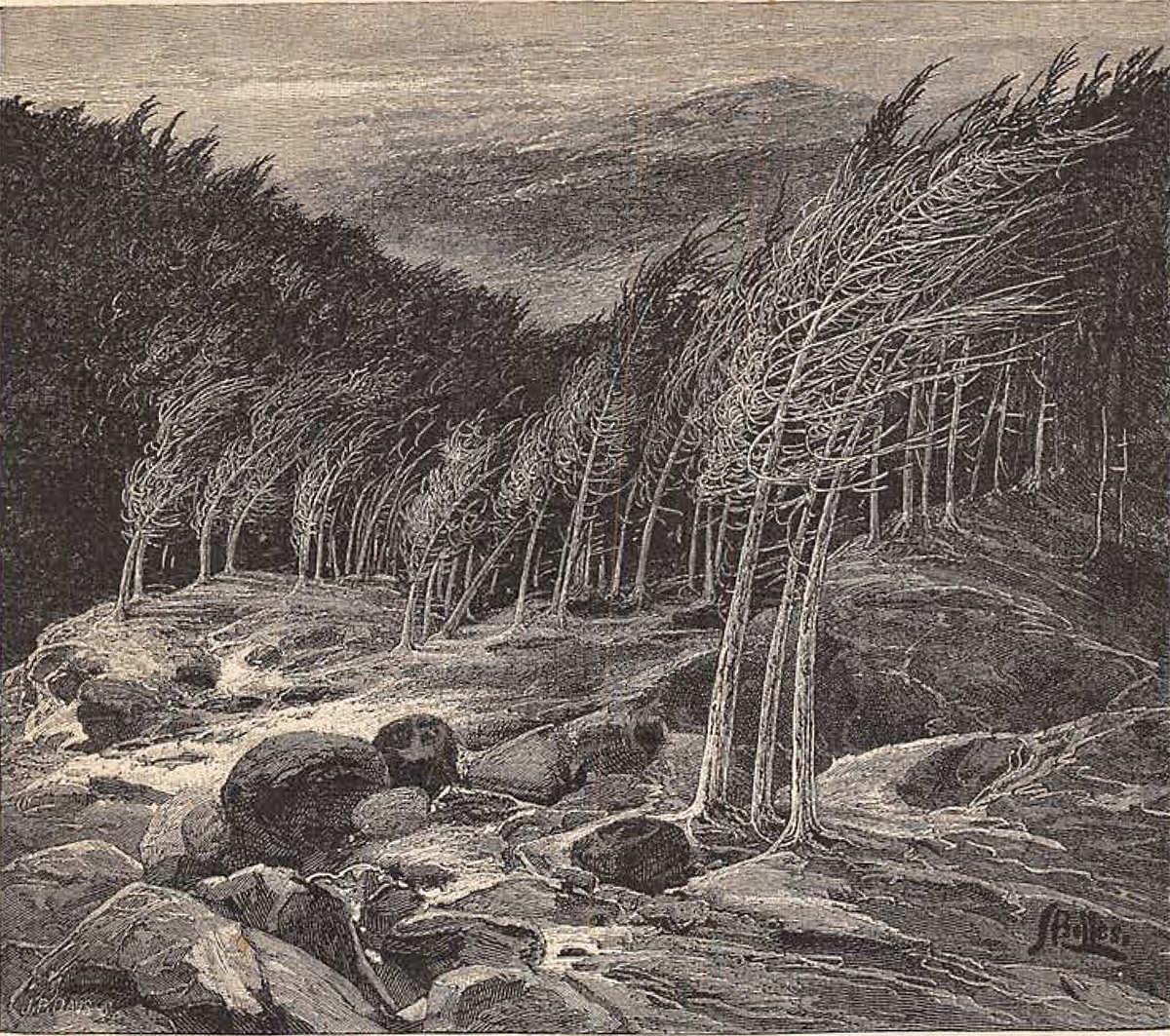
Illustration by American artist John W. Bolles (1860–1927) based on sketch by John Muir for “A Wind Storm in the Forests of the Yuba,” from the November 1878 issue of Scribner’s Monthly.
When “A Wind-Storm in the Forests” was included in the Library of America anthology American Earth: Environmental Writing Since Thoreau (2008), the volume editor, Bill McKibben, provided an introduction, which we reprint below, followed by additional background about the selection.

John Muir was the next great figure after Thoreau in the parade of American environmentalists. He is most celebrated for his practical achievements: founding the Sierra Club (he served as its president for 22 years until his death) and preserving Yosemite. But he is a literary hero as well. Beyond its pragmatic force, Muir’s prose introduced an ecstatic new grammar and vocabulary of wildness into the American imagination: in some sense, every national park on the planet owes its existence to the spell he cast.

Muir was born in Scotland, but moved to a Wisconsin homestead at the age of 11. His father was abusive, working his son long hours and beating him until he had memorized most of the Bible. He rebelled by becoming a vagabond, and by asking powerful questions about the orthodoxies of his day and ours, especially the notion that people stood at the center of the universe. His A Thousand-Mile Walk to the Gulf, written in 1867, is especially trenchant in its sympathetic portrait of the alligator: “Honorable representatives of the great saurians of an older creation, may you long enjoy your lilies and rushes, and be blessed now and then with a mouthful of terror-stricken man by way of dainty!” Muir’s evident pleasure in the prospect of an occasional successful alligator attack foreshadows current ideas about “anthropocentrism” among deep ecologists. His writings also anticipate the ecologist’s sense of interconnectedness: “When we try to pick out anything by itself,” he wrote in My First Summer in the Sierra (1911), “we find it hitched to everything else in the universe.”

Muir’s wanderings eventually led him to California, and then Yosemite, where he helped Louis Agassiz prove his controversial theories about glaciation. But he was more and more disgusted by the way that flocks of sheep were trashing the backcountry, and so he began writing a series of articles that led to the creation of the Sierra Club and the further protection of Yosemite. He was a friend of Theodore Roosevelt, but a sworn enemy of Roosevelt’s chief forester, Gifford Pinchot, who had no use for pristine wilderness.

His later years were saddened by the losing fight to save Yosemite’s Hetch Hetchy Valley, which San Francisco dammed as a water source. But his long treks across the granite fastness of the Sierra had doubtless left him with joy enough for one lifetime: “This grand show is eternal. It is always sunrise somewhere; the dew is never all dried at once; a shower is forever falling; vapor is ever rising. Eternal sunrise, eternal sunset, eternal dawn and gloaming, on seas and continents and islands, each in its turn, as the round earth rolls.”

Additional background about this selection: In 1878, when Muir had just begun to publish essays in the nation’s leading magazines, he captured readers’ imagination with “A Wind Storm in the Forests of the Yuba,” which appeared in Scribner’s Monthly Magazine. His account of riding a tree in the middle of a storm generated much feedback from readers, including a fan letter sent in 1885 from the Helen Hunt Jackson, author of Ramona: “I believe I know every word you have written. I never wished myself a man but once—that was when I read how it seemed to be rocked in the top of a pine tree in a gale.” The Scribner brothers wrote to Muir after the article appeared in their magazine:
We have read with much interest your paper in the November number of Scribner’s entitled “A Wind Storm in the Forests of the Yuba.” We understand that it is the first of a series of articles that have been arranged for publication in the magazine. We write particularly to say that should you intend hereafter bringing these papers together in a volume together with other articles that have appeared elsewhere (in Harper’s Magazine etc) we hope that you will without fail confer with us on the subject. We feel sure that you must have at your disposal an abundance of good material for a capital book.
In the end, however, the Scribners would not publish Muir’s collection of essays. In 1881 Scribner’s Monthly was sold to a new publisher and became The Century Illustrated Monthly Magazine. Right around this time, Muir got married, settled down on his farm, and stopped writing for publication. In 1889, Robert Underwood Johnson, an associate editor who had moved from Scribner’s to Century and who encouraged Muir to write again (“Have you abandoned literature altogether?”), traveled to California and met Muir in person for the first time. During the trip, Johnson and Muir agreed to launch an effort to make Yosemite a national park, and Muir wrote two articles for Century Magazine in support of the idea. Muir’s role in the successful campaign reinvigorated both his public profile and his literary career, and he signed a contract with the Century Company to publish his first book (not counting Picturesque California, an 1888 anthology he edited that gathered some 1,500 illustrations and accompanying texts by various artists and writers). With Johnson’s help, Muir reworked essays he had written between 1875 and 1881 and published the collection in 1894 as The Mountains of California. The book includes his famous “tree ride” essay under the simplified title “A Wind-Storm in the Forests,” and that is the version we present below.

*   *   *
The mountain winds, like the dew and rain, sunshine and snow, are measured and bestowed with love on the forests to develop their strength and beauty. . . . If you don't see the full story below, click here (PDF) or click here (Google Docs) to read it—free!

This selection may be photocopied and distributed for classroom or educational use.

Sunday, November 7, 2021

Yosemite Valley in Flood

John Muir (1838–1914)
From John Muir: Nature Writings

Sentinel Rock, Yosemite, 1872, oil on canvas by Scottish American painter William Keith (1838–1911). Wikimedia Commons. Both Keith and John Muir were born in Scotland the same year; the two men met for the first time when Keith traveled to Yosemite in 1872 and Muir took the visitor on one of his tours of the valley. They became close friends, occasionally traveling together in the Sierra Nevada range during the subsequent four decades, and Muir owned several of Keith’s paintings. In an 1875 article in The Overland Monthly, Keith criticized the accuracy of previous paintings of Yosemite by Albert Bierstadt and Thomas Hill: “The cliffs are neither red nor yellow, but an indescribable shifting gray, changing and shifting even as you look.”
A month before his twenty-ninth birthday, John Muir was fixing the belt system in an Indianapolis factory that manufactured wagon parts when he lost his grip and a sharp-pointed file pierced his right eye. The damage was serious enough to affect the vision in both eyes and he was unable to see for several weeks. While recuperating during the summer of 1867, he decided that if he fully regained his sight, he would take a trip “sufficient to lighten and brighten my after life in the gloom and hunger of civilization’s defrauding duties.” His sight in both eyes did return, and he planned to travel to the Amazon to focus on his botanical studies—but he didn’t make it that far. Instead, he took a train to Louisville and chose to walk to the Gulf of Mexico (via Savannah)—a trip of nearly a thousand miles. He then traveled to Cuba before heading north to New York City, where he decided to go to California—by way of Panama, the closest he got to South America.

Arriving in San Francisco in the spring of 1868, Muir took a job later in the year tending 1,800 sheep in the Central Valley. The following spring, he led his flock into the Sierra Nevada mountains and to the Yosemite Valley—and his fate was sealed. After quitting his shepherding job, he began working at a sawmill in Yosemite, and spent Sundays exploring the valley. Years earlier, as a student at the University of Wisconsin, he had studied geology as well as botany under Ezra S. Carr (now teaching, as it happened, at the University of California), and Muir quickly became convinced that glaciers had carved out the area’s landscape. Jeanne Carr, Ezra’s wife, began sending dignitaries, scientists, and artists to Yosemite with notes to Muir asking him to guide them through the valley.

Muir’s voluntary duties as tour guide won numerous converts to his belief in Yosemite’s glacial origins, and during the summer of 1871 Muir left the sawmill to devote more time to search for evidence to support the theory. And that’s when he struck “gold,” as it were. During one hike, he found a muddy stream that carried silt “entirely mineral of composition” and that issued from what he believed to be a moraine. As he recalled the following year:
When I had scrambled to the top of the moraine, I saw what seemed to be a huge snow-bank, four or five hundred yards in length, by half a mile in width. Imbedded in its stained and furrowed surface were stones and dirt like that of which the moraine was built. Dirt-stained lines curved across the snow-bank from side to side, and when I observed that these curved lines coincided with the curved moraine, and that the stones and dirt were most abundant near the bottom of the bank, I shouted, “A living glacier!
He determined that the glacier was “several hundred feet in depth,” and during subsequent weeks he measured its slow movement (about an inch per day) across the landscape. During the following years, he would identify a total of 65 glaciers in the Sierra Nevada. Many of them, including the first ice sheet identified by Muir as a “living glacier,” have completely melted away in recent decades.

Encouraged by Clinton L. Merriam (a New York congressman interested in geology) and John Daniel Runkle (president of Massachusetts Institute of Technology) to publish his findings, Muir adapted several of the letters he had written about glaciers and other natural phenomena into article form. His first published essay, “Yosemite Glaciers,” appeared in the New-York Tribune in December, for which he was paid $200—a princely sum at the time. Realizing he could earn a living as a writer, he began publishing a series of articles describing his adventures in Yosemite in The Overland Monthly, a California literary magazine. By 1875, he was writing about his investigations to a national audience; an article in Harper’s Monthly Magazine began, “The Sierra Nevada of California may be regarded as one grand wrinkled sheet of glacial records.”

All of this was a direct challenge to Josiah Whitney, the famed Harvard geologist and chief of the California Geological Survey, which in 1864 had named the state’s tallest mountain after him. The year Muir arrived in California, Whitney published The Yosemite Guide-Book, which posited his own theory on how Yosemite was formed—by a massive earthquake, a cataclysmic event during which “the bottom of the Valley sank down.” He preemptively dismissed speculation that glacial activity might have been involved: “A more absurd theory was never advanced than that by which it was sought to ascribe to glaciers the sawing out of these vertical walls and the rounding of the domes.” He furthermore insisted that there was no evidence that glaciers ever even existed in the region. After Muir’s findings convinced many geologists (including, most notably, Joseph Le Conte), Whitney doubled down, protesting in 1882 that “it seems surprising that a theory so utterly averse to the facts should have ever gained currency, and it is almost humiliating to be obliged to enter into an argument to prove that the Yosemite Valley was not dug out of the solid granite by ice.” He reaffirmed his belief that “there are no glaciers at all in the Sierra Nevada” and none even in the Rocky Mountains south of Idaho or Wyoming. Muir’s findings prevailed, of course, although Whitney insisted on the primacy of his “subsidence” theory until his death in 1896.*

In 1911, Muir wrote to a friend, “Have I forgotten the Amazon, Earth’s greatest river? Never, never, never. It has been burning in me half a century, and will burn forever.” That August, at the age of 71, Muir—alone, and over the objections of nearly everyone he knew—embarked on a steamer and finally fulfilled his dream of visiting the Amazon delta. His voyage took him throughout South America, as well as around the entire continent of Africa, through the Suez Canal, and into the Mediterranean. He returned to New York in March 1912, two and a half years before his death on Christmas Eve 1914.

For our Story of the Week selection, we present one of the articles Muir wrote in the 1870s for The Overland Monthly, describing a spectacular and torrential storm in late autumn.

* In most biographies of Muir, as well as in Yosemite guidebooks and online essays, Josiah Whitney is quoted as referring to Muir as “a mere sheep herder, an ignoramus” (or some similarly worded phrase). Geophysicist Craig H. Jones, in his book The Mountains That Remade America (2017), questions whether Whitney ever said anything of the sort about Muir—although, he admits, “this does sound like Whitney.” The word ignoramus was certainly in Whitney’s armory of insults; we found an 1851 letter in which he used it to describe a high school teacher peddling an inaccurate geological chart for academic use. But the earliest source for the quote we could locate—and the one cited by several subsequent authors—is Linnie Marsh Wolfe’s 1945 biography of Muir, Son of the Wilderness, published a full half century after Whitney’s death. Wolfe does not identify her source, however, and (as Jones points out) it does not appear that Whitney ever directly mentioned Muir, either in his published works or in his extant letters. Seven years earlier, in 1938, the geologist François E. Matthes wrote a laudatory profile for radio broadcast on the occasion of Muir’s centenary and reprinted it in the Sierra Club Bulletin, in which he stated, “His views were assailed, ridiculed, and belittled as the wild fantasies of an ignorant shepherd”—but Matthes did not attach this epithet to Whitney or any other individual. In sum, in the absence of any contemporaneous evidence, the attribution of the quote to Whitney should be considered apocryphal.

Notes: Hutching’s and Black’s were two hotels operating in the Yosemite Valley. Thomas Hill, who emigrated from England in 1840, painted dozens of Yosemite landscapes. It is not clear which of his paintings Muir refers to in his essay.

*   *   *
Many a joyful stream is born in the Sierras, but not one can sing like the Merced. . . . If you don't see the full story below, click here (PDF) or click here (Google Docs) to read it—free!

This selection may be photocopied and distributed for classroom or educational use.

Friday, August 19, 2016

Save the Redwoods

John Muir (1838–1914)
From John Muir: My First Summer in the Sierra & Selected Essays

John Muir and Theodore Roosevelt at the Grizzly Giant, Mariposa Big Tree Grove, 1903. Photograph by Joseph N. LeConte (1870–1950). Left to right: Two Secret Service agents, Secretary of the Navy William Henry Moody, California Governor George Pardee, Roosevelt, Dr. Presley Marion Rixey, Muir, Nicholas Murray Butler, Presidential secretary William Loeb Jr, and University of California president Benjamin Ide Wheeler. Image courtesy of the Sierra Club.
This month—on August 25, 2016, to exact—the National Parks Service celebrates its centennial. At the time of its founding, there were already a dozen national parks, including the first, Yellowstone (established in March 1872) and some thirty national monuments, such as Devils Tower in Wyoming, the Gila Cliff Dwellings in New Mexico, and other “historic landmarks, historic and prehistoric structures, and other objects of historic or scientific interest” protected by the 1906 Antiquities Act. The 1916 law brought all these areas under the umbrella of a single agency, which today manages 59 national parks, 82 national monuments, and several hundred other preserves, recreation areas, and historic sites.

John Muir, who died two years before the founding of the NPS, is widely considered one of several men responsible for its creation. For four decades Muir published articles in the national press urging protection of such natural wonders as the Petrified Forest, the Grand Canyon, and—above all—Yosemite. In 1889 Muir met Robert Underwood Johnson, associate editor of The Century Magazine, and the two men traveled to Yosemite in early June. They were alarmed to find substantial damage caused by lumbering, sheepherding, and tourism. Muir agreed to write two articles for the magazine proposing the creation of a Yosemite national park, and Johnson returned to Washington to lobby Congress. In October 1890, largely in response to the public debate that resulted from the Century articles, Congress passed legislation creating a park that was even larger than the one Muir had proposed.

Muir also played a significant and persistent role in saving several forests of giant sequoias (Sequoiadendron giganteum), which include the largest trees in the world, and of coastal redwoods (Sequoia sempervirens), which include the tallest trees in the world. One location was the North Calaveras Big Tree Grove, the first group of sequoias encountered by white settlers. On February 25, 1900, The San Francisco Chronicle published an article that was widely reprinted in the national press. “THE CALAVERAS BIG TREES: Cry of Alarm from California that the Entire Grove May Be Sold and Cut Down for Lumber” ran the headline in The New York Times. For the previous forty years, James Sperry had owned the land, operating a hotel for tourists and protecting the nearly 100 giant sequoias in the grove. (The South Grove, which was not nearly as accessible, hosts another 1,000 trees.) Now seventy-five years old and unable to pay for its maintenance, Sperry needed to sell his land and had been trying to “see the great trees preserved as a public park.” Instead, Job Whiteside, a lumberman from Wisconsin, put down a deposit for the grove, with a 90-day option to come up with the remaining money. Because of the public outcry, Congress passed legislation almost immediately, authorizing the Secretary of the Interior to negotiate for the park with its new would-be owner.

It was around this time that Muir wrote the brief essay “Save the Redwoods,” arguing that Americans should save the scattering of sequoia groves outside the already-established Sequoia National Park, as well as the forests of redwoods along the coast. In the opening paragraph he recounts the demise of the two most famous trees in the North Grove. The Discovery Tree, the first giant sequoia seen by white settlers, was cut down shortly after its discovery in 1852, and its stump was used as a dance floor and, later, a bowling alley. The immense Mother of the Forest, stripped of its bark in 1858, soon died and was destroyed by fire in 1908; the 100-foot stump—about a third of its original height—still stands.

As it happened, after Muir wrote this piece (which was found among his papers after his death), Whiteside refused to sell his new purchase to the federal government. Upset by the way he had been portrayed by the national press, however, he agreed that the sequoias would be preserved, and his family moved into the hotel and continued to operate Sperry’s tourist business. In 1908 President Theodore Roosevelt (who, during his first term in office, had accompanied Muir on a camping trip through the Yosemite area) was authorized by Congress to exchange federal land for the grove and create the Calaveras Big Tree National Park—but Whiteside again refused to give up the land.

Although most major sequoia and coastal redwood groves (including Muir Woods National Monument) were eventually gathered under the jurisdiction of the National Park Service, the Calaveras groves proved an exception, remaining in private hands until 1931, when it became Calaveras Big Trees State Park. Whiteside’s stepson served as the park’s first warden.

Note: On the third page of “Save the Redwoods,” the editors of the Sierra Club Bulletin, which first published this piece in 1920, mistakenly inserted the year 1905, apparently confusing state legislation transferring control of the Mariposa Grove to the federal government on March 3, 1905, with the Calaveras Grove bill approved by the U.S. House on March 3, 1900.

*   *   *
We are often told that the world is going from bad to worse, sacrificing everything to mammon. . . . If you don't see the full selection below, click here (PDF) or click here (Google Docs) to read it—free!

This selection may be photocopied and distributed for classroom or educational use.

Friday, October 5, 2012

Hetch Hetchy Valley

John Muir (1838–1914)
From John Muir: Nature Writings

The Hetch-Hetchy Valley, California, 1870s, oil on canvas by German-American artist Albert Bierstadt (1830–1902), currently at the Wadsworth Atheneum Museum of Art, Hartford, CT. Image courtesy of Wikimedia Commons.
In 1912 John Muir published his collection The Yosemite, which included “Hetch Hetchy Valley,” his essay singing the glories of the “other” Yosemite Valley and an argument against the construction of a dam that would flood the basin in order to provide water for San Francisco. The city had originally requested permission from the federal government to build a dam within the boundaries of Yosemite National Park in 1903 and again in 1905. The initial applications had the support of Gifford Pinchot, who became chief of the newly established United States Forest Service and who asserted that the impact of the dam would be minimal. When Muir first heard that his old friend was in favor of the idea he responded with dismay, “I cannot believe Pinchot, if he really knows the valley, has made any such statements.” The dispute would destroy their friendship, pitting Muir, the preservationist, against Pinchot, the conservationist, for the next decade.

The city’s initial requests were turned down, but the matter received renewed attention when the water supply was disrupted by the devastating 1906 earthquake. City officials again applied to the federal government and this time administration officials, led by Secretary of the Interior James Garfield, were more sympathetic to Pinchot’s lobbying and approved the plan, subject to Congressional approval. Muir, along with the Sierra Club he had founded a decade earlier, began a campaign against the proposal, and he published an early version of the following essay in the Sierra Club Bulletin. The measure stalled in Congress due to both the public outcry and the opposition of the new president, William Howard Taft, who would visit the valley in 1909. Muir, serving as the presidential guide, would argue to Taft that San Francisco could find alternative water supplies outside of the park’s boundaries, and the project was again shelved.

The battle resumed when Woodrow Wilson became president in 1913. The new Secretary of the Interior, Franklin K. Lane, supported the dam, and once again Muir and the Sierra Club rallied their troops to oppose the proposal. Before the year was out, however, a bill granting San Francisco permission to flood Hetch Hetchy Valley passed. The strain of the effort to oppose the dam had taken its toll on Muir (he fell ill several times during this latest campaign), and he died a year later. O'Shaughnessy Dam, named after the project’s chief engineer, was completed in 1923, and the first water reached the city via aqueduct in 1934.

The story of Hetch Hetchy Valley is not quite over. For the last one hundred years, various groups have lobbied to remove the dam, and next month a measure is on the ballot in San Francisco to approve a study of how the valley might be restored and replaced with alternative sources of water and power. [Update: The ballot measure was rejected in November 2012.]

*   *   *
Yosemite is so wonderful that we are apt to regard it as an exceptional creation, the only valley of its kind in the world; but Nature is not so poor as to have only one of anything. Several other yosemites have been discovered in the Sierra that occupy the same relative positions on the Range and were formed by the same forces in the same kind of granite. . . . If you don't see the full story below, click here (PDF) or click here (Google Docs) to read it—free!

This selection may be photocopied and distributed for classroom or educational use.

Friday, January 22, 2010

A Wind-Storm in the Forests

John Muir (1838–1914)
From American Earth: Environmental Writing Since Thoreau

This selection has been reposted with a newly researched and more detailed introduction here.

John Muir—the surprise star of Ken Burns’s recent PBS documentary, The National Parks—is most remembered for founding the Sierra Club in 1911 and for the preservation of Yosemite, but another of his great legacies is his prose, which introduced a new vocabulary to the genre of nature writing. Passionate and witty, his books and essays captured the national imagination and fueled support for the preservation movement. Included as a chapter of The Mountains of California in 1894, “A Wind-Storm in the Forests” exhibits Muir’s awe and love of the wilderness, twin feelings that motivated one of the most remarkable of American lives.

*   *   *
The mountain winds, like the dew and rain, sunshine and snow, are measured and bestowed with love on the forests to develop their strength and beauty. However restricted the scope of other forest influences, that of the winds is universal. The snow bends and trims the upper forests every winter, the lightning strikes a single tree here and there, while avalanches mow down thousands at a swoop as a gardener trims out a bed of flowers. . . . If you don't see the full story below, click here (PDF) or click here (Google Docs) to read it—free!

This selection may be photocopied and distributed for classroom or educational use.