From John Muir: Nature Writings
Interesting Links
“The Odd Couple That Saved Yosemite” (Mary Ann Gwinn, Los Angeles Times)
John Muir Exhibit (The Sierra Club)
Previous Story of the Week selections
• “Yosemite Valley in Flood,” John Muir
• “Echoes in the City of the Angels,” Helen Hunt Jackson
• “About Trees,” J. Sterling Morton
• “Letter from the Dust Bowl,” Caroline Henderson
Buy the book
 John Muir: Nature Writings
The Story of My Boyhood and Youth | My First Summer in the Sierra | The Mountains of California | Stickeen | 888 pages
List price: $35.00
Web store price: $28.00
This essay is also included in:
 American Earth: Environmental Writing Since Thoreau
1,047 pages | 80 plates of photographs
List price: $49.95
Web store price: $32.00
“The Odd Couple That Saved Yosemite” (Mary Ann Gwinn, Los Angeles Times)
John Muir Exhibit (The Sierra Club)
Previous Story of the Week selections
• “Yosemite Valley in Flood,” John Muir
• “Echoes in the City of the Angels,” Helen Hunt Jackson
• “About Trees,” J. Sterling Morton
• “Letter from the Dust Bowl,” Caroline Henderson
Buy the book
John Muir: Nature Writings The Story of My Boyhood and Youth | My First Summer in the Sierra | The Mountains of California | Stickeen | 888 pages
List price: $35.00
Web store price: $28.00
This essay is also included in:
American Earth: Environmental Writing Since Thoreau1,047 pages | 80 plates of photographs
List price: $49.95
Web store price: $32.00
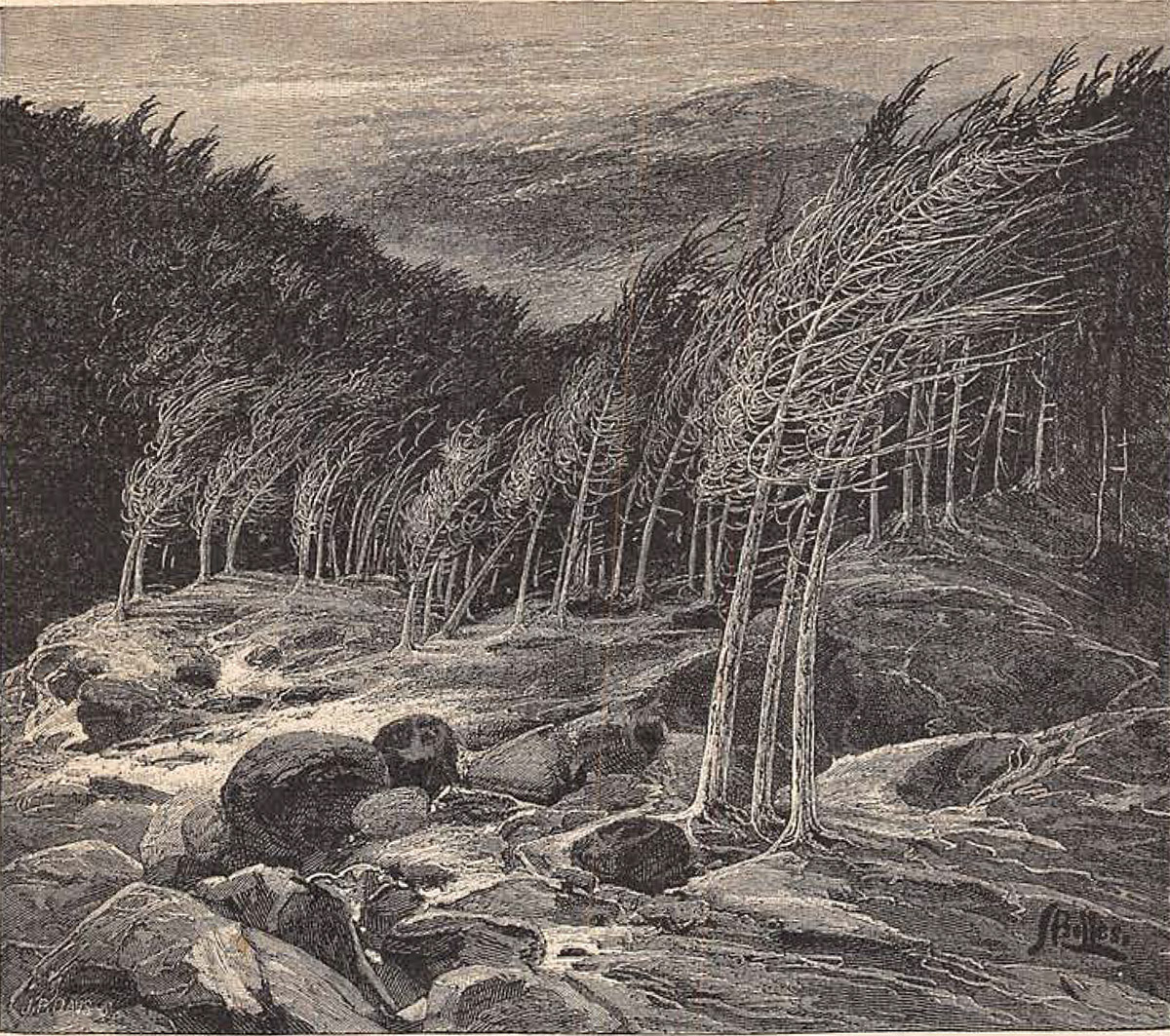 |
| Illustration by American artist John W. Bolles (1860–1927) based on sketch by John Muir for “A Wind Storm in the Forests of the Yuba,” from the November 1878 issue of Scribner’s Monthly. |
When “A Wind-Storm in the Forests” was included in the Library of America anthology American Earth: Environmental Writing Since Thoreau (2008), the volume editor, Bill McKibben, provided an introduction, which we reprint below, followed by additional background about the selection.
John Muir was the next great figure after Thoreau in the parade of American environmentalists. He is most celebrated for his practical achievements: founding the Sierra Club (he served as its president for 22 years until his death) and preserving Yosemite. But he is a literary hero as well. Beyond its pragmatic force, Muir’s prose introduced an ecstatic new grammar and vocabulary of wildness into the American imagination: in some sense, every national park on the planet owes its existence to the spell he cast.
Muir was born in Scotland, but moved to a Wisconsin homestead at the age of 11. His father was abusive, working his son long hours and beating him until he had memorized most of the Bible. He rebelled by becoming a vagabond, and by asking powerful questions about the orthodoxies of his day and ours, especially the notion that people stood at the center of the universe. His A Thousand-Mile Walk to the Gulf, written in 1867, is especially trenchant in its sympathetic portrait of the alligator: “Honorable representatives of the great saurians of an older creation, may you long enjoy your lilies and rushes, and be blessed now and then with a mouthful of terror-stricken man by way of dainty!” Muir’s evident pleasure in the prospect of an occasional successful alligator attack foreshadows current ideas about “anthropocentrism” among deep ecologists. His writings also anticipate the ecologist’s sense of interconnectedness: “When we try to pick out anything by itself,” he wrote in My First Summer in the Sierra (1911), “we find it hitched to everything else in the universe.”
Muir’s wanderings eventually led him to California, and then Yosemite, where he helped Louis Agassiz prove his controversial theories about glaciation. But he was more and more disgusted by the way that flocks of sheep were trashing the backcountry, and so he began writing a series of articles that led to the creation of the Sierra Club and the further protection of Yosemite. He was a friend of Theodore Roosevelt, but a sworn enemy of Roosevelt’s chief forester, Gifford Pinchot, who had no use for pristine wilderness.
His later years were saddened by the losing fight to save Yosemite’s Hetch Hetchy Valley, which San Francisco dammed as a water source. But his long treks across the granite fastness of the Sierra had doubtless left him with joy enough for one lifetime: “This grand show is eternal. It is always sunrise somewhere; the dew is never all dried at once; a shower is forever falling; vapor is ever rising. Eternal sunrise, eternal sunset, eternal dawn and gloaming, on seas and continents and islands, each in its turn, as the round earth rolls.”
Additional background about this selection: In 1878, when Muir had just begun to publish essays in the nation’s leading magazines, he captured readers’ imagination with “A Wind Storm in the Forests of the Yuba,” which appeared in Scribner’s Monthly Magazine. His account of riding a tree in the middle of a storm generated much feedback from readers, including a fan letter sent in 1885 from the Helen Hunt Jackson, author of Ramona: “I believe I know every word you have written. I never wished myself a man but once—that was when I read how it seemed to be rocked in the top of a pine tree in a gale.” The Scribner brothers wrote to Muir after the article appeared in their magazine:
We have read with much interest your paper in the November number of Scribner’s entitled “A Wind Storm in the Forests of the Yuba.” We understand that it is the first of a series of articles that have been arranged for publication in the magazine. We write particularly to say that should you intend hereafter bringing these papers together in a volume together with other articles that have appeared elsewhere (in Harper’s Magazine etc) we hope that you will without fail confer with us on the subject. We feel sure that you must have at your disposal an abundance of good material for a capital book.In the end, however, the Scribners would not publish Muir’s collection of essays. In 1881 Scribner’s Monthly was sold to a new publisher and became The Century Illustrated Monthly Magazine. Right around this time, Muir got married, settled down on his farm, and stopped writing for publication. In 1889, Robert Underwood Johnson, an associate editor who had moved from Scribner’s to Century and who encouraged Muir to write again (“Have you abandoned literature altogether?”), traveled to California and met Muir in person for the first time. During the trip, Johnson and Muir agreed to launch an effort to make Yosemite a national park, and Muir wrote two articles for Century Magazine in support of the idea. Muir’s role in the successful campaign reinvigorated both his public profile and his literary career, and he signed a contract with the Century Company to publish his first book (not counting Picturesque California, an 1888 anthology he edited that gathered some 1,500 illustrations and accompanying texts by various artists and writers). With Johnson’s help, Muir reworked essays he had written between 1875 and 1881 and published the collection in 1894 as The Mountains of California. The book includes his famous “tree ride” essay under the simplified title “A Wind-Storm in the Forests,” and that is the version we present below.
* * *
The mountain winds, like the dew and rain, sunshine and snow, are measured and bestowed with love on the forests to develop their strength and beauty. . . . If you don't see the full story below, click here (PDF) or click here (Google Docs) to read it—free!This selection may be photocopied and distributed for classroom or educational use.


