Showing posts with label Edgar Allan Poe. Show all posts

Monday, January 19, 2026

The Lunatic’s Skate

Nathaniel Parker Willis (1806–1867)
From The American Short Story: The Nineteenth Century

Moonlight [Hudson Valley], c. 1860–65, brush and oil, graphite on heavy cardboard by American painter Frederic Edwin Church (1826–1900). (Cooper Hewitt, Smithsonian Design Museum)
Edgar Allan Poe’s essay on “The Literati of New York City,” published in 1846, began its consideration of Nathaniel Parker Willis’s contribution to literature with a comment on his social prominence: “Whatever may be thought of Mr. Willis’s talents, there can be no doubt about the fact that, both as an author and as a man, he has made a good deal of noise in the world—at least for an American.” Willis, in Poe’s somewhat envious view, had overcome the obscurity and poverty of the typical professional American writer by creating an outsize persona for public consumption:
At a very early age Mr. Willis seems to have arrived at an understanding that, in a republic such as ours, the mere man of letters must ever be a cipher, and endeavoured, accordingly, to unite the éclat of the littérateur with that of the man of fashion or of society. He “pushed himself,” went much into the world, made friends with the gentler sex, “delivered” poetical addresses, wrote “scriptural” poems, traveled, sought the intimacy of noted women, and got into quarrels with notorious men. All these things served his purpose—if, indeed, I am right in supposing that he had any purpose at all. It is quite probable that, as before hinted, he acted only in accordance with his physical temperament; but be this as it may, his personal greatly advanced, if it did not altogether establish his literary fame.
By the mid-1840s, Willis was the highest-paid magazine writer in the country and made as much as $5,000 a year—the equivalent of about $200,000 today. When Poe wrote a largely positive review of Willis’s play Tortesa, The Usurer for the Literary Examiner, the editor responded that Poe was “scarcely severe enough but still Willis is a kind of national pet, and we must regard his faults as we do those of a spoiled stripling, in the hope he will amend.” Willis’s dandified European attire led Oliver Wendell Holmes, who would be one of the pallbearers at his funeral, to describe him as “something between a remembrance of Count D'Orsay and an anticipation of Oscar Wilde.” In a review of one of Willis’s travel books, Poe himself complained about how the experience of reading his work is often overwhelmed by the reputation of the author, “whose image is sure to jump up every now and then before us, in an embroidered morning gown and slippers, with a pen in one hand, and a bottle of eau de Cologne in the other.”

In April 1844, Poe had moved with his wife and mother-in-law to a farm near the Hudson River on the west side of Manhattan. Willis recalled how, in the fall, Poe ended up as an employee at The Evening Mirror, a daily newspaper he had cofounded earlier that year:
Our first knowledge of Mr. Poe’s removal to this city was by a call which we received from a lady who introduced herself to us as the mother of his wife. She was in search of employment for him, and she excused her errand by mentioning that he was ill, that her daughter was a confirmed invalid, and that their circumstances were such as compelled her taking it upon herself. . . . It was a hard fate that she was watching over. Mr. Poe wrote with fastidious difficulty, and in a style too much above the popular level to be well paid.
Willis hired Poe to work at $15 a week as a “paragraphist,” writing miscellaneous filler: literary news, announcements, capsule reviews, anecdotes, and such. The Mirror also published several longer pieces by Poe, including an infamous series of articles accusing Henry Wadsworth Longfellow of plagiarism and culminating in the first appearance of “The Raven,” with a brief appreciative headnote added by Willis. Poe lasted less than five months before accepting a position in February as the editor of the Broadway Journal.

Poe had mixed feelings about Willis as a writer. He was largely dismissive of Willis’s efforts at poetry (“deficient in vigour”), and his works of criticism did not give Poe “a high idea of his analytic abilities.” In 1836, when he was editor of the Southern Literary Messenger, Poe reviewed Willis’s Inklings of Adventure, a suite of tales told by the fictional Philip Slingsby—much in the manner of Washington Irving’s early books of sketches by Geoffrey Crayon. Instead of assessing the entire two-volume collection, Poe zeroed in on one melodramatic tale, “Niagara” (“one of Willis’s worst stories,” confirms literary scholar Richard P. Benton). Poe found Willis guilty of neglecting “totality of effect”; “the whole narrative is disfigured, and indeed utterly ruined, by the grievous sin of affectation. It is this sin, and not, we are convinced, any imbecility in the conceptions of Mr. Willis, which has beguiled him into the egregious folly of writing a long article, in a jocular manner, about the cataract of Niagara.”

Nevertheless, when Poe published a long review essay on Nathaniel Hawthorne, he proclaimed that “the tales of Willis, I think, surpass those of any American writer—with the exception of Mr. Hawthorne.” One of Willis’s early travel pieces, describing a masquerade in Paris during a cholera epidemic, may have been an inspiration for Poe’s “The Masque of the Red Death”; similarly, “The Madhouse of Palermo,” another of Willis’s tales in Inklings of Adventures, probably influenced “The System of Doctor Tarr and Professor Fether.”

“The Lunatic’s Skate,” one of three stories in a section of Inklings titled “Scenes of Fear,” has long been regarded by biographers and critics as one of Willis’s best. The genesis of the story can be found in a letter he wrote to his sister Julia during the summer of 1824, when he had just completed his first year at Yale:
I wish you were here to walk with me these beautiful moonlight evenings. I have seldom gone to bed and left the mild Queen of the Night riding in the heavens, for it seems a waste of noble feelings. When I am walking on such evenings as we have had this week past, and amidst such scenery as New Haven presents, chastened and softened in its beauty by the pure and quiet light of the moon, I have an elevation of thought and sentiment which I cannot drown in sleep without reluctance. I really think we had better lay it down as a rule never to go to sleep while the moon is shining. In fact, Julia, I suspect (for I find no one who sympathizes with me in this feeling) that I am something of a lunatic,—affected by the rays of that beautiful planet with a kind of happiness which is the result of a heated imagination, and which is not felt by the generality of the common-sense people of the world. Last Friday evening, you know, was beautiful. I attended a meeting of the professors of religion, statedly held on that evening in the theological chamber, and when it was out went alone to walk. I strolled along upon the shore of the bay towards the light-house a mile or more, and never did I meet with so delightful a scene. . . . The clock struck one, but I felt no disposition to go home, and, as the air was pure and balmy, the thought struck me that it would be a pleasant hour to bathe. Accordingly I undressed, and swam along the shore slowly for about half a mile in the cool, refreshing waters, with sensations which must be felt to be understood. After this delightful exercise I walked home, and, seating myself by the window where I could look at the moon, fell asleep, and did not wake till near morning.
Ten years later, while in England, he wrote the story we have reprinted below and published it in a London magazine. It is included in the forthcoming Library of America collection, The American Short Story: The Nineteenth Century.

Notes: The opening paragraphs place the two boys, Philip and Larry, at Phillips Academy in Andover, Massachusetts. Less than two miles from the school was (and is) Pomp’s Pond, named for Pompey Lovejoy, whose home was on its shore. Born into slavery in 1724, Lovejoy was freed in 1765 shortly before the death of Captain William Lovejoy, whose will stipulated that he “be given some choice acreage so that he might better enjoy his later years.” Pompey built a cabin overlooking the pond on the 31-acre plot he received from the estate. Numerous accounts indicate that he and his wife, Rose, were popular with the town’s residents, and they often welcomed Phillips students at their home. Pompey died in 1826 at the age of 102; Rose, 99, died the following year.

As indicated in the story, students with Calvinist upbringings invariably went to Yale, while other students went to Harvard. Biographer Henry A. Beers notes that Willis’s religiously strict father, known as Deacon Willis, “would almost as soon have sent his boy into the jaws of hell as into such a hot-bed of Unitarianism as the Cambridge college,” where William Ellery Channing was a prominent preacher and theologian.

“That two, or one, are almost what they seem;” is a line from Lord Byron’s Childe Harold’s Pilgrimage. Les montagnes Russes (French: literally “Russian mountains”) was the name of a roller coaster prototype constructed in Paris in 1804; the term came to be used for similar rides in France and the U.S. during the early nineteenth century. In Robert Southey’s epic poem Thalaba the Destroyer (1801), a green bird alights on the title character’s arm. Published anonymously (as were all Sir Walter Scott’s Waverley novels prior to 1827), Ivanhoe appeared in three volumes in London in December 1819; rival American editions, each in two volumes, were published by M. Carey & Sons and J. & J. Harper in 1820.

*   *   *

For this week’s selection, we depart from the usual format and reproduce the selection, in its entirety, below. You may also download it as a PDF or view it in Google Docs.


The Lunatic’s Skate

I have only, in my life, known one lunatic—properly so called. In the days when I carried a satchel on the banks of the Shawsheen, (a river whose half-lovely, half-wild scenery is tied like a silver thread about my heart,) Larry Wynn and myself were the farthest boarders from school, in a solitary farm-house on the edge of a lake of some miles square, called by the undignified title of Pomp’s Pond. An old negro, who was believed by the boys to have come over with Christopher Columbus, was the only other human being within any thing like a neighbourhood of the lake, (it took its name from him,) and the only approaches to its waters, girded in as it was by an almost impenetrable forest, were the path through old Pomp’s clearing, and that by our own door. Out of school, Larry and I were inseparable. He was a pale, sad-faced boy, and, in the first days of our intimacy, he had confided a secret to me which, from its uncommon nature, and the excessive caution with which he kept it from every one else, bound me to him with more than the common ties of schoolfellow attachment. We built wigwams together in the woods, had our tomahawks made of the same fashion, united our property in fox-traps, and played Indians with perfect contentment in each other’s approbation.

I had found out, soon after my arrival at school, that Larry never slept on a moonlight night. With the first slender horn that dropped its silver and graceful shape behind the hills, his uneasiness commenced, and by the time its full and perfect orb poured a flood of radiance over vale and mountain, he was like one haunted by a pursuing demon. At early twilight he closed the shutters, stuffing every crevice that could admit a ray; and then, lighting as many candles as he could beg or steal from our thrifty landlord, he sat down with his book, in moody silence, or paced the room with an uneven step, and a solemn melancholy in his fine countenance, of which, with all my familiarity with him, I was almost afraid. Violent exercise seemed the only relief, and when the candles burnt low after midnight, and the stillness around the lone farm-house became too absolute to endure, he would throw up the window, and, leaping desperately out into the moonlight, rush up the hill into the depths of the wild forest, and walk on with supernatural excitement till the day dawned. Faint and pale he would then creep into his bed, and, begging me to make his very common and always credited excuse of illness, sleep soundly till I returned from school. I soon became used to his way, ceased to follow him, as I had once or twice endeavoured to do, into the forest, and never attempted to break in on the fixed and rapt silence which seemed to transform his lips to marble. And for all this Larry loved me.

Our preparatory studies were completed, and, to our mutual despair, we were destined to different universities. Larry’s father was a disciple of the great Channing, and mine a Trinitarian of uncommon zeal; and the two institutions of Yale and Harvard were in the hands of most eminent men of either persuasion, and few are the minds that could resist a four years’ ordeal in either. A student was as certain to come forth a Unitarian from one as a Calvinist from the other; and in the New-England States these two sects are bitterly hostile. So, to the glittering atmosphere of Channing and Everett went poor Larry, lonely and dispirited; and I was committed to the sincere zealots of Connecticut, some two hundred miles off, to learn Latin and Greek, if it pleased Heaven, but the mysteries of “election and free grace,” whether or no.

Time crept, ambled, and galloped by turns, as we were in love or out, moping in term-time, or revelling in vacation, and gradually, I know not why, our correspondence had dropped, and the four years had come to their successive deaths, and we had never met. I grieved over it; for in those days I believed with a school-boy’s fatuity,

“That two, or one, are almost what they seem;”

and I loved Larry Wynn, as I hope I may never love man or woman again—with a pain at my heart. I wrote one or two reproachful letters in my senior years, but his answers were overstrained, and too full of protestations by half; and seeing that absence had done its usual work on him, I gave it up, and wrote an epitaph on a departed friendship. I do not know, by the way, why I am detaining you with all this, for it has nothing to do with my story; but let it pass as an evidence that it is a true one. The climax of things in real life has not the regular procession of incidents in a tragedy.

Some two or three years after we had taken “the irrevocable yoke” of life upon us, (not matrimony, but money-making,) a winter occurred of uncommonly fine sleighing—sledging, you call it in England. At such times the American world is all abroad, either for business or pleasure. The roads are passable at any rate of velocity of which a horse is capable; smooth as montagnes Russes, and hard as is good for hoofs; and a hundred miles is diminished to ten in facility of locomotion. The hunter brings down his venison to the cities, the western trader takes his family a hundred leagues to buy calicoes and tracts, and parties of all kinds scour the country, drinking mulled wine and “flip,” and shaking the very nests out of the fir-trees with the ringing of their horses’ bells. You would think death and sorrow were buried in the snow with the leaves of the last autumn.

I do not know why I undertook, at this time, a journey to the west; certainly not for scenery, for it was a world of waste, desolate, and dazzling whiteness, for a thousand unbroken miles. The trees were weighed down with snow, and the houses were thatched and half-buried in it, and the mountains and valleys were like the vast waves of an illimitable sea, congealed with its yesty foam in the wildest hour of a tempest. The eye lost its powers in gazing on it. The “spirit-bird” that spread his refreshing green wings before the pained eyes of Thalaba would have been an inestimable fellow-traveller. The worth of the eyesight lay in the purchase of a pair of green goggles.

Continue to next page

Sunday, October 20, 2024

The Facts in the Case of M. Valdemar

Edgar Allan Poe (1809–1849)
From Edgar Allan Poe: Poetry & Tales

“‘I have been sleeping—and now—now—I am dead.’ No person present even affected to deny, or attempted to repress, the unutterable, shuddering horror which these few words, thus uttered, were so well calculated to convey. Mr. L——1 (the student) swooned. The nurses immediately left the chamber, and could not be induced to return.” Illustration (cropped) by British artist Byam Shaw (1872–1919) for Selected Tales of Mystery by Edgar Allan Poe (London, 1909).

In 1844 Chauncy Hare Townshend, the author of Facts in Mesmerism—a book Edgar Allan Poe regarded “as one of the most truly profound and philosophical works of the day”—described an experience with mesmeric therapy:
I have watched the effects of mesmeric treatment upon a suffering friend, who was dying of that most fearful disorder—Lumbar Abscess. Unfortunately, through various hindrances, Mesmerism was not resorted to till late in the progress of the disease, so that, of course, that it should effect a cure was out of the question. Mesmerism does not profess to work miracles. It cannot restore a decayed bone to its integrity, or re-create a missing part;—but it can benefit, even where it cannot save. And how much is it to say of a power—that it is remedial even where not curative, and that in cases where it fails to rekindle life it can smooth the passage to the grave, and mitigate the horrors of physical pain! . . .

I have no hesitation in saying, that, under God, the life of my friend R. T. was prolonged, at least, two months by the action of Mesmerism.
During the 1840s mesmerism fascinated Poe, who could turn even the most promising advances of the era into the stuff of nightmares, and it stirred him to write a trio of stories. In 1844 he published “A Tale of the Ragged Mountains” and “Mesmeric Revelation,” and the following year, inspired in part by the experience of Townshend’s dying friend, he wrote the best known of the three, “The Facts in the Case of M. Valdemar.”

For the last 180 years, most readers and even many scholars seem to have assumed that mesmerism in Poe’s stories was simply the act of hypnotism. In an analysis of all three stories, Doris V. Falk reminds readers that hypnotism in Poe’s day was considered only one element of what mesmerists called “animal magnetism”: “an autonomous physical force pervading both the animate and inanimate worlds, accounting for the mesmerists’ therapeutic powers at the same time that it attracted iron to magnets [and] kept the stars in their places.” The influence of this pseudoscience on literature was vast; Falk drolly notes that it gave rise to “a popular contemporary genre, the dream vision or prophecy [which] probably constituted the greatest volume of unreadable effusions ever to pollute a literary atmosphere.”

In Poe’s stories, however, mesmerism becomes (as Falk puts it) “an amoral force operating within the mind and body, linking consciousness and ‘physique,’ animating both.” Thus, in Poe’s story “Mesmeric Revelation,” a dying man in a “sleep-waking” state explains that “there are gradations of matter of which man knows nothing; the grosser impelling the finer, the finer pervading the grosser. . . . The ultimate, or unparticled matter, not only permeates all things but impels all things—and thus is all things within itself. This matter is God. What men attempt to embody in the word ‘thought,’ is this matter in motion.”

Poe’s fascination seems to have focused on how this “force” or “matter” might operate when the mind straddles the boundary between life and death. In “Mesmeric Revelation,” the man is dead when the mesmerist awakens him from the trance, which leaves open the question of whether he had been talking to the mesmerist from “the region of the shadows.” Or, as another prominent scholar, Paul John Eakin, explains, “Mesmerism seemed to offer a means by which the barrier between the angelic and the mortal realms might be crossed by a living man.”

What Poe apparently had not anticipated when he published “The Facts in the Case of M. Valdemar” was that many readers would believe it was a true story. “I had not the slightest idea that any person should credit it as any thing more than a ‘Magazine-paper,’” he wrote to one of his publishers four years later. Yet Poe was hardly an author who would dampen the kind of publicity generated by the debate over whether the “case” was genuine. After the story appeared in the December 1845 issue of the American Review, under the title “Facts of M. Valdemar's Case,” a New-York Daily Tribune critic contended that it was “a pretty good specimen of Poe's style of giving an air of reality to fictions,” and that any reader who thought the events actually occurred “must have the bump of Faith large, very large indeed.” Without addressing the veracity of Valdemar’s case, Poe coyly responded in the Broadway Journal (the weekly newspaper he owned and edited), “Why cannot a man's death be postponed indefinitely by Mesmerism? Why cannot a man talk after he is dead? Why? — Why? — that is the question; and as soon as the Tribune has answered it to our satisfaction we will talk to it farther.” He then stirred things up some more by reprinting the story in the Broadway Journal with a headnote:
An article of ours, thus entitled, was published in the last number of Mr. Colton's “American Review,” and has given rise to some discussion—especially in regard to the truth or falsity of the statements made. It does not become us, of course, to offer one word on the point at issue. We have been requested to reprint the article, and do so with pleasure. We leave it to speak for itself. We may observe, however, that there are a certain class of people who pride themselves upon Doubt, as a profession.
Soon enough, the story worked its way across the Atlantic. While the London Morning Post reprinted it with an editor’s note suggesting it was “either a fabrication or the work of one little acquainted with consumption,” the Popular Record of Modern Science published the piece with a statement weighing the evidence and concluding “there is no strong point for disbelief. . . . The circumstances are, as the Post says, ‘wonderful,’ but so are all circumstances that come to our knowledge for the first time—and in mesmerism everything is new.”

A few weeks earlier, Poe had published The Raven and Other Poems, with a dedication to Elizabeth Barrett Browning, and he sent a copy to her in England along with his recent Tales. She responded with words of thanks and praise, adding:
Then there is a tale of yours which I do not find in this volume, but which is going the round of the newspapers, about mesmerism—throwing us all into “most admired disorder”, or dreadful doubts as to whether “it can be true”, as the children say of ghost stories. The certain thing in the tale in question is the power of the writer, & the faculty he has of making horrible improbabilities seem near & familiar.
In a subsequent letter to her husband, Robert Browning, Elizabeth joked they would need to “decide whether the outrageous compliment to me or the experiment on M. Vandeleur [sic] goes furthest to prove him mad.”

While Poe did little publicly to dampen the debate over the veracity of the story, he usually admitted the truth in personal correspondence. Arch Ramsay, “a believer in Mesmerism” living in Scotland, wrote and asked if Poe would deny, “for the sake of the Science & of truth,” that the story was a “hoax.” Poe responded bluntly, “‘Hoax’ is precisely the word suited to M. Valdemar's case. . . . Some few persons believe it—but I do not—and don’t you.”

Notes: The Latin phrase in articulo mortis translates “in the moment of death.” Wallenstein is a trilogy of epic historical dramas by Friedrich Schiller, first performed in 1798–99; they chronicle the fall and assassination of General Albrecht von Wallenstein during the Thirty Years War. Gargantua refers to François Rabelais’s The Five Books of the Lives and Deeds of Gargantua and Pantagruel, a sixteenth-century pentalogy of satirical novels relating the adventures of two giants. Phthisis is a consumptive disease, usually pulmonary tuberculosis.

*   *   *
Of course I shall not pretend to consider it any matter for wonder, that the extraordinary case of M. Valdemar has excited discussion. . . . If you don't see the full selection below, click here (PDF) or click here (Google Docs) to read it—free!

This selection may be photocopied and distributed for classroom or educational use.

Sunday, July 30, 2023

‘X-ing a Paragrab’

Edgar Allan Poe (1809–1849)
From Edgar Allan Poe: Poetry & Tales

A case of cast metal type pieces and a composing stick. (Photo by Willi Heidelbach, Wikimedia Commons)


The University of Virginia Library is home to a fragment of a letter written by Edgar Allan Poe sometime around the beginning of March in 1849. He teases two pieces scheduled to be published in Flag of Our Union, a Boston weekly featuring new fiction and poetry: “The Flag has 2 of my tales now — Hop-Frog & another called ‘X-ing a Paragrab’: — guess what that is about if you can!”

“Hop Frog” has become one of the better known of Poe’s tales (we previously presented it as a Story of the Week selection), but “X-ing a Paragrab” holds a curious, marginal place in his bibliography. A light-hearted bagatelle, it would be the second to last prose piece published in his lifetime (the final sketch, “Landor’s Cottage,” appeared a month later), and it is often glossed over in the biographies of Poe and in critical appraisals of his work.

The anecdote at the center of the tale “is by no means original with Poe,” writes Thomas Ollive Mabbott, whose annotations for Poe’s story cite as examples two contemporary pieces in the New-York Mirror, both about the “printers’ custom of substituting X for a letter for which type is lacking.” Although Poe’s humorous take on the topic doesn’t evoke the dread or chills of his most famous works, it does speak to one of his own personal “terrors”: having his text mangled by a typesetter or printer. As Michael J. S. Williams notes in A World of Words: Language and Displacement in the Fiction of Edgar Allan Poe, “On the most obvious thematic level, then, ‘X-ing a Paragrab’ dramatizes that element of risk, that ‘unknown quantity of X’ that intervenes between the act of writing a manuscript and its final printed version and threatens to deflate by X-ing an author’s sense of ‘conscious power’ in composition.”

Poe’s affiliation with Flag of Our Union fueled his anxieties. The four poems and four stories published during his lifetime after February 1849 all appeared in the popular weekly, and he felt the pieces were cheapened by their very presence in its pages. The rushed pace of publication for the journal exasperated him. When he was unable to make a handful of last-minute changes and corrections to the poem “For Annie,” he convinced editor Nathaniel Parker Willis to print, only days after it appeared in the Flag, a clean copy in The Home Journal, a subterfuge that angered his editors. Poe felt his work was tainted by association with the down-market fare that crowded the Flag’s newspaper format, but he desperately needed the money. “In this emergency I sell articles to the vulgar and trashy ⸺ – — ⸺, for $5 a piece,” he wrote to one friend. “I enclose my last, cut out, lest you should see by my sending the paper in what company I am forced to appear.” Against the backdrop of these challenges and humiliations, Poe wrote his satire of dueling editors, commercial printers, and corrupted texts.

Note: The “logic of a Brownson” is a sarcastic reference to the writings of Orestes Augustus Brownson, especially the didactic novel Charles Elwood, or The Infidel Converted (1840). Brownson ended a decade’s association with the Transcendentalists when he converted to Catholicism in 1844. “Oh, tempora! Oh, Moses!” is Mr. Bullet-head’s malapropism (or his apprentice’s typo?) for Cicero’s “O tempora, o mores” (“Oh, the times! Oh, the customs!”). Bullet-head hails from Frogpondium, Poe’s disparaging name for Boston, referring to the Frog Pond in the Boston Common. The line “Off with his head, So much for Buckingham!” is from Colley Cibber’s 1699 adaptation of Richard III, which was more commonly performed than Shakespeare’s original play. A printer’s devil was the term used for a young apprentice who performs small tasks, such as mixing ink, gathering type, and cleaning presses. XX and XXX were markings used by breweries to denote the quality and/or the strength of its ale.

*   *   *
As it is well known that the ‘wise men’ came ‘from the East,’ and as Mr. Touch-and-go Bullet-head came from the East, it follows that Mr. Bullet-head was a wise man; and if collateral proof of the matter be needed, here we have it—Mr. B. was an editor. . . . If you don't see the full selection below, click here (PDF) or click here (Google Docs) to read it—free!

This selection may be photocopied and distributed for classroom or educational use.

Sunday, November 13, 2022

The Business Man

Edgar Allan Poe (1809–1849)
From Edgar Allan Poe: Poetry & Tales

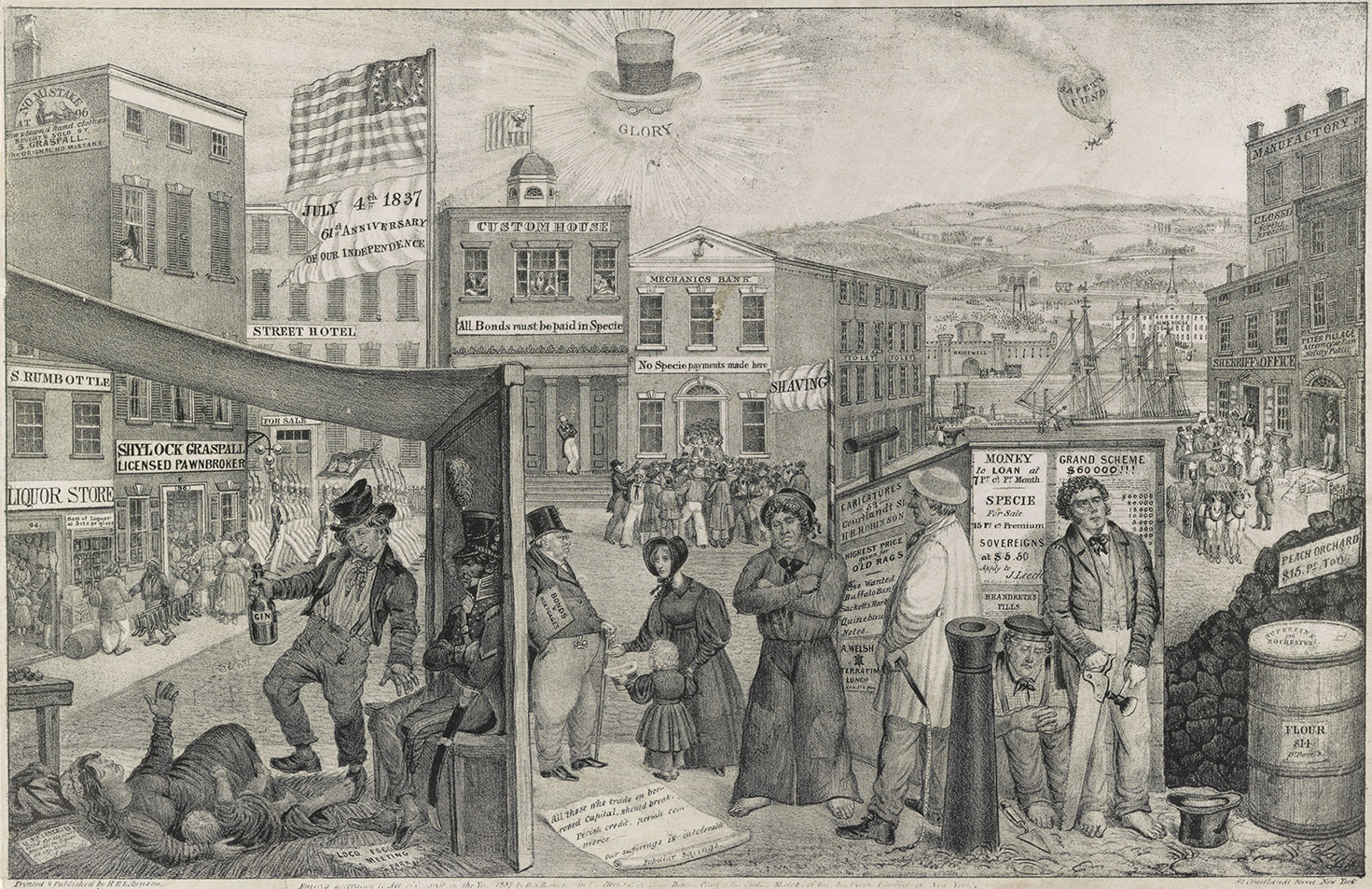
“The Times,” July 1837, drawing by Edward Williams Clay (1799-1857), lithograph on wove paper printed and published by H.R. Robinson, New York. Library of Congress.

In May 1837, five months after Edgar Allan Poe moved to Manhattan, New York banks suspended the payment of specie for commercial papers in May, setting off an economic depression that lasted seven years. The cartoon depicts crowds outside a pawnshop (left), a bank (center), and the sheriff’s office (right). The spirit of Andrew Jackson, who was largely blamed for the crisis, hovers in the sky. “Principal figures” identified by the Library of Congress include “(from left to right): a mother with infant (sprawled on a straw mat), an intoxicated Bowery tough, a militiaman (seated, smoking), a banker or landlord encountering a begging widow with child, a barefoot sailor, a driver or husbandman, a Scotch mason (seated on the ground), and a carpenter. These are in contrast to the prosperous attorney ‘Peter Pillage,’ who is collected by an elegant carriage at the far right.”

“It is an evil growing out of our republican institutions, that here a man of large purse has usually a very little soul which he keeps in it,” observed Edgar Allan Poe in “The Philosophy of Furniture,” an essay about—of all things—interior decorating. “The corruption of taste is a portion or a pendant of the dollar-manufacture. As we grow rich, our ideas grow rusty.” Poe’s essay explains that the upper class in America has no sense of style because its sense of home decoration has been governed by “the display of wealth” and “the rage for glitter.” While Poe’s essay was meant humorously, its underlying message about the conflict between refinement and materialism, or between art and business, appears throughout his writings. And few things seem to agitate him more than the business of running a magazine.

In the summer of 1838, after living in Manhattan for eighteen months, Poe moved to Philadelphia, with his wife (and cousin), Virginia Eliza Clemm Poe, and his mother-in-law (and aunt), Maria Poe Clemm. He had been unable to find employment, in part because of the recession that followed the Panic of 1837, when New York banks, their gold and silver reserves depleted, suspended payment on commercial paper. The family struggled to survive from his meager earnings for freelance articles and from Mrs. Clemm’s income as manager of a boarding house. His first and only novel, The Narrative of Arthur Gordon Pym, was a flop and the reviews were hostile; a typical critic, William E. Burton of Burton’s Gentleman’s Magazine, declared that “a rapid succession of improbabilities destroys the interest of the reader, and the writer’s evident ignorance in all nautical matters forbids the possibility of belief.” Poe’s situation didn’t get any better after he moved to Philadelphia; as of May 1839, he had made less than two hundred dollars in the previous two and a half years.

Finally, in what must have been an awkward interview for both men, Poe met with Burton—the very critic who had trashed his novel—about obtaining an editorial position at the magazine. A British playwright and comic actor, Burton had arrived in Philadelphia in 1834, the year after his play Ellen Wareham was an enormous success in London. He ended up staying in the U.S. and, in 1837, established a new monthly magazine that (its advertisements promised) would feature fine paper and sturdy bindings, include an abundance of engravings, and contain in each issue “more reading matter than a volume of a novel.”

The economic depression and a shortfall in subscriptions had curbed Burton’s ambitions somewhat. Yet, since he was often on the road starring in stage productions, he needed an assistant editor and talked Poe down to a salary of $10 a week. Over the course of the next year, Poe would write most of the magazine’s reviews, numerous occasional pieces, and several stories and essays, including “The Fall of the House of Usher” and “The Man in the Crowd.” He also began serial publication of “The Journal of Julius Rodman,” about the first (entirely fictitious) transcontinental expedition in 1792.

Tensions between publisher and his new coeditor appeared within the first month. On May 30, 1839, Burton responded to a letter from Poe that has not survived:
I am sorry that you thought necessary to send me such a letter as your last. The troubles of the world have given a morbid tone to your feelings which it is your duty to discourage. . . . We shall agree very well, but you must get rid of your avowed ill-feelings towards your brother authors—you see that I speak plainly—indeed, I cannot speak otherwise. Several of my friends, hearing of our connexion, have warned me of your uncalled for severity in criticism. . . . The independence of my book reviews has been noticed throughout the Union, . . . but there is no necessity for undue severity.
Burton’s admonishment that Poe must tone down his reviews was largely ignored, and it was in the pages of Burton’s that Poe launched his multi-year “war” on Longfellow and accused the celebrated poet of the rather absurd charge of plagiarism.

As the economy worsened and money became scarcer, Burton—who refused to cut corners on the production of the magazine—simply stopped paying the authors. In November, facing the predictable shortfall of submissions, he promoted a contest offering $1,000 in prizes to authors of the best stories, essays, and poems that appeared in the magazine. Individual awards ranged from $50 to $250—amounts unheard of for short works in the first half of the nineteenth century. Joseph Evans Snodgrass, Poe’s close friend and one of the authors Burton had stiffed earlier in the year, asked about the details of the contest and Poe responded, “I can give you no information about their designation further than is shown in the advertisement itself. The truth is, I object, in toto, to the whole scheme—but merely followed in Mr B’s wake upon such matters of business.” (The emphasis, tellingly, is Poe’s.) Burton first postponed the deadline for the contest and then, citing a dearth of submissions, canceled it and didn’t award a cent to the entries that had already appeared in the magazine’s pages. In June 1840 Poe told Snodgrass, “I am firmly convinced that it was never his intention to pay one dollar of the money offered; and indeed his plain intimations to that effect, made to me personally and directly, were the immediate reasons of my cutting the connexion as abruptly as I did.”

In fact, Poe had been fired. Throughout his tenure, Poe had been scheming to establish his own (competing) magazine, while Burton had been hoping to build his own theater in Philadelphia—a project that would require him to raise funds by selling the magazine. In mid-May 1840, soon after Burton announced the magazine was for sale, Poe published a prospectus for his new magazine—which lowered the value of the magazine Burton was trying to sell. The two men went their own ways. Several months later Burton finally sold the magazine, and he used the $3,500 purchase price to lease and refurbish the abandoned Cooke’s Royal Circus building (which had been damaged in a fire) and reopen it as the National Theater. At first the venture was prosperous, but in July 1841 Burton lost most of his earnings after the collapse of the United States Bank of Pennsylvania, managed by Nicholas Biddle. Poe fared better; because of the financial crisis, he was unable to raise funds for his magazine, but he was soon hired by Graham’s Lady’s and Gentleman’s Magazine—the new name of the very magazine Burton had sold. Poe did not, however, finish writing “The Journal of Julius Rodman,” which abruptly ended after the sixth installment in Burton’s.

It was amidst this tumultuous backdrop that Poe published “Peter Pendulum, The Business Man” in the February 1840 issue of Burton’s, the same month that the magazine’s “contest” was originally scheduled to end. Three years later, he added six paragraphs describing four more business scams, shortened the title to “The Business Man,” changed the character’s name to “Peter Proffit,” and reprinted it in the Saturday Museum. In 1845, when he was editor of The Broadway Journal, he made additional revisions and reprinted it a second time, which is the text we present below.

In his analysis of “The Business Man,” Thomas F. Marvin argues that, “seen in the light of Poe’s experiences in the publishing industry, . . . the story emerges as a pointed satire on the business of magazine publishing.” Other scholars have pointed to additional inspirations. J. A. Leo Lemay, who calls it “one of the cruelest burlesques of antebellum American materialism,” contends that it is both a rejection of the American concept of the “self-made” man and, more specifically, of the ideas presented in the Autobiography of Benjamin Franklin—whose profile adorned the title page of Burton’s. Several biographers have regarded the story as Poe’s repudiation of his deceased guardian, John Allan, a prosperous merchant in Richmond who had regarded his foster son as a wastrel and who had cut Poe entirely out of his will. All critics agree that, with slapstick and derision, the story satirizes American greed by pitting Peter Proffit against individuals and society without regard to culture, dignity, or morality.

Note: The abbreviation Nem. con. is Nemine contradicente, or “without opposition”.

Thomas F. Marvin’s article, “‘These Days of Double Dealing’: Edgar Allan Poe and the Business of Magazine Publishing,” American Periodicals (2001), provided several of the details on Poe’s experiences working with William Burton.

*   *   *
I am a business man. I am a methodical man. Method is the thing, after all. . . . If you don't see the full selection below, click here (PDF) or click here (Google Docs) to read it—free!

This selection may be photocopied and distributed for classroom or educational use.

Saturday, October 2, 2021

The Oval Portrait

Edgar Allan Poe (1809–1849)
From Edgar Allan Poe: Poetry & Tales

Pen and black ink and watercolor illustration by British artist Arthur Rackham (1867–1939) for “The Oval Portrait” in the 1935 edition of Tales of Mystery & Imagination by Edgar Allan Poe (London: George G. Harrap & Co.). See full image at Christie’s.
“My dear little wife has been dangerously ill,” Edgar Allan Poe wrote to a friend from his home in Philadelphia on February 3, 1842. Two weeks earlier, nineteen-year-old Virginia Poe was singing when she suddenly began coughing up blood—the first sign of the tuberculosis that would be the cause of her death five years later.

Poe’s correspondence during the following months alternated between despair and optimism, resignation and denial. “I have scarcely a faint hope of her recovery,” he wrote in one letter during the summer of 1842. “I am happy to say that Virginia’s health has slightly improved,” he wrote two weeks later, adding, “Perhaps all will yet go well.” The author Amanda Bartlett Harris later conveyed to an early biographer the account related to her by one of Poe’s neighbors:
[The] room where she lay for weeks, hardly able to breathe except as she was fanned, was a little place with the ceiling so low over the narrow bed that her head almost touched it. But no one dared to speak—Mr. Poe was so sensitive and irritable; “quick as steel and flint,” said one who knew him in those days. And he would not allow a word about the danger of her dying—the mention of it drove him wild.
In the weeks following the onset of Virginia’s illness, Poe wrote and published “Life in Death,” one of his final contributions to Graham’s Magazine while he was still its editor. As Kenneth Silverman notes in his biography of Poe, the story features a “Virginia-like narrator,” a “Virginia-like bride,” and a painter who “will not or cannot accept his bride’s dying.” Three years later, Poe made substantial changes to the story and republished it as “The Oval Portrait.”

“That he who many a year with toil of breath / Found death in life, may here find life in death,” wrote Samuel Taylor Coleridge in the epitaph he prepared while enduring “death in life” from the lung infection exacerbated (and perhaps caused) by his longtime addiction to laudanum. Poe—who regarded Coleridge as “a giant in intellect and learning”—opens “Life in Death” with the woes of a traveler in the Apennine mountains of Italy. “My fever had been excessive and of long duration,” Poe’s narrator begins, having been severely wounded after an attack by highway robbers. He takes refuge in a vacant chateau and, having already lost too much blood to undergo the bloodletting that might ease his fever, he decides to dull the pain with a portion of “a little pacquet of opium” acquired in Constantinople. “I had never swallowed opium before,” he realizes. “Laudanum and morphine I had occasionally used, and about them should have no reason to hesitate.” Not sure of the proper dosage, he apparently consumes far too much of the drug and, in a daze, becomes fixated on an “oval portrait” in his room. The narrator, one might say, has become not only “Virginia-like” but also “Coleridge-like”; his “dreamy stupor” and “delirium” enhance and distort both his examination of the painting and the grotesque story-within-the-story that reveals how the lifelike portrait was created. Coleridge had similarly framed his “Allegoric Vision” with a gothic tale in which the narrator, journeying through the Apennines, seeks shelter during a storm in a chapel, where a pilgrim relates a strange, allegorical dream that takes place in the Valley of Life.

“The Oval Portrait,” Poe’s revision of his story, omits the entire opening scene of “Life in Death.” Instead, we learn only that the narrator, who has been somehow wounded, finds shelter in an abandoned chateau. Gone are the bandits, the fever, the opium, and the hallucinatory state, all of which Poe had evidently decided were distractions from the story’s focus: the oval portrait and the monomania of its artist, whose obsession for depicting life on his canvas causes him to ignore life itself. At the end of the nineteenth century, the notoriously caustic British critic Charles Whibley, unaware that there had been a previous version of the story, extolled Poe’s concision: “Another writer would take five pages to explain what Poe has touched off in the first five lines of ‘The Oval Portrait,’ and to how many writers has this rejection of all save the essential been a noble example?”

Notes: Ann Ward Radcliffe was best known as the author of the gothic romance The Mysteries of Udolpho (1794), whose terrifying events are set—like Poe’s tale—in a solitary castle high in the Apennine mountains.

Poe describes the portrait at the center of the story as “much in the style of the favorite heads of Sully.” In The Collected Works of Edgar Allan Poe (1969), Thomas Mabbott contends that “Poe’s inspiration was a painting by his friend Robert M. Sully,” citing as his source a story told in the early 1920s by Sully’s granddaughter, who described “an oval portrait—two-thirds life size—of a young girl with a blue ribbon, on which was a locket, around her bare neck and the locket was held in her hand.” The portrait has never been located. Robert Sully, a friend of Poe’s since their childhood years in Richmond, is also believed to have painted at least one portrait of Poe himself in the late 1840s, several years after “The Oval Portrait” was published; that painting has also never been found. Mabbott acknowledges, however, that contemporary readers of the tale would have assumed that Poe’s reference to “Sully” was to Robert’s famous uncle, Thomas Sully, whose portraits were widely commended for their lifelike attributes—far more than were his nephew’s markedly inferior paintings.

*   *   *
For this week’s selection, we depart from the usual format and reproduce Poe’s story, in its entirety, below. You may also download it as a PDF or view it in Google Docs.

The Oval Portrait

The chateau into which my valet had ventured to make forcible entrance, rather than permit me, in my desperately wounded condition, to pass a night in the open air, was one of those piles of commingled gloom and grandeur which have so long frowned among the Appenines, not less in fact than in the fancy of Mrs. Radcliffe. To all appearance it had been temporarily and very lately abandoned. We established ourselves in one of the smallest and least sumptuously furnished apartments. It lay in a remote turret of the building. Its decorations were rich, yet tattered and antique. Its walls were hung with tapestry and bedecked with manifold and multiform armorial trophies, together with an unusually great number of very spirited modern paintings in frames of rich golden arabesque. In these paintings, which depended from the walls not only in their main surfaces, but in very many nooks which the bizarre architecture of the chateau rendered necessary—in these paintings my incipient delirium, perhaps, had caused me to take deep interest; so that I bade Pedro to close the heavy shutters of the room—since it was already night—to light the tongues of a tall candelabrum which stood by the head of my bed—and to throw open far and wide the fringed curtains of black velvet which enveloped the bed itself. I wished all this done that I might resign myself, if not to sleep, at least alternately to the contemplation of these pictures, and the perusal of a small volume which had been found upon the pillow, and which purported to criticise and describe them.

Long—long I read—and devoutly, devotedly I gazed. Rapidly and gloriously the hours flew by, and the deep midnight came. The position of the candelabrum displeased me, and outreaching my hand with difficulty, rather than disturb my slumbering valet, I placed it so as to throw its rays more fully upon the book.

But the action produced an effect altogether unanticipated. The rays of the numerous candles (for there were many) now fell within a niche of the room which had hitherto been thrown into deep shade by one of the bed-posts. I thus saw in vivid light a picture all unnoticed before. It was the portrait of a young girl just ripening into womanhood. I glanced at the painting hurriedly, and then closed my eyes. Why I did this was not at first apparent even to my own perception. But while my lids remained thus shut, I ran over in mind my reason for so shutting them. It was an impulsive movement to gain time for thought—to make sure that my vision had not deceived me—to calm and subdue my fancy for a more sober and more certain gaze. In a very few moments I again looked fixedly at the painting.

That I now saw aright I could not and would not doubt; for the first flashing of the candles upon that canvas had seemed to dissipate the dreamy stupor which was stealing over my senses, and to startle me at once into waking life.

The portrait, I have already said, was that of a young girl. It was a mere head and shoulders, done in what is technically termed a vignette manner; much in the style of the favorite heads of Sully. The arms, the bosom and even the ends of the radiant hair, melted imperceptibly into the vague yet deep shadow which formed the back-ground of the whole. The frame was oval, richly gilded and filagreed in Moresque. As a thing of art nothing could be more admirable than the painting itself. But it could have been neither the execution of the work, nor the immortal beauty of the countenance, which had so suddenly and so vehemently moved me. Least of all, could it have been that my fancy, shaken from its half slumber, had mistaken the head for that of a living person. I saw at once that the peculiarities of the design, of the vignetting, and of the frame, must have instantly dispelled such idea—must have prevented even its momentary entertainment. Thinking earnestly upon these points, I remained, for an hour perhaps, half sitting, half reclining, with my vision riveted upon the portrait. At length, satisfied with the true secret of its effect, I fell back within the bed. I had found the spell of the picture in an absolute life-likeliness of expression, which at first startling, finally confounded, subdued and appalled me. With deep and reverent awe I replaced the candelabrum in its former position. The cause of my deep agitation being thus shut from view, I sought eagerly the volume which discussed the paintings and their histories. Turning to the number which designated the oval portrait, I there read the vague and quaint words which follow:

“She was a maiden of rarest beauty, and not more lovely than full of glee. And evil was the hour when she saw, and loved, and wedded the painter. He, passionate, studious, austere, and having already a bride in his Art: she a maiden of rarest beauty, and not more lovely than full of glee: all light and smiles, and frolicksome as the young fawn: loving and cherishing all things: hating only the Art which was her rival: dreading only the pallet and brushes and other untoward instruments which deprived her of the countenance of her lover. It was thus a terrible thing for this lady to hear the painter speak of his desire to pourtray even his young bride. But she was humble and obedient, and sat meekly for many weeks in the dark high turret-chamber where the light dripped upon the pale canvas only from overhead. But he, the painter, took glory in his work, which went on from hour to hour and from day to day. And he was a passionate, and wild and moody man, who became lost in reveries; so that he would not see that the light which fell so ghastlily in that lone turret withered the health and the spirits of his bride, who pined visibly to all but him. Yet she smiled on and still on, uncomplainingly, because she saw that the painter, (who had high renown,) took a fervid and burning pleasure in his task, and wrought day and night to depict her who so loved him, yet who grew daily more dispirited and weak. And in sooth some who beheld the portrait spoke of its resemblance in low words, as of a mighty marvel, and a proof not less of the power of the painter than of his deep love for her whom he depicted so surpassingly well. But at length, as the labor drew nearer to its conclusion, there were admitted none into the turret; for the painter had grown wild with the ardor of his work, and turned his eyes from the canvas rarely, even to regard the countenance of his wife. And he would not see that the tints which he spread upon the canvas were drawn from the cheeks of her who sate beside him. And when many weeks had passed, and but little remained to do, save one brush upon the mouth and one tint upon the eye, the spirit of the lady again flickered up as the flame within the socket of the lamp. And then the brush was given, and then the tint was placed; and, for one moment, the painter stood entranced before the work which he had wrought; but in the next, while he yet gazed, he grew tremulous and very pallid, and aghast, and crying with a loud voice ‘This is indeed Life itself!’ turned suddenly to regard his beloved:—She was dead.”

First published in Graham's Lady's and Gentleman's Magazine (April 1842) as “Life in Death.” Revised for the April 26, 1845, issue of Broadway Journal.

Saturday, October 10, 2020

The Masque of the Red Death

Edgar Allan Poe (1809–1849)
From Selected Tales, with The Narrative of Arthur Gordon Pym

"The dagger dropped gleaming upon the sable carpet." Illustration (cropped) by Irish artist Harry Clarke (1889–1931) for an edition of Edgar Allan Poe’s Tales of Mystery and Imagination (London, 1919). Click on image to see entire illustration.
“I am sure you will pardon me for my seeming neglect in not replying to your last when you learn what has been the cause of the delay,” wrote Edgar Allan Poe wrote to his close friend Frederick W. Thomas on February 3, 1842. “My dear little wife has been dangerously ill. About a fortnight since, in singing, she ruptured a blood-vessel, and it was only on yesterday that the physicians gave me any hope of her recovery.”

That hope, however, was soon dashed when it became apparent that nineteen-year-old Virginia Poe was suffering from “consumption,” or—to give it the name coined just three years earlier—tuberculosis. “The renewed and hopeless illness of my wife, ill health on my own part, and pecuniary embarrassments have nearly driven me to distraction,” he wrote to another friend later in the year. “Mrs Poe is again dangerously ill with hemorrhage from the lungs. It is folly to hope.” She would be dead within five years.

In April Poe resigned from his editorship at Graham's Lady's and Gentleman's Magazine; “the namby-pamby character of the Magazine” frustrated him (he despised the fashion articles and illustrations) and the “salary, moreover, did not pay me for the labor which I was forced to bestow.” Before he left, however, he completed one of his shortest tales, “The Mask of the Red Death,” for the May issue—the last he edited. (When Poe reprinted the story three years later, he changed “Mask” to “Masque,” which is both an archaic spelling of mask and a type of drama performed by masked actors.) Virginia’s illness was obviously on his mind when he wrote the story, but he drew inspiration from other sources and experiences, including the cholera epidemic he had lived through in Baltimore in 1831. Poe scholar Robert Benton has identified a probable source that inspired the costume described in the story. A decade earlier Nathaniel Parker Willis (who would later publish Poe’s “The Raven”) had written for The New York Mirror a series of travel pieces from Europe that would make him one of the most famous journalists in America, and in 1835 the columns were collected in a volume, Pencillings by the Way, which went through several printings and editions. In one letter sent from Paris in 1832, Willis described a masquerade he attended during a cholera epidemic:
There were some two thousand people, I should think, in fancy dresses; most of them grotesque and satirical; and the ball was kept up till seven in the morning, with all the extravagant gaiety, noise and fun with which the French people manage such matters. There was a cholera-waltz and a cholera-galopade; and one man, immensely tall, dressed as a personification of the Cholera, with skeleton armour and blood-shot eyes, and other horrible appurtenances of a walking pestilence. It was the burden of all the jokes, and all the cries of the hawkers, and all the conversation. And yet, probably, nineteen out of twenty of those present lived in the quarters most ravaged by the disease, and most of them had seen it face to face, and knew perfectly its deadly character.
Another scholar, Robert Regan, has pointed to a review of Nathaniel Hawthorne’s Twice-Told Tales by Poe, who coyly noted similarities between the story “Howe’s Masquerade” (one of Hawthorne’s four “Legends of the Province House”) and his own story “William Wilson.” As it happens, Poe’s story first appeared in print more than one year later than Hawthorne’s—which makes his suggestion of plagiarism ridiculous. Yet, Regan argues, the story that resembles “Howe’s Masquerade” even more closely is “The Mask of the Red Death,” which appeared alongside the review in that last issue of Graham’s edited by Poe. Both stories “tell of noblemen who immure themselves and their followers in palaces in order to seek safety from a threatening adversary.” In Hawthorne’s version, General William Howe hosts a masquerade for his officers while Boston is under siege by George Washington’s army; Poe’s story features a prince hosting a masquerade in a castle under siege by a plague.

Other striking similarities between Poe’s tale and Hawthorne’s other “Legends of the Province House,” such as an outbreak of the “red flag of pestilence” (smallpox) in “Lady Eleanore’s Mantle,” have convinced a number of scholars that Poe had cleverly borrowed from Hawthorne to create a new story to appear alongside his review of Hawthorne. “More than any other American writer, Poe has left us puzzles to unravel, mysteries to solve,” write Regan, who sees the pairing of the story and review as a conglomerate of “hoax and banter and satire,” or yet another of Poe’s many parodies and cryptographic fictions. “He invites the reader—the very careful reader—to see ‘The Mask of the Red Death’ as a critical exercise which out-Hawthornes Hawthorne.”

Poe’s six-page story has inspired easily more than six hundred pages of discussion among puzzle-solvers who, like Benton and Regan, look for clues in the “coded treasure maps” he left for readers. “This masterpiece is unsurpassed, perhaps unequaled, among Poe’s very short stories,” Thomas Mabbott wrote a half century ago in his scholarly edition before cutting to the chase about what he thinks was Poe’s primary message. “Critics have differed widely in interpreting the tale, but I see in it a clear moral that one cannot run away from responsibility.”

Note: Poe compares the spectacle of the masquerade to French author Victor Hugo’s popular drama, Hernani, which was first staged in 1830.

*   *   *
The “Red Death” had long devastated the country. No pestilence had ever been so fatal, or so hideous. . . . If you don't see the full selection below, click here (PDF) or click here (Google Docs) to read it—free!

This selection may be photocopied and distributed for classroom or educational use.

Saturday, January 11, 2020

William Wilson

Edgar Allan Poe (1809–1849)
From Selected Tales, with The Narrative of Arthur Gordon Pym

“A masquerade in the palazzo of the Neapolitan Duke di Broglio.” Frontispiece illustration by British artist Byam Shaw (1872–1919) for Selected Tales of Mystery by Edgar Allan Poe (London, 1909). Click on image to see full painting. Via the Internet Archive.
In October 1839 thirty-year-old Edgar Allan Poe sent Washington Irving a copy of the latest issue of Burton’s Gentleman’s Magazine, a literary periodical published in Philadelphia. William Burton had hired Poe as his assistant editor only a few months earlier and the October number included Poe’s latest tale, “William Wilson.” Poe enclosed a cover letter with the issue, ostensibly to disclose that the story was based on Irving’s “An Unwritten Drama of Lord Byron” (1836). But he also had an ulterior motive: Poe wanted a blurb.
[If] I could be permitted to add even a word or two from yourself, in relation to the tale of “William Wilson” (which I consider my best effort) my fortune would be made. I do not say this unadvisedly—for I am deliberately convinced that your good opinion, thus permitted to be expressed, would ensure me that public attention which would carry me on to fortune hereafter, by ensuring me fame at once.
Since returning from Europe in 1832, Irving had done much to help younger American writers, and he responded without hesitation as soon as the letter reached him at his home in Tarrytown. “I have read your little tale of ‘William Wilson’ with much pleasure,” Irving wrote. “It is managed in a highly picturesque style, and the singular and mysterious interest is well sustained throughout. . . . I cannot but think a series of articles of like style and merit would be extremely well received by the public.” Irving added that he much preferred this new work over Poe’s previous story in the magazine, which suffered from “too much coloring.” (That tale, incidentally, was “The Fall of the House of Usher.”) While the endorsement might seem somewhat equivocal, Poe boasted to one editor that Irving’s support represented “a complete triumph over those little critics who would endeavor to put me down by raising hue and cry of exaggeration in style, of Germanism & such twaddle.” The quote from Irving was featured prominently in publicity for Poe’s new book, Tales of the Grotesque and Arabesque.

Three years later, Poe published a review of Nathaniel Hawthorne’s Twice-Told Tales, which appeared in two volumes in 1837 and 1842, and he was effusive in his praise: “Mr. Hawthorne’s distinctive trait is invention, creation, imagination, originality—a trait which, in the literature of fiction, is positively worth all the rest.” Yet, in spite of the acknowledgment of Hawthorne’s originality, Poe found echoes of his own work in one of the selections in the second volume. “In ‘Howe’s Masquerade’ we observe something which resembles a plagiarism—but which may be a very flattering coincidence of thought.” The ghostly doppelgänger, the climactic scene at a masquerade, the quarrel, the revealing items dropped on the floor—Poe notes that all these elements in Hawthorne’s story also appear near the end of “William Wilson.” "We have not only the same idea, but the same idea similarly presented in several respects.”

The half-hearted suggestion of “plagiarism” is nonsense, particularly because “Howe’s Masquerade” originally appeared in a magazine more than a year before the publication of Poe’s story. In the 1930s the poet Horace Thorner examined the evidence and determined that Hawthorne, too, had almost certainly based his story on Irving’s “Unwritten Drama,” and the common elements in all three tales can be found in literary works and legends dating back to the seventeenth century. In a recent scholarly essay Meghan A. Freeman suggests a likely motive for Poe’s pointing out the similarities between his and Hawthorne’s tales. “By drawing attention to their stories about doppelgängers, Poe is encouraging the reader to see the two authors as doppelgängers, notwithstanding surface distinctions, styles, and interests.”

“William Wilson” is unique among Poe’s short stories for its semi-autobiographical depiction of boyhood and the setting of its first half at an English boarding school—an institution very much like the Manor House School north of London, which young Poe attended for three years. Poe even uses the name of the head of the real school, Rev. John Bransby, for his fictional schoolmaster. Poe’s self-identification as the “original” of the young William Wilson is cemented by the fact that the story’s protagonist shares Poe’s birthday, “the nineteen of January.” Furthermore, in subsequent printings of the story Poe changed Wilson’s year of birth from 1809 to 1811 to 1813, exactly as Poe advanced the year of his own birth by two, then four years—or two years after his mother’s death. As Poe (or Burton, or both of them working together) noted in an unsigned section of miscellaneous items in Burton’s magazine, “The infirmity of falsifying our age is at least as old as the time of Cicero, who, hearing one of his contemporaries attempting to make out that he was ten years younger than he really was, very drily remarked, ‘Then, at the time you and I were at school together, you were not born.’”

Notes: The story’s epigraph is supposedly from William Chamberlayne’s verse romance Pharonnida (published in 1659; Poe misspells both title and author), but the lines are not to be found in the poem. Scholars cite vaguely similar lines (“Conscience waits on me, like the frightening shades / Of ghosts when ghastly messengers of death”) in Chamberlayne’s play Love’s Victory (1658) and speculate that Poe, writing from memory, had misremembered both quote and source. Elah-Gabalus (Elagabalus, or Heliogabalus), named after the sun god Elah-Gabal, was a third-century Roman emperor with a reputation for decadence and lasciviousness during a tumultuous four-year reign that concluded with his assassination at the age of eighteen by his own guards. Peine fort et dure (mentioned on page 77) was a form of torture, used as late as 1692, during the “Salem witchcraft” episode, in which the victim was slowly pressed to death. “Oh, le bon temps, que ce siècle de fer!” (page 78) translates as “That age of iron—how good it really was!” Born to a notably wealthy Greek family at the beginning of the second century, Herodes Atticus (page 87) became a Roman senator and consul. Known as a patron of the arts and of buildings (including the Herodion in Athens), he oversaw the education of future emperors Marcus Aurelius and Lucius Verus.

*   *   *
Let me call myself, for the present, William Wilson. The fair page now lying before me need not be sullied with my real appellation. . . . If you don't see the full selection below, click here (PDF) or click here (Google Docs) to read it—free!

This selection may be photocopied and distributed for classroom or educational use.

Sunday, January 13, 2019

MS. Found in a Bottle

Edgar Allan Poe (1809–1849)
From Edgar Allan Poe: Poetry & Tales

Two paintings illustrating scenes from Poe’s “MS. Found in a Bottle.” Left: “Upon the very verge of the precipitous descent, hovered a gigantic ship,” by British artist Byam Shaw (1872–1919), in Selected Tales of Mystery (London, 1909). Right: “The colossal waters rear their heads above us like demons of the deep,” by Irish artist Harry Clarke (1889–1931) in Tales of Mystery and Imagination (London, 1923).
In the spring of 1833 Edgar Allan Poe, hoping to find with fiction the commercial success that had eluded him with his first three books of poetry, began working on a volume of stories. The unifying frame story for the collection featured members of a literary club, sharing each other’s tales at their meetings, amply fueled by alcohol. The members, who are “quite as ill-looking as they are stupid,” critique one another’s stories. “Their criticisms are intended as a burlesque upon criticism generally,” Poe wrote in a cover letter to one prospective publisher.

When the Baltimore Saturday Visiter announced a contest offering $50 for the best short story and $25 for the best poem, Poe submitted six of the stories he had written for the collection, as well as a poem. From the hundred entries to the story contest, Poe was the clear winner, and the judges wrote:
Among the prose articles offered were many of various and distinguished merit; but the singular force and beauty of those sent by the author of the Tales of the Folio Club, leave us no room for hesitation in that department. We have accordingly awarded the premium to a Tale entitled “MS. found in a Bottle.” It would hardly be doing justice to the writer of this collection to say that the Tale we have chosen is the best of the six offered by him. We cannot refrain from saying that the author owes it to his own reputation, as well as to the gratification of the community, to publish the entire volume. These Tales are eminently distinguished by a wild, vigorous, and poetical imagination — a rich style — a fertile invention — and varied and curious learning.
John Pendleton Kennedy, one of the judges for the award and future Secretary of the Navy, invited Poe to dinner. “I cannot come, for reasons of the most humiliating nature—my personal appearance,” Poe responded. “You may imagine my mortification in making this disclosure to you.” Kennedy immediately called on the young author and “found him in Baltimore in a state of starvation.” He gave him “clothing, free access to my table, and the use of a horse” and brought him up from “the very verge of despair.”

When Poe began circulating the manuscript of the Folio Club collection to publishers later that year, there were eleven tales in all, including five that had appeared in the Philadelphia Saturday Courier in 1832. By 1836 the book had grown to seventeen stories, all of which had been published in periodicals. By this time Poe was desperate to get his name before the public, and he offered the book at no charge to the publisher willing to take it on: “In regard to remuneration, as ¾ of the book will have been published before, I expect none beyond a few copies of the work.” (The other quarter of the book was the frame story.)

For three years Poe shopped his manuscript to publishers; all he received in return were rejection letters. The editors at Harper & Brothers sent a letter with comments that will surely seem familiar to many authors today:
Readers in this country have a decided and strong preference for works, (especially fictions) in which a single and connected story occupies the whole volume, or number of volumes, as the case may be; and we have always found that republications of Magazine articles, known to be such, are the most unsaleable of all literary performances. . . . The papers are too learned and mystical. They would be understood and relished only by a very few — not by the multitude. The number of readers in this country capable of appreciating and enjoying such writings as those you submitted to us is very small indeed. We were therefore inclined to believe that it was for your own interest not to publish them. It is all important to an author that his first work should be popular.
If Poe ever completed the frame story, in which the Folio Club members babble about their literary efforts, it is lost. All that survives is a draft of the introduction, presumably written for the book’s earliest eleven-story incarnation since it briefly describes eleven members of the club. Of these dunderheaded men, Mr. Solomon Seadrift (“who had every appearance of a fish”) was almost certainly to have been the narrator of “MS. Found in a Bottle.”

Mr. Seadrift might have been Poe’s parody of Captain Adam Seaborn, the pseudonymous author of Symzonia: A Voyage of Discovery, a fictional travel adventure published in 1820 and often attributed to U.S. Army officer John Cleves Symmes Jr. The novel describes a journey to the Antarctic region and into the center of the earth. Whether or not Symmes was the actual author, Symzonia was inspired by his “scientific” theory that the earth was hollow and the entrances to the inner planet would be found at either pole. Poe scholar Richard P. Benton points out that the narrator of Poe’s story, shortly after finding paper for a record of the voyage, daubs “with a tar-brush” the word DISCOVERY on a barrel—possibly a coy reference to the subtitle of Symzonia.

After Poe gave up on finding a publisher for “Tales of the Folio Club,” he followed the advice he had received from publishers and finished his first (and only) novel, The Narrative of Arthur Gordon Pym of Nantucket (1839). The last half of the work reimagines the sea voyage to the Antarctic Poe had first conjured in “MS. Found in a Bottle,” and it includes a lengthy passage from an address to Congress by Symmes acolyte Jeremiah N. Reynolds, who lobbied for an expedition to the South Pole to verify the Hollow Earth Theory. This time around Harper & Brothers agreed to publish the book, but alas, like the poems and tales that preceded it, the novel failed to provide Poe with the recognition and financial windfall he so desperately sought.

Notes: The epigraph by Philippe Quinault is from the French opera Atys (1676) and translates as “He whose life has only a moment left has nothing left to hide.” Pyrrhonism is skepticism, a reference to the Greek skeptic Pyrrho. The Latin phrase ignes fatui (foolish fire) refers to ghost lights or, figuratively, to misleading illusions. The port of Batavia is present-day Jakarta. Simoon (simoom) usually refers to a strong, dry, hot desert wind laden with dust; Poe is probably describing a typhoon. Jaggeree is made from a mixture of sugar cane juice and the sap from date or palm trees. New Holland was the name given to Australia by Dutch explorers. Eld is an archaic word for old age. Balbec (Baalbek, Lebanon), Tadmore (Palmyra, Syria), and Persepolis (Iran) are ancient ruins.

*   *   *
Of my country and of my family I have little to say. . . . If you don't see the full selection below, click here (PDF) or click here (Google Docs) to read it—free!

This selection may be photocopied and distributed for classroom or educational use.