Showing posts with label Bret Harte. Show all posts

Sunday, August 16, 2026

The Outcasts of Poker Flat

Bret Harte (1836–1902)
From The American Short Story: The Nineteenth Century

“Mining Life in California: Faro,” illustration by Scottish artist John David Borthwick (1824–1892), who spent several years among California Gold Rush miners during the early 1850s. Published in the October 3, 1857, issue of Harper’s Weekly and as a lithographic plate in his memoir Three Years in California (1857), from which the above image is taken.
Perhaps the most bittersweet episode of Bret Harte’s life occurred early in his writing career. During the spring of 1870, Charles Dickens somehow got his hands on copies of The Overland Monthly, the new magazine edited by Harte in San Francisco. The publication’s second issue, dated July 1868, contained Harte’s story “The Luck of Roaring Camp,” while the January 1869 issue included “The Outcasts of Poker Flat.” Dickens forwarded those two issues to John Forster, his close friend and future biographer, who recalled that Dickens “had found such subtle strokes of character as he had not anywhere else in late years discovered; the manner resembling himself, but the matter fresh to a degree that had surprised him; the painting in all respects masterly, and the wild rude thing painted a quite wonderful reality. I have rarely known him more honestly moved.”

A few weeks later, on June 9, 1870, Dickens died after suffering from a stroke at the age of 58; when Harte learned the news, he halted printing of the July issue of The Overland Monthly so he could add a poetic tribute to the writer he had idolized since childhood. A narrative elegy, “Dickens in Camp” evoked the appreciation of the British author in a place as remote and rugged as a Gold Rush mining camp. Harte was still unaware that Dickens was an admirer when, a few days after the issue appeared, a letter arrived from Dickens himself, in which the novelist praised the two stories in the Overland, invited Harte to contribute to his own magazine, All the Year Round, and urged the young writer to visit him should he ever travel to England. During Harte’s first visit to London, in 1878, his friend Joaquin Miller accompanied him to Dickens’s grave. As Miller recalled to a biographer, “Bret is dead now, and it will not hurt him . . . to tell the plain truth, how he tried to speak, but choked up, how tears ran down and fell on the stone as he bowed his bare head very low; how his hand trembled as I led him away.”

Harte’s two groundbreaking stories, along with “Tennessee’s Partner,” which also appeared in The Overland, catapulted him to prominence among American writers of fiction; all three were included in the story collection The Luck of Roaring Camp and Other Sketches. Harte was suddenly the hottest name in publishing: His previous volume of parodies, the locally printed Condensed Novels and Other Papers, was reissued by a publisher in New York; The Atlantic Monthly offered him $10,000 for twelve new stories; and a collection of his poems appeared in 1871, the year he left California for good and headed east.

It is fair to claim that, by the early 1870s, Harte was the most famous (and certainly the best paid) living American writer of fiction. His popularity allowed him to crisscross the country on lecture tours and while he was on one such trip in 1873, he found himself traveling alongside a wagon train of immigrants on the prairie. “One of the young men, after riding beside me for a few moments, suddenly asked me if I weren't ‘Bret Harte.’” he wrote to his sister. “I answered ‘yes’ and asked him why he asked the question. He said I looked like my picture and produced it with the greatest naiveté from his pocket, greasy with handling. He said all my books were in the wagon, and to my great astonishment repeated nearly everything I had ever written.” A note in the literary section of the magazine Every Saturday compared Harte’s new celebrity status to Dickens’s early fame but cautioned, “It is nothing to be ashamed of; but it imposes upon the writer who is made subject of it the severe test of keeping up to the high-water mark of his own achievement, which must be rather trying to a modest man.”

Indeed, within a few years Harte was struggling to make ends meet as his output increased, his quality became uneven, and his popularity declined. His debut novel, the 476-page Gabriel Conroy (1876), was an abysmal failure. He sought a succession of political appointments to pay the bills and, when his position as the United States consul in Glasgow ended in 1885, he remained in England permanently. There, he wrote steadily for the last seventeen years of his life; the edition of his collected works fills some ten thousand pages in twenty volumes. While Harte’s attempts at experimentation, his efforts in other genres, and stories set outside the American frontier were apathetically greeted, his California and Western romances remained extremely popular. As he wrote to his wife, from whom he was permanently separated, “In spite of all the envious sneers and wicked prophecies that follow me, I find I still hold my old audience and that the publishers are quite ready for me when I have anything ready for them. It is quite wonderful also what a large and growing audience I have all over the Continent; anything I write is instantly translated.”

Four decades after Harte died of throat cancer in England at the age of 65, Oscar Lewis, a historian of the American West and a longtime fan, conceded that much of the late writing was “hack work” written to formula. “Gold Rush stories were what were expected of him, and he gave editors (and the public) what they wanted.” As William Dean Howells had put it shortly after the author’s death, Harte “went back to the semi-mythical California he had half discovered, half created, and wrote Bret Harte over and over as long as he lived.” Nevertheless, several of the late stories, such as “The Ingenue of the Sierras” and “The Protégé of Jack Hamlin’s,” are considered among Harte’s best and are still included in anthologies. His major contribution to literature, though, remains the group of tales published between 1868 and 1872 that, according to biographer Axel Nissen, “reinvented the American short story and laid the foundation for the Western.” Or, as Gary Scharnhorst concludes in another relatively recent study, “His best stories are as durable, if not as stylish, as denim pants. In the end, they lack everything but an audience.”

Notes: A sluice-robber is someone who steals gold from the unattended troughs or boxes used for sifting it.

The above passages from the letter to Harte's sister and from Every Saturday magazine are reprinted in Bret Harte: Prince and Pauper (2000), by Axel Nissen.

*   *   *
As Mr. John Oakhurst, gambler, stepped into the main street of Poker Flat on the morning of the twenty-third of November, 1850, he was conscious of a change in its moral atmosphere since the preceding night. . . . If you don't see the full selection below, click here (PDF) or click here (Google Docs) to read it—free!

This selection may be photocopied and distributed for classroom or educational use.

Sunday, June 11, 2023

A Lady from Redhorse

Ambrose Bierce (1842–1914?)
From Ambrose Bierce: The Devil’s Dictionary, Tales, & Memoirs

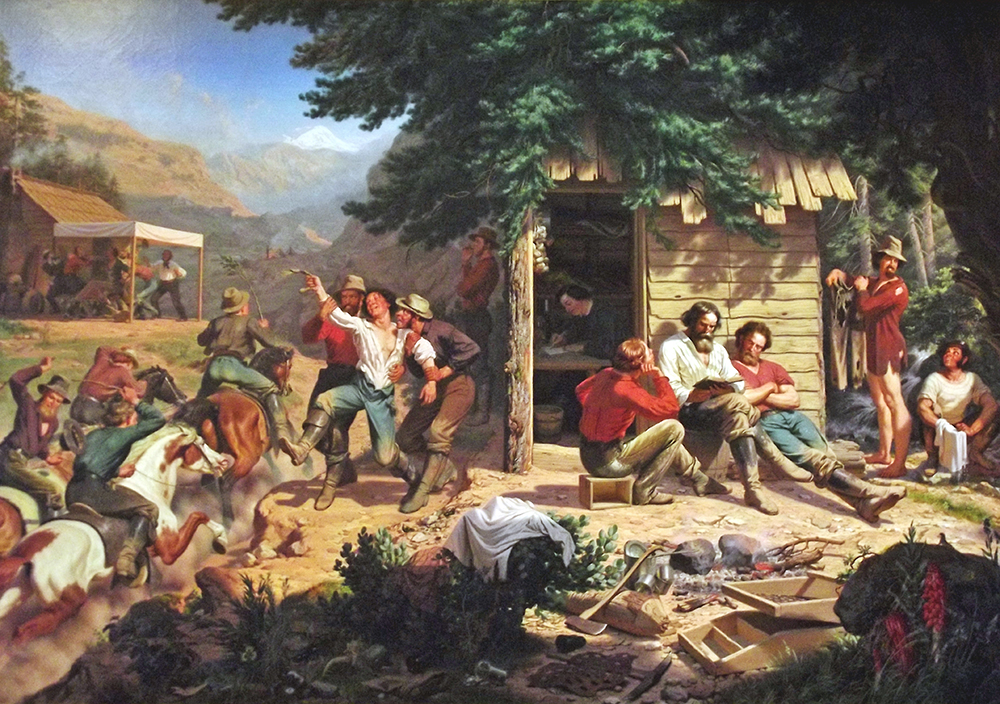
Sunday Morning in the Mines, 1872, oil on canvas by German-born American artist Charles Christian Nahl (1818–1878). Wikimedia Commons.
Soldiers, ghosts, and fiends—the name Ambrose Bierce conjures for most readers the ill-fated characters in his stories of the Civil War and his tales of horror and suspense. Many readers are also familiar with his cynically humorous Devil’s Dictionary. So it comes as a surprise when one encounters the short story “A Lady from Redhorse,” first published as “An Heiress from Redhorse” in the San Francisco Examiner on March 15, 1891, and reprinted in all three editions of Bierce’s In the Midst of Life (Tales of Soldiers and Civilians).

Biographers and reviewers have not known what to make of this curious tale by the man who came to be known to his contemporaries as “Bitter Bierce.” The year the story first appeared, it was reprinted in, of all places, the New York magazine Romance, alongside such selections as “How He Won Her” and “How a Woman Loved”; in 1929, it was included in the anthology World’s Great Romances. The critic Robert A. Wiggins, who once described Bierce as a “misanthrope pessimistically at odds with all mankind,” admitted that the tale is “unusual for Bierce in that it employs an epistolary form and ends happily. It might easily have graced the pages of a women’s magazine. Its ominous tone, suggesting imminent terror, is Biercean enough, but not the surprise conclusion with a cheerful ending.”

In 1981, the scholar Lawrence I. Berkove, who has called the tale a “romantic comedy,” came across a forgotten magazine piece that might shed light on the story’s origin. The week before “An Heiress from Redhorse” appeared in the Examiner, W. C. Morrow, who (like Bierce) was well known for his horror fiction, published a short item in the San Francisco literary weekly Wave. He described a day he had recently spent with Bierce at the Cliff House, a popular establishment overlooking the ocean on the western side of the city. On the train to the resort, a woman and her mother were brazenly staring at and talking about the two men—and especially, it seemed, about Morrow—and they followed the authors to the veranda of the restaurant. After a while, Bierce left to return to the city, the mother departed from the veranda, and at last the beautiful daughter approached Morrow. “I read everything you publish,” she gushed. “Oh, the terrible stories you write, that keep me awake and make me afraid when I’m alone! What a master mind to do these things! I have worshiped you so long from a great distance.” When she began to describe some of her favorite characters, it dawned on Morrow that the young woman thought he was Ambrose Bierce. He was unable to get in a word before “the poor girl had thrown her arms around my neck, clasped me close to her breast and pressed her lips to mine.” Both Morrow’s yarn (almost certainly embellished) and Bierce’s short story are set in seaside resorts and, as Berkove notes, feature “impressionable young ladies who fall hopelessly in love with handsome and somewhat mysterious men with personalities that were awesome yet attractive.” In other words, Bierce’s story might have been a whimsical response to Morrow’s teasing anecdote.

A better-known inspiration for Bierce’s story is Bret Harte’s similarly titled “An Heiress of Red Dog” (1878), about a young woman who unexpectedly inherits three million dollars from a man who had squirreled away seemingly worthless shares in the Rising Sun Mining Company, “which a day or two after his demise . . . suddenly sprang into opulence and celebrity.” In Bierce’s story, the heiress also gets her million from gold; her father struck it rich after years of hardship in a destitute mining town. Donald T. Blume, in his critical study Ambrose Bierce’s Civilians and Soldiers in Context (2004), points out that Bierce may have even taken his heiress’s name, Miss Dement, from Harte’s story. The testator during his final days had been “showing hints of his insanity [and] acts clearly attributable to dementia,” which, his estranged wife contends, explains why he left his supposedly moderate estate to “a freckle-faced maid-servant” at a local hotel. The will’s only stipulation is that the heiress cannot give a cent of it to any man with whom she falls in love.

Blume argues convincingly that Bierce’s story is “a lesson about human gullibility masquerading as a love story masquerading as a mystery”; a closer reading, certain textual evidence, and the historical context all suggest that, instead of a happy ending, the credulous heiress’s inevitable fate was—at best—ambiguous. (Readers may want to postpone reading the rest of this introduction until after they’ve read the selection.) The story isn’t only about a wealthy young woman falling madly in love with a mysterious stranger, who may or may not be after her money. Bierce also outlines her impoverished childhood in Redhorse, a California gold mining community, with her two friends, Jack Raynor (“Giggles”) and James Barts (“Dumps”), both of whom became miners themselves before moving on to other prospects. Raynor was hired by Wells, Fargo, & Company, and Miss Dement hints in passing that he had recently proposed and she had turned him down because he wasn’t her type. Barts, she believes, was killed while working as a stage driver, although Blume points out that Bierce may have modeled this character after real-life rogues, including the notorious stagecoach robber Black Bart (who was even the subject of one of Bierce’s poems).

In the end, the two storylines converge, the “mystery” is revealed, and Miss Dement believes she will live happily ever after. Yet Blume notes that in later editions Bierce, perhaps frustrated that readers had misunderstood the ending, changed the closing of the final letter from “they have played it upon / Your affectionate friend,” to “they have roped in your affectionate friend”—suggesting a trap rather than a prank. Blume concludes that “the revised statement seems to have been added by Bierce as a broad hint to readers that Miss Dement’s happy love story is not quite what she thought it to be.” There is still the matter of the money, after all, casting doubt on the motivations of the gold diggers who have successfully corralled her.

Notes: Coronado is an island near San Diego and was the site of a resort hotel for the wealthy. Helena Petrovska Blavatsky was a Russian mystic and founder of theosophy, who lived near Madras (in southeastern, not northern, India) from 1878 to 1885. The Sepoy Mutiny in 1857–58 was a large uprising of Indian soldiers (sepoys) serving in the British army. Thugs were members of the Thuggee cult, a group of Indian criminal gangs. They were suppressed by the British, who executed the last Thug in 1882. David Garrick was an eighteenth-century British actor and playwright; Bierce’s reference is to David Garrick Between Tragedy and Comedy, a famous painting by British artist Joshua Reynolds.

Chloriding the dumps was the process of using a corrosive chemical solution on mine tailings to extract any remaining traces of gold, silver, and other ores. In the story, Barts’s mother was “chlorided to her fathers,” suggesting that she was poisoned by the stuff—and, Blume posits, Barts might have played a role in the poisoning.

*   *   *
I find myself more and more interested in him. It is not, I am sure, his—do you know any good noun corresponding to the adjective “handsome”? . . . If you don't see the full selection below, click here (PDF) or click here (Google Docs) to read it—free!

This selection may be photocopied and distributed for classroom or educational use.
Sunday, August 1, 2021

The Lady of Little Fishing

Constance Fenimore Woolson (1840–1894)
From Constance Fenimore Woolson: Collected Stories

Voyageurs at Dawn, 1871. Oil on canvas by British artist Frances Anne Hopkins (1838–1919). WikiCommons.

From 1858 to 1870, Frances Anne Hopkins lived in Québec with her husband, a Hudson’s Bay Company administrator soon promoted to superintendent of the Montréal department, and she accompanied him on many of his journeys to HBC stations, expeditions that took them as far as Thunder Bay on Lake Superior’s northern shore and Marquette in upper Michigan. Like the Lady in Woolson’s story, she was often the only woman at an outpost, and she made sketches of trappers, traders, and voyageurs—the French Canadian boatmen who transported furs. She transformed many of these drawings into paintings after she and her husband returned to London in 1870.
In a blog post a few years ago, Anne Boyd Rioux resurrected a scathing notice that appeared in The Nation in 1874. “Our band of heart-wrenching female dealers in false feeling was never, we think, so numerous as now,” complained the critic John Richard Dennett. The two short stories that prompted this reaction were by Constance Fenimore Woolson: “Peter the Parson” (“noticeable for the raw coarseness of its assault on the feelings”) and “The Lady of Little Fishing,” which elicited a lengthier comment:
In the September Atlantic, Miss Woolson has another tale, wildly improbable, destitute of the truth of fact or the truth of fiction, which appears under the title of “The Lady of Little Fishing,” It is of this as much as of her story in Scribner’s that we are thinking when we speak of the large school of female writers to which she belongs, and of whom there is none who seems able to keep on her feet and write a moderate word when the reader’s feelings are to be touched, by the display of the throbbing feelings of the characters. Of the uses of restraint and of the nature of reserve they seem to have really about as much conception as if they wrote letters for the Beecher-Tilton case [in which Theodore Tilton publicly accused preacher Henry Ward Beecher of adultery]; and of good sense as little. They are, in a strict and now obsolete sense of the word, indecent.
As Rioux points out, Dennett died three months later, so he did not live to see the near-universal acclaim that greeted Woolson’s first collection, Castle Nowhere: Lake County Sketches, which reprinted both of the stories he despised. Moreover, his fellow reviewers understood immediately what Dennett, predisposed against fiction written by women, seems to have entirely missed: “The Lady of Little Fishing” is Woolson’s deliberate and obvious rewrite of (and response to) “The Luck of Roaring Camp,” the story that made Bret Harte famous just four years earlier. Harte’s tale, and the collection that contained it, proved so popular that in early 1871 William Dean Howells, the editor of The Atlantic Monthly, offered $10,000 for the exclusive rights to his work over the next year.

Before Woolson submitted “The Lady of Little Fishing” to Howells, “Solomon,” the first of her many stories to be published in The Atlantic, appeared in the October 1873 issue. “It has given me great pleasure to enter within the ‘Atlantic’ circle,” she wrote to him. “You may be amused to know that my three models, whose styles I study and admire, are George Eliot, Bret Harte, W. D. Howells. Quite unlike, are they not?” Her inclusion of Howells in this short list may have been meant as flattery, but the mention of Harte was probably not; by that time, The Atlantic had ended its costly arrangement with him. Harte’s popularity was declining, his new work was generally lacking in quality, and he had been unable to meet deadlines (his Christmas story appeared in the March issue). When Woolson sent her admiring letter to Howells, Harte was no longer a member of the “Atlantic circle.”

Although Woolson borrowed ambience and ideas from Harte’s popular tales, few readers would mistake her stories for anything written by him. “I do not plead guilty to imitating Harte,” she wrote to a new friend, the poet and critic Edmund Clarence Stedman, in September 1874. “In spite of all I said to you, I only meant that his style had impressed me so deeply that it would be a wonder if something did not show to others how much he was to me.” In any case, like everyone else, she was beginning to have doubts about Harte’s stature. She asked Publishers Weekly editor R. R. Bowker, “No one admires Bret Harte more than I do; but could he write a novel? — Is his fame work not like that of the journalist, — brilliant but vanishing too soon?” Before the year 1875 was out, readers had an answer of sorts to her first question. Harte’s first and only novel, the 470-page clunker Gabriel Conroy, was published, and the reaction from both readers and critics was virtually unanimous; it was “from beginning to end hopelessly and irredeemably bad,” lamented the Saturday Review. The novel, as one of Harte’s recent biographers admits, has “sufficient plots and subplots to fill a small library” and concludes “with more loose ends than a frayed rope.” After skimming parts of the book, Woolson told Stedman that she couldn't bring herself to read it through.

In “The Luck of Roaring Camp,” the only woman in the camp (and in the story) dies shortly after childbirth. Harte immediately dismisses her importance to the tale: “Perhaps the less said of her the better. She was a coarse and, it is to be feared, a very sinful woman.” Her baby, however, is left to the care of the gruff men who populate the camp. Not only does the infant boy Luck seem to bring fortune to the miners, who suddenly begin hauling in large quantities of gold, his very presence also calms and “civilizes” the men; they become concerned over the child’s upbringing and surroundings. At the end of the story, the camp is unexpectedly destroyed by a flash flood, in which both Luck and luck are swept away.

In an invaluable reappraisal of the relationship between Woolson’s and Harte’s stories, Caroline Gebhard contends that Woolson’s “self-conscious adoption of the ultramasculine style of Bret Harte is part of her declaration of literary independence. . . . Harte’s writing seemed as far as it was possible to be from the ‘pretty and sweet’ stories supposed the natural province of women.” In other words, Woolson purposefully wrote about subjects and locales that would distinguish herself from the “female writers” scorned by Dennett. (The irony is that Harte’s story has been often criticized for being too sentimental.) As Rioux notes in her recent biography of Woolson, “Harte’s phenomenal success with stories of rough, uncivilized miners and outlaws in California woke Woolson up to the literary marketability of the West.” For her version of the story, Woolson moved the setting from the gold mines of California to the remote fur-trapping camps in the Great Lakes region. “We had a cottage at Mackinac for two summers when I was a young girl,” she wrote to Howells, “and I knew all about the islands just west of the Straits, and their lawless inhabitants.”

Woolson didn’t simply change the location and retell Harte’s story with trappers instead of miners, of course. Instead of a baby, the civilizing force is a “spotless” young woman who arrives in the camp “as though she had dropped from heaven,” to preach the gospel to the wayward inhabitants, whose names and habits are near-parodies of the residents of Roaring Camp. Thus, “Woolson subtly undermines Harte’s version of the American fantasy of a happy, all-male existence uncomplicated by women,” writes Gebhard. “Not only can there not be a story without a woman in it—even Harte’s story, after all, needs a woman to produce the wonderful baby—but also, Woolson insists, the woman is the story.” The introduction of the Lady into this environment alters the entire thrust of the original story, and the camp’s history ends because of human behavior rather than a random natural catastrophe. As the scholar Alfred Bendixen puts it, “Woolson's focus is on the ways in which men construct women into objects of fantasy that meet their own emotional needs while ignoring the reality embodied in every complex human being.”

In the end, although the two tales mirror each other and share various elements, Woolson’s story is so different that readers need not have read Harte to understand or enjoy it. “The Lady of Little Fishing” has been reprinted for posterity in the recent Library of America volume collecting the best of Woolson’s stories, and we present it below as our Story of the Week selection.

Notes: The North West Company and the Hudson’s Bay Company, competing fur-trading firms in British North America, were forced to merge in 1821 by the British government after a series of skirmishes between the two companies. Bateaux were broad flat-bottomed boats used primarily for transporting men, supplies, and goods in colonial North America and during the fur trade.

*   *   *
It was an island in Lake Superior. I beached my canoe there about four o’clock in the afternoon, for the wind was against me and a high sea running. . . . If you don't see the full selection below, click here (PDF) or click here (Google Docs) to read it—free!

This selection may be photocopied and distributed for classroom or educational use.

Friday, July 6, 2012

The Legend of Monte del Diablo

Bret Harte (1836–1902)
From American Fantastic Tales: Terror and the Uncanny from Poe to the Pulps

“Night Scene on the San Joaquin River—Monte Diablo in the Distance,” engraving from Scenes of Wonder and Curiosity in California (1862) by James M. Hutchings.
In 1862 James Mason Hutchings, an Englishman who arrived in California during the Gold Rush, published Scenes of Wonder and Curiosity in California. In his book you’ll find the following passage:
Almost every Californian has seen Monte Diablo. It is the great central landmark of the state. Whether we are walking in the streets of San Francisco, or sailing on any of our bays and navigable rivers, or riding on any of the roads in the Sacramento and San Joaquin Valleys, or standing on the elevated ridges of the mining districts before us—in lonely boldness, and at almost every turn, we see Monte del Diablo. Probably from its apparent omnipresence we are indebted to its singular name, Mount of the Devil.
That same year another local resident, twenty-six years of age, used Monte del Diablo as the setting for one of his earliest stories. Like Hutchings, Bret Harte (a native of Albany, New York) had moved to California during the Gold Rush years and he too had just begun a career as a writer.

The young Harte made the acquaintance of the abolitionist Jessie Benton Frémont, who hosted a highly regarded salon in San Francisco. The wife of 1856 Republican presidential candidate (and future Union Army commander) John Frémont, she became a champion of Harte’s writing and continued to support him after the Frémonts left California for the war. In early 1862 she wrote to Atlantic Monthly editor James T. Fields to recommend the story “The Legend of Monte del Diablo,” calling Harte “a fresh mind filled with unworn pictures.” Another local abolitionist, the minister Thomas Starr King, also wrote Fields to recommend the selection (which he had not yet even read). As Gary Scharnhorst notes in a recent biography of Harte, Fields accepted the story but was not all that impressed, writing to Mrs. Frémont, “Your young friend fails to interest. He is not piquant enough for the readers of the Atlantic.”

The story appeared in the September 1863 issue of the magazine, alongside Thoreau’s “Life Without Principle.”  Five years later, Harte would write “The Luck of the Roaring Camp” and “The Outcasts of Poker Flat,” the two stories which made him internationally famous—and they would both appear in Overland Monthly, the California-based magazine he himself edited.

Over the course of the next century, “The Legend of Monte del Diablo” became an enduring favorite among the residents of Contra Costa County in California, and eventually the legend itself became part of regional lore. In 1959 the local chapter of the Knights of Columbus voted to change its name to the Father Jose A. Haro Council in honor of the “Jesuit Priest from the early San Pablo Mission who administered to the Bal Bognes Indians, about 1770, in our immediate vicinity of San Pablo.” As the recently renamed council’s own website sheepishly admits, both Father Haro and the mission he founded were Bret Harte’s wholly fictitious inventions.

Notes: Ayuntamientos are municipal councils. Junipero Serro (properly, Serra; 1713–1784) was the Franciscan friar who founded the chain of California missions. Calaveras, now a state park, is a grove of giant sequoias in California. Bartolomé de las Casas (d. 1566) was a Dominican friar known for fighting slavery and the mistreatment of the natives of south Mexico; he was appointed the first Protector of the Indians by Spanish administrators. Ophir was the biblical region where King Solomon’s mines were said to have been located. Alonso de Ojeda (d. 1515) was a Spanish explorer of the northern coast of South America.

*   *   *
The cautious reader will detect a lack of authenticity in the following pages. I am not a cautious reader myself, yet I confess with some concern to the absence of much documentary evidence in support of the singular incident I am about to relate. . . . If you don't see the full story below, click here (PDF) or click here (Google Docs) to read it—free!

This selection may be photocopied and distributed for classroom or educational use.