Sunday, December 19, 2021

According to Solomon

Charlotte Perkins Gilman (1860–1935)
From American Christmas Stories

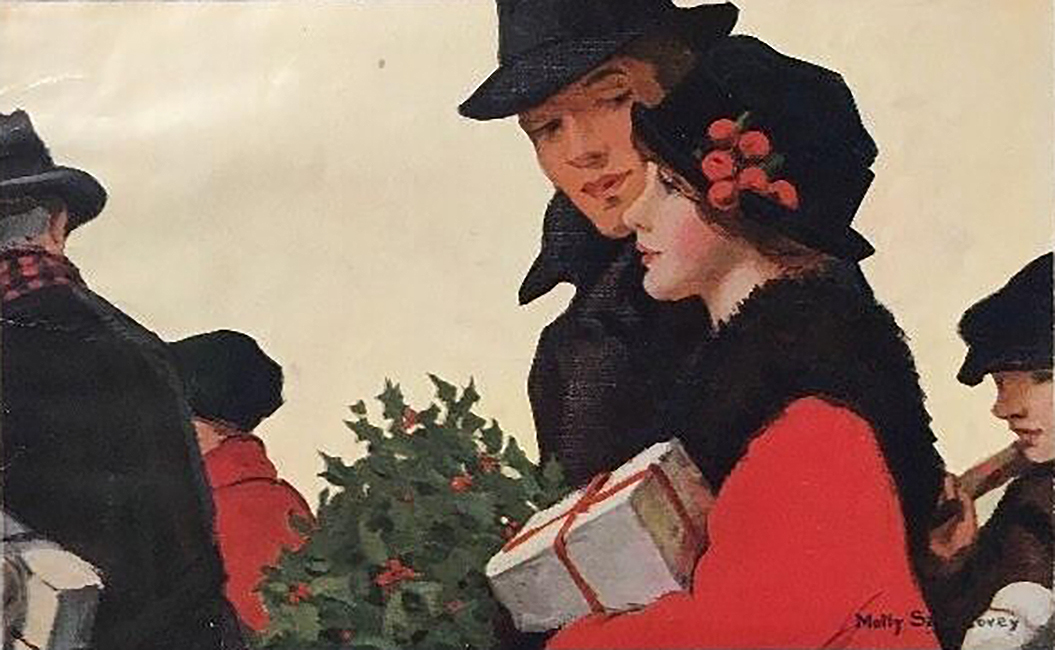
Illustration for the December 1914 cover of Woman’s Home Companion (“One Thousand Christmas Ideas”) by artist Molly Sale Covey (1880–1917), who immigrated to the United States from New Zealand in 1909. Image from eBay.
Nine years after she moved to New York City from Pasadena, California, Charlotte Perkins Gilman established The Forerunner, a monthly 32-page magazine that she wrote, edited, and published entirely by herself. In addition to offering poetry, short fiction, essays, and book reviews, most issues of the magazine contained installments of a short novel and a book-length nonfiction work. The inaugural number, published in November 1909, included the first chapter of her latest novel, What Diantha Did, and the opening section of a series called Our Androcentric Culture, or the Man-Made World, both of which would appear subsequently as books published by the Charlton Company, the name under which she issued both the magazine and her books during this period.

The magazine attracted only half of the 3,000 subscribers needed to make a profit, but Gilman kept The Forerunner going through 1916. The writings from those seven years, including her utopian novels Herland and With Her in Ourland, are now widely regarded by scholars and critics as among her greatest achievements. “Gilman used humor, anger, irony, sentimentalism, and whimsy to speak to a variety of concerns,” writes Ann J. Lane in her biography of the author. “The overriding commitments reflected in the magazine were to the belief in the rights of women and to the superiority of a collective social order.”

Gilman filled the next issue, for December, with several Christmas items. She wrote a short piece questioning why we “teach children the Santa Claus myth,” which had been corrupted into “a mere comic supplement character; a bulbous benevolent goblin, red-nosed and gross, doing impossible tricks with reindeers and chimneys.” Instead, she proposed we focus more on the “the turn of the year” and “the growing light, the longer days,” as well as on “the story of beauty and wonder about the birth of Jesus.”

She also devoted a couple of articles to the importance and value of gift giving, including these sentiments in the essay “An Obvious Blessing”:
The instinct of giving is the pressure of the surplus; the natural outgo of humanity, its fruit. We are not mere receptacles, we are productive engines, of immense capacity; and, having produced, we must distribute the product. To give, naturally, is to shed, to bear fruit; a healthy and pleasurable process.

What has confused us so long on this subject? Why have we been so blind to this glaring truth that we have stultified our giving instinct and made of it an abnormal process called “Charity,” or a much-restricted pleasure only used in families or at Christmas time?
Later in the magazine, in the “Comment and Review” section, more thoughts on the question of gift giving followed a suggestion to make Christmas a holiday for and about children:
Christmas will have a rejuvenation when it is recognized in this sense as the Child’s Festival. . . .

And Gifts?

Yes, gifts. There could be no more appropriate testimony to Joy and Hope and Love than these visible fruits. Gifts to the happy child to make him happier. Gifts from the happy child—and the new joy of giving. Gifts everywhere—from each to each—as showing the rich overflow of Love and Joy.

And more than that—Gifts from Each to All! There is a custom worth initiating! Not charity nor anything of that sort. Not the mere visiting of the sick and the prisoner. But a yearly practice of giving something to the Community—to show you love it!
To introduce this theme to readers, the December issue opened with a new Christmas story, “According to Solomon,” in which a husband and wife engage in a battle of wits revolving around their annual gift giving—and in which there is no mention of Santa Claus. The story has been included in the new Library of America collection, American Christmas Stories, and we present it here as our Story of the Week selection.

Notes: One of the presents Mr. Bankside considers giving his wife is an electric runabout, a battery-powered automobile produced in the early years of the twentieth century. A partially restored 1903 Columbia Electric Runabout in nearly pristine condition was recently available for sale; you can see it here.

In the above introduction, some details concerning Gilman and The Forerunner are adapted from the Chronology in the forthcoming Library of America collection, Charlotte Perkins Gilman: Novels, Stories, & Poems, edited by Alfred Bendixen (expected publication: August 2022).

*   *   *
“‘He that rebuketh a man afterwards shall find more favor than he that flattereth with his tongue,’” said Mr. Solomon Bankside to his wife Mary. . . . If you don't see the full selection below, click here (PDF) or click here (Google Docs) to read it—free!

This selection may be photocopied and distributed for classroom or educational use.

Saturday, December 11, 2021

Tall Tale Blue Over Mobile Bay in Harlem

Albert Murray (1916–2013)
From Albert Murray: Collected Essays & Memoirs

Restaurant owners Marion and Toots Evans pose in front of The Sisters, their soul-food restaurant at 119 West 135th Street, Harlem, June 27, 1967. Photograph by Patrick A. Burns (1908–1973). New York Times / Getty Images.

In a short article, “Soul: Thirty-two Meanings Not in Your Dictionary,” Murray includes the following definition: “Also down-home recipe cooking, as in soul food, soul feast, soul table (but not SOUL BREAD, which is money). Sometimes construed as food for the soul but more often the traditional food of soul people.”
“After working on what became The Omni-Americans,” recalled Albert Murray in an interview with Charles H. Rowell in 1997, “I got this assignment from Harper’s magazine to participate in a series which they called ‘Going Home in America.’ Somebody was going home in the Midwest, somebody going home in the East, somebody going home in the Far West. So the editor, who is a friend named Willie Morris, decided to give me an assignment.”

In 1967 Willie Morris had published the memoir North Toward Home, recalling his smalltown childhood in Mississippi, his young adulthood in Texas, and his life during the 1960s in New York City (including his close friendship with Ralph Ellison, who was also good friends with Murray). The book became a best seller and struck a chord with many Southerners who had moved north yet still felt nostalgic for the South. Two years after the book appeared, Morris suggested that Murray return to his own hometown of Mobile, Alabama, and write a magazine article about how things have changed in the wake of desegregation. Or that was the basic idea.

“Instead of going to Mobile,” Murray told Rowell, “I decided to go south, with Mobile included in it, Mobile being a point of return back north. . . . I’ll go south and stop in North Carolina, stop in Georgia, and then go by Tuskegee, go to Mobile, go to New Orleans, go to Greenville, Mississippi, and then stop in Memphis.” Supplied with an advance for travel expenses, he began the trip by heading north from his home in Harlem to New Haven, where he interviewed two well-known Southerners teaching at Yale: the historian C. Vann Woodward and the novelist Robert Penn Warren. He then went on his trip down South, meeting up with the novelist Walker Percy, the journalist Edwin M. Yoder Jr., and many Southern newspaper editors and reporters, as well as “homefolks” in Mobile. “I decided that I was not going to write a civil rights report or anything like that,” Murray explained. “I tried to make a poem, a novel, a drama—a literary statement—about being a Southerner.”

Although Murray may have strayed from the original “assignment,” he did so with Morris’s approval and support. In late 1970 Morris told an interviewer that Murray’s piece was “all written except for the last ten pages.” Paul Devlin, Murray’s assistant and close friend during the decade before his death, says that it isn’t known if the plan was to publish the article as a series or in a single issue of the magazine. In any case, the sixty-four-thousand-word result—part memoir, part interview-based journalism—never appeared in Harper’s, because Morris was fired just as Murray was finishing it. Fortunately, Murray already had a contract with McGraw-Hill for the project, and South to a Very Old Place appeared as a book in November 1971.

Shortly after it was published, a radio interviewer asked Murray, “Do you consider yourself a writer or a critic?” “A writer,” he answered without hesitation. “The critical work is just preliminary work for the creative work. I consider myself a maker of images. . . . The Omni-Americans would be considered a critical book—no, a critique of American culture, and it would be a counterstatement, whereas [South to a Very Old Place] is an attempt to create an image that would be a counterstatement—a counterimage.” Or, as he described his aim in the book itself: “the ever so newsworthy political implications would be obvious enough; and after all doesn’t anything that any black, brown, or beige person says in the United States have the most immediate political implications? No strain for that. But the overall statement would be literary—as literary, which is to say as much of a metaphorical net, as you could make it.”

Near the end of North Toward Home Morris described one memorable gathering that occurred as he was finishing his book. “At Al Murray’s apartment in Harlem, on New Year’s Day 1967, the Murrays, the Ellisons, and the Morrises congregated for an unusual feast: bourbon, collard greens, black-eyed peas, ham-hocks, and cornbread—a kind of ritual for all of us. Where else in the East but in Harlem could a Southern white boy greet the New Year with the good-luck food he had had as a child?” Where else, then, could Murray’s “counterimage” of the South begin other than where he ended up—in Harlem, his home since 1962 and until his death in 2013? Or as Murray himself said, “When you take the ‘A’ train for Harlem you are heading north but also south and home again.” And so, for the 50th anniversary of South to a Very Old Place, we present the book’s prologue—Murray’s Southern ode to Harlem.

Notes: Murray mentions numerous Harlem landmarks and celebrities in his essay. The IND Station at 125th Street refers to a station of the Independent Subway System (today’s A–G lines), one of several New York City systems managed separately. The IND was owned by the city; the IRT (1–7 lines) was a privately owned system. The thirteen-floor Hotel Theresa, now repurposed as an office building, was the choice of Black celebrities in the 1940s and 1950s. Lenox Terrace is a postwar Harlem apartment complex (and, after 1962, Murray’s place of residence). The Schomburg Library referred to the New York Public Library building on West 135th Street that housed a significant collection of books and manuscripts of the African diaspora donated by Arthur A. Schomburg in the 1930s. Both the building and the collection are now part of the much larger Schomburg Center for Research in Black Culture. Smalls Paradise was a Harlem nightclub. CCNY is the City College of New York. Adam Clayton Powell Jr. was pastor of Harlem’s Abyssinian Baptist Church and served as a U.S. congressman from 1945 to 1971. Buddy Bolden was a New Orleans–style cornet player. Billy Strayhorn wrote “Take the A Train” (1939), the signature tune of the Duke Ellington Orchestra.

Rowell’s interview from 1997, quoted in the introduction above, appeared in Callaloo, the literary journal he founded in 1976 and has edited ever since. Also quoted is a radio interview, which aired originally on the New York City program The World Today and was “re-broadcast” for the first time in half a century when Paul Devlin, coeditor of the two-volume Library of America edition of Murray’s writings, played it at the end of “A Tribute to Albert Murray,” a panel discussion that occurred on December 9, 2021. Other details of the above history about the book’s creation were also gleaned from Devlin’s presentation. The video can be viewed on YouTube; the radio interview with Murray begins at the 1:35:00 mark.

*   *   *
For this week’s selection, we depart from the usual format and reproduce Murray’s piece, in its entirety, below. You may also download it as a PDF or view it in Google Docs.

New York:
Tall Tale Blue Over Mobile Bay in Harlem


You can take the “A” train uptown from Forty-second Street in midtown Manhattan and be there in less than ten minutes. There is a stop at Fifty-ninth Street beneath the traffic circle which commemorates Christopher Columbus who once set out for destinations east on compass bearings west. But after that as often as not there are only six more express minutes to go. Then you are pulling into the IND station at 125th Street and St. Nicholas Avenue, and you are that many more miles north from Mobile, Alabama, but you are also, for better or worse, back among homefolks no matter what part of the old country you come from.

But then, going back home has probably always had as much if not more to do with people as with landmarks and place names and locations on maps and mileage charts anyway. Not that home is not a place, for even in its most abstract implications it is precisely the very oldest place in the world. But even so, it is somewhere you are likely to find yourself remembering your way back to far more often than it is ever possible to go by conventional transportation. In any case, such is the fundamental interrelationship of recollection and make-believe with all journeys and locations that anywhere people do certain things in a certain way can be home. The way certain very special uptown Manhattan people talk and the way some of them walk, for instance, makes them homefolks. So whoever says you can’t go home again, when you are for so many intents and purposes back whenever or wherever somebody or something makes you feel that way.

There is also the “D” train which you can take from Forty-second Street over on Sixth Avenue, because that way you still come into the “A” train route at Columbus Circle. Or you can take Number Two or Number Three on the IRT, and the uptown Avenue will be Lenox, and if you get off at 125th Street you walk west to the old Theresa Hotel corner at Seventh, the Apollo near Eighth, and Frank’s Chop House, on over toward St. Nicholas. At the 135th Street IRT stop you come out at the northwest corner of Lenox Terrace, and you are also at the new Harlem Hospital. From there, which is only a few steps from the AME Church that used to be the old Lincoln Theatre, you walk east to Riverton, Lincoln, and the water. But for the Schomburg Library, the YMCA poolroom, and Smalls Paradise, you walk west toward the hill and CCNY.

Sometimes, of course, all you need to do is hear pianos and trumpets and trombones talking, in any part of town or anywhere else for that matter. Or sometimes it will be pianos and saxophones talking and bass fiddles walking; and you are all the way back even before you have time to realize how far away you are supposed to have gone, even before you become aware of even the slightest impulse to remember how much of it you thought perhaps you had long since forgotten.

Sometimes it can be downhome church organs secularized to Kansas City four-four in a neighborhood cocktail lounge. It can be a Count Basie sonata suggesting blue steel locomotives on northbound railroad tracks (as “Dogging Around” did that summer after college). It can be any number of ensemble riffs and solo licks that also go with barbershops and shoeshine parlors; with cigar smoke and the smell and taste of seal-fresh whiskey; with baseball scores and barbecue pits and beer-seasoned chicken-shack tables; with skillets of sizzling mullets or bream or golden crisp oysters plus grits and butter; and with such white potato salads and such sweet potato pies as only downhome folks remember from picnics and association time camp meetings. Or it can even be a stage show at the Apollo Theatre which sometimes rocks like a church during revival time. It can be the jukebox evangelism of some third-rate but fad-successful soul singer (so-called) that carries you back not only to Alabama boyhood Sundays with sermons followed by dasher-turned ice cream, but also to off-campus hillside roadside beer joints and Alabama pine-needle breezes.

So naturally it can also be Lenox Avenue storefront churches, whether somewhat sedate or downright sanctified. Or it can be the big league uptown temples along and off Seventh Avenue: such as, say, Big Bethel, Mother Zion, Metropolitan, Abyssinian Baptist, where on the good days Adam Clayton Powell, for all his northern-boy upbringing, sounds like Buddy Bolden calling his flock.

None of which is to suggest—not even for one sentimental flicker of an instant—that being back is always the same as being where you wish to be. For such is the definitive nature of all homes, hometowns, and hometown people that even the most joyous of homecoming festivities are always interwoven with a return to that very old sometimes almost forgotten but ever so easily alerted trouble spot deep inside your innermost being, whoever you are and wherever you are back from.


For where else if not the old home place, despite all its prototypical comforts, is the original of all haunted houses and abodes of the booger man? Indeed, was even the cradle only a goochie-goochie cove of good-fairy cobwebs entirely devoid of hobgoblin shadows; or was it not also the primordial place of boo-boo badness and doo-doo-in-diapers as well?

Once back you are among the very oldest of good old best of all good friends, to be sure, but are you not also just as likely to be once again back in the very midst of some snarled-up situation from which you have always wanted to be long gone forever?

And where else did you ever in all your born days encounter so much arrogant ignorance coupled with such derisive mockery and hey-you who-you crosstalk? Where else except in this or that Harlem are you almost always in danger of getting kicked out of a liquor store for instance for browsing too casually in the wine section. Where else except among homefolks is that sort of thing most likely to tab you not as an expense-account gourmet-come-lately but a degenerate wino? Or something worse.

***

But still and all and still in all and still withal if there are (as no doubt there have always been) some parts of Harlem where even such thugs and footpads as inhabited the London of Charles Dickens would probably find themselves more often mooched and mugged than mooching and mugging so are there at least one thousand plus one other parts and parcels also. Not to mention such browngirl eyes as somehow can always make even the smoggiest New York City skies seem tall tale blue over Mobile Bay.

Naturally there are those who not only allege but actually insist that there can only be ghetto skies and pathological eyes in Harlem and for whom blues tales are never tall but only lowdown dirty and shameful. But no better for them. They don’t know what they’re missing. Or don’t they? For oh how their pale toes itch to twinkle as much to the steel blue percussion as to all the good-time moans and the finger-snapping grunts and groans in Billy Strayhorn’s ellington-conjugated nostalgia.

From SOUTH TO A VERY OLD PLACE by Albert Murray. Reprinted by permission of Vintage Books, an imprint of the Knopf Doubleday Publishing Group, a division of Penguin Random House LLC. Copyright © 1971 by Albert Murray.

This selection is used by permission. To photocopy and distribute this selection for classroom use, please contact the Copyright Clearance Center.

Sunday, December 5, 2021

The Christmas Magazines

and the Inevitable Story of the Snowbound Train

Dorothy Parker (1893–1967)
From American Christmas Stories

Christmas numbers from the late 1800s and early 1900s.
You can credit (or blame) Charles Dickens. After the extraordinary success of A Christmas Carol in 1843, he published four more novellas for Christmas before the end of the decade, thereby inventing the Christmas book as a genre of its own. In 1850 he began editing a new weekly magazine, Household Words and, perhaps taking a cue from the popularity of an 1848 “Christmas supplement” in The Illustrated London News, he devoted all twenty-four pages of the December 21 number to Christmas fare. This special issue contained his latest holiday story, “A Christmas Tree,” as well as stories and essays with titles like “Christmas in the Navy” and “Christmas among the London Poor and Sick,” and even a collection of cringey (to modern ears) carols, such as “The Deformed Child’s Christmas Carol” and “The Blind Child’s Carol.”

The sales of the issue were so impressive that Dickens continued publishing a Christmas number as an extra issue, separate from the weekly one, for the next seventeen years, first in Household Words and, when that folded due to a dispute with his publishers, in his new magazine, All the Year Round. In 1852 the Christmas issue expanded to 36 pages (“containing the amount of one number and a half,” the cover awkwardly boasted); beginning in 1860 it was twice the size of a regular issue. The Christmas specials took on a life of their own, each selling more than a quarter of a million copies by the mid-1860s—well over twice the circulation of the magazine.

Other magazine and newspaper publishers followed suit, as Christmas supplements and special issues and double numbers proliferated in England and crossed the Atlantic to the United States. Soon additional issues were created for other holidays. “The market for conversion and happily-ever-after stories for Christmas and Easter was immense,” Emily Toth writes in her biography of Kate Chopin. “It was also one of the best sources of income and recognition for professional writers”; in fact, a Christmas story, “The Going Away of Liza,” first brought Chopin to the attention of a national audience when it was syndicated as “The Christ Light” in newspapers all over the country.

With the publication of A Christmas Carol and subsequent tales, Dickens reinvigorated an old tradition of telling ghost stories during the holiday season, and many magazines followed his lead and featured supernatural tales in their Christmas numbers. But the typical Dickens classic wasn’t simply a ghost story, it was often about the differences between the rich and the poor—and especially about the stinginess and haughtiness of the privileged versus the worthiness of those less fortunate. American editors especially favored this type of uplifting morality tale, “the familiar, almost stereotypical genre in which poor children stand huddled in the cold outside the home of a rich family, gazing patiently through the window at the latter’s Christmas luxuries,” as cultural historian Stephen Nissenbaum describes it in his survey of the history of Christmas in America. “In the commonest version of this pattern, the poor children turn out, at the end, to be related to their benefactors by blood itself.” Nearly always, the needy prove themselves worthy of kindness by their innocence, honesty, and poignant generosity—a formula that Mark Twain ruthlessly parodied in “The Christmas Fireside (for Good Little Boys and Girls),” which appeared in the December 23, 1863, issue of The Californian.

Sentimental fiction was a mainstay of Christmas magazines through the end of the nineteenth century and well into the early twentieth. Although there were notable, memorable exceptions, “many of the stories were truly awful,” writes the novelist Connie Willis in her introduction to the new Library of America collection, American Christmas Stories, and she notes how “H. L. Mencken railed against stories in which ‘the deserving poor’ were force-fed Christmas dinner and unwanted sermons.” Similarly, in the fall of 1916, when a certain Vogue staff member was scouting around for an idea for a new piece to send down the hall to the more highbrow Condé Nast magazine, Vanity Fair, she lit upon the cloying holiday fare published by other American periodicals.

“In 1915 a small, dark-haired pixie, treacle-sweet of tongue but vinegar-witted, joined our staff,” Vogue editor Edna Chase later recalled. Her marriage to Edwin Parker two years in the future, the pixie was still known as Dorothy Rothschild. (“My God, no, dear! We never even heard of those Rothschilds!” she responded to the inevitable inquiry.) “After my father died there wasn’t any money,” she told The Paris Review years later. “I had to work, you see, and Mr. Crowninshield, God rest his soul, paid $12 for a small verse of mine and gave me a job at $10 a week. Well, I thought I was Edith Sitwell.” Frank Crowninshield was the editor of Vanity Fair and the job he found for the young poet was writing captions for Vogue. It turned out to be one of most decidedly mismatched hires in literary history. “It looks just like the entrance to a house of ill-fame,” Parker said of the magazine’s reception area. Later she recalled the dowdiness of the “plain women” who became her colleagues: “They were decent, nice women—the nicest women I ever met—but they had no business on such a magazine. They wore funny little bonnets and in the pages of their magazine they virginized the models from tough babes into exquisite little loves.”

Parker’s work for Vogue was notoriously offbeat. She wrote many captions that had to be removed by the staff, such as “When she was good she was very, very good, and when she was bad she wore this divine nightdress of rose-colored mousseline de soie, trimmed with frothy Valenciennes lace.” Another caption, “From these foundations of the autumn wardrobe, one may learn that brevity is the soul of lingerie,” made it past her censors into the pages of the magazine. As did, much to Chase’s mortification, an infamous piece on “Interior Desecration,” about an entirely fictitious tour of a house redecorated by a garish decorator (“No matter how anything began, it ended in a tassel”). By the winter of 1918, both Chase and Crowninshield agreed that Dorothy Parker should migrate down the hall to work instead at Vanity Fair, the magazine that had, in fact, been publishing the bulk of her poetry and prose over the previous two years anyway—including her story on Christmas stories.

Notes: Published from 1912 to the early 1930s, Snappy Stories: A Magazine of Entertaining Fiction was a popular pulp magazine, known for its saucy contents and for covers featuring pin-up girls. It was an unlikely venue for the type of Christmas story detested by Parker. Harrison Fisher was a book and magazine illustrator whose full-color drawings of elegant women frequently appeared on the cover of Cosmopolitan. His illustrations were collected annually in wall calendars and on calendar plates.
*   *   *

For this week’s selection, we depart from the usual format and reproduce the selection, in its entirety, below.
You may also download it as a PDF or view it in Google Docs.

This selection may be photocopied and distributed for classroom or educational use.

The Christmas Magazines
and the Inevitable Story of the Snowbound Train

Every year I buy them,—the Christmas magazines. Every year I say, hopefully, “Perhaps this time.” And every year I say, wearily, “Never again.”

But I’ll go on buying them, and I know it. Hope does die so hard within me. Somewhere, some time, possibly here, perhaps in Heaven, I shall find a Christmas magazine without the story of the snowbound train.

You know it, don’t you? The lonely old millionaire who snorts at the mere mention of Christmas, and, on the same train, the little golden-haired child who is going to spend Christmas out at Grandma’s in the country? You know how the snow piles up, and the wires are blown down, and the anxious train-hand says that there is no chance of going on? And then, don’t you remember how the lonely old millionaire always sees the pathetic little stocking dangling out the berth occupied by the golden-haired child? So the l. o. m. (who has perhaps made his millions as a conjuror) immediately produces an elaborately decorated Christmas tree and a seething mass of toys. Maybe it isn’t conjury, though. Perhaps all millionaires can do it. I don’t know any regular millionaires, you see. I knew a man once who was supposed to be a millionaire, and he couldn’t even do card tricks, but, then, the reports of his income were probably exaggerated. According to the writers of snowbound train stories, this feat of producing Christmas trees from thin air is a very common one among millionaires.

It seems to be a trait they share with actresses. For the snowbound train story sometimes has an actress in it instead of a lonely old millionaire,—though he is first choice, I suppose on account of the child’s future. If it’s an actress, she is always a self-made blonde, a member of a traveling burlesque troupe, and she unfailingly has a little golden-haired child of her own, hidden away in the West. Sometimes, to make it harder, she has two little golden-haired children, but the story goes just the same,—stocking, tree, toys, etc., etc.

***

That’s the story. If they have ever published a Christmas number of any magazine without it, it must have been before I was born. Words are powerless to convey the loathing which I have for that story. It ruins the holidays for me. I buy hordes of magazines in the hope of finding one—just one—without it. But there it always is. Even “Snappy Stories” has it,—the actress version of it, of course. And the horrible part of it is that when I see the title “Christmas on the Train,” or “A Snow-Bound Santa Claus,” or “A Little Child Shall Lead Them,” or any of the hideous titles under which it masquerades, I cannot drop the book and run. No, a morbid fascination makes me read every word of it. Perhaps I shall have my reward, some day. Perhaps it will be my lot to discover the radical spirit who will give that child dark hair.

And the rest of the average Christmas number is no better than that terrible story. Look at any one of the magazines. They are just the same this year as last. The verses may be a bit freer, but that’s all.

The first page is always given up to a highly decorated poem. You know the kind, one of those poems with mediæval spelling. It is one of those hearty, good-cheer things, and it usually contains frequent requests to “let the welkin ring.” Just what is a welkin, anyway? I wrote one of that kind of Christmas poems a week or so ago, just to see if I could do it. I sent it to a poor little magazine that hadn’t many friends, and I had such a nice note from the editor, saying that he would be most glad to accept it. That was all. I shook the envelope, but nothing fell out. Do you know what I am going to do? I shall give him one more week, and then I shall write to him and tell him that he is under a misapprehension,—my contribution was not meant to be free verse.

***

Then come the stories. The one about the burglar whom the child thinks is Santa Claus,—you know that one, don’t you? Then the strong, red-corpuscled one about the half-breed’s Christmas. And the misery story that starts, “She counted them again. Seven cents,—seven worn, thin, sweat-stained pennies, and to-morrow would be Christmas!” And the sweet, sweet, sweet little tale of Christmas in the old South. And the one about the erring wife who comes back to her husband, or the erring husband who comes back to his wife,—it depends on whether a man or a woman writes it—just as the Christmas chimes ring out on the old village clock. Then there are the “Christmas in the Trenches” articles, and the masterpiece in Harper’s which is always called “Christmas in Many Lands.”

***

Then there is the double-page spread about how certain actresses spend their Christmas at home. There they all are—the vampire lady, the heroine of the glad play, the musical comedy star, and all the rest of them, photographed at home, exclusively for every magazine on the news-stands. One gathers from the photographs that these ladies carry their art into their home and holiday life. The vampire lady, for instance, wears one of those home-wrecking gowns, drapes herself over an evil-looking divan, and spends a merry Christmas leaning on her elbows and looking at a skull. The heroine of the “glad” play is perched girlishly in the middle of her dining-room table, hugging a Teddy bear and smiling sunnily—for it is Christmas, and a blizzard is raging, and all the trains are tied up, and thousands of people are freezing and starving to death, and she is glad, glad, glad. And the musical comedy star is photographed in pink silk pajamas (the picture isn’t colored, of course, but you just know they’re pink). She is on her way to enter her holly-wreathed bath-tub, but she has paused for a moment to gloat over the brimming stocking which hangs by the fireplace,—though goodness only knows why a filled stocking should be any treat to her.

Then the pages and pages of What to Give. Oh, how I skip those pages! That awful page headed “Gifts for Her,” with its scentless sachets, and its timeless wristwatches, and its Harrison Fisher calendar with the lady and gentleman executing a different kiss for every month in the year.

***

And always there is that page of jokes. “Christmas Jests,” they are called, instead of the usual “Sense and Nonsense” or “Verse and Worse.” They are the customary little parlor anecdotes that you cannot remember even while you’re reading them, made timely by the use of such phrases as “said Willie, passing his plate for more plum-pudding,” and “Mother asked, as she trimmed the tree.” There is nothing on earth so serviceable as a joke. Later on, these same jests may be successfully used for the July number by the simple method of changing the Christmas phrases to “said Willie, as he stooped over the lighted firecracker,” and “Mother asked, as she bandaged Baby’s eye.” I read the jokes through quickly, dread in my soul. I always expect to find the snowbound train tale among them, considerably condensed, and with the fun lying in the train-hand’s remark to the Lonely Old Millionaire.

I bought all the Christmas numbers this year. Just at present I am deep in the “never again” stage. But I shall probably buy them again next year,—I feel it hanging over me. Oh, is there no great public-spirited soul, no intrepid reformer working for the future of the race, who will found a Society for the Suppression of Christmas Issues?

Originally published in the December 1916 issue of Vanity Fair.

Sunday, November 28, 2021

How I Escaped Being Killed in a Duel

Mark Twain (1835–1910)
From Mark Twain: Collected Tales, Sketches, Speeches, & Essays 1852–1890

Photograph of Samuel Clemens (center) with A. J. Simmons, Speaker of the Nevada Territory Legislature, and state legislator William H. Clagett, January 1864. Image from Turner Auctions, via BidSquare.
When Samuel Langhorne Clemens, aka Mark Twain, was twenty-eight years old, he endured a self-inflicted scandal that one historian has called “the single most damaging incident of his Nevada career.” Two weeks after he published a pair of articles in consecutive issues of the Virginia City Daily Territorial Enterprise, Clemens fled the Washoe region of Nevada, ostensibly to avoid arrest for challenging the editor of a rival newspaper to a duel.

The Enterprise’s publisher, Joseph Goodman, was away from town in May 1864 and left Clemens in charge of the newspaper. At the time, Reuel Gridley, a storekeeper in Austin, Nevada, and coincidentally one of Clemens’s friends from Hannibal, Missouri, was traveling from town to town, auctioning a sack of flour to raise funds for the Sanitary Commission of St. Louis, an organization that provided aid to disabled Union soldiers. The flour was never actually purchased; the winner donated it back to Gridley, who auctioned it off again and again and ultimately raised upwards of a quarter of a million dollars. Clemens met up with Gridley in Virginia City and helped him raise $22,000 in a series of auctions in the county. One reason for Gridley’s success was his ability to fuel competition between rival businesses and community leaders to outbid each other for the flour as a display of public-spiritedness.

Gridley wasn’t the only party in Nevada raising money for wounded soldiers. Fifteen miles to the northeast, a group of women in Carson City organized a charity ball. The titular head of the fundraising effort was Samuel’s older brother Orion Clemens, the Nevada Territorial Secretary (and acting governor when James W. Nye was away, which was often). Orion’s wife, Mollie, was one of the prominent women on the committee. The group debated whether to send the money to the Sanitary Commission in New York rather than the commission in St. Louis, because several women on the committee had objected that the St. Louis organization used some of its proceeds to fund the Freedmen's Aid Society, which provided education and housing for those who had been formerly enslaved.

As an occasional reporter for the Enterprise for nearly two years, Clemens had a reputation as a purveyor of hoaxes and satires, and some of his news items were written more for their comic potential than for the facts. He learned about the dispute among the women of the committee and wrote an unsigned item suggesting that the flour sack would not be auctioned in Carson City because “the money raised at the Sanitary Fancy Dress Ball, recently held in Carson for the St. Louis Fair, had been diverted from its legitimate course, and was to be sent to aid a Miscegenation Society* somewhere in the East,” adding ambiguously that this rumor “was a hoax, but not all a hoax, for an effort is being made to divert those funds from their proper course.” The following day, after the Enterprise had been outbid for the flour sack by its rival, the Virginia Daily Union, Clemens published another unsigned piece falsely accusing the Union of rescinding its bid.

Historians and biographers have spent a century and a half reconstructing what happened over the next two weeks, a task complicated by conflicting accounts, by later embellishments and fabrications, and by recollections softened in the years after Mark Twain became an international idol. Mollie Clemens was apparently ostracized by the other women of the committee, and Samuel sent her a half-apologetic, half-defensive letter admitting he had been drunk when he wrote the piece about the charity ball. After another editor convinced him not to print it, he had inadvertently left the manuscript in the pressroom where it ended up in the paper anyway. “Since it has made the ladies angry,” he wrote to his sister-in-law, “I am sorry the thing occurred, & that is all I can do, for you will see yourself that their communication [a letter responding to the “libel” and demanding publication of the author’s name] is altogether unanswerable. I cannot publish that, & explain it by saying the affair was a silly joke, & that I & all concerned were drunk. No—I’ll die first.”

As for the item claiming that the Union had reneged on their bid for the flour sack, the rival paper responded with an editorial denouncing Clemens and his “unmanly public journalism.” In the ensuing exchange of letters and articles Clemens was called “an unmitigated liar, a poltroon and a puppy,” while Union editor James Laird was condemned as (among other insults) a “cowardly sneak,” a “craven carcass,” and an “abject coward.” As the condemnations and accusations escalated, Clemens published the exchange of private letters between the two editors, and Laird published, on three consecutive days, the Carson City committee’s letter that Clemens had refused to print. At least three challenges to duels were issued: Clemens repeatedly tried to goad Laird into dueling him, Union printer J. W. Wilmington sent a challenge to Clemens, and William K. Cutler, the husband of one of the women on the committee, also demanded a faceoff with Clemens.

In the end, nothing happened. Laird steadfastly ignored Clemens’s blustering invitations to combat, Clemens refused to answer Wilmington, and Cutler abandoned his challenge. At the end of May, Clemens left town for San Francisco with Enterprise journalist Stephen Gillis, the man who would have been his second in a duel. Not a shot was fired—not even, apparently, in practice. The only thing harmed by the entire ordeal was the budding reputation of “Mark Twain,” the moniker Clemens had begun using the previous year. It’s not even clear that Clemens fled town to avoid arrest, because the law against dueling, passed in 1861, had been rarely (if ever) enforced—as Joseph Goodman, his own employer, could attest, having crippled a man in a duel months earlier. “We are not afraid of the grand jury,” he wrote to Orion, “but Washoe has long since grown irksome to us, & we want to leave it anyhow.”

Eight years later, Clemens sanitized and inflated the episode in “How I Escaped Being Killed in a Duel,” a farcical tale that erases his ignominious behavior and drunkenness, omits any reference to the squabble over the auction or the libel against the Carson City women (not to mention the inflammatory racism of his “joke”), and merely mocks himself for buffoonery and misplaced pride. He had told a similar story to audiences the previous year while on the Roughing It prepublication lecture tour, but aside from a passing reference to challenges to “six duels” he had received as editor, the incident didn’t make it into the book. He would tell the story again with a few more details in the autobiography he dictated during the years before his death. As Twain scholar Leland Krauth argues, “the differences between the duel and the later tales of it illuminate the processes whereby Mark Twain characteristically purged through his art that which was painful and humiliating in Sam Clemens’s past. For Clemens’s real fight was not with Laird but with recollections of his own conduct.”

* The term miscegenation was coined only a few months earlier, in December 1863, when the pamphlet Miscegenation: The Theory of the Blending of Races, Applied to the White Man and the Negro appeared. Allegedly the work of an abolitionist who supported Lincoln and the Republicans, it was revealed after the 1864 election as a hoax written by two New York Democrats. During the campaign the word spread rapidly across the country and became a bludgeon used by Democrats against supporters of both Lincoln and emancipation.

*   *   *
The only merit I claim for the following narrative is that it is a true story. . . . If you don't see the full selection below, click here (PDF) or click here (Google Docs) to read it—free!

This selection may be photocopied and distributed for classroom or educational use.

Sunday, November 14, 2021

In a Far Country

Jack London (1876–1916)
From Jack London: Novels & Stories

Four of Jack London’s acquaintances in Dawson City, July 1898: Marshall Bond, Oliver H. P. La Farge, Lyman R. Colt, Stanley Pearce, and their two dogs Jack (a 140-pound Saint Bernard–Scotch Collie mix that was the inspiration for Buck in The Call of the Wild) and Pat. Photographer unknown. Yale University Library. The photo, signed by London on the back, is among Marshall Bond’s papers at Yale. A copy of this photo with London’s handwriting identifying the dog Jack as belonging to Louis Bond (Marshall Bond’s brother) is in the Jack London Collection of the Huntington Library.
The year after Jack London died, The Silhouette, a short-lived Oakland-based literary magazine, published a brief item he had mailed to the editor, who had asked him to identify the factors that led to his literary success. London outlined his early years as an errand boy, an oyster pirate, a sailor on a sealing schooner in the Bering Sea and off the coast of Japan, a jute factory worker, a cross-country tramp to Boston (and back, through Canada), and an inmate in a New York jail (for vagrancy). That brought him up to the age of 19, when he began thinking of becoming a writer. He enrolled in high school while working as a janitor and, a year later, entered the University of California while working at a laundry but dropped out halfway through his freshman year. As he explained, “having decided that I was a failure as a writer, I gave it up and left for the Klondike to prospect for gold. It was in the Klondike that I found myself. There nobody talks. Everybody thinks. You get your true perspective. I got mine.”

He left the Bay Area for the Klondike in July 1897 and returned home a year later with less than five dollars’ worth of gold dust in his pockets. While wintering in a cabin eighty miles south of Dawson City, he had come down with a severe case of “Arctic leprosy,” or scurvy, and when spring arrived his fellow prospectors helped him constructed a raft on which, accompanied by camp doctor B. F. Harvey, he returned to Dawson to recover. With a pair of new companions, he then traveled 1,500 miles down the Yukon River in a small boat and finally, at the mouth of the river on the western edge of Alaska, he caught a steamer heading back to the States. (You can see a map of his journey here.)

Biographers have noted how easily he befriended the older, more seasoned campers and how he remained in touch with many of them for the rest of his life. W. B. Hargrave later recalled:
It was in October of 1897 that I first met him. . . . No other man has left so indelible an impression upon my memory as Jack London. He was but a boy then [but] he possessed the mental equipment of a mature man, and I have never thought of him as a boy except in the heart of him. . . . There were not many of us that winter in the little cabin on the Yukon; but the isolated group of cabins housed some lovable and adventurous souls [and] there is hardly one of them whom he has not immortalized in his writings.
London’s year in the Klondike helped him get not only his “true perspective” but also his subject matter and, above all, his characters. One man who appears, thinly disguised, in several Klondike tales is Ira Merritt Sloper, a scrawny, emaciated forty-year-old who had spent several years living in South America before teaming up with London on the ship to Alaska. Sloper’s experience as a ship carpenter and Jack’s previous career as an oyster pirate made them an invaluable pair when the miners had to navigate the Yukon River. One of their adventures is retold in “Through the Rapids on the Way to Klondike," which describes how they transported their party’s supplies through the nearly impassable Whitehorse Rapids and then went back and brought through the possessions of helpless married couple.

Sloper and two other men spent the winter as London’s roommates in a cabin measuring ten by twelve feet, and—as often happened in the camps—they became irritated with one another, provoked by the petty disputes and annoying habits that long isolation can amplify in the minds of the confined. The friction came to a head when London mistakenly used Sloper’s valuable, well-tended axe on the ice and broke off its edge. Discomfited by Sloper’s anger, London ended up leaving their camp and moving into a nearby cabin that housed Hargrave and “Doc” Harvey. London and Sloper apparently reconciled by the time they met up again in San Francisco; in December 1898, London served as a witness for his friend when Sloper’s wife sued for divorce after he, like London, returned from his trip with hardly a cent to his name.

London’s fifth published story, “In a Far Country,” also features Sloper—under his real name. The story is about a pair of men who, trapped in a cabin for the winter, suffer from both scurvy and stupidity and slowly drive each other crazy. While the obvious inspiration for the tale is London’s own experience wintering with Sloper, the two antagonists, a spiritless middle-class clerk and a self-indulgent “gentleman” of means, are nothing like the real-life roommates. Instead, in an homage to his friend, London portrays Sloper as a heroic 90-pound man “fleeing from a South America fever-hole” who “whipped his stronger comrades into venturing a thousand miles of the stiffest hardship man can conceive.” It is Sloper who predicts that the two “Incapables,” left behind in their cabin, will turn into fighting “cats” before the winter is over.

Notes: The voyageurs were French Canadian boatmen who transported furs. A Yukon stove-pipe was a homemade portable contraption consisting of one chamber for fuel and another for cooking. A slush-lamp was another homemade item, usually constructed from a tin can and fueled with bacon grease rather than oil. “The Boston Burglar,” an American folk song based on an old sea shanty, and “The Handsome Cabin Boy,” an English sea shanty, were popular in the late nineteenth century. German socks are long, thick socks that can be strapped at top.

*   *   *
When a man journeys into a far country, he must be prepared to forget many of the things he has learned, and to acquire such customs as are inherent with existence in the new land. . . . If you don't see the full selection below, click here (PDF) or click here (Google Docs) to read it—free!

This selection may be photocopied and distributed for classroom or educational use.

Sunday, November 7, 2021

Yosemite Valley in Flood

John Muir (1838–1914)
From John Muir: Nature Writings

Sentinel Rock, Yosemite, 1872, oil on canvas by Scottish American painter William Keith (1838–1911). Wikimedia Commons. Both Keith and John Muir were born in Scotland the same year; the two men met for the first time when Keith traveled to Yosemite in 1872 and Muir took the visitor on one of his tours of the valley. They became close friends, occasionally traveling together in the Sierra Nevada range during the subsequent four decades, and Muir owned several of Keith’s paintings. In an 1875 article in The Overland Monthly, Keith criticized the accuracy of previous paintings of Yosemite by Albert Bierstadt and Thomas Hill: “The cliffs are neither red nor yellow, but an indescribable shifting gray, changing and shifting even as you look.”
A month before his twenty-ninth birthday, John Muir was fixing the belt system in an Indianapolis factory that manufactured wagon parts when he lost his grip and a sharp-pointed file pierced his right eye. The damage was serious enough to affect the vision in both eyes and he was unable to see for several weeks. While recuperating during the summer of 1867, he decided that if he fully regained his sight, he would take a trip “sufficient to lighten and brighten my after life in the gloom and hunger of civilization’s defrauding duties.” His sight in both eyes did return, and he planned to travel to the Amazon to focus on his botanical studies—but he didn’t make it that far. Instead, he took a train to Louisville and chose to walk to the Gulf of Mexico (via Savannah)—a trip of nearly a thousand miles. He then traveled to Cuba before heading north to New York City, where he decided to go to California—by way of Panama, the closest he got to South America.

Arriving in San Francisco in the spring of 1868, Muir took a job later in the year tending 1,800 sheep in the Central Valley. The following spring, he led his flock into the Sierra Nevada mountains and to the Yosemite Valley—and his fate was sealed. After quitting his shepherding job, he began working at a sawmill in Yosemite, and spent Sundays exploring the valley. Years earlier, as a student at the University of Wisconsin, he had studied geology as well as botany under Ezra S. Carr (now teaching, as it happened, at the University of California), and Muir quickly became convinced that glaciers had carved out the area’s landscape. Jeanne Carr, Ezra’s wife, began sending dignitaries, scientists, and artists to Yosemite with notes to Muir asking him to guide them through the valley.

Muir’s voluntary duties as tour guide won numerous converts to his belief in Yosemite’s glacial origins, and during the summer of 1871 Muir left the sawmill to devote more time to search for evidence to support the theory. And that’s when he struck “gold,” as it were. During one hike, he found a muddy stream that carried silt “entirely mineral of composition” and that issued from what he believed to be a moraine. As he recalled the following year:
When I had scrambled to the top of the moraine, I saw what seemed to be a huge snow-bank, four or five hundred yards in length, by half a mile in width. Imbedded in its stained and furrowed surface were stones and dirt like that of which the moraine was built. Dirt-stained lines curved across the snow-bank from side to side, and when I observed that these curved lines coincided with the curved moraine, and that the stones and dirt were most abundant near the bottom of the bank, I shouted, “A living glacier!
He determined that the glacier was “several hundred feet in depth,” and during subsequent weeks he measured its slow movement (about an inch per day) across the landscape. During the following years, he would identify a total of 65 glaciers in the Sierra Nevada. Many of them, including the first ice sheet identified by Muir as a “living glacier,” have completely melted away in recent decades.

Encouraged by Clinton L. Merriam (a New York congressman interested in geology) and John Daniel Runkle (president of Massachusetts Institute of Technology) to publish his findings, Muir adapted several of the letters he had written about glaciers and other natural phenomena into article form. His first published essay, “Yosemite Glaciers,” appeared in the New-York Tribune in December, for which he was paid $200—a princely sum at the time. Realizing he could earn a living as a writer, he began publishing a series of articles describing his adventures in Yosemite in The Overland Monthly, a California literary magazine. By 1875, he was writing about his investigations to a national audience; an article in Harper’s Monthly Magazine began, “The Sierra Nevada of California may be regarded as one grand wrinkled sheet of glacial records.”

All of this was a direct challenge to Josiah Whitney, the famed Harvard geologist and chief of the California Geological Survey, which in 1864 had named the state’s tallest mountain after him. The year Muir arrived in California, Whitney published The Yosemite Guide-Book, which posited his own theory on how Yosemite was formed—by a massive earthquake, a cataclysmic event during which “the bottom of the Valley sank down.” He preemptively dismissed speculation that glacial activity might have been involved: “A more absurd theory was never advanced than that by which it was sought to ascribe to glaciers the sawing out of these vertical walls and the rounding of the domes.” He furthermore insisted that there was no evidence that glaciers ever even existed in the region. After Muir’s findings convinced many geologists (including, most notably, Joseph Le Conte), Whitney doubled down, protesting in 1882 that “it seems surprising that a theory so utterly averse to the facts should have ever gained currency, and it is almost humiliating to be obliged to enter into an argument to prove that the Yosemite Valley was not dug out of the solid granite by ice.” He reaffirmed his belief that “there are no glaciers at all in the Sierra Nevada” and none even in the Rocky Mountains south of Idaho or Wyoming. Muir’s findings prevailed, of course, although Whitney insisted on the primacy of his “subsidence” theory until his death in 1896.*

In 1911, Muir wrote to a friend, “Have I forgotten the Amazon, Earth’s greatest river? Never, never, never. It has been burning in me half a century, and will burn forever.” That August, at the age of 71, Muir—alone, and over the objections of nearly everyone he knew—embarked on a steamer and finally fulfilled his dream of visiting the Amazon delta. His voyage took him throughout South America, as well as around the entire continent of Africa, through the Suez Canal, and into the Mediterranean. He returned to New York in March 1912, two and a half years before his death on Christmas Eve 1914.

For our Story of the Week selection, we present one of the articles Muir wrote in the 1870s for The Overland Monthly, describing a spectacular and torrential storm in late autumn.

* In most biographies of Muir, as well as in Yosemite guidebooks and online essays, Josiah Whitney is quoted as referring to Muir as “a mere sheep herder, an ignoramus” (or some similarly worded phrase). Geophysicist Craig H. Jones, in his book The Mountains That Remade America (2017), questions whether Whitney ever said anything of the sort about Muir—although, he admits, “this does sound like Whitney.” The word ignoramus was certainly in Whitney’s armory of insults; we found an 1851 letter in which he used it to describe a high school teacher peddling an inaccurate geological chart for academic use. But the earliest source for the quote we could locate—and the one cited by several subsequent authors—is Linnie Marsh Wolfe’s 1945 biography of Muir, Son of the Wilderness, published a full half century after Whitney’s death. Wolfe does not identify her source, however, and (as Jones points out) it does not appear that Whitney ever directly mentioned Muir, either in his published works or in his extant letters. Seven years earlier, in 1938, the geologist François E. Matthes wrote a laudatory profile for radio broadcast on the occasion of Muir’s centenary and reprinted it in the Sierra Club Bulletin, in which he stated, “His views were assailed, ridiculed, and belittled as the wild fantasies of an ignorant shepherd”—but Matthes did not attach this epithet to Whitney or any other individual. In sum, in the absence of any contemporaneous evidence, the attribution of the quote to Whitney should be considered apocryphal.

Notes: Hutching’s and Black’s were two hotels operating in the Yosemite Valley. Thomas Hill, who emigrated from England in 1840, painted dozens of Yosemite landscapes. It is not clear which of his paintings Muir refers to in his essay.

*   *   *
Many a joyful stream is born in the Sierras, but not one can sing like the Merced. . . . If you don't see the full story below, click here (PDF) or click here (Google Docs) to read it—free!

This selection may be photocopied and distributed for classroom or educational use.

Saturday, October 30, 2021

An Episode of War

Stephen Crane (1871–1900)
From Stephen Crane: Prose & Poetry

Civil War study “no. 77” (a wounded Union soldier), c. 1886, oil on linen attributed to German American painter Friedrich Wilhelm Heine (1845–1921). According to the Wisconsin Historical Society (the source of this image), Heine’s diaries suggest this study may have been for the Battle of Atlanta cyclorama or the since-destroyed Missionary Ridge cyclorama.
At the very beginning of November in 1895, Stephen Crane received an invitation from the “Corresponding Editor” of The Youth’s Companion:
In common with the rest of mankind we have been reading The Red Badge of Courage and other war stories by you. And our editors feel a strong desire to have some of your tales in The Youth’s Companion.

While we have a number of standards inside of which all our stories have to fall I am confident that you would not find them a grave inconvenience. But to save you possible misdirection of effort, would you be so kind (if our invitation is acceptable to you) to write me and let me send you a few hints as to the kind of stories we want and dont want.
Founded seven decades earlier, The Companion had become famous for its subscription base of half a million households, for the amounts they paid contributors, and for the roster of eminent authors appearing in its pages (including Harriet Beecher Stowe, Louisa May Alcott, Mark Twain, Jules Verne, Emily Dickinson, Helen Keller, and—by the end of the century—Jack London). Crane wrote back almost immediately; he was currently “possessed by a small novel” (The Third Violet) but “in the future, I might perchance do a story you would like.” The following March he sent in a story with a cover note that suggested the possibility of more: “I have some thought of writing a Part II to it but that is a matter the next two weeks will decide. As it stands it is of course complete.”

The story Crane sent to The Companion was “An Episode of War.” In Burning Boy, a masterful and often riveting new biography published just this past week, the novelist Paul Auster canvases Crane’s Civil War pieces and highlights this four-page tale as “the strongest, the boldest, and the most moving—a thoroughly modern work that takes on the issue of war trauma with pinpoint clarity and perceptiveness.” Auster catalogs the names by which this condition has been known—soldier’s heart, shell shock, war neurosis, PTSD—and notes “its symptoms have never varied, and the affliction is the same in all wars, repeated again and again in an eternal pattern of inner brokenness and wordless suffering.” Crane’s story on one lieutenant’s experience is “so perfect in its execution that it justifiably ranks as one of the finest war stories in American literature.”

Crane never wrote a “Part II” but, more notably, The Youth’s Companion didn’t publish the story they did receive. The editors certainly paid for it, they retained the exclusive rights to it, and they ultimately licensed it for publication in a British magazine in 1899. Yet they evidently decided that Crane’s “Episode” was either not patriotic enough or too dark for a magazine that promoted itself as “a safe paper for young people” with “ethics [that] will not be out of place in a business man’s counting room.” As a result, Auster points out, this story “was never circulated among American readers in Crane’s lifetime.” (Just a few years earlier, another author, Kate Chopin, had a similar experience with the ethics guardians of The Companion, when she sold to them—and they spiked—an Easter story.)

In 1916, with the First World War raging in Europe (and before the American entry into the war), the editors of The Youth’s Companion located Crane’s manuscript in their files and finally published it with the following headnote:
When it is read in the light of the war news of to-day, this story, has, we believe, an unusual interest. It was written for The Companion just twenty years ago this month by the young American who is best remembered for his battle story, The Red Badge of Courage. Stephen Crane died in 1900, after a few years of brilliant achievement and even brighter promise.
Battlefield trauma had apparently become acceptable reading material for American families, who would soon be sending their sons to war.

*   *   *
The lieutenant’s rubber blanket lay on the ground, and upon it he had poured the company's supply of coffee. . . . If you don't see the full selection below, click here (PDF) or click here (Google Docs) to read it—free!

This selection may be photocopied and distributed for classroom or educational use.

Sunday, October 24, 2021

Miss Mary Pask

Edith Wharton (1862–1937)
From Edith Wharton: Collected Stories 1911–1937

Image of ghost produced by double exposure, 1899, photographer unknown. National Archives (UK).
When Edith Wharton was a child, she fell deathly ill with typhoid fever. While she was recovering, she begged to be allowed to read again, and two friends lent her a book with “robbers & ghosts,” which contained scenes that terrified her nine-year-old imagination and brought on a relapse. It was a book that would have never been permitted by her parents; Wharton’s father had even banned from his library the works of the Edgar Allan Poe, who he regarded as “an atheist and blasphemer.”

When she recovered from her illness a second time, “it was to enter a world haunted by formless horrors,” she wrote in “Life and I,” an autobiographical fragment published decades after her death. “I had been naturally a fearless child; now I lived in a state of chronic fear.” She suffered from hallucinations for several years and was stricken with terror whenever she had to wait “for the door to be opened . . . before It caught me!” She confessed that “till I was twenty-seven or eight, I could not sleep in the room with a book containing a ghost-story, & that I have frequently had to burn books of this kind, because it frightened me to know they were downstairs in the library!”

By the time she was forty, Wharton graduated from burning ghost stories to writing them. Between 1902 and her death in 1937, she published the eleven stories later collected in her final book, Ghosts, including “All Souls’,” the story she finished shortly before her death. Wharton’s supernatural tales had far more to do with disturbed (and disturbing) people and human interactions than with spectral images—and sometimes they resolved their mysteries without actually resorting to paranormal phenomenon. Like the rest of her fiction, many of her ghost stories featured women characters who, various readers paradoxically observed, were indecent or too sophisticated, vulgar or snobbish, immoral or prudish:
I received what is surely one of the tersest and most vigorous letters ever penned by an amateur critic. “Dear Madam,” my unknown correspondent wrote, “have you never known a respectable woman? If you have, in the name of decency write about her!” It seems a long way from that comminatory cry to the point of view of the critic who, referring the other day to the republication (in an anthology of ghost stories) of one of my tales, ‘The Lady’s Maid’s Bell’, scathingly said it was hard to believe that a ghost created by so refined a writer as Mrs. Wharton would do anything so gross as to ring a bell!
During the 1920s, when she was in her sixties, Wharton published a number of her major works in a women’s magazine called Pictorial Review, which had been established in 1899 as a vehicle to promote and distribute dress patterns for the American Fashion Company; by 1930 it boasted more than two million readers. Four of her novels, including The Age of Innocence, were serialized in its pages, and four of her shorter works, including two ghost stories, appeared there as well. “This publishing relationship put Wharton’s work in front of a new audience, drew the attention of the film industry, and increased her readership exponentially,” literary scholar Noreen O’Connor writes in an essay examining how the magazine transformed Wharton’s audience, her fortune, and the public perception of her writing. “The new publishing arrangement also paid handsomely; McCall’s and The Delineator engaged in bidding wars with Pictorial Review for rights to publish Wharton’s work.” Each of her novels during the 1920s earned her from $18,000 to $40,000 for the magazine rights alone, and she earned far more in royalties as nearly every book became a best seller. At least six movie adaptations were made between 1918 and 1934, including a now-lost silent film version of Glimpses of the Moon that used dialogue title cards written by F. Scott Fitzgerald (most of which probably didn’t end up in the final cut). A hit Broadway production of The Age of Innocence in 1928–29 earned Wharton another $23,500.

“Miss Mary Pask” was one of the two ghost stories published in Pictorial Review. The verdict from Wharton’s contemporary critics was mixed: While praising the story for its mood and setting, a reviewer in The New York Times faulted the “trickery” of the story as derivative of Poe’s tales (which, to be fair, it is—deliberately so). Other critics seemed desperate to find fault with her stories from the period. A critic in the North American Review dismissed “Miss Mary Pask” as “silly” and “inconsequential”; what he found particularly galling was that the thoughts of the emotionally frail narrator were ungrammatical. Equally contemptuous of half a dozen other selections that had appeared in women’s magazines, the reviewer ended by suggesting that if “Mrs. Wharton is determined to continue the inviting path of short story writing,” then she should consult the “familiar, yet incomparable, O. Henry and read, read and read him again.”

Yet, as so often seems the case, her “inconsequential” story has been resurrected by scholars and critics in the last half century. Among its earliest fans was the novelist Louis Auchincloss, who singled it out in his 1961 biography of Wharton as one of her better, “more ominous” ghost tales. More recent readers have focused on the subversive element that none of Wharton’s contemporary male reviewers could bring themselves to mention: the not-so-subtle sexual desires and pent-up loneliness of the spectral woman encountered by the story’s narrator. Wharton herself says that, as a ghost, Mary Pask can “express at last what the living woman had always had to keep dumb and hidden.” Or, as the late British scholar Nickianne Moody rephrased it, “women have to be dead before they can say what they feel or think,” particularly if they are speaking to a man. Once the story’s final secret is revealed, readers who revisit the earlier dialogue between the narrator and Mary Pask will find that it takes on an entirely different cast. “In this little story that seemed at first to be a charming trifle in Wharton's ghostly oeuvre,” writes cultural historian John C. Tibbetts, “there is a terrible social insight that is devastating.”

Note: Baie des Trépassés (Bay of the Dead), is on the west coast of Finistère, in Brittany, France.

*   *   *
It was not till the following spring that I plucked up courage to tell Mrs. Bridgeworth what had happened to me that night at Morgat. . . . If you don't see the full selection below, click here (PDF) or click here (Google Docs) to read it—free!

This selection may be photocopied and distributed for classroom or educational use.