From Jim Thompson: Five Noir Novels of the 1950s & 60s
Interesting Links
Interview: “Dime Stores & Bus Stations: Robert Polito on the Savage Art of Jim Thompson” (Library of America)
“Soul of a Writer” (David Geffner, Humanities)
Previous Story of the Week selections
• “The Actual Thing,” William Maxwell
• “Mrs. Manstey’s View,” Edith Wharton
• “Stories Told by an Artist,” Stephen Crane
Buy the book
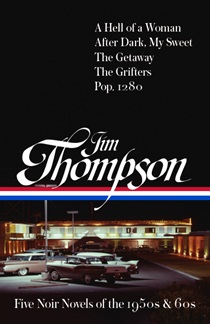 Jim Thompson: Five Noir Novels of the 1950s & 60s
A Hell of a Woman | After Dark, My Sweet | The Getaway | The Grifters | Pop. 1280
List price: $45.00
Web store price: $35.00
Interview: “Dime Stores & Bus Stations: Robert Polito on the Savage Art of Jim Thompson” (Library of America)
“Soul of a Writer” (David Geffner, Humanities)
Previous Story of the Week selections
• “The Actual Thing,” William Maxwell
• “Mrs. Manstey’s View,” Edith Wharton
• “Stories Told by an Artist,” Stephen Crane
Buy the book
Jim Thompson: Five Noir Novels of the 1950s & 60sA Hell of a Woman | After Dark, My Sweet | The Getaway | The Grifters | Pop. 1280
List price: $45.00
Web store price: $35.00
 |
| Jim Thompson (far right) with Federal Writers’ Project staff writers Joe Paskvan and Louis L’Amour, c. 1938. (Jim Thompson Estate, via NEH). |
Pop Thompson’s previous career had included embezzlement while a Texas county sheriff, gambling debts, fly-by-night jobs, and spectacularly reckless investments, and this time, too, his arrogance was misplaced. Planters Petroleum was dissolved in the spring of 1921—not even three years after it was founded. “The fortune which I was to inherit shrank at the rate of almost four hundred thousand dollars a year,” Thompson wrote. “Was a man who had made such a thorough screw-up of his own affairs a suitable mentor for me?”
To support his family, young Jim took a full-time job as a bellboy at the Hotel Texas, where he worked after school and on the weekends. “It was the bellboy who was always in the closest contact with this hurly-burly world, a world always populated by strangers of unknown background and unpredictable behavior,” he wrote. “The Hotel Texas was a nice hotel, but things were rough in those days,” Jim’s sister Maxine later told biographer Robert Polito. “He was so quiet around home that we never really knew all the horrible things that happened, getting women, booze, cocaine, and whatever for people.” Perhaps inevitably, the young student became complicit in various illicit activities and soon began drinking heavily.
Meanwhile, the dynamic between Jim and his father had shifted. “He had been cool and formal with me for some time,” Jim wrote. “At first he had argued sternly against my going to work at the hotel. Then, his affairs went from bad to worse, and my earnings were necessary for the maintenance of the family. Pop’s attitude changed. He no longer argued. It seemed to him, I suppose, that I had usurped his position in the family.”
Jim’s school attendance was sporadic and his coursework suffered. In the spring of 1924, during his tenth semester of high school, he became ill and was hospitalized for exhaustion, tuberculosis, and alcoholism; while recovering in the hospital, his ailments were exacerbated by delirium tremens. Soon after he was discharged, Jim discovered that his father had emptied his bank account for an oil fields investment that failed. Although Jim returned briefly to high school for one last attempt at completing his senior year, he never did graduate.
The fraught relationship between Jim Thompson and his father would dominate his fiction. Polito surveys just a few of the parallels:
Thompson’s novels engage the nuclear family principally in the act of detonation. An astonishing number of his characters are orphans. . . . A preponderance of the nonorphaned Thompson heroes grow up in single-parent households, overseen by ineffective or brutish guardians.“Big Jim” even haunts Thompson’s nonfiction, such as “The Drilling Contractor,” probably written in 1939–40 and the only surviving report from his oral-history fieldwork for the Federal Writers’ Project in Oklahoma. The subject of the interview is supposedly Thompson’s father, thinly disguised as the oil tycoon “Bob Carey,” yet what follows is an account of the man’s relationship with his son. But, as Polito points out, “the ‘oral history’ would have been prepared at a time when Pop was about to be committed to a rest home for senility, and too ill to speak for himself. Under the cover of this ghostwritten reminiscence Thompson revisited his own wounded adolescence. . . . A harrowing self-portrait concealed within a knockoff life history, ‘The Drilling History’ also discharged a son’s ultimate act of vindication and dominance: Thompson got to write his old man’s autobiography.”
Sons who can’t respect their fathers (The Criminal), sons who wish their father dead (A Swell-Looking Babe), and self-proclaimed prodigies who strive to subvert their fathers’ place in their mothers’ lives and beds (A Swell-Looking Babe, Child of Rage) also stagger through Thompson’s books, by turn nursing and picking at their wounds.
In June 1939, while Thompson was director of the Oklahoma Federal Writers’ Project, he published the short story “Time Without End” in a pamphlet called Economy of Scarcity: Some Human Footnotes—its title a mocking echo of The Economy of Abundance, the 1934 book by New Deal economist Stuart Chase. The preface to the collection explained, “Some Human Footnotes presents the reverse side of that glamorous world of penthouses, furs, and shining cars which the movies give us.” The pamphlet included three other works by members of the Writers’ Project: “Cotton-Picker,” a poem by Welborn Hope, who would become the self-styled “Tramp Poet” of Oklahoma in the 1940s; “Gasoline for Cornbread,” a story about tenant farmers by Daniel M. Garrison; and “With Lyrics by Riley,” by Ned DeWitt, a story about a little girl at a Salvation Army mission house.
Unlike his fellow contributors, Thompson avoided Depression-era subjects and instead presented a story focusing on a cash-strapped family’s difficulty in their care of an elderly man suffering from cognitive decline. Based on his own family’s experience, the story is notable among Thompson’s writings inspired by his father for the relative gentleness with which he treated their relationship. The folklorist Ben Botkin, who served as chairman of the Federal Writers’ Project, wrote to Thompson from Washington: “Your story is the best of the lot and the best thing of yours I have seen. The illusion of age and decay is perfectly created and controlled.” As Thompson’s wife, Alberta, recalled, “I doubt whether Pop ever saw that story Jimmie did about him. He was too far gone by then, I think. But Jimmie was very proud that he had done it.”
Portions of the above introduction have been adapted from the Chronology and Note on the Text in Jim Thompson: Five Noir Novels of the 1950s & 60s, edited by Robert Polito. Additional information is from Polito’s Savage Art: A Biography of Jim Thompson (1995).
* * *
Mr. Joseph Mazinky waddled painfully along under the August sun, stepping as gingerly on the hot bricks as if they had been so many red, rectangular eggs. . . . If you don't see the full selection below, click here (PDF) or click here (Google Docs) to read it—free!This selection is used by permission.
To photocopy and distribute this selection for classroom use, please contact the Copyright Clearance Center.
To photocopy and distribute this selection for classroom use, please contact the Copyright Clearance Center.