Showing posts with label Charlotte Perkins Gilman. Show all posts

Sunday, December 7, 2025

Five Girls

Charlotte Perkins Gilman (1860–1935)
From Charlotte Perkins Gilman: Novels, Stories & Poems

Art Students [cropped], c. 1871, oil on canvas by German American artist Louis Lang. (Metropolitan Museum of Art; click here to see a fascinating online explanation of the painting and its rediscovery)
In 1897, while living in New York, Charlotte Perkins Stetson renewed her acquaintance with her cousin George Houghton Gilman, a Wall Street attorney who three years later would become her second husband. They had not seen each other for fifteen years and shortly after their reunion Charlotte shared with him issues of The Impress, a sixteen-page weekly she had edited in San Francisco from October 1894 to February 1895. George apparently read every issue, cover to cover, and she responded to his comments, “But most am I pleased with your remarks on the short stories. I take no small credit to myself on those efforts. It is the only ‘literary work’ I ever did; and I think some of it is good.”

When the future Charlotte Perkins Gilman lived in San Francisco, she served as vice president and then president of the Pacific Coast Women’s Press Association, as well as managing editor of the association’s paper, the Bulletin, which she renamed The Impress and expanded into a weekly. The publication’s headquarters was an apartment that Charlotte shared with her colleagues Paul Tyner, who had newspaper experience, and Helen Stuart Campbell, a modestly successful author of works on home economics and of children’s books, including the Ainslee series. Gilman recalled in her autobiography:
Our little weekly was a clean and handsome paper. Bruce Porter made a beautiful heading for it. Mr. Tyner did the political stuff, theatrical notes, and so on. I wrote articles, verses, editorials, ethical problems—a department, and reviews. We needed stories. I could not write a good story every week, much less buy one. So I instituted a series of "Studies in Style,” producing each week a short story, or a chapter from a long one, in avowed imitation of a well-known author. The readers were to guess the original, and the first correct guesser to receive a copy of one of that author's books. Sad to relate they never did, The Impress did not live long enough.
The stories in the series—there are seventeen of them—were published under the title “Who Wrote It?” and the answer to each riddle of authorship was printed in the following issue along with Gilman’s brief analysis of the distinctive features of the author’s literary style. Among the authors imitated were Rudyard Kipling, Nathaniel Hawthorne, George Eliot, Edgar Allan Poe, Charles Dickens, Henry James, and Mark Twain. The series generated positive mentions in the press and seemed to be popular with readers. Gilman was especially delighted when nearly every contestant correctly guessed Mary E. Wilkins Freeman as the model for the highly praised second story; Gilman’s imitation proved to be the sincerest form of flattery for both authors. The stories vary in quality and a couple of them approach parody rather than pastiche, yet—as literary scholar Kenneth Huntress Baldwin has noted—in spite of Gilman’s protest that she “‘could not write a good story every week,’ she did, of course, just that, adding to the weekly task the demanding requirement of conforming each original story to the style of a different and influential author.” Complicating the challenge was the small space allotted—about two thousand words—to make each story or chapter complete, original, and recognizable.

One of the more successful stories is “Five Girls.” In the next issue of The Impress, Gilman described her approach:
Every girl in America ought to be able to recognize the author given in “Five Girls.” There might well have been a moment’s hesitation between one and another of our young girls’ favorites. Mrs. A. D. T. Whitney might well have had a thought, and some few others; but none of them all has the breezy swing and warm cheerfulness of our old favorite Louisa M. Alcott.

In this little sketch, the points of composition kept in view are these: the dealing with earnest, gay, young people as characters; the whole-souled indifference to detail; the broad humanitarian trend, the insistence on happy family life, and on freedom and progress. In style, the little trick of three adjectives together, the general swift ease of handling, and the strongly personal trait of finishing a sentence in conversation with the act of the person speaking: as, “‘Indeed we will!’ said Kate, and rushed out of the room.” Or, “‘O girls, they’ve come! They’ve come!’ and pretty Susan fairly flew down stairs to meet them, while Rob pranced madly after.”
After twenty weeks, The Impress folded, both because it failed to reach the number of subscribers needed to pay the bills and because of Gilman’s damaged social reputation. She had willingly given up custody of her daughter to her ex-husband and she remained on companionable terms with his new wife—her closest childhood friend, Grace Ellery Channing—and even published a poem by her in The Impress. “That continued friendship was what the pure-minded San Franciscans could not endure,” she later wrote in her memoir. “Hatred, jealousy, preliminary misdemeanors, they would have accepted as quite natural. That we three should have remained in friendly correspondence, with mutual understanding, affection and respect, through these hard years, was to them incomprehensible.” The gossip about her personal affairs diminished the weekly’s opportunities; Gilman learned that Campbell had “made some inquiries as to the rather surprising lack of support, either in subscribers or advertisers, and was answered, ‘Nothing that Mrs. Stetson does can succeed here,’ and, ‘You risk your own reputation in joining her.’” Gilman resigned the position and soon moved to Chicago and, later, New York.

The seventeen stories published in The Impress had never been collected in full until, three years ago, they were reprinted in the Library of America edition of Gilman’s writings. The LOA edition also includes “The Unnatural Mother,” an eighteenth story that appeared in the final issue of The Impress in the spot usually reserved for the “Studies in Style” series. One of her more admired works, then and now, the story served as a wholly original and pointed answer to her critics.

*   *   *
Note: The headless and armless Winged Victory of Samothrace is a classical Greek statue of the goddess Nike that was excavated on the island of Samothrace in the northern Aegean Sea and transported to Paris in 1864. It has had a prominent place in the Louvre Museum since 1894 and countless replicas have been made since its rediscovery.

*   *   *

For this week’s selection, we depart from the usual format and reproduce the selection, in its entirety, below. You may also download it as a PDF or view it in Google Docs.


Five Girls

“There won’t be many more such good times as these for us,” said Olive Sargent, mournfully hugging her knees as she sat on the floor under the big Victory; “we’ve got to go out into the cold world presently and earn our livings.”

“I don’t mind earning the living a bit,” pretty Mollie Edgerton asserted; “I like to, and I shall never give it up; but I do hate to be separated the way we shall be. I wish we needn’t.” And Mollie dusted the crumbs of her luncheon from her spotless gingham apron.

The other girls always had charcoal on their aprons, or water colors, or oil, or dabs of clay; even sometimes all of these; but Mollie’s was always clean. To be sure, her work was mostly pencil drawing, the making of delicately beautiful designs for jewelry, for fans, for wood carving, for lace even—she was a born designer, and made the other girls green with envy.

Then Serena Woods opened her mouth and spoke. Serena was going to be an architect; indeed she was one already in a modest way, having planned the school-house in her native town, and also the dwelling of her married sister. To be sure, the sister did sometimes complain to intimate friends of certain minor deficiencies in the edifice, but what is that to a rising architect whose brain glows with enthusiasm and lives in a luminous cloud of architraves, pediments, and facades. She spoke slowly, looking down from her perch on a high stool. “Girls, let’s not separate. “Let’s go and live together in a house of our own. I’ll build it.”

“O do!” said Julia Morse, “I’ll decorate it! We shall each have a room in our favorite color, with most appropriate designs, and the rooms down stairs shall be a real sermon and poem in one!” And Julia gushed on with fervid descriptions of her proposed scheme of mural decoration, while the others joined in rapturous applause.

Then Maud Annersley joined in. Maud was a tall, pale, slender girl, with dark, thoughtful, blue eyes and a quiet voice. She was a painter, and had had a picture in the last exhibition which had won approval from the best critics. “Do you know,” she said earnestly, “that we really might do this thing? We are all good friends and used to rooming together for these two years. We know all we mean to each other and when to stop—when to let each other alone. We’ve all got to earn our living, as Olive says, and it would be cheaper to earn it together than it would apart.” And Maud rinsed her biggest brush in the turpentine cup with severe decision.

Olive rose to her feet tempestuously.

“I do believe we could!” she said, her blue eyes lighting with sudden fervor. “What is to hinder our joining forces and working on together, having the sweetest, grandest, most useful life in the world! We could club our funds, go to some nice place where land is cheap, and Serena could really plan for us one of those splendid compound houses that are so beautiful and convenient. We could arrange it with studios, all as they should be, and other artists could rent them of us to help on. You know I shall have some money as soon as I’m twenty-one; and I’d rather invest it so than any way I know.” Olive stopped for breath, flushed and triumphant; and the others looked at each other with new earnestness.

“We’re talking of an awfully serious thing,” said Maud. “It would mean living, you know, really living right along;” and she scraped her palette softly as she talked, making a beautiful mixed tint of the spotty little dabs of burnt sienna, cadmium and terre vert. “There is no reason we should not do it though. But it ought to mean for life, and we’re not all going to be single, I hope.”

Beautiful Maud, with her pale, sweet, oval face and wealth of soft, glistening, chestnut hair, had seen her lover buried, and turned to her chosen art as a life-long companion. But, she could speak all the more earnestly to her heart free friends; though there was a tell-tale blush on pretty Mollie’s cheek, and Julia looked a little conscious as she spoke.

“Well anyway,” said the last named damsel, with rather a defiant tone; “if we do marry we don’t mean to give up our work I hope. I mean to marry some time, perhaps—but I don’t mean to cook! I mean to decorate always, and make lots of money and hire a housekeeper.”

“I don’t see” said Mollie dimpling softly, “why that should be an obstacle. Couldn’t we have a house so big and beautiful and live so happily and get to be so famous that—that—if any one wanted to marry us they could come there too?”

“What sort of compound fractions do you think we are?” demanded Serena. “Any one marry us indeed! It would take five to marry us, Mollie!”

“Now stop joking, girls,” said Olive. “We are all grown and trained. We all want to always work—indeed, some of us have got to. Now, honestly, why shouldn’t we build a sort of apartment home you know, a beautiful ‘model tenement’ affair, artistic and hygienic and esthetic and everything else; with central kitchens and all those things; and studios and rooms for ourselves, and a hall to exhibit in and so on. Then we could have suites of apartments for families and let them; and bye and bye, if we are families, we can occupy those ourselves and let the others!”

And Olive hugged the headless Victory in her enthusiasm while the girls applauded rapturously.

Then what a happy year they had before their course at the Institute was finished! Such innumerable plans and elevations; such glowing schemes of color, such torrents of design for carving and painting and modelling, such wild visions of decoration, where races and epochs and styles waltzed madly together in interminable procession.

The class work went on, of course, and Maud’s great picture won the first prize at the exhibition, though no one guessed that the lovely walls in the background were from one of Serena’s least practicable elevations, and that the group of girls in front were the future owners thereof. There was a troubadour in it also, but he was purely imaginary; though Maud did tell Mollie that he was the fortunate youth that was going to marry them.

It was but a year or two before the lovely plan came true, for after all there was nothing impossible in it. Between them all there was money enough to buy the lot and build the house, and the “families” consented to hire apartments therein to such an extent as to furnish all the funds for running expenses.

Julia Morse’s redoubtable Aunt Susan came down from her New Hampshire home to keep house in the new mansion, and declared that she never had had half a chance to show what was in her before.

Olive’s widowed mother made the dearest of chaperones for the girls, and their long parlor rang with music and merriment on the pleasant winter evenings.

The studios were easy to let also, and the velveteen coat and loose blouse became as frequent in the long halls as the paint-daubed gingham apron. Also the troubadour materialized in the shape of a most angelic-voiced singing master, who occupied a room on the top floor; and who, though he did not marry them all, as was aforetime suggested, did marry Olive in due season and stayed in the same pleasant quarters thereafter. Only a “family” was evicted, so to speak, for their convenience, and Olive’s room was let to an aspiring little sister of the troubadour.

Pretty Mollie followed suit in a few months more—it took some time to convince her devoted but conservative lover that they could just as well have a suite in this beautiful great home cluster as in a flat near the park. Every girl of them married, as years passed on; even Maud, who forgot her early sorrow in a newer, deeper joy.

But live together they did, and work together always, with various breaks and lapses, as the sweet home cares sometimes interfered with working hours, and the charming little kindergarten in the south wing grew fuller and fuller.

“There’s nothing like planning things for life,” said Olive one still June evening in after years, as the same five girls sat together on the rose shadowed porch; older, but no less earnest in their work and their love for each other.

“That’s so,” said Serena heartily—“especially when you do the things you plan.”

First published in The Impress (December 1, 1894).

Sunday, July 21, 2024

Turned

Charlotte Perkins Gilman (1860–1935)
From Charlotte Perkins Gilman: Novels, Stories & Poems

Detail from The Lost Path, 1863, oil on canvas by British artist Frederick Walker (1840–1875). WikiGallery.
During the first decade of the twentieth century, the “white slavery” panic swept the United States, with lurid tales in the press of rural and immigrant women moving into cities and being pressured or lured into prostitution by unscrupulous men. The uproar led to the adoption in 1910 of the Mann Act, the law prohibiting the transportation across state lines of “any woman or girl for the purpose of prostitution or debauchery, or for any other immoral purpose.” The following year, McClure’s Magazine published in installments Jane Addams’s new book, A New Conscience and an Ancient Evil, a treatise on prostitution and trafficking. Among other measures, Addams urged the adoption of a safety net, including higher starting wages and better housing, that would allow the many young women migrating to the cities to survive without deprivation.

The fourth chapter of the work, which appeared in the February issue, includes a passage describing the plight of numerous household servants:
A surprising number of suicides occur among girls who have been in domestic service, when they discover that they have been betrayed by their lovers. Perhaps nothing is more astonishing than the attitude of the mistress when the situation of such a forlorn girl is discovered, and it would be interesting to know how far this attitude has influenced these girls either to suicide or to their reckless choice of a disreputable life, which statistics show so many of their number have elected. The mistress almost invariably promptly dismisses such a girl, assuring her that she is disgraced forever and too polluted to remain for another hour in a good home. . . . Such a woman seldom follows the ruined girl through the dreary weeks after her dismissal; her difficulty in finding any sort of work, the ostracism of her former friends added to her own self-accusation, the poverty and loneliness, the final ten days in the hospital, and the great temptation which comes after that, to give away her child.
Literary scholars Janet Beer and Katherine Joslin have suggested that many of Charlotte Perkin Gilman’s ideas were “either shared or inspired by the work of Jane Addams; there are numerous points at which Addams raises the social problem and then, through enactment of the problem in her fiction, Gilman offers a solution.” As it happens, the previous September—just weeks before before Addams’s treatise was beginning its run in McClure’s—Gilman published a short story, “Turned,” that could well have taken its premise from the above passage. The major difference between the two works is the way Gilman’s story takes an unexpected “turn” in a new direction, toward a new “solution.”

Because only a handful of letters from their decades of friendship survives, however, we have no way of knowing if Addams and Gilman ever discussed the matter in the months before they wrote their respective works. The two women met in 1894, and Gilman stayed with Addams in Hull House for several months in 1896; subsequently they ran into each other at conventions and lectures. In addition, both women wrote several pieces about the challenges facing servants and the households that employ them. Gilman published “A New Basis for the Servant Question” in 1894 and Addams published “The Servant Problem” in 1903. The topic is discussed in their various books, and the London Daily News even interviewed Gilman on “the servant difficulty” in 1904. In this instance, then, each writer might well have come to this topic at the same time on her own, spurred by the headlines in the newspapers around the passage of the Mann Act.

“Turned” was a front-page story in The Forerunner, the magazine that Gilman singlehandedly wrote, edited and published for seven years. Although she is better known for her earlier gothic stories “The Yellow Wall Paper” and “The Giant Wistaria,” both written in the 1890s, Gilman’s writing two decades later was more influenced by the novels and stories of the literary realists, the works of Charles Darwin and American sociologist Lester Frank Ward, and the utopian visions of the likes of Edward Bellamy, author of Looking Backward. As she proclaimed in the first issue of her new magazine, her writings were intended “to stimulate thought; to arouse hope, courage, and impatience; to offer practical suggestions and solutions, to voice the strong assurance of better living. . . . It is a magazine for humanity, and humanity is social. It holds that Socialism, the economic theory, is part of our gradual socialization, and that the duty of conscious humanity is to promote Socialization.” As biographer Cynthia J. Davis notes, however, Gilman distrusted Marxism. When she attended the International Socialist Workers and Trade Union Congress in England in 1896, Gilman declined to sign the membership card because of the Marxist views printed on it, and she acknowledged that others regarded her as “merely a kid-glove Socialist.”

Her literary evolution also stopped short of following the path taken by such naturalist writers as Frank Norris, Theodore Dreiser, and Jack London. “Gilman rejected the doctrine of determinism embraced by canonical literary naturalists,” writes Gary Scharnhorst in his study of her writing career. “Her didactic purpose led Gilman to adopt a fortunate literary strategy, a type of reform naturalism, which enabled her to transcend the contradiction of design and purpose inherent in conventional naturalism.” She disparaged much of the work by the naturalists as the “Jack Kipling school” and “Masculine Literature.”

“Her legacy is a complicated one,” reflects Lauren Schaffer at the New-York Historical Society, “filled with an unconquerable struggle to correct the balance between men and women in the world within her lifetime, yet deeply influenced by racist beliefs, particularly in her later years. . . . Many of her ideas about evolution and social motherhood stemmed from her xenophobia and racism, which were prevalent in her private writings and became more obvious as she aged.” Her prejudices become more noticeable in later issues of The Forerunner. Yet her stories and early essays continue to intrigue scholars and readers: While her male contemporaries at the turn of the last century used their fiction to extol or lament the world as it was, she too, in her own way, portrayed the existing social order—and then she imagined how it could change for the better.

*   *   *
In her soft-carpeted, thick-curtained, richly furnished chamber, Mrs. Marroner lay sobbing on the wide, soft bed. . . . If you don't see the full selection below, click here (PDF) or click here (Google Docs) to read it—free!

This selection may be photocopied and distributed for classroom or educational use.

Sunday, October 23, 2022

The Giant Wistaria

Charlotte Perkins Gilman (1860–1935)
From Charlotte Perkins Gilman: Novels, Stories & Poems

This photograph from 1894–95 shows a cottage engulfed by wisteria vines and climbing roses on the Carmelita estate owned by Jeanne C. Carr and her husband, Ezra S. Carr, in Pasadena. Charlotte Perkins Gilman lived “right opposite” from 1888 to 1891, during which she wrote “The Giant Wistaria.” The Carrs lived in the cottage until the completion of their three-story, 22-room home in the early 1880s and moved back in 1892, when they sold the larger house and most of the estate. Ezra died in 1896; Jeanne died in Oakland in 1903. (University of Southern California Libraries)
In The Grove: A Nature Odyssey in 19½ Front Gardens, published earlier this year, the Australian gardener and landscape historian Ben Dark discusses the sinuous and unsettling beauty of wisteria vines:
Budding from seemingly veteran wood gives Wisteria sinensis a uniquely gothic appeal. It has the poet’s ability to play the tortured ancient from youth. The stems bite into each other as they twist. Constricted growth bulges and flattens. Its wood quickly becomes striated, as if the thin bark lies over a mass of knotted tendon and muscle. It is why the wisteria is such a potent symbol of haunting. It is something decrepit and half-ruined but capable of transforming into a being of otherworldly beauty. . . .
Its destructive splendor, Dark adds, explains Charlotte Perkin Gilman’s choice of placing a monstrous wisteria at the center of her story: “only that plant’s roots could embrace the horrific secret at the tale’s heart.”

When she lived in Rhode Island, Gilman certainly would have been familiar with the plant, which had been imported from Japan and China early in the nineteenth century—but when she lived in Pasadena, California, in the late 1880s she would have been surrounded by massive specimens of Wisteria sinensis. She became friends with Jeanne C. Carr, a horticulturist, and Ezra S. Carr, a retired professor of agricultural science, who had moved in the late 1870s to the 42-acre Pasadena estate they called Carmelita. Jeanne became a prominent member of a group of settlers who encouraged the farming of citrus fruit and the ornamentation of homes with enormous, hardy, fast-growing plants that quickly covered gardens and buildings. The region soon became famous for both wisterias and roses—not to mention the orange farms that fueled the local economy. Gigantic Gold of Ophir rosebushes soon dominated the landscape, and the first Tournament of Roses took place in 1890. Brochures touting flower-laden gardens and homes were printed to attract tourists from the East; one widely distributed postcard is a hand-colored print of a photograph dating from 1894–95 showing Ezra Carr himself sitting in front of Carmelita’s wisteria- and rose-covered cottage. The world’s largest blossoming plant is a one-acre specimen of Chinese wisteria planted in 1894 in nearby Sierra Madre. It eventually destroyed the house it was meant to decorate.

In the hope of recovering from depression and ill health, Gilman first visited Pasadena in the winter of 1885. She stayed with her childhood friend Grace Ellery Channing, whose house was within walking distance of the Carrs’ residence. “The Channings had bought a beautiful place by the little reservoir at the corner of Walnut Street and Orange Avenue,” she recalled in her memoir, The Living of Charlotte Perkins Gilman. “Already their year-old trees were shooting up unbelievably, their flowers a glory.” Soon after she returned to Rhode Island the following year, Gilman wrote the ghost story that would become “The Giant Wistaria,” but it was apparently rejected for publication. The manuscript has not survived, however, and we don’t know its title or even if the original version featured a wisteria.

In October 1888, Gilman returned to Pasadena, where for three years she and her daughter lived in a rented cottage “right opposite Carmelita,” as she later put it. Amid wisteria vines, rose bushes, and orange trees, she launched her career. “With Pasadena begins my professional ‘living,’” she wrote. “Before that there was no assurance of serious work. To California, in its natural features, I owe much. Its calm sublimity of contour, richness of color, profusion of flowers, fruit and foliage, and the steady peace of its climate were meat and drink to me.”

Gilman may have been prompted to revise her ghost story when her uncle Edward Everett Hale, editor of The New England Magazine, accepted a short work by Grace Channing for the March 1890 issue. “Have you seen Grace’s story, ‘A Strange Dinner Party,’ in The New England Mag?” she wrote to a friend. “I’ve sent a story there too, my one ghost story, which I think I read you once. It now figures as ‘The Giant Wistaria,’ and has a prelude.” The magazine accepted Gilman’s tale, it appeared in the June 1891 issue under her first married name, Charlotte P. Stetson, and she was paid $14. Seven months later, the same magazine published, apparently without her prior knowledge, her most famous story, “The Yellow Wall-Paper,” for which she received nothing.

“The Giant Wistaria” was largely forgotten until 1988, when Gloria A. Biamonte reprinted it with an introduction in an issue of Legacy: A Journal of Nineteenth-Century Women Writers. Since then, it has received so much attention that it may well be regarded as Gilman’s second-most famous short story. The “prelude” Gilman mentions in her letter sets the story not among the wisterias of Pasadena but in the settlements of colonial New England; the “giant wistaria” has been brought from Europe by an immigrant family whose daughter has become an unwed mother. The remainder of the story takes place in the same house more than a century later.

Eulalia Piñero Gil, a professor of American literature at the Universidad Autónoma of Madrid, echoes many commentators when she points out that Gilman’s story “reelaborates, in a more radical way, the central debate of the paradigmatic novel The Scarlet Letter, as it represents the position of women in Puritan society.” While acknowledging the parallels between Hawthorne’s novel and Gilman’s story, literary scholar Gary Scharnhorst argues that the daughter’s “literary forebear is not so much Hester Prynne” but rather Cassy, the enslaved mother in Harriet Beecher Stowe’s Uncle Tom’s Cabin. “Lest this point seem forced or contrived,” he adds, “note that Gilman considered Stowe, her great-aunt, ‘one of the world’s greatest women’ and her novel ‘a great book,’ the most popular and influential ‘work of fiction that was ever written.’” To discuss the similarities any further would give away too much of the story, so we’ll leave it to our readers to make the connections to Hawthorne and Stowe.

One aspect that has attracted much attention (and debate) among readers and critics is the mystery of what exactly happens after the scene depicted in the prelude. In a detailed examination of the story, Scharnhorst concludes, “An ambiguous, half-told tale disrupted by silences and ellipses, ‘The Giant Wistaria’ is a type of open-ended riddle rather than a closed authorial monologue. . . . The narrative is, perhaps, all the more terrifying for the questions it leaves dangling.”

Notes: For an overview of Gilman’s complex relationship with her first husband, Charles Walter Stetson, and Stetson’s eventual marriage to Grace Channing, see our introduction to Gilman’s “The Unnatural Mother.”

Wisteria is often spelled wistaria, in part because the genus is believed to have been named in the early nineteenth century after the Philadelphia physician Caspar Wistar. Sticklers will note an anachronism: early American colonists would not have been able to bring over a seedling of wisteria because the plant was not introduced into Europe until the 1810s. An old-fashioned repeater is a watch that can chime hours or minutes. The expression “vide Jack!” translates loosely as “as Jack said earlier.” (Vide is Latin for “see” or “consult.”)

*   *   *
“Meddle not with my new vine, child! See! Thou hast already broken the tender shoot! . . .” If you don't see the full selection below, click here (PDF) or click here (Google Docs) to read it—free!

This selection may be photocopied and distributed for classroom or educational use.

Sunday, August 7, 2022

The Unnatural Mother

Charlotte Perkins Gilman (1860–1935)
From Charlotte Perkins Gilman: Novels, Stories & Poems

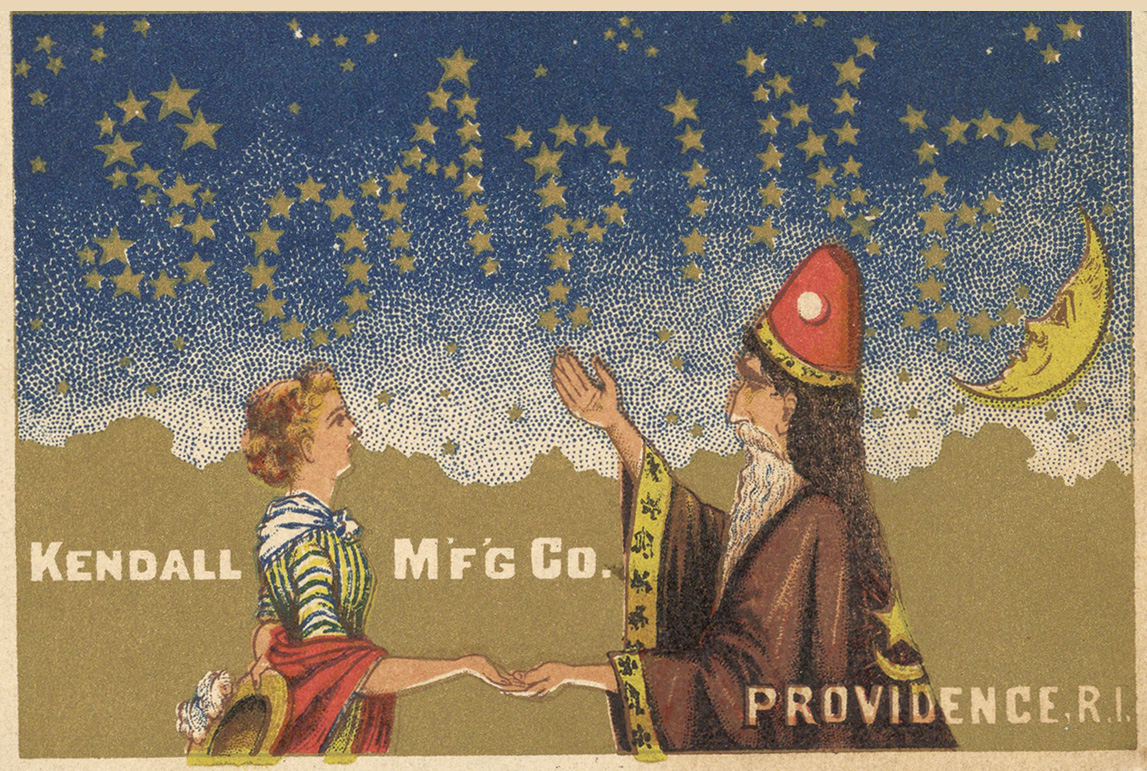
From 1880 to 1884, when she was in her early 20s, Charlotte Perkins Gilman provided the illustrations for Soapine detergent trade cards (including the one above), which she and her cousin Robert Brown designed for the Kendall Soap Company. Many of the cards depicted women performing various household tasks: laundry, ironing, dusting, etc. (University of Rochester Libraries)
     Two decades later, in her then-controversial treatise The Home: Its Work and Influence (1903), Gilman questioned the traditional housekeeping role for women. “How are the duties of the mother compatible with the duties of the housewife? . . . Hour after hour, day after day, the child sees his mother devoting her entire life to attendance upon these things—the daily cleaning, the weekly cleaning, the spring and fall cleaning, the sewing and mending at all times. . . . Must the child always associate womanhood with house-service?”
“I’ve just made a fool of myself,” Charlotte Perkins Stetson wrote on Christmas Day, 1899, in a letter to George Houghton Gilman, whom she would marry the following June. “Went across the way to call on some old neighbors, and—I foolishly supposed—friends, and got violently slapped in the face. . . . I’ve been so used of late to friendship—affection—honor; that it was painfully surprising. It’s the ‘unnatural mother’ racket—same old thing.”

She had returned for the winter to Pasadena, California, a place she had lived in the late 1880s with her first husband, Charles Walter Stetson, and daughter, Katharine. In 1890, she and Stetson separated; he moved back East to attend to his ailing mother, and two years later she moved with her daughter to Oakland. Between 1892 and 1895, Charlotte would be widely and publicly condemned in the press and by her neighbors on two counts: first for her divorce from her husband and then for relinquishing custody of her daughter to him.

When Walter Stetson petitioned a Rhode Island court for divorce in late 1892, The San Francisco Examiner, owned by William Randolph Hearst, led the charge against the couple with headlines like “The Wife and the Writer: Should Literary Women Be Addicted to the Marriage Habit?” and “His Wife’s Plans for Bettering the Universe Annoy Him.” Charlotte was attacked as a “muscular” woman with an interest in gymnastics who refused to wear “corsets or even waistbelts.” In his weekly column for the Examiner, Ambrose Bierce wrote, “Apart from her work in literature, she is said to be a very good man.” It didn’t take long for the newspaper’s reporters to discover that, before Walter had separated from Charlotte, he had fallen in love with Grace Ellery Channing, Charlotte’s closest childhood friend. “There Was Another Woman. She Gives Him to Another,” read the Examiner’s headline trumpeting a story with lurid details about a love triangle.

The court in Providence denied Stetson’s petition for divorce in June 1893, but Charlotte’s subsequent petition was granted by a court in California the following April. With the Stetsons’ divorce finalized at last, Walter and Grace planned to marry that summer in Providence—an arrangement Charlotte fully supported.

In May 1894, Charlotte wrote in her diary, “I am about to give up my home, send Kate to her father, and begin new; being now a free woman, legally and actually.” She planned to move that summer from Oakland to San Francisco, “in a place unsuitable for a child,” to take a new job as president of the Pacific Coast Women’s Press Association and editor of its weekly newsletter, which she renamed The Impress. “To hear what was said and read what was printed one would think I had handed over a baby in a basket,” she later recalled in her autobiography.
Since her second mother was fully as good as the first, better in some ways perhaps; since the father longed for his child and had a right to some of her society; and since the child had a right to know and love her father—I did not mean her to suffer the losses of my youth—this seemed the right thing to do. No one suffered from it but myself. This, however, was entirely overlooked in the furious condemnation which followed. I had “given up my child.”
Walter agreed to assume the responsibility for Katharine’s care but requested that her departure be delayed until after the summer, when he and Grace would be married and would have had time to settle into a new home. Charlotte’s father decided to return to the East Coast in May, however, and the availability of a chaperone for her nine-year-old daughter probably seemed too good an opportunity to pass up. So—apparently without any warning—Katharine arrived with her grandfather months sooner than expected. Grace, still working in Boston on the editorial staff of the Youth’s Companion magazine, had to travel to New York to pick up Katharine, who ended up using Grace’s bed, while her future stepmother slept on the sofa. Decades later, when Katharine was 90 years old, she told Gilman biographer Mary A. Hill that Grace “had to come and fetch me because she knew my father could not take care of me in a studio and do any painting.”

Years later, Charlotte wrote to her daughter and indirectly acknowledged her obliviousness. “I did try so carefully not to hurt you, and to love and pet you as I so longed to be loved and petted and never was. But I suppose you were hurt in ways I never knew.” Katharine never quite forgave her mother for (as she put it) “seizing the opportunity to get her freedom by shipping me East to my father because it was ‘his turn’” or for imposing on her future stepmother. “My mother had not the ability of putting herself into the place of another person,” she told Hill.
She had very strong principles and was very honest, which does not mean that she always saw herself as others saw her. . . . And she of course never never would have willingly hurt anyone. I think she did at times, probably, because if you are pretty honest and you do disagree with people there is always a good chance of hurting their feelings.
“By all accounts,” writes Cynthia J. Davis in her biography of Gilman, “Katharine flourished under Walter and Grace’s care”; in 1895, the Stetsons moved back to Pasadena, and eventually the Stetsons and Gilman would share custody of their daughter until she came of age. Gilman remained convinced she had done the right thing. “In the years that followed [Katharine] divided her time fairly equally between us,” she wrote in her autobiography, “but in companionship with her beloved father she grew up to be the artist that she is, with advantages I could never have given her. . . . It would have been of no benefit to her to keep that dear child away from her father and a pleasant home, to drag her over land and sea on lecture trips, or board her with strangers while I traveled. That might have been ‘natural,’ but not good for the child.”

Meanwhile, back in San Francisco, Charlotte was beginning to realize that her social reputation had doomed her prospects for a living. She later reported that Helen Campbell, her fellow editor on The Impress, “made some inquiries as to the rather surprising lack of support, either in subscribers or advertisers, and was answered, ‘Nothing that Mrs. Stetson does can succeed here,’ and, ‘You risk your own reputation in joining her.’” Charlotte’s editorship of the newsletter lasted twenty weeks before she was forced to relinquish her position. “This fiasco was what showed me my standing in that city,” and she left for Chicago to live for several months in Hull House at the invitation of Jane Addams. In the last issue of The Impress, she answered her critics with a short story, “The Unnatural Mother,” which has been included in the new Library of America collection of Gilman’s writings and is presented below as this week’s selection.

The quotes by Katharine Stetson in the above introduction are all from Mary A. Hill’s Charlotte Perkins Gilman: The Making of a Radical Feminist, 1860–1896 (1980). Numerous biographical details for both Gilman and her daughter have been culled from Cynthia J. Davis’s Charlotte Perkins Gilman: A Biography.

*   *   *
“Don’t tell me!” said old Mis’ Briggs, with a forbidding shake of the head; “no mother that was a mother would desert her own child for anything on earth!” . . . If you don't see the full selection below, click here (PDF) or click here (Google Docs) to read it—free!

This selection may be photocopied and distributed for classroom or educational use.

Sunday, December 19, 2021

According to Solomon

Charlotte Perkins Gilman (1860–1935)
From American Christmas Stories

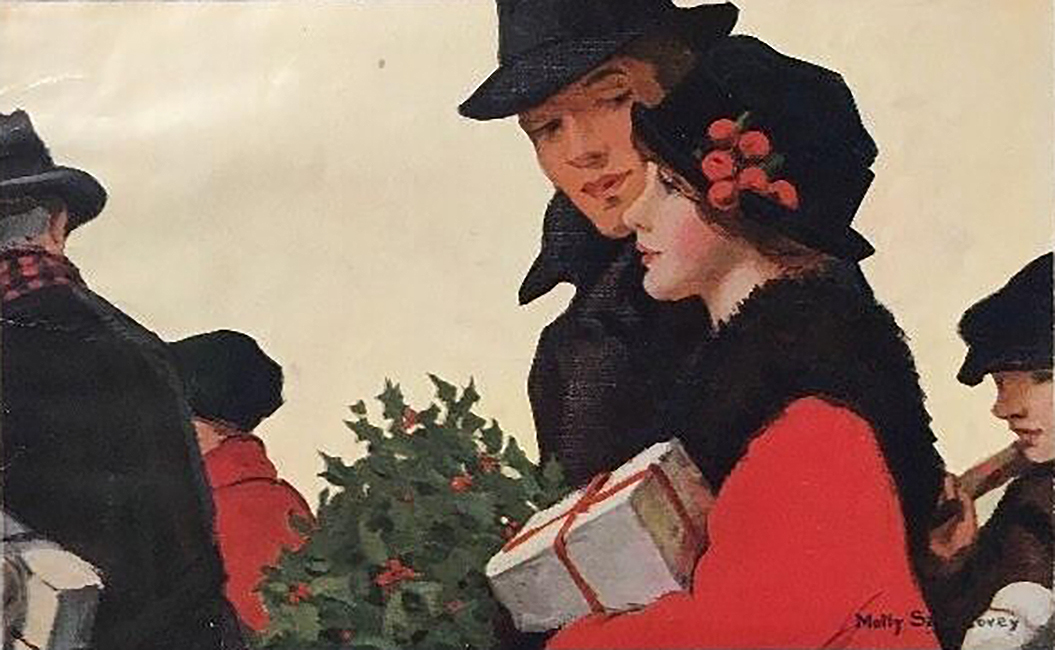
Illustration for the December 1914 cover of Woman’s Home Companion (“One Thousand Christmas Ideas”) by artist Molly Sale Covey (1880–1917), who immigrated to the United States from New Zealand in 1909. Image from eBay.
Nine years after she moved to New York City from Pasadena, California, Charlotte Perkins Gilman established The Forerunner, a monthly 32-page magazine that she wrote, edited, and published entirely by herself. In addition to offering poetry, short fiction, essays, and book reviews, most issues of the magazine contained installments of a short novel and a book-length nonfiction work. The inaugural number, published in November 1909, included the first chapter of her latest novel, What Diantha Did, and the opening section of a series called Our Androcentric Culture, or the Man-Made World, both of which would appear subsequently as books published by the Charlton Company, the name under which she issued both the magazine and her books during this period.

The magazine attracted only half of the 3,000 subscribers needed to make a profit, but Gilman kept The Forerunner going through 1916. The writings from those seven years, including her utopian novels Herland and With Her in Ourland, are now widely regarded by scholars and critics as among her greatest achievements. “Gilman used humor, anger, irony, sentimentalism, and whimsy to speak to a variety of concerns,” writes Ann J. Lane in her biography of the author. “The overriding commitments reflected in the magazine were to the belief in the rights of women and to the superiority of a collective social order.”

Gilman filled the next issue, for December, with several Christmas items. She wrote a short piece questioning why we “teach children the Santa Claus myth,” which had been corrupted into “a mere comic supplement character; a bulbous benevolent goblin, red-nosed and gross, doing impossible tricks with reindeers and chimneys.” Instead, she proposed we focus more on the “the turn of the year” and “the growing light, the longer days,” as well as on “the story of beauty and wonder about the birth of Jesus.”

She also devoted a couple of articles to the importance and value of gift giving, including these sentiments in the essay “An Obvious Blessing”:
The instinct of giving is the pressure of the surplus; the natural outgo of humanity, its fruit. We are not mere receptacles, we are productive engines, of immense capacity; and, having produced, we must distribute the product. To give, naturally, is to shed, to bear fruit; a healthy and pleasurable process.

What has confused us so long on this subject? Why have we been so blind to this glaring truth that we have stultified our giving instinct and made of it an abnormal process called “Charity,” or a much-restricted pleasure only used in families or at Christmas time?
Later in the magazine, in the “Comment and Review” section, more thoughts on the question of gift giving followed a suggestion to make Christmas a holiday for and about children:
Christmas will have a rejuvenation when it is recognized in this sense as the Child’s Festival. . . .

And Gifts?

Yes, gifts. There could be no more appropriate testimony to Joy and Hope and Love than these visible fruits. Gifts to the happy child to make him happier. Gifts from the happy child—and the new joy of giving. Gifts everywhere—from each to each—as showing the rich overflow of Love and Joy.

And more than that—Gifts from Each to All! There is a custom worth initiating! Not charity nor anything of that sort. Not the mere visiting of the sick and the prisoner. But a yearly practice of giving something to the Community—to show you love it!
To introduce this theme to readers, the December issue opened with a new Christmas story, “According to Solomon,” in which a husband and wife engage in a battle of wits revolving around their annual gift giving—and in which there is no mention of Santa Claus. The story has been included in the new Library of America collection, American Christmas Stories, and we present it here as our Story of the Week selection.

Notes: One of the presents Mr. Bankside considers giving his wife is an electric runabout, a battery-powered automobile produced in the early years of the twentieth century. A partially restored 1903 Columbia Electric Runabout in nearly pristine condition was recently available for sale; you can see it here.

In the above introduction, some details concerning Gilman and The Forerunner are adapted from the Chronology in the forthcoming Library of America collection, Charlotte Perkins Gilman: Novels, Stories, & Poems, edited by Alfred Bendixen (expected publication: August 2022).

*   *   *
“‘He that rebuketh a man afterwards shall find more favor than he that flattereth with his tongue,’” said Mr. Solomon Bankside to his wife Mary. . . . If you don't see the full selection below, click here (PDF) or click here (Google Docs) to read it—free!

This selection may be photocopied and distributed for classroom or educational use.

Friday, May 31, 2013

The Yellow Wall Paper

Charlotte Perkins Gilman (1860–1935)
From American Fantastic Tales: Terror and the Uncanny from Poe to the Pulps

Cover of the 1899 edition of The Yellow
Wall Paper
.The book version of Gilman’s
story was published under her name from
her first marriage.
During the last months of her life, Charlotte Perkins Gilman finished her autobiography and recalled how she came to write “The Yellow Wall Paper”:
It is a description of a case of nervous breakdown beginning something as mine did, and treated as Dr. S. Weir Mitchell treated me with what I consider the inevitable result, progressive insanity.
Mitchell, immortalized by name in Gilman’s story, was the physician who first developed the famous “rest cure” for women suffering from depression. The regimen included isolation, bed rest, and heavy foods and prohibited work of any kind, physical or intellectual. His male patients who suffered from nervous disorders, however, were treated with the “West cure,” which incorporated outdoor living, physical activity, and male companionship; they were also encouraged to write about their experiences. The authors Virginia Woolf, Edith Wharton, and Jane Addams all underwent the “rest cure,” while Walt Whitman, Owen Wister (The Virginian), and Theodore Roosevelt were among the writers who benefited from Mitchell’s “West cure.”

Gilman sent her manuscript to William Dean Howells in 1890, who tried to place it in The Atlantic Monthly, but the magazine’s current editor declined, saying the story made him feel “miserable.” It was published instead by The New England Monthly in 1892—although she never received payment, having apparently been robbed by an unscrupulous agent.

The story caused a sensation. Gilman quotes one letter-writer who protested to the editors: “[To those] whose lives have become a struggle against an heredity of mental derangement, such literature contains deadly peril.” A Missouri doctor, however, wrote that he was “overwhelmed with the delicacy of your touch and the correctness of portrayal. . . . So far as I know, and I am fairly well up in literature, there has been no detailed account of incipient insanity.” The doctor wondered hesitantly (and as tactfully as possible, considering the nature of the question) if Gilman herself had suffered from such an illness, and she responded, “I had been as far as one could go and get back.”

In 1920, the year he died, Howells included “The Yellow Wall Paper” in The Great Modern American Stories. But for the next fifty years, the story was largely confined to Gothic horror anthologies—until Elaine Hedges published an edition for The Feminist Press in 1973, calling it a “small literary masterpiece.” In recent decades, the story has been ubiquitous in literary anthologies and textbooks and is now widely taught to high school and college students.

Note: Wall Paper or Wall-Paper or Wallpaper? Readers will note that the spelling of the title of Gilman’s most famous work varies from source to source. The story was reprinted several times during Gilman’s life, and the title was printed in any number of ways. The LOA uses the text of the story’s first appearance as a small book, published in 1899 and titled The Yellow Wall Paper.

*   *   *
It is very seldom that mere ordinary people like John and myself secure ancestral halls for the summer. . . . If you don't see the full selection below, click here (PDF) or click here (Google Docs) to read it—free!

This selection may be photocopied and distributed for classroom or educational use.