Showing posts with label Edith Wharton. Show all posts

Sunday, January 11, 2026

Angel at the Grave

Edith Wharton (1862–1937)
From Edith Wharton: Collected Stories 1891–1910

Amphioxus lanceolatus (now known as Branchiostoma lanceolatum), c. 1880–90, drawing by Italian illustrator Comingio Merculiano (1845–1915). The amphioxus plays a pivotal and unexpected role in Wharton’s story. (CC by 4.0, via ResearchGate)
When Edith Wharton sought help for improving her early writings, she requested advice and suggestions most often from Walter Berry, one of her closest friends until his death in 1927. He helped Wharton arrange and polish the “lumpy pages” of material for her first book, The Decoration of Houses (1897), into something suitable for publication. During the next three decades, in person and in their correspondence, he gave her support, ideas, appreciation, and whimsy, including this seemingly inexplicable yet flirtatiously odd short poem he sent her in November 1900:
Then amphioxa:
Her buccal cirri sweep his rays,
And quivering down her not-
ochord and myotome, she says:
“I love you, Lance, a lot.”
The amphioxi (also known as lancelets) are fish-like invertebrate ocean-dwellers that were once proposed as a possible bridge between invertebrate and vertebrate animals. Joking references to related biological terms are sprinkled throughout Berry’s letters to Wharton during this period, and it all started when she shared with him the draft of a story, “Angel at the Grave.” A pivotal scene depended on the discovery of a tract published in the 1830s concerning the “missing link,” and Berry urged her to change it:
Why not take amphioxus, the real missing link between vertebrate and invertebrate—so much more important than the missing link between man and the anthropoid. Amphioxus is a persistent specialized type—not degenerate like the ascidian—and is undoubtedly the true ancestral line of vertebrates. . . . [French naturalist] St. Hilaire was the first to assert the existence of a direct relationship between vertebrate and invertebrate, and you remember the row between Cuvier and him in 1830 (especially Goethe’s account of it), the latter recognizing one universal type, while Cuvier claimed several entirely distinct types or plans of animal organization. The “unity of plan” theory was bitterly attacked and completely knocked out at that time. Just a little later, in 1836, William Yarrell, an Englishman, gave our “fish” the name amphioxus and was the first to describe the notochord as a cartilaginous vertebrae column. No attention was paid to this and it wasn’t till considerable time afterwards that the fact was “rediscovered.” . . . Such a discovery would be a miracle in 1830 in Mass., but then any important discovery would be just as miraculous. . . .
Even in this letter filled with scientific jargon, Berry couldn’t resist turning his suggestion into a joking response to the news that Wharton had sold her debut novel, The Valley of Decision:
Let me say right here that your backbone had no cartilage whatever when you agreed to give Scribner’s The Valley for only $2000 “advance royalties.” It should be $2000 cash and royalties beginning with the first volume sold. . . . I do send you lots of congratulations, and I’m so glad.
Wharton gratefully incorporated his suggestions into her story, and for the next few months the humble amphioxus became shorthand in their correspondence for hesitation and spinelessness: “I do hope you are vertebrating your notochord and getting back your taste,” he teased her as late as March of the following year, after the story had been published.

Wharton’s lifelong fascination with Darwin and evolution can be seen in the titles of her first three story collections: The Greater Inclination is from Edmond Kelly’s 1895 study, Evolution and Effort; Crucial Instances is a phrase used by Darwin in his discussion of the laws of inheritance in The Descent of Man, which itself provides the title for her third collection. In the memoir A Backward Glance, Wharton recalled how in the mid-1890s her friendship with Egerton Winthrop, an older acquaintance of her husband’s family, led to this new interest:
It was too late for me to acquire the mental discipline I had missed in the schoolroom, but my new friend directed and systematized my reading, and filled some of the worst gaps in my education. Through him I first came to know the great French novelists and the French historians and literary critics of the day, but his chief gift was to introduce me to the wonder-world of nineteenth century science. He it was who gave me Wallace’s “Darwin and Darwinism,” and “The Origin of Species,” and made known to me Huxley, Herbert Spencer, Romanes, Haeckel, Westermarck, and the various popular exponents of the great evolutionary movement.
In 1906, as Wharton’s literary star was ascending, her close friend Sara (“Sally”) Norton jotted down some notes in a journal recalling Edith’s transformation.
When she was twenty-two, with the reading of the “Origin of Species,” came the most exciting and important intellectual experience of her life. Henceforth, she was to regard the world from a new standpoint; the old faith lay dead—if that may be called faith which from childhood you have accepted without much serious thought. With new vision came new strength: the spirit found its wings.
To Wharton, the “old faith” included transcendentalism, and she mocked its adherents in her early stories. “Angel at the Grave,” which appeared in the February 1901 issue of The Atlantic, revolves around a philosopher who was a “friend of Emerson” vaguely associated with Brook Farm, the utopian community of transcendentalists. Similarly, “The Recovery,” published the same month in Harper’s, portrays a “a prehistoric relic who had known Emerson, and who was still sent about the country in cotton-wool to open educational institutions with a toothless oration on Brook Farm.”

Paulina Anson, the main character of “Angel at the Grave,” may well have been inspired by Sally Norton. In a biography of Wharton, Shari Benstock notes that Sally, the daughter of the prominent art historian and literary scholar Charles Eliot Norton, fell in love with Arthur Hugh Clough Jr., son of the English poet. When Clough proposed, Sally could not bring herself to leave her father—especially if it meant living in England—so she called off the relationship, assisted her father until his death, and remained at the family home for the rest of her life.

Like Sally Norton, Paulina Anson has turned down a marriage proposal and has chosen to dedicate her life to the legacy of her grandfather, Orestes Anson. Wharton’s story stages the clash between philosophy and science within the walls of the prison Paulina has created for herself. The options available to her are limited by the work of three men: the writings of her father, the decisions of the publisher of her father’s books, and the theories of a young scientist. Some critics have regarded the story and especially its “happy” ending as evidence of Wharton’s acceptance of the patriarchy. Instead, Emily J. Orlando argues in Edith Wharton and the Visual Arts, “it might be more useful to consider the ending as reflective of Wharton’s awareness of patriarchy’s stronghold. . . . Wharton’s stance here—as we might come to expect from her—is cautious and realist.” Despite the story’s many comic and satirical moments, many readers will finish it with conflicted feelings about Paulina’s past—and about the possibilities for her future.

The above excerpts from Berry’s letters have been transcribed from digital copies of the originals hosted at the Beinecke Library (Yale) website.

Notes: The name of Paulina’s grandfather, Orestes Anson, evokes the name of Orestes Brownson (1803–1876), a former transcendentalist and visitor at Brook Farm who converted to Catholicism. Coincidentally, he is prominently mentioned in the introduction to the previous Story of the Week selection as a leading critic of the fiction of Mary Agnes Tincker, the author of “From the Garden of a Friend.”

The Culprit Fay is a narrative poem published in 1816 by American poet Joseph Rodman Drake. Felicia Hemans was, aside from Byron, perhaps the most popular English-language poet of the nineteenth century; her poems, hymns, and songs were published between 1808 and her death at the age of 41 in 1835. Raphael Morghen (1758–1833) was an Italian engraver. Persephone, the queen of the underworld, was abducted by Hades through a well that opened up in a meadow near the Sicilian town of Enna. A Mechlin cap refers to a head covering that has been trimmed with lace produced in the Belgian town of Mechlin.

*   *   *
The House stood a few yards back from the elm-shaded village street, in that semi-publicity sometimes cited as a democratic protest against old-world standards of domestic exclusiveness. . . . If you don't see the full selection below, click here (PDF) or click here (Google Docs) to read it—free!

This selection may be photocopied and distributed for classroom or educational use.

Sunday, January 26, 2025

After Holbein

Edith Wharton (1862–1937)
From Edith Wharton: Collected Stories 1911–1937

“The Noblewoman” and “The Old Man,” 1523–26, two wood engravings from The Dance of Death by Hans Holbein the Younger (d. 1543). Holbein is not mentioned in Wharton’s story itself; instead, the title is meant to suggest to the reader that the tale has been written in the manner of Holbein’s most famous work. (Metropolitan Museum of Art)
On Monday, January 9, 1905, Caroline Webster Schermerhorn Astor—the Mrs. Astor—hosted her ninth annual ball uptown, on Fifth Avenue across the street from Central Park, in the double mansion she shared with her son. Invitations went out with the simple message, “Mrs. Astor at home January Ninth, at 10 o’clock,” and as The New York Times reported, “it was 11, as usual, before the first guests began to arrive, and after midnight before all had come.” Approximately six hundred partygoers crowded the residence and its huge ballroom.

For two decades Caroline Astor had ruled the social scene of the New York elite, the men and women known mostly for their wealth or their ancestry, a group christened by Ward McAllister as “the Four Hundred”—named for the number of people who would comfortably fit in the Astor ballroom. The day before the 1905 ball, an article in the New York Sunday World described the conservative routine of “the Queen of the Four Hundred”:
From the day that she married until this, Mrs. Astor has been a woman of amazing system. Her dances are always upon Mondays, her state dinners always upon Thursdays. She has had the same butler, Thomas Hade, since 1876. She sails for Europe on the first steamer after Ash Wednesday. She keeps the same apartment in Paris. She returns always in the same week in June. Her Newport villa, Beechwood, is always open on the same date. She comes to town in the same week on October. And so each year is rounded out.
She was rarely photographed, but the press reported on her every move. Yet nobody would have guessed that the triumphant 1905 ball would be the last. A short time later, the 74-year-old tumbled down the grand central staircase of her home. Although she refused to go to the hospital, the injuries to her head were quite serious, and she never fully recovered her health.

Over the next year, Mrs. Astor cut back on her social schedule, although she did make her annual trip to Europe. She suffered a serious relapse late in 1906 that was politely called “a nervous breakdown” in the society papers. In fact, she began displaying periodic and increasingly severe signs of dementia, and her family and staff secluded her in the vast empty rooms of the mansion, where she relived past parties and social visits. In the 1937 book The Saga of American Society, Dixon Wecter described how Mrs. Astor had “habitually stood in front of a life-size portrait of herself by Carolus-Duran when receiving formally—and there in the befogged sunset of her old age she often planted herself, greeting imaginary guests long dead, exchanging pleasantries with ghosts of the utmost social distinction.” She died on October 30, 1908.

Edith Wharton, the daughter of George Frederic Jones and Lucretia Stevens Rhinelander, came from a family very much enmeshed in the Four Hundred; indeed, Mrs. Astor was first cousin to Wharton’s father, whose mother, Elizabeth Schermerhorn Jones, was the sister of Caroline Astor’s father, Abraham Schermerhorn. There is convincing evidence that the phrase “keeping up with the Joneses,” popularized by a comic strip in the 1910s, originated as a reference to Wharton’s great aunts, who built garishly large mansions in the Hudson River Valley and in uptown New York, the latter of which launched a competitive building frenzy in the blocks alongside the still-unfinished Central Park.

Wharton had little patience with those she called “the tiara-ed heads and bulging white waistcoats of the most accredited millionaires”; she once cuttingly remarked that her new neighbors “tell me they have decided to have books in their library.” Revealingly, she was not on the roster of the Four Hundred published by Ward McAllister in 1892 (when she was thirty), although her sister-in-law and niece were listed. She rarely mixed with that crowd, and when she did they were likely to become material for her stories and novels. In the fall of 1905, she did attend a banquet for eighty people in honor of Prince Louis of Battenberg during his tour of the United States; the event was hosted by Mrs. Astor after her accident and Wharton may have witnessed for herself how her cousin’s perspicuity had deteriorated.

Twenty years after the death of Mrs. Astor, Wharton published “After Holbein,” featuring a character, Mrs. Evelyn Jasper, whose appearance and late-life illness bear striking resemblances to “Cousin Lina,” as Caroline Astor had been called by Wharton’s family. In the story, Wharton portrays the wasted potential and empty yesteryears of two members of the Four Hundred as they dance toward death. In her dotage, Mrs. Casper pursues muddled gratification that derives less from her indifferent children or from friends who no longer visit than from her ephemeral memories as a hostess. The male protagonist of the story, Anson Warley, a 63-year-old bachelor suffering from various ailments, was at one time a young man with intellectual ambitions but ultimately became a social butterfly who was known to appear at every fashionable occasion—yet who steadfastly avoided the “boredom” of evenings at Mrs. Casper’s townhouse. As Mrs. Casper and Mr. Warley lose their hold on the realities of their age, Wharton brings them together for one last gathering.

Notes: Mrs. Casper covers her shoulders with point de Venise, or Venetian lace, also known as “Renaissance lace.” Mr. Amesworth is kept alive with piqûres, or hypodermic injections. The Rose Dubarry on the dining room table is chintz-patterned china. Apollinaris is a natural sparkling water imported from the German town of Bad Neuenahr.

*   *   *
Anson Warley had had his moments of being a rather remarkable man; but they were only intermittent; they recurred at ever-lengthening intervals; and between times he was a small poor creature, chattering with cold inside, in spite of his agreeable and even distinguished exterior. . . . If you don't see the full selection below, click here (PDF) or click here (Google Docs) to read it—free!

This selection may be photocopied and distributed for classroom or educational use.

Sunday, January 21, 2024

Atrophy

Edith Wharton (1862–1937)
From Edith Wharton: Collected Stories 1911–1937

Walter Berry and Edith Wharton, undated photograph. The man in the background is unidentified. (The Mount)
In the Maine seaside town of Bar Harbor during the summer of 1883, Edith Jones met twenty-four-year-old Walter Berry, a scion of the Van Rensselaer family who stood to inherit a small fortune from his mother and who was studying to be a lawyer in Washington, D.C. Three years his junior, Edith spent the early weeks of the summer with him, canoeing and cycling and sharing their similar intellectual preoccupations. As she recalled in A Backward Glance, “the encounter had given me a fleeting hint of what the communion of kindred intelligences might be.” Soon after Berry left, she met up with thirty-three-year-old Edward (“Teddy”) Wharton, a friend of her older brothers who was a Harvard graduate living off his trust fund and interested mainly in camping and hunting—and not at all in books. Teddy and Wharton were married two years later.

Wharton resumed her friendship with Berry in 1897. She was at work on her first book, The Decoration of Houses, with coauthor Ogden Codman Jr., the architect who had renovated her mansion in Newport. As she wrote in her memoir:
He happened to come and stay with us at Land’s End the very summer that Codman and I were struggling with our book. Walter Berry was born with an exceptionally sensitive literary instinct, but also with a critical sense so far outweighing his creative gift that he had early renounced the idea of writing. . . . I remember shyly asking him to look at my lumpy pages; and I remember his first shout of laughter (for he never flattered or pretended), and then his saying good-naturedly: “Come, let’s see what can be done,” and settling down beside me to try to model the lump into a book.
Two years later, Berry helped the Whartons find a place to stay for four months in Washington and, a lifelong bachelor, he remained one of Edith’s closest friends until his death in 1927.

By the early 1900s, Edith’s marriage was falling apart under the strain of Edward’s debilitating depression and erratic behavior; they would finally divorce in 1913. “One cannot help feeling that her punishment has been awful—tied to a crazy person, who is only just sane enough not to be locked up,” Codman wrote to his mother. Many of their friends assumed Edith and Walter had become lovers and until late in the twentieth century, that belief resulted in several erroneous biographies and fanciful legends about their relationship. A secret journal Wharton kept in 1908, addressed to an unnamed lover, was for years assumed to have been about Berry. In the 1970s, however, biographer R.W.B. Lewis confirmed that Wharton’s affair, which lasted for more than two years (while she and her husband were separated), had been with the journalist Morton Fullerton. The subsequent discovery in the 1980s of her letters to Fullerton ended any doubts about the matter.

Similarly, Lewis dispensed with another myth, as he recounted in 1975:
One of the silliest and most characteristic of the stories—and one finds it solemnly stated in print—was that a secret stairway connected Edith Wharton’s apartment on the Rue de Varenne in Paris with that of Walter Berry. It was used, presumably, to creep up and down for assignations. The picture conjured up is not without attraction; but in fact Edith and Berry never had apartments in the same building. Berry succeeded to the lease of Edith’s apartment in 1920. I had a guided tour of the rooms . . . and suspect that a back-stairway entrance combined with the all-powerful Berry legend to generate this canard.
In the fall of 1926, Berry underwent surgery for appendicitis; the following January he suffered a stroke that rendered him unable to speak. Wharton cared for him in the weeks following both episodes; against his express wishes, his interfering sister showed up during the second convalescence and complicated the matter of who oversaw his care. In October, he died after a second stroke. Wharton wrote in her diary, “The Love of all my life died today, & I with him.” To one of her closest correspondents, the Cambridge historian Galliard Lapsley, she wrote, “No words can tell of my desolation. He had been to me in turn all that one being can be to another, in love, in friendship, in understanding.”

Wharton enlisted the help of Berry’s sister to locate her letters in his apartment and burned them all. She also destroyed his letters to her, and all we have left to us are a few surviving pieces of correspondence, including one from Berry sent in 1923 to commemorate forty years of friendship. He recalls when they spent a day canoeing in Bar Harbor and how he later “wondered” why nothing came of it. “Well, my dear, I’ve never ‘wondered’ about anyone else, and there wouldn’t be much of me if you were out of it.” There’s no doubt they had an intense and close relationship, but we will probably never know if they spent those forty years—or any part of it—as lovers. In a recent biography, Hermione Lee weighs the evidence and decides that is “more likely . . . they were not. But that does not mean she did not love him.”

In the months following Berry’s surgery and first stroke, Wharton wrote “Atrophy,” one of her shortest tales and the only story she published that year. It is a curious yet masterful story and, given the above biographical details, one is perhaps tempted to read too much into it—although the piece was submitted for publication before Berry’s death. The protagonist, Nora Frenway, is a married woman who finds out that her former lover appears to be dying and decides to visit him at his home, where he is under the protective care of his sister. The affair had been a source of great happiness and intimacy, but she has kept it a secret (she thinks) from everyone. The story was reprinted in the 1930 collection Certain People, which was reviewed in The New York Times Book Review by Percy Hutchison. The first half of his article focused on “Atrophy” and concluded:
It was another Nora who blustered out through the door of a Doll’s House. Well, it can’t be done, says Mrs. Wharton, rather savagely. And who is right? Crestfallen, spiritually bedraggled Nora Frenway’s clattering back to the Connecticut railway station in the antiquated taxicab may become quite as important a literary figure as Ibsen’s Nora, from whose eruption cataclysmic social changes were predicted. If Mrs. Wharton is right, then those changes were not so cataclysmic after all, and it is pretty much the same old world. “Atrophy” is a story to be read and pondered.
*   *   *
The source for the quote from Ogden Codman’s letter to his mother is Shari Benstock’s No Gifts from Chance: A Biography of Edith Wharton (1994).

*   *   *
Nora Frenway settled down furtively in her corner of the Pullman and, as the express plunged out of the Grand Central Station, wondered at herself for being where she was. . . . If you don't see the full selection below, click here (PDF) or click here (Google Docs) to read it—free!

This selection may be photocopied and distributed for classroom or educational use.

Sunday, April 23, 2023

His Father’s Son

Edith Wharton (1862–1937)
From Edith Wharton: Collected Stories 1891–1910

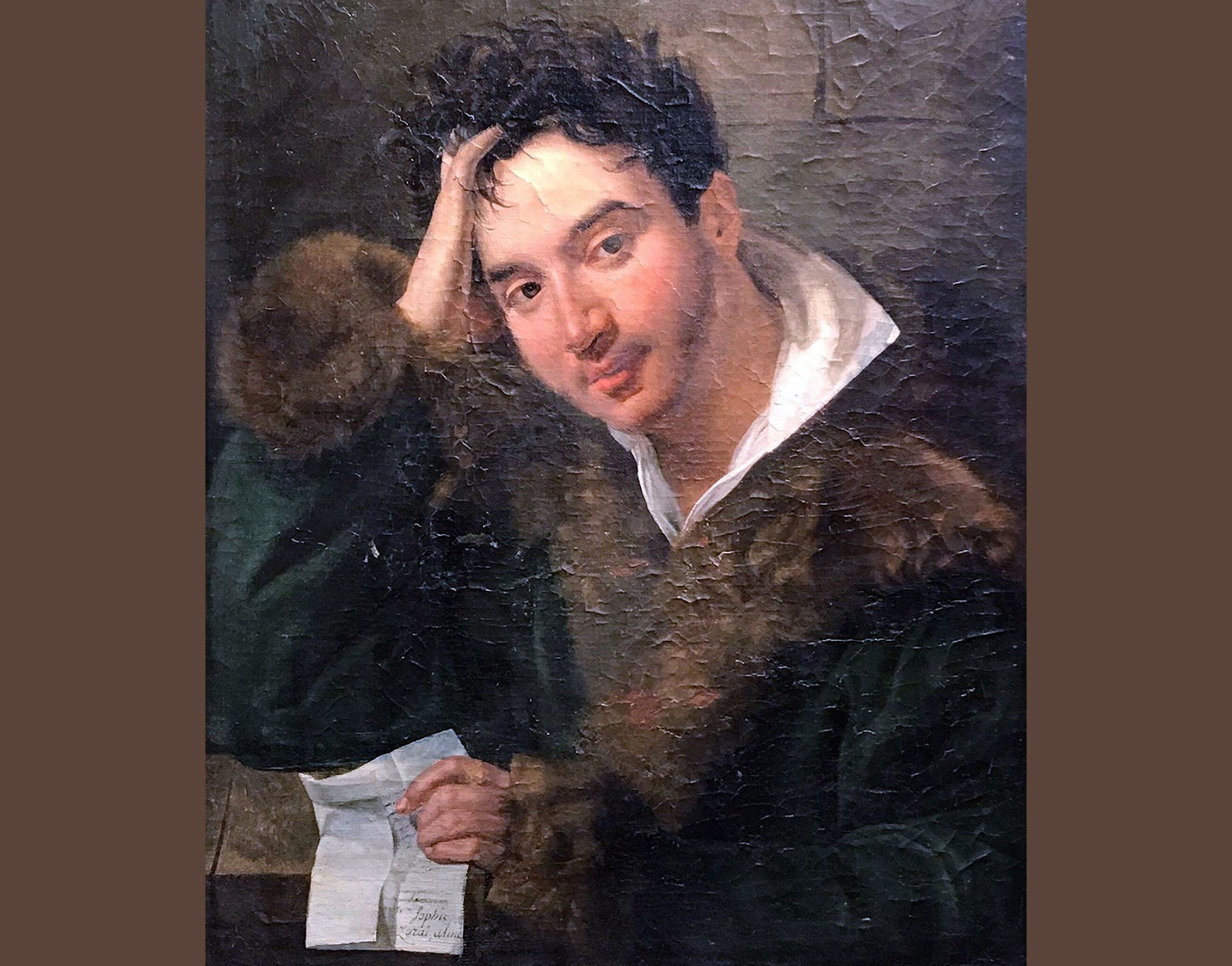
Portrait of a man with a letter, late nineteenth century, oil on canvas by an unknown (probably French) artist. Image courtesy of The Art of Antiquing, Round Pond, Maine. “‘Is this what you’d like to say to him?’ I asked her when the letter was done. . . . And she copied it out and signed her name to it, and sent it.” (from “His Father’s Son”)
In her later years, rumors swirled about Edith Wharton (née Jones), and they persisted after her death in 1937. The claim, as recorded by second- and third-hand sources in Wharton’s social circle, was that George Frederic Jones was not her biological father. In the story’s most prevalent form, her “real” father was her brothers’ “extremely cultivated English tutor” mentioned in her memoir A Backward Glance, who lived with the family in New York during the early 1860s. When Percy Lubbock published the first full-scale biography of Wharton in 1947, Edmund Wilson responded with a review scolding him for failing to consider “crucial questions one needs to answer to understand her career,” including the assertion, “by persons who should be in a position to know, that Edith Wharton had some reason for believing herself to have been an illegitimate child and that her family rather let her down from the point of view of social backing.”

When R.W.B. Lewis published his biography of Wharton in 1975, he devoted an entire appendix to the topic and decided that, while impossible to disprove, the gossip was almost certainly false. “On balance,” he concluded, “there was definitely a rumor about Edith Wharton's illegitimacy, and it was a fairly tenacious one; but it did not originate with her or with anyone close to her in her childhood. It attracted Edith Wharton's attention during the first decade of the century, and she was sufficiently stirred to make some attempt at validating it.” Louis Auchincloss, in his short biography, found the doubts regarding Wharton’s paternity ridiculous and posited they were fueled by little more than a misguided, snobbish belief that the Jones lineage, with its “rarity of such intellectual achievement,” could not have produced an Edith Wharton. He added, “The theory seems to spring from the same kind of thinking that cannot conceive a Shakespeare born in Stratford.”

Although the identity of Edith Wharton’s biological father is no longer in doubt, what remains relevant is that, at some point, she learned about the rumors. Lewis believes that she might have first heard the gossip in the years prior to writing “His Father’s Son,” which appeared in Scribner’s Magazine in 1909. Because of its connection to questions of legitimacy, the story has always been of interest to her biographers, and Wharton seems to tackle the issue head on. Her story implies that support and encouragement from one’s parents, as well as their secret or untapped ambitions, can matter far more than social or intellectual heredity to the development of a child’s creativity and intelligence.

Readers have made much of the twist—or more accurately, twists—of the final section, which suggests the influence of O. Henry and other contemporary magazine writers who dominated the literary scene in the first decade of the twentieth century. Yet, in recent decades, numerous critics have pointed to various questions those plot turns seem to evoke: whether nature or nurture is more important to the development of the artist, whether a man can write convincingly as a woman (or vice versa), whether a text (or in this case, a series of letters) can reveal to the reader the gender of the writer, and how two readers can conjure two entirely contrary understandings from the same text.

Note: A Latmian night refers to a poetic tradition based on a Greek myth: Selene, the goddess of the Moon, descends to visit Endymion, a handsome shepherd of Mount Latmos, and chastely admires his beauty as he sleeps.

*   *   *
After his wife’s death Mason Grew took the momentous step of selling out his business and moving from Wingfield, Connecticut, to Brooklyn. . . . If you don't see the full selection below, click here (PDF) or click here (Google Docs) to read it—free!

This selection may be photocopied and distributed for classroom or educational use.
Sunday, March 27, 2022

Mrs. Manstey’s View

Edith Wharton (1862–1937)
From Edith Wharton: Collected Stories 1891–1910

Backyard (1888), oil on board by American artist Jerome Myers (1867–1940). Wikimedia Commons. In 1923, Myers said of his paintings, many of which were of Manhattan’s Lower East Side: “Others saw ugliness and degradation there, I saw poetry and beauty, so I came back to them.”
In 1878, when Edith Jones was fifteen, her parents arranged to have Verses, a volume of her poems, privately printed in Newport. The following year, the poem “Only a Child” appeared in the New York World, and that summer a neighbor, Allen Thorndike Rice, the editor of the North American Review, showed some of the poems to Henry Wadsworth Longfellow, who then sent them to William Dean Howells, who in turn accepted five for publication in the March and April 1880 issues of the Atlantic Monthly. “And then something happened,” writes Hermione Lee in her recent biography:
It would be nine years before a few more poems appeared, between 1889 and 1891, in Scribner’s Magazine. She would publish her first story, “Mrs. Manstey’s View,” there when she was twenty-nine. It was another seven years before her first book publication, and eight years before her first volume of stories, marking the true beginning, at the age of thirty-seven, of her thereafter unstoppable professional career.
What “happened,” in part, was courtship, two engagements, and eventually marriage—an unhappy one at that. Her first engagement was broken off because, according to a gossip piece in a local society paper, her prospective mother-in-law worried that she was “an ambitious authoress”—that there was “an alleged preponderance of intellectuality on the part of the intended bride.” Three years later she would instead marry Edward Wharton. “It was, eventually, greatly to Wharton’s benefit that she had to perform, for years, not as a young writer, but as a young debutante, socialite and wife, in a period of dramatic social change,” Lee argues. “Whatever her private frustrations, she missed nothing of what was going on around her, and would use everything.”

And so, like many women writers of the era, Edith Wharton truly began her career as a full-time author relatively late in life. Her first novel, The Valley of Decision, appeared in 1902, when she was forty, and sold a remarkable 25,000 copies. During her last four decades she would publish fifteen novels, nine novellas, nine books of nonfiction, and more than eighty short stories.

In her earliest stories Wharton wrote about America’s underprivileged residents rather than the portraits of the upper crust that readers would come to expect from her. This vein of fiction culminated in the bleak realism of the largely overlooked novella “Bunner Sisters”; numerous critics and scholars since the days of Edmund Wilson and Irving Howe have touted it as unjustly neglected gem. “Wharton's strong strand of compassionate realism—more Dreiser than James—has tended to be undervalued,” writes Lee, who agrees that “Bunner Sisters,” is a “subdued, realist masterpiece.”

Although it would not be published until 1916 (Scribner’s rejected it twice), Wharton wrote “Bunner Sisters” in 1892—just two years after the appearance of her first published story, “Mrs. Manstey’s View,” which portrays a lonely widow living on the third floor of a New York boarding house. “Perhaps at heart Mrs. Manstey was an artist,” writes Wharton as she describes her protagonist’s delight in the flora and the humanity of the ramshackle neighborhood seen from her window—a pleasure threatened by planned construction in the neighboring yard. “The problems of Mrs. Manstey’s penurious life seem at a far remove from those of Mrs. Edward Wharton (fashionable East Side resident),” notes Cynthia Griffin Woolf, in a reappraisal that considers the possible autobiographical roots of the story. “It is not a difficult leap to move from this portrait of diminished existence to the life of a woman who had begun to write after so long a silence.”

Note: Quintus Curtius was a Roman historian, probably of the first century, who wrote De Rebus Gestis Alexandri Magni, a ten-book life of Alexander the Great. Wharton compares the condition of the tenement yards to the condition of the remnants of his work; the surviving text begins with book 3 and has gaps between books 5 and 6 and in book 10.

*   *   *
The view from Mrs. Manstey’s window was not a striking one, but to her at least it was full of interest and beauty. . . . If you don't see the full selection below, click here (PDF) or click here (Google Docs) to read it—free!

This selection may be photocopied and distributed for classroom or educational use.

Sunday, October 24, 2021

Miss Mary Pask

Edith Wharton (1862–1937)
From Edith Wharton: Collected Stories 1911–1937

Image of ghost produced by double exposure, 1899, photographer unknown. National Archives (UK).
When Edith Wharton was a child, she fell deathly ill with typhoid fever. While she was recovering, she begged to be allowed to read again, and two friends lent her a book with “robbers & ghosts,” which contained scenes that terrified her nine-year-old imagination and brought on a relapse. It was a book that would have never been permitted by her parents; Wharton’s father had even banned from his library the works of the Edgar Allan Poe, who he regarded as “an atheist and blasphemer.”

When she recovered from her illness a second time, “it was to enter a world haunted by formless horrors,” she wrote in “Life and I,” an autobiographical fragment published decades after her death. “I had been naturally a fearless child; now I lived in a state of chronic fear.” She suffered from hallucinations for several years and was stricken with terror whenever she had to wait “for the door to be opened . . . before It caught me!” She confessed that “till I was twenty-seven or eight, I could not sleep in the room with a book containing a ghost-story, & that I have frequently had to burn books of this kind, because it frightened me to know they were downstairs in the library!”

By the time she was forty, Wharton graduated from burning ghost stories to writing them. Between 1902 and her death in 1937, she published the eleven stories later collected in her final book, Ghosts, including “All Souls’,” the story she finished shortly before her death. Wharton’s supernatural tales had far more to do with disturbed (and disturbing) people and human interactions than with spectral images—and sometimes they resolved their mysteries without actually resorting to paranormal phenomenon. Like the rest of her fiction, many of her ghost stories featured women characters who, various readers paradoxically observed, were indecent or too sophisticated, vulgar or snobbish, immoral or prudish:
I received what is surely one of the tersest and most vigorous letters ever penned by an amateur critic. “Dear Madam,” my unknown correspondent wrote, “have you never known a respectable woman? If you have, in the name of decency write about her!” It seems a long way from that comminatory cry to the point of view of the critic who, referring the other day to the republication (in an anthology of ghost stories) of one of my tales, ‘The Lady’s Maid’s Bell’, scathingly said it was hard to believe that a ghost created by so refined a writer as Mrs. Wharton would do anything so gross as to ring a bell!
During the 1920s, when she was in her sixties, Wharton published a number of her major works in a women’s magazine called Pictorial Review, which had been established in 1899 as a vehicle to promote and distribute dress patterns for the American Fashion Company; by 1930 it boasted more than two million readers. Four of her novels, including The Age of Innocence, were serialized in its pages, and four of her shorter works, including two ghost stories, appeared there as well. “This publishing relationship put Wharton’s work in front of a new audience, drew the attention of the film industry, and increased her readership exponentially,” literary scholar Noreen O’Connor writes in an essay examining how the magazine transformed Wharton’s audience, her fortune, and the public perception of her writing. “The new publishing arrangement also paid handsomely; McCall’s and The Delineator engaged in bidding wars with Pictorial Review for rights to publish Wharton’s work.” Each of her novels during the 1920s earned her from $18,000 to $40,000 for the magazine rights alone, and she earned far more in royalties as nearly every book became a best seller. At least six movie adaptations were made between 1918 and 1934, including a now-lost silent film version of Glimpses of the Moon that used dialogue title cards written by F. Scott Fitzgerald (most of which probably didn’t end up in the final cut). A hit Broadway production of The Age of Innocence in 1928–29 earned Wharton another $23,500.

“Miss Mary Pask” was one of the two ghost stories published in Pictorial Review. The verdict from Wharton’s contemporary critics was mixed: While praising the story for its mood and setting, a reviewer in The New York Times faulted the “trickery” of the story as derivative of Poe’s tales (which, to be fair, it is—deliberately so). Other critics seemed desperate to find fault with her stories from the period. A critic in the North American Review dismissed “Miss Mary Pask” as “silly” and “inconsequential”; what he found particularly galling was that the thoughts of the emotionally frail narrator were ungrammatical. Equally contemptuous of half a dozen other selections that had appeared in women’s magazines, the reviewer ended by suggesting that if “Mrs. Wharton is determined to continue the inviting path of short story writing,” then she should consult the “familiar, yet incomparable, O. Henry and read, read and read him again.”

Yet, as so often seems the case, her “inconsequential” story has been resurrected by scholars and critics in the last half century. Among its earliest fans was the novelist Louis Auchincloss, who singled it out in his 1961 biography of Wharton as one of her better, “more ominous” ghost tales. More recent readers have focused on the subversive element that none of Wharton’s contemporary male reviewers could bring themselves to mention: the not-so-subtle sexual desires and pent-up loneliness of the spectral woman encountered by the story’s narrator. Wharton herself says that, as a ghost, Mary Pask can “express at last what the living woman had always had to keep dumb and hidden.” Or, as the late British scholar Nickianne Moody rephrased it, “women have to be dead before they can say what they feel or think,” particularly if they are speaking to a man. Once the story’s final secret is revealed, readers who revisit the earlier dialogue between the narrator and Mary Pask will find that it takes on an entirely different cast. “In this little story that seemed at first to be a charming trifle in Wharton's ghostly oeuvre,” writes cultural historian John C. Tibbetts, “there is a terrible social insight that is devastating.”

Note: Baie des Trépassés (Bay of the Dead), is on the west coast of Finistère, in Brittany, France.

*   *   *
It was not till the following spring that I plucked up courage to tell Mrs. Bridgeworth what had happened to me that night at Morgat. . . . If you don't see the full selection below, click here (PDF) or click here (Google Docs) to read it—free!

This selection may be photocopied and distributed for classroom or educational use.

Sunday, April 25, 2021

The Other Two

Edith Wharton (1862–1937)
From Edith Wharton: Collected Stories 1891–1910

“‘Why, how do you do?’ she said with a distinct note of pleasure.” Illustration by American artist Francis Day (1863–1942) for “The Other Two” when it appeared in the February 13, 1904, issue of Collier’s Weekly.
A couple of months after the publication of her story collection The Descent of Man, Edith Wharton received a packet of clippings from William Crary Brownell, who worked as an advisor to Scribner’s, her publisher. In late June 1904 she wrote back, upset that so many reviewers insisted on comparing her to her good friend Henry James:
I have never before been discouraged by criticism, because when the critics have found fault with me I have usually abounded in their sense, & seen, as I thought, a way of doing better the next time, but the continued cry that I am an echo of Mr. James (whose books of the last ten years I can’t read, much as I delight in the man), & the assumption that the people I write about are not “real” because they are not navvies & char-women, makes me feel rather hopeless. I write about what I see, what I happen to be nearest to, which is surely better than doing cowboys de chic.
Such comparisons and assumptions, both positive and negative, were scattered throughout the reviews, and several focused particularly on “The Other Two," one of the book’s most memorable and comical stories, in which twice-divorced Alice Waythorn is seen through the eyes of her third husband, who is haunted, so to speak, by the unexpected appearances of his wife’s former spouses. “No one except perhaps Mr. Henry James can present a revolting scene with more social delicacy,” wrote the critic for The Independent in New York, about the moral implications of the story’s ending. “The very ease with which the incident passes is offensive.” The reviewer also complained that “nowhere, either in her ideas of virtue or vice, does she come into contact with normal life.” Across the ocean, in the pages of London’s The Bookman, a reviewer came to the opposite conclusion about the story’s cleverly constructed climax yet still managed to sound similar notes: “The whole situation is intensely realized, and the subtle, elusive interplay of these four characters is a brilliant and masterly psychological study. Mrs. Wharton is as rare an artist as Mr. Henry James; she has all his insight and subtlety of thought, and a simplicity and directness of expression that he lacks.”

Brownell responded to Wharton that the refusal to recognize her uniqueness was certainly “unpleasant” but reassured her that in the comparisons to James she often comes “out of the mix better than he does.” Most recent biographers have directly addressed the question of the similarities—and differences—between James and Wharton. Her first major biographer, R.W.B. Lewis, for example, contends that in over two dozen stories Wharton tackled “the marriage question” and became “perhaps the first American writer to make [it] almost exclusively her own: even more, I dare say, than Henry James, who would in any event be her only rival in this respect.” Hermione Lee notes that they “did share subjects and attitudes, character-types and social themes” and that, “as do all writers who are friends, they spent years exchanging literary allusions and jokes, thoughts on their reading, and gossip about authors; and they occasionally exchanged plots, too.” Yet, Lee adds, while there is little doubt that James was a literary model (and, to a lesser extent, the reverse is true), “it is more often to write against him rather than to write under him.” Some of her stories, in their subversion of his themes and preoccupations, can even be read as critiques of James’s fiction.

One way in which Wharton’s thematic focus differs from James’s can be seen in the titles of her first three story collections, which reference her lifelong fascination with Charles Darwin, T. H. Huxley, Herbert Spencer, and evolution in general—both social and biological. The title of her first story collection, The Greater Inclination, is from Edmond Kelly’s 1895 study, Evolution and Effort; Crucial Instances is a phrase used by Darwin in his discussion of the laws of inheritance in The Descent of Man, which itself provides the title for her third story collection. Wharton scholar Janet Beer notes the metaphorical use of evolution throughout the stories in these collections and particularly in “The Other Two.” The heroine, Alice Waythorn, “has, using the restricted means at her disposal, managed to find a way to adapt and change, in order to improve her social standing and economic position. . . . [She] is an example from a society in the process of ‘adaptation.’” Cynthia Griffin Wolff sees Alice evolving into something more troubling, however, at least in the eyes of her husband. “She has become a grotesque, some specialized form of monster, endlessly mutating—willing to please, not malicious, but not—not quite—human.”

In her book-length study of Wharton’s short fiction, Barbara A. White reminds readers that the narrative is told entirely from the point of view of Alice’s third husband, Waythorn (a near-anagram of Wharton), and suggests that he, rather than Alice, is the character that “mutates” by the story’s end. “Waythorn’s view of her moves from one extreme to another,” she writes. “Alice’s actions reveal a person very different from the one Waythorn sees.” Furthermore, Waythorn’s use of language reduces his view of Alice to a piece of real estate (her first husband is “a lien on the property”; “his predecessors were his partners in the business,” etc.) and often examines her in terms of her value to him. “There is no evidence in the story that Alice’s motives are economic and every indication that the market-mad Waythorn conceives the world in financial terms.”

These various interpretations complement rather than contradict each other. By looking at Alice solely through the eyes of her unreliable, possessive, moderately jealous third husband, Wharton intentionally makes the real Alice unknowable; it is that detachment, along with the assembly of puns and situational details (the sick child, the governess, the cognac, the business deal) that gives the satire its bite. “What Edith Wharton knew with surprising assurance from her beginnings as a writer of social satire was the importance of particulars, that each amusing detail must carry more than its apparent weight,” remarks the novelist Maureen Howard. Lewis, who believes that “The Other Two” is “the most nearly perfect short story Edith Wharton ever wrote,“ asserts that it stands out “as the measure of her achievement in the short story form; for it has scarcely any plot—it has no real arrangement of incidents, there being too few incidents to arrange—but consists almost entirely in the leisurely, coolly comic process by which a situation is revealed to those involved in it.”

*   *   *
Waythorn, on the drawing-room hearth, waited for his wife to come down to dinner. . . . If you don't see the full selection below, click here (PDF) or click here (Google Docs) to read it—free!

This selection may be photocopied and distributed for classroom or educational use.

Sunday, October 18, 2020

Kerfol

Edith Wharton (1862–1937)
From Edith Wharton: Collected Stories 1911–1937

View of the Château de Tonquédec at dusk in Brittany, 1879, oil on canvas by French artist Félix Jean Clément Choisnard (1846–1924).
“‘I don’t believe in ghosts, but I’m afraid of them,’ is much more than the cheap paradox it seems to many,” Edith Wharton wrote in the preface to the 1937 collection Ghosts. “‘To believe,’ in that sense, is a conscious act of the intellect, and it is in the warm darkness of the prenatal fluid far below our conscious reason that the faculty dwells with which we apprehend the ghosts we may not be endowed with the gift of seeing.”

Wharton died during the preparation of Ghosts, which gathered ten previously published tales of the supernatural with her final story, “All Souls’.” As her last book, it is perhaps a surprising endnote to her five-decade career. “When I first began to read, then to write, ghost stories,” she explained, “I was conscious of a common medium between myself and my readers, of their meeting me halfway among the primeval shadows, and filling in the gaps in my narrative with sensations and divinations akin to my own.” To Wharton, whether ghosts actually “existed” was beside the point: “It is luckier for a ghost to be vividly imagined than dully ‘experienced.’” One might even say “there are no ghosts, but only tellers of ghost stories.” A successful ghost story was one that produced “a thermometrical quality; if it sends a cold shiver down one’s spine, it has done its job and done it well.” Yet she feared most of all that modern life was bankrupting readers’ imaginations and their ability to understand and enjoy not only ghost stories but any kind of literature. She rarely received mail after her stories appeared in magazines, but in 1931, when “Pomegranate Seeds” was published in Ladies’ Home Journal, she was “bombarded by a host of inquirers,” many of whom demanded “to be told how a ghost could write a letter, or put it in a letterbox.” In those italics, one can almost hear the echo of Wharton’s exasperated sigh over how her readers have missed the point.

“Kerfol” is unique among her ghost stories because the specters are not humans, but dogs. She recorded her feelings about her own beloved pets in a diary entry in 1924:
I am secretly afraid of animals—of all animals except dogs, and even of some dogs. I think it is because of the Usness in their eyes, with the underlying Not-Usness which belies it, and is so tragic a reminder of the lost age when we human beings branched off and left them; left them to eternal inarticulateness and slavery. Why? their eyes seem to ask us.
Throughout her life Wharton had several dogs at a time; she was a charter member of the New York Society for the Prevention of Cruelty to Animals, and she participated in a campaign to place water bowls for dogs on the sidewalks of New York City. To this day, a cemetery for half a dozen of her dogs is preserved at the Mount, her famous home in Lenox, Massachusetts. When her last dog, eleven-year-old Linky, died, she told a friend, “Now, for the first time, literally, I am faced with real loneliness. . . . Oh, what a train of ghosts will follow her burial today.” Wharton died four months later.

A “train” of canine ghosts haunt “Kerfol,” written during the early months of World War I, when Wharton was living in France. It is the “strangest piece of fiction to come out of her war years,” writes Hermione Lee in her biography of Wharton. Indeed, literary scholar R.W.B. Lewis notes that, rather than vehicles for scary apparitions, some of her ghost stories are “fictional strategies” that allowed her to deal “with intensities of sexual behavior by distancing them into the spectral and legendary.” The real horror in “Kerfol” is spousal abuse. A wealthy bachelor, urged by friends to purchase a home in Brittany, finds the estate of Kerfol devoid of human presence and populated instead by a pack of eerily silent dogs. Directed to a regional chronicle by a local resident, the narrator reads the 200-year-old account of a woman tyrannized by her jealous husband and of his gruesome murder—a mix that Lewis calls “one of Edith Wharton’s finest exercises in the imagination of violence, terror, and the erotic.”

When we first presented this story as a Story of the Week selection more than a decade ago, numerous readers were perplexed by the abrupt, enigmatic final sentence, particularly by the offhanded mention to the famous seventeenth-century mathematician and logician Blaise Pascal. Suffice to say that this name-drop might be read as Wharton’s sly wink at the struggle between the readers’ willingness to believe the story and a rationalism that would try to explain it away. Pascal, like the fictional character Hervé de Lanrivain, became a Jansenist, and he later had a mystical experience. His most famous work, Pensées, is a posthumously published, unfinished manuscript of fragments attempting to reconcile reason and logic with belief in God (see, for example, “Pascal’s wager”), and it was one of Wharton’s favorite books ever since she first encountered Pascal's writings as a young girl. One might imagine Lanrivain, then, recounting his lover’s experiences to Pascal, and the two men attempting to square her story with the “realities” of the world.

Notes: A chemin de ronde is the walkway behind a castle battlement, where defenders would patrol the ramparts. A “Sleeve-dog” can refer to any small dog that can be carried on one arm but often refers to a Pekingese. At the time of the story-within-the-story, Pekingese were owned exclusively by the royal family of China; any dogs outside the court would have been stolen and smuggled—a serious crime. The breed became popular in the West during Wharton’s lifetime and she had several of them. The pardon of Locronan is a penitential ceremony and festival held in July, one of several such pilgrimages unique to the Catholics of Brittany. Robert Arnauld d'Andilly became the head of the Arnauld family after the death of his father; he and his nineteen siblings (ten of whom outlived their father) were all prominent Jansenists connected with the Benedictine abbey of Port Royal. A powerful figure in the French court, d'Andilly used his political influence to defend fellow Jansenists from the attacks of the Jesuits and the condemnations of the popes.

The diary excerpt quoted above is from Hermione Lee’s biography of Edith Wharton (2007).

*   *   *
“You ought to buy it,” said my host; “it’s just the place for a solitary-minded devil like you. And it would be rather worth while to own the most romantic house in Brittany. . . . If you don't see the full selection below, click here (PDF) or click here (Google Docs) to read it—free!

This selection may be photocopied and distributed for classroom or educational use.

Sunday, November 17, 2019

Expiation

Edith Wharton (1862–1937)
From Edith Wharton: Collected Stories 1891–1910

A Cup of Tea (1904), oil on canvas by American artist Walter Granville-Smith (1870–1938). Click on the image to see the entire painting. Courtesy of The Athenaeum.
Just before she turned fifteen, Edith Newbold Jones finished writing a 30,000-word novella that she titled, of all things, “Fast and Loose.” Chronicling the trials of ill-starred young lovers, the story was inspired by—and partly mocked—the kind of British romantic novels that young women read in secret during the Victorian era, and it took its title from the novel-in-verse Lucile, by Robert Lytton (under the pseudonym Owen Meredith): “Let woman beware / How she plays fast and loose thus with human despair, / And the storm in man’s heart.” Edith also affected to write the novella under a pseudonym, David Olivieri, and she even appended several fake magazine reviews trashing her own book, like the following from an imaginary notice in The Nation:
It is a false charity to reader and writer to mince matters. The English of it is that every character is a failure, the plot a vacuum, the style spiritless, the dialogue vague, the sentiment weak and the whole thing a fiasco. . . . Is not the author very, very like a sick-sentimental school-girl who has begun her work with a fierce and bloody resolve to make it as bad as “Wilhelm Meister” [by Goethe], “Consuelo” [George Sand], & “Goodbye Sweetheart” [Rhoda Broughton] together, & has ended with a blush, & a general erasure of all the naughty words which her modest vocabulary could furnish?
The future Edith Wharton wrote “Fast and Loose” for an older friend and, as she noted in her memoir A Backward Glance, it “was never exposed to the garish light of print”—which was true until the University Press of Virginia published it in 1977, exactly one hundred years after she wrote it.

Even read as parody, “Fast and Loose” is juvenilia of interest primarily to scholars and biographers. Yet at various points during her career Wharton’s youthful undertaking inspired her more mature fiction—usually by poking fun at both the work and her adolescent precociousness. In one early story, “April Showers,” young Theodora finishes writing her first novel, which is ultimately doomed to an unintentionally cruel rejection when her favorite “society novelist” submits a different work with the same title, April Showers, to the same publisher. The story opens with Theodora writing a mawkish ending for her novel, “But Guy’s heart slept under the violets on Muriel’s grave”—which happens to be the last line of Wharton’s own unpublishable novella.

Wharton revisited the theme of nascent authorship a few years later in the story “Expiation,” which again features a novelist preparing to make her debut. The story appeared in 1903, two years before the publication of The House of Mirth, as Margaret Drabble notes, so Wharton “had not yet enjoyed or endured the experience of finding herself a famous author, although the story shows that she had armed herself against it.” This time out, the novel written by the lead character of Wharton’s story is called Fast and Loose and it has found a publisher, but her friends—including her uncle, a bishop—fear that she may have chosen the “excessively suggestive” title without “realising all that it implies.” As it happens, the author made her choice deliberately (“I’ve handled the subject without gloves”) and is preparing herself eagerly and nervously for the possibility that the story will be a “succès de scandale.” What happens instead is the stuff of comedy.

Notes: A Mechlin cap, which the Bishop’s friend Mrs. Gollinger wears, is a head covering made of or trimmed with Mechlin lace. Revue de Paris was a renowned French literary magazine; the religious magazine or journal Reredos appears to be Wharton’s creation. (A reredos is a large screen or decoration placed behind the altar in a church.) La Cathédrale (1898) is a novel by Joris-Karl Huysmans that includes detailed descriptions of the Chartres Cathedral.

*   *   *
“I can never,” said Mrs. Fetherel, “hear the bell ring without a shudder.” . . . If you don't see the full selection below, click here (PDF) or click here (Google Docs) to read it—free!

This selection may be photocopied and distributed for classroom or educational use.

Saturday, November 10, 2018

The Mission of Jane

Edith Wharton (1862–1937)
From Edith Wharton: Collected Stories 1891–1910

The Reading Lesson, c. 1901, oil on canvas by American artist Mary Cassatt (1844–1926). Courtesy of the Dallas Museum of Art.
One of Edith Wharton’s earliest literary influences was the popular—and then-famous—French novelist Paul Bourget, whom she met in 1893 when he and his wife stayed at Land’s End, her summer home in Newport, Rhode Island. Bourget had come to the United States to write a series of commissioned articles on American life for The New York Herald and Le Figaro. As Wharton later wrote in a memoir of Bourget for a French weekly, when they met she was “a young woman impassioned with literature, but not having even a dream of the possibility of herself joining the illustrious brotherhood of writers.”* Her friendship with the Bourgets deepened at the end of the decade, when she toured Italy in their company. She would dedicate her first novel to the Bourgets and he, in turn, dedicated one of his stories to her.

Bourget’s newspaper articles were collected in a book in 1895 under the title Outre-Mer: Impressions of America. The chapter on “Society: Women and Young Girls” catalogs a series of American types (as he perceived them), one of which has received particular attention from literary scholars. Bourget describes, in contrast to the “physical tomboy”:
the more serious face of the intellectual tomboy; the girl who is up to the times, who has read everything understood everything, not superficially, but really, with an energy of culture that could put to shame the whole Parisian fraternity of letters. The trouble is that nine times out of ten this mind, which is capable of assimilating everything, is incapable of tasting anything. . . . Though like all the others she gets her gowns from the best houses of the Rue de la Paix, there is not a book of Darwin, Huxley, Spencer, Renan, Taine, which she has not studied, not a painter or sculptor of whose works she could not compile a catalogue, not a school of poetry or romance of which she does not know the principles. She subscribes impartially to the Revue des Deux Mondes and the gazettes of the latest coteries of the Latin Quarter or Montmartre. Only she does not distinguish between them.
For years many critics assumed that Bourget’s profile of an “intellectual tomboy” was inspired by Wharton herself, but more recent biographers have expressed mixed reactions to this assertion. While R.W.B. Lewis believes it “obvious that Edith Wharton was the model for Bourget’s portrait,” Hermione Lee is ambivalent (at 31 years old, Wharton was “rather old for a tomboy, and too discriminating for this type”) and Shari Benstock is adamant that the description was “not a portrait of Edith Wharton.”

Wharton did read Outre-Mer when it first appeared, and there is no evidence she recognized herself in Bourget’s caricature. Instead, the book was instrumental in shaping her view of character development; she noticed “how the smallest details of this life of lazy ladies and gentlemen interested him.” Bourget’s influence on Wharton at the start of her career can hardly be overstated. As she recalled in her memoir, A Backward Glance, he was “one of the most stimulating and cultivated intelligences I have ever met.” She added, “[he] was always rebuking me for my apathy in continuing a life of wearisome frivolity, and telling me that at the formative stage of my career I ought to be with people who were thinking and creating.”

Wharton’s contemporaries explicitly recognized her debt to Bourget; in fact, many reviewers on both sides of the Atlantic lumped together the trio of Wharton, Bourget, and Henry James. Her stories, wrote one critic in 1899, “concern themselves with problems far beyond the range of the girl—even of the American girl as M. Paul Bourget drew her in Outre-Mer.” The painter Mary Cassatt wrote that she did not care for Wharton’s fiction—“such an imitation of Bourget, a writer I cannot endure.”

More recently, Wharton scholar Carol J. Singley looked specifically at Wharton’s seriocomic satire, “The Mission of Jane” and remarked that Bourget’s description of the intellectual tomboy type “is uncannily like Wharton’s portrait” of the title character. Yet Singley also noted that Jane is a bit like Wharton herself, with parents “nonplussed by their daughter’s precocious intelligence.”

As with Bourget’s intellectual tomboy, the model for the portrait of Jane (assuming there was one) must remain ambiguous. When the story appeared, one reviewer wrote that its effectiveness “may be due to the uncertainly in the reader’s mind as to whether the writer is telling a good story, merely, or offering a ‘character study,’ or deliciously satirizing the hackneyed forms that short stories are apt to take—or all of these.” Moreover, because the story of Jane’s life is told from the unreliable and detached perspective of a reluctant adoptive father, readers can only speculate and debate how intelligent or accomplished Jane really is and who Wharton may have been mocking with her barbed comments on a young woman’s social and intellectual development.

* As translated by Millicent Bell in The Cambridge Companion to Edith Wharton.

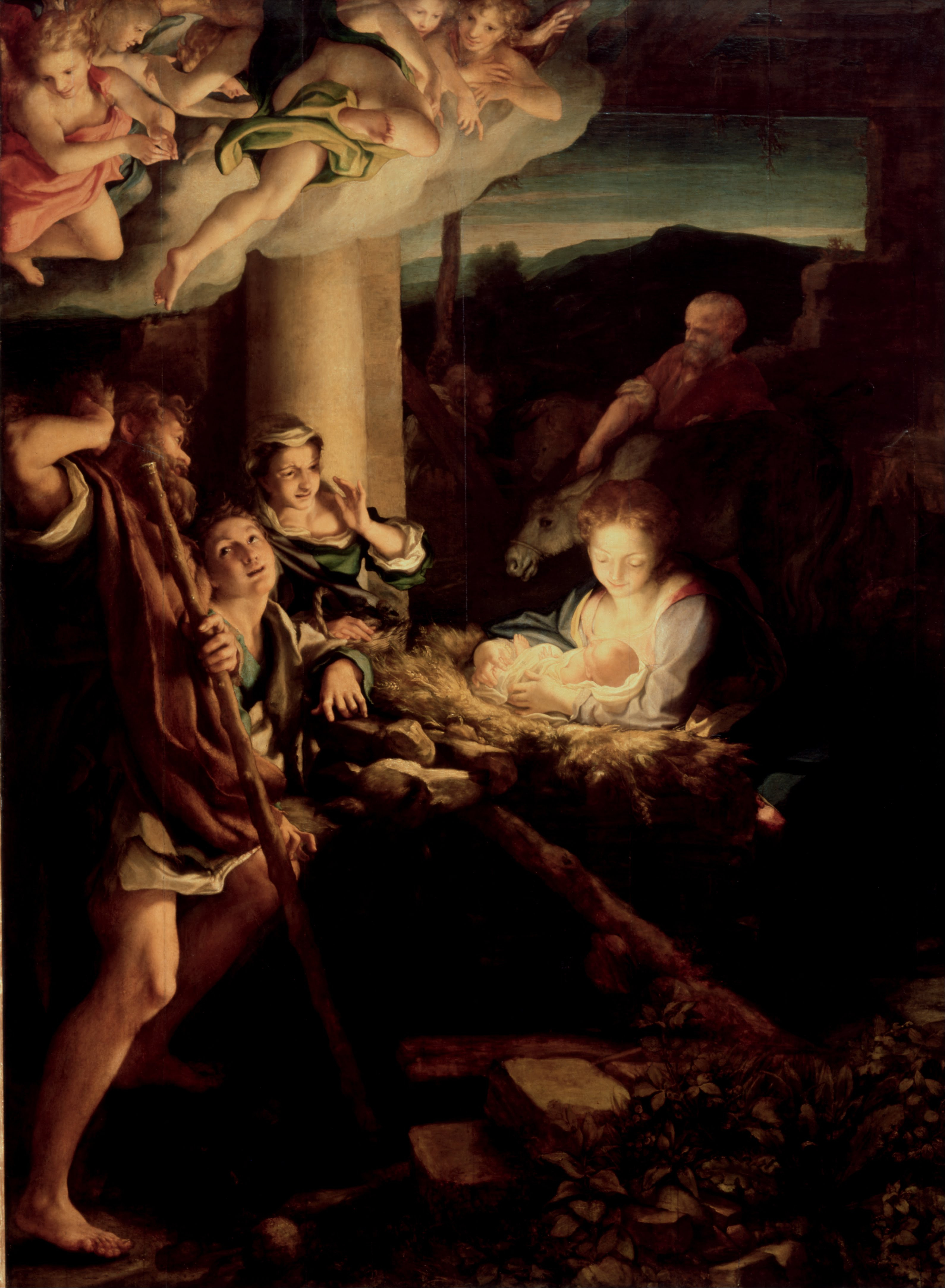
Note: On page 419 Wharton refers to Correggio’s Night-piece, referring to Nativity (Adoration of the Shepherds), a sixteenth-century painting by Antonio da Correggio.

*   *   *
Lethbury, surveying his wife across the dinner table, found his transient glance arrested by an indefinable change in her appearance. . . . If you don't see the full selection below, click here (PDF) or click here (Google Docs) to read it—free!

This selection may be photocopied and distributed for classroom or educational use.