Showing posts with label Jack London. Show all posts

Sunday, October 15, 2023

War

Jack London (1876–1916)
From Jack London: Novels & Stories

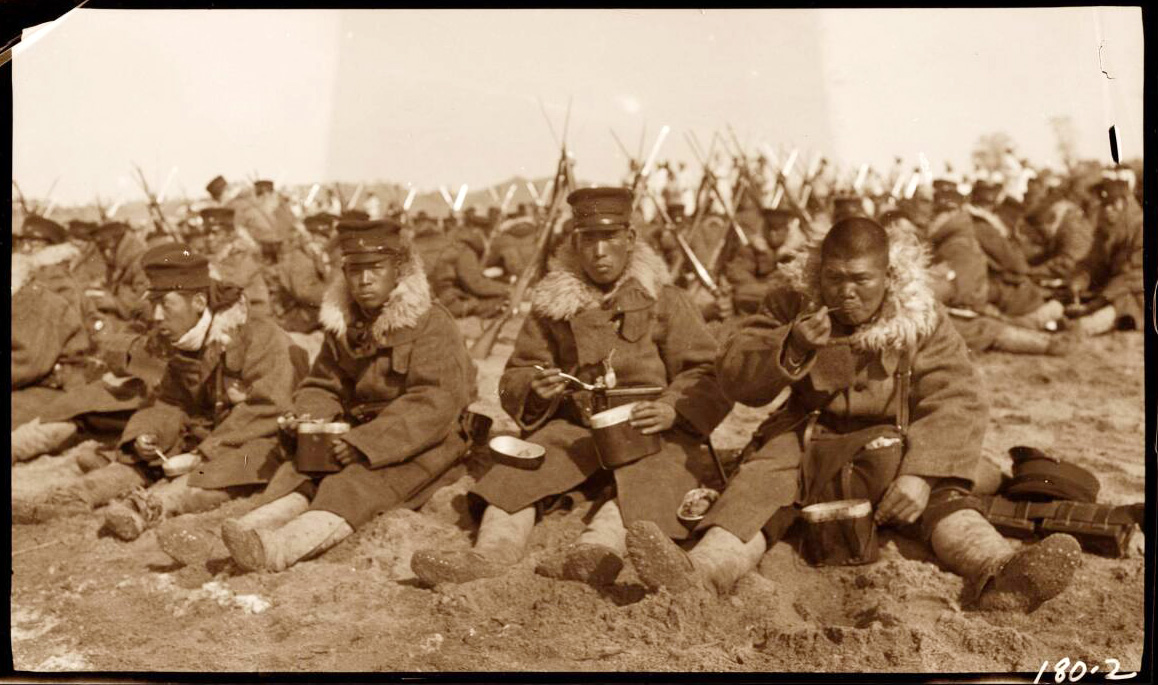
Japanese soldiers near the location of the Battle of the Yalu in 1904. Photograph by Jack London. (California State Parks Collection)
“I entered upon this campaign with the most gorgeous conceptions of what a war correspondent's work in the world must be,” a frustrated Jack London concluded his final dispatch from the Manchurian city of Antung on June 2, 1904. “I remembered Stephen Crane's descriptions of being under fire in Cuba. I had heard—God wot, was there aught I had not heard?—of all sorts and conditions of correspondents in all sorts of battles and skirmishes, right in the thick of it, where life was keen and immortal moments were being lived. In brief, I came to war expecting to get thrills. My only thrills have been those of indignation and irritation.”

The newly famous author of The Call of the Wild had been commissioned by William Randolph Hearst to cover the Russo-Japanese War for his flagship newspaper, The San Francisco Examiner. London left for Japan on January 7, but fell sick with influenza four days later on his 28th birthday and recovered only to sprain his ankle severely while horsing around on deck. “I hope war isn’t declared for at least a month after I arrive in Japan,” he wrote his future wife, Charmian Kittredge, as it “will give my ankle a chance to strengthen.”

Instead, before that month was up, London had ensnared himself in trouble. Western journalists expected Japanese authorities to arrange for passage to the front in Korea, but their hosts were having none of it. The reporters booked themselves into comfortable Tokyo hotels and waited for permissions that never came. Frustrated, London took a train to the western shore, where he planned to catch a steamer across the Sea of Japan to Korea. While awaiting transport in the town of Moji, near a heavily fortified naval base, he began taking photographs of the local attractions and residents—and was quickly arrested for spying. London had a telegram sent to Richard Harding Davis, a veteran war correspondent who was in Tokyo with the rest of the reporters. A decade earlier Davis had had his hands full dealing with Stephen Crane’s recklessness during the Spanish-American War, and once again he found himself coming to the rescue of the world’s newest literary celebrity. He requested the help of the American minister, who intervened, and London was released.

Undeterred, London nevertheless made his way to the Korean peninsula. He met up with Collier’s magazine photographer Robert L. Dunn, and they traveled by horseback 180 miles from Seoul to Pyongyang, where the commanding general prohibited the two journalists from going any further. While ensconced in a hotel, London got his first scoop: a Japanese lieutenant told him that, outside the walls of Pyongyang a week earlier, twenty Cossack scouts had encountered five Japanese soldiers, who were soon backed up by reinforcements. Shots were fired and, although nobody was injured, the fight proved to be the first ground skirmish of the war and London reported it as such in the Examiner. Dunn returned to Seoul, but London bluffed his way out of town and made it as far as Sunan, 25 miles to the north. Once again, he was detained by Japanese troops; he spent a week in custody while, as he wrote Charmian, “the wires are working hot between here and Ping Yang and Seoul.” He was eventually returned to Seoul and released.

By the end of April, London had filed nearly twenty stories: portraits of Japanese soldiers, accounts of military preparations in Korea, sympathetic depictions of refugees and peasants, descriptions of Japanese and Korean culture and customs, and comic reports of his encounters with the authorities and of the travails of other journalists. Yet, after three months in Japan and Korea, he had yet to achieve his goal of experiencing war in person. Finally, Japanese military leaders permitted a small contingent of reporters to witness what would be the Battle of Yalu River. Despite his frequent defiance of Japanese strictures (or perhaps because of it), London was allowed to be one of the reporters.

It proved to be a complete charade. The reporters were allowed to view the battleground from a high point overlooking the valley—but more than two miles away. Under the headline “Japanese in Invisible War,” London reported:
This was the battle—a river bed, a continuous and irregular sound of rifle firing over a front of miles, a few black moving specks. That was all. No Russians were to be seen. With all the hubbub of shooting no smoke arose. No shot was seen to be fired. The black specks disappeared in the willows. The hubbub of firing continued. Smoke filtered through the air, but the enemies who hurled death at each other were not visible.

It might be a war of ghosts for all that eye or field-glass could discern. . . .
London had had enough and decided to return to San Francisco. “I am . . . profoundly irritated by the futility of my position in this Army and sheer inability (caused by the position) to do decent work,” he wrote to Charmian. “What ever I have done I am ashamed of. The only compensation for these months of irritation is a better comprehension of Asiatic geography and Asiatic character. Only in another war, with a whiteman’s army, may I hope to redeem myself.” London was undervaluing his reporting; as Jeanne Campbell Reesman writes in Jack London’s Racial Lives, his two dozen dispatches and hundreds of photographs show “his keen eye for detail and moreover his ability to place the immediate human scene within historical and cultural frameworks.” Reesman adds, however, that “the false note is sounded when he tries to analyze ‘the Japanese character’ or ‘the Asiatic.’” His subsequent reputation has ever since been stained by the racist comments that pepper his dispatches, letters, and subsequent writings, often written in anger at the supposed inability of Japanese leaders to understand “the mental processes of a correspondent, which are a white man’s mental processes.” Later that year, when he was attacked for his views and arrogance at a political meeting in San Francisco, he angrily shouted, “I am first of all a white man and only then a socialist!”

Before the month of May was over, he got in trouble with the Japanese military one last time. His Korean valet, Manyoungi, complained that a neighboring groom was stealing horsefeed. A confrontation ensued and London laid flat the accused thief with a punch. London was arrested and threatened with a court martial. Still stranded in Tokyo, Davis learned of the news, stepped in one more time, and cabled President Theodore Roosevelt. London was released, he booked passage on a ship home, and took with him both Belle, the horse he had purchased for his travels in Korea, and Manyoungi, who lived with the Londons as a servant for three years.

London stopped in Tokyo on his way to California and took the chance to thank Davis. “I liked him very much,” Davis wrote to his mother at the time. “He is very bitter against the wonderful little people and says he carries away with him only a feeling of irritation. But I told him that probably would soon wear off and he would remember only the pleasant things. I did envy him so, going home after having seen a fight and I not yet started.” In fact, Davis would wait until the end of August until he was allowed to travel to Manchuria. When he was informed that the Russians had retreated fifty miles north from Liaoyang to Mukden (Shenyang) and he wouldn’t be allowed to join in the pursuit, he returned to Tokyo—only to discover that he had been deliberately misinformed and had missed the Battle of Liaoyang.

In 1911, when Jack London sat down to write what would be his only short story about war,* he lacked the background of the “keen and immortal moments” and firsthand “thrills” he had hoped to endure in Korea. Featuring unnamed combatants during an unspecified conflict in an unidentified land, “War” is a masterpiece of brevity, but—like some of the best stories about war—it is a tale based ultimately on imagination rather than experience.

* London’s early story, “An Old Soldier’s Story” (1899), is often categorized as a war story, although it’s more of a comic Civil War anecdote, apparently told to him by his stepfather, featuring a provost marshal who hunts down and arrests for desertion young soldiers overstaying their furloughs to help with farm chores.

*   *   *
He was a young man, not more than twenty-four or five, and he might have sat his horse with the careless grace of his youth had he not been so catlike and tense. . . . If you don't see the full selection below, click here (PDF) or click here (Google Docs) to read it—free!

This selection may be photocopied and distributed for classroom or educational use.

Sunday, December 18, 2022

A Klondike Christmas

Jack London (1876–1916)
From American Christmas Stories

Double-page illustration by American artist Ignacio Gomez (b. 1941) for the first publication of “A Klondike Christmas,” 78 years after it was written, in the December 1976 issue of Boys’ Life.
In the summer of 1898, when Jack London returned to his home in Oakland from a misfortune-ridden excursion in the Klondike, he decided to settle down and become a professional writer. By the end of the year, the 22-year-old was nearly defeated. “About the loneliest Christmas I ever faced, guess I’ll write to you,” began his letter to his girlfriend for the past two years, Mabel Applegarth, whose family had moved to the South Bay area. “Nothing to speak of, though—everything quiet. How I wish I were down at College Park [in San Jose], if for no more than a couple of hours. Nobody to talk to, no friend to visit—nay, if there were, and if I so desired, I would not be in position to.” He was so broke that his rented typewriter would have to be returned on New Year’s Eve. He had accumulated nearly fifty rejection notices and had heard nothing in response to several other submissions, including “Where Boys Are Men,” a seven-part serial sent with high hopes to The Youth’s Companion.

There had been only one somewhat promising development in recent weeks. About a month earlier, he delivered one of his manuscripts to The Overland Monthly, the San Francisco magazine that had helped propel to national prominence such writers as Bret Harte, Mark Twain, John Muir, and Ambrose Bierce. The publisher at the time, James Howard Bridge, described thirty years later what happened next:
One day, toward the end of ’98, my assistant Green came into my office and said there was a man outside who had a story to sell, and wanted an immediate decision as to its acceptability. I went to the outer office and greeted him. He said his name was Jack London. “You mean ‘John,’” I said. “No, just Jack,” was the reply. He looked like a tramp, and nothing like a man who could have written an acceptable story for Bret Harte’s old magazine. But when he said he had just come down from the Klondike, I said “Give me your story and come back tomorrow.” I took the manuscript home with me that night and had the surprise of my life. . . . I understood that he had never published before, and that he had come into the office because he needed money—was in fact “dead-broke.” Of course, there was no hesitation when I saw him the next morning.

“We will accept your story, and pay our maximum price—$25—for it. If you will write us a series of six stories, I will pay for them as you bring them in. . . .”
Although Bridge deserves credit as the first editor to publish a short story by Jack London, the details of his reminiscence must be unpacked and judged for their veracity—beginning, of course, with the unlikelihood that a magazine publisher who had once served as secretary to Andrew Carnegie would invite an unknown “tramp” back to his office. Fortunately, we have Jack’s account of what happened in a letter he sent to Mabel at the time:
Received a letter from the Overland Monthly. This is the substance of it: — We have read your MS. Are so greatly pleased with it, that, though we have an enormous quantity of accepted and paid-for material on hand, we will at once publish it in the January number, if — aye, if you can content yourself with five dollars.

There are between three and four thousand words in it. Worth far more than five dollars, at the ordinary reportorial rate of so much per column. What do you think of that for a first class magazine like the Overland?
London seems to have been unaware that the Overland had declined from the esteem and financing of its heyday; Bierce had begun calling it The Warmed-Overland Monthly. Given the dearth of opportunities, however, London accepted the offer of five dollars and then agreed to write seven additional stories set in the Klondike for $7.50 a piece—a far cry from the $25 Bridge later claimed to pay his authors. It would be a full two months before London received the five dollars for the first story, and he would endure an ongoing struggle that year to get the rest of the payments owed to him.

When the January 1899 issue containing his first story, “To the Man on Trail,” appeared in December, London had to borrow a dime to buy a copy so he could sent it to Mabel. The editors had added a subtitle, “A Klondike Christmas,” and had also changed the title to “To the Man on the Trail,” which did not please the author. “What trail? The thing was abstract,” he complained to a friend.

In the second half of the twentieth century, as London’s archives were opened to researchers, another manuscript with the title “A Klondike Christmas” was found. While “To the Man on Trail” is a Klondike story set on Christmas Day, “A Klondike Christmas” is better described as a Christmas story set in the Klondike. London’s notebooks reveal that both stories were drafted at about the same time, in November 1898, and they seem to be two very different versions of the same idea. In “To the Man on Trail,” the Malamute Kid, a recurring character in London’s stories, is preparing “punch” (whiskey, brandy, pepper sauce) for a Christmas gathering when a stranger shows up and claims to be in pursuit of thieves who have stolen his sled dogs—but the Kid quickly realizes the stranger is the one on the lam. In London’s earlier version, “A Klondike Christmas,” two brothers are scraping together odds and ends for Christmas dinner when unexpected guests arrive, including a burly stranger who, this time, really is in hot pursuit of dog thieves. London sent the Christmas story to Harper’s Round Table, an “illustrated monthly magazine for youth,” which declined it, and then to Youth and Age, which accepted it and promised to pay on publication. When Christmas 1899 passed with the story still unpublished, London requested return of the manuscript and filed it away.

Because it was written for young readers, “A Klondike Christmas” displays a sentimental optimism not found in London’s other stories of the Far North. London had little reason to be optimistic; shortly after his first story appeared, he finally heard from The Youth’s Companion—yet another rejection—and, forlorn, he responded to the magazine, “I understand and appreciate your urging me to not make writing my means of livelihood.” Neither London nor the editors had any way of knowing that, during the next six years, sixteen of his stories would appear in the pages of the magazine and London would become one of the highest-paid writers in the world.

Note: At the end of the nineteenth century, the word “bully,” made popular by Theodore Roosevelt (“Bully for you!”) was used to express approval, as in “cool” or “excellent.”

*   *   *
My dearest Mother:
       Here we are, all safe and sound, and snugly settled down in winter quarters. Have received no letters yet, so you can imagine how we long to hear from home
. . . . If you don't see the full selection below, click here (PDF) or click here (Google Docs) to read it—free!

This selection may be photocopied and distributed for classroom or educational use.

Sunday, November 14, 2021

In a Far Country

Jack London (1876–1916)
From Jack London: Novels & Stories

Four of Jack London’s acquaintances in Dawson City, July 1898: Marshall Bond, Oliver H. P. La Farge, Lyman R. Colt, Stanley Pearce, and their two dogs Jack (a 140-pound Saint Bernard–Scotch Collie mix that was the inspiration for Buck in The Call of the Wild) and Pat. Photographer unknown. Yale University Library. The photo, signed by London on the back, is among Marshall Bond’s papers at Yale. A copy of this photo with London’s handwriting identifying the dog Jack as belonging to Louis Bond (Marshall Bond’s brother) is in the Jack London Collection of the Huntington Library.
The year after Jack London died, The Silhouette, a short-lived Oakland-based literary magazine, published a brief item he had mailed to the editor, who had asked him to identify the factors that led to his literary success. London outlined his early years as an errand boy, an oyster pirate, a sailor on a sealing schooner in the Bering Sea and off the coast of Japan, a jute factory worker, a cross-country tramp to Boston (and back, through Canada), and an inmate in a New York jail (for vagrancy). That brought him up to the age of 19, when he began thinking of becoming a writer. He enrolled in high school while working as a janitor and, a year later, entered the University of California while working at a laundry but dropped out halfway through his freshman year. As he explained, “having decided that I was a failure as a writer, I gave it up and left for the Klondike to prospect for gold. It was in the Klondike that I found myself. There nobody talks. Everybody thinks. You get your true perspective. I got mine.”

He left the Bay Area for the Klondike in July 1897 and returned home a year later with less than five dollars’ worth of gold dust in his pockets. While wintering in a cabin eighty miles south of Dawson City, he had come down with a severe case of “Arctic leprosy,” or scurvy, and when spring arrived his fellow prospectors helped him constructed a raft on which, accompanied by camp doctor B. F. Harvey, he returned to Dawson to recover. With a pair of new companions, he then traveled 1,500 miles down the Yukon River in a small boat and finally, at the mouth of the river on the western edge of Alaska, he caught a steamer heading back to the States. (You can see a map of his journey here.)

Biographers have noted how easily he befriended the older, more seasoned campers and how he remained in touch with many of them for the rest of his life. W. B. Hargrave later recalled:
It was in October of 1897 that I first met him. . . . No other man has left so indelible an impression upon my memory as Jack London. He was but a boy then [but] he possessed the mental equipment of a mature man, and I have never thought of him as a boy except in the heart of him. . . . There were not many of us that winter in the little cabin on the Yukon; but the isolated group of cabins housed some lovable and adventurous souls [and] there is hardly one of them whom he has not immortalized in his writings.
London’s year in the Klondike helped him get not only his “true perspective” but also his subject matter and, above all, his characters. One man who appears, thinly disguised, in several Klondike tales is Ira Merritt Sloper, a scrawny, emaciated forty-year-old who had spent several years living in South America before teaming up with London on the ship to Alaska. Sloper’s experience as a ship carpenter and Jack’s previous career as an oyster pirate made them an invaluable pair when the miners had to navigate the Yukon River. One of their adventures is retold in “Through the Rapids on the Way to Klondike," which describes how they transported their party’s supplies through the nearly impassable Whitehorse Rapids and then went back and brought through the possessions of helpless married couple.

Sloper and two other men spent the winter as London’s roommates in a cabin measuring ten by twelve feet, and—as often happened in the camps—they became irritated with one another, provoked by the petty disputes and annoying habits that long isolation can amplify in the minds of the confined. The friction came to a head when London mistakenly used Sloper’s valuable, well-tended axe on the ice and broke off its edge. Discomfited by Sloper’s anger, London ended up leaving their camp and moving into a nearby cabin that housed Hargrave and “Doc” Harvey. London and Sloper apparently reconciled by the time they met up again in San Francisco; in December 1898, London served as a witness for his friend when Sloper’s wife sued for divorce after he, like London, returned from his trip with hardly a cent to his name.

London’s fifth published story, “In a Far Country,” also features Sloper—under his real name. The story is about a pair of men who, trapped in a cabin for the winter, suffer from both scurvy and stupidity and slowly drive each other crazy. While the obvious inspiration for the tale is London’s own experience wintering with Sloper, the two antagonists, a spiritless middle-class clerk and a self-indulgent “gentleman” of means, are nothing like the real-life roommates. Instead, in an homage to his friend, London portrays Sloper as a heroic 90-pound man “fleeing from a South America fever-hole” who “whipped his stronger comrades into venturing a thousand miles of the stiffest hardship man can conceive.” It is Sloper who predicts that the two “Incapables,” left behind in their cabin, will turn into fighting “cats” before the winter is over.

Notes: The voyageurs were French Canadian boatmen who transported furs. A Yukon stove-pipe was a homemade portable contraption consisting of one chamber for fuel and another for cooking. A slush-lamp was another homemade item, usually constructed from a tin can and fueled with bacon grease rather than oil. “The Boston Burglar,” an American folk song based on an old sea shanty, and “The Handsome Cabin Boy,” an English sea shanty, were popular in the late nineteenth century. German socks are long, thick socks that can be strapped at top.

*   *   *
When a man journeys into a far country, he must be prepared to forget many of the things he has learned, and to acquire such customs as are inherent with existence in the new land. . . . If you don't see the full selection below, click here (PDF) or click here (Google Docs) to read it—free!

This selection may be photocopied and distributed for classroom or educational use.

Sunday, August 16, 2020

The Water Baby

Jack London (1876–1916)
From Jack London: Novels & Stories

“By the time they discovered they had missed him, he had gone to the bottom and come back, within his hand a fat lobster.” Double-page illustration by American artist G. Patrick Nelson (1876–?) for London’s “The Water Baby” when the story first appeared in the September 1918 issue of Cosmopolitan.
Jack London spent much of the last year of his life in Hawaii. He and his wife Charmian arrived in the winter of 1915–16 and stayed through late July. “The New York dweller must wait till summer for the Adirondacks, till winter for the Florida beach,” London wrote in a three-part travel essay published that year in Cosmopolitan. “But in Hawaii, say on the island of Oahu, the Honolulu dweller can decide each day what climate and what season he desires to spend the day in.”

It was the Londons’ second trip to the islands; their original visit in 1907 was the initial leg of their famous (and famously aborted) two-year voyage on his leaky sailboat, the Snark. During that first trip, Jack fell in love not only with the locale but also its people.
Hawaii and the Hawaiians are a land and a people loving and lovable. By their language may ye know them, and in what other land save this one is the commonest form of greeting, not “Good day,” nor “How d’ye do,” but “Love?” That greeting is Aloha—love, I love you, my love to you. Good day—what is it more than an impersonal remark about the weather? How do you do—it is personal in a merely casual interrogative sort of a way. But Aloha! It is a positive affirmation of the warmth of one’s own heart-giving.
Over the objections of most of the Native population, the islands became a U.S. territory in 1898, just four years after a group led by the descendants of American and European settlers overthrew Queen LiliÊ»uokalani and established a provisional government led by Sanford Ballard Dole, the son of Protestant missionaries from Maine. Charmian’s recollection of their meeting with the deposed queen in 1907 interpreted the expression of her eyes as “implacably savage in their cold hatred of everything American. And who can blame her?” Jack’s opinions on the coup were mixed. On the one hand, he wrote:
The haoles, or whites, overthrew the Hawaiian monarchy, formed the Dole Republic, and shortly thereafter brought their loot in under the sheltering folds of the Stars and Stripes. There is little use to balk at the word “loot.” The white man is the born looter. And just as the North American Indian was looted of his continent by the white man, so was the Hawaiian looted by the white men of his islands. Such things be. They are morally indefensible.
On the other hand, he argued, it was almost certain that the islands would have been taken over by the Japanese if not by the Americans; the Japanese were far and away the largest group of settlers of the islands and they vastly outnumbered even the Native inhabitants. Better the Americans, London decided. “And let this particular haole who writes these lines here and now subscribe his joy and gladness in the Hawaiian loot.”

In addition to travel essays, London wrote thirteen stories set in Hawaii, which were collected in two volumes, House of Pride (1912) and the posthumously published On the Makaloa Mat (1919). The later tales show the influence of London’s intensive study of the recently translated Psychology of the Unconscious by Carl Jung, which “helped Jack to write some of his better short stories in the last months of his life,” writes biographer Andrew Sinclair. “Jack began to reveal the power of his dreams and his unconscious rather than parading his socialism or his realism.”

One of these tales, “The Water Baby,” was the last story London completed, on October 2, 1916, and it is unlike anything he had previously written. There is little in the way of action or adventure or human struggle; instead, the narrator John Lakana nurses a hangover while taking part in a largely one-sided conversation with Kohokumu, an old Hawaiian fisherman, whose very name (kumu) suggests a teacher or foundation. (Lakana was the name given to London by Hawaiians, although, Charmian wrote in her journal, “how London can be transmuted into Lakana is as much a mystery as the mutation of [their friend] Thurston into Kakina.”) In her biography of Jack, Charmian points out that the exploration of Jungian philosophy in “The Water Baby” is “subtly presented through the medium of Hawaiian mythology. Throughout Dr. Jung’s chapter on ‘Symbolism of Mother and Rebirth,’ there are penciled indications of Jack's grasp of the meaning of folk-lore and mythology of recorded time.”

The result is that, unusually for a story by Jack London, both the moral and the conclusion are ambiguous. “At the end of ‘The Water Baby’ the reader does not know whether the protagonist’s mind has truly been changed, nor if the limitations of his world-view transcended,” writes literary scholar Jeanne C. Reesman in an article examining this final story of one the most prolific American storywriters. “Would that London had lived a few more years—at least—in order to explore further this resonant ambiguity of knowledge.”

Notes: London scatters a few Hawaiian words throughout his story: ukikiki is blue snapper; wahine is female; aliis is a member of the royal family; kona is a strong southwest wind; opihis are limpets (aquatic snails); limu is the general name given to a number of edible seaweeds native to Hawaiian waters. Swipes is a word for beer. Kahoolawe is the smallest of the eight main Hawaiian islands; due to its lack of fresh water, it has always been sparsely populated and currently has no permanent residents. Haleakala is the volcano that makes up much of the island of Maui.

*   *   *
I lent a weary ear to old Kohokumu's interminable chanting of the deeds and adventures of Maui. . . . If you don't see the full selection below, click here (PDF) or click here (Google Docs) to read it—free!

This selection may be photocopied and distributed for classroom or educational use.

Friday, January 5, 2018

Love of Life

Jack London (1876–1916)
From Jack London: Novels & Stories

“He cried loudly to the pitiless desolation that ringed him around.” / “Yet the life that was in him drove him on.” / “His mirth was hoarse and ghastly, like a raven's croak, and the sick wolf joined him, howling lugubriously.” Three of the four illustrations by American artist Ernest L. Blumenschein (1874–1960) for “Love of Life” in the December 1905 issue of McClure’s Magazine. Scans courtesy of Carl W. Bell / Baylor University Library.
In the spring of 1906 Jack London received a letter from magazine editor S. S. McClure, who was inquiring about an article published in The New York World and inelegantly headlined “Singular Similarity of a Story Written by Jack London and One Printed Four Years Before a New Literary Puzzle.” The writer for The World noted similarities between Augustus Bridle and J. K. Macdonald’s “Lost in the Land of the Midnight Sun,” which appeared in McClure’s in December 1901, and London’s “Love of Life,” which appeared in the same magazine exactly four years later. “People are asking questions based on this parallel,” McClure wrote London. “Can’t you give us something to quote back at them?” Soon even Bridle had seen the article in The World (although, it seems, not London’s story) and wrote for an explanation.

It wasn’t the first time Jack London would be tainted with accusations of plagiarism, nor would it be the last. In this case, as London notes in his response to McClure, “The World, however, did not charge me with plagiarism. It charged me with the identity of time and situation. Certainly The World is right. I plead guilty. . . .” Nevertheless, London answered at length, because the “newspaper wanted the goods of sensation, and by refusing to charge plagiarism, [leaves] the inference of plagiarism to the reader.”

London began his response by first noting that many fiction writers base their stories and novels on current events and incidents; “it is a common practice of authors to draw material for their stories, from the newspapers.” As an example of this practice, London recalled when, in 1902, both he and Frank Norris published, in the same month, two different stories featuring a dog that retrieves a stick of dynamite, with tragic results—London’s “Moon-Face” in the San Francisco Argonaut and Norris’s “The Passing of Cock-Eye Blacklock” in Century Magazine. (It was a first assumed that London took the idea from Norris, but subsequent research revealed that London had in fact submitted his story first.) Readers soon found a third story, written several months earlier by Charles Forrest McLean and featuring, it seemed, the same dog. Although all three stories were far more dissimilar than alike, several publications hinted that both Norris and London had plagiarized from McLean—until the authors noted that the idea originated in an incident reported in California News the previous year. Still, The Pacific Monthly admonished, “it behooves authors as well as editors to keep themselves familiar with current fiction to minimize the possibility of such occurrences.”

London then explained how his latest story, “Love of Life,” had a similar genesis:
“Lost in the Land of the Midnight Sun” is not a story. It is a narrative of fact. . . . It tells the actual sufferings of a man with a sprained ankle in the country of the Coppermine River. It is not fiction, and it is not literature. I took the facts of life contained in it, added to them the many other facts of life gained from other sources, and made, or attempted to make, a piece of literature out of them. There was another narrative of suffering I used quite as extensively as I did “Lost in the Land of the Midnight Sun.” This other narrative was a newspaper account of a lost and wandering prospector near Nome, Alaska. On top of this, I drew upon all my own personal experience of hardship and suffering and starvation, and upon the whole fund of knowledge I had of the hardship and suffering and starvation of hundreds and thousands of other men.
[For a brief summary of London’s own experiences in the Yukon during the winter of 1898, see our introduction to “The White Silence,” a previous Story of the Week selection.]

London closed his letter with an acerbic comment on how his accuser has something in common with authors like himself. “I, in the course of making my living turning journalism into literature, used material from various sources by men who made their living by turning the facts of life into journalism. Along comes the space-writer on The World who makes his living by turning the doings of other men into sensation. Well, all three of us made our living. . . .” In a postscript and in a subsequent letter, the author urged that his response be submitted to The World for publication; the newspaper obliged and the “controversy” seems to have died. In the end, of course, London won this battle over words, since—of all the pieces mentioned here—his short story is the only one that has stood the test of time.

Note: The Dease River is in fact in British Columbia, far south of where London places it. The man is attempting to reach Fort Simpson, a Hudson’s Bay Company post on the Mackenzie River south of Great Bear Lake.

*   *   *
They limped painfully down the bank, and once the foremost of the two men staggered among the rough-strewn rocks. They were tired and weak, and their faces had the drawn expression of patience which comes of hardship long endured. . . . If you don't see the full selection below, click here (PDF) or click here (Google Docs) to read it—free!

This selection may be photocopied and distributed for classroom or educational use.

Friday, March 11, 2016

Told in the Drooling Ward

Jack London (1876–1916)
From Jack London: Novels & Stories

Jack London riding through his ranch in Sonoma Valley, undated photo. Image courtesy of the Jack London State Historic Park website.
In March 1905 Jack London ran, for a second time, as the Socialist candidate for Oakland city mayor and placed last in a field of four contenders, with 981 votes of the 11,429 cast. He decided to leave the East Bay area and, flush with his recent success as a best-selling author, he bought a ranch near Glen Ellen in the Sonoma Valley. At about the same time, he and his first wife, Bess London, finalized their divorce, and on November 19 he married Charmian Kittredge. While he continued to travel extensively (usually with Charmian), London expanded “Beauty Ranch” to more than 1,100 acres and retained it as his home base for the remainder of his short life.

During his last decade London expanded the boundaries of his fiction beyond the naturalism of his early writing, and his final novels and stories include science fiction, supernatural tales, and experimentation with technique. “Even though London’s life in the bucolic setting of Sonoma Valley may seem far from an experimental context, in fact his ranching innovations and his new approaches to writing went hand-in-hand,” writes literary scholar Jeanne Campbell Reesman in her survey of his short fiction, and she singles out “Told in the Drooling Ward” as “one of London’s unique experiments with point of view.” In this case, the connection between London’s rural home and the subject of the story is direct: The narrator is a resident of a mental institution, and London’s ranch abutted the grounds of the California Home for the Care and Training of the Feeble Minded (which changed its name to the Sonoma State Home in 1909). Moreover, part of the story actually takes place on Beauty Ranch—and London and his wife, thinly disguised, make cameo appearances.

The Londons were well known to the Home’s staff and residents, and they appear to have visited the facility with some frequency. In November 1911 London sent a draft of “Drooling Ward” to Dr. William Dawson, the medical superintendent, who replied with a brief letter: “I have read the article with a great deal of interest and find it in greater part to be true to life. The ‘hero’ of the story I think is our old inmate, Newton Dole.” Dawson also let London and his wife know that the residents of the home were staging a musical the coming weekend and, enclosing a copy of the program, he invited them both to attend.

A hundred years later the institution, now the Sonoma Developmental Center, is still in operation. At its peak, the campus had nearly 1,700 acres, 145 buildings and 3,400 residents and, the largest employer in Sonoma Valley, it operated as a town unto itself. London’s story depicts the facility in a favorable light, but its history in the intervening century has been peppered with scandal and controversy, including the forced sterilization of more than five thousand residents from the 1920s through the 1950s, allegations of lethal medical experiments on children with cerebral palsy in the late 1950s, and (most recently) the use of Tasers on patients with disabilities. During the last four decades the facility has greatly reduced the size of its population and its grounds, and in 1999 nearly 700 acres were transferred—fittingly enough—to the adjoining Jack London State Park. The state government recently announced plans to shut down the center and place its remaining 400 residents with smaller, more personal group homes.

*   *   *
Me? I’m not a drooler. I’m the assistant. I don’t know what Miss Jones or Miss Kelsey could do without me. . . . If you don't see the full selection below, click here (PDF) or click here (Google Docs) to read it—free!

This selection may be photocopied and distributed for classroom or educational use.

Saturday, January 10, 2015

The White Silence

Jack London (1876–1916)
From Jack London: Novels & Stories

“Yukon Dog Team Freighting Through Alaskan Canyon," photographic postcard, tinted, c. 1910–15. Printed by the Edward H. Mitchell Company (series #1990). The original photograph was taken circa 1897 and distributed in several forms by the Juneau-based studio of Lloyd Winter and E. Percy Pond.
At the height of the Klondike Gold Rush, twenty-one-year-old Jack London headed to the Yukon with his brother-in-law and spent the winter of 1898 in a cabin south of Dawson City. By the spring he was suffering from advanced scurvy. When the river ice began to melt, his friends made a raft from the timbers of their cabin and, accompanied by a medical doctor from the camp, London headed to Dawson, where his recovery was aided by a diet of potatoes. He would lose four front teeth from the disease, adding to the several he had lost as a teenager “cheerfully somewhere in a fight” (as one of his teachers later recalled). With two new companions, he then traveled 1,500 miles down the Yukon River in a small boat and, helped along by the kindness of strangers, headed on a steamer to Port Townsend, Washington. From there, he took a ship back to San Francisco, arriving in July.

Returning home to Oakland with gold dust in his pockets worth less than five dollars, London resolved to become a writer. His early stories were based on his experiences in the Klondike, but his very first inquiry was met with the response, “Interest in Alaska has subsided in an amazing degree.” He would eventually collect over 650 rejection slips, most of which are housed today in the archives of the Huntington Library.

Barely making ends meet, London finally found a magazine interested in his stories. The editors of the low-paying—and notoriously slow-paying—Overland Monthly agreed to publish eight of them during the course of 1899. One of the selections, bearing the title “Northland Episode” when it had been previously refused by other magazines, was “The White Silence.” Soon after reading it, the San Francisco Chronicle’s weekly book columnist wrote, “I would rather have written ‘The White Silence’ than any thing that has seen the light in fiction in ten years.”

Five of the Overland stories, including “The White Silence,” portray Malemute Kid, a Yukon native living among white settlements. The Malemute Kid stories made London famous, particularly when the sixth in the series, “An Odyssey of the North,” was published in January 1900 by the prestigious Atlantic Monthly, which paid him $120—three times as much as he had received for the first five tales combined. All six, along with the other three selections that had appeared in Overland, were collected in London’s first book, The Son of the Wolf.

London scholar James I. McClintock has argued, “Jack London identified himself strongly with Malemute Kid and saw him, probably, as an idealized extension of himself.” The author himself confirmed his empathy for the Kid in letters to Cloudesley Johns, a postmaster in a remote California desert town who became London’s first true fan. After Johns apparently cautioned against the risk of romanticizing the Kid, London admitted, “In the June tale he will not appear at all, or even be mentioned. You surprise me with the aptness of your warning, telling me I may learn to love him too well myself. I am afraid I am rather stuck on him—not on the one in print, but the one in my brain. I doubt if I ever shall get him in print.”

Notes: The first page of the story, Mason mentions an Epworth to refer to a chapter of a Methodist religious organization for young adults. The distance between Arctic City and Fort Yukon (p. 299), which Mason uses as a hypothetical example of a telephone line, was 200 miles. (This was not farfetched in the late 1890s: The February 1900 issue of Popular Science Monthly reports that telephone service had been established within Dawson City, and two lines allowed communication “with the nearer mining region.”) A gee-pole (p. 300) is the steering shaft lashed to the front of a dog sled. The ice-run (p. 304) is the spring break-up of ice rushing down the river.

*   *   *
“Carmen won’t last more than a couple of days.” Mason spat out a chunk of ice and surveyed the poor animal ruefully, then put her foot in his mouth and proceeded to bite out the ice which clustered cruelly between the toes. . . . If you don't see the full selection below, click here (PDF) or click here (Google Docs) to read it—free!

This selection may be photocopied and distributed for classroom or educational use.

Friday, August 30, 2013

South of the Slot

Jack London (1876–1916)
From Jack London: Novels & Stories

1905 photograph looking westward on Market Street
in San Francisco. "South of the Slot" was the
neighborhood to the left of the cable car tracks.
Image from The Cable Car Guy (Joe Thompson).
After the publication of the international bestseller White Fang (1906), Jack London built a schooner, which he christened the Snark, and embarked on a voyage around the world. This ambitious undertaking hardly slowed down his literary output; in one letter to his publisher sent from Guadalcanal on October 25, 1908, he detailed “what I have on hand,” summarizing his progress on seven books: the story anthologies Lost Face (“containing my latest Klondike short-stories”), When God Laughs (recent “miscellaneous stories”), South Sea Tales, and a good chunk of The House of Pride (“Hawaiian short stories”); the collection Revolution and Other Essays; his travel book Cruise of the Snark; and the beginnings of his short novel Adventure. He even calculated how much he had completed for each project—a total of 323,000 words. That remarkable list does not even mention the acclaimed, 120,000-word novel Martin Eden, which he had finished a few months earlier and which had just begun appearing as a serial in Pacific Monthly.

The grueling combination of seafaring and writing took its toll. In early 1909, after traveling to Hawaii, the Marquesas, Tahiti, and the Solomon Islands, London was forced to cut short his trip because of a series of debilitating ailments, including malaria and two fistulas (which necessitated surgery). He spent several months recuperating in Australia before returning to his ranch in Sonoma Valley, California.

One of the works London wrote while recuperating in Australia is “South of the Slot,” a story widely considered to be among his best. Similar in concept to Stephen Crane’s “An Experiment in Misery” (which, in its original version, features a wealthy man pretending to be a tramp), London’s story describes a college professor, sociologist Freddie Drummond, who disguises himself as “Big” Bill Totts in order to work among and study the laborers south of Market Street (“the Slot”) in San Francisco.

Many biographers see London himself reflected in the figure of Drummond/Totts. Like his professor-hero, who “made a practice of living in both worlds,” London traversed the divide between enjoyment of life as a wealthy author and his sympathetic observations of laborers and the unemployed. The difference is that London had grown up among the poorest strata of society, living for several years as a train-hopping hobo, and had worked his way up the social ladder, while his fictional counterpart had been raised comfortably guided by the “tempered seed of his ancestors” and had insinuated himself among the denizens of the “labor-ghetto.” “London struggled to reconcile his radical, working-class identity with that of his middle-class, literary self,” suggests literary scholar Joan D. Hedrick. “His satirical portrait of Freddie Drummond distances him from a self he might have become.

Notes: On the first page of the story, London refers to two famous contemporary works. “A Message to Garcia” (1899) is Elbert Hubbard’s inspirational essay, eventually published as a booklet that sold over forty million copies during the first two decades of the twentieth century. Often distributed by businesses to their employees to promote loyalty and resourcefulness, it coined the catchphrase "take a message to Garcia" as shorthand for take the initiative and just do it yourself. Mrs. Wiggs of the Cabbage Patch (1901), by Louisville writer Alice Caldwell Hegan Rice, is a novel about a poor but thrifty widow.

* * *
Old San Francisco, which is the San Francisco of only the other day, the day before the Earthquake, was divided midway by the Slot. . . . If you don't see the full selection below, click here (PDF) or click here (Google Docs) to read it—free!

This selection may be photocopied and distributed for classroom or educational use.

Saturday, March 2, 2013

Hunting Human Game

Frank Norris (1870–1902)
From True Crime: An American Anthology

In 1894, at the age of twenty-four, Benjamin Franklin (“Frank”) Norris finished his fourth year at Berkeley but didn’t receive his degree, having repeatedly flunked the mathematics portion of his examinations. His failure to graduate did not slow him down. During the following eight years he took writing courses at Harvard; reported for the San Francisco Chronicle on the Boer War in South Africa, where he fell ill before being expelled from the territory; wrote at least 160 short stories, sketches, and essays for various newspapers and magazines; covered the Spanish-American War in Cuba, where he again became sick (and where he befriended Stephen Crane); became an editor for Doubleday in New York (where he “discovered” and championed the novel Sister Carrie by up-and-coming writer Theodore Dreiser); and managed to finish writing seven novels, including the national bestseller The Octopus. In 1902, he was back in the San Francisco area and planning a trip around the world on a tramp steamer when he suffered an attack of appendicitis. Initially ignoring the pain, he finally went to a doctor—but it was far too late. Suffering from gangrene, he died of peritonitis at the age of thirty-two.

Like fellow San Francisco writer Jack London, Norris was heavily influenced by the theories of Charles Darwin and the literary naturalism of French writer Émile Zola. (In spite of overlapping careers and friendships, Norris and London appeared to have never met.) Jeanne Campbell Reesman, in her essay for A Companion to the American Short Story, tallies up some of the many similarities in Norris’s and London’s works: “such key naturalistic concerns as the nature of the self; heredity and environment in shaping lives versus free will; Darwinistic ideas concerning an individual’s ability to adapt to environment; awareness of the human capacity for animalistic and brutal behavior; patterns of dominance and submission; survival of the individual versus survival of the community of species.” All of which explains Norris’s fascination with crime and criminals in such pieces as “Hunting Human Game.”

This week’s story was recommended by longtime Story of the Week fan Ben Ostrander of Austin, Texas, who found this “grisly little report on an Australian serial killer” to be a fine early sample of true crime writing. (Squeamish readers need not worry: the grisliness is left entirely off the page and to the reader’s imagination.)

*   *   *
On the 21st of November in the year 1896 there appeared in one of the newspapers of Sydney, Australia, an advertisement to the effect that one Frank Butler—mining prospector, was in search of a partner with whom to engage in a certain mining venture. . . . If you don't see this week's selection below, click here (PDF) or click here (Google Docs) to read it—free!

This selection may be photocopied and distributed for classroom or educational use.

Friday, September 2, 2011

The Apostate

Jack London (1876–1916)
From Jack London: Novels and Stories

Bibb Mill No. 1 in Macon, GA, 1909. “Some boys were so small they had to climb up on the spinning frame to mend the broken threads and put back the empty bobbins.” Lewis W. Hine (1874-1940). Library of Congress Prints and Photographs Division.
Jack London worked a number of odd jobs during his childhood years in West Oakland, California: delivering newspapers, sweeping salon floors, and setting up pins in a bowling alley. After he completed grammar school in 1890 at the age of fourteen, he found employment at the nearby Hickmott’s cannery, where he spent twelve to eighteen hours a day stuffing pickles into jars—at ten cents an hour. The work was strenuous, tedious, and robotic, and the long hours kept the teenager from his favorite pastime: reading in the local library. As Alex Kershaw notes in his biography of London, “There had been no attempt to outlaw child labor in California, nor was there health and safety regulation, nor any limits on hours worked.” Toward the end of the century, some states began passing laws prohibiting factory and quarry work for children under fourteen, but evasion was widespread and enforcement was spotty.

Seeking to escape the grueling monotony, London became an “oyster pirate,” one of a covert gang of nighttime thieves who stole from privately owned oyster beds and sold their booty in the Bay Area fish markets—receiving up to $25 for an evening’s catch. When his sloop became damaged and no longer seaworthy, he switched to “the other side” and was hired by the California Fish Patrol. At the age of seventeen, he signed on as a seaman for a seven-month voyage. But by the end of 1893, London was back working ten hours a day, at ten cents an hour, in a jute textile mill. In four arduous years as a teenager, his life had come full circle: “Despite my increase in strength and general efficiency, I was receiving no more than when I worked in the cannery several years before.”

At the age of eighteen, he abandoned the ranks of the working poor, adopted the mien of a hobo, and joined Kelly’s Army, the western branch of Coxey’s Army—a national movement of so-called “tramps” who marched to Washington in protest. (See our introduction to Stephen Crane’s “An Experiment in Misery,” a previous Story of the Week selection, for more on Coxey’s Army.) London made it only as far as Hannibal, Missouri; he was eventually arrested for vagrancy and sentenced to thirty days in a New York penitentiary.

Twelve years later, in 1906, his life had turned around spectacularly and he used his nightmarish adolescent adventures as the basis for “The Apostate,” which originally carried the subtitle “A Child Labor Parable.” He had become one of the highest paid writers in the world; Woman’s Home Companion paid him $767.30 for this 7,673-word story. As The World of Jack London website points out, the boy who once toiled for ten cents an hour was now a young man earning ten cents a word.

*   *   *
“If you don't git up, Johnny, I won't give you a bite to eat!” . . . If you don't see the full story below, click here (PDF) or click here (Google Docs) to read it—free!

This selection may be photocopied and distributed for classroom or educational use.

Friday, February 25, 2011

To Build a Fire

Jack London (1876–1916)
From Jack London: Novels and Stories

“As he looked apathetically about him, his eyes chanced on the dog.” Illustration by American artist Frank E. Schoonover (1877–1972), which appeared in black and white with “To Build a Fire” in the August 1908 issue of Century Magazine.
In 1902 Jack London published a story in Youth’s Companion, a magazine for young boys. Six years later he recalled the story, wrote a new version, and sent it to Richard Watson Gilder, editor of The Century Magazine. It was accepted and published, but questions were raised about the provenance of the story. A few months later, after the magazine was printed, London responded to Gilder:
[The original story] was purely juvenile in treatment; its motif was not only very strong, but was very true. . . . As the years went by, I was worried by the inadequate treatment I had given the motif, and by the fact that I had treated it for boys merely. . . . I had no access to the boys’ version of it, and I wrote it just as though I had never used the motif before. I do not remember anything about the way I handled it for juveniles, but I do know, I am absolutely confident, that beyond the motif itself, there is no similarity of treatment whatsoever.

I can only say that it never entered my head that there was anything ethically wrong in handing the same motif over again in the way I did. . . .
The stories are so dissimilar that it’s surprising the matter came up at all. Except for the basic premise and the title, everything about the second version is different: London’s more mature and confident style, the story's length (the “adult” version is nearly three times longer), and—most significant of all—the outcome. The version for boys is instructional and moralistic; the later version is a classic in naturalism (indeed, Nature is as much a character as the unnamed traveler of the story). And, while the original version of “To Build a Fire” would surely have been lost and forgotten in the dustbins of yellowing magazines, the 1908 version is still considered by many readers as the best short story London ever wrote.

This week’s selection was recommended by Story of the Week reader Ben Ostrander of Austin, Texas, who thought it “appropriate for the cold winter in the United States or anywhere the cold winds are blowing.” Fortunately (unless you happen to live on the northernmost shore of the continent), it’s still 50 to 120 degrees warmer than the temperatures endured by the man and his dog in “To Build a Fire.”

*   *   *
Day had broken cold and gray, exceedingly cold and gray, when the man turned aside from the main Yukon trail and climbed the high earth-bank, where a dim and little-travelled trail led eastward through the fat spruce timberland. . . . If you don't see the full story below, click here (PDF) or click here (Google Docs) to read it—free!

This selection may be photocopied and distributed for classroom or educational use.

Friday, February 26, 2010

War

Jack London (1876–1916)
From Jack London: Novels and Stories

This selection has been reposted here with a newly researched introduction chronicling Jack London's experience as a correspondent during the Russo-Japanese War.

John Griffith Chaney—or, to use the name by which he was known after his mother’s marriage, Jack London—is primarily remembered as the author of adventure tales set in the Klondike (Call of the Wild, “To Build a Fire”) and of proletarian fiction (Martin Eden, The Iron Heel). But the nearly two hundred stories he published during his lifetime are impossible to pigeonhole into such tidy categories; London often blended genres from naturalism to science fiction to create unprecedented hybrids for an international readership.

Set during an unspecified conflict in an unspecified land, “War” (1911) uses deceptively quiet, sparse prose to describe a young, voiceless man who suddenly confronts an enemy soldier “with several weeks’ growth of ginger-colored beard.” The story is a masterpiece of brevity; in London's best work, H. L. Mencken noted, “are all the elements of sound fiction: clear thinking, a sense of character, the dramatic instinct, and, above all, the adept putting together of words.”

*   *   *
He was a young man, not more than twenty-four or five, and he might have sat his horse with the careless grace of his youth had he not been so catlike and tense. His black eyes roved everywhere, catching the movements of twigs and branches where small birds hopped, questing ever onward through the changing vistas of trees and brush, and returning always to the clumps of undergrowth on either side. . . . If you don't see the full selection below, click here (PDF) or click here (Google Docs) to read it—free!

This selection may be photocopied and distributed for classroom or educational use.