Sunday, December 18, 2022

A Klondike Christmas

Jack London (1876–1916)
From American Christmas Stories

Double-page illustration by American artist Ignacio Gomez (b. 1941) for the first publication of “A Klondike Christmas,” 78 years after it was written, in the December 1976 issue of Boys’ Life.
In the summer of 1898, when Jack London returned to his home in Oakland from a misfortune-ridden excursion in the Klondike, he decided to settle down and become a professional writer. By the end of the year, the 22-year-old was nearly defeated. “About the loneliest Christmas I ever faced, guess I’ll write to you,” began his letter to his girlfriend for the past two years, Mabel Applegarth, whose family had moved to the South Bay area. “Nothing to speak of, though—everything quiet. How I wish I were down at College Park [in San Jose], if for no more than a couple of hours. Nobody to talk to, no friend to visit—nay, if there were, and if I so desired, I would not be in position to.” He was so broke that his rented typewriter would have to be returned on New Year’s Eve. He had accumulated nearly fifty rejection notices and had heard nothing in response to several other submissions, including “Where Boys Are Men,” a seven-part serial sent with high hopes to The Youth’s Companion.

There had been only one somewhat promising development in recent weeks. About a month earlier, he delivered one of his manuscripts to The Overland Monthly, the San Francisco magazine that had helped propel to national prominence such writers as Bret Harte, Mark Twain, John Muir, and Ambrose Bierce. The publisher at the time, James Howard Bridge, described thirty years later what happened next:
One day, toward the end of ’98, my assistant Green came into my office and said there was a man outside who had a story to sell, and wanted an immediate decision as to its acceptability. I went to the outer office and greeted him. He said his name was Jack London. “You mean ‘John,’” I said. “No, just Jack,” was the reply. He looked like a tramp, and nothing like a man who could have written an acceptable story for Bret Harte’s old magazine. But when he said he had just come down from the Klondike, I said “Give me your story and come back tomorrow.” I took the manuscript home with me that night and had the surprise of my life. . . . I understood that he had never published before, and that he had come into the office because he needed money—was in fact “dead-broke.” Of course, there was no hesitation when I saw him the next morning.

“We will accept your story, and pay our maximum price—$25—for it. If you will write us a series of six stories, I will pay for them as you bring them in. . . .”
Although Bridge deserves credit as the first editor to publish a short story by Jack London, the details of his reminiscence must be unpacked and judged for their veracity—beginning, of course, with the unlikelihood that a magazine publisher who had once served as secretary to Andrew Carnegie would invite an unknown “tramp” back to his office. Fortunately, we have Jack’s account of what happened in a letter he sent to Mabel at the time:
Received a letter from the Overland Monthly. This is the substance of it: — We have read your MS. Are so greatly pleased with it, that, though we have an enormous quantity of accepted and paid-for material on hand, we will at once publish it in the January number, if — aye, if you can content yourself with five dollars.

There are between three and four thousand words in it. Worth far more than five dollars, at the ordinary reportorial rate of so much per column. What do you think of that for a first class magazine like the Overland?
London seems to have been unaware that the Overland had declined from the esteem and financing of its heyday; Bierce had begun calling it The Warmed-Overland Monthly. Given the dearth of opportunities, however, London accepted the offer of five dollars and then agreed to write seven additional stories set in the Klondike for $7.50 a piece—a far cry from the $25 Bridge later claimed to pay his authors. It would be a full two months before London received the five dollars for the first story, and he would endure an ongoing struggle that year to get the rest of the payments owed to him.

When the January 1899 issue containing his first story, “To the Man on Trail,” appeared in December, London had to borrow a dime to buy a copy so he could sent it to Mabel. The editors had added a subtitle, “A Klondike Christmas,” and had also changed the title to “To the Man on the Trail,” which did not please the author. “What trail? The thing was abstract,” he complained to a friend.

In the second half of the twentieth century, as London’s archives were opened to researchers, another manuscript with the title “A Klondike Christmas” was found. While “To the Man on Trail” is a Klondike story set on Christmas Day, “A Klondike Christmas” is better described as a Christmas story set in the Klondike. London’s notebooks reveal that both stories were drafted at about the same time, in November 1898, and they seem to be two very different versions of the same idea. In “To the Man on Trail,” the Malamute Kid, a recurring character in London’s stories, is preparing “punch” (whiskey, brandy, pepper sauce) for a Christmas gathering when a stranger shows up and claims to be in pursuit of thieves who have stolen his sled dogs—but the Kid quickly realizes the stranger is the one on the lam. In London’s earlier version, “A Klondike Christmas,” two brothers are scraping together odds and ends for Christmas dinner when unexpected guests arrive, including a burly stranger who, this time, really is in hot pursuit of dog thieves. London sent the Christmas story to Harper’s Round Table, an “illustrated monthly magazine for youth,” which declined it, and then to Youth and Age, which accepted it and promised to pay on publication. When Christmas 1899 passed with the story still unpublished, London requested return of the manuscript and filed it away.

Because it was written for young readers, “A Klondike Christmas” displays a sentimental optimism not found in London’s other stories of the Far North. London had little reason to be optimistic; shortly after his first story appeared, he finally heard from The Youth’s Companion—yet another rejection—and, forlorn, he responded to the magazine, “I understand and appreciate your urging me to not make writing my means of livelihood.” Neither London nor the editors had any way of knowing that, during the next six years, sixteen of his stories would appear in the pages of the magazine and London would become one of the highest-paid writers in the world.

Note: At the end of the nineteenth century, the word “bully,” made popular by Theodore Roosevelt (“Bully for you!”) was used to express approval, as in “cool” or “excellent.”

*   *   *
My dearest Mother:
       Here we are, all safe and sound, and snugly settled down in winter quarters. Have received no letters yet, so you can imagine how we long to hear from home
. . . . If you don't see the full selection below, click here (PDF) or click here (Google Docs) to read it—free!

This selection may be photocopied and distributed for classroom or educational use.
Sunday, December 11, 2022

The Loudest Voice

Grace Paley (1922–2007)
From American Christmas Stories

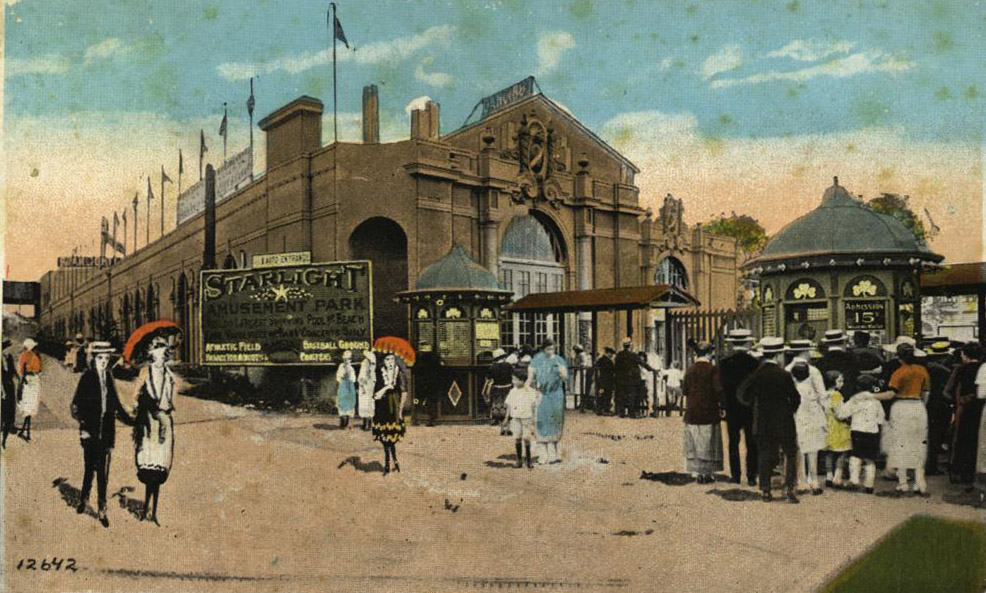
Entrance to Starlight Amusement Park on East 173rd Street, Bronx, NY. Printed by Belmont Postcard Company, 1923. A popular destination during the 1920s and early 1930s, the park was alongside the Bronx River. (Seymour B. Durst Old York Library, Columbia University)

Until she was 19, Grace Paley lived a short walk away from Starlight Park in a two-story townhouse (built in 1901 and still standing). To the west, also within walking distance, is Crotona Park; the Bronx Zoo is a fifteen-minute stroll to the north. In her later years, she pinpointed the moment that, in retrospect, defined how city managers, commercial interests, and highway construction would ensure the neighborhood’s eventual demise. “I was in kindergarten,” she recalled in 1996. “My entire class, probably many other classes as well, walked all the way from our school, P.S. 50 on Vyse Avenue and East 173rd Street, east, east to the Bronx River. There the Mayor of the City of New York, Jimmy Walker, dedicated the East 174th Street Bridge. Dedicated to what?”
Gracie Goodside, who would one day be known to the world as Grace Paley, joined a Socialist youth group called the Falcons when she was nine years old. “With the Socialist ending, not the Communist one, we sang the ‘Internationale,’” she recalls in her collection of autobiographical pieces, Just As I Thought. The Falcons were warned against singing the wrong version by mistake whenever the group joined demonstrations at which members of the Communist camp might be in attendance. “They would try, with their sneaky politics, to drown us out.”

One of the leaders decided that the Falcons would host a party, at which they would perform a musical play. The skit was, according to Paley, typical Depression-era “agitprop,” pitting an unemployed father against City Hall—and Gracie was asked to sing a solo number. Her mother was appalled. “Gracie darling, you can't sing. You know you can't hold the tune,” she told her daughter. “You'll make a fool of yourself. People will laugh. . . . And I'm supposed to sit in the audience and see how your feelings are hurt when they laugh at you?” So Mrs. Goodside prohibited her from going. “Guiltless but full of shame,” Gracie never went to another Falcons meeting.

This childhood experience might remind readers of Paley’s 1959 story, “The Loudest Voice.” Instead of acting in socialist agitprop, the children are corralled into a public school’s Christmas play, and instead of withdrawing from the performance full of shame, Shirley Abramowitz emerges triumphant from the production. As the poet and children’s author Janet Ruth Heller remarks in her appraisal of this often-anthologized story, “Paley emphasizes Shirley’s ability to retain her own ‘voice,’ despite various attempts to silence her.”

The story is also a celebration of the Jewish community in the Bronx between Croton Park and the Bronx River, where Paley grew up. She was the youngest of three children. Isaac and Manya Guzeit, both socialists pardoned by the Russian czar in 1904, immigrated to the United States, anglicized their last name, and had two children by 1908. By the time Gracie came along fourteen years later, Isaac Goodside had purchased a two-story townhouse, learned English, gone to medical school, and become a doctor. “They didn’t stay radical,” Paley told an interviewer in 1985. “They began to live the life of the immigrant—extremely patriotic, very hardworking—but they talked a lot about that period of their lives; they really made me feel it and see it, so there is that tradition. All of them were like that; my father’s brothers and sister all belonged to different leftist political parties. My grandmother used to describe how they fought every night at the supper table and how hard it was on her!” In the introduction to Just As I Thought, Paley notes that “my serious atheistic Jewish parents gave me enough stories—biblical, historical—so that I grew up as a Jewish woman and liked it.”

During the mid-1950s, while raising two children, she tried writing fiction and finished three short stories. With a prose style echoing the cadences of Yiddish, the pieces were unlike the literary fiction published at the time, which she described as “fifties fiction, a masculine fiction, whether traditional, avant-garde, or—later—Beat.” She wrote what she knew (“Everyday life, kitchen life, children life had been handed to me, my portion”), and her submissions were roundly rejected by magazines.

A neighbor who had heard about the stories from his ex-wife asked to read them. The next time he saw Paley, he asked her to finish seven more like them and he, Ken McCormick, an editor at Doubleday, would publish them as a book. The collection, The Little Disturbances of Man, appeared to acclaim in 1959. Two more books of stories would be published over the next quarter century, and in 1994, The Collected Stories, which gathered all 44 selections from the three books, was a finalist for both the Pulitzer Prize and the National Book Award. “I’m not writing a history of famous people,” she had told a reporter for The New York Times years earlier. “I am interested in a history of everyday life.”

*   *   *
There is a certain place where dumbwaiters boom, doors slam, dishes crash; every window is a mother’s mouth bidding the street shut up, go skate somewhere else, come home. My voice is the loudest. . . . If you don't see the full selection below, click here (PDF) or click here (Google Docs) to read it—free!

This selection is used by permission.
To photocopy and distribute this selection for classroom use, please contact the Copyright Clearance Center.

Sunday, December 4, 2022

A Christmas Party That Prevented a Split in the Church

Margaret Black (fl. 1895–1920)
From American Christmas Stories

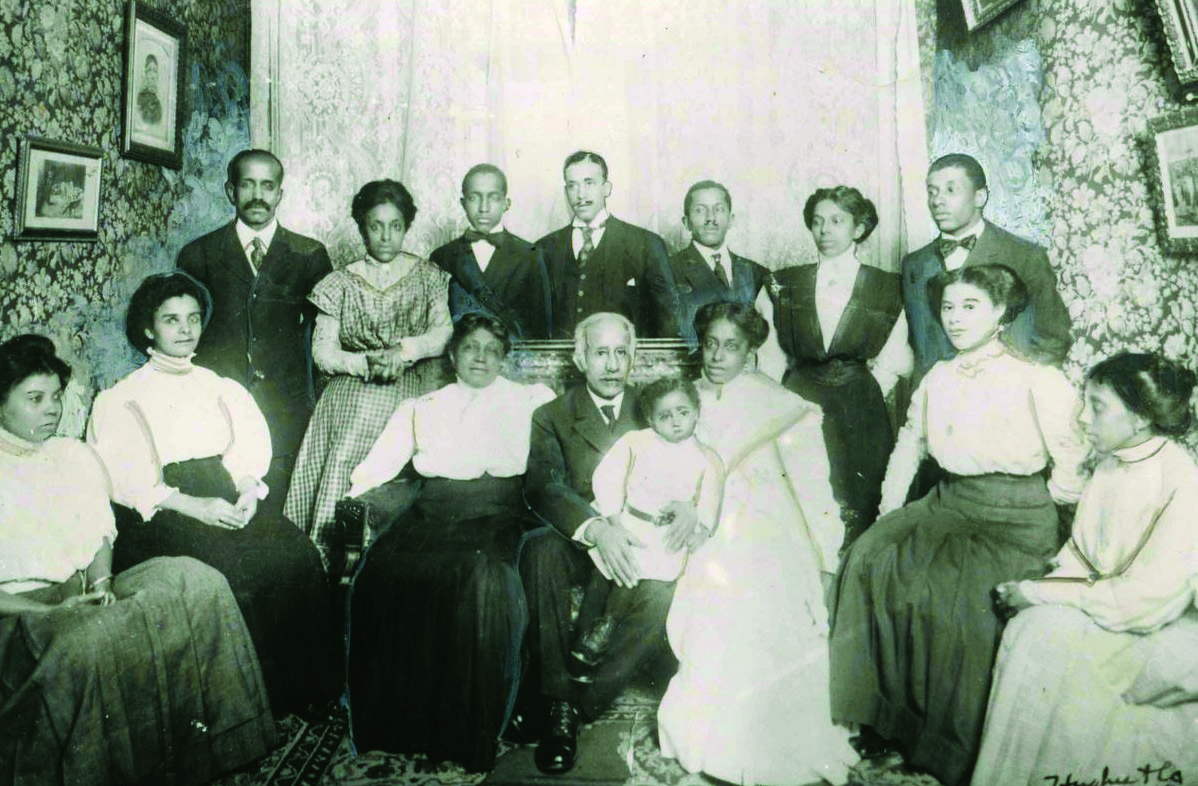
The Murphy family, c. 1920. Martha (seated, at left) and her husband, John (seated, center), who purchased The Afro-American newspaper in 1897. (Afro-American Newspaper Archives, via Atlas Obscura.)
John H. Murphy, Sr., was a 56-year-old foreman in The Afro-American pressroom when the firm went under in July 1896. The Baltimore newspaper had gone through two changes of ownership since its establishment four years earlier, and the new parent corporation, the Northwestern Family Supply Company, raided the paper’s funds as it slid into bankruptcy. When The Afro-American’s equipment was auctioned the following March, Murphy borrowed $200 from his wife and became the latest owner. “The money came from the sale of a piece of land that Martha’s family had been enslaved on in Montgomery County, Maryland,” their great-great-granddaughter Savannah Wood recently explained. “They eventually came to own that land, and Martha sold her portion of it to invest in her husband’s business.” The family still owns and publishes the newspaper today.

One of the employees who stayed with the firm when Murphy bought the newspaper in 1897 was Margaret Black, who had been responsible for the “Women’s Column.” Black’s weekly article collated a variety of news about women’s clubs, religious events, lectures, temperance, and education, as well as recipes and wholesome activities for school vacations; some of the items were submitted by readers. The column disappeared when Murphy assumed ownership, but Black remained at the paper. In its 25th anniversary number, he named her as one of two employees who had “written regularly for twenty years,” which suggests she had been responsible for many of the unsigned pieces.

In December 1915, The Afro-American published, in two installments, “The Woman,” a Christmas story by Black. Then, in the last issue of the following month, she announced (under a resuscitated “Women’s Column” heading), “Dear friends: For the first time in many years, we are to have ‘A COLUMN’ all our own,” and she invited readers to send in community news and short articles. The reinstatement of the column may have been related to reorganization after the departure of the longtime editor, George Bragg, an Episcopal priest whose faith guided the paper’s tone and coverage for more than fifteen years. “Although the piety of Bragg and Murphy remained in the wake of Bragg’s departure,” writes historian Hayward Farrar, “The Afro-American adopted a sensationalist format in its news presentation.” Staff members featured more articles on crime and corruption and redesigned the layout to incorporate graphics, photos, and larger headlines. In the next five years, circulation increased from 7,500 to nearly 20,000.

In the latest incarnation of her column, Margaret Black returned to a topic she had examined twenty years earlier: “The New Woman,” that is, independent, middle-class Black women who were educated and active in the community and (as she wrote in 1896) “who deserve more than cursory notice.” With the passage of the Nineteenth Amendment on the horizon, her writing on this subject now included discussions of women’s suffrage. In August she attended the convention of the National Association of Colored Women, which held its 1916 meeting in Baltimore. The “spectacle” of a national gathering of women with “thoughts of bettering the race and planning for the good of the coming generation of children, was unheard of in olden times,” she wrote. Impressed by the appearance and confidence of the women she met, she added, “The modern woman or modern girl simply refuses to stay in the background; she knows how to manage a home, and she can attend the clubs, parties, or anything else she has a penchant for and be the sweet, lovable wife.”

Toward the end of 1916, Black published two works of fiction in the paper: a story for Thanksgiving, followed by “A Christmas Party That Prevented a Split in the Church.” The latter was rescued from oblivion in 1997 by historian Bettye Collier-Thomas, who included it in A Treasury of African American Christmas Stories. The setting is St. Michaels, a harbor village of about 1,500 inhabitants in Talbot County on Maryland’s Eastern Shore; before the Civil War, the region boasted a significant free Black community that dated back to the 1780s, and many more African Americans settled there after emancipation. “Margaret Black has recorded the thoughts, words, deeds, and feelings of Black churchwomen as they struggled to give meaning and definition to their lives,” explains Collier-Thomas in her introduction. “At the center of this text is an African American and female consciousness rarely seen at this early date.”

Margaret Black’s column and short stories continued to appear under her name until early 1919. Other than minimal personal information gleaned from her articles, little is known about the woman who spent a quarter of a century writing for the nation’s most influential African American weekly newspaper.

*   *   *
“Goodness,” exclaimed Milly Brown. “All these things to move and dust, they’re a sight and if I had my way, I’d get rid of some of them. No single man needs all this trash around, especially a minister.” . . . If you don't see the full selection below, click here (PDF) or click here (Google Docs) to read it—free!

This selection may be photocopied and distributed for classroom or educational use.
Sunday, November 27, 2022

Eve’s Diary

Mark Twain (1835–1910)
From Mark Twain: Collected Tales, Sketches, Speeches, & Essays 1891–1910

Three of the 55 illustrations created by American artist Lester Ralph (1876–1927) for the book publication of Eve’s Diary. The first two show Adam and Eve in Eden; the third shows Adam at the end of the story, after the Fall. The Charlton Library in Worcester, Massachusetts, banned the book from its shelves because, as The New York Times drolly put it in a front-page article, the images “represent Eve in summer costume. Her dresses are all cut Garden of Eden style.”

In 1909, the year before he died, Mark Twain published his last book, Is Shakespeare Dead?: From My Autobiography, which argues that Francis Bacon wrote Shakespeare’s plays and (as the subtitle suggests) includes anecdotes from his own life to examine the relevance of “literary celebrity” in history. In an early chapter of this slim book, Twain begins a recollection from his own childhood:
When I was a Sunday-school scholar something more than sixty years ago, I became interested in Satan, and wanted to find out all I could about him. I began to ask questions, but my class-teacher, Mr. Barclay the stone-mason, was reluctant about answering them, it seemed to me. I was anxious to be praised for turning my thoughts to serious subjects when there wasn’t another boy in the village who could be hired to do such a thing. I was greatly interested in the incident of Eve and the serpent, and thought Eve’s calmness was perfectly noble. I asked Mr. Barclay if he had ever heard of another woman who, being approached by a serpent, would not excuse herself and break for the nearest timber. He did not answer my question, but rebuked me for inquiring into matters above my age and comprehension. . . .
Even if Twain’s boyhood anecdote is fabricated (quite possible) or embellished (almost certain), we do know that throughout his life he was both fascinated by and skeptical of the accounts in the Book of Genesis—and this obsession led him to write more than a dozen sketches and satires inspired by them, most of which remained unpublished at his death. These efforts at biblical storytelling began as early as 1866, when he lit on the idea of a “conversation between the carpenters of Noah’s Ark.” Instead, this initial work took the form of a diary written by Shem, one of Noah’s sons. Twain made several attempts to work on the project during the 1870s—and picked it up again in 1909—but nothing came of it, and among his papers there are only a few surviving fragments of “diaries” by Shem and by Noah’s grandfather Methuselah.

The idea of using the journal format to portray biblical characters eventually bore fruit, however. In late 1892, Twain wrote “Extracts from Adam’s Diary.” Unable to find a magazine willing to publish it, he agreed to sell it the following year to a friend who was assembling a volume to promote Niagara Falls to travelers attending the World's Columbian Exposition in Chicago. Twain revised the story for this publication, relocated Eden in the Niagara region, and described Adam going over the Falls in a barrel—additions Twain would later regret and try, unsuccessfully, to get removed when the story was included in future collections. The Niagara Book was reprinted when Buffalo hosted the Pan-American Exposition in 1901, and the story appeared that year in Harper’s Magazine, reaching a national audience for the first time. (During the Buffalo fair, in a curious case of life imitating art, Annie Edson Taylor, a 63-year-old schoolteacher, became the first person to strap herself in a barrel and take the trip over the Niagara Falls.)

Twain’s story opens with Adam perplexed and annoyed by the appearance of the “new creature with the long hair. . . . I wish it would not talk; it is always talking.” But by the tale’s end, ten years after their exile from Eden, he admits, “I see that I was mistaken about Eve in the beginning; it is better to live outside the Garden with her than inside it without her. At first I thought she talked too much; but now I should be sorry to have that voice fall silent and pass out of my life.”

Mark Twain had long questioned, both humorously and seriously, whether Adam and Eve were to blame for the Fall and often suggested that, given their naivete and human nature, failure must have been part of the plan. “If God had told [Adam] to help himself,” he wrote to the industrialist Henry Huttleston Rogers in 1898, “the crop would have rotted on the trees; but as soon as He loaded the apples up with extra-territorial royalties and other wanton exactions and obstructions, Adam was bound to sample the orchard if it cost him his shirt-tail.” Similarly, one of the maxims that open the chapters of Pudd’nhead Wilson reads:
Adam was but human—this explains it all. He did not want the apple for the apple’s sake, he wanted it only because it was forbidden. The mistake was in not forbidding the serpent; then he would have eaten the serpent.
Around the time the Adam story was reprinted in Harper’s, Twain began toying with the idea of imagining it from Eve’s point of view. At one point he had a 75-page manuscript tentatively titled “Autobiography of Eve,” a far more cynical account that follows Eve until her death in the year 920. Not satisfied with what he’d written, he set it aside, unfinished, and parts of it were posthumously published as “Eve Speaks” and “That Day in Eden.”

In June 1904, Olivia, Mark Twain’s beloved wife of 34 years, died after an extended illness while the family was in Florence, Italy. Shattered with grief, their daughter Clara broke down and, after their return to the U.S., admitted herself to rest-cure facilities for more than a year. The following May, afflicted with gout, dyspepsia, and chronic bronchitis, Twain traveled with this daughter Jean to a hideaway in Dublin, New Hampshire. During his first month there, in part to distract himself from grief and illness, he churned out “an intolerable pile of manuscript,” including the start of a new version of The Mysterious Stranger and an odd fantasy titled “3,000 Years Among the Microbes” (imagining the world from the point of view of a cholera bacteria living in the body of a tramp). Finding himself at an impasse with both novel-length works, he took some time off. “Since I stopped work I have had a two months holiday,” he wrote to Frederick A. Duneka, the secretary of Harper & Brothers. “The summer has been my working time for 35 years. To have a holiday in it (in America) is new for me.”

During his “holiday,” in mid-July, he reported to Duneka that he had completed “Eve’s Diary,” which uses “Adam’s Diary as her (unwitting and unconscious) text, of course, since to use any other text would have been an imbecility.” He added, “Eve’s Diary is Eve’s Love-Story, but we will not name it that.” The new tale parallels the events of the earlier story but the emotional stance is altogether different; as one contemporary reviewer put it, it is a “tribute from the widowed author to his lost partner of many years.”

Only days after Olivia Clemens died, Twain had written to her brother, “I am a man without a country. Wherever Livy was, that was my country.”—a line echoed in the final entry of “Eve’s Diary.” In the words of Twain’s first biographer, Albert Bigelow Paine, “Adam’s single comment at the end . . . holds the full tale of Mark Twain’s love and sorrow, and is perhaps the most beautiful line he ever wrote.”

*   *   *
Saturday. — I am almost a whole day old, now. — I arrived yesterday. That is as it seems to me. And it must be so, for if there was a day-before-yesterday I was not there when it happened, or I should remember it. . . . If you don't see the full selection below, click here (PDF) or click here (Google Docs) to read it—free!

This selection may be photocopied and distributed for classroom or educational use.

Sunday, November 20, 2022

Cookery: Meat Department

Harriet Beecher Stowe (1811–1896)
From American Food Writing: An Anthology With Classic Recipes

Trade card for the New American Cook Stove, Perry & Co., Albany, NY, 1874. Lithograph by Weed, Parsons & Co. The back of the card describes the stove’s features including a clinkerless grate, illuminated front, and portable fuel chamber. (Historic New England) “The introduction of cooking-stoves offers to careless domestics facilities for gradually drying-up meats, and despoiling them of all flavor and nutriment,” Stowe writes in “Cookery.”
In January 1864, Christopher Crowfield began publishing in The Atlantic Monthly a series of columns on household matters. “My wife and I were somewhat advanced housekeepers,” he wrote, “and our dwelling was first furnished by her father, in the old-fashioned jog-trot days, when furniture was made with a view to its lasting from generation to generation.” The first installment describes the purchase of an inexpensive, commercially produced carpet from Brussels to replace the heavily worn “old rag” in their parlor. Once it was installed, his daughters worried the sunlight would bleach its bright colors and realized that its novelty made the room’s other furnishings look out of place. Sure enough, within a year the room was freshly appointed “with two lounges in decorous recesses, a fashionable sofa, and six chairs and a looking glass, and a grate always shut up, and a hole in the floor which kept the parlor warm, and great, heavy curtains that kept out all the light that was not already excluded by the green shades.” In the end, the room was so pristine and sterile and dark that nobody ever used it. If the moral of the story wasn’t clear, Crowfield spelled it out in the next month’s column: “There are many women who know how to keep a house, but there are few that know how to keep a home.”

The story proved popular with Atlantic readers, as did Crowfield’s subsequent installments that appeared in all but one issue in 1864. The columns, with a newly written twelfth chapter, were gathered the following year in a book, House and Home Papers, which went through several printings. In the concluding essay, Crowfield declares, “My wife, as you may have seen in these papers, is an old-fashioned woman, something of a conservative.” Yet, as many, and perhaps most, readers knew at the time, there was no Mrs. Crowfield, nor was there even a Christopher Crowfield. Instead, all twelve essays were written by Harriet Beecher Stowe.

In 1863, Stowe’s husband, Calvin Ellis Stowe, resigned from his position at Andover Theological Seminary in Massachusetts, and the couple decided to move to Hartford, Connecticut, with their three grown daughters and their 13-year-old son. Harriet assumed responsibility for the construction and outfitting of their new home and, because her husband was no longer collecting a salary, the family depended upon the income from her writing. “I came here a month ago to hurry on the preparations for our house, in which I am now writing, in the high bow window of Mr. Stowe’s study, overlooking the wood and river,” she wrote to Atlantic editor James T. Field in May 1864. “We are not moved in yet, only our things, and the house presents a scene of the wildest chaos, the furniture having been tumbled in and lying boxed and promiscuous.” Her adventures while building, furnishing, and living in the house gave her the idea for the Crowfield columns. Her son Frederick had been seriously wounded at the Battle of Gettysburg, and the essays provided her (and her readers) with much-needed distractions: “It is not wise that all our literature should run in a rut cut through our hearts and red with our blood—I feel the need of a little gentle household merriment and talk of common things.”

Why Stowe, the most famous living American novelist at the time, chose to write under a pseudonym remains a matter for scholarly debate. “If there were rhetorical advantages to be gained in 1864 by her choice of a male persona to speak on domestic topics, it is hard to discern them,” writes Joan Hedrick in her Pulitzer Prize–winning biography. Hedrick suggests that writing as a man was “the price of admission to the Atlantic club,” yet the magazine advertised Stowe’s authorship in publications ranging from the American Literary Gazette to The Gardener’s Monthly: “MRS. HARRIET BEECHER STOWE begins, in the January number, a series of capital sketches to be continued through several months, with the title of ‘House and Home Papers, by Christopher Crowfield.’” The charade was so widely known that a reviewer in the The Ladies’ Repository complained, “We should rather have had Mrs. Stowe speak in propria persona rather than with the nom de plume of Christopher Crowfield. The veil is no veil, and should therefore not be worn.”

The success of both the essays and the book that resulted from them enabled Stowe to negotiate future pieces at $200 each—double the rate she was paid the first year. The twenty columns that “Christopher Crowfield” published in 1865 and 1866 under a new series rubric, “The Chimney-Corner,” were collected in two volumes as Little Foxes and The Chimney-Corner; the former went through twenty-five printings by the time of Stowe’s death thirty years later and the latter sold 10,000 copies in England alone during its first year of publication.

“Cookery,” the final installment of House and Home Papers in The Atlantic, appeared in the December 1864 issue. Five years later, Stowe excised the fictional trappings, changed the title to “Good Cooking,” and included the essay in The American Woman’s Home; or Principles of Domestic Science, a book she—under her own name—coauthored with her sister Catharine E. Beecher. In both versions, she discusses the “five great departments of cookery”: Bread, Butter, Meat, Vegetables, and Tea & Coffee. In the third section, which we present below, Stowe criticizes both butchers and cooks for the crudeness of meat preparation in America and advises homemakers and chefs alike to look to Europe for guidance.

Note: The figure of John Bull was a popular personification of England, usually representing the common man (unlike, say, Uncle Sam, who is the personification of the American federal government).

*   *   *
The third head of my discourse is that of Meat, of which America furnishes, in the gross material, enough to spread our tables royally, were it well cared for and served. . . . If you don't see the full selection below, click here (PDF) or click here (Google Docs) to read it—free!

This selection may be photocopied and distributed for classroom or educational use.

Sunday, November 13, 2022

The Business Man

Edgar Allan Poe (1809–1849)
From Edgar Allan Poe: Poetry & Tales

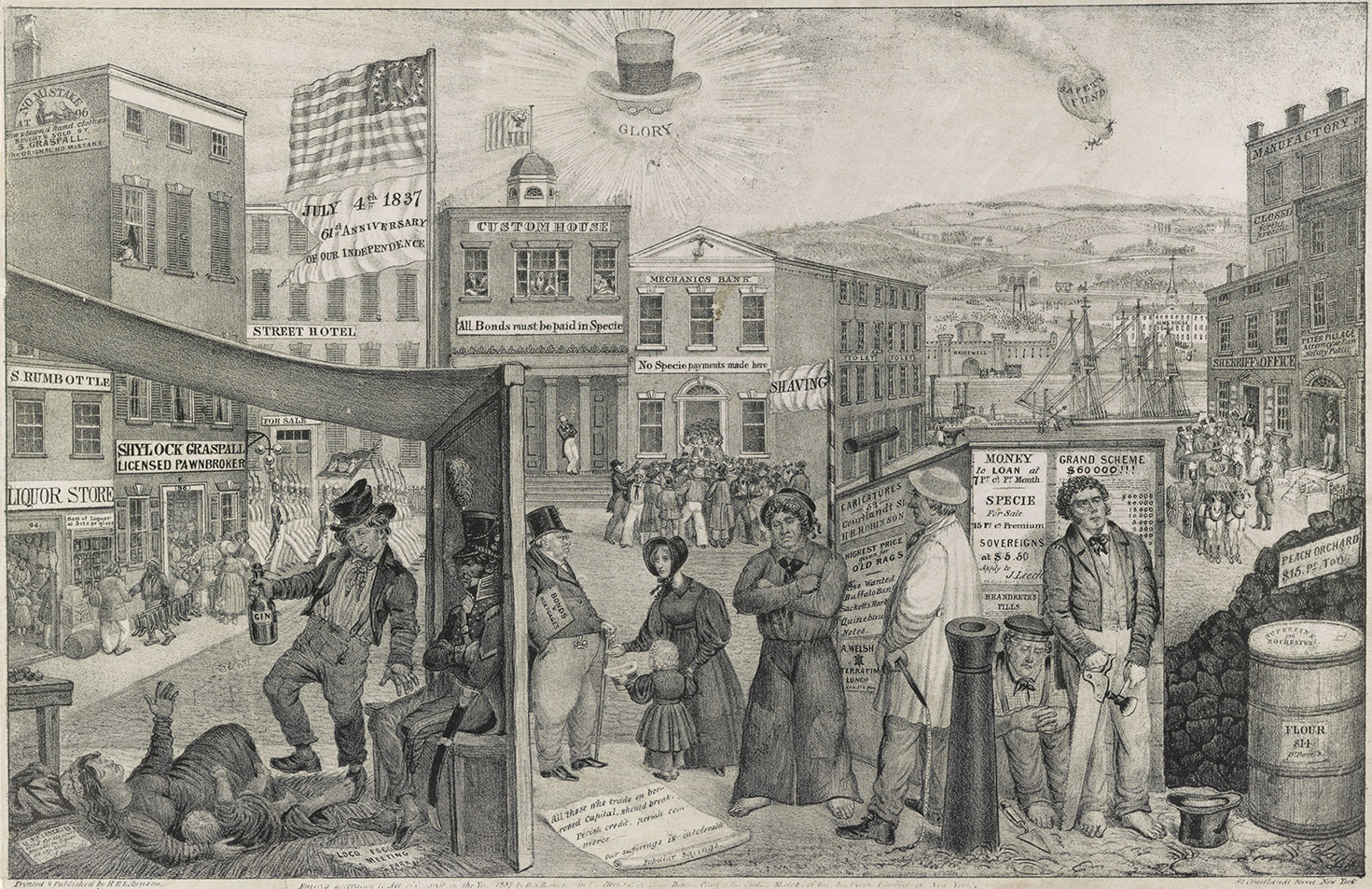
“The Times,” July 1837, drawing by Edward Williams Clay (1799-1857), lithograph on wove paper printed and published by H.R. Robinson, New York. Library of Congress.

In May 1837, five months after Edgar Allan Poe moved to Manhattan, New York banks suspended the payment of specie for commercial papers in May, setting off an economic depression that lasted seven years. The cartoon depicts crowds outside a pawnshop (left), a bank (center), and the sheriff’s office (right). The spirit of Andrew Jackson, who was largely blamed for the crisis, hovers in the sky. “Principal figures” identified by the Library of Congress include “(from left to right): a mother with infant (sprawled on a straw mat), an intoxicated Bowery tough, a militiaman (seated, smoking), a banker or landlord encountering a begging widow with child, a barefoot sailor, a driver or husbandman, a Scotch mason (seated on the ground), and a carpenter. These are in contrast to the prosperous attorney ‘Peter Pillage,’ who is collected by an elegant carriage at the far right.”

“It is an evil growing out of our republican institutions, that here a man of large purse has usually a very little soul which he keeps in it,” observed Edgar Allan Poe in “The Philosophy of Furniture,” an essay about—of all things—interior decorating. “The corruption of taste is a portion or a pendant of the dollar-manufacture. As we grow rich, our ideas grow rusty.” Poe’s essay explains that the upper class in America has no sense of style because its sense of home decoration has been governed by “the display of wealth” and “the rage for glitter.” While Poe’s essay was meant humorously, its underlying message about the conflict between refinement and materialism, or between art and business, appears throughout his writings. And few things seem to agitate him more than the business of running a magazine.

In the summer of 1838, after living in Manhattan for eighteen months, Poe moved to Philadelphia, with his wife (and cousin), Virginia Eliza Clemm Poe, and his mother-in-law (and aunt), Maria Poe Clemm. He had been unable to find employment, in part because of the recession that followed the Panic of 1837, when New York banks, their gold and silver reserves depleted, suspended payment on commercial paper. The family struggled to survive from his meager earnings for freelance articles and from Mrs. Clemm’s income as manager of a boarding house. His first and only novel, The Narrative of Arthur Gordon Pym, was a flop and the reviews were hostile; a typical critic, William E. Burton of Burton’s Gentleman’s Magazine, declared that “a rapid succession of improbabilities destroys the interest of the reader, and the writer’s evident ignorance in all nautical matters forbids the possibility of belief.” Poe’s situation didn’t get any better after he moved to Philadelphia; as of May 1839, he had made less than two hundred dollars in the previous two and a half years.

Finally, in what must have been an awkward interview for both men, Poe met with Burton—the very critic who had trashed his novel—about obtaining an editorial position at the magazine. A British playwright and comic actor, Burton had arrived in Philadelphia in 1834, the year after his play Ellen Wareham was an enormous success in London. He ended up staying in the U.S. and, in 1837, established a new monthly magazine that (its advertisements promised) would feature fine paper and sturdy bindings, include an abundance of engravings, and contain in each issue “more reading matter than a volume of a novel.”

The economic depression and a shortfall in subscriptions had curbed Burton’s ambitions somewhat. Yet, since he was often on the road starring in stage productions, he needed an assistant editor and talked Poe down to a salary of $10 a week. Over the course of the next year, Poe would write most of the magazine’s reviews, numerous occasional pieces, and several stories and essays, including “The Fall of the House of Usher” and “The Man in the Crowd.” He also began serial publication of “The Journal of Julius Rodman,” about the first (entirely fictitious) transcontinental expedition in 1792.

Tensions between publisher and his new coeditor appeared within the first month. On May 30, 1839, Burton responded to a letter from Poe that has not survived:
I am sorry that you thought necessary to send me such a letter as your last. The troubles of the world have given a morbid tone to your feelings which it is your duty to discourage. . . . We shall agree very well, but you must get rid of your avowed ill-feelings towards your brother authors—you see that I speak plainly—indeed, I cannot speak otherwise. Several of my friends, hearing of our connexion, have warned me of your uncalled for severity in criticism. . . . The independence of my book reviews has been noticed throughout the Union, . . . but there is no necessity for undue severity.
Burton’s admonishment that Poe must tone down his reviews was largely ignored, and it was in the pages of Burton’s that Poe launched his multi-year “war” on Longfellow and accused the celebrated poet of the rather absurd charge of plagiarism.

As the economy worsened and money became scarcer, Burton—who refused to cut corners on the production of the magazine—simply stopped paying the authors. In November, facing the predictable shortfall of submissions, he promoted a contest offering $1,000 in prizes to authors of the best stories, essays, and poems that appeared in the magazine. Individual awards ranged from $50 to $250—amounts unheard of for short works in the first half of the nineteenth century. Joseph Evans Snodgrass, Poe’s close friend and one of the authors Burton had stiffed earlier in the year, asked about the details of the contest and Poe responded, “I can give you no information about their designation further than is shown in the advertisement itself. The truth is, I object, in toto, to the whole scheme—but merely followed in Mr B’s wake upon such matters of business.” (The emphasis, tellingly, is Poe’s.) Burton first postponed the deadline for the contest and then, citing a dearth of submissions, canceled it and didn’t award a cent to the entries that had already appeared in the magazine’s pages. In June 1840 Poe told Snodgrass, “I am firmly convinced that it was never his intention to pay one dollar of the money offered; and indeed his plain intimations to that effect, made to me personally and directly, were the immediate reasons of my cutting the connexion as abruptly as I did.”

In fact, Poe had been fired. Throughout his tenure, Poe had been scheming to establish his own (competing) magazine, while Burton had been hoping to build his own theater in Philadelphia—a project that would require him to raise funds by selling the magazine. In mid-May 1840, soon after Burton announced the magazine was for sale, Poe published a prospectus for his new magazine—which lowered the value of the magazine Burton was trying to sell. The two men went their own ways. Several months later Burton finally sold the magazine, and he used the $3,500 purchase price to lease and refurbish the abandoned Cooke’s Royal Circus building (which had been damaged in a fire) and reopen it as the National Theater. At first the venture was prosperous, but in July 1841 Burton lost most of his earnings after the collapse of the United States Bank of Pennsylvania, managed by Nicholas Biddle. Poe fared better; because of the financial crisis, he was unable to raise funds for his magazine, but he was soon hired by Graham’s Lady’s and Gentleman’s Magazine—the new name of the very magazine Burton had sold. Poe did not, however, finish writing “The Journal of Julius Rodman,” which abruptly ended after the sixth installment in Burton’s.

It was amidst this tumultuous backdrop that Poe published “Peter Pendulum, The Business Man” in the February 1840 issue of Burton’s, the same month that the magazine’s “contest” was originally scheduled to end. Three years later, he added six paragraphs describing four more business scams, shortened the title to “The Business Man,” changed the character’s name to “Peter Proffit,” and reprinted it in the Saturday Museum. In 1845, when he was editor of The Broadway Journal, he made additional revisions and reprinted it a second time, which is the text we present below.

In his analysis of “The Business Man,” Thomas F. Marvin argues that, “seen in the light of Poe’s experiences in the publishing industry, . . . the story emerges as a pointed satire on the business of magazine publishing.” Other scholars have pointed to additional inspirations. J. A. Leo Lemay, who calls it “one of the cruelest burlesques of antebellum American materialism,” contends that it is both a rejection of the American concept of the “self-made” man and, more specifically, of the ideas presented in the Autobiography of Benjamin Franklin—whose profile adorned the title page of Burton’s. Several biographers have regarded the story as Poe’s repudiation of his deceased guardian, John Allan, a prosperous merchant in Richmond who had regarded his foster son as a wastrel and who had cut Poe entirely out of his will. All critics agree that, with slapstick and derision, the story satirizes American greed by pitting Peter Proffit against individuals and society without regard to culture, dignity, or morality.

Note: The abbreviation Nem. con. is Nemine contradicente, or “without opposition”.

Thomas F. Marvin’s article, “‘These Days of Double Dealing’: Edgar Allan Poe and the Business of Magazine Publishing,” American Periodicals (2001), provided several of the details on Poe’s experiences working with William Burton.

*   *   *
I am a business man. I am a methodical man. Method is the thing, after all. . . . If you don't see the full selection below, click here (PDF) or click here (Google Docs) to read it—free!

This selection may be photocopied and distributed for classroom or educational use.

Sunday, November 6, 2022

When It Changed

Joanna Russ (1937–2011)
From The Future Is Female! More Classic Science Fiction Stories by Women

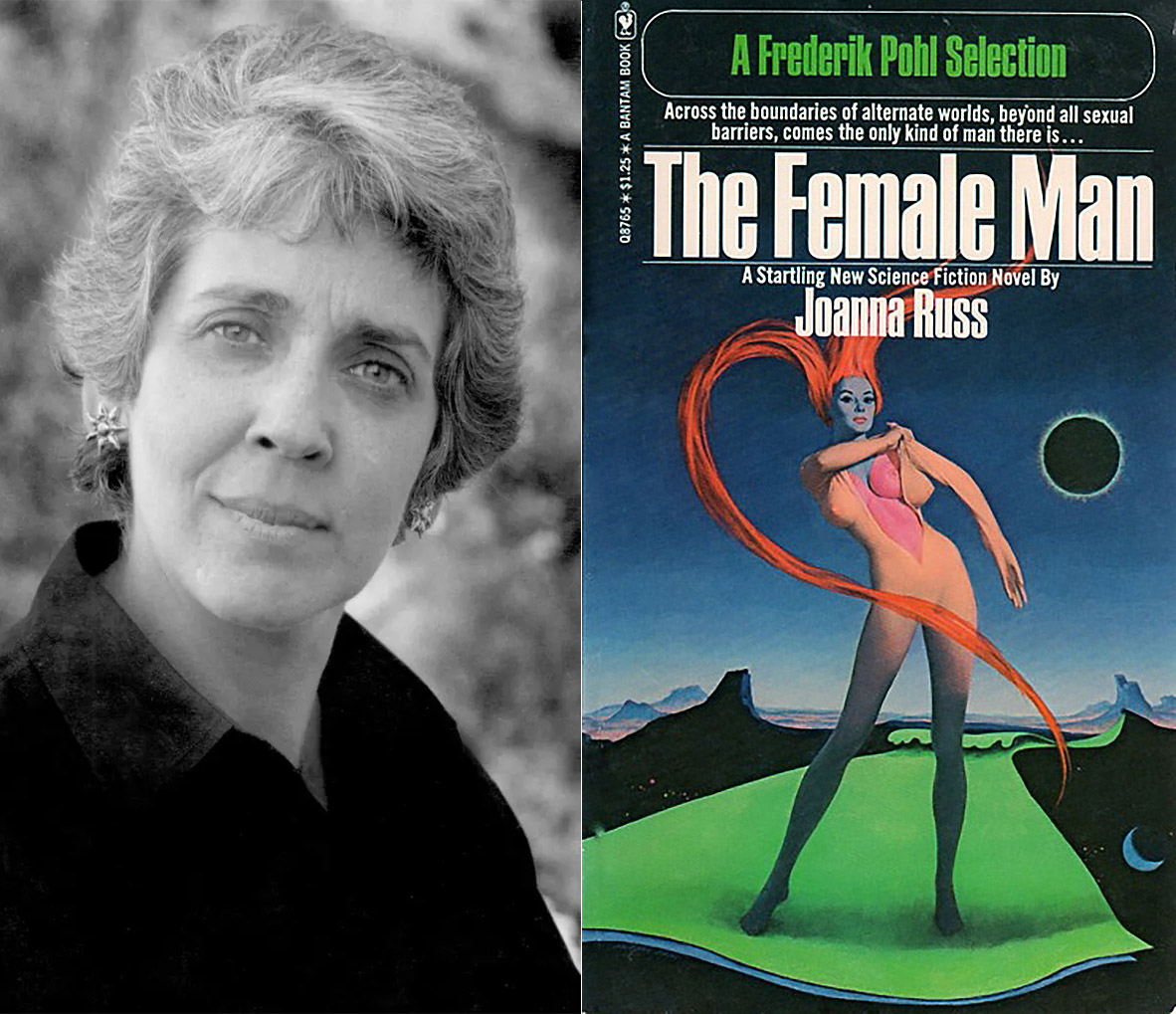
Photograph of Joanna Russ, 1984, by Ileen Weber (Wikipedia). First American edition of Russ’s The Female Man (Bantam, 1975) with a cover illustration by American artist Morgan Kane (1916–2014). “When It Changed” and parts of The Female Man are set on the planet Whileaway.
“There are plenty of images of women in science fiction. There are hardly any women.”

So concludes Joanna Russ’s often-reprinted essay, “The Image of Women in Science Fiction,” which first appeared in 1970 in the seventh and last issue of Red Clay Reader, a relatively obscure literary annual. Three years earlier, Russ had published her debut book, the sword-and-sorcery space adventure Picnic on Paradise, which was a finalist for the Nebula Award and a notable break from the conventions and stereotypes common in science fiction and fantasy during the previous decades. “Long before I became a feminist in any explicit way,” Russ told an interviewer in 1975, “I had turned from writing love stories about women in which women were the losers, and adventure stories about men in which men were winners, to writing adventure stories about a woman in which the woman won.”

Born and raised in the Bronx, Joanna Ruth Russ demonstrated early aptitude in the sciences and became one of the top ten finalists in the national 1953 Westinghouse Science Talent Search for her project “Growth of Certain Fungi Under Colored Light and in Darkness.” She turned to literature at Cornell, where she studied with Vladimir Nabokov (to whom she dedicated her second novel, And Chaos Died) and then earned an MFA in Playwriting from the Yale School of Drama before beginning a career as a college English professor. She sold her first science fiction story, “Nor Custom Stale,” while still in graduate school, and by the late 1960s she had established herself as a leading voice in science fiction’s New Wave. In a recent interview with Russ biographer Gwyneth Jones, Kathryn Cramer, a prominent SF editor, recalled Russ’s place in the academic and SF worlds:
Her life consisted of playing to various audiences that were difficult to reconcile. She wanted to be respected as fully as her colleagues in the English Department, even though she wrote SF. She wanted to be respected by the Radical Women for her feminist SF for which they had no use. And at the same time she wanted the respect of major figures in science fiction even though she was a woman, a lesbian, a feminist, and a socialist. She held her own there through rigor, but rigor plus depression made her a harsher critic than she wanted to be, so she eventually gave up reviewing.
Russ often pointed out how frontiers had been crossed by SF in every direction: outer space and interplanetary travel, other dimensions and extraterrestrial civilizations, technological advances and human-made catastrophes, political organizations and economic systems, and even various parasciences (ESP and the like)—yet speculations on future social arrangements and the domestic sphere had been limited. “Most science fiction is set far in the future, some of it very far in the future, hundreds of thousands of years sometimes,” she wrote in her 1970 essay. “One would think that by then human society, family life, personal relations, child-bearing, in fact anything one can name, would have altered beyond recognition.” Instead, most science fiction had either carried “today’s standards and values into its future” or returned to “an idealized and exaggerated past.”
Many recent stories do show a two-sexed world in which women, as well as men, work competently and well. But this is a reflection of present reality, not genuine speculation. And what is most striking about these stories is what they leave out: the characters’ personal and erotic relations are not described; child-rearing arrangements (to my knowledge) are never described; and the women who appear in these stories are either young and childless or middle-aged, with their children safely grown up.
As for the matriarchy motif that occasionally showed up in speculative fiction:
There is something about matriarchy that makes science fiction writers think of two things: biological engineering and social insects; whether women are considered naturally chitinous or the softness of the female body is equated with the softness of the “soft” sciences I don't know, but the point is often made that “women are conservative by nature” and from there it seems an easy jump to bees or ants. . . .
Russ’s initial attempts to address the genre’s shortcomings are evident in two pieces of fiction she was working on at the time she wrote her essay: the Nebula Award–winning short story “When It Changed” and her pioneering masterpiece, The Female Man. Both works depict a world named Whileaway, which is populated entirely by women. When the short story appeared in Harlan Ellison’s second anthology, Again, Dangerous Visions (1972), Russ wrote in an afterword that she had read “SF stories about manless worlds before; they are either full of busty girls in wisps of chiffon who slink about writing with lust, . . . or the women have set up a static, beelike society in imitation of some presumed primitive matriarchy.” She adds, “Of SF attempts to depict real matriarchies (‘He will be my concubine for tonight,’ said the Empress of Zar coldly) it is better not to speak.”

Lisa Yaszek, who selected “When It Changed” for the just-published second volume of The Future Is Female!, points out that the story pays homage to the fictional all-female societies depicted in Mizora (1880–81) by Mary Bradley Lane and in Herland (1915) by Charlotte Perkins Gilman—that is, to “the dream of a separate space for women outside the constraints of a culture where ‘men hog the good things.’” When the poet and playwright Jewelle Gomez reviewed Russ’s 1983 collection The Zanzibar Cat, which included the story, she wrote about how “When It Changed” both defies any attempt at summarization and overcomes the wariness of some readers: “In outline this story has all the classic (i.e., dull), politically correct potential: a group of women in an independent utopia about to do battle with the enemy. On the page it is a funny, touching tale of two women who confront the problems of how to raise their children so they are not destroyed by the earth-men’s idea of sexual equality, and how their own marriage can survive.”

Notes: Parts of the above paragraph on Joanna Russ’s early life are from the biographical note in The Future Is Female!

I.C. is the abbreviation for internal combustion. Verweile doch, du bist so schoen!: “Stay a while, you are so beautiful!,” from Part 1 of Johann Wolfgang von Goethe’s Faust (1808).

*   *   *
Katy drives like a maniac; we must have been doing over 120 km/hr on those turns. She’s good, though, extremely good, and I’ve seen her take the whole car apart and put it together again in a day. . . . If you don't see the full selection below, click here (PDF) or click here (Google Docs) to read it—free!

This selection is used by permission.
To photocopy and distribute this selection for classroom use, please contact the Copyright Clearance Center.

Sunday, October 30, 2022

Stories Told by an Artist

Stephen Crane (1871–1900)
From Stephen Crane: Prose & Poetry

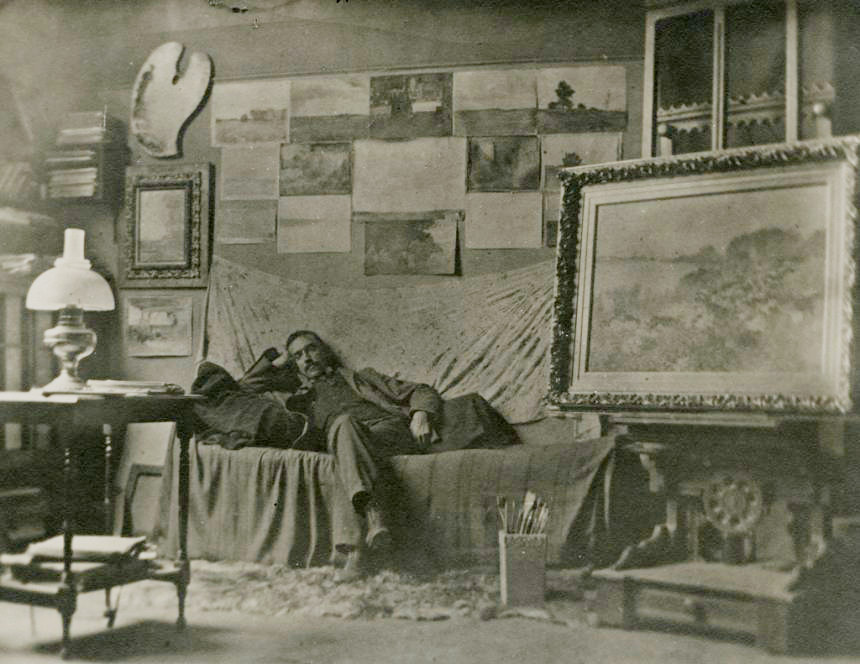
Stephen Crane in Corwin Knapp Linson’s studio on West 22nd Street, Manhattan, c. 1894, when Crane was writing The Red Badge of Courage. At the beginning of 1894, Linson had moved his studio to this room, three blocks away from where Crane lived with his friends in the old Art Students League building. Linson makes an appearance as “Corinson” in “Stories Told by an Artist.” (Syracuse University Libraries via Roger Williams University)

The oil painting in the foreground is Linson’s Purple and Gold (see image below), which was completed in late 1892 and shown at the Spring 1893 Exhibition of the National Academy of Design, at which it was listed for $75 (and apparently did not find a buyer). Linson’s work is largely forgotten; Purple and Gold reappeared at an auction two years ago and sold for $2,500.
“We slept two or three in the big bed, and one on the coal box,” wrote Nelson Greene fifty years later, remembering early autumn of 1893, when three cash-strapped artists allowed 21-year-old Stephen Crane to move into their small one-room apartment in the old Art Students League building on East 23rd Street in New York. Greene’s roommates “played poker and smoked constantly from the afternoon till midnight or after, while I went to bed early so I could put in 9 hours daily as a proofreader at $18 a week.” Beyond that paltry sum, there wasn’t much in the way of financial support for them to live on. “The four of us were often so hard up that we were down to $2 on Saturday morning. This we invested in a big wad of frankfurters, rye bread, coffee and condensed milk, which took us through the two days.”

After a few months, their situation improved a little when one of the men, R. G. Vosburgh, found work as an illustrator for a newspaper syndicate. “With Crane the studio had four occupants,” Vosburgh remembered in an article published the year after Crane’s death. “He could contribute nothing to its maintenance, but he added very little to the expense, and the others were glad to have him. . . . It was during that time that The Red Badge of Courage was written.”

Surrounded by horse stables and saddleries (East 24th, the street behind, was known as Old Stable Row well into the twentieth century), the old Art Students League building had previously been a Carhart & Needham melodeon plant and then the headquarters for famed piano manufacturer Sohmer & Co. before becoming a school for fledgling artists. By the early 1890s, the makeshift academy was overcrowded, infested with rats and roaches, and enveloped by a pungent combination of tannery odors and equine manure. The artists had good company, though: across the street was the aging City College of New York building, packed beyond capacity with more than 1,700 undergraduates. Hoping to improve conditions for its students, the League had recently opened its new (and present) facility further uptown, but artists were allowed to remain in the old building as new businesses moved in—including the Allison Chemical Company, suppliers of “everything for the destruction of vermin.” Crane and his roommates paid $14 a month for their room. The landlord, Charles Austin Needham, was the son of the melodeon manufacturer, a former League student, and a landscape painter who kept his own studio in the building until the late 1910s; one of Crane’s friends later recalled that he was “as considerate of our financial difficulties as he could be in reason.”

Crane moved out in April 1894, and it wasn’t long after the school finished closing its former location that Crane and his friends began to romanticize their time there. “The old building will be to a great many artists of this country a place endeared to them by the memory of many an escapade of the old student days when the boys of the life class [an advanced workshop with models] used to row gaily with the boys of the ‘preparatory antique’ [a required first-year class] in the narrow halls,” Crane wrote in his notebook. “Everyone was gay, joyous, and youthful in those blithe days and the very atmosphere of the old place cut the austere and decorous elements out of a man’s heart and made him rejoice when he could divide his lunch of sandwiches with the model.”
Corwin Knapp Linson's Purple and Gold.
(Click image to enlarge; courtesy Heritage Auctions)

In the fall of 1894, Crane memorialized his friends in a trio of vignettes that appeared as “Stories Told by an Artist” in The New York Press. The four men are disguised by pseudonyms: Nelson Greene becomes Purple; Vosburgh is Warwickson (or Great Grief); the remaining roommate, William W. Carroll, is Wrinkles; and Crane himself is Little Pennoyer, or Penny. The successful artist who drops by their room is Crane’s older friend, Corwin Knapp Linson, barely concealed by the name of Corlinson. For most of the 1890s, Linson earned his keep illustrating magazines while struggling to sell his paintings. In Linson’s studio a short walk away, Crane perused old issues of Century Magazine containing “Battles and Leaders of the Civil War,” a series published during the 1880s that provided him with background material for The Red Badge of Courage.

In the recently published Burning Boy: The Life and Work of Stephen Crane, Paul Auster singles out “Stories Told by an Artist” for its “down-to-the-ground realism” and for Crane’s ability to find warmth and wit despite the hardship and hunger. “The caustic humor that occasionally surges up in the three episodes comes from the characters themselves and not from an act of willful intention on the part of the author—an advance—and Crane is particularly adept here at capturing what I would call an air of good-natured nastiness in the dialogue, the taunting, teasing exchanges of young men forced to live together in cramped quarters, and the episodes glide along smoothly and convincingly with no wrong turns.” Crane later revised these sketches and incorporated them in his fourth novel, The Third Violet.

Note: A table d'hôte refers to a restaurant, often with shared tables, where several courses of only two or three choices are charged at a fixed total price.

*   *   *
Wrinkles had been peering into the little drygoods box that acted as a cupboard. “There is only two eggs and a half of a loaf of bread left,” he announced brutally. . . . If you don't see the full selection below, click here (PDF) or click here (Google Docs) to read it—free!

This selection may be photocopied and distributed for classroom or educational use.

Sunday, October 23, 2022

The Giant Wistaria

Charlotte Perkins Gilman (1860–1935)
From Charlotte Perkins Gilman: Novels, Stories & Poems

This photograph from 1894–95 shows a cottage engulfed by wisteria vines and climbing roses on the Carmelita estate owned by Jeanne C. Carr and her husband, Ezra S. Carr, in Pasadena. Charlotte Perkins Gilman lived “right opposite” from 1888 to 1891, during which she wrote “The Giant Wistaria.” The Carrs lived in the cottage until the completion of their three-story, 22-room home in the early 1880s and moved back in 1892, when they sold the larger house and most of the estate. Ezra died in 1896; Jeanne died in Oakland in 1903. (University of Southern California Libraries)
In The Grove: A Nature Odyssey in 19½ Front Gardens, published earlier this year, the Australian gardener and landscape historian Ben Dark discusses the sinuous and unsettling beauty of wisteria vines:
Budding from seemingly veteran wood gives Wisteria sinensis a uniquely gothic appeal. It has the poet’s ability to play the tortured ancient from youth. The stems bite into each other as they twist. Constricted growth bulges and flattens. Its wood quickly becomes striated, as if the thin bark lies over a mass of knotted tendon and muscle. It is why the wisteria is such a potent symbol of haunting. It is something decrepit and half-ruined but capable of transforming into a being of otherworldly beauty. . . .
Its destructive splendor, Dark adds, explains Charlotte Perkin Gilman’s choice of placing a monstrous wisteria at the center of her story: “only that plant’s roots could embrace the horrific secret at the tale’s heart.”

When she lived in Rhode Island, Gilman certainly would have been familiar with the plant, which had been imported from Japan and China early in the nineteenth century—but when she lived in Pasadena, California, in the late 1880s she would have been surrounded by massive specimens of Wisteria sinensis. She became friends with Jeanne C. Carr, a horticulturist, and Ezra S. Carr, a retired professor of agricultural science, who had moved in the late 1870s to the 42-acre Pasadena estate they called Carmelita. Jeanne became a prominent member of a group of settlers who encouraged the farming of citrus fruit and the ornamentation of homes with enormous, hardy, fast-growing plants that quickly covered gardens and buildings. The region soon became famous for both wisterias and roses—not to mention the orange farms that fueled the local economy. Gigantic Gold of Ophir rosebushes soon dominated the landscape, and the first Tournament of Roses took place in 1890. Brochures touting flower-laden gardens and homes were printed to attract tourists from the East; one widely distributed postcard is a hand-colored print of a photograph dating from 1894–95 showing Ezra Carr himself sitting in front of Carmelita’s wisteria- and rose-covered cottage. The world’s largest blossoming plant is a one-acre specimen of Chinese wisteria planted in 1894 in nearby Sierra Madre. It eventually destroyed the house it was meant to decorate.

In the hope of recovering from depression and ill health, Gilman first visited Pasadena in the winter of 1885. She stayed with her childhood friend Grace Ellery Channing, whose house was within walking distance of the Carrs’ residence. “The Channings had bought a beautiful place by the little reservoir at the corner of Walnut Street and Orange Avenue,” she recalled in her memoir, The Living of Charlotte Perkins Gilman. “Already their year-old trees were shooting up unbelievably, their flowers a glory.” Soon after she returned to Rhode Island the following year, Gilman wrote the ghost story that would become “The Giant Wistaria,” but it was apparently rejected for publication. The manuscript has not survived, however, and we don’t know its title or even if the original version featured a wisteria.

In October 1888, Gilman returned to Pasadena, where for three years she and her daughter lived in a rented cottage “right opposite Carmelita,” as she later put it. Amid wisteria vines, rose bushes, and orange trees, she launched her career. “With Pasadena begins my professional ‘living,’” she wrote. “Before that there was no assurance of serious work. To California, in its natural features, I owe much. Its calm sublimity of contour, richness of color, profusion of flowers, fruit and foliage, and the steady peace of its climate were meat and drink to me.”

Gilman may have been prompted to revise her ghost story when her uncle Edward Everett Hale, editor of The New England Magazine, accepted a short work by Grace Channing for the March 1890 issue. “Have you seen Grace’s story, ‘A Strange Dinner Party,’ in The New England Mag?” she wrote to a friend. “I’ve sent a story there too, my one ghost story, which I think I read you once. It now figures as ‘The Giant Wistaria,’ and has a prelude.” The magazine accepted Gilman’s tale, it appeared in the June 1891 issue under her first married name, Charlotte P. Stetson, and she was paid $14. Seven months later, the same magazine published, apparently without her prior knowledge, her most famous story, “The Yellow Wall-Paper,” for which she received nothing.

“The Giant Wistaria” was largely forgotten until 1988, when Gloria A. Biamonte reprinted it with an introduction in an issue of Legacy: A Journal of Nineteenth-Century Women Writers. Since then, it has received so much attention that it may well be regarded as Gilman’s second-most famous short story. The “prelude” Gilman mentions in her letter sets the story not among the wisterias of Pasadena but in the settlements of colonial New England; the “giant wistaria” has been brought from Europe by an immigrant family whose daughter has become an unwed mother. The remainder of the story takes place in the same house more than a century later.

Eulalia Piñero Gil, a professor of American literature at the Universidad Autónoma of Madrid, echoes many commentators when she points out that Gilman’s story “reelaborates, in a more radical way, the central debate of the paradigmatic novel The Scarlet Letter, as it represents the position of women in Puritan society.” While acknowledging the parallels between Hawthorne’s novel and Gilman’s story, literary scholar Gary Scharnhorst argues that the daughter’s “literary forebear is not so much Hester Prynne” but rather Cassy, the enslaved mother in Harriet Beecher Stowe’s Uncle Tom’s Cabin. “Lest this point seem forced or contrived,” he adds, “note that Gilman considered Stowe, her great-aunt, ‘one of the world’s greatest women’ and her novel ‘a great book,’ the most popular and influential ‘work of fiction that was ever written.’” To discuss the similarities any further would give away too much of the story, so we’ll leave it to our readers to make the connections to Hawthorne and Stowe.

One aspect that has attracted much attention (and debate) among readers and critics is the mystery of what exactly happens after the scene depicted in the prelude. In a detailed examination of the story, Scharnhorst concludes, “An ambiguous, half-told tale disrupted by silences and ellipses, ‘The Giant Wistaria’ is a type of open-ended riddle rather than a closed authorial monologue. . . . The narrative is, perhaps, all the more terrifying for the questions it leaves dangling.”

Notes: For an overview of Gilman’s complex relationship with her first husband, Charles Walter Stetson, and Stetson’s eventual marriage to Grace Channing, see our introduction to Gilman’s “The Unnatural Mother.”

Wisteria is often spelled wistaria, in part because the genus is believed to have been named in the early nineteenth century after the Philadelphia physician Caspar Wistar. Sticklers will note an anachronism: early American colonists would not have been able to bring over a seedling of wisteria because the plant was not introduced into Europe until the 1810s. An old-fashioned repeater is a watch that can chime hours or minutes. The expression “vide Jack!” translates loosely as “as Jack said earlier.” (Vide is Latin for “see” or “consult.”)

*   *   *
“Meddle not with my new vine, child! See! Thou hast already broken the tender shoot! . . .” If you don't see the full selection below, click here (PDF) or click here (Google Docs) to read it—free!

This selection may be photocopied and distributed for classroom or educational use.