Showing posts with label Sherwood Anderson. Show all posts

Sunday, March 13, 2022

The Tarot Witch

Ray Bradbury (1920–2012)
From Ray Bradbury: Novels & Story Cycles

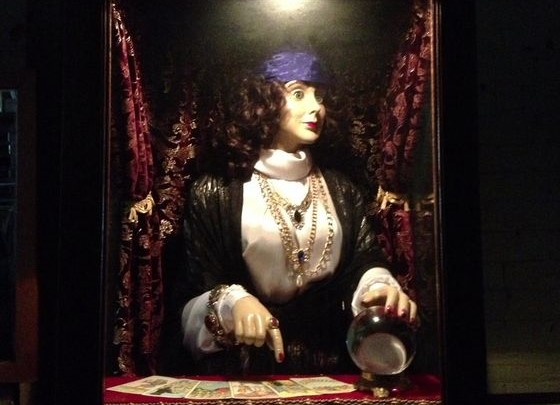
Close-up of a vintage fortune-teller automaton with an array of Tarot cards before her. Manufacturer unknown. Image from Pinterest/@areagallery; the full cabinet can be seen here. Another machine of this same model recently went on auction
.
“It was Sherwood Anderson’s Winesburg, Ohio that set me free,” Ray Bradbury recalled in his preface to the 1997 edition of The Martian Chronicles. “Sometime in my twenty-fourth year, I was stunned by its dozen characters living their lives on half-lit porches and in sunless attics of that always autumn town. ‘Oh, Lord,’ I cried. ‘If I would write a book half as fine as this, but set it on Mars, how incredible that would be!’”

The man who led Bradbury to Winesburg was Henry Kuttner, a prominent science fiction writer who was five years older and who became one of Bradbury’s mentors in the earliest years of his career. In 1944 he urged him to read Anderson’s masterpiece, a story cycle featuring characters living in a fictional Ohio town. Yet, aside from both books’ hybrid framework, the stories of Martian colonists have little in common with the tales of the residents of Winesburg, or as Bradbury put it, “Will you find traces of Sherwood Anderson here? No. His stunning influence had long since dissolved into my ganglion.”

Bradbury instead pointed his readers to the fictional town of Green Town, Illinois, featured in a later book: “You might see a few apparitions of Winesburg, Ohio in my other book-of-stories-pretending-to-be-a-novel, Dandelion Wine. But there are no mirror images. Anderson’s grotesques were gargoyles off the town roofs; mine are mostly collie dogs, old maids lost in soda fountains, and a boy super¬sensitive to dead trolley cars, lost chums, and Civil War Colonels drowned in time or drunk on remembrance.”

Bradbury began work on the book that would become Dandelion Wine around the time he first read Winesburg, Ohio. Initially titled “The Winds of Time,” then “Summer Morning, Summer Night,” his “Illinois novel” drew on his memories of his boyhood in Waukegan, but he was unable to wrestle the various episodes into a sustained narrative. While he was working on the book, however, many of the “Green Town” stories appeared in magazines as varied as Weird Tales, Ellery Queen’s Mystery Magazine, The Reporter, Good Housekeeping, Collier’s, and The Saturday Evening Post. His editor at Doubleday, Walter Bradbury (no relation) became convinced that the novel would ensure his soon-to-be star author’s transition from pulp magazines into the literary mainstream, and he offered him a contract for the book in 1951.

Ray Bradbury was hardly idle during the decade he struggled to write the Green Town novel: he finished The Martian Chronicles and Fahrenheit 451, as well as three story collections: The Illustrated Man, Golden Apples of the Sun, and The October Country. Sensing an impasse, Walter Bradbury suggested that he assemble a collection of linked stories from his Green Town project and finally, in October 1956, Ray sent Walter the first draft of Dandelion Wine. He continued to revise and expand the manuscript, adding two previously unpublished stories, “Exorcism” and “The Tarot Witch,” before the book went to the typesetters. He also decided to remove the titles of the stories, even of those that had previously appeared in magazines.

In its final form, Dandelion Wine is a far cry from Winesburg, Ohio, but perhaps the most important difference is the nature of its collective portrait of the town’s residents. After Sherwood Anderson published his warts-and-all novel, upstanding citizens from two Ohio towns could barely acknowledge his existence without speaking ill of him: not only his childhood home of Clyde, which was clearly the model for the book, but also the real Winesburg, Ohio, which Anderson didn’t even know existed when he chose the name for his fictional town. Bradbury never had to worry about such a reception in his own hometown of Waukegan, Illinois, which he remembered and reimagined through the prism of fond, aching nostalgia, of the kind that can originate only in the mind of young child. As he wrote in 1974:
I was amused and somewhat astonished at a critic a few years back who wrote an article analyzing Dandelion Wine plus the more realistic works of Sinclair Lewis, wondering how I could have been born and raised in Waukegan, which I renamed Green Town for my novel, and not noticed how ugly the harbor was and how depressing the coal docks and railyards down below the town.

But, of course, I had noticed them and, genetic enchanter that I was, was fascinated by their beauty. Trains and boxcars and the smell of coal and fire are not ugly to children. Ugliness is a concept that we happen on later and become self-conscious about. . . .
“In other words,” he added, “if your boy is a poet, horse manure can only mean flowers to him; which is, of course, what horse manure has always been about.”

Notes: The bumbling Keystone Kops were featured in a series of slapstick silent films produced by Mack Sennett during the 1910s. Much of San Francisco burned to the ground following the earthquake of April 18, 1906. Many of the Hal Roach comedy shorts and films of the 1920s (including the first Our Gang films) were directed by Charles Joseph Parrott, who often appeared in the comic lead role of Charley Chase. For the “real” Mme. Tarot, Bradbury may have been thinking of Marie Anne Adelaide Lenormand, a famous French card reader of the early nineteenth century; various decks of tarot cards evolved from her influence.

*   *   *
There she sat in her glass coffin, night after night, her body melted by the carnival blaze of summer, frozen in the ghost winds of winter, waiting with her sickle smile and carved, hooked, and wax-pored nose hovering above her pale pink and wrinkled wax hands poised forever above the ancient fanned-out deck of cards. . . . If you don't see the full selection below, click here (PDF) or click here (Google Docs) to read it—free!

This selection is used by permission. To photocopy and distribute this selection for classroom use, please contact the Copyright Clearance Center.

Monday, September 7, 2020

The New Englander

Sherwood Anderson (1876–1941)
From Sherwood Anderson: Collected Stories

The Line Storm, 1934. Oil and tempera on panel by American artist John Steuart Curry (1897–1946). From a print produced in 1937 by the National Committee for Art Appreciation, a short-lived federal project established under the direction of Eleanor Roosevelt.
“Sherwood Anderson has brought to the American short story the simple faith of a worshiper of art,” N. Bryllion Fagin began his review in the pages of English Journal in 1927. “He has deliberately ignored all the traditions of mechanics.” Anderson was very much aware of how completely his first three story collections subverted the conventions for writing short fiction, Fagin asserted, quoting an interview with the author that appeared six years earlier in Brentano’s Book Chat:
The short story form has become among us very much what I call corrupt. Publishers of short stories sought what they called the story with a kick in it. Plots for short stories were found and about these plots our writers sought to hang a semblance of reality to life. The plot, however, being uppermost in the writers' minds, what we got was a snappy, entertaining, artificial thing, forgotten completely an hour after it was read.

Perhaps because of a native laziness, I found myself unable to think up plots. To try to do so bored me unspeakably. On the other hand, there were all about me human beings living their lives and in the process of doing so creating drama. . . .
The author of Short-Story Writing: An Art or a Trade?, Fagin included a revised version of his article as a chapter of The Phenomenon of Sherwood Anderson, which, to be frank, reads in places like an unabashed fan letter. In its book form, however, his essay does acknowledge that Anderson was certainly not the first or the only writer “who has revolted against the machine-made story. . . . But because of his influence, the revolt has gathered momentum.” Or, as the neurologist and occasional literary critic Joseph Collins similarly wrote in “Sex in Literature,” the lead article in the April 1924 issue of The Bookman: “The rigid old shibboleths about how a good story must be written are disintegrating before the attacks of a new generation of writers.”

As the title of Collins’s essay indicates, not just the “mechanics” of the story were changing but also the range of acceptable subject matter. “You and I know that the big story here is the story of repression, of the strange and almost universal insanity of society,” Anderson wrote to the psychoanalyst Trigant Burrow, a close friend, about his difficulties finding magazines to publish the stories that would eventually be included in his second collection, The Triumph of the Egg. “The story does not need to be an unpleasant one to right-minded men and women, but it must be boldly and subtly told and make its audience slowly.”

Because of the revolutionary boldness of his stories, Anderson was frequently—and perhaps inevitably—linked to D. H. Lawrence. In 1927 the British critic Wyndham Lewis speculated that Lawrence was probably more widely read by Americans than by his own countrymen and that “his name is invariably associated, in America, with that of Sherwood Anderson.” When The Triumph of the Egg appeared in 1921, the American critic John Peale Bishop similarly noted that “Anderson alone among the Americans seems to bear a resemblance to Lawrence. . . . Anderson, like Lawrence, understands the physical ecstasy and contentment that would come of belonging utterly to the dark rich life of the earth and moving with the ancient rhythms of light and dark, of green and sterile seasons, of dayrise and nightfall.” So linked were the two authors in the public mind that H. L. Mencken’s satirical “Americana” column in The American Mercury quoted a newspaper writer in Alabama condemning “the social smut of your Sherwood Lawrences.”

The revolution in literature during the 1920s also reflected a geographical shift in American society. “The economic, political, and cultural eminence of New England was being supplanted by the Midwest’s increasing power,” writes Judy Jo Small, a literary scholar. The decade opened with a presidential race between Warren G. Harding and James M. Cox, both from Anderson’s home state of Ohio. Such artists as Thomas Hart Benton and Grant Wood became extraordinary successes with both critics and audiences. F. Scott Fitzgerald, Ernest Hemingway, Edna Ferber, Langston Hughes, and T. S. Eliot all hailed from the Midwest, following in the footsteps of such veteran writers as Willa Cather, Theodore Dreiser, and Sinclair Lewis.

To Sherwood Anderson, the changing attitudes in American literature were as much geographical as literary, a rejection of what he saw as the restrictive primness of aging New England institutions in favor of the expansive physicality of life in the wide open spaces out west. Nowhere, perhaps, is this shift made more explicit than in his story “The New Englander.” Biographer Walter B. Rideout describes it as “almost a paradigm of Anderson’s view of certain cultural-geographic differences in the United States and of the emotional damage done by what in the 1920s he was not alone in stigmatizing as ‘Puritanism,’ defined as that pervasive spirit of intolerant, joyless moralism, which was especially antagonistic to any expression of the power of sex.” As Small points out in an overview of “The New Englander,” the two women at the center of the story reflect the clash of “regional attitudes”: the older Elsie is both troubled and excited by the earthiness of her new Midwestern home and Elizabeth, a rambunctious teenager, secretly wants “to be a lady” like her aunt. Through the portraits of these two women, Anderson “enriches the historical-cultural dimension” of his tale by evoking “desiccated Easterners looking with longing at the robust vigor of the Midwest while crude Midwesterners look with longing at the refinement of the East.”

*   *   *
Her name was Elsie Leander and her girlhood was spent on her father’s farm in Vermont. . . . If you don't see the full selection below, click here (PDF) or click here (Google Docs) to read it—free!

This selection may be photocopied and distributed for classroom or educational use.

Saturday, May 4, 2019

Hands

Sherwood Anderson (1876–1941)
From Sherwood Anderson: Collected Stories

Sweet Pea Mood, July 23, 1917, watercolor and crayon on paper by Ohio artist Charles Ephraim Burchfield (1893–1967). Image courtesy of Christie’s.
A century ago, on May 8, 1919, the small press run by B. W. Huebsch, who had previously introduced American readers to D. H. Lawrence’s Sons and Lovers and James Joyce’s Dubliners and Portrait of the Artist as a Young Man, published a debut story collection by an up-and-coming writer. Sales of Sherwood Anderson’s first two novels, Windy McPherson’s Son and Marching Men, and his poetry collection, Mid-American Chants, had been poor, and the editors at the firm that had published his first three books didn’t think much of the new stories, finding them “too gloomy.” So the author traveled to New York in late 1918 to find a new publisher and through a mutual acquaintance he met Huebsch, who agreed to issue the book the following year. Huebsch’s literary acumen once again paid off: by the time he merged his imprint with Viking Press in 1924 Winesburg, Ohio: A Group of Tales of Ohio Small Town Life had gone through five printings.

Later in life, Anderson remembered finishing the interconnected stories of Winesburg, Ohio “in a few months, one following the other, a kind of joyous time for me, the words and ideas flowing freely, very little revision to be done.” In fact, the composition of Winesburg was neither so rapid nor so effortless, and the extant manuscripts show considerable evidence of rewriting. He arranged and on more than one occasion rearranged the stories before submitting them for publication as a book. All told, he may have taken as long as two and a half years—from November 1915 to April 1918—to complete them.

Still, Anderson’s recollection of an intensely creative “few months” only mildly exaggerates the pace at which Winesburg came into being. He began, very probably, in November 1915, with “The Book of the Grotesque”—a metafictional preamble that gave him a working title for the collection—and the story “Hands.” Both selections were published in early 1916 in consecutive issues of Masses, a little magazine edited by Max Eastman and Floyd Dell. By November 1916 he reported he had written fifteen of these “intensive studies of people in my home town, Clyde, Ohio,” out of the two dozen in the published Winesburg.

“They were all grotesques,” Anderson wrote in the introductory section, which conjured an “old writer” working on a book:
All of the men and women the writer had ever known had become grotesques. . . .

For an hour the procession of grotesques passed before the eyes of the old man, and then, although it was a painful thing to do, he crept out of bed and began to write. Some one of the grotesques had made a deep impression on his mind and he wanted to describe it.

At his desk the writer worked for an hour. In the end he wrote a book which he called “The Book of the Grotesque.” It was never published, but I saw it once and it made an indelible impression on my mind.
Anderson later wrote to a friend, “I think the most absorbingly interesting and exciting moment in any writer’s life must come when he, for the first time, knows that he is a real writer.” That moment arrived for Anderson in late 1915, when he wrote “Hands,” and he often retold his account, with varying details, in the years ahead:
I was ill, discouraged, broke. I was living in a cheap rooming house. I remember that I went upstairs and into the room. It was very shabby. I had no relatives in the city and few enough friends. I remember how cold the room was. On that afternoon I had heard that I was to lose my job.

. . . There was some paper on a small kitchen table I had bought and brought up into the room. I turned on a light and began to write. I wrote, without looking up—I never changed a word of it afterwards—a story called “Hands.” It was and is a very beautiful story.

I wrote the story and then got up from the table at which I had been sitting, I do not know how long, and went down into the city street. . . . It must have been several hours before I got the courage to return to my room and read my own story.

It was all right. It was sound. It was real. I went to sit by my desk. A great many others have had such moments. I wonder what they did. For the moment I thought the world very wonderful, and I thought also that there was a great deal of wonder in me.
As with Anderson’s other boasts about the ease of writing Winesburg, his claim that he “never changed a word” in the story is belied by the manuscript’s subsequent revisions, softening and compressing the phrasing or making the descriptions of Wing Biddlebaum’s “handsy” behavior more ambiguous. But the gist of the story remained intact; Anderson would often refer to it as his “first authentic tale,” and it became the opening story of Winesburg, Ohio.

Note: The details about Winesburg’s publication history have been abridged from “The Note on the Texts” in the Library of America edition of Sherwood Anderson: Collected Stories.

*   *   *
Upon the half decayed veranda of a small frame house that stood near the edge of a ravine near the town of Winesburg, Ohio, a fat little old man walked nervously up and down. . . . If you don't see the full selection below, click here (PDF) or click here (Google Docs) to read it—free!

This selection may be photocopied and distributed for classroom or educational use.

Friday, March 23, 2018

Loneliness

Sherwood Anderson (1876–1941)
From Sherwood Anderson: Collected Stories

Pond near Springfield, Ohio, 1924, oil on canvas by German American artist Oscar Grosch (1863–1928).
In 1916 Sherwood Anderson wrote to Waldo Frank, editor of the short-lived (but incredibly influential) literary monthly Seven Arts.
I am glad you liked the story "Mother" and that you are going to publish it. Damn it, I wanted you to like the story about Enoch Robinson. . . . Why do I try to convince you of this story? Well, I want it in print in Seven Arts. A writer knows when a story is good, and that story is good. Sometime when I am in New York, I'll bring that story in, and I'll make you see it.
Mother” was the third of four Sherwood Anderson stories published in Seven Arts, and it appeared in the March 1917 issue. Anderson visited Waldo Frank in New York around the time the issue arrived from the printer and, if they did in fact discuss the rejected story, “Loneliness,” Anderson was unable to change Frank’s mind. Six months later, after only twelve issues, the monthly folded when its patron, Annette Rankine, under pressure from family members, withdrew her support because of the magazine’s staunch opposition to America’s entry in the European war.

Between the beginning of 1916 and the end of 1918, Anderson published in a trio of little magazines—Seven Arts, Little Review, and Masses—a total of ten stories set in the fictional Ohio town of Winesburg. In May 1919 he gathered these interrelated stories, along with more than a dozen additional selections (including “Loneliness”), in the book that would be his masterpiece: Winesburg, Ohio: A Group of Tales of Ohio Small Town Life.

At the end of the story “Adventure,” the character Alice Hindman muses, “Many people must live and die alone, even in Winesburg.” One of those isolated people is Enoch Robinson, the central character of “Loneliness.” Hoping to become an artist in New York City, Enoch draws and paints various hometown memories but, to make a living, ends up as an illustrator at an advertising firm. Some scholars have noted the apparent parallels between author and character, since Anderson also left his hometown, married, had children, and worked in advertising to support his family. What Enoch does with charcoal and paintbrush, Anderson did with pen and typewriter.

Yet, biographer Kim Townsend contends, the more obvious inspiration for Enoch is Anderson’s brother Earl, who moved to Chicago with grand hopes but settled for a dead-end job as a restaurant cashier. “To Anderson,” writes Townsend, “his brother always symbolized the sensitive, lonely, vulnerable people of America.” In 1913 Earl disappeared altogether, and Anderson had no idea where his brother was when he wrote “Loneliness,” which may explain why the story is “one of the most moving of the Winesburg, Ohio tales.”

In a case of life imitating art, Earl was located in a Manhattan hospital in February 1926— thirteen years after his disappearance (and seven years after the publication of Winesburg). He had collapsed on the street from a stroke that entirely paralyzed him. Anderson soon discovered that Earl had been in Brooklyn for many years, living (as his landlady put it) a “happy but lonely” existence while working in Manhattan at a bakery. Earl never recovered and he died the following year. As Anderson wrote to a friend, in Earl’s apartment were copies of his brother’s books and “a stack of drawings, illustrations—etc. which were remarkably fine, finer than most of the illustrations one finds in magazines—he had the ability to make a fine living and possibly great distinction [but] for years he had been mixing dough.”

Note: For some background on Clyde, the town where Anderson spent his childhood and which served as the inspiration for Winesburg, as well as information on the real Ohio locale that shares the name of Anderson's fictional town, see our introduction to “Adventure.”

*   *   *
Free audio: This selection is accompanied by a streaming audio version, read by the award-winning short-story writer Antonya Nelson.


*   *   *
He was the son of Mrs. Al Robinson who once owned a farm on a side road leading off Trunion Pike, east of Winesburg and two miles beyond the town limits. . . . If you don't see the full selection below, click here (PDF) or click here (Google Docs) to read it—free!

This selection may be photocopied and distributed for classroom or educational use.

Friday, September 9, 2016

Unlighted Lamps

Sherwood Anderson (1876–1941)
From Sherwood Anderson: Collected Stories

End of the Trolley Line, Oak Park, Illinois, 1893, oil on canvas by American artist Frederick Childe Hassam (1859–1935), painted when Hassam was in Chicago for the World's Fair. Like Oak Park, Anderson’s fictional Huntersburg is due west of Chicago—albeit forty miles further out. Image courtesy of WikiArt.
As early as 1913, two years before he began drafting the stories of Winesburg, Ohio, Sherwood Anderson worked simultaneously on two novels, “Talbot Whittingham” and “Mary Cochran.” The first was a semi-autographical study of a young man struggling to become an artist; according to biographer Walter B. Rideout, the surviving manuscript reveals much about Anderson’s evolution as a writer, but “the novel has serious flaws.” “Talbot Whittingham” remains “unpublished and unpublishable” and survives among his papers, examined only by scholars and biographers.

“Mary Cochran,” on the other hand, is a portrait of a New England village girl who moves west with her father and eventually ends up working an office job in a Chicago factory, insisting upon her independence while looking for a suitable husband. This novel, too, was ultimately set aside and never published. Yet, according to Rideout, “Mary Cochran” is “so well-conceived and shows so much sympathetic understanding of its woman protagonist that it is surprising Anderson remained dissatisfied with it.”

Toward the end of 1919 Anderson still hoped to finish the book, but—because of the success of Winesburg—he reconceived it as a collection of interrelated stories rather than a novel. He wrote to his publisher:
One of these days I shall be able to give you the Mary Cochran book. It has tantalized me a good deal but is coming clear now. In its final form it will be like Winesburg, a group of tales woven about the life of one person but each tale will be longer and more closely related to the development of the central character.
Only a few weeks later, however, Anderson’s tone sounded a more discouraging note:
The tales that are to make up the Mary Cochran book are waiting like tired people on the doorstep of the house of my mind. They are unclothed. I need to be a tailor and make warm clothes of words for them.
In the end, Anderson revised only two sections of the novel as stories (“Unlighted Lamps” and “The Door of the Trap”), and he included them in The Triumph of the Egg, his follow-up collection to Winesburg, Ohio. Given the tortured paths of these two stories to publication, some critics have dismissed them as “pages salvaged from discarded novels” (to quote one reference work). Such an appraisal is misleading. The stories had been extensively revised from the episodes in the novel manuscript, each was accepted for publication as a stand-alone story by editors of two different magazines (Smart Set and Dial), and neither was regarded by readers as a novel excerpt. Rideout argues that the transformation is especially noteworthy in “Unlighted Lamps,” which is drawn from the opening chapter. “Granted the necessary differences between a short story and the first chapter of the novel,” Rideout writes, “it is clear that [Anderson] knew now how to reject extraneous material and to concentrate on the essentials of the action.”

Although the Mary Cochran narrative didn’t live up to the author’s original expectations, the two published tales are hardly out of place in The Triumph of the Egg. In a retrospective essay published shortly after Anderson’s death in 1941, his longtime friend Robert Morss Lovett evaluated Anderson’s writing and found that many of his stories “are concerned with the frustration of human life that comes from isolation, the inability of one being to come near, to enter into understanding with another.” Of all the stories in the collection, “Unlighted Lamps” is probably the most successful at bringing together these twin themes of crippling loneliness and of the failure of loved ones to communicate.

Note: Much of the background in this introduction and the letter excerpts have been culled from the first volume of Rideout’s masterful biography, Sherwood Anderson: A Writer in America (2006).

*   *   *
Mary Cochran went out of the rooms where she lived with her father, Doctor Lester Cochran, at seven o’clock on a Sunday evening . . . If you don't see the full selection below, click here (PDF) or click here (Google Docs) to read it—free!

This selection may be photocopied and distributed for classroom or educational use.


Saturday, August 8, 2015

Adventure

Sherwood Anderson (1876–1941)
From Sherwood Anderson: Collected Stories

Alone (1911), oil on cardboard by American artist Frank Coburn (1862–1938). Image courtesy of The Athenaeum.
In many of the interrelated stories collected in Sherwood Anderson’s Winesburg, Ohio, the word “adventure” is used to indicate (in the words of literary scholar Ray Lewis White) “the one brief moment, the one epiphany, the one telling instant, that captures and communicates the essence of that character’s personality, leaving nothing more to be said or learned about him or her.” Among the stories featuring such epiphanies, Anderson placed the story titled “Adventure” in the middle. In his study of famous story cycles, Forrest L. Ingram points out that there are five tales before and five after in which Anderson makes explicit this motif, often caused by an “attempt to establish contact with another Winesburger, to transcend one’s self-containment and isolation.” Or as the best-selling novelist Tom Perrotta adds, “Winesburg, Ohio feels like a village full of eccentric strangers desperate for a moment of connection,” and reading the book reminds him of “wandering the quiet night-time streets of my hometown, slowly coming to realize that the people I knew were more complicated and interesting than they appeared.”

Biographers have often pointed out that Winesburg resembles in essential ways the town of Clyde, where Anderson spent most of his childhood in the late 1800s; critical editions of the stories often identity various landmarks and events with their fictional counterparts. Because some residents felt they or their neighbors were depicted in unflattering or indelicate ways, the inhabitants of Clyde ignored the book for many years and disdained any comparison to Anderson’s fictional town. Perhaps unsurprisingly, the area now proudly hypes its connection to their native son and has even set aside his birthday, September 13, as Sherwood Anderson Day.

Soon after the book was published in 1919, Anderson discovered—to his dismay—that there was a real town in Ohio with the name of Winesburg. “It was no doubt stupid of me,” he later admitted to the local Methodist minister, Arthur H. Smith, who privately printed a thin book called An Authentic History of Winesburg, Holmes County, Ohio in 1930 and sent a copy to Anderson. Smith understood that the stories were not in any way about his own municipality—and said as much in his study. Anderson appreciated receiving the book and appears to have read it in its entirety, but he took exception to Smith’s use of the word “burlesque” to describe his story collection:
The book is, of course, in no sense a burlesque, but it is an effort to treat the lives of simple ordinary people in an American middle western town with sympathy and understanding. . . . Certainly, I did not write to make fun of these people or to make them ridiculous or ugly, but instead to show by their example what happens to simple, ordinary people—particularly the unsuccessful ones—what life does to us here in America in our times—and on the whole how decent and real we nevertheless are.
*   *   *
Note: The Epworth League (mentioned on page 78) was organized in 1889 by the Methodist Episcopal Church in Cleveland, Ohio, to encourage and train young people in churchmanship and religious life.

Free audio: This selection is accompanied by a streaming audio version, read by the award-winning short-story writer Deborah Eisenberg.


*   *   *
Alice Hindman, a woman of twenty-seven when George Willard was a mere boy, had lived in Winesburg all her life. She clerked in Winney’s Dry Goods Store and lived with her mother who had married a second husband. . . . If you don't see the full selection below, click here (PDF) or click here (Google Docs) to read it—free!

This selection may be photocopied and distributed for classroom or educational use.

Friday, October 10, 2014

Mother

Sherwood Anderson (1876–1941)
From Sherwood Anderson: Collected Stories

Panoramic Landscape with a View of a Small Town, c. 1850. Artist unknown. Image courtesy of the online collection of the Brooklyn Museum.
In 1916 the new monthly magazine Seven Arts accepted for publication a brief story, “Queer,” by advertising copywriter and household goods salesman Sherwood Anderson. It was slotted for the magazine’s second issue, but before it had even gone to press, Anderson sent in another tale and informed the editor, Waldo Frank, that both selections were part of “a series of intensive studies of people of my home town, Clyde, Ohio.” He continued:
In the book I called the town Winesburg, Ohio. Some of the studies you may think pretty raw, and there is a sad note running through them. One or two of them get pretty closely down to ugly things of life.
The second submission, “The Untold Lie” (a previous Story of the Week selection), was promptly accepted for the third issue of Seven Arts and, intrigued, Frank encouraged Anderson to send in other selections from the series. Yet another story, “Mother,” soon appeared in the magazine, with a note identifying Anderson as “one of the significant new men out of the West.”

“Mother” introduced readers to Elizabeth Willard, whose son who would appear in many of the Winesburg tales. She is disappointed with her life and her marriage and hopes that her son will be able to escape the isolation and misery she has endured in the town of Clyde. Anderson based the character on his own mother, who died in 1895 when he was eighteen, and he dedicated Winesburg, Ohio to his mother’s memory, “whose keen observations on the life about her first awoke in me the hunger to see beneath the surface of lives.”

Today’s readers might find it hard to imagine the intensity of the reactions, both positive and negative, when the Winesburg stories first began appearing and especially after they were collected as a book in May 1919. Although the stories found favor with most critics, an early reviewer accused the author of reducing his characters “from human clay to plain dirt”; another called the book “the picture of a maggoty mind.” (The latter critic, William Allen White, would rescind his opinion when, two decades later, he recommended Anderson’s latest work to Book-of-the-Month Club members.) A somewhat ambivalent notice in the Chicago Tribune asserted, with considerable overstatement, that the tales are “practically all concerned chiefly with the sex life of the inhabitants of the Ohio village.” One of the newspaper’s readers responded with a letter:
[The book] seems to me a distillation of the sort of leering gossip one would expect to find bandied about by male scandalmongers chewing tobacco on cracker barrels in a dirty cross-roads grocery store. . . . I suppose this book will be “hailed” by a few Dreiser devotees and some impressionable reviewers will admire it as “strong.” It is so strong it ought to be buried without delay in the nearest public sanitation.*
Fortunately for the history of American literature, Anderson’s masterpiece remained well above ground. Years later William Faulkner (who dedicated Sartoris, his third novel, to Anderson) wrote, “Sherwood Anderson was the father of all my works—and those of Hemingway, Fitzgerald, etc. We were influenced by him. He showed us the way.”

* As reprinted in Walter B. Rideout’s Sherwood Anderson: A Writer in America (volume 1, 2006), p. 316.

*   *   *
Free audio: This selection is accompanied by a streaming audio version, read by the award-winning memoirist Patricia Hampl.

*   *   *
Elizabeth Willard, the mother of George Willard, was tall and gaunt and her face was marked with smallpox scars. Although she was but forty-five, some obscure disease had taken the fire out of her figure. . . . If you don't see the full selection below, click here (PDF) or click here (Google Docs) to read it—free!

This selection may be photocopied and distributed for classroom or educational use.

Friday, March 15, 2013

Certain Things Last

Sherwood Anderson (1876–1941)
From Sherwood Anderson: Collected Stories

Detail from Chicago Street Scene, undated oil on canvas by American artist William Clusmann (1859–1927). Image courtesy of M. Christine Schwartz Collection.
Although “Certain Things Last” was probably written by Sherwood Anderson in the 1920s, it remained unpublished until it was rescued from his papers and included as the title story in a collection of his stories in 1992—five decades after his death. The late Charles E. Modlin, the editor of that collection (and, at the time, one of the trustees of the Sherwood Anderson Literary Estate Trust), singled out the story in an introduction:
Anderson criticized the writers of popular fiction that pandered to the public’s desire for adventure, romance, or moral uplift. . . . He maintained instead that fiction should take on a natural form that, instead of distorting life, captures it honestly. While art is distinct from real life, “the imagination must constantly feed upon reality or starve.” This is the essential point in “Certain Things Last” . . .
The novelist Ben Marcus recently elaborated on the uniqueness of Anderson’s fiction and, in particular, this story:
What makes Sherwood Anderson’s stories so special (when you read the stories in Winesburg, Ohio, for instance) is the way he extracts from the ordinary something so uncanny, so sublime, so extraordinary . . . and that defines him as a writer. It’s his ability to work with the plain encounter and to record the way it feels simply to be a person in the world. In “Certain Things Last,” he’s giving, in a sense, the most candid, honest, and searching interview a writer could give. . . . It’s an amazing example of metafiction—in other words, “fiction about fiction,” that reveals the process of the writer: a writer talking about craft.
* * *
Free audio: This selection is accompanied by a streaming audio version, read by the acclaimed author Ben Marcus.


* * *
For a year now I have been thinking of writing a certain book. “Well, tomorrow I’ll get at it,” I’ve been saying to myself. Every night when I get into bed I think about the book. . . . If you don't see the full selection below, click here (PDF) or click here (Google Docs) to read it—free!

This selection is used by permission.
To photocopy and distribute this selection for classroom use, please contact the Copyright Clearance Center.

Saturday, January 12, 2013

The Egg

Sherwood Anderson (1876–1941)
From Sherwood Anderson: Collected Stories

Farm by the Shore, c. 1881, oil on canvas, by Ohio native Thomas Worthington Whittredge (1820–1910). Courtesy of The Athenaeum.
“It is the particular virtue of ‘The Egg,’” wrote Irving Howe in 1951, “that while each paragraph seems comic its total effect is one of great pathos.” Fifteen years later, Howe would affirm, “‘The Egg’ seems to me one of the greatest stories ever written, a masterpiece of grotesque pathos that will live as long as the English language survives.” Howe also emphasized Anderson’s (and the story’s) notable debt to Mark Twain. Similarly, although William Faulkner would later satirize Anderson, he called him “the father of all of my works” and acknowledged in the same breath that Twain was the writer who influenced them both.

In 1918 Anderson began an extraordinary correspondence with literary critic Van Wyck Brooks, who was considering the possibility of writing a book on Twain. Dead for nearly a decade, Twain was as widely read, perhaps more so, than he had been during his lifetime. Yet the critical and scholarly assessment could be said to have been mixed. His most popular works were often dismissed as boy’s tales; Arnold Bennett famously wrote, “Episodically, both Huckleberry Finn and Tom Sawyer are magnificent, but as complete works of art they are of quite inferior quality,” and Henry James dismissed Twain’s popularity as proof of its appeal to “rudimentary minds.”

Anderson was excited by the prospect that a New York critic like Brooks would publish a book on Twain, and his letters, “showed his desire to ‘sell’ Twain to the easterner,” according to biographer Walter Bates Rideout. “A good part of what Sherwood wished to sell had been, as it were, bought by Van Wyck already.” In his letters Anderson sketched a portrait of Twain as a “river man” who went East and was tamed by “that New England crowd,” which then tempered his creative genius. Yet one thing Anderson failed to sell to Brooks—and he tried—was the raw aesthetic power (the “proud, conscious innocence,” as he put it) of one particular novel by Mark Twain. Brooks “did not change his decision, one he later publicly regretted, to minimize the importance of Huckleberry Finn.”

Brooks’s groundbreaking study, The Ordeal of Mark Twain, appeared in 1920 and set the tone for Twain studies for several decades. It argues that after a promising start Twain fell victim to the moneymaking enticements of the Gilded Age and, as a result, never realized his full potential as an artist—a thesis that echoed Anderson’s letters to Brooks. That same year “The Triumph of the Egg” (later retitled simply “The Egg”) was published, and even the first-time reader of Sherwood Anderson will discern Twain’s influence. In his memoirs Anderson wrote that, like his beloved literary predecessor, his stories frequently returned to “the first twenty years of his life, impressions of people, and events experienced during these formative years when the imagination is most alive.”

Note: On page 237, there is a reference to a legend about Christopher Columbus that dates at least to the sixteenth century. Columbus is said to have challenged fellow diners to stand an egg on its end, a feat he then accomplished by cracking the shell at the tip.

Free audio: This selection is accompanied by a streaming audio version, read by the best-selling novelist Rick Moody.


*   *   *
My father was, I am sure, intended by nature to be a cheerful, kindly man. Until he was thirty-four years old he worked as a farm-hand for a man named Thomas Butterworth whose place lay near the town of Bidwell, Ohio. . . . If you don't see the full selection below, click here (PDF) or click here (Google Docs) to read it—free!

This selection may be photocopied and distributed for classroom or educational use.

Friday, August 24, 2012

The Untold Lie

Sherwood Anderson (1876–1941)
From Sherwood Anderson: Collected Stories

Sherwood Anderson became a published author of fiction relatively late in life. As a young man he had written articles and essays for such regional periodicals as Agricultural Advertising, but his short stories were routinely rejected by publishers and his attempts at novel-writing went nowhere. His primary employment was as an advertising copywriter, and he owned a small business selling household products. But in 1912 the Anderson Manufacturing Company began to fail. On Thanksgiving Day, he left his office, walked toward Cleveland for four days (sleeping outdoors), and sent his wife a fairly incoherent seven-page letter describing his experiences. He was admitted to a hospital in Cleveland, and in early December a local newspaper reported the episode, attributing his behavior to “nervous exhaustion.” Eventually he recovered and his first published story, “The Rabbit-pen,” appeared in Harper’s in July 1914; two years later, at the age of forty, he finally published his first book, the novel Windy McPherson’s Son.

Soon after the book’s publication, Anderson began sending stories to the new and ultimately influential (if short-lived) journal The Seven Arts. According to Irving Howe, Anderson’s tales so impressed editor Waldo Frank that he wrote a glowing appreciation, “Emerging Greatness,” for the first issue, and stories by Anderson appeared in the second and third issues. In 1917 Anderson visited the Seven Arts offices; the staff expected an introverted young writer and was thrown by the sight of the actual man. As one editor recalled, “I had built an Anderson out of the stories, a shy sort of fellow, a little mussed, slipping against the wall so as not to occupy too much space. Instead of that I looked straight at an up-and-coming ad man with a stiff collar, and a bit of the super-salesman air.” But Anderson quickly became friends with many of the New York literary set, including the critic Van Wyck Brooks and the young poet Hart Crane. Frank later wrote, “To me, the young New Yorker, Sherwood Anderson was America.”

One of the two first stories that Anderson sent to The Seven Arts was “The Untold Lie.” When he initially wrote this and subsequent stories, each was meant to be read separately, but since they were set in the same locale, he revised and gathered them into Winesburg, Ohio, which contains twenty-five interlocking stories describing moments in the lives of the characters of one town. It was the first of four story collections that, as Joyce Carol Oates has written, “had an incalculable influence upon generations of American writers. The deceptively artless, unadorned, anecdotal Anderson voice has come to characterize for many readers the distinctive American voice.”

Incredibly, no publisher has ever gathered Sherwood Anderson’s four story collections into one book—until now. At the end of this year, The Library of America will publish the most comprehensive volume of Anderson’s stories ever published—containing Winesburg, Ohio; The Triumph of the Egg; Horses and Men; and Death in the Woods, plus fifteen stories that Anderson didn’t include in these four landmark collections.

*   *   *
Ray Pearson and Hal Winters were farm hands employed on a farm three miles north of Winesburg. On Saturday afternoons they came into town and wandered about through the streets with other fellows from the country. . . . If you don't see the full story below, click here (PDF) or click here (Google Docs) to read it—free!

This selection may be photocopied and distributed for classroom or educational use.