Showing posts with label World War I. Show all posts

Sunday, April 12, 2026

The American Volunteer Motor-Ambulance Corps in France

Henry James (1843–1916)
From Henry James: Collected Travel Writings: The Continent

An American ambulance in the commune of Sacy, south of Reims, France, c. 1914–17, by Parisian photographer J. Patras (about whom little is known). Courtesy University of Nebraska–Lincoln Libraries.
“I write you under the black cloud of portentous events on this side of the world, horrible, unspeakable, iniquitous things,” Henry James wrote on August 21, 1914, to Margaret La Farge, a longtime friend from his youthful days in Newport. “I mean horrors of war criminally, infamously precipitated. . . . The air is full of the wars, and rumors, and I brace myself with the fear of the newspaper.”

After several months in London, he was back at Lamb House, his home in the East Sussex village of Rye, where he fretted over the events on the Continent. Germany had declared war on France on August 3 and invaded Belgium the next day. In response, Great Britain, which had guaranteed Belgium’s neutrality by treaty, declared war on Germany and sent 75,000 soldiers to France. On August 23, the British Expeditionary Force fought its first battle alongside the French army in the coal-mining region around Mons, Belgium. “Never has England in all her time, gone at anything with cleaner hands or a cleaner mind and slate,” James wrote to a friend two weeks later. At month’s end, James updated his nephew William James Jr. by telling him the Allies had thwarted the quick, decisive conquest the invaders had expected: “Roughly speaking, Germany, immensely prepared and with the biggest fighting-power ever known on earth, has staked her all on a colossal onslaught, and yet is far even yet from having done with it what she believed she would in the time, or on having done it as she first designed. . . . But it is all for the moment tremendously dark and awful.”

The truth was more complicated; when James wrote his nephew the British forces were in full retreat and a halt to the seemingly unstoppable German offensive was still more than a week in the future. After initially repulsing several attacks by the much larger German army, the B.E.F. was forced to withdraw as the Allied armies fell back before the offensive. By September 5, the British had lost 15,000 men and had retreated more than 200 miles to a position southeast of Paris. The Allies regrouped and on September 6 the B.E.F. began advancing north toward the Marne River. The Allied success in the first battle of the Marne caused the Germans to halt their offensive on September, withdraw northward to the Aisne River, and dig into defensive positions.

To James, now 71 years old, wartime jitters brought back memories of his late teen years. “I felt in the air the recall of our Civil War shocks and anxieties, and hurryings and doings, of 1861,” he wrote to the American painter Helena de Kay Gilder on September 2. “The pressure in question has already become a much nearer and bigger thing, and a more formidable and tragic one, than anything we of the North in those years had to face.” While dreading and decrying the futility and destruction, James idolized the young men willing to fight. “Ever since his visit to a Civil War camp , where he had gone to see his younger brothers, he had had an image of men committed to heroism and to death,” noted Leon Edel, in his biography of James. “The sense of power and glory in James made him an admirer always of the soldier.” When 29-year-old Burgess Coakes, James’s servant for the previous fifteen years, decided to enlist, James offered his full support, both emotional and material—despite his own dependence on assistance during his frequent illnesses and attacks of angina. (Worried for her friend’s well-being, Edith Wharton lent James one of her own servants.)

After two months in Rye, James found the news of the war so distracting and upsetting that he returned to London, where he could “feel a little less finished & useless & doddering.” Almost immediately, he began raising money for Belgian refugees and visiting the wounded soldiers flooding the city’s hospitals. Even these acts recalled the Civil War to him; in his memoir Notes of a Son and Brother (published later that year) he compared his bedside visits to those of Walt Whitman: “Yet again, as I indulge this memory, do I feel that I might if pushed a little rejoice in having to such an extent coincided with, not to say perhaps positively anticipated, dear old Walt—even if I hadn’t come armed like him with oranges and peppermints.” His notebook reveals, however, that he arranged for the delivery of notable quantities of chocolate for recovering soldiers.

In October, in a letter to his nephew Henry, James voiced his concern for the Belgian soldiers who, in addition to recovering from their wounds, worried over the fate of their families in their conquered homeland. “Not one of those with whom I talked the last time had yet come by the shadow of a clue or trace of any creature belonging to him, young wife or child or parent or brother, in all the thick obscurity of their scatterment.” His charitable impulses extended beyond the many days he spent visiting hospitals and refugee centers; he was known to offer assistance and comfort to wounded soldiers he encountered on the street. He described one such incident to Edith Wharton:
The thing that most assuages me continues to be dealing with the wounded in such scant measure as I may; such, e.g., as my having turned into Victoria Station, yesterday afternoon, to buy an evening paper and there been so struck with the bad lameness of a poor hobbling khaki convalescent that I inquired of him to such sympathetic effect that, by what I can make out, I must have committed myself to the support of him for the remainder of his days—a trifle on account having sealed the compact on the spot. It all helps, however—helps me; which is so much what I do it for.
The archaeologist Richard Norton, whose family James had known for decades, arrived in London soon after the declaration of war, traveled onward to France, and realized quickly that the French and British armies alike were ill-prepared to transport the wounded from battlefield to hospital. Using his own funds, Norton purchased ten ambulances, gathered a group of mostly American volunteers, and requested approval from the London War Office to travel to France. In October, the new American Volunteer Motor Ambulance Corps in its first week transported 500 wounded soldiers from the frontlines, and the effort grew from that auspicious start.

James offered his support early on and in December accepted the position of honorary chairman, in which capacity he raised funds and organized publicity efforts. Within a week he issued a pamphlet containing an open letter to the American press, reprinted below, in which he described the work of the corps, solicited donations for its efforts, and encouraged young men, particularly American undergraduates or recent graduates, to volunteer. An abridged version of the document appeared first in the United States in the January 4 issue of The New York World. He even broke a self-imposed rule and met with a reporter; “I can’t put my devotion and sympathy for the cause of our corps more strongly than in permitting it thus to overcome my dread of the assault of the interviewer,” he told New York Times journalist Preston Lockwood in March. One of the most unexpected outcomes of the Corps and the subsequent wartime ambulance services was the number of American drivers who later became well-known writers, including Louis Bromfield, Malcolm Cowley, E. E. Cummings, John Dos Passos, Dashiell Hammett, Ernest Hemingway, Archibald MacLeish, Charles Nordhoff, and Gertrude Stein. The critic Alfred Kazin later called the Corps “the most distinguished of the lost generation’s finishing schools.”

When James attempted to return to Lamb House, situated near the coast of the English Channel, he learned that, even as an American who had lived in England for forty years, he was still considered an alien and had to report to the police. His fealty to Britain and the war effort, combined with his disappointment over American neutrality, compelled him to apply for British citizenship. James had known Herbert Henry Asquith since the 1890s, and after Asquith became prime minister in 1908, James would occasionally dine with him at 10 Downing Street. So James requested that Asquith and three other friends (as required by law) “bear witness to their kind acquaintance with me, to my apparent respectability, and to my speaking and writing English with an approach of propriety.” On July 26, 1915, seven months before his death, Henry James became a British citizen.

Notes: Among the French terms used by James are postes de secours (first-aid stations), blessés assis (wounded men who can be seated), and villageoises (villagers). Eliot Norton was the brother of Richard Norton; both were sons of Harvard professor Charles Eliot Norton.

*   *   *
SIR,—Several of us Americans in London are so interested in the excellent work of this body, lately organised by Mr. Richard Norton and now in active operation at the rear of a considerable part of the longest line of battle known to history, . . . If you don't see the full selection below, click here (PDF) or click here (Google Docs) to read it—free!

This selection may be photocopied and distributed for classroom or educational use.
Sunday, July 20, 2025

Now I Lay Me

Ernest Hemingway (1899–1961)
From Ernest Hemingway: A Farewell to Arms & Other Writings 1927–1932

Ernest Hemingway recovering at the American Red Cross Hospital in Milan, Italy, in the summer of 1918. Photograph by Henry S. Villard, who was a fellow volunteer ambulance driver and hospital patient. (John F. Kennedy Presidential Library and Museum)
A few weeks after Ernest Hemingway began work as a Red Cross ambulance driver in Italy during the first World War, he volunteered for canteen service on the front lines, outside the town of Fossalta on the Piave River. On the night of July 8, 1918, he was about one hundred yards behind the Italian trenches when he was hit by an Austrian trench mortar, which landed less than a yard away, followed almost immediately by a machine gun bullet. The twenty-six-year-old Italian soldier standing next to Hemingway was instantly killed.

"I died then,” Hemingway later told his friend Guy Hickok. “I felt my soul or something coming right out of my body, like you'd pull a silk handkerchief out of a pocket by one corner. It flew around and then came back and went in again and I wasn’t dead anymore.” A month later, in a letter to his family, he described the scene:
After I came to they carried me on a stretcher three kilometers back to a dressing station. The stretcher bearers had to go over lots because the road was having the “entrails” shelled out of it. . . . The dressing station had been evacuated during the attack so I lay for two hours in a stable, with the roof shot off, waiting for an ambulance. When it came I ordered it down the road to get the soldiers that had been wounded first. It came back with a load and then they lifted me in. The shelling was still pretty thick and our batteries were going off all the time way back of us and the big 250s and 350s [mortar shells] going over head for Austria with a noise like a railway train.
He was transported to the American Red Cross Hospital in Milan, where he spent the next ten weeks recovering from mortar fragment wounds (“227 little devils”) in his legs and feet.

This formative, tragic experience was, to varying extents, transformed into fiction in several of Hemingway’s works—most famously in A Farewell to Arms but also notably in “Now I Lay Me,” one of the two dozen Hemingway stories featuring the character Nick Adams. The link between author and character in this story is reinforced, in the view of some scholars, by an early draft in which Nick’s mother refers to him as Ernie, which Hemingway crossed out and replaced with Nicky. The story has often been paired with another semiautobiographical story, “In Another Country,” featuring an unnamed wounded soldier (almost universally assumed to be Nick Adams) recovering in a military hospital in Milan. Hemingway himself used the title “In Another Country—Two” for an early draft of “Now I Lay Me.”

The story opens with Nick lying on the floor in a silkworm house. More than one scholar has compared the subsequent series of reflections and memories to a “therapeutic talk-session” for addressing post-combat stress. The tendency among many critics, then, has been to treat Nick on a bed of straw as if he were Ernest on a couch. Yet Paul Smith, in his Reader’s Guide to the Short Stories of Ernest Hemingway, cautions against approaching the story as a fictionalized memoir:
As with other stories, it seems that the apparently autobiographical nature of “Now I Lay Me” has chilled any interest in its literary sources; and if so, there is an irony in the fact that so little of its narrative can be corroborated as personal history. Hemingway was wounded (once, not twice as was Nick); suffered from insomnia; slept one night on a visit with two friends in a silk “factory” (before, not after he was wounded, as Nick was); he loved trout fishing and cherished his recollections of the sport; and when he was six, his grandfather died, his family moved from the grandfather’s house in which Ernest was born to “a new house designed and built” by his mother when he was seven. If the rest of the story is not fiction, it is still, in varying degrees, unsubstantiated “fact.”
Nevertheless, Smith adds, “the more important elements of the story, all those so precisely and dramatically realized, have been taken by one biographer after another as personal experience and then read by later critics, in turn, as biographical evidence to support an interpretation—most often a psychological one—of the story.” Or, as another scholar suggests, “Autobiographical assumption is virtually automatic among those who write about Nick. On the other hand, those who read the Nick stories generally become caught up in his experience, and eschew the vast Hemingway scholarship, for the time, to respond to Nick as his own person.”

*   *   *
The above quote from Guy Hickock appeared in “A Portrait of Mister Papa,” a profile of Hemingway by Malcolm Cowley in the January 10, 1949, issue of Life magazine.

Notes to the story: Tenente is Italian for lieutenant. In 1918, American journalist Arthur Brisbane was editor of the Hearst-owned Chicago Harold and Examiner. The story concludes with mention of the October offensive, or the Battle of Vittorio Veneto, October 24, 1918–November 3, 1918, an Italian victory that led to Austria’s suing for an armistice.

*   *   *
That night we lay on the floor in the room and I listened to the silk-worms eating. . . . If you don't see the full selection below, click here (PDF) or click here (Google Docs) to read it—free!

This selection may be photocopied and distributed for classroom or educational use.

Sunday, July 14, 2024

In Another Country

Ernest Hemingway (1899–1961)
From Ernest Hemingway: A Farewell to Arms & Other Writings 1927-1932

Physical Therapy at Bath Hospital, 1918. Watercolor by English artist E. Horton [Sarah Elizabeth Roberts Horton] (1865–1959). WikiCommons.

On the night of July 8, 1918, Hemingway was hit by an Austrian trench mortar, followed almost immediately by a machine gun bullet. He was transported to the American Red Cross Hospital in Milan, where he spent the next ten weeks recovering from mortar fragment wounds (“227 little devils”) in his legs and feet.
When Ernest Hemingway’s story collection Men Without Women appeared in 1927, Dorothy Parker—who considered him “the greatest living writer of short stories”—reviewed it for The New Yorker, with (she confessed) some concern. She had greatly admired Hemingway’s debut collection, In Our Time, and believed it had been too readily dismissed by some American critics:
Well, you see, Ernest Hemingway was a young American living on the left bank of the Seine in Paris, France; he had been seen at the Dome and the Rotonde and the Select and the Closerie des Lilas. He knew Pound, Joyce and Gertrude Stein. There is something a little well, a, little you-know—in all of those things. You wouldn’t catch Bruce Barton or Mary Roberts Rinehart doing them. No, sir.

And besides, In Our Time was a book of short stories. That’s no way to start off. People don’t like that; they feel cheated.
After The Sun Also Rises was published, however, Hemingway became the new thing. “He was praised, adored, analyzed, best-sold, argued about, and banned in Boston; all the trimmings were accorded him,” Parker wrote. “People got into feuds about whether or not his story was worth the telling. . . . They affirmed, and passionately, that the dissolute expatriates in this novel of ‘a lost generation’ were not worth bothering about; and then they devoted most of their time to discussing them.”
After all the high screaming about The Sun Also Rises, I feared for Mr. Hemingway’s next book. You know how it is—as soon as they all start acclaiming a writer, that writer is just about to slip downward. The littler critics circle like literary buzzards above only the sick lions.

So it is a warm gratification to find the new Hemingway book, Men Without Women, a truly magnificent work. It is composed of thirteen short stories, most of which have been published before. They are sad and terrible stories; the author’s enormous appetite for life seems to have been somehow appeased. . . . I do not know where a greater collection of stories can be found.

Ford Maddox Ford has said of the author, “Hemingway writes like an angel.” I take issue. . . . Hemingway writes like a human being.
The collection (which actually has fourteen stories) includes some of Hemingway’s best, most famous, and most anthologized works: “The Killers” (which Parker regarded as “one of the four great American short stories”), “Hills Like White Elephants,” “The Undefeated,” “Fifty Grand,” and our current Story of the Week selection, “In Another Country.”

Set in and near a hospital in Italy during World War I, “In Another Country” portrays a group of soldiers struggling through experimental therapies using machinery to help them learn to use their mangled or wounded limbs. Soon after F. Scott Fitzgerald read the story in Scribner’s Magazine, he wrote to Hemingway that the opening was “one of the most beautiful prose sentences I’ve ever read,” and he reiterated his praise in another letter after Men Without Women appeared.

Not many stories receive the kind of attention accorded to the opening passages of “In Another Country”; you’ll find the first paragraph reprinted and dissected in any number of books on the writing of fiction. “This is a most peculiar way to begin a story,” writer and critic Dwight Macdonald wrote. “The first sentence is a perfect opening phrase, mannered enough to jolt the reader awake without making him go to see if the front door is locked.” Similarly, the essayist and editor Joseph Epstein noted in his book Literary Genius, “The narrative voice in this paragraph is almost entirely detached, and the effect is unnerving. The man telling this story has lived through a great deal. . . . He will only describe; he will not attempt to explain.” Referring to the story’s opening, Joan Didion remarked how “we sometimes forgot that this was a writer who had in his time made the English language new, changed the rhythms of the way both his own and the next few generations would speak and write and think. The very grammar of a Hemingway sentence dictated, or was dictated by, a certain way of looking at the world, a way of looking but not joining, a way of moving through but not attaching, a kind of romantic individualism distinctly adapted to its time and source. If we bought into those sentences, we would see the troops marching along the road, but we would not necessarily march with them.”

Yet few homages to this story—or to any story—are as moving and memorable as an essay by Andre Dubus that appeared in 1997 in The Kenyon Review. Dubus begins by recalling one day in 1966, when he was teaching at the University of Iowa. He and his neighbor Kurt Vonnegut hosted Ralph Ellison, who was speaking at a conference, and during one of their conversations, Dubus mentioned that “In Another Country” was his favorite story—and Ellison proceeded to recite the opening paragraph, word for word, from memory. After Dubus moved to Bradford College in Massachusetts, he assigned the story in his classes for years. The first year, he recalled, “I understood more of it, because of what the students said, and also because of what I said: words that I did not know I would say.” Subsequently, “I did go into the classroom in the years after that, knowing exactly what I would say about the story.” He told his students, “In the center of this canvas is death”; at first it is “a story about young men who have lost that joy in being alive which is normal for young and healthy people”—and then death unexpectedly interferes yet again: “It is what no one can escape.”

In July 1986, Dubus had stopped on the highway one night to help two people, Luz Santiago and her brother Luis, stranded on the side of the road after their vehicle had collided with a motorcycle. (The cyclist had been drunk, fell off the cycle, left it there, and was later found wandering along the highway.) While Dubus was helping the Santiagos—they all believed the cyclist was trapped under the stranded vehicle—a passing car struck both Luis, killing him instantly, and Dubus, who pushed Luz out of the way at the last minute. One of Dubus’s legs had to be amputated, the other was paralyzed, and he never walked again.

After months of recovery and therapy, he began a reading group at his home for teenaged girls who, for various reasons, lived in protective custody in a nearby state-run facility. “One night in the fall of 1991, five years after my injury, I read ‘In Another Country’ to a few girls and a staff woman. This was the first time I had read it since my crippling,” and the story had changed for Dubus:
I saw something I had never seen in the story, and I do not know whether Hemingway saw it when he wrote it or later or never, but there it was, there it is, and with passion and joy I looked up from the book, looked at the girls’ faces and said: “This story is about healing too. The major keeps going to the machines. And he doesn’t believe in them. But he gets out of his bed in the morning. He brushes his teeth. He shaves. He combs his hair. He puts on his uniform. He leaves the place where he lives. He walks to the hospital, and sits at the machines. Every one of those actions is a movement away from suicide. Away from despair. Look at him. Three days after his wife has died, he is in motion. He is sad. He will not get over this. And he will get over this. His hand won’t be cured but someday he will meet another woman. And he will love her. Because he is alive.”
*   *   *
Notes: “A bacco gli ufficiali!” is Hemingway’s misspelling of Abbasso gli ufficiali (Down with the officers!). After Hemingway sent the typescript to Maxwell Perkins at Scribner’s, he followed up with a note that partially corrected the error: “the Italian should read ‘A basso gli ufficiali!’ I have forgotten my Italian or so mixed it with Spanish that I could not remember how to spell ‘bacco’ for the very good reason that there is no such word.” Arditi were the elite assault troops of the Royal Italian Army. The name translates as “daring” or “audacious.” Fratellanza and abnegazione are the Italian words for brotherhood and self-sacrifice.

*   *   *
In the fall the war was always there, but we did not go to it any more. . . . If you don't see the full selection below, click here (PDF) or click here (Google Docs) to read it—free!

This selection may be photocopied and distributed for classroom or educational use.

Sunday, July 19, 2020

A Veteran Visits the Old Front—Wishes He Had Stayed Away

Ernest Hemingway (1899–1961)
From Ernest Hemingway: The Sun Also Rises & Other Writings 1918–1926

Ernest Hemingway on crutches at an American Red Cross Hospital in Milan, Italy, during World War I, 1918. (Photo by American Red Cross/Library of Congress/Corbis/VCG via Getty Images)
Toward the end of 1917, five months after graduating from high school, Ernest Hemingway enlisted in the Missouri Home Guard, which was formed during the war to keep the peace at home, and he went through training exercises at Swope Park in Kansas City. Despite his father’s steadfast opposition, he really wanted to join the American war effort in Europe. Most biographers accept Hemingway’s claim (as the Kansas City Star reported the following year) that he “tried eleven times to get into service since the war started, but the physical tests ruled him out each time,” or (as his sister Marcelline remembered) that “the Army, the Navy, and the Marine Corps had all turned him down” because of his poor eyesight. Some recent scholars have expressed skepticism, pointing out that there seems to be no official record of any of Hemingway’s repeated efforts to sign up with various branches of the military. Yet, even if the story of his attempted enlistments was embellished, his intent was clear. “I’ll make it to Europe some way in spite of this optic,” he wrote to Marcelline. “I can’t let a show like this go on without getting into it. There hasn’t been a real war to go to since Grandfather Hemingway’s shooting at the battle of Bull Run.”

That fall, Hemingway was working as a reporter for the Kansas City Star—a job his father secured for him in lieu of military service. At the paper, he met and interviewed Theodore Brumback, who had just returned from a five-month stint as an ambulance driver in northern France and whose story presented Hemingway with a possible path to the war. Brumback ended up writing a riveting account of his service, and its appearance in the Star in February coincided with the American Red Cross call for volunteers in Italy. Soon thereafter, both young men enlisted with the Ambulance Corps, went to New York for two weeks of training, and reached Milan in early June. They separated shortly after their arrival when the Red Cross sent Hemingway to Schio, a town 150 miles to the east.

A little bored by his new posting, Hemingway volunteered for canteen service on the front lines, outside the town of Fossalta on the Piave River, “to get a little action down here,” as he wrote to a friend back home. “Don’t publish this to the family who fondly picture me chaufing a Ford through Sylvan glens. . . . The big Italian guns are all back of us and they roar all night. What I am supposed to be doing is running a posto Di ricovero. That is I dispense chocolate and cigarettes to the wounded and the soldiers in the front line.” On the night of July 8, 1918, he was hit by an Austrian trench mortar, followed almost immediately by a machine gun bullet. The Italian soldier standing next to him took the brunt of the explosion and was killed instantly. Hemingway was transported to the American Red Cross Hospital in Milan, where he spent the next ten weeks recovering from mortar fragment wounds (“227 little devils”) in his legs and feet.

Although he would have rather sent a reassuring letter conveying the news to his family, he instead wired as soon as he could, out of concern that they might read about it first in the newspapers. “I hope that the cable didnt worry you very much,” he wrote in his first letter home from the hospital. “You see I’m the first American wounded in Italy,” which made his story of interest to reporters; there had been previous American casualties in Italy, but Hemingway was the first to survive his battlefield injuries. His follow-up letter in late August sounded a sober note:
You know they say there isn’t anything funny about this war. And there isn’t. I wouldn’t say it was hell, because that’s been a bit overworked since Gen. Sherman’s time, but there have been about 8 times when I would have welcomed Hell. Just on a chance that it couldn’t come up to the phase of war I was experiencing.
Four years later, Hemingway was living in France with his wife, Hadley, and working for the Toronto Star as a European correspondent. The couple met up with Eric Edward Dorman-Smith, a British officer Ernest had met during his convalescence, and they all went on a hiking trip for several weeks through Switzerland and Italy and ended up in Milan, an excursion memorably recorded by Hemingway in A Moveable Feast. On June 11, 1922, Ernest and Hadley took a car up to the areas where he had been stationed, an outing that led him to write “A Veteran Visits His Old Front—Wishes He Had Stayed Away.” Although the article describes his return to Fossalta di Piave, it doesn’t mention that he had been wounded there. But in a letter to William D. Horne, another friend who served with him in the Ambulance Corps, Hemingway wrote, “I found where I’d been wounded, it was a smooth green slope down to the river bank—reminded me of contemporary pictures of the battle of Gettysburg.”

“A Veteran Visits His Old Front” is one of thirty-one pieces of journalism included in the new LOA volume, Ernest Hemingway: The Sun Also Rises & Other Writings 1918–1926, and we present it below as our Story of the Week selection.

Notes: Hemingway’s opening sentences refer both to the battle of Passchendaele, a costly Allied victory fought in Flanders under extremely muddy conditions from July to November 1917, and the battle of Vimy Ridge (April 9–12, 1917), a successful attack by four Canadian divisions (and one British division) that captured a German-controlled escarpment on the Arras front. The leading role played by Canadian forces in both battles would have been familiar to his Toronto Star readers. Midway through the article, Hemingway mentions the Italian counterattack to the surprise offensive by the Austro-Hungarians during the battle of Asiago on May 15, 1916, two years before his Red Cross service. He then describes the Austrian army’s last offensive in Italy across the Piave River on June 15, shortly after he arrived in Schio. The better-supplied Italian army was able to defend itself and drive the Austrians back across the river by June 23.

Many of the details in this introduction have been incorporated from the Chronology and Notes in Ernest Hemingway: The Sun Also Rises & Other Writings, edited by Robert W. Trogdon.

*   *   *
PARIS. — Don’t go back to visit the old front. If you have pictures in your head of something that happened in the night in the mud at Paschendaele or of the first wave working up the slope of Vimy, do not try and go back to verify them. . . . If you don't see the full selection below, click here (PDF) or click here (Google Docs) to read it—free!

This selection may be photocopied and distributed for classroom or educational use.
>

Sunday, June 14, 2020

The Souls of White Folk

W.E.B. Du Bois (1868–1963)
From W.E.B. Du Bois: Writings

Handwritten draft of “The Souls of White Folk,” which was published in The Independent, August 18, 1910. Image from W.E.B. Du Bois Papers / UMass Amherst.
“The race problem is not insoluble if the correct answer is sought,” W.E.B. Du Bois wrote in the original version of “The Souls of White Folks” in 1910. “lt is insoluble if the wrong answer is insisted upon, as it has been insisted upon for thrice a hundred years.”

The year proved to be a consequential one for Du Bois’s future. The National Association for the Advancement of Colored People was established in May, with Du Bois as the only African American on its thirty-member board of directors. He resigned from his position as a professor at Atlanta University and moved to New York City to serve both as the organization’s Director of Publications and Research and as the founding editor of its monthly magazine, The Crisis. The first issue had a circulation of 1,000, four years later the base had grown to 35,000, and by the end of the decade some issues were selling in excess of 100,000 copies. Its success insured his editorial independence and control, and for twenty-five years the NAACP’s board meetings were dominated by clashes with conservative trustees over Du Bois’s political opinions and his management of the magazine, which was effectively the public face of the association.

“The Souls of White Folk,” a coda of sorts to Du Bois’s famous collection The Souls of Black Folk, appeared in an issue of the weekly political magazine The Independent soon after his arrival in New York. The brief essay was, in part, a rumination on how whiteness was a historically recent concept and how the principles espoused by the adherents of this “new religion” had infected politics, science, and theology. Du Bois was particularly appalled by the misuse of “scientific” theories to justify white supremacy. The following year he gave a speech at the Universal Races Congress in London, a gathering of scholars and scientists devoted to the goal of promoting racial harmony and combating racism in academia. Again writing for The Independent, Du Bois reported that “the one thing that this congress could do of inestimable importance [would be to] make clear the present state of scientific knowledge concerning the meaning of the term ‘race.’” The assumptions supporting the idea of white supremacy “have become the scientific sanction for widespread and decisive political action,” and he prophetically warned the attendees of the consequences of such beliefs.

As the decade progressed, Du Bois worried increasingly that the battle was being lost on several fronts; his “already grim state of mind verged on apocalyptic bitterness,” as biographer David Levering Lewis puts it. In 1915 he took an active role in the NAACP’s unsuccessful campaign against the film The Birth of the Nation for its derisive depictions of African Americans and glorification of the Ku Klux Klan. He was concerned about the popularity of such books as The Passing of the Great Race, or the Racial Basis of European History (1916), a best seller by the zoologist Madison Grant, who espoused pseudoscientific theories on the superiority of Europeans and claimed that white people were heading toward “racial suicide” and domination by “inferior” races.

Then, in 1917, Du Bois decided that participation in America’s war effort was crucial to future political and economic gains and asked Crisis readers to “forget our special grievances and close our ranks shoulder to shoulder with our own white fellow citizens and the allied nations that are fighting for democracy.” He campaigned for the establishment of training camps for black army officers and urged men to work in war industries if they were barred from military service. After the war, however, black laborers and returning soldiers endured a series of violent disturbances, lynchings, and massacres that culminated in the “Red Summer” of 1919, including four days of riots and destruction of African American businesses in Washington, D.C., with 15 deaths and 150 wounded; thirteen days of mob violence and bombings in Chicago, during which 38 people were killed and more than 500 injured; and the Elaine Massacre in rural Arkansas, where hundreds of African Americans were murdered.

At the beginning of 1918, Du Bois began gathering material for his next book. One of the pieces he dusted off was “The Souls of White Folks,” which he overhauled and expanded, incorporating passages from an essay he had published the previous year in The Journal of Race Development, an academic publication on international relations. In the autobiographical essay that opened the new collection, he revealed that he finished the book, Darkwater: Voices from Within the Veil, on his fiftieth birthday, February 23, 1918. It already had a publisher, but during the next two years, as the war ended and the United States seemed to be coming apart at the seams, the book was delayed while he tinkered with several of the pieces. To “The Souls of White Folks” he added postwar comments about the “orgy” of homeland violence against black citizens, about “the American crusade to make the ‘World Safe for Democracy’” that he had supported three years earlier, and about the Great War itself. We present this version of his essay, which appeared in 1920, as our Story of the Week selection.

Notes: Du Bois makes a series of passing references to contemporary incidents that would have been known to his readers. From May to July in 1917 white mobs in East St. Louis, Illinois, often abetted by police and state militia, rioted, killing at least 50 black residents and leaving approximately 6,000 homeless. In May 1917 Ell Persons, a black man accused of the murder of a white girl, was taken from deputies by a mob and burned at the stake before a crowd of thousands in Memphis. In Waco, Texas, in May 1916, Jesse Washington, convicted of murdering a white woman, was taken from the courtroom by a mob, tortured, and lynched. In Estill Springs, Tennessee, on February 8, 1918, Jim McIlherron was assaulted by three white men and shot them, killing two. A black clergyman who helped him escape was killed by a mob. McIlherron was later captured, tortured, and burned alive.

E. J. Glave served with Sir Henry Morton Stanley in Africa and wrote In Savage Africa, Or, Six Years of Adventure in Congo-Land (1892). John Hobbis Harris wrote several books on Africa, including Down in Darkest Africa (1912) and Africa: Slave or Free (1919). Askia Muhammad I was the third ruler of Songhai, largest of the empires of West Africa in the fifteenth and sixteenth centuries; Sonni Ali became Songhai’s first king in 1464.

*   *   *
High in the tower, where I sit above the loud complaining of the human sea, I know many souls that toss and whirl and pass, but none there are that intrigue me more than the Souls of White Folk. . . . If you don't see the full selection below, click here (PDF) or click here (Google Docs) to read it—free!

This selection may be photocopied and distributed for classroom or educational use. Teachers: Note that in his condemnation of bigotry in all its forms, Du Bois mentions several ethnic and racist slurs, including the n-word.

Sunday, March 22, 2020

Influenza on a Troopship

Henry A. May (1874–1960)
From World War I and America: Told by the Americans Who Lived It

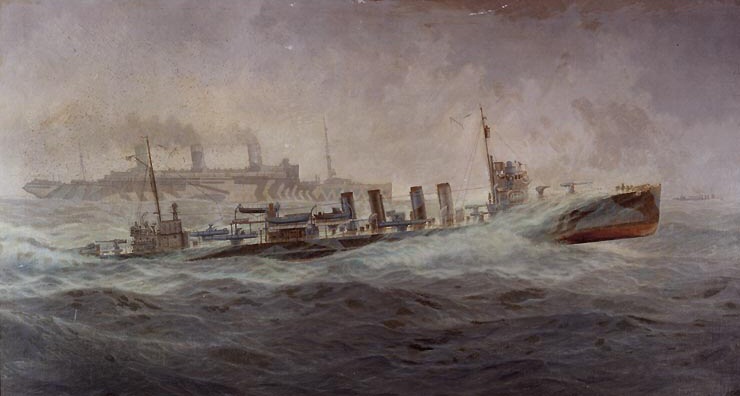
A Fast Convoy, oil on canvas by American naval artist Burnell Poole (1884–1933), one of a series of WWI scenes painted by Poole for the Navy. The USS Leviathan is escorted by USS Allen; both ships are painted in the dazzle camouflage used by the British and American navies. "No series of paintings would be complete without showing a destroyer acting as escort for a fast troop transport,” Poole wrote. This painting depicts both ships traveling “on a typical dull day in the North Atlantic in rough weather." Image courtesy of Naval Historical Foundation via WikiCommons.
The following introduction is adapted from headnotes by A. Scott Berg in the Library of America anthology World War I and America.
In March 1918 a virulent strain of the influenza virus appeared at Camp Funston, an army training facility in northeastern Kansas. The virus spread across the United States and into Europe and Asia over the next six months. A much deadlier wave of the disease began to ravage the United States that fall. The influenza pandemic killed between thirty and fifty million people worldwide, including 675,000 Americans. Even though medical authorities realized that packed troopships cultured an environment that spread the disease, the constant requirement to deliver more men to France during the fall offensive outweighed concerns about infection.

On September 29, 1918, the troopship Leviathan (formerly the German ocean liner Vaterland) began its crossing of the Atlantic. Lieutenant Commander Henry A. May, a senior medical officer assigned to the ship recorded the progress of the disease as it spread among the passengers and crew. His report was included in the 1919 publication History of the U.S.S. Leviathan.

Of the more than 9,000 troops on board, 2,000 became ill and 91 died — by far the worst outbreak of influenza on any transport during the war. All told, an estimated 46,000 members of the U.S. armed forces died of influenza in 1918–19.

Notes: Epistaxis is the medical term for bleeding from the nose. E.R.S. 2 is a ship designation for E Room Section 2; CCS, for Chief Commissary Steward, SC-2, Ship’s Cook 2nd Class.

*   *   *
COURSE OF THE EPIDEMIC
This was influenced materially by these main factors:

First, the widespread infection of several organizations before they embarked, and their assignment to many different parts of the ship. . . . If you don't see the full selection below, click here (PDF) or click here (Google Docs) to read it—free!

This selection may be photocopied and distributed for classroom or educational use.

Saturday, May 25, 2019

Memorial Day Address at Suresnes

Woodrow Wilson (1856–1924)
From World War I and America: Told by the Americans Who Lived It

President Woodrow Wilson and his wife Edith laying a wreath in Suresnes American Cemetery, Memorial Day, 1919. (National Archives/Army Signal Corps).
A century ago, in May 1919, U.S. Ambassador to France Hugh Wallace invited President Woodrow Wilson to speak at a Memorial Day ceremony to honor the Americans killed during World War I. Wilson responded:
I have no time that I can honestly call my own in the hours of daylight. I am almost continuously in conference or engaged on my papers, except for the intervals when I try to snatch a breath of fresh air, and I feel that I cannot in good conscience accept an afternoon engagement, at any rate for such an hour as three o’clock. If the Committee could change the hour of the exercises at Bagnolet Cemetery from three to two, I would try to be present and say a few words, taking the liberty of coming away in time for my afternoon engagements with the conference. I sincerely hope that this may prove possible and satisfactory to the committee.
The ceremony was subsequently moved to the Suresnes American cemetery. After the American entry in the war in 1917, the Army Quartermaster Corps had created in Suresnes a makeshift graveyard on the slope of Mont Valérien overlooking Paris for the burial of troops who died in city hospitals, including those who died during the influenza epidemic of 1918–1919. The French government donated the land permanently to the U.S., making it the first overseas American military cemetery, and Prime Minister Georges Clemenceau, who was unable to attend the event, sent a letter that was read at the ceremony. “With America,” he wrote, “France will preserve in peace as an inspiration and example an undying remembrance of their enthusiasm, discipline and courage. We see the wreaths on their tombs and will take care of them as piously and gratefully as the tombs of our own soldiers.” The site was beautifully renovated by French architect Jacques Gréber in 1922 and to this day it holds the remains of 1,541 Americans. The chapel walls list the names of 974 others who went missing in action.

Wilson had been in France since mid-March; in April he collapsed, a victim of the flu epidemic, and the demands of the peace process continued to exhaust him. Only the day before the Memorial Day ceremony, on May 29, Ulrich von Brockdorff-Rantzau, the president of the German delegation, presented vehement objections to the proposed Treaty of Versailles and declared, “Thus must a whole people sign the decree for its own proscription, nay, its own death sentence.” Despite Wilson’s ill health, the pressing nature of events, and the threat that the Germans might refuse to sign the treaty, the President attended the ceremony, which had been moved to an earlier hour in the day. He made it back in time for the 4:00 meeting of the Council of Four, which took place at his own residence in Paris.

Wilson’s appearance at the cemetery would be one of the more memorable events of his stay in France. “Extemporizing from notes, he delivered one of the most poignant speeches of his life,” writes biographer A. Scott Berg. “The notes proved to be an essential crutch, for the pathos of the occasion almost broke the President’s self-control.” The journalist Ray Stannard Baker, who didn’t even notice Wilson glancing at his notes, was awestruck by both the speech and Wilson’s delivery. “I saw tears in the eyes of those around me and felt them in my own,” he wrote in his diary. “On the whole, I think this is the greatest speech—the greatest speech in its power over the people present—of any I ever heard.” Afterward Baker wholeheartedly commended Wilson, who responded, “I am glad to hear it. When I speak extemporaneously, I am as uncertain and nervous just after it is over as I usually am just before.” Charles L. Swem, Wilson’s stenographic secretary, transcribed the speech and gave a typescript copy to Baker barely an hour later. We present it below as our Story of the Week selection.

Later that year, after Wilson had returned to the States, he realized that the Senate was unlikely to ratify the treaty creating the League of Nations. To drum up popular support, he went on a whistle-stop tour across the country. In spite of his fatigue and piercing headaches, he delivered hour-long appeals, projecting his voice to be heard by immense audiences of hundreds or even thousands of people. During the speech in Pueblo, Colorado, he recalled the Memorial Day ceremony in Paris:
My friends, on last Decoration Day, I went to a beautiful hillside near Paris, where was located the cemetery of Suresnes, a cemetery given over to the burial of the American dead. Behind me on the slopes was rank upon rank of living American soldiers. And, lying before me upon the levels of the plain, was rank upon rank of departed American soldiers. Right by the side of the stand where I spoke, there was a little group of French women who had adopted these boys—they were mothers to these dear boys—putting flowers every day upon those graves, taking them as their own sons, their own beloved, because they had died to save France. France was free, and the world was free because America had come!
The speech in Pueblo was the last Wilson ever gave. Ordered by his doctor to end the trip, he returned to the White House, where he suffered an ischemic stroke on October 2, leaving him paralyzed on his left side and restricting his ability to speak. He did not make public appearances for the remainder of his presidency and the full extent of his condition was concealed from the nation. The Senate voted against his treaty.

*   *   *
Mr. Ambassador, ladies and gentlemen, fellow countrymen: No one with a heart in his breast, no American, no lover of humanity, can stand in the presence of these graves without the most profound emotion. . . . If you don't see the full selection below, click here (PDF) or click here (Google Docs) to read it—free!

This selection may be photocopied and distributed for classroom or educational use.

Friday, February 15, 2019

“A Very Sad Thing”

Theodore Roosevelt (1858–1919)
From Theodore Roosevelt: Letters & Speeches

Left to right: Quentin, President Roosevelt, Ted, Archie, Alice, Kermit, First Lady Edith, and Ethel, July 12, 1903, at their summer home, Sagamore Hill, in Oyster Bay, New York. Hand-colored photograph by the Pach Brothers studio. From the New York Public Library, Prints and Photographs division.
On July 14, 1918, twenty-year-old Army pilot Quentin Roosevelt, the youngest son of Theodore and Edith Roosevelt, was shot down over France—the only child of a U.S. president ever to be killed in combat. By July 16 the Roosevelt family began hearing rumors: that something about Quentin’s mission had gone awry, that he and his fellow fighters had been captured behind enemy lines, that he was missing in action. On July 18 the death was reported in the press, and the Roosevelts received official confirmation on the 20th.

Quentin’s death was a blow to Roosevelt, who had prominently advocated against American neutrality, had harshly criticized President Woodrow Wilson’s hesitation to declare war, and had very much encouraged his sons to join the war effort. In April 1917, days after the American declaration of war, Roosevelt met with Wilson and requested permission to raise a volunteer division to fight in France—an offer the administration turned down. In his stead, all four of Roosevelt’s sons enlisted within a few months. “We looked at it as an exclusive war,” Archie Roosevelt told historian Henry Berry sixty years later. “We all knew how badly Dad wanted to go, so we went for him. He always told us to lead meant to serve.”

Theodore Jr. (Ted) and Archie were commissioned as officers and sailed to France to serve with the 1st Infantry Division, Quentin arrived in late July, and Kermit joined the British forces fighting the Turks in Mesopotamia and later served as an artillery officer in France. The following March Archie was seriously wounded in the knee and arm by shell fragments. Months later, just days after Quentin was killed, Ted was wounded in the leg.

“To feel that one has inspired a boy to conduct that has resulted in his death, has a pretty serious side for a father,” Roosevelt wrote to one of Quentin’s friends, “and at the same time I would not have cared for my boys and they would not have cared for me if our relations had not been just along that line.” The former president died six months after his son, on January 6, 1919. Shortly before his death a French journalist asked Roosevelt if he had anything to say now that the war was over. "I have no message for France,” he answered. “I have already given her the best I had.”

The three surviving sons would go on to serve in the armed forces during World War II. Theodore Roosevelt Jr. was the only general to land with the first wave of troops on D-Day, leading an infantry regiment and tank battalion at Utah Beach on June 6, 1944. He died of a heart attack a month later. As a lieutenant colonel, Archie led an infantry regiment in New Guinea, where he was severely wounded by a grenade in the same knee that had been hit in 1918. Kermit fought with the British in Norway, where he was injured during the Battle of Narvik, and was reassigned to North Africa. Suffering from a years-long battle with depression and alcoholism, he was discharged and was eventually given a U.S. Army post as an intelligence officer in Alaska. He shot and killed himself in June 1943.

For our Story of the Week selection, we present four letters Theodore Roosevelt wrote in the weeks following the death of his son: to King George V of England, to French premier Georges Clemenceau, to former British ambassador to the U.S. James Bryce (a correspondent of Roosevelt’s for nearly thirty years), and to Kermit’s wife, Belle Willard Roosevelt.

Notes: In his letter to King George, Roosevelt sends his regards to King Haakon VII of Norway, formerly Prince Carl of Denmark, who had married George’s sister (and Haakon’s first cousin) Maud of Wales in 1896. They became king and queen of Norway in 1905. Six days before Roosevelt wrote this letter, the Bolsheviks executed Russian czar Nicholas II and his family. Roosevelt also discusses two German documents that had recently been published in the American press. The first was a forgery, allegedly written by German steel manufacturer August Thyssen, describing how in 1912 the Kaiser had planned a war of global conquest. The second, a memorandum by Karl von Lichnowsky, was authentic. The German ambassador to Britain from 1912 to 1914, Lichnowsky reflected on the mistakes of German policy and acknowledged German responsibility for the outbreak of war in 1914.

The letter to James Bryce includes a quote (“proved their truth by their endeavor”) that appears frequently in Roosevelt’s writings and speeches. The original is a line from the frequently anthologized “Dirge for a Soldier, in Memory of General Philip Kearny” (1864) by American poet George Henry Boker: “As man may, he fought his fight, / Proved his truth by his endeavour; / Let him sleep in solemn night, / Sleep forever and forever.”

The letters to Bryce and Belle Willard Roosevelt were sent from the Maine home of Edith Roosevelt Derby, the Roosevelts’ daughter; she and her husband had two children, Richard and Edie. Belle, Kermit’s wife, was the daughter of Joseph Edward Willard, the U.S. ambassador to Spain. By 1918 they had two children: Kermit Jr. (Kim) and Joseph Willard. Flora was Quentin Roosevelt’s fiancée. Eleanor Alexander Roosevelt, the wife of Theodore Jr., was a volunteer in Paris with the YMCA and was thus able to attend to her husband while he was recovering from his injuries.

*   *   *
If you don't see the full selection below, click here (PDF) or click here (Google Docs) to read it—free!

This selection may be photocopied and distributed for classroom or educational use.

Friday, November 2, 2018

Waiting for the Armistice

Harry S. Truman (1884–1972)
From World War I and America: Told by the Americans Who Lived It

Beginning of Harry S. Truman’s letter to Bess Wallace, November 11, 1918 (the day of the Armistice ending World War I). Courtesy Harry S. Truman Library.
Days after the soldiers commanded by Harry S. Truman in France experienced combat for the first time, Private (and soon-to-be Corporal) William O’Hare wrote to his father, “We have a captain who cannot be beaten.” For decades after World War I, virtually everyone in Battery D, 129th Field Artillery, would similarly recall their commanding officer with admiration and fondness—but it didn’t start out that way.

Truman had been promoted to captain and given command of the “Dizzy D” in July 1918. The battery was a difficult and somewhat notorious group of nearly two hundred Missouri National Guardsmen, self-described “wild kids,” many of them Irish and German Catholics who had attended Rockhurst Academy in Kansas City. They had already gone through three previous commanding officers since arriving in France. When Truman first addressed the battery, these city toughs, many former athletes, scoffed at the bespectacled 34-year-old farmer who (as one recalled) “gave the impression more of a professor than he did an artillery officer.” The rebellious soldiers concluded the assembly on Truman’s first day with a noisy “Bronx cheer,” proceeded to stage a mock stampede using the battery’s horses, and ended the evening with an alcohol-fueled brawl that sent four men to the infirmary. The next morning Truman posted a notice demoting half of the noncommissioned officers, along with a good number of the first class privates for good measure. Their mirth instantly turned to disgruntlement—but he had got their attention.

During the next month Truman earned the grudging respect of at least some of the men. And then, on the night of August 29, 1918, in the Vosges Mountains, Battery D faced its first firefight. As Private Vere Leigh told an interviewer in 1970, “We were firing away and having a hell of a good time doing it until they began to fire back.” As Truman confessed two days later in a letter to Bess Wallace, his future wife, “My greatest satisfaction is that my legs didn’t succeed in carrying me away, although they were very anxious to do it.” Not all the battery’s members resisted the temptation to flee and an unknown number of soldiers turned tail. The usually genteel Truman let loose with a blistering barrage of words “in language that they could understand” and rallied his troops forward. After the war, as battery members disputed over who fled and who stuck with their captain, the episode entered Battery D lore as the “Battle of Who Run.”

Truman continued to lead his troops in the Battle of Saint-Mihiel (September 12) and the Meuse-Argonne campaign (‎September 26–November 11). As a whole, the National Guardsmen from Missouri and Kansas that made up the 35th Division were largely unprepared for war, and the division’s organization and command occasionally bordered on chaotic. Harry wrote Bess about one incident he witnessed in late October:
One of [the German] aviators fell right behind my Battery yesterday and sprained his ankle, busted up the machine [plane], and got completely picked by the French and Americans in the neighborhood. They even tried to take their (there were two in the machine) coats. One of our officers, I am ashamed to say, took the boots off of the one with the sprained ankle and kept them. . . . If a guard had not been placed over the machine, I don't doubt that it would have been carried away bit by bit. . . . I heard a Frenchman remark that Germany was fighting for territory, England for the sea, France for patriotism, and Americans for souvenirs. Yesterday made me think he was about right.
Yet the members of Battery D soon realized that their commanding officer had their backs and that he was just as generous with commendation and reward as he was with punishment. During three months of combat, the “Dizzy D” stood out from the other five batteries in the regiment not only because of its tighter discipline and its successes in the midst of heavy fighting but also because, under Truman’s command, none of its members were killed in action and only two were wounded. The other batteries suffered a total of 16 killed and 55 wounded.

On each of the last two days of the war Harry wrote a letter to Bess, and we present both of them below. For the duration of Harry’s deployment Bess lived in her family’s home in Independence and, after their marriage the following year, Truman moved into the house, which would be his Missouri home for the rest of his life.

Notes (first letter): Fred A. Boxley, was a Kansas City lawyer Truman had met in the Missouri National Guard. In the fall of 1916 Truman had become a partner in the Morgan Oil & Refining Company, a venture that failed in 1917. Old daddy Foch refers to Allied supreme commander General Ferdinand Foch, who had presented the Armistice terms to a German delegation on November 8. Lizzie was Truman’s nickname for the five-seater car he had purchased in 1914. Sausage balloons were observation balloons.

(Second letter): The great big 155 battery refers to a French howitzer, supplied to American forces, that fired shells 155mm (6.1 inches) in diameter and had a maximum range of seven miles. Bill’s letter, sent by Corporal William O’Hare to his father and then excerpted in the Kansas City Post, contains flattering comments about Truman, including the line quoted at the beginning of this introduction. Mrs. [Maud Gates] Wells was Bess’s aunt. “Stars & Stripes” was the U.S. Army newspaper published weekly in France from February 8, 1918, until June 13, 1919.

*   *   *
If you don't see the full selection below, click here (PDF) or click here (Google Docs) to read it—free!

This selection may be photocopied and distributed for classroom or educational use.
Friday, September 28, 2018

“I Am Not Dead”

Ashby Williams (1874–1944)
From World War I and America: Told by the Americans Who Lived It

Machine gunners of the 80th “Blue Ridge” Division on the battlefield. National Archives.
The Meuse-Argonne campaign, which lasted from September 26 through November 11, 1918, remains the largest and deadliest battle in American history. The 47-day offensive involved more than 1.2 million American troops, 26,000 of whom were killed, with nearly one hundred thousand wounded. The battle concluded with the signing of the Armistice ending the war.

Major Ashby Williams, a Virginia native who practiced law in Roanoke, was lucky to make it through the campaign relatively unscathed. He had arrived in France in May 1918, trained behind British lines during the summer, and served in the trenches southwest of Arras. In late August he was assigned command of a battalion in the 80th Division and led them first at St. Mihiel and then at Meuse-Argonne. As he recalled the following year, Williams and his men came under shellfire as they were moving into position on September 25, the eve of the beginning of the campaign:
We could hear the explosion as the shell left the muzzle of the Boche [German] gun, then the noise of the shell as it came toward us, faint at first, then louder and louder until the shell struck and shook the earth with its explosion. . . .

. . . No man can tell what surges through the heart and mind as you lie with your face upon the ground listening to the growing sound of the hellish thing as it comes towards you. You do not think, sorrow only fills the heart, and you only hope and pray. And when the doubly-damned thing hits the ground, you take a breath and feel relieved, and think how good God has been to you again.
A little over two weeks later, Major Williams had an even closer brush with death, when a shell struck the rifle pit in which he crouched with the commanding officer of another battalion while planning the evening’s mission. He describes that experience in the following selection, which was published in Experiences from the Great War (1919).

Notes: In the headnote, the acronym AEF refers to the American Expeditionary Forces. Major German H. H. Emory, who survived the attack described by Williams, was killed in action on November 1 near Sommerance.

*   *   *
It was a hazardous move looked at from any point of view, but the triangle of wood in my left front was practically impregnable as the situation stood. . . . If you don't see the full selection below, click here (PDF) or click here (Google Docs) to read it—free!

This selection may be photocopied and distributed for classroom or educational use.