Showing posts with label Ernest Hemingway. Show all posts

Sunday, July 19, 2026

The End of Something

Ernest Hemingway (1899–1961)
From Ernest Hemingway: The Sun Also Rises & Other Writings 1918–1926

Leaping Trout, 1889. Watercolor over graphite by American painter Winslow Homer (1836–1910). The Cleveland Museum of Art.
We will never know what exactly was in the letter Ernest Hemingway sent in February 1921 to Marjorie Bump; much later in life, she destroyed all the correspondence she had received from him over the years. But he received a stinging response:
The long delay in writing was caused by the fact that I have been trying to decide just how your remark, that you were good for me, could be justified. Two months consideration has failed to show any point where you have been greatly beneficial. . . . I see it was wrong to think highly of a person of such abomnable conceit, but it did seem queer that you should still hold the idea that you were good for me. As for the phrase you seem so fond of, “a phase in every girl’s life,” I prefer the idea that it never existed.
Taken aback, Hemingway worked up a draft of a defensive and mocking reply to “Red” (one of his nicknames for her). The document, in the Hemingway archives, is repetitive and heavily revised, with entire passages crossed out, and the letter was almost certainly never sent. Part of it reads:
Abominable is not spelled Abomnable.

That should show, without 2 month’s consideration, how I’ve been good for you. Was joking about that you know Red.

Wonder what the grand outburst was about anyway. Suppose I’ll never know. What’s the stuff about conceit? Am I really so doggone conceited?

Was going to write you a sarcastic letter — but don’t feel like it now. Got started remembering that summer of 1919— Best I’ve ever had summer there ever was I guess— Not going to spoil that summer or fall for anybody. It was idyllic — perfect as some days in Spring are and mountain valleys you pass on puffing trains — and other impermanent things.

Afterward you reverted to type and I acted like a cad — and it all came out right. . . .
Ernest and Marjorie first met during their summer vacation in Horton Bay, Michigan, in 1915, and she became a close friend of his sisters. During the summer of 1919, after he returned from the war in Europe, they began dating. That July he turned 20 years old; she turned 18 the following month and would be a high school senior in the nearby town of Petoskey in the fall. “Ernest played the part of a wiser brother, giving me advice on trout fishing such as cutting and skinning perch bait, trolling, and dropping my line at the exact right time for a successful catch,” Bump later told her daughter, Georgianna Main. “Many times we spent evenings together at the Point and built driftwood campfires while we waited for fish to bite.”

During the fall of 1920, before Hemingway left Michigan to work in Toronto, the couple ended their relationship but remained friendly: “I got to thinking about you today and of the good times we have had,” she wrote to him the following summer. “You were the best all around pal I have ever known.” Yet one of Hemingway’s closest friends, William B. Smith Jr., thought Marjorie was wrong for Ernest, and he was apparently open in his disapproval. When she was in college, Bump wrote to Hemingway, “I guess I’d have to try to stop liking Bill. It’s rather difficult to try to keep on liking a person who extremely dislikes in return.”

The paragraphs above outline the basic autobiographical “facts” that inspired two of Hemingway’s better-known Nick Adams stories: “The End of Something” and “The Three-Day Blow,” both of which were published in 1925. Hemingway, however, used Marjorie and Bill’s real names in his fictional accounts of their summer together, an act Marjorie increasingly lamented as the years went by:
It has remained a deep hurt for all my long life because Ernest painted a false picture of me under my real name. . . . It made me so upset that I was never at all comfortable about going back to Petoskey, Michigan, where people knew the real Marge. I felt humiliated to be the object of their pity when they read about me as a young lady to whom Nick [as Ernest] had spoken these words about our relationship: “It isn’t fun anymore.”
Perhaps worse for Marjorie, who lived more than three decades after Ernest’s death, numerous biographers went beyond the facts of their lives and used the fictional aspects and implications of the stories both to describe the real-life person of Marjorie Bump and to exaggerate the relatively benign nature of her brief relationship with Hemingway.

Marjorie’s angry letter of 1921 might have been something of a declaration of independence from Ernest, whose letters had apparently continued to address her as the obsequious high school student he dated two years earlier. As she later acknowledged to her daughter, a “youthful, naïve self combined with hero worship and adoration” might well describe her role while they were dating—but she had grown up. Whatever the cause of the contretemps, Marjorie and Ernest kept in touch for decades. “Other letters from him were such treats that I was in ecstasy. Words from him were always sprinkled with descriptive phrases, metaphors, and poetic images,” she admitted. He even made a surprise visit to Majorie and her family in the 1930s. “During his visit in Florida,” Georgianna Main later remembered, “my mother and father accepted Ernest without bitterness so, to me, he is still the jovial, attractive, magnetic man I met when I was nine. I am sure that Hemingway could not have foreseen how much of a problem it would be for Marge to be misunderstood by his biographers.”

Georgianna Main sympathized with her mother’s “hurt” but believed that, regardless of the fictional embellishments, Hemingway’s two stories depicted Marge in a flattering light. “In the process of creating her character, he actually painted a powerful portrait of her as part of a Michigan setting that he had loved. Hemingway's Marge possesses dignity, discipline, poise, serenity, and her own kind of courage under the stress of rejection. Such qualities will make her immortal because she will never be lost to the readers of the world.”

*   *   *
This week’s selectionis appears in its entirety below. You may also download it as a PDF or view it in Google Docs.

The End of Something

In the old days Hortons Bay was a lumbering town. No one who lived in it was out of sound of the big saws in the mill by the lake. Then one year there were no more logs to make lumber. The lumber schooners came into the bay and were loaded with the cut of the mill that stood stacked in the yard. All the piles of lumber were carried away. The big mill building had all its machinery that was removable taken out and hoisted on board one of the schooners by the men who had worked in the mill. The schooner moved out of the bay toward the open lake carrying the two great saws, the traveling carriage that hurled the logs against the revolving, circular saws and all the rollers, wheels, belts and iron piled on a hull-deep load of lumber. Its open hold covered with canvas and lashed tight, the sails of the schooner filled and it moved out into the open lake, carrying with it everything that had made the mill a mill and Hortons Bay a town.

The one-story bunk houses, the eating-house, the company store, the mill offices, and the big mill itself stood deserted in the acres of sawdust that covered the swampy meadow by the shore of the bay.

Ten years later there was nothing of the mill left except the broken white limestone of its foundations showing through the swampy second growth as Nick and Marjorie rowed along the shore. They were trolling along the edge of the channel-bank where the bottom dropped off suddenly from sandy shallows to twelve feet of dark water. They were trolling on their way to the point to set night lines for rainbow trout.

“There’s our old ruin, Nick,” Marjorie said.

Nick, rowing, looked at the white stone in the green trees.

“There it is,” he said.

“Can you remember when it was a mill?” Marjorie asked.

“I can just remember,” Nick said.

“It seems more like a castle,” Marjorie said.

Nick said nothing. They rowed on out of sight of the mill, following the shore line. Then Nick cut across the bay.

“They aren’t striking,” he said.

“No,” Marjorie said. She was intent on the rod all the time they trolled, even when she talked. She loved to fish. She loved to fish with Nick.

Close beside the boat a big trout broke the surface of the water. Nick pulled hard on one oar so the boat would turn and the bait spinning far behind would pass where the trout was feeding. As the trout’s back came up out of the water the minnows jumped wildly. They sprinkled the surface like a handful of shot thrown into the water. Another trout broke water, feeding on the other side of the boat.

“They’re feeding,” Marjorie said.

“But they won’t strike,” Nick said.

He rowed the boat around to troll past both the feeding fish, then headed it for the point. Marjorie did not reel in until the boat touched the shore.

They pulled the boat up the beach and Nick lifted out a pail of live perch. The perch swam in the water in the pail. Nick caught three of them with his hands and cut their heads off and skinned them while Marjorie chased with her hands in the bucket, finally caught a perch, cut its head off and skinned it. Nick looked at her fish.

“You don’t want to take the ventral fin out,” he said. “It’ll be all right for bait but it’s better with the ventral fin in.”

He hooked each of the skinned perch through the tail. There were two hooks attached to a leader on each rod. Then Marjorie rowed the boat out over the channel-bank, holding the line in her teeth, and looking toward Nick, who stood on the shore holding the rod and letting the line run out from the reel.

“That’s about right,” he called.

“Should I let it drop?” Marjorie called back, holding the line in her hand.

“Sure. Let it go.” Marjorie dropped the line overboard and watched the baits go down through the water.

She came in with the boat and ran the second line out the same way. Each time Nick set a heavy slab of driftwood across the butt of the rod to hold it solid and propped it up at an angle with a small slab. He reeled in the slack line so the line ran taut out to where the bait rested on the sandy floor of the channel and set the click on the reel. When a trout, feeding on the bottom, took the bait it would run with it, taking line out of the reel in a rush and making the reel sing with the click on.

Marjorie rowed up the point a little way so she would not disturb the line. She pulled hard on the oars and the boat went way up the beach. Little waves came in with it. Marjorie stepped out of the boat and Nick pulled the boat high up the beach.

“What’s the matter, Nick?” Marjorie asked.

“I don’t know,” Nick said, getting wood for a fire.

They made a fire with driftwood. Marjorie went to the boat and brought a blanket. The evening breeze blew the smoke toward the point, so Marjorie spread the blanket out between the fire and the lake.

Marjorie sat on the blanket with her back to the fire and waited for Nick. He came over and sat down beside her on the blanket. In back of them was the close second-growth timber of the point and in front was the bay with the mouth of Hortons Creek. It was not quite dark. The firelight went as far as the water. They could both see the two steel rods at an angle over the dark water. The fire glinted on the reels.

Marjorie unpacked the basket of supper.

“I don’t feel like eating,” said Nick.

“Come on and eat, Nick.”

“All right.”

They ate without talking, and watched the two rods and the fire-light in the water.

“There’s going to be a moon tonight,” said Nick. He looked across the bay to the hills that were beginning to sharpen against the sky. Beyond the hills he knew the moon was coming up.

“I know it,” Marjorie said happily.

“You know everything,” Nick said.

“Oh, Nick, please cut it out! Please, please don’t be that way!”

“I can’t help it,” Nick said. “You do. You know everything. That’s the trouble. You know you do.”

Marjorie did not say anything.

“I’ve taught you everything. You know you do. What don’t you know, anyway?”

“Oh, shut up,” Marjorie said. “There comes the moon.”

They sat on the blanket without touching each other and watched the moon rise.

“You don’t have to talk silly,” Marjorie said; “what’s really the matter?”

“I don’t know.”

“Of course you know.”

“No I don’t.”

“Go on and say it.”

Nick looked on at the moon, coming up over the hills.

“It isn’t fun any more.”

He was afraid to look at Marjorie. Then he looked at her.

She sat there with her back toward him. He looked at her back.

“It isn’t fun any more. Not any of it.”

She didn’t say anything. He went on. “I feel as though everything was gone to hell inside of me. I don’t know, Marge. I don’t know what to say.”

He looked on at her back.

“Isn’t love any fun?” Marjorie said.

“No,” Nick said. Marjorie stood up. Nick sat there, his head in his hands.

“I’m going to take the boat,” Marjorie called to him. “You can walk back around the point.”

“All right,” Nick said. “I’ll push the boat off for you.”

“You don’t need to,” she said. She was afloat in the boat on the water with the moonlight on it. Nick went back and lay down with his face in the blanket by the fire. He could hear Marjorie rowing on the water.

He lay there for a long time. He lay there while he heard Bill come into the clearing, walking around through the woods.

He felt Bill coming up to the fire. Bill didn’t touch him, either.

“Did she go all right?” Bill said.

“Oh, yes,” Nick said, lying, his face on the blanket.

“Have a scene?”

“No, there wasn’t any scene.”

“How do you feel?”

“Oh, go away, Bill! Go away for a while.”
Bill selected a sandwich from the lunch basket and walked over to have a look at the rods.

From In Our Time (1925).
Sunday, July 20, 2025

Now I Lay Me

Ernest Hemingway (1899–1961)
From Ernest Hemingway: A Farewell to Arms & Other Writings 1927–1932

Ernest Hemingway recovering at the American Red Cross Hospital in Milan, Italy, in the summer of 1918. Photograph by Henry S. Villard, who was a fellow volunteer ambulance driver and hospital patient. (John F. Kennedy Presidential Library and Museum)
A few weeks after Ernest Hemingway began work as a Red Cross ambulance driver in Italy during the first World War, he volunteered for canteen service on the front lines, outside the town of Fossalta on the Piave River. On the night of July 8, 1918, he was about one hundred yards behind the Italian trenches when he was hit by an Austrian trench mortar, which landed less than a yard away, followed almost immediately by a machine gun bullet. The twenty-six-year-old Italian soldier standing next to Hemingway was instantly killed.

"I died then,” Hemingway later told his friend Guy Hickok. “I felt my soul or something coming right out of my body, like you'd pull a silk handkerchief out of a pocket by one corner. It flew around and then came back and went in again and I wasn’t dead anymore.” A month later, in a letter to his family, he described the scene:
After I came to they carried me on a stretcher three kilometers back to a dressing station. The stretcher bearers had to go over lots because the road was having the “entrails” shelled out of it. . . . The dressing station had been evacuated during the attack so I lay for two hours in a stable, with the roof shot off, waiting for an ambulance. When it came I ordered it down the road to get the soldiers that had been wounded first. It came back with a load and then they lifted me in. The shelling was still pretty thick and our batteries were going off all the time way back of us and the big 250s and 350s [mortar shells] going over head for Austria with a noise like a railway train.
He was transported to the American Red Cross Hospital in Milan, where he spent the next ten weeks recovering from mortar fragment wounds (“227 little devils”) in his legs and feet.

This formative, tragic experience was, to varying extents, transformed into fiction in several of Hemingway’s works—most famously in A Farewell to Arms but also notably in “Now I Lay Me,” one of the two dozen Hemingway stories featuring the character Nick Adams. The link between author and character in this story is reinforced, in the view of some scholars, by an early draft in which Nick’s mother refers to him as Ernie, which Hemingway crossed out and replaced with Nicky. The story has often been paired with another semiautobiographical story, “In Another Country,” featuring an unnamed wounded soldier (almost universally assumed to be Nick Adams) recovering in a military hospital in Milan. Hemingway himself used the title “In Another Country—Two” for an early draft of “Now I Lay Me.”

The story opens with Nick lying on the floor in a silkworm house. More than one scholar has compared the subsequent series of reflections and memories to a “therapeutic talk-session” for addressing post-combat stress. The tendency among many critics, then, has been to treat Nick on a bed of straw as if he were Ernest on a couch. Yet Paul Smith, in his Reader’s Guide to the Short Stories of Ernest Hemingway, cautions against approaching the story as a fictionalized memoir:
As with other stories, it seems that the apparently autobiographical nature of “Now I Lay Me” has chilled any interest in its literary sources; and if so, there is an irony in the fact that so little of its narrative can be corroborated as personal history. Hemingway was wounded (once, not twice as was Nick); suffered from insomnia; slept one night on a visit with two friends in a silk “factory” (before, not after he was wounded, as Nick was); he loved trout fishing and cherished his recollections of the sport; and when he was six, his grandfather died, his family moved from the grandfather’s house in which Ernest was born to “a new house designed and built” by his mother when he was seven. If the rest of the story is not fiction, it is still, in varying degrees, unsubstantiated “fact.”
Nevertheless, Smith adds, “the more important elements of the story, all those so precisely and dramatically realized, have been taken by one biographer after another as personal experience and then read by later critics, in turn, as biographical evidence to support an interpretation—most often a psychological one—of the story.” Or, as another scholar suggests, “Autobiographical assumption is virtually automatic among those who write about Nick. On the other hand, those who read the Nick stories generally become caught up in his experience, and eschew the vast Hemingway scholarship, for the time, to respond to Nick as his own person.”

*   *   *
The above quote from Guy Hickock appeared in “A Portrait of Mister Papa,” a profile of Hemingway by Malcolm Cowley in the January 10, 1949, issue of Life magazine.

Notes to the story: Tenente is Italian for lieutenant. In 1918, American journalist Arthur Brisbane was editor of the Hearst-owned Chicago Harold and Examiner. The story concludes with mention of the October offensive, or the Battle of Vittorio Veneto, October 24, 1918–November 3, 1918, an Italian victory that led to Austria’s suing for an armistice.

*   *   *
That night we lay on the floor in the room and I listened to the silk-worms eating. . . . If you don't see the full selection below, click here (PDF) or click here (Google Docs) to read it—free!

This selection may be photocopied and distributed for classroom or educational use.

Sunday, July 14, 2024

In Another Country

Ernest Hemingway (1899–1961)
From Ernest Hemingway: A Farewell to Arms & Other Writings 1927-1932

Physical Therapy at Bath Hospital, 1918. Watercolor by English artist E. Horton [Sarah Elizabeth Roberts Horton] (1865–1959). WikiCommons.

On the night of July 8, 1918, Hemingway was hit by an Austrian trench mortar, followed almost immediately by a machine gun bullet. He was transported to the American Red Cross Hospital in Milan, where he spent the next ten weeks recovering from mortar fragment wounds (“227 little devils”) in his legs and feet.
When Ernest Hemingway’s story collection Men Without Women appeared in 1927, Dorothy Parker—who considered him “the greatest living writer of short stories”—reviewed it for The New Yorker, with (she confessed) some concern. She had greatly admired Hemingway’s debut collection, In Our Time, and believed it had been too readily dismissed by some American critics:
Well, you see, Ernest Hemingway was a young American living on the left bank of the Seine in Paris, France; he had been seen at the Dome and the Rotonde and the Select and the Closerie des Lilas. He knew Pound, Joyce and Gertrude Stein. There is something a little well, a, little you-know—in all of those things. You wouldn’t catch Bruce Barton or Mary Roberts Rinehart doing them. No, sir.

And besides, In Our Time was a book of short stories. That’s no way to start off. People don’t like that; they feel cheated.
After The Sun Also Rises was published, however, Hemingway became the new thing. “He was praised, adored, analyzed, best-sold, argued about, and banned in Boston; all the trimmings were accorded him,” Parker wrote. “People got into feuds about whether or not his story was worth the telling. . . . They affirmed, and passionately, that the dissolute expatriates in this novel of ‘a lost generation’ were not worth bothering about; and then they devoted most of their time to discussing them.”
After all the high screaming about The Sun Also Rises, I feared for Mr. Hemingway’s next book. You know how it is—as soon as they all start acclaiming a writer, that writer is just about to slip downward. The littler critics circle like literary buzzards above only the sick lions.

So it is a warm gratification to find the new Hemingway book, Men Without Women, a truly magnificent work. It is composed of thirteen short stories, most of which have been published before. They are sad and terrible stories; the author’s enormous appetite for life seems to have been somehow appeased. . . . I do not know where a greater collection of stories can be found.

Ford Maddox Ford has said of the author, “Hemingway writes like an angel.” I take issue. . . . Hemingway writes like a human being.
The collection (which actually has fourteen stories) includes some of Hemingway’s best, most famous, and most anthologized works: “The Killers” (which Parker regarded as “one of the four great American short stories”), “Hills Like White Elephants,” “The Undefeated,” “Fifty Grand,” and our current Story of the Week selection, “In Another Country.”

Set in and near a hospital in Italy during World War I, “In Another Country” portrays a group of soldiers struggling through experimental therapies using machinery to help them learn to use their mangled or wounded limbs. Soon after F. Scott Fitzgerald read the story in Scribner’s Magazine, he wrote to Hemingway that the opening was “one of the most beautiful prose sentences I’ve ever read,” and he reiterated his praise in another letter after Men Without Women appeared.

Not many stories receive the kind of attention accorded to the opening passages of “In Another Country”; you’ll find the first paragraph reprinted and dissected in any number of books on the writing of fiction. “This is a most peculiar way to begin a story,” writer and critic Dwight Macdonald wrote. “The first sentence is a perfect opening phrase, mannered enough to jolt the reader awake without making him go to see if the front door is locked.” Similarly, the essayist and editor Joseph Epstein noted in his book Literary Genius, “The narrative voice in this paragraph is almost entirely detached, and the effect is unnerving. The man telling this story has lived through a great deal. . . . He will only describe; he will not attempt to explain.” Referring to the story’s opening, Joan Didion remarked how “we sometimes forgot that this was a writer who had in his time made the English language new, changed the rhythms of the way both his own and the next few generations would speak and write and think. The very grammar of a Hemingway sentence dictated, or was dictated by, a certain way of looking at the world, a way of looking but not joining, a way of moving through but not attaching, a kind of romantic individualism distinctly adapted to its time and source. If we bought into those sentences, we would see the troops marching along the road, but we would not necessarily march with them.”

Yet few homages to this story—or to any story—are as moving and memorable as an essay by Andre Dubus that appeared in 1997 in The Kenyon Review. Dubus begins by recalling one day in 1966, when he was teaching at the University of Iowa. He and his neighbor Kurt Vonnegut hosted Ralph Ellison, who was speaking at a conference, and during one of their conversations, Dubus mentioned that “In Another Country” was his favorite story—and Ellison proceeded to recite the opening paragraph, word for word, from memory. After Dubus moved to Bradford College in Massachusetts, he assigned the story in his classes for years. The first year, he recalled, “I understood more of it, because of what the students said, and also because of what I said: words that I did not know I would say.” Subsequently, “I did go into the classroom in the years after that, knowing exactly what I would say about the story.” He told his students, “In the center of this canvas is death”; at first it is “a story about young men who have lost that joy in being alive which is normal for young and healthy people”—and then death unexpectedly interferes yet again: “It is what no one can escape.”

In July 1986, Dubus had stopped on the highway one night to help two people, Luz Santiago and her brother Luis, stranded on the side of the road after their vehicle had collided with a motorcycle. (The cyclist had been drunk, fell off the cycle, left it there, and was later found wandering along the highway.) While Dubus was helping the Santiagos—they all believed the cyclist was trapped under the stranded vehicle—a passing car struck both Luis, killing him instantly, and Dubus, who pushed Luz out of the way at the last minute. One of Dubus’s legs had to be amputated, the other was paralyzed, and he never walked again.

After months of recovery and therapy, he began a reading group at his home for teenaged girls who, for various reasons, lived in protective custody in a nearby state-run facility. “One night in the fall of 1991, five years after my injury, I read ‘In Another Country’ to a few girls and a staff woman. This was the first time I had read it since my crippling,” and the story had changed for Dubus:
I saw something I had never seen in the story, and I do not know whether Hemingway saw it when he wrote it or later or never, but there it was, there it is, and with passion and joy I looked up from the book, looked at the girls’ faces and said: “This story is about healing too. The major keeps going to the machines. And he doesn’t believe in them. But he gets out of his bed in the morning. He brushes his teeth. He shaves. He combs his hair. He puts on his uniform. He leaves the place where he lives. He walks to the hospital, and sits at the machines. Every one of those actions is a movement away from suicide. Away from despair. Look at him. Three days after his wife has died, he is in motion. He is sad. He will not get over this. And he will get over this. His hand won’t be cured but someday he will meet another woman. And he will love her. Because he is alive.”
*   *   *
Notes: “A bacco gli ufficiali!” is Hemingway’s misspelling of Abbasso gli ufficiali (Down with the officers!). After Hemingway sent the typescript to Maxwell Perkins at Scribner’s, he followed up with a note that partially corrected the error: “the Italian should read ‘A basso gli ufficiali!’ I have forgotten my Italian or so mixed it with Spanish that I could not remember how to spell ‘bacco’ for the very good reason that there is no such word.” Arditi were the elite assault troops of the Royal Italian Army. The name translates as “daring” or “audacious.” Fratellanza and abnegazione are the Italian words for brotherhood and self-sacrifice.

*   *   *
In the fall the war was always there, but we did not go to it any more. . . . If you don't see the full selection below, click here (PDF) or click here (Google Docs) to read it—free!

This selection may be photocopied and distributed for classroom or educational use.

Sunday, July 23, 2023

Out of Season

Ernest Hemingway (1899–1961)
From Ernest Hemingway: The Sun Also Rises & Other Writings 1918–1926

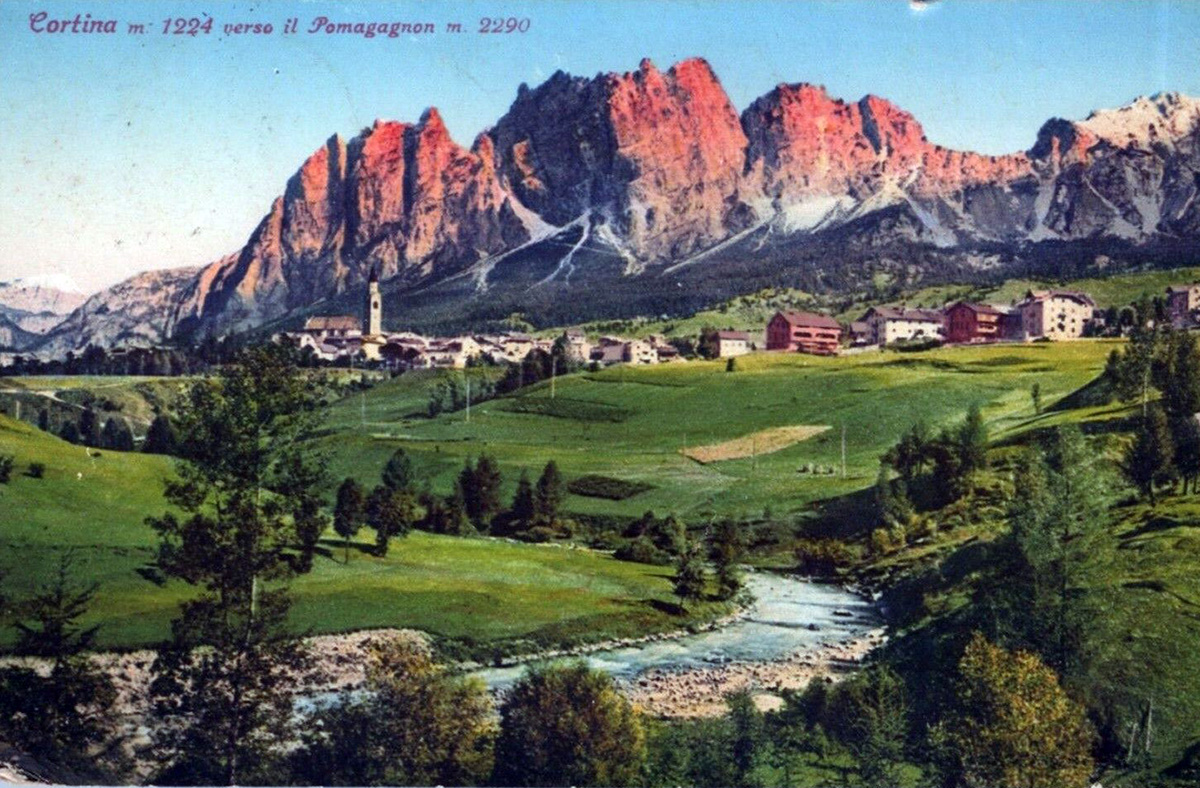
Hand-colored photographic postcard showing Cortina d’Ampezzo during the 1920s, with the cliffs of Pomagagnon in the background. (eBay)
It is, perhaps, every writer’s worst nightmare. When the journalist Ernest Hemingway arrived in Switzerland from Constantinople to cover the Lausanne Peace Conference in late 1922, he wrote to his wife, Hadley, then at their home in Paris, and urged her to join him for the upcoming holiday season. She packed in a valise all of his manuscripts, with their carbon copies, took a taxi to the Gare de Lyon, and hired a porter to carry the luggage to the train. Amidst the melee of the station, when her bags were momentarily out of sight, the valise was stolen. As Hemingway recalled decades later in A Moveable Feast:
I had never seen anyone hurt by a thing other than death or unbearable suffering except Hadley when she told me about the things being gone. She had cried and cried and could not tell me. I told her that no matter what the dreadful thing was that had happened nothing could be that bad, and whatever it was, it was all right and not to worry. We would work it out. Then, finally, she told me. . . . It was probably good for me to lose early work and I told [editor Edward J. O’Brien] all that stuff you feed the troops. I was going to start writing stories again I said and, as I said it, only trying to lie so that he would not feel so bad, I knew that it was true.
Only two manuscripts (the stories “My Old Man” and “Up in Michigan,” each of which were elsewhere) survived the debacle.

During the following months, the couple attempted to put this incident behind them by skiing the slopes of the Alps and going on a walking tour from Milan to Cortina d’Ampezzo. In February or March, Hadley realized she was pregnant, and arguments over whether they were ready to become parents may have increased tensions between the couple. Their journey and the strains in their marriage inspired Hemingway to work on two stories during this period. First, in the seaside town of Rapallo, he scribbled four pages of notes for a story that, a year later, would become “Cat in the Rain.” Then, in April, while he and Hadley were staying in the alpine town of Cortina d’Ampezzo, he finished the story “Out of Season,” which would appear that summer alongside his two surviving stories in his first book, Three Stories and Ten Poems. He would also include the story in his 1925 collection, In Our Time.

On Christmas Eve 1925, Hemingway wrote to F. Scott Fitzgerald, whom he had met earlier in the year. Fitzgerald and his wife, Zelda, both thought the woman in “Cat in the Rain” was Hadley, which Hemingway denied, claiming that the story brought together various characters and places encountered during their trip—a hotel in Rapallo, an innkeeper in Cortina d’Ampezzo, and a couple they met in Genoa. Instead, Hemingway insisted:
The only story in which Hadley figures is Out of Season which was an almost literal transcription of what happened. Your ear is always more acute when you have been upset by a row of any sort, mine I mean, and when I came in from the unproductive fishing trip I wrote that story right off on the typewriter without punctuation. I meant it to be tragic about the drunk of a guide because I reported him to the hotel owner — the one who appears in Cat In The Rain — and he fired him and as that was the last job he had in the town and he was quite drunk and very desperate he hanged himself in the stable. At that time I was writing the In Our Time chapters and I wanted to write a tragic story without violence. So I didnt put in the hanging. Maybe that sounds silly. I didnt think the story needed it.
Three decades later, in A Moveable Feast, Hemingway reiterated, “I had omitted the real end of it which was that the old man hanged himself.”

As Hemingway scholar Paul Smith notes in his essay on the story, the surviving typescript seems to confirm Hemingway’s recollection that he wrote the story immediately after returning to the hotel: “With his memory for dialogue sharpened by an abrasive row with Hadley—or Tiny, as he nicknamed her then—he wrote in too much of a hurry to pause over punctuation, especially during the writing of the couple’s bitter dialogue in the Concordia, which he did not bother to paragraph.” He later made several additions and revisions to the story—but none to the dialogue between husband and wife. If the first part of his recollection is true, however, the subsequent suicide of the guide is not something he could have omitted when he wrote the first draft but, at most, a tragedy he chose not to add to the story during its revision.

In sum, the tale as originally written is ostensibly about a fishing trip led by a drunken and comically impertinent guide scorned by his fellow townspeople, but its underlying portrait is of a couple during the hours after a heated argument. In his biography of Hemingway, Carlos Baker writes that the story’s dual nature marks a turning point in Hemingway’s career:
Ernest later spoke of it as a "very simple story." It was not. . . .

With this story, in fact, he discovered for the first time the infinite possibilities of a new narrative technique. This consisted in developing two intrinsically related truths simultaneously, as a good poet does with a metaphor that really works. The "out-of-season" theme applied with equal force to the young man's relations with his wife Tiny, and to the officious insistence by the guide Peduzzi that the young man fish for trout in defiance of the local fishing laws. . . . The metaphorical confluence of emotional atmospheres . . . was what gave the story its considerable distinction. This first successful use of it was the foremost esthetic discovery of Ernest's early career. It was in this, rather than in the flat and uninspired verse of which he seemed so proud, that his true gifts as a poet were to be repeatedly displayed.
Whether “Cat in the Rain” and “Out of Season” portray “Hemingway’s own marriage seems of less moment than that the subject of marriage inspired his return to fiction in 1923,” writes Smith in The Cambridge Companion to Ernest Hemingway. The stories can be said to have relaunched Hemingway’s writing career; as Gioia Diliberto, in her biography of Hadley, remarks: “The successful completion of ‘Out of Season’ eased his anguish over the lost manuscripts, for he knew that it was much better than any of the material that had been lost.”

Notes: A musette is a small knapsack. In 1922, while covering the International Economic Conference in Genoa, Hemingway visited the humorist and caricaturist Max Beerbohm at his home outside Rapallo; he was accompanied by the American writer Max Eastman and the British journalist George Slocombe, and Beerbohm greeted his guests with glasses of marsala. With the allusion to Beerbohm’s preference for marsala, “Hemingway was able to characterize the young gentleman as, perhaps, a bit of a dandy and maybe a bit self-absorbed,” suggests literary scholar Charles J. Nolan, Jr. The Carleton Club is a gentlemen’s club in London favored by Conservative leaders.

Foreign expressions: Was Wollen sie? (German: What do you want?); vecchio (Italian: an old man); caro (Italian: dear, dear one)

*   *   *
On the four lire Peduzzi had earned by spading the hotel garden he got quite drunk. . . . If you don't see the full selection below, click here (PDF) or click here (Google Docs) to read it—free!

This selection may be photocopied and distributed for classroom or educational use.

Saturday, July 9, 2022

Cat in the Rain

Ernest Hemingway (1899–1961)
From Ernest Hemingway: The Sun Also Rises & Other Writings 1918–1926

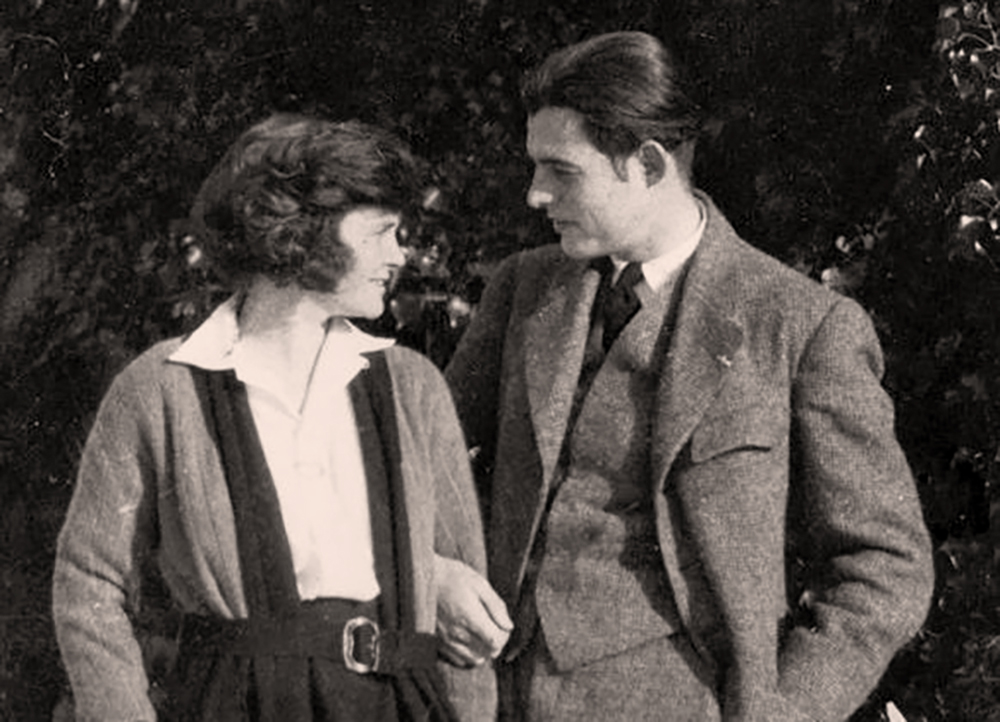
Hadley and Ernest Hemingway in Chamby, Switzerland, 1922. (Wikimedia Commons)
“‘Cat in the Rain’ wasn’t about Hadley. I knew you and Zelda always thought it was,” Ernest Hemingway insisted in a letter to F. Scott Fitzgerald in late December 1925, denying that the central character of the story was modeled after his wife, Hadley Richardson. He continued:
When I wrote that we were at Rapallo but Hadley was 4 months pregnant with Bumby. The Inn Keeper was the one at Cortina D’Ampezzo and the man and girl were a harvard kid and his wife that I’d met at Genoa. Hadley never made a speech in her life about wanting a baby because she had been told various things by her doctor and I’d—. No use going into all that.
In this passage, Hemingway recalls their stay at the Hotel Riviera Splendide in Rapallo, Italy, where he and Hadley visited Ezra Pound and his wife, the artist Dorothy Shakespear. They arrived on February 7 and early the following month left to spend several weeks skiing in Cortina D’Ampezzo. Hemingway has at least one detail wrong in his letter: At the time of their stay in Rapallo, Hadley was no more than two months pregnant; their son John (“Bumby”) was born on October 10, so the couple would not have known for sure that they were going to be parents until well after their arrival in the seaside town.

While in the Hotel Splendide, Hemingway scribbled four pages of random notes that would, a year later, form the basis of “Cat in the Rain.” Hemingway labeled the draft as “False start Rapallo story possible Fascisto story”; it opens with a description of a Fascist hotel owner and describes a “happy” couple traveling by train from Genoa to Rapallo. There is no cat, nor is there a drop of rain marring “the oranges in the trees” or the “blue head land of Portofino,” a nearby fishing village. The draft clearly identifies the hotel in Rapallo as the Splendide and the wife is addressed as “Kitty,” an echo of “Feather Kitty,” Ernest’s nickname for Hadley. On the one hand, then, we have Ernest Hemingway’s insistence that the unnamed wife in the final story is not Hadley; on the other, there are numerous clues that Hadley was, at least initially, the inspiration.

Still, the final story, which we present below, was written a year later in Paris and bears little resemblance to the first draft; gone are the Italian Fascists and the oranges and the blue sea. In his five-volume biography of Hemingway, Michael Reynolds reminds us that our inclination to “substitute his later story for that February’s reality is to use his fiction to create further fictions of our own.” Even Reynolds admits, however, that Hadley must have recognized her own marriage in the portrait of the couple, “but not only in Rapallo. Some of it was [a year later] in the February rain and snow of Paris.” Gioia Diliberto, in her biography of Hadley, agrees: “It's not hard to see Hadley's vulnerability and loneliness in ‘Cat in the Rain.’”

The few scraps of Hadley’s writing that survive from the period hint at her insecurities: about her body, still carrying the extra weight from pregnancy; about her hair, which she had trimmed short on a whim to match Ernest’s haircut; about her isolation as a new mother in the bohemian social circle of the Left Bank. Shortly after Ernest finished the story and six months after their son was born, Hadley wrote “Kitty Love Story,” an unpublished tale about a cat whose exhilarating days as a kitten are over once it has given birth: “The black cat, now shapeless and baggy, . . . steps heavily over the roof in the shining dark of spring night, remembering with her whole doleful body the new love of only a few weeks ago—and wonders why she is called out almost never now.”

For such a brief story, “Cat in the Rain” has inspired an impressive amount of critical commentary and disagreement: not only about its possible autobiographical elements but also about what it means—and even about what actually happens. Is there one cat—or are there two? Would the wife be satisfied by what happens at the end of the story, or disappointed? Is her desire for a “kitty” really a longing for a baby—as the above passage from Hemingway’s letter seems to imply? In a thorough and now-classic examination of the story, the novelist David Lodge explains it has provoked conflicting interpretations: “although it is a well-formed narrative, with a clearly defined beginning, middle and end, the primary action is not the primary vehicle of meaning.” That is, the story presents “a plot of revelation (the relationship between husband and wife) disguised as a plot of resolution (the quest for the cat).”

Notes: The war monument mentioned in the story is Giacinto Pasciuto’s recently unveiled bronze statue commemorating the Italian soldiers who had died in World War I; Ernest and Hadley could see it from their second-story window in the Hotel Splendide. “Il piove” translates as rain; “Ha perduto qualque cosa, Signora?” as Have you lost something, Madam?

*   *   *
For this week’s selection, we depart from the usual format and reproduce Hemingway’s story, in its entirety, below. You may also download it as a PDF or view it in Google Docs.

Cat in the Rain

There were only two Americans stopping at the hotel. They did not know any of the people they passed on the stairs on their way to and from their room. Their room was on the second floor facing the sea. It also faced the public garden and the war monument. There were big palms and green benches in the public garden. In the good weather there was always an artist with his easel. Artists liked the way the palms grew and the bright colors of the hotels facing the gardens and the sea. Italians came from a long way off to look up at the war monument. It was made of bronze and glistened in the rain. It was raining. The rain dripped from the palm trees. Water stood in pools on the gravel paths. The sea broke in a long line in the rain and slipped back down the beach to come up and break again in a long line in the rain. The motor cars were gone from the square by the war monument. Across the square in the doorway of the café a waiter stood looking out at the empty square.

The American wife stood at the window looking out. Outside right under their window a cat was crouched under one of the dripping green tables. The cat was trying to make herself so compact that she would not be dripped on.

“I’m going down and get that kitty,” the American wife said.

“I’ll do it,” her husband offered from the bed.

“No, I’ll get it. The poor kitty out trying to keep dry under a table.”

The husband went on reading, lying propped up with the two pillows at the foot of the bed.

“Don’t get wet,” he said.

The wife went downstairs and the hotel owner stood up and bowed to her as she passed the office. His desk was at the far end of the office. He was an old man and very tall.

“Il piove,” the wife said. She liked the hotel-keeper.

“Si, si, Signora, brutto tempo. It is very bad weather.”

He stood behind his desk in the far end of the dim room. The wife liked him. She liked the deadly serious way he received any complaints. She liked his dignity. She liked the way he wanted to serve her. She liked the way he felt about being a hotel-keeper. She liked his old, heavy face and big hands.

Liking him she opened the door and looked out. It was raining harder. A man in a rubber cape was crossing the empty square to the café. The cat would be around to the right. Perhaps she could go along under the eaves. As she stood in the doorway an umbrella opened behind her. It was the maid who looked after their room.

“You must not get wet,” she smiled, speaking Italian. Of course, the hotel-keeper had sent her.

With the maid holding the umbrella over her, she walked along the gravel path until she was under their window. The table was there, washed bright green in the rain, but the cat was gone. She was suddenly disappointed. The maid looked up at her.

“Ha perduto qualque cosa, Signora?”

“There was a cat,” said the American girl.

“A cat?”

“Si, il gatto.”

“A cat?” the maid laughed. “A cat in the rain?”

“Yes,” she said, “under the table.” Then, “Oh, I wanted it so much. I wanted a kitty.”

When she talked English the maid’s face tightened.

“Come, Signora,” she said. “We must get back inside. You will be wet.”

“I suppose so,” said the American girl.

They went back along the gravel path and passed in the door. The maid stayed outside to close the umbrella. As the American girl passed the office, the padrone bowed from his desk. Something felt very small and tight inside the girl. The padrone made her feel very small and at the same time really important. She had a momentary feeling of being of supreme importance. She went on up the stairs. She opened the door of the room. George was on the bed, reading.

“Did you get the cat?” he asked, putting the book down.

“It was gone.”

“Wonder where it went to,” he said, resting his eyes from reading.

She sat down on the bed.

“I wanted it so much,” she said. “I don’t know why I wanted it so much. I wanted that poor kitty. It isn’t any fun to be a poor kitty out in the rain.”

George was reading again.

She went over and sat in front of the mirror of the dressing table looking at herself with the hand glass. She studied her profile, first one side and then the other. Then she studied the back of her head and her neck.

“Don’t you think it would be a good idea if I let my hair grow out?” she asked, looking at her profile again.

George looked up and saw the back of her neck, clipped close like a boy’s.

“I like it the way it is.”

“I get so tired of it,” she said. “I get so tired of looking like a boy.”

George shifted his position in the bed. He hadn’t looked away from her since she started to speak.

“You look pretty darn nice,” he said.

She laid the mirror down on the dresser and went over to the window and looked out. It was getting dark.

“I want to pull my hair back tight and smooth and make a big knot at the back that I can feel,” she said. “I want to have a kitty to sit on my lap and purr when I stroke her.”

“Yeah?” George said from the bed.

“And I want to eat at a table with my own silver and I want candles. And I want it to be spring and I want to brush my hair out in front of a mirror and I want a kitty and I want some new clothes.”

“Oh, shut up and get something to read,” George said. He was reading again.

His wife was looking out of the window. It was quite dark now and still raining in the palm trees.

“Anyway, I want a cat,” she said, “I want a cat. I want a cat now. If I can’t have long hair or any fun, I can have a cat.”

George was not listening. He was reading his book. His wife looked out of the window where the light had come on in the square.

Someone knocked at the door.

“Avanti,” George said. He looked up from his book.

In the doorway stood the maid. She held a big tortoise-shell cat pressed tight against her and swung down against her body.

“Excuse me,” she said, “the padrone asked me to bring this for the Signora.”

From In Our Time (1925).

Sunday, July 18, 2021

The Doctor and the Doctor’s Wife

Ernest Hemingway (1899–1961)
From Ernest Hemingway: The Sun Also Rises & Other Writings 1918–1926

Ernest Hemingway, c. 1905, photographed by his father at Horton Creek near Windemere Cottage, the family summer home on Walloon Lake, Michigan. Image from the Facebook page of the JFK Library.
It remains unclear how a copy of the December 1924 issue of The Transatlantic Review, a literary monthly edited in Paris by Ford Madox Ford and published in London, reached Clarence Hemingway at his home in Oak Park, Illinois. The journal wasn’t widely available in the United States and only twelve issues were ever published; in fact, the December number was actually the last. However it happened, he had a copy in his hands the following March, read the story “The Doctor and the Doctor’s Wife” by his son Ernest, and sent a letter to him in Paris:
I know your memory is very good for details and I surely saw that old log on the beach as I read your article — I got out the Old Bear Lake book and showed Carol and Leicester [Ernest’s younger sister and brother] the shots of Nic Boulton and Bill Tabeshaw on the beach sawing the big old beech log. That was when you were 12 years old and Carol was born that summer. Wish, dear boy, that you would send me some of your work often.
Ernest Hemingway’s relief is palpable in the response he wrote to his father. “I’m so glad you liked the Doctor story,” he began. He explained that he had not sent his parents any of his recent work because they had returned the copies of his recent book, in our time, to the publisher, and so he had assumed they “did not want to see any.” According to Ernest’s older sister, Marcelline, their father was offended by the book’s mention of venereal disease and its “vulgar expressions,” and “he would not tolerate such filth in his home.” Little did his parents know that it was actually their son’s second book, since Ernest didn’t have the nerve to show them the first, Three Stories and Ten Poems, which included “Up in Michigan,” a story that, due to its sexual content, he was unable to publish in the United States until 1938.

Because “The Doctor and the Doctor’s Wife” reminded his father of a seemingly innocuous event from their past, when an “old beech log” was chopped up during the summer of 1911 at the family’s summer cottage on Walloon Lake (Bear Lake) in Michigan, Hemingway felt he needed to make clear the boundary between the events of his childhood and what he had written on the page. Much of the rest of the letter, then, borders on defensiveness:
I put in Dick Boulton* and Billy Tabeshaw as real people with their real names because it was pretty sure they would never read the Transatlantic Review. I’ve written a number of stories about the Michigan country — the country is always true — what happens in the stories is fiction.

You see I’m trying in all my stories to get the feeling of the actual life across — not to just depict life — or criticize it — but to actually make it alive. So that when you have read something by me you actually experience the thing. You cant do this without putting in the bad and the ugly as well as what is beautiful. Because if it is all beautiful you cant believe in it. . . .

So when you see anything of mine that you dont like remember that I’m sincere in doing it and that I’m working toward something. If I write an ugly story that might be hateful to you or to Mother the next one might be one that you would like exceedingly.
What’s entirely unmentioned in Ernest’s explanation is that the story’s lead characters—the physician Dr. Adams and his wife—resemble in several obvious ways Ernest’s parents, and their portraits can hardly be called flattering. Grace Hemingway was most definitely not a Christian Scientist, however, a detail undoubtedly added to the character of Mrs. Adams to denote a woman with little faith in her husband or his profession. Adding to the autobiographical verisimilitude of “The Doctor and the Doctor’s Wife” is the appearance at the story’s end of the young Nick Adams, the character widely regarded as Hemingway’s alter ego. Because he included echoes from his own life in his stories, Hemingway struggled to convince family members that his articles (to use his father’s term) were fiction. “Everything good he’d ever written he’d made up. None of it had happened,” Hemingway wrote in a passage deleted from a later Nick Adams story. “That was what the family couldn’t understand. They thought it was all experience.”

A quarter century later, in 1951, the literary critic Malcolm Cowley was mediating between Philip Young, who was finishing up the first major literary biography of Hemingway, and the author himself, who had become disillusioned by the whole project. “You missed a trick on the story ‘The Doctor and the Doctor's Wife,’” Cowley wrote in a letter to Young. “Hemingway said, ‘It’s a story about my finding out that my father was a coward’—with that key you can see how it fits into the rest of the pattern.” The context in which Cowley learned or remembered this statement is unknown, but when Ernest Hemingway: A Reconsideration appeared the following year, Young included the quote from Hemingway in a footnote while disagreeing with its relevance: “A writer’s intention is not necessarily the same as his accomplishment.”

Nevertheless, biographers and scholars during the last seventy years have been employing this “key” and other clues, both to determine which elements of the Nick Adams stories may have been inspired by known incidents of Hemingway’s biography and to reveal real-life events and details that have somehow remained secret. Often lost in this concern over what’s “real” and what’s “imagined” is an acknowledgment of the power and concision of the story itself; in a tale of just 1,400 words, Hemingway portrays a man whose authority and masculinity are challenged, first in his community and then in his home.

* Although Clarence Hemingway recalls Boulton’s first name as Nic, Ernest refers to him as Dick Boulton, both in his letter and in the story. The latter name is confirmed by documentary evidence for Richard Boulton, including records mentioned by Paul Smith in A Reader's Guide to the Short Stories of Ernest Hemingway (1989), as well as 1910 census records and school archives located by recent online researchers of Native American genealogy.

*   *   *
For this week’s selection, we depart from the usual format and reproduce the selection, in its entirety, below.
You may also download it as a PDF or view it in Google Docs.


The Doctor and the Doctor’s Wife

Dick Boulton came from the Indian camp to cut up logs for Nick’s father. He brought his son Eddy, and another Indian named Billy Tabeshaw with him. They came in through the back gate out of the woods, Eddy carrying the long cross-cut saw. It flopped over his shoulder and made a musical sound as he walked. Billy Tabeshaw carried two big cant-hooks. Dick had three axes under his arm.

He turned and shut the gate. The others went on ahead of him down to the lake shore where the logs were buried in the sand.

The logs had been lost from the big log booms that were towed down the lake to the mill by the steamer Magic. They had drifted up onto the beach and if nothing were done about them sooner or later the crew of the Magic would come along the shore in a rowboat, spot the logs, drive an iron spike with a ring on it into the end of each one and then tow them out into the lake to make a new boom. But the lumbermen might never come for them because a few logs were not worth the price of a crew to gather them. If no one came for them they would be left to waterlog and rot on the beach.

Nick’s father always assumed that this was what would happen, and hired the Indians to come down from the camp and cut the logs up with the cross-cut saw and split them with a wedge to make cord wood and chunks for the open fireplace. Dick Boulton walked around past the cottage down to the lake. There were four big beech logs lying almost buried in the sand. Eddy hung the saw up by one of its handles in the crotch of a tree. Dick put the three axes down on the little dock. Dick was a half-breed and many of the farmers around the lake believed he was really a white man. He was very lazy but a great worker once he was started. He took a plug of tobacco out of his pocket, bit off a chew and spoke in Ojibway to Eddy and Billy Tabeshaw.

They sunk the ends of their cant-hooks into one of the logs and swung against it to loosen it in the sand. They swung their weight against the shafts of the cant-hooks. The log moved in the sand. Dick Boulton turned to Nick’s father.

“Well, Doc,” he said, “that’s a nice lot of timber you’ve stolen.”

“Don’t talk that way, Dick,” the doctor said. “It’s driftwood.”

Eddy and Billy Tabeshaw had rocked the log out of the wet sand and rolled it toward the water.

“Put it right in,” Dick Boulton shouted.

“What are you doing that for?” asked the doctor.

“Wash it off. Clean off the sand on account of the saw. I want to see who it belongs to,” Dick said.

The log was just awash in the lake. Eddy and Billy Tabeshaw leaned on their cant-hooks sweating in the sun. Dick kneeled down in the sand and looked at the mark of the scaler’s hammer in the wood at the end of the log.

“It belongs to White and McNally,” he said, standing up and brushing off his trousers knees.

The doctor was very uncomfortable.

“You’d better not saw it up then, Dick,” he said, shortly.

“Don’t get huffy, Doc,” said Dick. “Don’t get huffy. I don’t care who you steal from. It’s none of my business.”

“If you think the logs are stolen, leave them alone and take your tools back to the camp,” the doctor said. His face was red.

“Don’t go off at half cock, Doc,” Dick said. He spat tobacco juice on the log. It slid off, thinning in the water. “You know they’re stolen as well as I do. It don’t make any difference to me.”

“All right. If you think the logs are stolen, take your stuff and get out.”

“Now, Doc—”

“Take your stuff and get out.”

“Listen, Doc.”

“If you call me Doc once again, I’ll knock your eye teeth down your throat.”

“Oh, no, you won’t, Doc.”

Dick Boulton looked at the doctor. Dick was a big man. He knew how big a man he was. He liked to get into fights. He was happy. Eddy and Billy Tabeshaw leaned on their cant-hooks and looked at the doctor. The doctor chewed the beard on his lower lip and looked at Dick Boulton. Then he turned away and walked up the hill to the cottage. They could see from his back how angry he was. They all watched him walk up the hill and go inside the cottage.

Dick said something in Ojibway. Eddy laughed but Billy Tabeshaw looked very serious. He did not understand English but he had sweat all the time the row was going on. He was fat with only a few hairs of mustache like a Chinaman. He picked up the two cant-hooks. Dick picked up the axes and Eddy took the saw down from the tree. They started off and walked up past the cottage and out the back gate into the woods. Dick left the gate open. Billy Tabeshaw went back and fastened it. They were gone through the woods.

In the cottage the doctor, sitting on the bed in his room, saw a pile of medical journals on the floor by the bureau. They were still in their wrappers unopened. It irritated him.

“Aren’t you going back to work, dear?” asked the doctor’s wife from the room where she was lying with the blinds drawn.

“No!”

“Was anything the matter?”

“I had a row with Dick Boulton.”

“Oh,” said his wife. “I hope you didn’t lose your temper, Henry.”

“No,” said the doctor.

“Remember, that he who ruleth his spirit is greater than he that taketh a city,” said his wife. She was a Christian Scientist. Her Bible, her copy of Science and Health and her Quarterly were on a table beside her bed in the darkened room.

Her husband did not answer. He was sitting on his bed now, cleaning a shotgun. He pushed the magazine full of the heavy yellow shells and pumped them out again. They were scattered on the bed.

“Henry,” his wife called. Then paused a moment. “Henry!”

“Yes,” the doctor said.

“You didn’t say anything to Boulton to anger him, did you?”

“No,” said the doctor.

“What was the trouble about, dear?”

“Nothing much.”

“Tell me, Henry. Please don’t try and keep anything from me. What was the trouble about?”

“Well, Dick owes me a lot of money for pulling his squaw through pneumonia and I guess he wanted a row so he wouldn’t have to take it out in work.”

His wife was silent. The doctor wiped his gun carefully with a rag. He pushed the shells back in against the spring of the magazine. He sat with the gun on his knees. He was very fond of it. Then he heard his wife’s voice from the darkened room.

“Dear, I don’t think, I really don’t think that anyone would really do a thing like that.”

“No?” the doctor said.

“No. I can’t really believe that anyone would do a thing of that sort intentionally.”

The doctor stood up and put the shotgun in the corner behind the dresser.

“Are you going out, dear?” his wife said.

“I think I’ll go for a walk,” the doctor said.

“If you see Nick, dear, will you tell him his mother wants to see him?” his wife said.

The doctor went out on the porch. The screen door slammed behind him. He heard his wife catch her breath when the door slammed.

“Sorry,” he said, outside her window with the blinds drawn.

“It’s all right, dear,” she said.

He walked in the heat out the gate and along the path into the hemlock woods. It was cool in the woods even on such a hot day. He found Nick sitting with his back against a tree, reading.

“Your mother wants you to come and see her,” the doctor said.

“I want to go with you,” Nick said.

His father looked down at him.

“All right. Come on, then,” his father said. “Give me the book, I’ll put it in my pocket.”

“I know where there’s black squirrels, Daddy,” Nick said.

“All right,” said his father. “Let’s go there.”

Originally published in the December 1924 issue of The Transatlantic Review and collected in In Our Time (1925).

Saturday, September 26, 2020

Refugee Procession Is Scene of Horror

Ernest Hemingway (1899–1961)
From Ernest Hemingway: The Sun Also Rises & Other Writings 1918–1926

Refugee camp near the Theseion [Temple of Hephaestus], following the 1922 defeat of Greece in Asia Minor and the evacuation of Eastern Thrace. American National Red Cross photograph collection; Library of Congress
In late August 1922 Ernest Hemingway and his wife, Hadley, were in Germany when news broke that, after a twelve-month standoff, the Turkish National Movement forces had overrun Greek defenses and were working their way west to Smyrna (present-day Izmir), a major port on the Aegean coast. At the end of the month, the Hemingways headed back to Paris and, by the time they returned to their apartment, the Greek army was in rapid retreat as Turkish forces captured city after city, reaching Smyrna on September 8–9. A few days later, a massive fire broke out that destroyed Smyrna’s Greek and Armenian sections and killed thousands, as people fled to the quay to escape the flames. During the following days British and American ships conducted a chaotic evacuation of approximately 200,000 Greeks and Armenians; more than 30,000 men were taken prisoner by the Turkish forces and sent inland.

Three days after the Great Fire of Smyrna, Hemingway received a wire from his editors at the Toronto Star instructing him to travel to Asia Minor to cover the war. He also accepted an offer from William Randolph Hearst’s International News Service to report on the same conflict, essentially double-dipping—a deceit that angered Hadley, who was already upset that he would both leave her alone in Paris and jeopardize his life in a warzone. To hide his duplicity from his employers at the Star, Hemingway would use “John Hadley” as a pseudonym for his articles for Hearst, many of which repeated his dispatches to Toronto.

He left via the Simplon-Orient Express on September 25 for the four-day trip to Constantinople. By the time he arrived, the Greek government had collapsed, King Constantine had been overthrown by his military, and the Greco-Turkish War was essentially over. Instead of arriving at the frontlines of battle, Hemingway found himself in the middle of a refugee crisis.

Within days, Hemingway and his fellow correspondents began hearing stories of Turkish atrocities against fleeing Greeks and learned of the stream of more than a quarter million refugees evacuated from Smyrna and the surrounding areas. Sickened with fever, probably from malaria, he was unable to follow up on the reports or even to attend the briefings for journalists and instead ended up at the British hospital in Constantinople on October 13. An armistice was signed two days later, giving the Greek population fifteen days to leave eastern Thrace and launching yet another mass exodus—including those who had just been evacuated from Smyrna. Still ailing, Hemingway left Constantinople (soon to be Istanbul) and traveled to Adrianople (present-day Edirne, near the border with modern-day Greece), where he witnessed the flood of refugees on October 17 and filed a brief report, which began:
ADRIANOPLE. — In a never-ending, staggering march, the Christian population of Eastern Thrace is jamming the roads toward Macedonia. The main column crossing the Maritza River at Adrianople is twenty miles long. Twenty miles of carts drawn by cows, bullocks and muddy-flanked water buffalo, with exhausted, staggering men, women and children, blankets over their heads, walking blindly along in the rain beside their worldly goods. . . .
Two years later, the “march” of refugees still haunted him, and he echoed the prose of his reporting in a short chapter of the modernist classic in our time:
The carts were jammed for thirty miles along the Karagatch road. Water buffalo and cattle were hauling carts through the mud. No end and no beginning. Just carts loaded with everything they owned. The old men and women, soaked through, walked along keeping the cattle moving. The Maritza was running yellow almost up to the bridge. Carts were jammed solid on the bridge with camels bobbing along through them. Greek cavalry herded along the procession. Women and kids were in the carts crouched with mattresses, mirrors, sewing machines, bundles. There was a woman having a kid with a young girl holding a blanket over her and crying. Scared sick looking at it. It rained all through the evacuation.
The day after he sent off his report from Adrianople, a much-emaciated, still-feverish Ernest Hemingway, his head shaved from sleeping in lice-infested quarters, took the train back to Paris. On the way, he wrote a longer, more personal story that he mailed to the Star, which published it four weeks later and which we present below as our Story of the Week selection.

*   *   *
SOFIA, Bulgaria. — In a comfortable train with the horror of the Thracian evacuation behind me, it is already beginning to seem unreal. That is the boon of our memories.. . . . If you don't see the full selection below, click here (PDF) or click here (Google Docs) to read it—free!

This selection may be photocopied and distributed for classroom or educational use.

Sunday, July 19, 2020

A Veteran Visits the Old Front—Wishes He Had Stayed Away

Ernest Hemingway (1899–1961)
From Ernest Hemingway: The Sun Also Rises & Other Writings 1918–1926

Ernest Hemingway on crutches at an American Red Cross Hospital in Milan, Italy, during World War I, 1918. (Photo by American Red Cross/Library of Congress/Corbis/VCG via Getty Images)
Toward the end of 1917, five months after graduating from high school, Ernest Hemingway enlisted in the Missouri Home Guard, which was formed during the war to keep the peace at home, and he went through training exercises at Swope Park in Kansas City. Despite his father’s steadfast opposition, he really wanted to join the American war effort in Europe. Most biographers accept Hemingway’s claim (as the Kansas City Star reported the following year) that he “tried eleven times to get into service since the war started, but the physical tests ruled him out each time,” or (as his sister Marcelline remembered) that “the Army, the Navy, and the Marine Corps had all turned him down” because of his poor eyesight. Some recent scholars have expressed skepticism, pointing out that there seems to be no official record of any of Hemingway’s repeated efforts to sign up with various branches of the military. Yet, even if the story of his attempted enlistments was embellished, his intent was clear. “I’ll make it to Europe some way in spite of this optic,” he wrote to Marcelline. “I can’t let a show like this go on without getting into it. There hasn’t been a real war to go to since Grandfather Hemingway’s shooting at the battle of Bull Run.”

That fall, Hemingway was working as a reporter for the Kansas City Star—a job his father secured for him in lieu of military service. At the paper, he met and interviewed Theodore Brumback, who had just returned from a five-month stint as an ambulance driver in northern France and whose story presented Hemingway with a possible path to the war. Brumback ended up writing a riveting account of his service, and its appearance in the Star in February coincided with the American Red Cross call for volunteers in Italy. Soon thereafter, both young men enlisted with the Ambulance Corps, went to New York for two weeks of training, and reached Milan in early June. They separated shortly after their arrival when the Red Cross sent Hemingway to Schio, a town 150 miles to the east.

A little bored by his new posting, Hemingway volunteered for canteen service on the front lines, outside the town of Fossalta on the Piave River, “to get a little action down here,” as he wrote to a friend back home. “Don’t publish this to the family who fondly picture me chaufing a Ford through Sylvan glens. . . . The big Italian guns are all back of us and they roar all night. What I am supposed to be doing is running a posto Di ricovero. That is I dispense chocolate and cigarettes to the wounded and the soldiers in the front line.” On the night of July 8, 1918, he was hit by an Austrian trench mortar, followed almost immediately by a machine gun bullet. The Italian soldier standing next to him took the brunt of the explosion and was killed instantly. Hemingway was transported to the American Red Cross Hospital in Milan, where he spent the next ten weeks recovering from mortar fragment wounds (“227 little devils”) in his legs and feet.

Although he would have rather sent a reassuring letter conveying the news to his family, he instead wired as soon as he could, out of concern that they might read about it first in the newspapers. “I hope that the cable didnt worry you very much,” he wrote in his first letter home from the hospital. “You see I’m the first American wounded in Italy,” which made his story of interest to reporters; there had been previous American casualties in Italy, but Hemingway was the first to survive his battlefield injuries. His follow-up letter in late August sounded a sober note:
You know they say there isn’t anything funny about this war. And there isn’t. I wouldn’t say it was hell, because that’s been a bit overworked since Gen. Sherman’s time, but there have been about 8 times when I would have welcomed Hell. Just on a chance that it couldn’t come up to the phase of war I was experiencing.
Four years later, Hemingway was living in France with his wife, Hadley, and working for the Toronto Star as a European correspondent. The couple met up with Eric Edward Dorman-Smith, a British officer Ernest had met during his convalescence, and they all went on a hiking trip for several weeks through Switzerland and Italy and ended up in Milan, an excursion memorably recorded by Hemingway in A Moveable Feast. On June 11, 1922, Ernest and Hadley took a car up to the areas where he had been stationed, an outing that led him to write “A Veteran Visits His Old Front—Wishes He Had Stayed Away.” Although the article describes his return to Fossalta di Piave, it doesn’t mention that he had been wounded there. But in a letter to William D. Horne, another friend who served with him in the Ambulance Corps, Hemingway wrote, “I found where I’d been wounded, it was a smooth green slope down to the river bank—reminded me of contemporary pictures of the battle of Gettysburg.”

“A Veteran Visits His Old Front” is one of thirty-one pieces of journalism included in the new LOA volume, Ernest Hemingway: The Sun Also Rises & Other Writings 1918–1926, and we present it below as our Story of the Week selection.

Notes: Hemingway’s opening sentences refer both to the battle of Passchendaele, a costly Allied victory fought in Flanders under extremely muddy conditions from July to November 1917, and the battle of Vimy Ridge (April 9–12, 1917), a successful attack by four Canadian divisions (and one British division) that captured a German-controlled escarpment on the Arras front. The leading role played by Canadian forces in both battles would have been familiar to his Toronto Star readers. Midway through the article, Hemingway mentions the Italian counterattack to the surprise offensive by the Austro-Hungarians during the battle of Asiago on May 15, 1916, two years before his Red Cross service. He then describes the Austrian army’s last offensive in Italy across the Piave River on June 15, shortly after he arrived in Schio. The better-supplied Italian army was able to defend itself and drive the Austrians back across the river by June 23.

Many of the details in this introduction have been incorporated from the Chronology and Notes in Ernest Hemingway: The Sun Also Rises & Other Writings, edited by Robert W. Trogdon.

*   *   *
PARIS. — Don’t go back to visit the old front. If you have pictures in your head of something that happened in the night in the mud at Paschendaele or of the first wave working up the slope of Vimy, do not try and go back to verify them. . . . If you don't see the full selection below, click here (PDF) or click here (Google Docs) to read it—free!

This selection may be photocopied and distributed for classroom or educational use.
>