Showing posts with label Ray Bradbury. Show all posts

Sunday, October 16, 2022

The Emissary

Ray Bradbury (1920–2012)
From Ray Bradbury: The Illustrated Man, The October Country, Other Stories

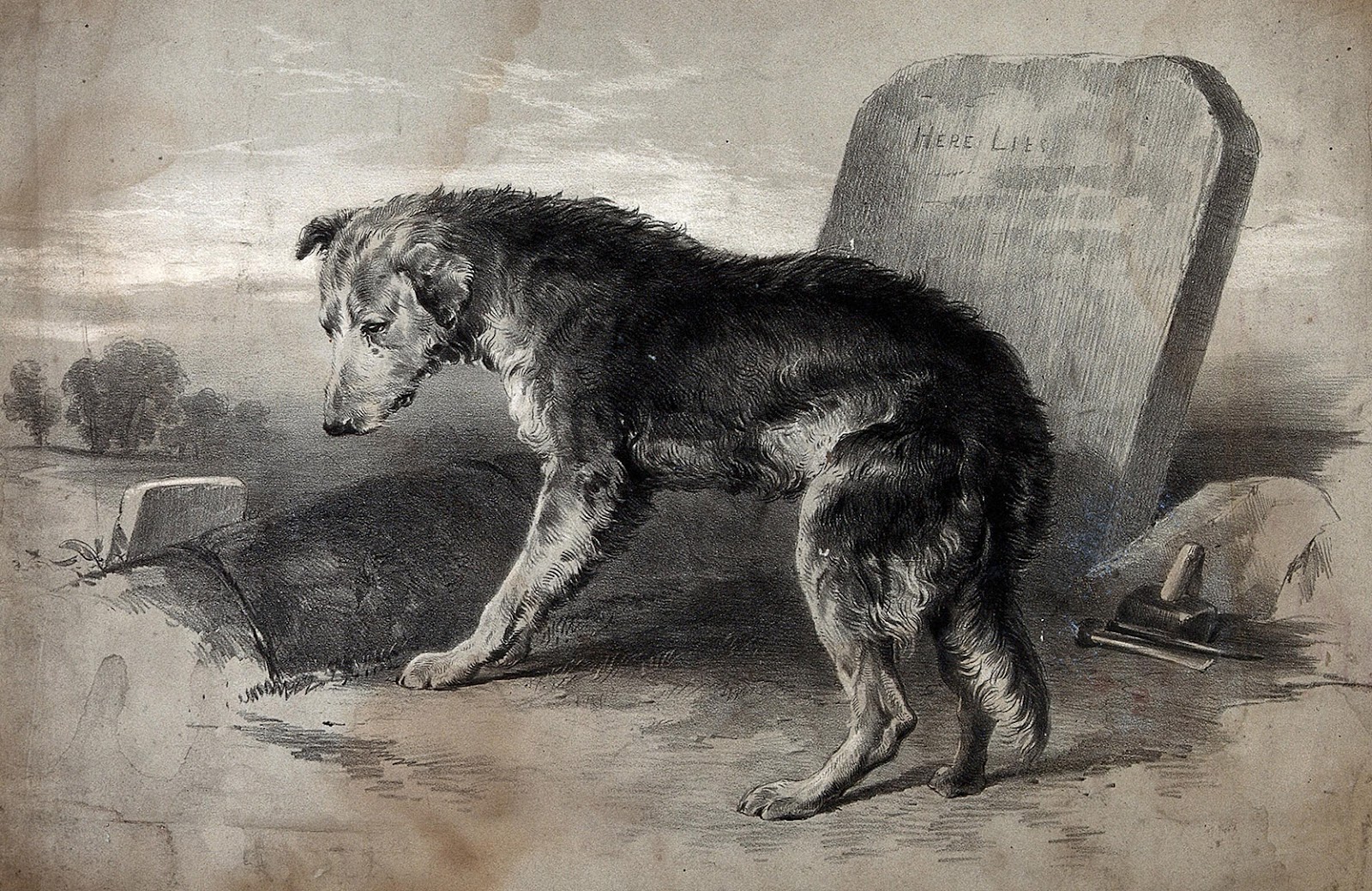
A plate from Studies in Two Crayons. After Sir Edwin Landseer, a collection of 23 lithographs published by George Rowney and Co., 1879. This drawing is of Landseer’s oil painting The Poor Dog (1829). Courtesy Wellcome Collection (London).
“Halloweens I have always considered wilder and richer and more important than even Christmas morn,” Ray Bradbury wrote in an article for the October 1975 issue of Reader’s Digest. “1928 was one of the prime Halloween years. Everything that was grandest came to a special climax that autumn.”

Ray Bradbury was eight years old that year, and his beloved Aunt Neva, 19 years old and recently graduated from high school, owned a Model-A Ford. Sometime around October 20, he recalls in his essay, she said to Ray, “It’s coming fast. Let’s make plans.” She drove him and his brother, Skip, around the countryside to collect pumpkins, corn sheaves, and other decorations to embellish their grandparents’ house for the upcoming festivities. “Then, everything set and placed and ready, you run out late from house to house to make certain-sure that each boy-ghost remembers, that each girl-become-witch will be there.” The big night arrived . . . and then it was over.

“365 darn days until Halloween again. What if I die, waiting?” Ray complained.

“Why, then,” Skip responded, “you’ll be Halloween. Dead people are Halloween.”

“All the worlds of art and imagination flowed to me through Neva,” Bradbury recalled in 1964, “but especially she put me in touch with October Country, a year packed into a single month, a special climate which I still delight in. If I could have chosen my birthday, Halloween would be it.” An artist-designer who studied at the Chicago Art Institute, Neva Bradbury introduced her nephew to gothic and fantastical writings. Ray long cherished her childhood gift of a volume of fairy tales called Once Upon a Time—his first book of fantasy—and he was allowed access to her idiosyncratically stocked bookcase, which included the works of such authors as Edgar Rice Burroughs and L. Frank Baum. When Bradbury had been isolated in bed with whooping cough for three months, Neva visited and read to him the stories of Edgar Allan Poe. Mix all these elements together—illness, confinement, a cherished visitor, Halloween, Poe, death—and you have the ingredients for a story much like “The Emissary.”

Bradbury originally wrote “The Emissary” for his first book, Dark Carnival (1947) and then revised it in 1951 for publication in the short-lived literary journal New-Story. He then rewrote it extensively for inclusion in The October Country (1955). Along the way, however, the story appeared in an unexpected form: it was plagiarized, with flimsily disguised alterations (the sick boy confined to bed becomes a blind young woman in a wheelchair), as “What the Dog Dragged In,” in the December 1951 issue of the EC Comics publication Vault of Horror. The adaptation was written by EC editor Al Feldstein with artwork by Jack Kamen. Other unauthorized comic-book appropriations followed, and when Bradbury learned that the April/May 1952 issue of Weird Fantasy, another EC series, contained a comic called “Home to Stay,” which ripped off not one but two of his stories (“Kaleidoscope” and “Rocket Man” from The Illustrated Man), he took action.

That April, Bradbury wrote to EC Comics: “Just a note to remind you of an oversight. You have not as yet sent on the check for $50 to cover the use of secondary rights on my two stories. . . . I feel this was probably overlooked in the general confusion of office-work, and look forward to your payment in the near future.” In a postscript, though, Bradbury indicated he would be willing to work together on future adaptations: “Have you ever considered doing an entire issue of your magazine based on my stories in Dark Carnival, or my other two books The Illustrated Man and The Martian Chronicles?” Although William Gaines, EC’s publisher, initially denied that the firm had plagiarized the stories, he sent the author the check for $50, and before the end of the year Weird Fantasy announced in its pages that the formerly unauthorized “Home to Stay” was just the first in a series of authorized comic book adaptations of Bradbury stories. Both parties had come to an agreement: rather than a full-length treatment of his books, EC would end up adapting some two dozen stories by Bradbury for publication in their various comic books, such as Tales from the Crypt, Shock SuspenStories, and Weird Science.

*   *   *
Martin knew it was autumn again, for Dog ran into the house bringing wind and frost and a smell of apples turned to cider under trees. . . . If you don't see the full selection below, click here (PDF) or click here (Google Docs) to read it—free!

This selection is used by permission. To photocopy and distribute this selection for classroom use, please contact the Copyright Clearance Center.

Sunday, March 13, 2022

The Tarot Witch

Ray Bradbury (1920–2012)
From Ray Bradbury: Novels & Story Cycles

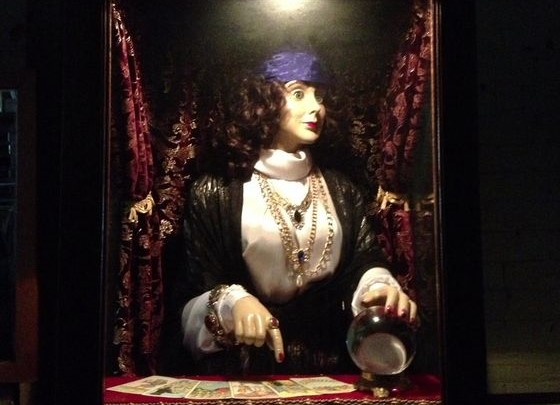
Close-up of a vintage fortune-teller automaton with an array of Tarot cards before her. Manufacturer unknown. Image from Pinterest/@areagallery; the full cabinet can be seen here. Another machine of this same model recently went on auction
.
“It was Sherwood Anderson’s Winesburg, Ohio that set me free,” Ray Bradbury recalled in his preface to the 1997 edition of The Martian Chronicles. “Sometime in my twenty-fourth year, I was stunned by its dozen characters living their lives on half-lit porches and in sunless attics of that always autumn town. ‘Oh, Lord,’ I cried. ‘If I would write a book half as fine as this, but set it on Mars, how incredible that would be!’”

The man who led Bradbury to Winesburg was Henry Kuttner, a prominent science fiction writer who was five years older and who became one of Bradbury’s mentors in the earliest years of his career. In 1944 he urged him to read Anderson’s masterpiece, a story cycle featuring characters living in a fictional Ohio town. Yet, aside from both books’ hybrid framework, the stories of Martian colonists have little in common with the tales of the residents of Winesburg, or as Bradbury put it, “Will you find traces of Sherwood Anderson here? No. His stunning influence had long since dissolved into my ganglion.”

Bradbury instead pointed his readers to the fictional town of Green Town, Illinois, featured in a later book: “You might see a few apparitions of Winesburg, Ohio in my other book-of-stories-pretending-to-be-a-novel, Dandelion Wine. But there are no mirror images. Anderson’s grotesques were gargoyles off the town roofs; mine are mostly collie dogs, old maids lost in soda fountains, and a boy super¬sensitive to dead trolley cars, lost chums, and Civil War Colonels drowned in time or drunk on remembrance.”

Bradbury began work on the book that would become Dandelion Wine around the time he first read Winesburg, Ohio. Initially titled “The Winds of Time,” then “Summer Morning, Summer Night,” his “Illinois novel” drew on his memories of his boyhood in Waukegan, but he was unable to wrestle the various episodes into a sustained narrative. While he was working on the book, however, many of the “Green Town” stories appeared in magazines as varied as Weird Tales, Ellery Queen’s Mystery Magazine, The Reporter, Good Housekeeping, Collier’s, and The Saturday Evening Post. His editor at Doubleday, Walter Bradbury (no relation) became convinced that the novel would ensure his soon-to-be star author’s transition from pulp magazines into the literary mainstream, and he offered him a contract for the book in 1951.

Ray Bradbury was hardly idle during the decade he struggled to write the Green Town novel: he finished The Martian Chronicles and Fahrenheit 451, as well as three story collections: The Illustrated Man, Golden Apples of the Sun, and The October Country. Sensing an impasse, Walter Bradbury suggested that he assemble a collection of linked stories from his Green Town project and finally, in October 1956, Ray sent Walter the first draft of Dandelion Wine. He continued to revise and expand the manuscript, adding two previously unpublished stories, “Exorcism” and “The Tarot Witch,” before the book went to the typesetters. He also decided to remove the titles of the stories, even of those that had previously appeared in magazines.

In its final form, Dandelion Wine is a far cry from Winesburg, Ohio, but perhaps the most important difference is the nature of its collective portrait of the town’s residents. After Sherwood Anderson published his warts-and-all novel, upstanding citizens from two Ohio towns could barely acknowledge his existence without speaking ill of him: not only his childhood home of Clyde, which was clearly the model for the book, but also the real Winesburg, Ohio, which Anderson didn’t even know existed when he chose the name for his fictional town. Bradbury never had to worry about such a reception in his own hometown of Waukegan, Illinois, which he remembered and reimagined through the prism of fond, aching nostalgia, of the kind that can originate only in the mind of young child. As he wrote in 1974:
I was amused and somewhat astonished at a critic a few years back who wrote an article analyzing Dandelion Wine plus the more realistic works of Sinclair Lewis, wondering how I could have been born and raised in Waukegan, which I renamed Green Town for my novel, and not noticed how ugly the harbor was and how depressing the coal docks and railyards down below the town.

But, of course, I had noticed them and, genetic enchanter that I was, was fascinated by their beauty. Trains and boxcars and the smell of coal and fire are not ugly to children. Ugliness is a concept that we happen on later and become self-conscious about. . . .
“In other words,” he added, “if your boy is a poet, horse manure can only mean flowers to him; which is, of course, what horse manure has always been about.”

Notes: The bumbling Keystone Kops were featured in a series of slapstick silent films produced by Mack Sennett during the 1910s. Much of San Francisco burned to the ground following the earthquake of April 18, 1906. Many of the Hal Roach comedy shorts and films of the 1920s (including the first Our Gang films) were directed by Charles Joseph Parrott, who often appeared in the comic lead role of Charley Chase. For the “real” Mme. Tarot, Bradbury may have been thinking of Marie Anne Adelaide Lenormand, a famous French card reader of the early nineteenth century; various decks of tarot cards evolved from her influence.

*   *   *
There she sat in her glass coffin, night after night, her body melted by the carnival blaze of summer, frozen in the ghost winds of winter, waiting with her sickle smile and carved, hooked, and wax-pored nose hovering above her pale pink and wrinkled wax hands poised forever above the ancient fanned-out deck of cards. . . . If you don't see the full selection below, click here (PDF) or click here (Google Docs) to read it—free!

This selection is used by permission. To photocopy and distribute this selection for classroom use, please contact the Copyright Clearance Center.

Friday, August 25, 2017

Barbed Wire and Brown Skulls

Loren Eiseley (1907–1977)
From Loren Eiseley: Collected Essays on Evolution, Nature, and the Cosmos

Loren Eiseley in his office at the University of Pennsylvania Museum, May 12, 1960. Photo by Bernie Cleff, courtesy of the University of Pennsylvania Archives and Records Center.
“My wife’s friends are constantly being startled by the skulls which glare down at them from the top of one of my book cases!” Loren Eiseley wrote in a letter to a friend. “We're short of room here in the apartment, and we’ve lived with dead men so long that we occasionally forget that outsiders must occasionally regard us with the horror and disgust which is reserved for New Guinea head hunters.” At the time the paleontologist was teaching at the University of Kansas; in late 1944 he moved to Oberlin College before finding a permanent home in 1947 at the University of Pennsylvania, where he had earned his PhD. That same year, he began publishing the series of articles in Harper’s Magazine that would make his writings known to a wider audience.

Ray Bradbury came across one of the early Harper’s essays and sent off “a love letter” (as he later described it to an interviewer) praising “the single best essay I’ve read in an American magazine in twenty years.” The two soon-to-be-famous authors became correspondents and friends, and Bradbury accompanied Eiseley when the latter gave a speech at Occidental College in Los Angeles. The event was a flop. “He put everyone to sleep, because he was face down in his speech,” Bradbury recalled. “When it was over I ran up on the stage, I said, ‘Gimme that!’ I grabbed his speech and looked at it, and I said, ‘My God, Doctor, this is beautiful.” Bradbury—thirteen years younger than Eiseley—then lectured him on how he needed to work on his speaking skills: “I felt like a young punk, telling him what to do.” Oddly enough, Bradbury’s hubris seems to have reinforced their friendship, and Eiseley later wrote a letter thanking Bradbury and reporting that he had begun teaching himself to memorize his speeches.

In public addresses and popular articles, Eiseley frequently referred to himself and his colleagues as “bone hunters”—most famously in “Obituary of a Bone Hunter,” a tongue-in-cheek eulogy for himself that described the frustrating and often futile quests for prehistoric fossils:
There are really two kinds of bone hunters—the big bone hunters and the little bone hunters. The little bone hunters may hunt big bones, but they’re little bone hunters just the same. They are the consistent losers in the most difficult game of chance that men can play: the search for human origins. . . . I am a little bone hunter. I’ve played this game for a twenty-year losing streak.
Another essay, “People Leave Skulls with Me,” appeared in Harper’s in 1951 and revealed one of the odder aspects of Eiseley’s career as a bone hunter: how complete strangers occasionally offered old skulls to add to his collection. His various drafts indicate he had a hard time settling on a title; among those rejected are “The Heads in Haggerty’s Barn,” “Headhunting in the USA,” “The Head Takers,” “In a Place of Skulls,” “A Place in the Light,” and “Anthropologists?” When he revised the essay for inclusion in his 1971 collection, The Night Country, he changed the title again, to “Barbed Wire and Brown Skulls,” and it is that version we present as our Story of the Week selection.

Notes: American cartoonist Charles Addams (page 183) was noted for his macabre characters, particularly those which became famous as the Addams Family. Cochise, Victorio, Nana, and Geronimo (page 186) were Apache leaders of the nineteenth century.

*   *   *
Archaeologists, during the course of their lives, see and hear many strange things, but the fact that they are scientific men keeps them for the most part silent. . . . If you don't see the full selection below, click here (PDF) or click here (Google Docs) to read it—free!

This selection is used by permission.
To photocopy and distribute this selection for classroom use, please contact the Copyright Clearance Center.