Showing posts with label John Quincy Adams. Show all posts

Sunday, June 1, 2025

Harvard Oration

John Quincy Adams (1767–1848)
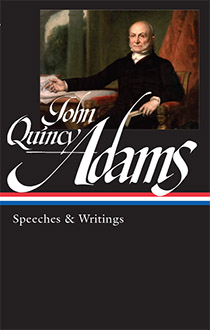
From John Quincy Adams: Speeches & Writings

“A Westerly View of The Colledges in Cambridge New England,” engraving hand-colored with water colors, 1767. Drawn by Joshua Chadwick (c. 1721–1783) and engraved by Paul Revere (1734–1818). At the bottom is the legend “A Harvard Hall | B Stoughton | C Massachusett [sic] | D Hollis | E Holden Chapel,” corresponding to the five buildings in this order: E D A B C. Courtesy American Antiquarian Society.
The following introduction to Adams’s graduation speech is the headnote included in the recently published John Quincy Adams: Speeches & Writings, edited by David Waldstreicher.

On July 11, 1787, just one week before he delivered his first public address, graduating Harvard senior and future law student John Quincy Adams marked his twentieth birthday in the pages of his diary. “I am good for nothing,” he lamented, “and cannot even carry myself forward in the world: three long years I have yet to study in order to qualify myself for business: and then—oh! and then; how many more years, to plod along, mechanically, if I should live; before I shall really get into the world?” Adams was, by any measure, the most accomplished of the young men taking degrees from Harvard that year, having already made two voyages to Europe with his diplomat father, where he enjoyed a range of cultural and educational experiences unknown to many twice his age. Still, he was impatient for something greater, in a hurry to “really get into the world.”

Graduation offered a first chance. The faculty of Harvard College designated Adams one of the class orators at the ceremony, always a significant occasion in the civic life of the Commonwealth of Massachusetts, with the governor and other dignitaries usually in attendance. Adams’s oration came in the middle of a lengthy program of student presentations that included orations and colloquies in Latin, Greek, and Hebrew; scientific and mathematical demonstrations; and syllogistic and forensic disputations on such topics as “Whether any man be so depraved as to have left all sense of virtue?” His topic, set by the college president, was “The importance and necessity of public faith to the well-being of a Community.” “Public faith” here referred not to religion but to the respect for public and private debts and contracts, a subject of paramount importance for the new nation during the “critical period” (a phrase Adams may have coined here) of the framing and ratification of the Constitution.

Nowhere was this issue more urgent than in Massachusetts. The Commonwealth had raised taxes to pay its portion of the national debt in hard coin, aggravating an ongoing currency shortage that hit farmers especially hard. A tax revolt ensued, with Daniel Shays and his followers closing courts in the central and western parts of the state. Shays’s insurgents included some of the leading men of Berkshire County, frustrated by policies that threatened dispossession of their neighbors from their farms, seemingly to pay war bonds held by easterners. Ultimately, the state militia, “the hand of patriotism,” as Adams calls it, had been called out to crush the “noxious plant” of rebellion, with several of Adams’s classmates joining the ranks.

For Adams the issue was bigger than just his home state. Both the debt controversy and the rebellion had national ramifications. The question young Adams asks in his address is the same his father had posed during the protests of the 1760s and early 1770s, and then during the Revolutionary War: Could devotion to the public good be made to last? And more pressingly now, would the present generation take up the task? The answer, for Adams, lay in a renewed commitment to a national compact—“the radiant sun of our union”—and the prompt payment of debts would convey the substance of this renewed nationalism. Local issues would be solved by faith in the union of states. If Americans did not trust each other, why would the foreigners who supported their trade and their outstanding loans? More than just important, public credit was the lifeblood of the social compact. Without it, the nation itself might be of short duration.

Adams’s first turn on the public stage was well received. In a July 27 letter to his friend and former comrade-in-arms Henry Knox, David Humphries, who had served as George Washington’s aide-de-camp during the war, wrote that “I was present at the Commencement in your University of Cambridge & highly delighted with most of the Academic Exercises, in particular young Mr. Adams distinguished himself by a manly and dignified oration on public credit.” Another witness described the event in a Boston newspaper: “The public expectations from this gentleman, being the son of an Ambassador . . . were greatly inflated. The performance justified the preconceived partiality. He is warmly attached to the republican system of his father, and descanted upon the subject of public justice with great energy.” Adams was already sensitive to charges of nepotism or favoritism; when clergyman and historian Jeremy Belknap sought permission to publish the address in Philadelphia’s Columbian Magazine, Adams asked Belknap to publish it anonymously so it could be judged on its own merits. But when the address appeared in the September issue, it carried not only his name, but the additional identifier “son of his Excellency John Adams, L. L. D. the American Minister at the court of London.”

Whatever its billing, the oration fit well with the nationalist sentiments on offer in the magazine, which included the first periodical publication of the U.S. Constitution, under the title “The new plan for a FÅ“deral Government proposed by the Convention.”

Notes: The following address appeared in the September 1787 issue of The Columbian Magazine or Monthly Miscellany under the title “An Oration, Delivered at the Public Commencement, in the University of Cambridge, in New England, July 18, 1787, by Mr. JOHN QUINCY ADAMS, son of his Excellency JOHN ADAMS, L. L. D. the American Minister at the court of London.”

The quote “when then the souls of men were tried” is an allusion to the opening line of Thomas Paine’s pamphlet The American Crisis, written in December 1776. The distinguished patriot mentioned by Adams is John Hancock, who had been the first governor of Massachusetts under its new constitution, serving from 1780 to 1785, and became its third when elected again on May 30, 1787, just six weeks before the Harvard commencement; he was in attendance, along with the governor’s council. Adams alludes to the disastrous fate of Alba, and of Carthage. According to Livy, the ancient city of Alba Longa in Latium was a precursor and rival to Rome until it was destroyed by the Romans in the seventh century BCE. The Carthaginians, who were conquered by Rome in the Third Punic War in the second century BCE, were characterized by their victorious rivals as a proverbially dishonorable people. The four mighty nations united against England during the War of American Independence were the American colonies, France, Spain, and the Dutch Republic. The bald eagle was a late addition to the Great Seal of the United States, which was officially adopted by the Confederation Congress on June 20, 1782.

*   *   *
The solemnity of the present occasion, the numerous concourse of this brilliant audience, and the consciousness of my own insufficiency, all conspire to fill my breast with terrors hitherto unknown. . . . If you don't see the full selection below, click here (PDF) or click here (Google Docs) to read it—free!

This selection may be photocopied and distributed for classroom or educational use.

Saturday, October 31, 2020

“The Spirit of party has overpowerd the Spirit of Patriotism”

Abigail Adams (1744–1818)
From Abigail Adams: Letters

The President’s House, Washington, D.C. Site Plan and Principal Story Plan, 1807. Watercolor and ink on paper by architect Benjamin Henry Latrobe (1764–1820). Library of Congress. Click to see full plan. In letter written in April 1800, Abigail Adams worried that her husband’s insistence on moving into the still-under-construction house “would prove his death.” When she arrived that fall, she wrote “this House is built for ages to come” but complained of the damp inside. “Not one room or chamber is finished of the whole.”
Edith Gelles, editor of Abigail Adams: Letters, provides this week’s introduction of an especially noteworthy letter from Adams to her son John Quincy after the election of 1800, when her family was beset by public and private calamity.

“The Spirit of party has overpowerd the Spirit of Patriotism,” observes Abigail Adams in her January 29, 1801, letter to her eldest son John Quincy, then American minister to the Prussian court in Berlin. Written after having learned that her husband John had been defeated for a second term as president, Adams’s letter vividly conveys the unsettled nature of American politics in the early republic.

The election of 1800 was perhaps the most vituperative in our history. Federalist John Adams, the incumbent, was despised by a prominent faction of his own party, the so-called Essex Junto. Alexander Hamilton, the de facto leader of the Federalist party, had written a pamphlet denouncing the President as a madman. This fratricidal conflict opened the door for the two Republican candidates, Thomas Jefferson and Aaron Burr, who, by a fluke of the original electoral process established by the Constitution, ended up tied in the Electoral College, with Adams coming third. The deadlock shifted the decision to the House of Representatives, where (two weeks after Abigail wrote her letter) it would take 36 ballots over the course of seven days for Jefferson to secure election. Denied a second term, President Adams, in a move that was as controversial then as it would be today, made a series of “midnight appointments” in the final days of his administration, including that of John Marshall to be the Chief Justice of the Supreme Court. As the young nation prepared for the first transfer of power from one party to another, the outgoing First Lady despaired for the future.

Adams’s mood in this letter is melancholy for more personal reasons as well. She had recently arrived in the swampy new capital, the first First Lady to occupy what would become known as the White House. On her journey to Washington, over roads that were so rutted that “it was like a ploughd field,” she had passed through New York City to pay a “dying visit” to her beloved second son, Charles, who was fast fading from the effects of alcoholism. Not yet regarded as a disease, alcoholism was then considered a sign of personal weakness and a sin. She prays that Charles, the son she remembers as the charming and loveable man “he once was,” will be forgiven, and that John Quincy will become a surrogate father to his brother’s younger daughter. Abigail and John took Charles’s older daughter, Susanna, home with them to Quincy, Massachusetts, where she remained until her marriage in 1817.

Abigail’s ray of hope in this grim landscape is the prospect of John Quincy’s return home and a fantasy of retirement “passed in Peace and quietness,” surrounded by her family.

Notes: The pamphlet by Alexander Hamilton. The Public Conduct and Character of John Adams Esq., President of the United States, was a savage, 54-page attack not only on the policies but on the temperament of the President. John had considered responding immediately to this calumny of the charges but delayed until 1809 in a series of letters in the Boston Patriot.

Until 1933, U.S. Presidents were inaugurated on March 4 (or if the 4th was a Sunday, March 5). Thus, there were still five weeks left of the Adams administration when Abigail wrote this letter. In the section discussing her husband’s recent changes in the Cabinet, Abigail mentions that Oliver Wolcott Jr., the secretary of the treasury who resigned at the end of December, was replaced by Samuel Dexter, the secretary of war. Roger Griswold, a Federalist lawyer and congressman from Connecticut declined John Adams’s request to replace Dexter as secretary of war and the post remained unfilled until Jefferson appointed Henry Dearborn in early March. Col. Smith is William Stephens Smith, John and Abigails’s son-in-law and husband of Abigail Adams Smith. He had been appointed by President Adams as surveyor of the Port of New York, “an office which affords him and his Family a handsome Support,” as Abigail notes. William Cranch, the son of Abigail’s sister, was one of John’s “midnight judges,” appointed to the District of Columbia Circuit Court, where he served until his death.
This selection may be photocopied and distributed for classroom or educational use.

*   *   *
For this week’s selection, we depart from the usual format and reproduce the selection, in its entirety, below.
You may also download it as a PDF or view it in Google Docs.

Abigail Adams to John Quincy Adams

Washington Jan’ry 29 1801

My dear Son
Your Brother Thomas has performed the painfull office of announcing to you the death of your Brother Charles. With what a weight of sorrow is my bosom opprest, when I reflect, that he was cutt down in the bloom of Life, in the midst of his days. he is numberd with the dead; it becomes me in Silence to mourn; mourn over him living, I have for a long time, and now he is gone.—the tender remembrance of what he once was rises before me, and I wish to forget. I wish to draw a veil over all those propencities, which have rung my Heart, with unutterable pang’s. I would hope, that from that Throne of Sovereign Mercy, where I have often besought it for him, he may have obtaind forgiveness—think of him my Son with the compassion of a Brother, and if you are permitted to return to your native Country, be a Father to the little Girl who bears my Name—the other I have taken, and if my Life is Spared, I mean to bring her up,—the Mother has no means of Support but that which She derives from her Friend’s She is amiable and worthy; I can lay no blame to her Charge. She attended with constant and unwearied Solisitude, to the last Scene, his Sickness was short; his constitution was undermined; his Sufferings were Severe, his patience under them was great, a dropsey in his Chest was the cause of his Dissolution; I knew not that he was Sick: indeed he had not been more than a week confined, when I arrived in November at Newyork, on my way to this City, I went to see him but you may judge of my feelings, when I Saw that his case was desperate, tho he entertaind no Idea himself that it was so, but he Survived only a fortnight. he was at Lodgings. your sister Smith who had Spent the Summer with me, returnd to Nyork when I did. She removed him immediatly, and every kind care and Sisterly attention was Shewn him, both from the Col. & herself. the removal of him, was all the releaf, all the consolation I could derive; I came to this city with a heavey Heart; in daily expectation of his death, which took place on the first of december; my Residence in this City, has not Served to endear the World to me, to private and domestick Sorrow, is added a prospect of publick Calamity for our Country. the Spirit of party has overpowerd the Spirit of Patriotism. the Intrigue of one Man, and the dissapointed ambition of an other has divided the Strength of the Country, and thrown into the antifediral Scale the weight of Numbers; this Change has been produced by the practise of all those low arts of calumny, and falshood, which are the weapons of unprincipled Men, and the power of faction, the corrupt and infatuated members of it, have acted without any regard to right, or wrong, and the question with them has been who shall govern, not how they shall be governed; If as is expected a total Change of Men, and measures follow, universal confusion will be the concequence. The Election is not yet determined, for two candidates being equal, the House of Representitives must decide; if they stear from Scylla, they must wrecked upon Charibdis—what is before us Heaven only know’s time only can unfold—that ingratitude was considerd by the Athenians as a Sin; we are told could Athens produce stronger instances, than are to be found in our Country? You can trace the train of my thoughts, when you consider the wise and judicious administration of our Government for the last 12 years—when you view it rising in power at home, and respectability abroad, acquiring wealth, and oppulence daily; who but must lament, that this fair prospect is vanishing like the baseless fabrick of a vision—it would require a vol’m instead of a single Letter; to unfold to you, all the Machinations which have combined to produce this Change in the Administration; honest Men have been cheated, and duped, ambitious Men have Seen themselves, and their plots discoverd, and counteracted by a watchfullness which they could not elude; and were therefore determined to get rid off, at any hazard; If you received a Letter I wrote you, just before I left Quincy it will Serve you, in Some measure as a clue to the objects of a certain Party call’d the Essex Junto, but a pamphlet written by Hamilton concerning the public conduct & Character of John Adams President of the united States, and which I presume has been sent you, will more fully display the falshood and malignity of the Anglo Federalist. from this pamphlet however the Author has not acquired more fame, or reputation than he did from the precious confession of an other; to Burr is the merrit due, with the antifederal party for turning the Election of Nyork in their favour. to Burr then will that party owe their President, provided mr Jefferson is chosen—and this was a bargain and Sale business!! Is it not sufficent to give every considerate, and reflecting person a surfeit of Elective Governments, when in this young Country and thus early such proffs appear of corruption and want of principle?—

I turn from this disgusting object to one nearer my Heart. I mean the return of my dear Son to his family and Friends my last letter was full upon this Subject; tho it will be urksome to you to return with Such prospects opening before you; I presume you will not feel as tho you could remain abroad;

I expect to take a final leave of this City next week, and return to Quincy; could I be assured that the remainder of my days might be passed in Peace and quietness, I should have reason to rejoice in a liberation from public Life; The President retains his Health, and his Spirits beyond what you could imagine; he has the conscienciouss of having served his Country with pure intentions; with upright views and from the most disinterested motives, as his own pecuniary affairs manifest. tho free from debts, or embarassments of that nature; his income will oblige us to a strickt oeconomy, in order to preserve that independance upon which Our future tranquility rests. I repine not, at any of the allotments, or dispensations of providence; we have been a scatterd family if some of my Children could now be collected round the parent Hive it appears to me, that it would add much to the happiness of our declining Years; Thomas has determined to remain in Pennsilvana he is the joy of our Hearts. his conduct in all respects, is prudent and judicious I think it not unlike that the State he has chosen for his residence may become under the new administration Such a hot bed of turbulence and Sedition as to induce him to change his Quarters; Some recent Changes have taken place in the public offices. mr Wolcot has resignd, and mr dexter is appointed in his place; Mr Marshall is appointed Chief Justice of the united States in the Room of mr Elsworth, resignd. Mr Griswold is this day nominated in the place of mr Dexter; Secritary of War. no Secretary of State is yet nominated and I cannot say that any will be; it is difficult to get Such Gentlemen as are esteemed proper, to accept offices from which they may be removed in the course of a few weeks—Yet in the present critical State of the Country when it is undetermined, and altogether uncertain which of the candidates will be our future President, or whether there will be any Election at all, the President has thought it best to fill up the offices with Such men as are fit, and capable of discharging the duties of them in any Event; if they are to be removed; let the world See how they will again be filled.

I have not any Letter from you of a later date than July 11th, I have seen Letters from Louisa to her Father in August and to the 5 of Sep’tr. Your Brother has Letters of as late a date from you which have been a source of much entertainment to me; I have very little cause to accuse you of not writing to me. I have myself been very deficient. tell Louisa that her Family are all well Situated about one mile from the Presidents house, but Such a quagmire between, that our intercourse is much impeeded. Caroline has had a long fit of Sickness, a Nervious fever from which she has so far recoverd as to have Spent one Day with me. I expect the Family all to dine with me on Saturday for the last time. Col. Smith is now in an office which affords him and his Family a handsome Support. my mind is easier upon their account. mr W. Cranch will do very well here. he is appointed one of the city Commissoners—my paper obliges me to conclude. Your truly affectionate &c &c.

From original at the Massachusetts Historical Society, via The Founders website (founders.archives.gov).

Friday, June 23, 2017

“This Whole Horrible Transaction”

John Quincy Adams (1767–1848)
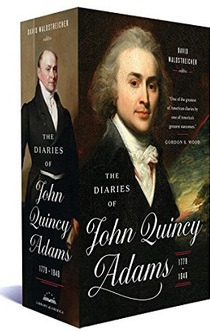
From John Quincy Adams: Diaries 1821–1848

Drawing of the Slave Pen in Alexandria, 1862. The building sign in the illustration reads, incorrectly, “Pierce, Birch & Co. Dealers in Slaves”; the company’s actual name was Price, Birch & Co. (The slave trader James H. Birch is mentioned by Adams in the selection below.) Originally built as a private home in 1812, the compound was converted into a large slave jail and pen in 1828. The central three-story edifice still stands at 1315 Duke Street and is the home to the North Virginia Urban League and the Freedom House Museum. Image courtesy of the Virginia Historical Society.
Elected to the House of Representatives in 1830, former President John Quincy Adams almost immediately began presenting to Congress various petitions from citizens, nearly all of them demanding the abolition of slavery, and he insisted on First Amendment grounds that these documents be received by the House and referred to the proper committees. By the middle of the decade thousands of such petitions were flooding Washington. In May 1836 South Carolina representative Laurens Pinckney proposed three resolutions on the issue of slavery, the third of which advocated that all petitions, memorials, and resolutions relating to slavery be peremptorily tabled and not acted upon. Denied an opportunity to speak against the proposals, Adams demanded, “Am I gagged or am I not?” For each of the next four years, over his strenuous protests, the House successfully reintroduced what became known as the gag rule.

In June 1838 John Quincy Adams used a parliamentary maneuver to “ungag” himself, at least temporarily. The question of annexing Texas was under consideration by the Committee on Foreign Affairs, which moved to table it since there weren’t enough votes in the House for it to pass. Adams, who opposed annexation (since it would further tilt the balance of power to the slave states), took the opportunity to seize control of the House floor. Each morning for three weeks, from June 16 to July 7, he maintained a filibuster against a motion he in fact supported—tabling the question of Texas annexation—and delivered a series of speeches describing a long-standing “conspiracy” among the slave states to acquire Texan territory, upholding the propriety of women petitioning Congress, and declaring slavery to be a sin. His daily orations ended with the arrival of summer recess.

Midway through the filibuster, on June 30, Adams responded to an interruption by South Carolina representative Francis Wilkinson Pickens and described a notorious incident from the previous year.
I do not doubt in the least that he is, himself, a kind and indulgent master; so, I doubt not, are all the gentlemen who represent his State on this floor. They know not the horrors that belong to the system, and attend it even in their own State; and when they are stated by those who have witnessed them, he calls the whole a tissue of misrepresentation. . . . He does not know the profligate villain who procreates children from his slaves, and then sells his own children as slaves. He does not know the crushing and destruction of all the tenderest and holiest ties of nature which that system produces, but which I have seen, with my own eyes, in this city of Washington. Twelve months have not passed since a woman, in this District, was taken with her four infant children, and separated from her husband, who was a free man, to be sent away, I know not where. That woman, in a dungeon in Alexandria, killed with her own hand two of her children, and attempted to kill the others. She was tried for murder, and, to the honor of human nature I say it, a jury was not to be found in the District who would find her guilty. . . . The woman was asked how she could perpetrate such an act, for she had been a woman of unblemished character and of pious sentiments. She replied that wrong had been done to her and to them; that she was entitled to her freedom though she had been sold to go to Georgia and that she had sent her children to a better world.
The incident involving Dorcas Allen, the woman described by Adams, is described in detail in several fascinating entries of his diary. When he first came across the case in the newspaper, he asked for more information about it from his brother-in-law and business associate Nathaniel Frye, who seemed reluctant to speak on the subject. Adams gradually learned the complicated history of “this horrible transaction”; his investigation would involve such luminaries as Francis Scott Key, the U.S. Attorney for the District of Columbia; William Cranch, Adams’s cousin and the chief judge of the U.S. Circuit Court; and General Walter Smith, most famously the commander of a brigade of the district’s militia during the War of 1812. During the fall of 1837 Adams “imprudently” involved himself in the matter and became personally acquainted, for the first time, with the byzantine horrors of slavery. We present the relevant entries as they appear in the Library of America edition of The Diaries of John Quincy Adams.

Notes: During this period (until 1846), a substantial portion of Alexandria and the surrounding area was part of the District of Columbia, which is why the case falls under the jurisdiction of district officials. In the first diary entry presented here, Adams mentions belatedly receiving issues of Niles’s Register, an influential Baltimore-based national weekly news magazine published by Hezekiah Niles. William Winston Seaton was co-publisher of the National Intelligencer, the dominant daily newspaper in Washington, DC. The entry of October 28 notes that the prosecutor of Dorcas Allen’s case entered a noli prosequi (nolle prosequi) on the second indictment, a legal term declaring an abandonment of all or part of a suit or action.

In each diary entry, the letter following the number refers to the time; thus the first entry was written at 5 in the morning on October 23. The entries, when possible, are presented in full. Certain passages, especially such recurring items as meteorological observations, records of social visits received and returned, and accounts of bills paid and due, have been cut; such breaks are indicated with the ≈ symbol.

*   *   *
There was in the National Intelligencer this morning an advertisement, signed James H. Birch, and Edward Dyer Auctioneer — headed Sale of Slaves — A sale at public auction at 4 O’Clock this afternoon, of Dorcas Allen, and her two surviving children aged about 7 and 9 years. . . . If you don't see the full selection below, click here (PDF) or click here (Google Docs) to read it—free!

This selection may be photocopied and distributed for classroom or educational use.