Showing posts with label Joan Didion. Show all posts

Sunday, November 17, 2024

A Sunday Lunch in Clarksdale

Joan Didion (1934–2021)
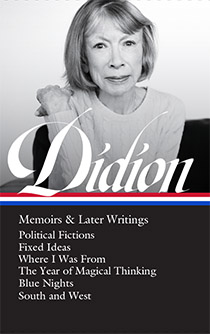
From Joan Didion: Memoirs & Later Writings

Joan Didion in Los Angeles on August 2, 1970, shortly after the publication of Play It As It Lays and weeks after she returned from her trip to the South. Photograph, cropped top and bottom, by Kathleen Ballard for the Los Angeles Times. (CC-BY 4.0, UCLA Library Special Collections)
After Joan Didion finished writing her second novel, Play It As It Lays, she signed a contract to contribute a column in Life magazine, but she became quickly disillusioned when several of the articles she turned in were rejected by the editors. As the summer of 1970 approached, she arranged to write feature articles instead. “I said that I was interested in driving around the Gulf Coast, and somehow that got translated into ‘The Mind of the White South,’” she recalled in a 2006 Paris Review interview with Hilton Als. “I had a theory that if I could understand the South, I would understand California, because a lot of the California settlers came from the Border South.”

Her husband, John Gregory Dunne, recalled that he had imagined they would go on a road trip “to drink Dr. Pepper at the general store and do the underwear and the dirty sheets at the crossroads coin laundry, to go to Little League games and get my hair cut while my wife got a manicure or a pedicure at the local beauty parlor—in other words, to take the pulse of the white South.” As Didion’s biographer Daugherty notes, Dunne’s description revealed “how firmly he’d determined already what the South had to offer” but, for her part, Didion seemed to have “carried no preconceptions into the bayous; more impressively she aimed herself in whatever direction turned up, even when she didn’t understand it, when it appeared to make no connection to anything she might do.” Or, as she put it nearly fifty years later: “The idea was to start in New Orleans and from there we had no plan. We went wherever the day took us.”

With Dunne driving the rental car, the couple left New Orleans for Gulfport and from there to Biloxi, before heading inland to various cities in Mississippi and Alabama (Meridian, Tuscaloosa, Birmingham, Oxford, Clarksdale, Greenville, Covington) and back to New Orleans to return to Los Angeles. Among the people Didion interviewed along the way were Stan Torgerson, the white owner of the Black radio station in Meridian who was celebrated throughout the state as the announcer of Ole Miss football and basketball games; the artist Marshall Bouldin, a well-known portrait painter whose subjects included William Faulkner, both of Richard Nixon’s daughters, and numerous elected officials; and the novelist Walker Percy, whose most famous novel, The Moviegoer, had been published a decade earlier.

In several ways, it was an unsettling time for a trip to the region. The coastal towns visited by Didion and Dunne were still recovering from the devastation (including 259 deaths) caused by Hurricane Camille. There had been widespread resistance and protests during the previous year in response to the “integration orders [that] were flying around Mississippi” (as Bouldin put it). A month before their visit, on May 15, 1970, two Black students, James Earl Green, a high school senior on his way home from work, and Phillip Lafayette Gibbs, a prelaw college junior, were killed on the campus of Jackson State University after dozens of city police and state troopers unleashed a barrage of indiscriminate gunfire against a crowd of protesters and the building behind them; a dozen students were wounded. Afterward, the police asserted that there had been a sniper firing from one of the windows, but no evidence supporting this claim was found in a subsequent FBI investigation.

“I could never precisely name what impelled me to spend time in the South during the summer of 1970,” Didion later wrote in her notebook. “I had only some dim and unformed sense, a sense which struck me now and then, and which I could not explain coherently, that for some years the South and particularly the Gulf Coast had been for America what people were still saying California was, and what California seemed to me not to be: the future, the secret source of malevolent and benevolent energy, the psychic center.” Much of the trip she found “fantastic,” particularly their week-long stay in New Orleans and their sojourn along the coast. Yet, despite the richness of her experiences, the piece wouldn’t come together. “The way in which all the reporting tricks I had ever known atrophied in the South,” she wrote at the time. “There were things I should do, I knew it: but I never did them. . . . I was underwater in some real sense, the whole month.”

Didion updated Faulkner’s adage of the South (“The past is never dead. It's not even past.”) with her own maxim: “The Civil War was yesterday, but 1960 is spoken of as if it were about three hundred years ago.” A quarter century later, she concluded, “One of the many differences between the South and California was this: in South they remained convinced that they had bloodied their land with history. In California we did not believe that history could bloody the land, or even touch it.” She ended up abandoning the project.

Nearly fifty years later, Didion dusted off her notebook from the period and decided to publish, in a small book called South and West, some of the material she had written during and after her trip. For our Story of the Week selection, we present her description of the day she interviewed the painter Marshall Bouldin in Clarksdale, Mississippi. In his foreword to the book, Nathaniel Rich writes, “Didion’s notes, which surpass in elegance and clarity the finished prose of most other writers, are a fascinating record of this time. But they are also something more unsettling. Readers today will recognize, with some dismay and even horror, how much is familiar in these long-lost American portraits. . . . Joan Didion went to the South to understand something about California and she ended up understanding something about America.”

*   *   *
One day we drove from Oxford over to Clarksdale, to have Sunday lunch with Marshall Bouldin and his wife, Mel. . . . If you don't see the full selection below, click here (PDF) or click here (Google Docs) to read it—free!

This selection is used by permission. To photocopy and distribute this selection for classroom use, please contact the Copyright Clearance Center.
Sunday, July 14, 2024

In Another Country

Ernest Hemingway (1899–1961)
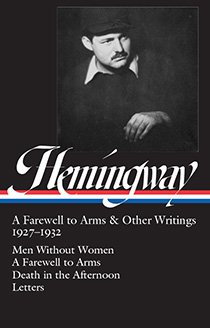
From Ernest Hemingway: A Farewell to Arms & Other Writings 1927-1932

Physical Therapy at Bath Hospital, 1918. Watercolor by English artist E. Horton [Sarah Elizabeth Roberts Horton] (1865–1959). WikiCommons.

On the night of July 8, 1918, Hemingway was hit by an Austrian trench mortar, followed almost immediately by a machine gun bullet. He was transported to the American Red Cross Hospital in Milan, where he spent the next ten weeks recovering from mortar fragment wounds (“227 little devils”) in his legs and feet.
When Ernest Hemingway’s story collection Men Without Women appeared in 1927, Dorothy Parker—who considered him “the greatest living writer of short stories”—reviewed it for The New Yorker, with (she confessed) some concern. She had greatly admired Hemingway’s debut collection, In Our Time, and believed it had been too readily dismissed by some American critics:
Well, you see, Ernest Hemingway was a young American living on the left bank of the Seine in Paris, France; he had been seen at the Dome and the Rotonde and the Select and the Closerie des Lilas. He knew Pound, Joyce and Gertrude Stein. There is something a little well, a, little you-know—in all of those things. You wouldn’t catch Bruce Barton or Mary Roberts Rinehart doing them. No, sir.

And besides, In Our Time was a book of short stories. That’s no way to start off. People don’t like that; they feel cheated.
After The Sun Also Rises was published, however, Hemingway became the new thing. “He was praised, adored, analyzed, best-sold, argued about, and banned in Boston; all the trimmings were accorded him,” Parker wrote. “People got into feuds about whether or not his story was worth the telling. . . . They affirmed, and passionately, that the dissolute expatriates in this novel of ‘a lost generation’ were not worth bothering about; and then they devoted most of their time to discussing them.”
After all the high screaming about The Sun Also Rises, I feared for Mr. Hemingway’s next book. You know how it is—as soon as they all start acclaiming a writer, that writer is just about to slip downward. The littler critics circle like literary buzzards above only the sick lions.

So it is a warm gratification to find the new Hemingway book, Men Without Women, a truly magnificent work. It is composed of thirteen short stories, most of which have been published before. They are sad and terrible stories; the author’s enormous appetite for life seems to have been somehow appeased. . . . I do not know where a greater collection of stories can be found.

Ford Maddox Ford has said of the author, “Hemingway writes like an angel.” I take issue. . . . Hemingway writes like a human being.
The collection (which actually has fourteen stories) includes some of Hemingway’s best, most famous, and most anthologized works: “The Killers” (which Parker regarded as “one of the four great American short stories”), “Hills Like White Elephants,” “The Undefeated,” “Fifty Grand,” and our current Story of the Week selection, “In Another Country.”

Set in and near a hospital in Italy during World War I, “In Another Country” portrays a group of soldiers struggling through experimental therapies using machinery to help them learn to use their mangled or wounded limbs. Soon after F. Scott Fitzgerald read the story in Scribner’s Magazine, he wrote to Hemingway that the opening was “one of the most beautiful prose sentences I’ve ever read,” and he reiterated his praise in another letter after Men Without Women appeared.

Not many stories receive the kind of attention accorded to the opening passages of “In Another Country”; you’ll find the first paragraph reprinted and dissected in any number of books on the writing of fiction. “This is a most peculiar way to begin a story,” writer and critic Dwight Macdonald wrote. “The first sentence is a perfect opening phrase, mannered enough to jolt the reader awake without making him go to see if the front door is locked.” Similarly, the essayist and editor Joseph Epstein noted in his book Literary Genius, “The narrative voice in this paragraph is almost entirely detached, and the effect is unnerving. The man telling this story has lived through a great deal. . . . He will only describe; he will not attempt to explain.” Referring to the story’s opening, Joan Didion remarked how “we sometimes forgot that this was a writer who had in his time made the English language new, changed the rhythms of the way both his own and the next few generations would speak and write and think. The very grammar of a Hemingway sentence dictated, or was dictated by, a certain way of looking at the world, a way of looking but not joining, a way of moving through but not attaching, a kind of romantic individualism distinctly adapted to its time and source. If we bought into those sentences, we would see the troops marching along the road, but we would not necessarily march with them.”

Yet few homages to this story—or to any story—are as moving and memorable as an essay by Andre Dubus that appeared in 1997 in The Kenyon Review. Dubus begins by recalling one day in 1966, when he was teaching at the University of Iowa. He and his neighbor Kurt Vonnegut hosted Ralph Ellison, who was speaking at a conference, and during one of their conversations, Dubus mentioned that “In Another Country” was his favorite story—and Ellison proceeded to recite the opening paragraph, word for word, from memory. After Dubus moved to Bradford College in Massachusetts, he assigned the story in his classes for years. The first year, he recalled, “I understood more of it, because of what the students said, and also because of what I said: words that I did not know I would say.” Subsequently, “I did go into the classroom in the years after that, knowing exactly what I would say about the story.” He told his students, “In the center of this canvas is death”; at first it is “a story about young men who have lost that joy in being alive which is normal for young and healthy people”—and then death unexpectedly interferes yet again: “It is what no one can escape.”

In July 1986, Dubus had stopped on the highway one night to help two people, Luz Santiago and her brother Luis, stranded on the side of the road after their vehicle had collided with a motorcycle. (The cyclist had been drunk, fell off the cycle, left it there, and was later found wandering along the highway.) While Dubus was helping the Santiagos—they all believed the cyclist was trapped under the stranded vehicle—a passing car struck both Luis, killing him instantly, and Dubus, who pushed Luz out of the way at the last minute. One of Dubus’s legs had to be amputated, the other was paralyzed, and he never walked again.

After months of recovery and therapy, he began a reading group at his home for teenaged girls who, for various reasons, lived in protective custody in a nearby state-run facility. “One night in the fall of 1991, five years after my injury, I read ‘In Another Country’ to a few girls and a staff woman. This was the first time I had read it since my crippling,” and the story had changed for Dubus:
I saw something I had never seen in the story, and I do not know whether Hemingway saw it when he wrote it or later or never, but there it was, there it is, and with passion and joy I looked up from the book, looked at the girls’ faces and said: “This story is about healing too. The major keeps going to the machines. And he doesn’t believe in them. But he gets out of his bed in the morning. He brushes his teeth. He shaves. He combs his hair. He puts on his uniform. He leaves the place where he lives. He walks to the hospital, and sits at the machines. Every one of those actions is a movement away from suicide. Away from despair. Look at him. Three days after his wife has died, he is in motion. He is sad. He will not get over this. And he will get over this. His hand won’t be cured but someday he will meet another woman. And he will love her. Because he is alive.”
*   *   *
Notes: “A bacco gli ufficiali!” is Hemingway’s misspelling of Abbasso gli ufficiali (Down with the officers!). After Hemingway sent the typescript to Maxwell Perkins at Scribner’s, he followed up with a note that partially corrected the error: “the Italian should read ‘A basso gli ufficiali!’ I have forgotten my Italian or so mixed it with Spanish that I could not remember how to spell ‘bacco’ for the very good reason that there is no such word.” Arditi were the elite assault troops of the Royal Italian Army. The name translates as “daring” or “audacious.” Fratellanza and abnegazione are the Italian words for brotherhood and self-sacrifice.

*   *   *
In the fall the war was always there, but we did not go to it any more. . . . If you don't see the full selection below, click here (PDF) or click here (Google Docs) to read it—free!

This selection may be photocopied and distributed for classroom or educational use.

Sunday, December 17, 2023

The Big Rock Candy Figgy Pudding Pitfall

Joan Didion (1934–2021)
From American Christmas Stories

“It was late in September, about the time certain canny elves began strategically spotting their Make It Yourself for Christmas books near supermarket check-out counters.” Three of the many 1966 Christmas decor publications that inspired Joan Didion to write her humorous Christmas story. (eBay).
Joan Didion had been working at Vogue for eight years when she was dismissed in late 1964, shortly after she and her husband, John Gregory Dunne, moved to Los Angeles. She began at the magazine as a writer of promotional copy and eventually worked her way up to the position of features associate before becoming one of Vogue’s two film critics. Years later, both Didion and Pauline Kael, who was the film critic at McCall’s, would tell people they had been fired for trashing The Sound of Music; Didion’s review of that movie includes the often-quoted zinger, “Just whistle a happy tune, and leave the Anschluss behind.” While Kael’s recollection concerning her dismissal has been questioned by those who worked with her at the time, “Didion has a bit more leverage in her legend, if only because there is no loud opponent to her version of events,” writes film critic Justine Smith.

Working as a freelancer, Didion began publishing articles and stories for The Saturday Evening Post, and she and Dunne struggled to make ends meet. In early 1966, they adopted a baby girl, who had been born at St. John’s Hospital in Santa Monica on March 3, and named her Quintana Roo. “Once she was born I was never not afraid,” she recalls in her 2011 memoir Blue Nights. “What if I fail to take care of this baby?” The struggle to balance domestic concerns and a career, along with doubts of her own abilities, haunted and inspired Didion’s work for the next five decades.

“Our daybook for those months shows no income at all for April, $305.06 for May, none for June, and, for July, $5.29, a dividend on our single capital asset, fifty shares of Transamerica stock left to me by my grandmother,” she wrote years later. Amidst this hardship, she published “The Big Rock Candy Figgy Pudding Pitfall,” a humor piece for the holidays that pokes fun of her desire to be a “‘can do’ kind of woman.” Reprinted below, the piece is somewhat atypical for her, resembling Shirley Jackson’s or Erma Bombeck’s stories about home life far more than anything Didion would write in the coming years.

During the remainder of the decade, she and Dunne enjoyed a complete turnaround in fortunes. They struck a relatively lucrative deal with The Saturday Evening Post for a monthly column which would alternate between the two of them, and her first book, Slouching Towards Bethlehem, became a critical success. At the end of 1969, she and Dunne worked together on the screenplay for The Panic in Needle Park, adapted from the novel about heroin addicts by James Mills and starring Al Pacino and Kitty Winn. After The Post folded that year, she was offered a column in Life, and the opening of one piece seems almost a sequel of sorts—a far more Didion-like revision of the “Figgy Pudding” story.
I had wanted to make this Christmas a “nice” Christmas, for my husband and for our baby and for everyone who came to our house in Los Angeles, and, because such plans lend always to involve an element of self-congratulation, a way of perceiving oneself in a new and flattering light, I suppose most of all for myself. I saw a house full of candles and star jasmine. . . . We would make pomegranate jelly and wrap the jars in red Cellophane. We would sit at the piano and pick out carols together. . . .
The remainder of this newest holiday essay, however, does not echo the obsessive home decor mania of her previous story. Didion and Dunne were in New York to work on the film, and the day after she wrote the piece they had “an appointment with a dealer in a Blimpy Burger on a desolate side street” and would “spend the next week with two junkies.” She felt remorseful because she wouldn’t be spending Christmas Day with her three-year-old daughter doing “so many small things as to imprint indelibly upon her memory some trace of the rituals of family love.” Yet in the end she concluded, “The baby will know something about family love on Christmas because she knows something about it today, and she will also know something about its complexities.”

*   *   *
For this week’s selection, we depart from the usual format and reproduce the selection, in its entirety, below.
You may also download it as a PDF or view it in Google Docs.
The Big Rock Candy Figgy Pudding Pitfall

You will perhaps have difficulty understanding why I conceived the idea of making 20 hard-candy topiary trees and 20 figgy puddings in the first place. The heart of it is that although I am frail, lazy and unsuited to doing anything except what I am paid to do, which is sit by myself and type with one finger, I like to imagine myself a “can-do” kind of woman, capable of patching the corral fence, pickling enough peaches to feed the hands all winter, and then winning a trip to Minneapolis in the Pillsbury Bake-Off. In fact, the day I stop believing that if put to it I could win the Pillsbury Bake-Off will signal the death of something.

It was late in September, about the time certain canny elves began strategically spotting their Make it Yourself for Christmas books near supermarket check-out counters, when I sensed the old familiar discontent. I would stand there in the Westward Ho market, waiting to check out my frozen chicken Tetrazzini and leafing through the books, and I would see how far I had drifted from the real pleasures. I did not “do” things. I did not sew spangles on potholders for my friends. I did not make branches of marzipan mistletoe for my hostesses. I did not give Corn Dog and Caroling Parties for neighborhood children (Did I know any neighborhood children? Were there any neighborhood children? What exactly was my neighborhood?), the Corn Dogs to be accompanied by Hot Santa’s Grog.

Nor had it ever occurred to me to buy Styrofoam balls, cover them with hard candies, plant them on wooden stalks in small flowerpots, and end up with amusingly decorative hard-candy topiary trees, perfect for centerpieces or last-minute gifts. At the check-out counter, I recognized clearly that my plans for the Christmas season—making a few deadlines—were stale and unprofitable. Had my great-great-grandmother come west in a covered wagon and strung cranberries on scrub oaks so that I might sit by myself in a room typing with one finger and ordering Italian twinkle lights by mail from Hammacher Schlemmer?

I wanted to be the kind of woman who made hard-candy topiary trees and figgy puddings. The figgy puddings were not in the Make it Yourself for Christmas books but something I remembered from a carol. “Oh bring us a figgy pudding and a happy new year,” the line went. I was unsure what a figgy pudding was, but it had the ring of the real thing.

“Exactly what kind of therapy are we up to this week?” my husband asked when I arrived home with 20 Styrofoam balls, 20 flowerpots and 60 pounds of, or roughly 6,000, hard candies, each wrapped in cellophane.

“Hard-candy topiary trees, if you don’t mind,” I said briskly, to gain the offensive before he could mention my last project, a hand-knitted sweater which would have cost $60 at Jax, the distinction being that, had I bought it at Jax, it would very probably be finished. “Twenty of them. Decorative. Amusing.”

He said nothing.

“Christmas presents,” I said.

There was a moment of silence as we contemplated the dining-room table, covered now with shifting dunes of lemon drops.

“Presents for whom?” he said.

“Your mother might like one.”

“That leaves nineteen.”

“All right. Let’s just say they’re centerpieces.”

“Let’s just say that if you’re making twenty centerpieces, I hope you’re under contract to Chasen’s. Or maybe to Hilton.”

“That’s all you know,” I countered, wittily.

Provisions for the figgy puddings were rather more a problem. The Vogue Book of Menus and Recipes made no mention of figgy pudding, nor did my cookbook, although the latter offered a recipe for “Steamed Date or Fig Pudding.” This had a tentative sound, and so I merely laid in 20 pounds of dried figs and planned, when the time came, to improvise from there. I thought it unnecessary to mention the puddings to my husband just yet.

Meanwhile, work on the topiary trees proceeded. Pebbles were gathered from the driveway to line the flowerpots. (“Next time it rains and that driveway washes out,” I was informed, “there’s going to be one unhappy Santa’s Helper around here.”) Lengths of doweling to be used as stalks were wrapped with satin ribbons. The 20 Styrofoam balls glistened with candies, each affixed with an artfully concealed silk pin. (As it happened I had several thousand silk pins left from the time I planned to improvise a copy of a Grès evening dress.) There was to be a lemon-drop tree and an ice-mint tree and a cinnamon-lump tree. There was to be a delicate crystallized-violet tree. There was to be a witty-licorice tree.

All in all, the operation went more smoothly than any I had undertaken since I was 16 and won third prize in the Sacramento Valley Elimination Make-It-Yourself-With-Wool Contest. I framed graceful rejoinders to compliments. I considered the probability that I. Magnin or Neiman-Marcus would press me to make trees for them on an exclusive basis. All that remained was to set the candy balls upon their stalks—that and the disposition of the figs—and I had set an evening aside for this crowning of the season’s achievement.

I suppose that it was about seven o’clock when I placed the first candy-covered ball on the first stalk. Because it did not seem overly secure, I drilled a deeper hole in the second ball. That one, too, once on its stalk, exhibited a certain tendency to sway, but then so does the Golden Gate Bridge. I was flushed with imminent success, visions of candy trees come true all around me. I suppose it was about eight o’clock when I placed the last ball on the last stalk, and I suppose it was about one minute after eight when I heard the first crack, and I suppose it was about 8:15 (there were several minutes of frantic shoring maneuvers) when my husband found me sitting on the dining-room floor, crying, surrounded by 60 pounds of scattered lemon drops and ice-mints and cinnamon lumps and witty licorice.

“I’ll tell you what,” he said. “Why don’t we get the grout left over from when you were going to retile the bathroom, and make a ceramic candy floor.”

“If you think you’re going to get any figgy puddings,” I said, “you’d better think again.”

But I had stopped crying, and we went out for an expensive dinner. The next morning I gathered up the candies and took them to Girl Scout headquarters, presumably to be parceled into convalescents’ nut cups by some gnome Brownie. The Styrofoam balls I saved. A clever woman should be able to do something very attractive for Easter with Styrofoam balls and 20 pounds of figs.

Originally published in The Saturday Evening Post (December 3, 1966). Copyright © 1966 by Joan Didion. Reprinted by permission.

Sunday, January 9, 2022

After Henry

Joan Didion (1934–2021)
From Joan Didion: The 1980s & 90s

Joan Didion in Berkeley, California, April 1981. Photograph by Janet Fries/Getty Images.
When Joan Didion delivered the commencement address at the University of California, Riverside, in 1975, she urged upon the graduates a worldview that could just as well summarize her attitude toward writing:
I’m not telling you to make the world better, because I don’t think that progress is necessarily part of the package. I’m just telling you to live in it. Not just to endure it, not just to suffer it, not just to pass through it, but to live in it. To look at it. To try to get the picture. To live recklessly. To take chances. To make your own work and take pride in it. To seize the moment. And if you ask me why you should bother to do that, I could tell you that the grave’s a fine and private place, but none, I think, do there embrace.* Nor do they sing there, or write, or argue, or see the tidal bore on the Amazon, or touch their children. And that’s what there is to do and get it while you can and good luck at it.
You wouldn’t guess from the confident tone of her speech that, less than ten years earlier, she and her husband, John Gregory Dunne, were freelance magazine writers evicted from their home in Rancho Palos Verdes. They had just adopted their infant daughter and had earned $300 between them over the previous three months when Henry Robbins flew in from New York and took them to dinner in June 1966.

A senior editor at Farrar, Straus & Giroux, Robbins was on the West Coast looking for new writers. He had been impressed with Dunne’s and Didion’s magazine articles and hoped to persuade them to develop book-length projects. He was also in California to encourage labor activist Cesar Chavez to write a memoir but, when that didn’t pan out (Chavez was too busy), he convinced Dunne to write a book-length journalistic essay about the California grape workers’ strike. In February 1967 Robbins sent a contract to Dunne for his debut book, Delano: The Story of the California Grape Strike, and added in the cover letter, “And now that you’re with FSG—how about bringing your charming wife along?”

The following month Dunne wrote to Robbins and asked if it were true that Tom Wolfe (one of Robbins’s writers at FSG) was at work on a book about the “acidheads.” His response, whatever it may have been, didn’t prevent Didion from heading off to the Haight-Ashbury district of San Francisco to do her own report on the counterculture. Although her essays for magazines paid the bills, she still hoped to be a novelist; three years earlier she had published Run River, “a novel that nobody read” (as she later put it), and she was at work on a new novel, “Maria Talking,” which would end up with the title Play It As It Lays. So, in July, Robbins sent her a contract for her second novel and for a book about “the LSD life in California,” with an advance of $6,000 each.

Her essay on the Haight-Ashbury hippies, “Slouching Towards Bethlehem” appeared as the cover story in the September 23, 1967, issue of The Saturday Evening Post. Didion couldn’t imagine how she might turn the piece into a book-length work, so Robbins convinced her to make it the centerpiece of a collection. “Henry functions mainly as a sounding board,” Dunne told New York Times reporter Tom Buckley. “He lets you talk your way through your problems. ‘How do you propose to fix this?’ he’ll ask. He won’t impose himself on you. Joan says he thinks like a writer in terms of structure. Slouching Towards Bethlehem was completely his idea. Joan had no intention of publishing a book of pieces.” The collection, with its famous title essay, was published in May 1968 and although sales were modest at first, many of the reviews were rhapsodic. If there had been any lingering competitiveness between Didion and Tom Wolfe for covering each other’s beat, it was certainly laid to rest a few months later, when she and her husband opened their home for a party to celebrate the publication of Wolfe’s The Electric Kool-Aid Acid Test. Hundreds of people showed up, including Janis Joplin who, fresh from a concert, downed tumblers of brandy and (according to Wolfe) passed out on their couch.

During the following decade both Dunne and Didion became two of Robbins’s numerous celebrity authors. “I can’t say that I’m surprised by my success,” Henry Robbins told Buckley in June 1979. “With more and more publishing houses becoming parts of conglomerates, personal publishing might seem to have become an anachronism. I don’t think it has. The essential ingredient of good publishing is still strong and competent editors who have good relationships with their authors.” Two months later, Robbins was dead of a heart attack.

A few weeks later, Didion eulogized her editor and friend in an essay titled “A Death in the Family,” which details their initial meeting and the special relationship that launched her career. In 1992, when she gathered for a new book some of the articles she had written in the thirteen years since Robbins’s death, she included her remembrance as the introduction, renaming the essay with the title she gave to the collection: After Henry.

* “The Grave’s a fine and private place, / But none I think do there embrace,” is a couplet from Andrew Marvell’s poem “To His Coy Mistress” (c. 1650).

A few of the details in the above introduction, including the quote from Robbins’s letter to Dunne, are from Tracy Daugherty’s The Last Love Song: A Biography of Joan Didion (2015).

Notes for the essay: The Daisy was a members-only Los Angeles nightclub, established in 1962. “In the Midnight Hour” was a hit for Wilson Pickett in 1965; “Softly As I Leave You,” for Frank Sinatra in 1963. Didion quotes two poems: “Childhood Is the Kingdom Where Nobody Dies” by Edna St. Vincent Millay and “Time’s Declaration” by Delmore Schwartz.

*   *   *
In the summer of 1966 I was living in a borrowed house in Brentwood, and had a new baby. I had published one book, three years before. . . . If you don't see the full selection below, click here (PDF) or click here (Google Docs) to read it—free!

This selection is used by permission. To photocopy and distribute this selection for classroom use, please contact the Copyright Clearance Center.

Sunday, April 4, 2021

L. A. Noir

Joan Didion (1934–2021)
From Joan Didion: The 1980s & 90s

Promotional poster for The Cotton Club, 1984, featuring artwork by Michael Marcus and Jim Pearsall, designed by Ron Brant. ArtNet.com
In the early 1970s Dominick Dunne produced two movies written by his brother John Gregory Dunne and sister-in-law Joan Didion: The Panic in Needle Park (1971), which featured Al Pacino in his first starring role, with Raul Julia in his film debut, and Play It as It Lays (1972), adapted from Didion’s second novel, which earned Tuesday Weld a Golden Globe nomination for best actress. Dunne’s next feature film, made without his brother’s or Didion’s involvement, would end his career as a movie producer.

Ash Wednesday (1973) is one of those films with a reputation that survives in no small part through the stories surrounding its creation. As Dunne recounted in his 1999 memoir The Way We Lived Then, the movie was grotesquely over budget, it was behind schedule, and the star, Elizabeth Taylor, was chronically late to the set, leaving more than a hundred extras and crew members waiting around and her costar Henry Fonda “fuming on the sidelines.” Taylor’s husband was on the set as well, and Dunne remembered how he “watched with utter fascination the deterioration of the famous marriage of Elizabeth and Richard Burton, as my own life was unraveling at the same time.”

The screenplay for the film was by Jean-Claude Tramont, who was the fiancé of the agent Sue Mengers (“the most powerful woman in Hollywood at the time”), who was a close friend of Robert Evans, the chief executive of Paramount, which was financing the movie. Two years later Mengers would play a pivotal role in bringing the script for “Rainbow Road” by Didion and John Gregory Dunne to the attention of her client Barbra Streisand; it would eventually be released as A Star Is Born. In a made-for-Hollywood coincidence, when Dominick Dunne finally met Tramont at a meeting in Paris, on his way to Italy to shoot Ash Wednesday, he was stunned to discover that years earlier he had known the screenwriter as a young NBC Studios page named Jack Schwartz from the Bronx—but that’s another story. “What I learned from this episode of my life,” Dunne wrote, “is that it’s not a good thing to know other people’s family secrets.” Their previous acquaintance got the two men off to a bad start, because Dunne assumed Tramont/Schwartz was a chameleon who had exploited his romance with Mengers to place his script. Things got worse when Tramont had to leave the set after Taylor learned that the screenwriter was mocking her taste in clothing behind her back.

The end of Dunne’s Hollywood career occurred at a party following a screening of the movie back in Los Angeles. “I told a terribly cruel joke when I was drunk about Sue Mengers and Jean-Claude Tramont,” he admitted. To his utter mortification, the joke was printed verbatim in The Hollywood Reporter on the eve of the movie’s premiere. Dunne immediately received a phone call from a furious Robert Evans. “I can still recall the conversation almost word for word twenty years later,” he wrote in his memoir. “The underlying theme of the call was ‘You’ll never work in this town again.’” And he didn’t—as a movie producer, anyway.

Sixteen years later, after Dunne had recreated himself as a best-selling novelist and a crime reporter for Vanity Fair, he was in a Los Angeles courtroom covering the preliminary hearing for a Hollywood murder case. “Life has so many twists and turns, and people turn up whom you thought you’d never see again. . . . I watched Robert Evans, standing by his friend and lawyer Robert Shapiro—who himself later became famous at the O. J. Simpson trial—take the Fifth Amendment over and over during the trial of the hired killers who murdered show business entrepreneur Roy Radin, his former partner on the film The Cotton Club.”

Like many insiders in Hollywood’s cutthroat film industry, Dunne must have seen the trial as a comeuppance of sorts; he would never again mention Evans in print without bringing up the murder. “When I appeared in court, there wasn’t an empty seat,” Evans wrote in his autobiography, The Kid Stays in the Picture. “All the vultures were there: the producers and would-be producers of miniseries and TV shows; the book writers looking for an angle; the newspaper reporters and magazine writers of the world press.” He added pointedly, “Only after the verdicts were in did Vanity Fair publish an article stating that Roy Radin’s murder had nothing to do with The Cotton Club.”

Evans was not the only person Dunne knew at the preliminary hearing; also in attendance was his sister-in-law Joan Didion. She had an entirely different take on the proceeding: in her view, Evans shouldn’t have been there at all. She argued that the famous producer had been shoehorned into a narrative created by prosecutors looking for a story to capture the attention of the public, the media, and Hollywood itself. Despite her brother-in-law’s insinuation, Radin and Evans were never partners on the film The Cotton Club—or on anything else. The following year, in her skeptical and (at the time) contrarian report of the Central Park Five trial, in which five innocent teenagers were convicted of rape, she wrote that “crimes are universally understood to be news to the extent that they offer, however erroneously, a story, a lesson, a high concept.” In the Cotton Club murder trial, as it became known in the press, Evans himself was the “story” that made it “news”; without his name, the case was just another murder trial.

Didion published her dissection of the court case as one of her “Letters from Los Angeles” in The New Yorker. When she included it in her collection 1992 essay collection, After Henry, she changed the title to “L.A. Noir,” and that is the version we present as our Story of the Week selection.

Notes: Tiny Tim, a musician, is most often remembered for his comic falsetto-and-ukulele rendition of “Tiptoe through the Tulips,” and Frank Fontaine, a comedian, for his guest appearances on television variety shows in the 1950s and 1960s. In the McMartin child-abuse case, Virginia McMartin, founder of a preschool in Manhattan Beach, California, was arrested in 1984 with six others and charged with child sexual abuse. There were two trials in their case, among the longest and most expensive in U.S. history, involving hundreds of children and allegations of satanic ritualism; the second came to an end in July 1990, and all charges were dropped. William Morris was a Hollywood talent agency. Colombian cocaine smuggler Carlos Lehder, a cofounder of the Medellín cartel, was extradited to the United States in 1987 and sentenced to life imprisonment.

*   *   *
Around Division 47, Los Angeles Municipal Court, the downtown courtroom where, for eleven weeks during the spring and summer of 1989, a preliminary hearing was held to determine if the charges brought in the 1983 murder of a thirty-three-year-old road-show promoter named Roy Alexander Radin should be dismissed or if the defendants should be bound over to superior court for arraignment and trial, it was said that there were, “in the works,” five movies, four books, and “countless” pieces about the case . . . If you don't see the full selection below, click here (PDF) or click here (Google Docs) to read it—free!

This selection is used by permission. To photocopy and distribute this selection for classroom use, please contact the Copyright Clearance Center.

Sunday, November 10, 2019

Quiet Days in Malibu

Joan Didion (1934–2021)
From Joan Didion: The 1960s & 70s

A ball of fire leaps over a home during the 1978 “Mandeville Canyon” fire in Malibu, California, that destroyed more than 80 homes. The house pictured here escaped major damage due the efforts of firefighters parked in the driveway. Photograph by George Rose. Getty Images.
“The city burning is Los Angeles’s deepest image of itself,” Joan Didion wrote in her 1968 collection Slouching Towards Bethlehem. “Los Angeles weather is the weather of catastrophe, of apocalypse, and, just as the reliably long and bitter winters of New England determine the way life is lived there, so the violence and the unpredictability of the Santa Ana affect the entire quality of life in Los Angeles, accentuate its impermanence, its unreliability. The wind shows us how close to the edge we are.”

Didion and her husband, John Gregory Dunne, had been living in Los Angeles since 1964, moving there when life in New York began to overwhelm her and her anxiety became so debilitating she had a hard time leaving home. They agreed to move to California for a recuperative visit of six or seven months—and ended up staying for twenty-three years, during which Didion wrote the essays and novels that would make her famous. For her first standout piece she traveled to Mexico to the set of the 1965 Western film The Sons of Katie Elder. The resulting article for The Saturday Evening Post, “John Wayne: A Love Story,” provided her with a template she would often use in the future, framing her reporting through a personal, even autobiographical, lens.

During the 1960s Dunne and Didion moved from home to home in the western Los Angeles area—from the Palos Verdes peninsula to West Los Angeles to Hollywood. “This house on Franklin Avenue was rented,” Didion later described their rundown mansion in Hollywood, “and paint peeled inside and out, and pipes broke and window sashes crumbled and the tennis court had not been rolled since 1933, but the rooms were many and high-ceilinged and, during the five years that I lived there, even the rather sinistral inertia of the neighborhood tended to suggest that I should live in the house indefinitely.”

Headquartering in this dilapidated rental, Didion traveled throughout California and, alternating with Dunne, wrote the “Points West” column in every other issue for the biweekly Saturday Evening Post. She also signed a two-book deal with Farrar, Straus and Giroux, receiving an advance of $6,000 each for a nonfiction book about “the LSD life in California” and for a novel. In September 1967 the essay “Slouching Towards Bethlehem,” which gathered her impressions of the new hippie community in the Haight-Ashbury section of San Francisco, appeared as the Post’s cover story. Didion decided she couldn’t expand the essay into a book, so—at the suggestion of her editor—she instead began to gather and revise her previously published pieces. The collection, with its celebrated title essay, was published to much acclaim and brisk sales, and Time magazine sent Julian Wasser to photograph Didion. In now-iconic images, she is seen smoking alongside her Corvette Stingray outside the home on Franklin Avenue. A few years ago, when she was asked what she thought of that Time profile, she responded, “I don’t remember the article. I remember the pictures.”

In 1971, the year after Didion published her best-selling novel Play It As It Lays, she and Dunne, with their adopted five-year-old daughter Quintana Roo, moved to a house 132 steps above the ocean, on the Pacific Coast Highway in Malibu, where they lived for seven years. (A profile in People magazine noted, “It can only tickle their tingling sense of irony that it was a gambling den in the late 1940s.”) The house was in a state of disrepair so they contracted for renovations with a local carpenter named Harrison Ford. “I think I became their carpenter for the same reason I became their friend,” Ford said in a recent documentary. “It’s that I was out of my depth, kind of. I didn’t know where I was going, how I got there.”

After Didion and Dunne had lived in the house a few years, Susan Braudy, then a contributor to Ms. magazine, dropped by for an interview. “This place was a mess,” Didion told her. Dunne chimed in, “We said, why did we buy it? The floors were covered with green wall-to-wall, and the walls were covered—” and Didion concluded “with that awful prefabricated plywood with fake wood marks and separations.” As Braudy recently recalled, “They were like the left and right hands of a pianist. Didion supplied delicate melody, while Dunne surged on with mighty supporting chords. . . . Their conversation was a two-person monologue.”

In 1978, Didion and Dunne sold the beach home and move inland, to Brentwood Park, their home for a decade before they moved back to New York. During her years in Malibu, Didion wrote most of the essays that she would include in her 1979 collection, The White Album, with its famous opening line, “We tell ourselves stories in order to live.” She made substantial revisions to the texts from the original periodicals, and in a few cases she expanded them significantly. The concluding essay, “Quiet Days in Malibu,” combines two pieces written for Esquire in 1976 that showcase the beach community not through the lives of its celebrity residents but rather through profiles of the lifeguards on the beach and the manager of a local orchid farm. The essay in the book ends with a coda describing yet another monstrous fire caused by “the violence and the unpredictability of the Santa Ana” that haunts Los Angeles to this day.

Parts of the above introduction have been adapted from David Ulin’s “Chronology” and “Notes on the Text” in the just-published collection, Joan Didion: The 1960s & 70s.

*   *   *
In a way it seems the most idiosyncratic of beach communities, twenty-seven miles of coastline with no hotel, no passable restaurant, nothing to attract the traveler’s dollar. . . . If you don't see the full selection below, click here (PDF) or click here (Google Docs) to read it—free!

This selection is used by permission.
To photocopy and distribute this selection for classroom use, please contact the Copyright Clearance Center.