Showing posts with label Henry James. Show all posts

Sunday, April 12, 2026

The American Volunteer Motor-Ambulance Corps in France

Henry James (1843–1916)
From Henry James: Collected Travel Writings: The Continent

An American ambulance in the commune of Sacy, south of Reims, France, c. 1914–17, by Parisian photographer J. Patras (about whom little is known). Courtesy University of Nebraska–Lincoln Libraries.
“I write you under the black cloud of portentous events on this side of the world, horrible, unspeakable, iniquitous things,” Henry James wrote on August 21, 1914, to Margaret La Farge, a longtime friend from his youthful days in Newport. “I mean horrors of war criminally, infamously precipitated. . . . The air is full of the wars, and rumors, and I brace myself with the fear of the newspaper.”

After several months in London, he was back at Lamb House, his home in the East Sussex village of Rye, where he fretted over the events on the Continent. Germany had declared war on France on August 3 and invaded Belgium the next day. In response, Great Britain, which had guaranteed Belgium’s neutrality by treaty, declared war on Germany and sent 75,000 soldiers to France. On August 23, the British Expeditionary Force fought its first battle alongside the French army in the coal-mining region around Mons, Belgium. “Never has England in all her time, gone at anything with cleaner hands or a cleaner mind and slate,” James wrote to a friend two weeks later. At month’s end, James updated his nephew William James Jr. by telling him the Allies had thwarted the quick, decisive conquest the invaders had expected: “Roughly speaking, Germany, immensely prepared and with the biggest fighting-power ever known on earth, has staked her all on a colossal onslaught, and yet is far even yet from having done with it what she believed she would in the time, or on having done it as she first designed. . . . But it is all for the moment tremendously dark and awful.”

The truth was more complicated; when James wrote his nephew the British forces were in full retreat and a halt to the seemingly unstoppable German offensive was still more than a week in the future. After initially repulsing several attacks by the much larger German army, the B.E.F. was forced to withdraw as the Allied armies fell back before the offensive. By September 5, the British had lost 15,000 men and had retreated more than 200 miles to a position southeast of Paris. The Allies regrouped and on September 6 the B.E.F. began advancing north toward the Marne River. The Allied success in the first battle of the Marne caused the Germans to halt their offensive on September, withdraw northward to the Aisne River, and dig into defensive positions.

To James, now 71 years old, wartime jitters brought back memories of his late teen years. “I felt in the air the recall of our Civil War shocks and anxieties, and hurryings and doings, of 1861,” he wrote to the American painter Helena de Kay Gilder on September 2. “The pressure in question has already become a much nearer and bigger thing, and a more formidable and tragic one, than anything we of the North in those years had to face.” While dreading and decrying the futility and destruction, James idolized the young men willing to fight. “Ever since his visit to a Civil War camp , where he had gone to see his younger brothers, he had had an image of men committed to heroism and to death,” noted Leon Edel, in his biography of James. “The sense of power and glory in James made him an admirer always of the soldier.” When 29-year-old Burgess Coakes, James’s servant for the previous fifteen years, decided to enlist, James offered his full support, both emotional and material—despite his own dependence on assistance during his frequent illnesses and attacks of angina. (Worried for her friend’s well-being, Edith Wharton lent James one of her own servants.)

After two months in Rye, James found the news of the war so distracting and upsetting that he returned to London, where he could “feel a little less finished & useless & doddering.” Almost immediately, he began raising money for Belgian refugees and visiting the wounded soldiers flooding the city’s hospitals. Even these acts recalled the Civil War to him; in his memoir Notes of a Son and Brother (published later that year) he compared his bedside visits to those of Walt Whitman: “Yet again, as I indulge this memory, do I feel that I might if pushed a little rejoice in having to such an extent coincided with, not to say perhaps positively anticipated, dear old Walt—even if I hadn’t come armed like him with oranges and peppermints.” His notebook reveals, however, that he arranged for the delivery of notable quantities of chocolate for recovering soldiers.

In October, in a letter to his nephew Henry, James voiced his concern for the Belgian soldiers who, in addition to recovering from their wounds, worried over the fate of their families in their conquered homeland. “Not one of those with whom I talked the last time had yet come by the shadow of a clue or trace of any creature belonging to him, young wife or child or parent or brother, in all the thick obscurity of their scatterment.” His charitable impulses extended beyond the many days he spent visiting hospitals and refugee centers; he was known to offer assistance and comfort to wounded soldiers he encountered on the street. He described one such incident to Edith Wharton:
The thing that most assuages me continues to be dealing with the wounded in such scant measure as I may; such, e.g., as my having turned into Victoria Station, yesterday afternoon, to buy an evening paper and there been so struck with the bad lameness of a poor hobbling khaki convalescent that I inquired of him to such sympathetic effect that, by what I can make out, I must have committed myself to the support of him for the remainder of his days—a trifle on account having sealed the compact on the spot. It all helps, however—helps me; which is so much what I do it for.
The archaeologist Richard Norton, whose family James had known for decades, arrived in London soon after the declaration of war, traveled onward to France, and realized quickly that the French and British armies alike were ill-prepared to transport the wounded from battlefield to hospital. Using his own funds, Norton purchased ten ambulances, gathered a group of mostly American volunteers, and requested approval from the London War Office to travel to France. In October, the new American Volunteer Motor Ambulance Corps in its first week transported 500 wounded soldiers from the frontlines, and the effort grew from that auspicious start.

James offered his support early on and in December accepted the position of honorary chairman, in which capacity he raised funds and organized publicity efforts. Within a week he issued a pamphlet containing an open letter to the American press, reprinted below, in which he described the work of the corps, solicited donations for its efforts, and encouraged young men, particularly American undergraduates or recent graduates, to volunteer. An abridged version of the document appeared first in the United States in the January 4 issue of The New York World. He even broke a self-imposed rule and met with a reporter; “I can’t put my devotion and sympathy for the cause of our corps more strongly than in permitting it thus to overcome my dread of the assault of the interviewer,” he told New York Times journalist Preston Lockwood in March. One of the most unexpected outcomes of the Corps and the subsequent wartime ambulance services was the number of American drivers who later became well-known writers, including Louis Bromfield, Malcolm Cowley, E. E. Cummings, John Dos Passos, Dashiell Hammett, Ernest Hemingway, Archibald MacLeish, Charles Nordhoff, and Gertrude Stein. The critic Alfred Kazin later called the Corps “the most distinguished of the lost generation’s finishing schools.”

When James attempted to return to Lamb House, situated near the coast of the English Channel, he learned that, even as an American who had lived in England for forty years, he was still considered an alien and had to report to the police. His fealty to Britain and the war effort, combined with his disappointment over American neutrality, compelled him to apply for British citizenship. James had known Herbert Henry Asquith since the 1890s, and after Asquith became prime minister in 1908, James would occasionally dine with him at 10 Downing Street. So James requested that Asquith and three other friends (as required by law) “bear witness to their kind acquaintance with me, to my apparent respectability, and to my speaking and writing English with an approach of propriety.” On July 26, 1915, seven months before his death, Henry James became a British citizen.

Notes: Among the French terms used by James are postes de secours (first-aid stations), blessés assis (wounded men who can be seated), and villageoises (villagers). Eliot Norton was the brother of Richard Norton; both were sons of Harvard professor Charles Eliot Norton.

*   *   *
SIR,—Several of us Americans in London are so interested in the excellent work of this body, lately organised by Mr. Richard Norton and now in active operation at the rear of a considerable part of the longest line of battle known to history, . . . If you don't see the full selection below, click here (PDF) or click here (Google Docs) to read it—free!

This selection may be photocopied and distributed for classroom or educational use.
Sunday, April 14, 2024

The Romance of Certain Old Clothes

Henry James (1843–1916)
From Henry James: Complete Stories 1864–1874

Detail from The Bride, 1856, oil on canvas by English painter Abraham Solomon (1823–1862). (WikiCommons)
When Henry James was twenty-two years old, he published in the pages of The Nation a review of Aurora Floyd, the latest novel by Mary Elizabeth Braddon, an English author who three years earlier had published the extraordinarily popular Lady Audley's Secret. James criticized the excesses of Braddon’s “sensation novels,” as they were called: “Bigamy, murder, and arson are exceptional. Miss Braddon distributes these materials with a generous hand, and attracts the attention of her public.” He compared Braddon’s novels with other sensational romances and made a comment in passing that would inform all future discussions of his later novella The Turn of the Screw:
A good ghost story, to be half as terrible as a good murder-story, must be connected at a hundred points with the common objects of life. The best ghost story probably ever written—a tale published some years ago in Blackwood's Magazine—was constructed with an admirable understanding of this principle.
The unnamed tale praised by James, as many of his readers would have known, is Edward Bulwer-Lytton’s “The Haunted and the Haunters” (1859), in which its narrator enunciates the author’s view “that the Supernatural is the Impossible, and that what is called supernatural is only a something in the laws of nature of which we have been hitherto ignorant.” The implication, then, is that a tale of the inexplicable, to be successful, needed to have its basis in reality.

When James wrote his review, he had published only two of his 112 stories and novellas. Three years later, he published “The Romance of Certain Old Clothes,” his eighth work of short fiction—and the first of eighteen tales of a genre James referred to as “quasi-supernatural” or “gruesome,” ten of which are often categorized as ghost stories. While one can find in this ghostly tale subdued hints of his readings of sensational literature, the most obvious influence is the Gothic fiction of Nathaniel Hawthorne.

Four years earlier, when Hawthorne died at the age of 59, James was devastated: “I sit on my belated bed, I say, and yield to the pang that made me positively and loyally cry,” he recalled in his memoir Notes of a Son and Brother. For much of his career James would seem both to incorporate and to resist Hawthorne’s influence. “If you have a mind to, you can see Nathaniel Hawthorne in Henry James’s work at the very beginning, in the middle years, and perhaps most impressively in the last masterpieces,” the literary scholar Peter Buitenhuis more than half a century ago. “Everywhere you look in James you find Hawthorne.”

In 1879 James published Hawthorne, a book-length work of literary criticism, in which he expressed his mixed feelings about the stories and novels by the idol of his youth. “There is in all of them something cold and light and thin, something belonging to the imagination alone, which indicates a man but little disposed to multiply his relations, his points of contact, with society.” This lack of connection to the world outside Hawthorne’s door was, in James’s view, displaced by the confines of the imagination—and even the fantastic:
Hawthorne was a man of fancy, and I suppose that in speaking of him it is inevitable that we should feel ourselves confronted with the familiar problem of the difference between the fancy and the imagination. . . . I am often struck, especially in the shorter tales, of which I am now chiefly speaking, with a kind of small ingenuity, a taste for conceits and analogies, which bears more particularly what is called the fanciful stamp.
James had foreshadowed this criticism in various places, included an 1874 review of one of the melodramatic novels of Hawthorne’s son:
Mr. Julian Hawthorne, who is doubtless weary of being contrasted with his father, has not the latter’s profundity or delicacy; but he looks at things in the same way—from the imagination, and not from observation—and he is equally fond of symbolisms and fanciful analogies.
“The Romance of Certain Old Clothes” was James’s first attempt to bridge the chasm between the real world and the imaginative one. Set in colonial Massachusetts, this Hawthorne-like story about sibling rivalry ends with an unambiguously supernatural element. Unlike most of James’s earliest stories, it was revised and reprinted in his story collections, once in 1875 and again in 1885. Yet the story fell short of the standards he later developed for himself—the supernatural twist is sudden, sensational, and explicit—and he excluded it from the 26-volume New York edition published between 1907 and 1909. As T. J. Lustig writes in Henry James and the Ghostly, “Opening the Pandora’s box of romance, James discovers that in practice there is a contradiction, or at least an incompatibility, between realism and the ghost story.”

Nevertheless, the story still has many fans: it has often been included in anthologies of Gothic and horror fiction (including American Gothic Tales, edited by Joyce Carol Oates), and it was recently one of several Henry James stories adapted as an episode of the acclaimed Netflix series The Haunting of Bly Manor.

Notes: The father of the Willoughby sisters names them after Shakespearean characters: Viola is the lead character of Twelfth Night, and Perdita (“the lost one”) is the daughter of the King of Sicily in The Winter’s Tale. The French expression belle jeunesse means “beautiful youth”; empressement translates as “alacrity.” The Vicar of Wakefield (1766), a novel by Oliver Goldsmith, tells the story of the burdens endured by the title character’s family after the bankruptcy of the firm in which much of his fortune is invested.

*   *   *
Toward the middle of the eighteenth century there lived in the Province of Massachusetts a widowed gentlewoman, the mother of three children. . . . If you don't see the full story below, click here (PDF) or click here (Google Docs) to read it—free!

This selection may be photocopied and distributed for classroom or educational use.

Sunday, August 14, 2022

The Real Right Thing

Henry James (1843–1916)
From Henry James: Complete Stories 1898–1910

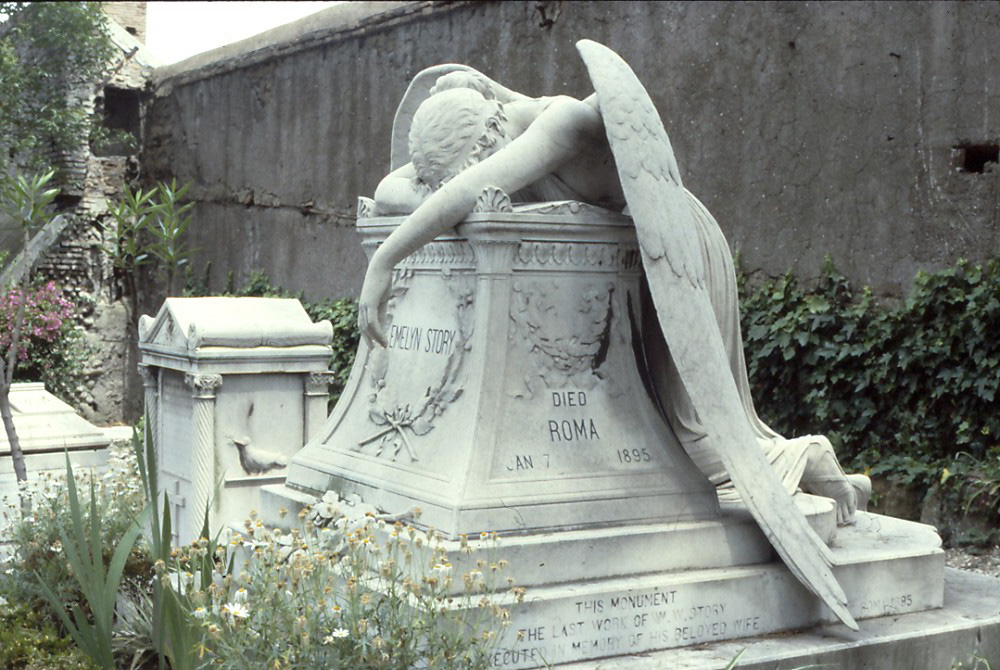
The Angel of Grief Weeping Over the Dismantled Altar of Life, 1894, gravestone by American artist William Wetmore Story (1819–1895) for his wife, Emelyn, in the Protestant Cemetery, Rome. “The end was already almost there by the time he had produced the only work that occupied him after the death of his wife,” wrote Henry James in his biography of Story. “The figure thus produced, [is] unsurpassed, in all his work, for intensity of expression.” (Photograph by Einar Einarsson Kvaran / Carptrash, via Wikimedia Commons)
“My sole wish is to frustrate as utterly as possible the post mortem exploiter—which, I know, is but so imperfectly possible,” Henry James wrote to his nephew Henry (“Harry”) James III in 1914. Designated as James’s executor, Harry had written inquiring about his “literary remains” at a time when the author had been concerned about his “liability to the invading chronicler.” James continued:
Your question determines me definitely to advert to the matter in my will—that is to declare my utter and absolute abhorrence of any attempted biography or the giving to the world by “the family,” or by any person for whom my disapproval has any sanctity, of any part or parts of my private correspondence. One can discredit and dishonour such enterprises even if one can’t prevent them, and as you are my sole and exclusive literary heir and executor you will doubtless be able to serve in some degree as a check and a frustrator.
During the last few years of his life, James destroyed more than four decades’ worth of correspondence, but, of course, he could only destroy the personal letters he received—not the ones he wrote.

Henry James’s feelings about biographies (and biographers) were nuanced, complicated, and sometimes contradictory. He often read them, and he even praised numerous biographies in his reviews, but he also felt that books in the genre had become commonplace and often unnecessary. In late 1902, the editors of Houghton, Mifflin asked James if he might be willing to write a biography of the poet and critic James Russell Lowell. He declined because he regarded Lowell as unworthy of the full biographical treatment. “If a man has had a quiet life, but a great mind, one may do something with him; as one may also do something with him even if he has had a small mind and great adventures,” he responded. “But when he has had neither adventures nor intellectual, spiritual, or whatever inward, history, then one’s case is hard.”

One of James’s primary objections to biographers was their inclination to scour private correspondence and diaries in search of what he condemned as “revelations.” James expressed his displeasure, for example, when the younger brother of the French novelist Alphonse Daudet published a book in 1882 about their family life. “Alphonse Daudet is living, and very living; that is his great attraction,” James wrote. “We hold, all the same, that there is little to please us in the growing taste of the age for revelations about the private life of the persons in whose works it is good enough to be interested. In our opinion, the life and the works are two very different matters, and an intimate knowledge of the one is not at all necessary for a genial enjoyment of the other.”

There is, however, the occasional subject whose public life is so informed by matters usually considered “private” that it becomes impossible for the honest biographer to avoid them. In 1895, Horatio Brown’s two-volume life of the cultural historian John Addington Symonds appeared. When James’s close friend Ariana Curtis, who had been Symonds’s neighbor in Venice, suggested that James write a review essay about the biography, he responded:
There was in Symonds a whole side—tout un côté—that was strangely morbid & hysterical & which toward the end of his life coloured all his work & utterance. To write of him without dealing with it, or at least looking at it, would be an affectation; & yet to deal with it either ironically or explicitly would be a Problem—a problem beyond me. . . . Yet, there are also in him—in his work—there were in him things I utterly don’t understand; & the idea of taking the public into his intimissima confidence which seems to me to have been almost insane.
The ”Problem” James is referring to here is the increasingly public awareness of Symonds’s homosexuality—a subject a little too close to home for James himself. Although Symonds and James had met briefly only once, in 1877, they had kept tabs on each other through a mutual friend, Edmund Gosse, until Symonds’s death in 1893. James absorbed and admired nearly everything written by Symonds, who in turn didn’t think much of James’s fiction—which the novelist apparently never knew. Symonds, who was married with four daughters and whose wife disapproved of his books, served as the model for the main character in James’s tragic story, “The Author of ‘Beltraffio,’” about a writer of novels his wife deems immoral.

In his historical works, Symonds dealt with same-sex love in the ancient world far more directly than had previous writers in English, and he privately printed two essays, A Problem in Greek Ethics and A Problem in Modern Ethics, that were more explicitly defenses of “Greek love.” Through Gosse, James received and read the Problem pamphlets, as well as a stack of Symonds’s most personal letters, which James described as “fond outpourings.” James, according to his biographer Leon Edel, affected to be neutral toward yet intrigued by Symonds’s “passionate crusade” in the treatises; “what seems to have bothered him was Symonds’s desire for public display in matters James deemed wholly private.”

At the end of the century, James was ensnared in a literary challenge similar to the one depicted in his story “The Real Right Thing” (1899): he had reluctantly agreed to become a “post mortem exploiter” and write a biography of the American sculptor William Wetmore Story, who had died in 1895. To make matters worse, James didn’t think much of Story’s sculptures. Yet he was friends with his son and daughter-in-law, who had managed to convince him to write the book, and they sent him “a boxful of old papers, personal records and relics all.” He delayed work on the project for as long as he could; when he finally turned his full attention to it in 1903, he wrote in frustration to William Dean Howells: “There is no subject—there is nothing in the man himself to write about. There is nothing for me but to do a tour de force, or try to—leave poor dear W.W.S. out.” The result, William Wetmore Story and His Friends, was less a biography than a travel book disguised as a group portrait of Story’s social circle—the American and British artists who populated Italy, and especially Rome, earlier in the century.

And so, in “The Real Right Thing,” a would-be biographer becomes absorbed in, then haunted (or stymied) by the life of his subject. When Edel mentions the story in his five-volume life of Henry James, he remarks, “It was as if James, about to join the ranks of biographers, wondered whether this was the real right thing for a novelist to be doing.”

Willie Tolliver’s book, Henry James as a Biographer: A Self Among Others (2000), proved to be an invaluable resource for tracking down several of the above quotes.

Notes: James refers to two pairs of biographers and their subjects by their last names: James Boswell and the writer Samuel Johnson, and John Gibson Lockhart and his father-in-law, the novelist Walter Scott.

*   *   *
When, after the death of Ashton Doyne—but three months after—George Withermore was approached, as the phrase is, on the subject of a 'volume,' the communication came straight from his publishers, who had been, and indeed much more, Doyne's own. . . . If you don't see the full selection below, click here (PDF) or click here (Google Docs) to read it—free!

This selection may be photocopied and distributed for classroom or educational use.

Sunday, February 27, 2022

In Sloane Street

Constance Fenimore Woolson (1840–1894)
From Constance Fenimore Woolson: Collected Stories

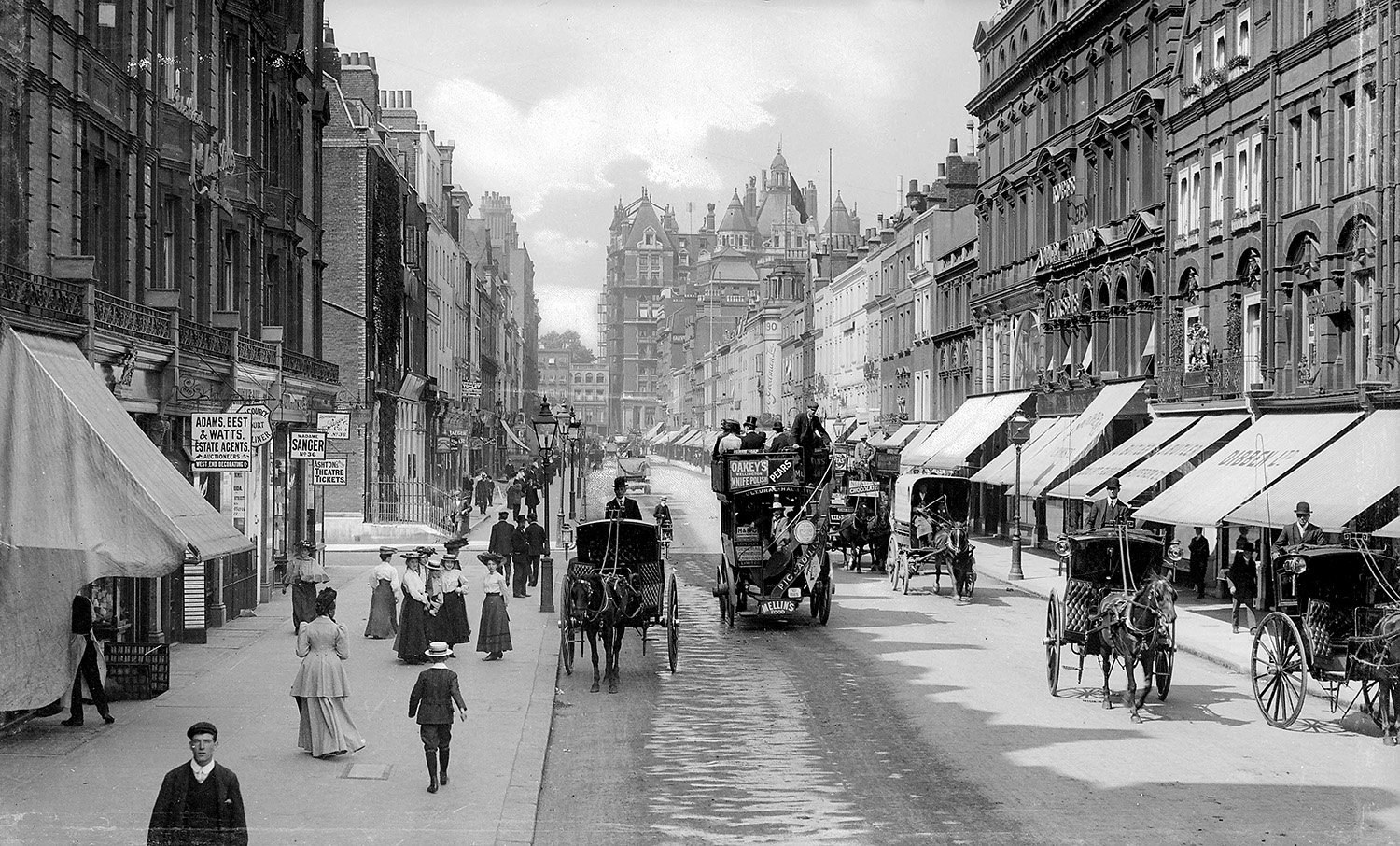
Sloane Street, c. 1900, a short walk north of the townhouse where Woolson stayed during her first winter in London. The dominant building at the end of the street is an apartment block built in 1882, the year before she arrived. After a fire in 1904, it reopened as the Hyde Park Hotel (currently the Mandarin Oriental Hyde Park). The horse-drawn omnibus at center boasts then-ubiquitous advertisements for Pears Soap and Oakey’s Knife Polish. In her story, which is set in 1892, Woolson describes omnibuses passing by on Sloane Street: “their sides bore advice (important in the blackest of towns) about soap.” (Photo by LL/Roger Viollet via Getty Images)

While Constance Fenimore Woolson was staying in the German spa town of Baden-Baden during the summer of 1883, she learned that her brother, Charlie, had killed himself in California. For several years, Charles Woolson had suffered from episodes of depression, alarming his family, yet his death was nevertheless unexpected and the news sent Woolson, who had in the past experienced her own depressive episodes, into a tailspin.
I have been ill three months. Three times during that period I rallied, & tried to call myself well; but only to sink back again. . . . It was not any one thing but a succession of ailments & difficulties. All is well now, I trust. The Dr has dismissed me.

I presume all came from the shock of Charlie’s death,—which made me suffer more than I have ever suffered in my life. I was so extremely unhappy for a number of weeks that I did not know where to turn.
Her grief was compounded by Charles’s suicide note: several pages written in diary form in the days and weeks before he poisoned himself. She decided to head to England, which nearly all her friends opposed, convinced that a winter alone in London would make her even worse. “Fortunately, I have learned to do what I think best and let the rest go,” she wrote to a friend after her arrival. “If I tried to follow all the advice I get, I should soon be in an asylum.”

And so she arrived in London in October, taking up residence for eight months at 116 Sloane Street, in a townhouse apartment across the street from the Cadogan Place Gardens, between the Chelsea and Belgravia neighborhoods. As it happens, she got very lucky: “The winter has been the ‘mildest on record,’” she wrote in late March. “It has been far warmer than it ever was (in winter) on the Riviera, in Florence, in Sorrento, in Rome.” (Subsequent trips would cure her of any fondness for London’s weather.) Henry James, whom she had met three years earlier and whose writing she greatly admired, was also in town for the winter. “[He] comes to see me now & then, & sends me books to read,” she wrote to her nephew in January.

A few years earlier, James had privately inveighed against “the literary spinster, sailing into-your-intimacy-American-hotel piazza type” who showed up in London expecting to meet him; later in life, he would write to a friend, “Women aren't literary in any substantial sense of the term.” Yet Woolson, calling herself an “admiring aunt” (she was only three years his senior), quickly won him over; she eventually became one of his closest friends and literary confidants, and the two authors shared, and forcefully critiqued, each other’s writing. They even discussed collaborating on a play, although nothing came of it. “Though in the course of his professional career James offered outlines to various editors,” writes biographer Lyndall Gordon, “there is no evidence, so far, that he discussed work with anyone else in the questioning way he did with Miss Woolson.”

Just how much the two writers cared for each other has always been a matter of speculation for their biographers. “He was as good at hiding his desire for men as she was at hiding her desire to be loved,” concludes Anne Boyd Rioux in her recent biography of Woolson:
James recognized that Woolson was as devoted to her work as he was to his. Living below her apartment [in Italy during the spring of 1887], he was aware of her steady work habits and admired her for them. Sometime in 1887 he gave her a volume of Shelley’s poetry inscribed to “Constance Woolson / from her friend and confrére.” With the French word confrére—colleague or comrade, the root of which is Latin for “brother’—he acknowledged her as a companion in the writing life and as a would-be sibling. Theirs was a chosen kinship. They both knew by now that the other would never marry.
As a result of their close friendship, their stories contain echoes of each other’s work. In early 1888, after returning to London from various trips to the Continent, James wrote “The Lesson of the Master,” in which a famous novelist advises a young author not to get married because it would require him to compromise his art to provide for his family. Four years later, Woolson published “In Sloane Street,” which addresses the same theme in an entirely different manner. Gordon, along with other literary historians, believes that Woolson’s story “retold” James’s novella, but Rioux thinks that Woolson had probably begun her story long before its publication. Hard at work on a new novel, Woolson may not have even read “The Lesson of the Master” when it first appeared in two consecutive issues of The Universal Review, a small-circulation London monthly that folded two years after its founding. The chance that Woolson had access to copies of the magazine in Italy seems slight, so her first opportunity to encounter James’s story was likely when it appeared in book form in 1892, just before her own story was published in Harper’s Bazar. Woolson and James probably both discussed in general terms how marriage might weigh on an author’s artistic goals—James occasionally proclaimed he would never marry because it would ruin his writing—and their conversations simply inspired two very different stories.

Two of Woolson’s best stories, “Miss Grief” (a previous Story of the Week selection) and “In Sloane Street,” bookend her real-life relationship with Henry James; in both tales she portrays a male author who bears a marked resemblance to her confrére. “Miss Grief,” written before she even met him, depicts its protagonist as Woolson imagined an author like James might be. “In Sloane Street,” published eighteen months before she died, conjures a writer of “analytical novels” similar to the books published by James; unlike his real-life counterpart, Philip Moore is married. At the center of both stories are unmarried “literary” women: one an author, the other a reader, and both thinly disguised reflections of Woolson herself.

Notes: In the 1870s English writer Augustus J. C. Hare published Memorials of a Quiet Life, the life story of his adopted mother, who, he says in the introductory note, would be surprised to learn that “anything she could do or say would have an interest beyond the loving circle in which she lived.” Anna Brownell Jameson was an influential Anglo-Irish art historian. John Ruskin, the most prominent art authority of the nineteenth century, was author of the multivolume Modern Painters. Martin Farquhar Tupper published Proverbial Philosophy (1838), a collection of moralizing maxims. The popular children’s book The History of Sandford and Merton was written in the 1780s by Thomas Day. The opera Cavalleria Rusticana by Pietro Mascagni, had its British premiere in London on October 19, 1891. French-born British writer George du Maurier was known for his popular novels, such as Trilby, as well as his illustrations for Punch, Harper’s, and other magazines. Jules Lemaître was a French literary and drama critic. The journal of Russian-French artist Marie Bashkirtseff, translated into English in 1890, was published to great acclaim—and criticism—for its frank portrayal of the author’s extraordinary ambitions to become a famous artist. The Society for the Collegiate Instruction for Women, popularly known as the Harvard Annex, was founded in 1879 and became Radcliffe College in 1894. St. James’s Gazette was a London evening paper known for its conservative politics and highbrow literary content.

*   *   *
“Well, I’ve seen the National Gallery, and that’s over,” said Mrs. Moore, taking off her smart little bonnet and delicately drying with her handkerchief two drops which were visible on its ribbons. . . . If you don't see the full selection below, click here (PDF) or click here (Google Docs) to read it—free!

This selection may be photocopied and distributed for classroom or educational use.
Sunday, April 25, 2021

The Other Two

Edith Wharton (1862–1937)
From Edith Wharton: Collected Stories 1891–1910

“‘Why, how do you do?’ she said with a distinct note of pleasure.” Illustration by American artist Francis Day (1863–1942) for “The Other Two” when it appeared in the February 13, 1904, issue of Collier’s Weekly.
A couple of months after the publication of her story collection The Descent of Man, Edith Wharton received a packet of clippings from William Crary Brownell, who worked as an advisor to Scribner’s, her publisher. In late June 1904 she wrote back, upset that so many reviewers insisted on comparing her to her good friend Henry James:
I have never before been discouraged by criticism, because when the critics have found fault with me I have usually abounded in their sense, & seen, as I thought, a way of doing better the next time, but the continued cry that I am an echo of Mr. James (whose books of the last ten years I can’t read, much as I delight in the man), & the assumption that the people I write about are not “real” because they are not navvies & char-women, makes me feel rather hopeless. I write about what I see, what I happen to be nearest to, which is surely better than doing cowboys de chic.
Such comparisons and assumptions, both positive and negative, were scattered throughout the reviews, and several focused particularly on “The Other Two," one of the book’s most memorable and comical stories, in which twice-divorced Alice Waythorn is seen through the eyes of her third husband, who is haunted, so to speak, by the unexpected appearances of his wife’s former spouses. “No one except perhaps Mr. Henry James can present a revolting scene with more social delicacy,” wrote the critic for The Independent in New York, about the moral implications of the story’s ending. “The very ease with which the incident passes is offensive.” The reviewer also complained that “nowhere, either in her ideas of virtue or vice, does she come into contact with normal life.” Across the ocean, in the pages of London’s The Bookman, a reviewer came to the opposite conclusion about the story’s cleverly constructed climax yet still managed to sound similar notes: “The whole situation is intensely realized, and the subtle, elusive interplay of these four characters is a brilliant and masterly psychological study. Mrs. Wharton is as rare an artist as Mr. Henry James; she has all his insight and subtlety of thought, and a simplicity and directness of expression that he lacks.”

Brownell responded to Wharton that the refusal to recognize her uniqueness was certainly “unpleasant” but reassured her that in the comparisons to James she often comes “out of the mix better than he does.” Most recent biographers have directly addressed the question of the similarities—and differences—between James and Wharton. Her first major biographer, R.W.B. Lewis, for example, contends that in over two dozen stories Wharton tackled “the marriage question” and became “perhaps the first American writer to make [it] almost exclusively her own: even more, I dare say, than Henry James, who would in any event be her only rival in this respect.” Hermione Lee notes that they “did share subjects and attitudes, character-types and social themes” and that, “as do all writers who are friends, they spent years exchanging literary allusions and jokes, thoughts on their reading, and gossip about authors; and they occasionally exchanged plots, too.” Yet, Lee adds, while there is little doubt that James was a literary model (and, to a lesser extent, the reverse is true), “it is more often to write against him rather than to write under him.” Some of her stories, in their subversion of his themes and preoccupations, can even be read as critiques of James’s fiction.

One way in which Wharton’s thematic focus differs from James’s can be seen in the titles of her first three story collections, which reference her lifelong fascination with Charles Darwin, T. H. Huxley, Herbert Spencer, and evolution in general—both social and biological. The title of her first story collection, The Greater Inclination, is from Edmond Kelly’s 1895 study, Evolution and Effort; Crucial Instances is a phrase used by Darwin in his discussion of the laws of inheritance in The Descent of Man, which itself provides the title for her third story collection. Wharton scholar Janet Beer notes the metaphorical use of evolution throughout the stories in these collections and particularly in “The Other Two.” The heroine, Alice Waythorn, “has, using the restricted means at her disposal, managed to find a way to adapt and change, in order to improve her social standing and economic position. . . . [She] is an example from a society in the process of ‘adaptation.’” Cynthia Griffin Wolff sees Alice evolving into something more troubling, however, at least in the eyes of her husband. “She has become a grotesque, some specialized form of monster, endlessly mutating—willing to please, not malicious, but not—not quite—human.”

In her book-length study of Wharton’s short fiction, Barbara A. White reminds readers that the narrative is told entirely from the point of view of Alice’s third husband, Waythorn (a near-anagram of Wharton), and suggests that he, rather than Alice, is the character that “mutates” by the story’s end. “Waythorn’s view of her moves from one extreme to another,” she writes. “Alice’s actions reveal a person very different from the one Waythorn sees.” Furthermore, Waythorn’s use of language reduces his view of Alice to a piece of real estate (her first husband is “a lien on the property”; “his predecessors were his partners in the business,” etc.) and often examines her in terms of her value to him. “There is no evidence in the story that Alice’s motives are economic and every indication that the market-mad Waythorn conceives the world in financial terms.”

These various interpretations complement rather than contradict each other. By looking at Alice solely through the eyes of her unreliable, possessive, moderately jealous third husband, Wharton intentionally makes the real Alice unknowable; it is that detachment, along with the assembly of puns and situational details (the sick child, the governess, the cognac, the business deal) that gives the satire its bite. “What Edith Wharton knew with surprising assurance from her beginnings as a writer of social satire was the importance of particulars, that each amusing detail must carry more than its apparent weight,” remarks the novelist Maureen Howard. Lewis, who believes that “The Other Two” is “the most nearly perfect short story Edith Wharton ever wrote,“ asserts that it stands out “as the measure of her achievement in the short story form; for it has scarcely any plot—it has no real arrangement of incidents, there being too few incidents to arrange—but consists almost entirely in the leisurely, coolly comic process by which a situation is revealed to those involved in it.”

*   *   *
Waythorn, on the drawing-room hearth, waited for his wife to come down to dinner. . . . If you don't see the full selection below, click here (PDF) or click here (Google Docs) to read it—free!

This selection may be photocopied and distributed for classroom or educational use.

Sunday, April 11, 2021

The Real Thing

Henry James (1843–1916)
From Henry James: Complete Stories 1892–1898

“Mrs. Monarch went through her paces before me, and did it quite well.” Illustration by the Belgian-born British artist Rudolf Blind (1850–1916) for “The Real Thing,” Black & White, April 16, 1892.
In his memoir A Small Boy and Others, Henry James recalled how, as a child, he would pore over the “steel-plate volumes” in the family library, particularly one tome devoted to Shakespeare, “in which the plates were so artfully coloured and varnished, and complexion and dress thereby so endeared to memory, that it was for long afterwards a shock to me at the theatre not to see just those bright images, with their peculiar toggeries, come on.” Similarly, his memory of Oliver Twist was “more Cruikshank’s than Dickens’s,” referring to the twenty-four illustrations created by George Cruikshank for the novel, “all marked with that peculiarity of Cruikshank that the offered flowers or goodnesses, the scenes and figures intended to comfort and cheer, present themselves under his hand as but more subtly sinister, or more suggestively queer, than the frank badnesses and horrors. The nice people and the happy moments, in the plates, frightened me almost as much as the low and the awkward.”

When James began publishing his own stories and novels in magazines and books, he became preoccupied with how the accompanying pictures might overwhelm the text itself. “He greatly admired the work of the illustrators,” notes his biographer Leon Edel, “but he was not altogether happy at having his own prose illustrated.” He wrote in frustration to an editor of The Century Illustrated Monthly Magazine, “Ah, your illustrations—your illustrations; how, as a writer, one hates ’em; and how their being as good as they are makes one hate ’em more! What one writes suffers essentially, as literature, from going with them, and the two things ought to stand alone.” He struck a similar note when he sent his novel The Other House to be serialized in The Illustrated London News: “I like so little to be illustrated (I resent it so, amiably speaking, on behalf of good prose and real writing).”

His ambivalence about magazine illustrations was complicated by his friendships with several of the most prominent artists. He wrote an entire book, Picture and Text (1893), containing appreciations of the art of “black and white,” with essays focusing on its leading practitioners, several of whom would gather each summer in the English village of Broadway, where James would join them for a few days. Among the artists profiled by James is George du Maurier, who had illustrated James’s novel Washington Square when it appeared in 1880 and who gave James the idea for “The Real Thing,” perhaps the most anthologized of any of his short stories.

In February 1891, shortly after he had begun drafting the tale, he recorded in his notebook that it was based on an incident related to him by du Maurier involving a “lady and gentleman” sent to him by landscape painter William Powell Firth: “an oldish, faded, ruined pair—he an officer in the army—who unable to turn a penny in any other way, were trying to find employment as models.” Du Maurier had been for a quarter century one of the lead illustrators for the British humor magazine Punch, and the couple apparently hoped that they might earn money by posing as models for the upper-crust characters depicted in his society illustrations. James was struck by the “pathos” of their situation; two “good-looking gentlefolk” who were “now utterly unable to do anything, had no cleverness, no art nor craft to make use of as a gagne-pain [livelihood].” What James wrote next is fascinating for how he worked through the direction of the story once he became stuck on what to do with the idea:
I thought I saw a subject for very brief treatment in this donnée—and I think I do still; but to do anything worth while with it I must (as always, great Heavens!) be very clear as to what is in it and what I wish to get out of it. I tried a beginning yesterday, but I instantly became conscious that I must straighten out the little idea. It must be an idea—it can’t be a ‘story’ in the vulgar sense of the word. It must be a picture; it must illustrate something. . . . One must put a little action—not a stupid, mechanical, arbitrary action, but something that is of the real essence of the subject. I thought of representing the husband as jealous of the wife—that is, jealous of the artist employing her, from the moment that, in point of fact, she begins to sit. But this is vulgar and obvious—worth nothing. What I wish to represent is the baffled, ineffectual, incompetent character of their attempt, and how it illustrates once again the everlasting English amateurishness—the way superficial, untrained, unprofessional effort goes to the wall when confronted with trained, competitive, intelligent, qualified art—in whatever line it may be a question of. It is out of that element that my action and movement must come. . . .
Years later, when Henry James was collecting his stories and novels in the uniform New York Edition, he added in a preface that du Maurier’s married couple thought that “their not having to make believe would in fact serve them” and would also make the illustrator’s job easier because he wouldn’t have to depend on the “comparatively sordid professionals” who could only pretend to be what the husband and wife were: “the real thing.”

James’s story about an illustrator and his hopeful models would itself be illustrated, both when it was syndicated by S. S. McClure to numerous American newspapers in early April 1892 and when it appeared, later that month, in the British magazine Black & White. Yet the story is not merely a tale on the art of illustration. Earlier in his career, like many American writers of the late nineteenth century, James had been greatly influenced by the French literary realists. Yet by the 1890s, the late literary scholar George Monteiro has pointed out, James “was much closer to claiming the supremacy of the fiction-writer’s imagination in the creation of literary reality. Actual reality (experience) might be the necessary basis—the starting place—for the writer’s exercise of his art but his imagination realized the people and action of his tale.” In literature, too, the “real thing” isn't enough. Or, as James himself put it in his preface to a different story, “We can surely account for nothing in the novelist’s work that hasn’t passed through the crucible of his imagination, hasn’t in that perpetually simmering cauldron his intellectual pot-au-feu, been reduced to savoury fusion. . . . Thus it has become a different and, thanks to a rare alchemy, a better thing.”

Notes: A “sunk” piece of painting is one on which the colors have spread or sunk into the paper, losing their effect. Among the French expressions used by James are bêtement (stupidly), profils perdus (literally, lost profiles; portraits in which the head is turned more than halfway away from the painter), and sentiment de la pose (James’s own coinage denoting a feel for posing). A lazzarone is a vagabond or beggar. "Ce sont des gens qu'il faut mettre à la porte" translates as “These are people you have to throw out of the house.” When Jack Hawley repeats “those who know” in Italian (coloro che sanno), he is making a reference to Dante's epithet for Aristotle in the Inferno: ’l maestro di color che sanno, the master of those who know.

*   *   *
When the porter’s wife (she used to answer the house-bell), announced “A gentleman-with a lady, sir,” I had, as I often had in those days, for the wish was father to the thought, an immediate vision of sitters. . . . If you don't see the full selection below, click here (PDF) or click here (Google Docs) to read it—free!

This selection may be photocopied and distributed for classroom or educational use.
Saturday, May 9, 2020

The After-Season in Rome

Henry James (1843–1916)
From Henry James: Collected Travel Writings: The Continent

“The Colonnade of St. Peter, Rome,” illustration by American artist Joseph Pennell (1857–1926) for Henry James’s Italian Hours (1909).
“The other day, I became THIRTY!—solemn fact—which I have been taking to heart,” Henry James wrote from Rome to his parents in May 1873. Although he had not yet published a book, his first novel, the melodramatic Watch and Ward, had been serialized two years earlier in The Atlantic Monthly and he was steadily placing short stories, reviews, essays, and travel pieces in such prominent American magazines as The Nation, Scribner’s, and The Century. He was still financially dependent on his parents, who doubled in Boston as his bankers; all his earnings went directly to his father to help offset the funds sent to Henry in Europe. The letter home served two purposes: to reassure his mother that her parsimonious THIRTY!-year-old son did not (in her words) live “as the lilies, and feed like the sparrows” and to point out that the income he was due to receive from various publications that spring would, for the first time, put him “abreast with my drafts.” After a ten-year apprenticeship, Henry James was finally making ends meet as a full-time writer.

His letter also celebrated the change in atmosphere in Roman society that month: “The Barbarians are thinning out here very blessedly; I shall devote a portion of this last fortnight to going to various places where I have been waiting all winter for them to clear out.” The “Barbarians” were forestieri (foreigners) like himself—the seasonal tourists who invaded southern Italy each winter. He noted the city’s transformation in a letter to his new friend Sarah Butler Wister (daughter of the actress Fanny Kemble): “The weather is deliciously cool and brilliant and I have been pitying the good people who left religiously a month ago because it was the tenth of April. For the most part, though, I don’t want to recall them.”

James’s first visit to the Eternal City was three years earlier—two exciting months at the end of 1869. “At last—for the first time—I live!” he wrote exuberantly to his brother William after his arrival. “I went reeling and moaning thro' the streets, in a fever of enjoyment. In the course of four or five hours I traversed almost the whole of Rome and got a glimpse of everything—the Forum, the Coliseum (stupendissimo!), the Pantheon, the Capitol, St. Peter's, the Column of Trajan, the Castle of St. Angelo—all the Piazzas and ruins and monuments.” To his sister Alice he described Rome as “so vast, so heavy, so multitudinous that you seem to require all your energy simply to bear up against it.” For the first trip, however, he was mostly alone: “I see no people, to speak of, or for that matter to speak to,” he told William.

To read his letters and travel essays from both journeys is to witness his metamorphosis from a wide-eyed sightseer to a citified bohemian trying to blend with the natives. During his second stay in Rome, he abandoned his hotel room and rented a two-room alcove on the fourth floor of a building in the Corso, with the landlord’s family living just down the hall. (“A hotel gives one a disagreeable tourist feeling,” he had told his father earlier in the season.) His enthusiasm for sightseeing had been somewhat dampened, but his social circle had greatly expanded. He became fast friends with Kemble and her daughter and visited with the young historian Henry Adams and the sculptor William Wetmore Story. He played tour guide to Ralph Waldo Emerson when the “enviable man, fresh from the East,” passed through town at the end of his Mediterranean tour. At several dinner parties, James ran into one of his idols, Matthew Arnold, who was “decidedly a disappointment, in a superficial sense”; their conversation “remained small-talk and he did nothing to make it big.” Even as James became more firmly ensconced in the community of American and British expatriates, he convinced himself that each day left him “a little more Roman than before.”

It was during James’s second residence in Rome that he formulated the idea for his first book. As he wrote to his mother, “What I desire is this, to make a volume, a short time hence, of tales on the theme of American adventurers in Europe.” That collection, A Passionate Pilgrim and Other Tales, would appear in January 1875. Three decades later, when James revised his essay “The After-Season in Rome” for the 1909 collection Italian Hours (which is the version reprinted below), he recycled the expression passionate pilgrim to describe the “quiet observer” who wants nothing more than to enjoy the delights of Rome in May, when all the other tourists are gone and “when Rome becomes Rome again and you may have her all to yourself.”

Note: James’s French “informant” was Ernest Hébert, a painter and the director of the Académie de France in Rome. The French phrase renaît à elle-même translates “returns to herself.” James’s reference to “the most morbid blue” is a pun; the Italian azurrro morbide translates correctly as “soft blue.”

The Pope during this period was Pius IX, who was also the sovereign ruler of the Papal States until Victor Emmanuel II of Sardinia captured all the papal territories in 1860, became King of Italy in 1861, and cemented his victory over the Vatican by capturing Rome in 1870. In 1869 Victor Emmanuel married Rosa (“Rosina”) Vercellana Guerrieri, his second wife, whom James describes as living in the Villa Ludovisi at the time of his second visit. In June 1873 (after James left the city), the Italian government passed the Law of the Convents, abolishing the corporate status of religious orders in the former Papal States and placing hundreds of hospitals and schools managed by the orders under civil administration. The Palazzo del Quirinale, the destination of the protesters shouting Abbasso il ministero! (“Down with the government!”), was the official residence of Victor Emmanuel.

*   *   *
One may at the blest end of May say without injustice to anybody that the state of mind of many a forestiero in Rome is one of intense impatience for the moment when all other forestieri shall have taken themselves off. . . . If you don't see the full selection below, click here (PDF) or click here (Google Docs) to read it—free!

This selection may be photocopied and distributed for classroom or educational use.
Sunday, December 15, 2019

“Miss Grief”

Constance Fenimore Woolson (1840–1894)
From Constance Fenimore Woolson: Collected Stories

Detail from Woman Reading / La Liseuse (1895), oil on board, by French artist Henri Matisse (1869–1954). Click on image to see full painting. Via Wikimedia Commons.
“Constance Fenimore Woolson was a popular American writer of the late nineteenth century, whose friendship with Henry James has, among James scholars, long qualified hers as a distinctly lesser life,” writes Vivian Gornick in a review of Anne Boyd Rioux’s groundbreaking biography. “In all the James biographies, Woolson appears as a shadowy presence whose morbid anxieties simply echo those of the Master himself.” Indeed, until recently Woolson was perhaps remembered only for her close relationship with James, including the lurid details of her death (a probable suicide) in Venice and the devastating effect the news had on him. For more than a century, her own writings, widely respected and read at the time, have been largely overlooked. Yet a reading of her stories, Gornick concludes, shows that “Woolson emerges as a figure of some dimension in her own right.”

During the recent revival of interest in Woolson’s writing, particularly her short fiction, the story “‘Miss Grief’” has perhaps commanded the most attention. A tale of a self-important, established male writer who tries to advise and mentor a reluctant yet willful young woman, it has often been read as a fictionalization of the relationship between James and Woolson—even though the two authors had not yet met when she wrote the story. Woolson knew James only through her extensive reading of his works (she had recently published two admiring appraisals of James’s latest novel, The Europeans) and through what she’d heard from mutual acquaintances, including his close friend, John Hay—former secretary to Lincoln and future secretary of state under Theodore Roosevelt.

In 1879 Woolson was grieving from the death of her mother, suffering from depression and illness, and learning to live with deafness—a degenerative condition she inherited from her father. Her sister suggested a trip to Europe and, accompanied by her eleven-year-old niece, they arrived in London in late November at the start of one of the coldest English winters in memory. While in the city, Woolson knocked on the door of Henry James’s flat, hoping to introduce herself, but discovered he was in Paris. They spent only ten days in London before traveling to the continent in search of warmer weather. At some point during the course of their winter travels, she wrote “‘Miss Grief.’”

At the time, James—the younger writer by three years—was preparing his sixth novel, Washington Square, for serial publication. Although she had published numerous short stories during the previous decade, Woolson was still waiting for Harper & Brothers to publish her debut novel, Anne. So when, uninvited and unannounced, she showed up at his residence in London, it seems probable that Woolson, the relatively “new” author, was inspired to imagine how such a meeting might have played out. In any case, the narrator of “‘Miss Grief’” is certainly someone much like James; as Amy Gentry notes in The Chicago Tribune, “Woolson satirizes James's self-regard lightly and with perfect control, stopping just short of mean-spiritedness. Of all the send-ups of James by his contemporaries—and the list is long—Woolson’s story is the only one that works as more than pure comedy.”

Woolson finally caught up with James in Florence, around the time her story appeared in the May issue of Lippincott’s Magazine. For the next month he guided her around the city’s churches and museums in the mornings. James hadn’t read any of her work and he wrote home that she was “old-maidish, deaf & ‘intense’; but a good little woman & a perfect lady.” She thought him “a delightful companion.” The places they visited together in Florence and their differing views on art made their way into Woolson’s story “A Florentine Experiment.” During the same period, James was working on The Portrait of a Lady, and Woolson seems to have provided some of the inspiration for the book’s heroine, Isabelle Archer. “With no character of yours have I ever felt myself so much in sympathy,” she wrote James shortly after reading the novel. When “‘Miss Grief’” was subsequently anthologized in Scribner’s Stories by American Authors (1884), Woolson changed the name of the narrator’s romantic interest from “Ethelind” to “Isabel.”

In a recent essay Rioux suggests why Woolson’s story resonates so strongly with readers today:
Although the story has been read primarily as an index to Woolson’s own feelings of neglect as a woman writer, it is much more than that. It showcases the conflicting views of her time about what made literature valuable, staging the tensions between polish and power in the forms of a male and female writer, respectively. It touches on still-sensitive questions about how gender informs perspective, literary value, and success. Besides that, it is a delight to read.

*   *   *
Parts of the above introduction have been adapted from Anne Boyd Rioux’s “Chronology” and “Notes on the Text” in the new Library of America collection, Constance Fenimore Woolson: Collected Stories.

Notes: In the opening paragraph, the narrator says, “When found, make a note of it,” a quote from Charles Dickens’s Dombey and Son. Tullia D’Aragona was a highly esteemed Renaissance poet and philosopher as well as a great beauty and courtesan; in later accounts she was often portrayed as dangerously seductive. In the early sixteenth century lurid rumors of incest and murder swirled around Lucrezia Borgia, the daughter of Pope Alexander VI and his mistress, Vannozza dei Cattanei. The Latin phrase “Væ victis!” means “Woe to the vanquished!” Samuel Taylor Coleridge claimed his famous poem “Kubla Kahn: or, A Vision in a Dream: A Fragment” came to him in its entirety in a dream but was interrupted in its composition by “a person on business from Porlock.”

*   *   *
“A conceited fool” is a not uncommon expression. Now, I know that I am not a fool, but I also know that I am conceited. . . . If you don't see the full selection below, click here (PDF) or click here (Google Docs) to read it—free!

This selection may be photocopied and distributed for classroom or educational use.

Saturday, April 13, 2019

Brooksmith

Henry James (1843–1916)
From Henry James: Complete Stories 1884–1891

Title illustration for “Brooksmith” by Henry James, from the May 2, 1891, issue of Harper’s Weekly.
Two decades after the death of Henry James, British novelist Ford Madox Ford recalled their friendship in his memoir Return to Yesterday. Although James could be impatient or prickly to those closest to him—especially when they didn’t live up to his expectations for social behavior—he was attentive to and gracious with acquaintances and strangers from all stations of life:
His eyes were singularly penetrating, dark and a little prominent. On their account he was regarded by the neighbourhood poor as having the qualities of a Wise Man—a sorcerer. My servants used to say: “It always gives me a turn to open the door for Mr. James. His eyes seem to look you through to the very back-bone.” . . .

His conversation used to contain a great many compliments to his interlocutor, male or female. They were the current coin of his conversation. . . Every woman from the Lady Maud Warrender on the hill to Meary Walker in the meshes was “dear lady”; every man, “my dear fellow.”
The attention James paid—and the sympathies he extended—to those outside his immediate circle informed his creation of the characters in his novels and stories. The protagonist of “Brooksmith,” one of the most highly regarded stories from his so-called “middle years,” is a butler, a man (as The Henry James Encyclopedia puts it) “whom James’s social milieu normally considered beneath notice.”

James first got the idea for the story in 1884, when the journalist Christina Stewart Rogerson updated him about a longtime lady’s maid employed by her mother, Harriet Gore Stewart (Mrs. Duncan Stewart), who had just died. For several years mother and daughter had hosted a highly regarded literary salon, and James knew the maid from his visits to the Stewarts’ home. He recorded her plight in his notebook:
She had to find a new place of course, on Mrs. S.’s death, to relapse into ordinary service. Her sorrow, the way she felt the change, and the way she expressed it to Mrs. R. ‘Ah yes, ma’am, you have lost your mother, and it’s a great grief, but what is your loss to mine?’ (She was devoted to Mrs. D.S.) ‘You continue to see good society, to live with clever, cultivated people: but I fall again into my own class, I shall never see such company—hear such talk—again. She was so good to me that I lived with her, as it were; and nothing will ever make up to me again for the loss of her conversation. Common, vulgar people now: that's my lot for the future!’
James considered how he could turn the descent of the maid into a story:
Represent this—the refined nature of the little plain, quiet woman—her appreciation—and the way her new conditions sicken her, with a denouement if possible. Represent first, of course, her life with the old lady—figure of old Mrs. D.S. (modified)—her interior—her talk. Mrs. R.’s relations with her servants. ‘My child— my dear child.’
The story James published seven years later faithfully retained his original concept, with one considerable modification. He later explained that his “little derived drama . . . seemed to require, to be ample enough, a hero rather than a heroine. I desired for my poor lost spirit the measured maximum of the fatal experience.” James felt that, even more than a lady’s maid, a butler would better able to insinuate himself in the “rare table talk” of a salon, and he likewise changed the host to a retired diplomat—this despite the fact, acknowledged by James, that successful salons were usually hosted by women. Unsurprisingly, critics in recent decades have made much of James’s deliberate decision to transform an anecdote about two married women and a lady’s maid into a story about a trio of lifelong bachelors, one of whom—the narrator—has an interest that borders on obsession with the butler, Brooksmith.

Hardly an unobtrusive or neutral observer, the unnamed narrator “often reveals his own snobbery, and his frequent, unfounded inferences make him unreliable,” notes Andrew Maunder in the Encyclopedia of the British Short Story. “While Brooksmith descends into casual work and poverty in full view of the narrator, neither the narrator nor any of his social circle do anything to help.” After making their cherished salon an extraordinary success, Brooksmith is excluded from their lives. This dichotomy—the superficial concern for servants against the reluctance to get too involved with their lives—has led many scholars to extol what biographer Fred Kaplan recently termed the story’s “subtle indictment of British class structure.”

Notes: Mentioned on the first page, dotations are endowments. James tosses off numerous French expressions and words during his story, including several that have since passed into the English language: L’Ecole Anglaise, The English School; malentendus, misunderstandings; c’est la fin de tout, it’s all over; casaque, a kind of woman's blouse; coucher, repose in bed; de race, pure bred; sur le retour, past her prime.

*   *   *
We are scattered now, the friends of the late Mr. Oliver Offord; but whenever we chance to meet I think we are conscious of a certain esoteric respect for each other. . . . If you don't see the full selection below, click here (PDF) or click here (Google Docs) to read it—free!

This selection may be photocopied and distributed for classroom or educational use.