Showing posts with label Frances Hodgson Burnett. Show all posts

Sunday, October 27, 2024

The Lover and the Tell-Tale

Stephen Crane (1871–1900)
From Stephen Crane: Prose & Poetry

Little Boy Writing Letter, oil on canvas by American artist Norman Rockwell (1894–1978); cover illustration for The Saturday Evening Post, January 17, 1920. The discarded draft at the boy’s feet reads, “dear sweethart i luve you more and more every day.”

Rockwell wrote to the first owner of the painting: “There is a real original for the boy and I often use him. His name is Eddy Carlson and he is a fine little model. You might be glad to know that I always use real persons for every picture I paint. The idea of the red headed boy picture was suggested to me one day when one of the little boys I use for a model, was in my studio trying to write a letter to his girl. He presented much the same picture as the one I painted, only I made it a country boy with country surroundings.” (Image and Rockwell quote courtesy of Sotheby’s)
Little Lord Fauntleroy was the Harry Potter of its day,” writes Gretchen Holbrook Gurzina in her biography of the novel’s author, Frances Hodgson Burnett. “In a few years, after the book hit the stage, there would be no one from the smallest midwestern American town to the streets of Paris who had not heard of Cedric, and who did not know what he looked like.” Published in 1886, the novel relates the tale of a poor New York City boy who becomes heir to an earldom after the death of his father, a British aristocrat alienated from the family in England. An immediate success, the book sold hundreds of thousands of copies and went through more than thirty American printings in two years.

Just as famous were the book’s illustrations by Reginald B. Birch. Burnett had sent him as a model a photograph of her son Vivian in a velvet suit with a lace collar. The suit and the long curls of hair depicted in Birch’s illustrations became all the rage—often to the consternation of the boys made to wear them by their mothers. The fashion trend swelled when Burnett’s stage adaptation opened on Broadway in December 1888 and became as big a hit as the book, eventually going on tour. “All across the country, boys who escaped the lace collars the first time around found themselves forced into them now,” writes Gurzina. “The androgyny of the Fauntleroy look, not helped by girls playing the boy on stage, caused boys dressed in the suits to be taunted on the streets.”

Stephen Crane loathed Burnett’s novel. His first biographer, Thomas Beer, relates that in 1894 Crane encountered two boys sporting long curls and Fauntleroy suits, and he gave them money to get their hair cut—much to the distress of their mothers. The incident, possibly apocryphal or at least embellished, is described with different details in another magazine article, in which a grateful father sent the author a box of cigars. Crane wrote his Whilomville stories partly in reaction to Burnett’s sentimental ideal of childhood and Cedric’s wholesome innocence; perhaps tellingly, in one story, the town’s mothers are horrified when they learn that all the children in the gang—boys and girls—get their curly locks shaved off by the local barber. Yet Crane’s stories were not written for children but about children, and one contemporary critic noted that they seemed “more natural” to her than most other stories about young people. “True, the children have the same marvelous predilection for getting into mischief, an equally marvelous ability for making their elders uncomfortable; nevertheless, the stories emphasize more the appreciative and humorous study of the healthiest side of child life.”

When a friend teasingly compared the series to Burnett’s best seller, Crane responded, “If the Whilomville stories seem like Little Lord Fauntleroy to you, you are demented and I know that you are joking, besides. See here, my friend, no kid except a sick little girl would like Lord Fauntleroy unless to look at Birch's pictures for it. The pictures are all right.” Set in opposition to Burnett’s novel and its many imitations, Crane’s story cycle breathed new life into an American literary tradition often referred to as “bad boy literature,” which includes Thomas Bailey Aldrich’s The Story of a Bad Boy (1870), Mark Twain’s The Adventures of Tom Sawyer (1875), and William Dean Howells’s A Boy's Town (1876)—each about childhood life in a small town. The thirteen Whilomville stories, published monthly in Harper’s from mid-1899 through mid-1900, were collected in a book in August 1900, two months after Crane’s death. An earlier story, “His New Mittens,” appeared in a previous collection, along with the Whilomville novella “The Monster,” a much darker and more serious work usually not considered part of the series.

Most prominent among the Whilomville children is Crane’s preadolescent alter ego, Jimmie Trescott, a boy “versed in villainy” who is neither the gang’s leader nor their fool. Most of the tales focus on the misadventures, pranks, and rivalries of Jimmie and his friends, along with the perplexed reactions of the town’s adults. “When all is said and done, however,” writes the late Paul Auster in his recent biography of Crane, “the most effective stories are the ones in which a child from another place comes to Whilomville and disturbs the balance of that closed-off world.” Auster singles out Cora, the “angel-child” from New York City who appears in three stories—and who shares the name of Crane’s common-law wife. One summer, the Trescott family is visited by a relative, who is a famous painter, and his wife:
They had one child. Perhaps it would be better to say that they had one CHILD. It was a girl. When she came to Whilomville with her parents, it was patent that she had an inexhaustible store of white frocks, and that her voice was high and commanding. These things the town knew quickly. Other things it was doomed to discover by a process.
Cora proceeds to lay waste to the always-fragile tranquility of the children and their parents—and especially to the dignity of Jimmie, who “was in love. The beauty of his regal little cousin has stolen his manly heart.” In “The Lover and the Tell-Tale,” her influence persists in absentia when, after her return to New York, Jimmie writes her a love letter—with humiliating results.

*   *   *
When the angel-child returned with her parents to New York the fond heart of Jimmie Trescott felt its bruise greatly. . . . If you don't see the full selection below, click here (PDF) or click here (Google Docs) to read it—free!

This selection may be photocopied and distributed for classroom or educational use.

Sunday, February 19, 2023

Tommy’s Burglar

O. Henry (1862–1910)
From O. Henry: 101 Stories

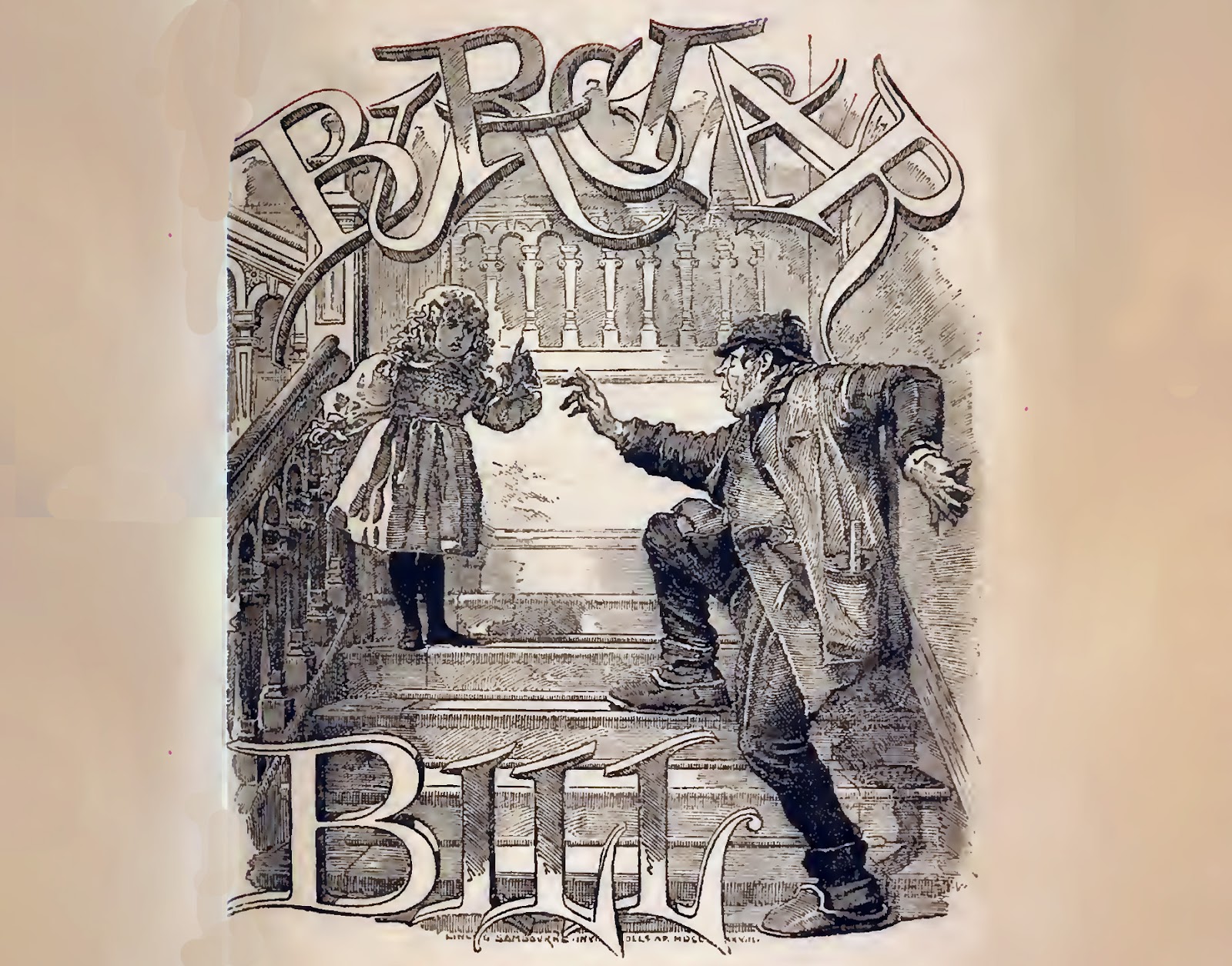
Cover illustration by British cartoonist Edward Linley Sambourne (1844–1910) for F. Anstey’s Burglar Bill, and other pieces for the use of the young reciter (1888); the title piece is an early parody of Frances Hodgson Burnett’s Editha’s Burglar.
In the O. Henry story “The Man Higher Up,” the con-man Jeff Peters reveals his conflicted attitude toward robbery:
“There are two kinds of grafts,” said Jeff, “that ought to be wiped out by law. I mean Wall Street speculation, and burglary.”

“Nearly everybody will agree with you as to one of them,” said I, with a laugh.

“Well, burglary ought to be wiped out, too,” said Jeff; and I wondered whether the laugh had been redundant.
O. Henry’s fiction about the underworld was informed by the acquaintances he made in the Ohio penitentiary where he served a three-year sentence for embezzlement; most of the inhabitants, particularly those convicted of nonviolent offenses, seemed to him no worse than the Gilded Age robber barons who lived in their mansions. More often than not, O. Henry’s scam artists, burglars, and pickpockets are portrayed comically and even sympathetically; there is honor among his thieves, and under the tough-guy, semiliterate veneer are basically decent men just waiting for their moment—like the former safe-cracker in “A Retrieved Reformation.” Even the grafter Jeff Peters follows a distorted code of “ethics”: “I never believed in taking any man’s dollars unless I gave him something for it—something in the way of rolled gold jewelry, garden seeds, lumbago lotion, stock certificates, stove polish or a crack on the head to show for his money.”

“A burglar who respects his art always takes his time before taking anything else,” claims the narrator of “Makes the Whole World Kin,” the O. Henry tale in which an intruder confronts the owner of the home he is robbing and ends up discussing various ailments for the rheumatism that afflicts them both. The criminal in “Tommy’s Burglar” (1905) experiences a similar encounter in a Manhattan brownstone—this time with a young boy—but not only does the thief abandon his original plan, the story itself goes off the rails. Prompted by the boy, the burglar “takes his time” undermining the telling of his latest caper.

Two decades earlier, in 1881, Frances Hodgson Burnett (the author of The Secret Garden and A Little Princess) published the story “Editha’s Burglar” in the American children’s magazine St. Nicholas. An illustrated book version appeared in 1888 on the heels of her first best seller, Little Lord Fauntleroy; the story was adapted several times for the stage in both London and New York and eventually expanded to The Burglar, a four-act play by Augustus Thomas with Maurice Barrymore in the title role. Editha’s Burglar was widely imitated in children’s magazines—and was just as widely parodied. The best known of these at the time was written by Punch contributor F. Anstey (the pen name of Thomas Anstey Guthrie), who published “Burglar Bill,” a playlet in verse that deftly mocks the idea of a burglar overcome by the kindness of a little girl (“Go away!” he whimpers hoarsely, / “Burglars hev their bread ter earn. / I don't need no Gordian angel / Givin' of me sech a turn!”)

In the book version of Editha’s Burglar, seven-year-old Editha encounters a prowler (“If you please,” she said with great delicacy, “are you really a burglar?”) and, with her father away from home for the night, asks him politely if he could go about his business as quietly as possible to avoid waking up her mother. By the end of the book, the burglar is captured and imprisoned, but chastened and reformed.

O. Henry takes the premise of the Burnett story—a burglar encountering a child while the father is away and the mother is sleeping—and transforms it into a story about writing a story, skewering both the mawkish romances that dominated children’s literature and the 2,000-word tales he was contractually required to write every week for the New York Sunday World. While all the other parodies of Editha’s Burglar are lost to the dustbin of literature, O. Henry’s story is still read and anthologized in no small part because readers entirely unaware of the original children’s story can enjoy it.

Notes: St. George Rathborne was an American author known for adventure stories and dime novels. Polish tenor Jean de Reszke retired from performing in 1903, two years before the story ostensibly takes place. Italian tenor Enrico Caruso made his American debut at the Metropolitan Opera in 1903, and he was regarded as de Reszke’s successor. Tony Pastor was an American vaudeville impresario. Parsifal is an opera by Richard Wagner. Benjamin Sayre Cory Kilvert was a Canadian-born illustrator known for his depictions of children. O. Henry refers to the unities, a theory, derived from Aristotle, that a play should have a single action occurring in a single place and within the course of a single day. The S.P.C.C. is the Society for the Prevention of Cruelty to Children, founded in New York in 1874.

*   *   *
At ten o’clock p.m. Felicia, the maid, left by the basement door with the policeman to get a raspberry phosphate around the corner. . . . If you don't see the full selection below, click here (PDF) or click here (Google Docs) to read it—free!

This selection may be photocopied and distributed for classroom or educational use.
Saturday, September 21, 2019

My Robin

Frances Hodgson Burnett (1849–1924)
From The Secret Garden, A Little Princess, Little Lord Fauntleroy

“In the most thrilling tone and with an affected manner.” Frontispiece illustration by American artist Alfred Brennan (1853–1921) for Burnett’s My Robin (1912).
Frances Hodgson Burnett “spent her life as neither British nor American but reveled in straddling both countries’ opportunities and attitudes,” writes biographer Gretchen Holbrook Gerzina. Born in Manchester, England, she spent seven formative years with her family in Tennessee, and then for the following four decades she was constantly on the move. She lived in London and Paris, in Washington and New York, in Boston and Florence, as well as at various summer and winter resorts from North Carolina and Cape Cod to Suffolk and Surrey. She made at least thirty-three trips across the Atlantic. Her last fifteen years were split between the estate she built on Long Island and a winter home in Bermuda. National boundaries and characteristics seemed fluid to her, notes Gerzina: “The characters in her books and plays delighted in breaking down class and continental divisions, bringing American independence of thought and speech into the English drawing room, or Yorkshire dialect into the books read by American southerners.”

Burnett’s childhood in England was marred by two events: the death of her father while she was still a toddler, which left her mother a widow with five children, and the American Civil War’s decimation of the local economy, which depended on Southern cotton for its textile industry. When she was fifteen, the family left for Knoxville, the home of her uncle, who had promised to find jobs for Frances’s two brothers.

When her family arrived in the United States in 1865, they found that Frances’s uncle had wildly exaggerated his financial situation and that the region had been ravaged by the war. Although he was able to find employment for the two boys, his own residence was not large enough for all six of them, so the Hodgsons moved first into a log cabin twenty-five miles outside of the city and the following year to Clinton Pike, which was much closer.

Seeking some way to help with the family’s finances, Frances—with the help of her two younger sisters—secretly sent a story, “Miss Caruthers’ Engagement,” to the down-market Ballou’s Monthly (which advertised itself as “The Cheapest Magazine in the World”). Her cover letter bluntly stated, “My object is remuneration.” The editors praised the story and offered editorial suggestions for improving it, but their response was unclear about whether Ballou’s would pay her. She requested the return of the manuscript and forwarded it to the more respectable Godey’s Lady’s Book and Magazine, whose editors were puzzled; the story’s setting and tone were distinctly English, yet the manuscript had been mailed from an east Tennessee address. They asked for another sample before making a decision, so she promptly wrote “Hearts and Diamonds,” a story with an American theme and location, and sent it with a cover note explaining that she had emigrated from England but now lived in Tennessee. She almost immediately received a check for $35 and both stories appeared in 1868. She submitted additional stories and received another $40. At the age of eighteen, Frances was a published author bringing in more income for the family than both of her brothers.

From that time on, no publisher on either side of the Atlantic rejected anything Burnett submitted, and her earnings were to rise as high as $60,000 a year—an astronomical sum for an author at the time. During the next fifty-six years of her career, she published fifty-two books and produced thirteen plays.

In 1898 Burnett again returned to England and leased Great Maytham Hall, in Kent (a few miles away from her friend, the novelist Henry James), which served as the headquarters for her travels for ten years. When the owners sold the residence, she returned to the United States. Missing the Maytham’s picturesque grounds and the walled rose beds she herself had restored, she began work on her next book at her new house in Plandome, Long Island, under the title “Mistress Mary Quite Contrary.” It was finished by October 1910 and serialized as The Secret Garden in The American Magazine starting the next month—the first children’s story this adult magazine had ever published. Burnett revised the novel after its serial appearance, and it was published in book form in August 1911.

Prompted by readers’ favorable responses, Burnett wrote My Robin, a memoir of the bird that became her pet at Maytham Hall and inspired the “robin” episodes of The Secret Garden. Appearing as a separate book in September 1912, the short tale ably details a relationship many readers with pets will recognize, including Burnett’s tendency to anthropomorphize the bird’s every behavior. A few months later The New York Times carried this brief item in its “Among the Authors” column:
Mrs. Frances Hodgson Burnett, whose delight in gardens has been portrayed in two of her recent books, is now in Bermuda rejoicing in the wonderful garden which she has been working on for several Winters. She has no English robin there to beguile her hours, as did the little robin she tells about in The Secret Garden, but in the very plants about her she is reminded of the former robin friend and of the book My Robin, which she wrote about him; for the royalties of that very book, it is said, have been devoted to the beautifying of her wonderful garden in Bermuda.
My Robin has been reprinted in the new Library of America edition of Burnett’s trio of famous children books, and we present it here, in its entirety, as our Story of the Week selection.

Note: Much of this introduction was adapted from the chronology of Burnett’s life included in Frances Hodgson Burnett: The Secret Garden, A Little Princess, Little Lord Fauntleroy, edited by Gretchen Holbrook Gerzina.

*   *   *
There came to me among the letters I received last spring one which touched me very closely. . . . If you don't see the full selection below, click here (PDF) or click here (Google Docs) to read it—free!

This selection may be photocopied and distributed for classroom or educational use.