Showing posts with label Bernard Malamud. Show all posts

Sunday, April 16, 2023

The Silver Crown

Bernard Malamud (1914–1986)
From Bernard Malamud: Novels and Stories of the 1970s & 80s

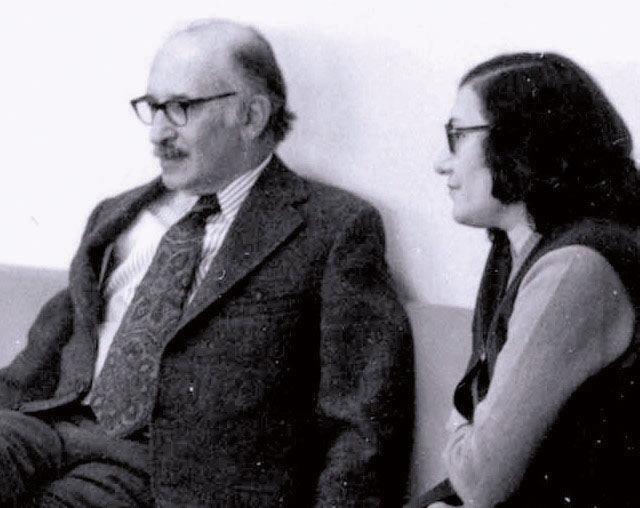
Bernard Malamud and Cynthia Ozick, backstage before his debut reading of “The Silver Crown” at the 92nd Street Y, New York City, November 6, 1972. Photographer unknown. Image via The Paris Review.
In 1986, shortly after the death of Bernard Malamud, the novelist Cynthia Ozick published a eulogy in the pages of the Partisan Review. She began with a recollection of an early occasion in their friendship:
In 1976 I answered the telephone and heard privately an instantly recognizable public voice. I knew this voice with the intimacy of passionate reverence. I had listened to it in the auditorium of the 92nd Street Y reading an as yet unpublished tale called “The Silver Crown,” a story so electrifying that I wished with all my heart that it was mine. Since it was not, I stole it. In my version, I described the author of the stolen story as “very famous, so famous that it was startling to see he was a real man. He wore a conventional suit and tie, a conventional haircut and conventional eyeglasses. His whitening mustache made him look conventionally distinguished. He was not at all as I had expected him to be—small and astonished, like his heroes."

His voice on the telephone was also not what I had expected. Instead of bawling me out for usurping his story, he was calling me with something else in mind. He had noticed that the dedication to a collection containing the stolen story was to my daughter, who was then ten years old. “Joy of my life,” I had written. “I have to tell you,” he said, “that I understand just how you feel.” And he spoke of his own joy in being the father of his own children. . . .
Ozick is being somewhat modest in her reminiscence. She was not merely a member of the audience at the reading; having already published her first novel and a well-received collection of stories, she introduced Malamud to the crowd. In addition, the novella she refers to, “Usurpation (Other People’s Stories),” was, of course, no act of theft but was a homage of sorts, about a young author who hears a reading by a famous older writer at the 92nd Street Y and feels that the story (summarized and retitled by Ozick as “The Magic Crown”) is one she should have written. When she learns that the famous author himself has “usurped” the story from an item in the newspaper, she haughtily argues that had she seen the article first she would have written something different: “I would have fingered out the magical parts. Magic—I admit it—is what I lust after.” Ozick then conjures a series of interwoven tales her imaginary narrator might have created. As Ozick explains in a preface to the book that contained the story, “Belief in idols is belief in magic. And storytelling, as every writer knows, is a kind of magic act.” Ozick’s novella, then, cautions that “story-making” can be “a corridor to the corruption and abominations of idol-worship, of the adoration of magical event.”

There is little in the way of actual “magic” in Malamud’s story; the newspaper article he “usurped” is real enough. From The New York Times, October 14, 1971:
A 68‐year‐old Orthodox rabbi and three of his relatives were indicted in the Bronx yesterday on charges that they took money for cabalastic faith‐healing rituals that never took place.

As unfolded by Burton B. Roberts, the Bronx District Attorney, the indictments told of people paying as much as $1,387 for health‐restoring silver crowns that were never made. . . . Mr. Roberts said his investigation began last spring when a number of rabbis came to his office, bringing with them members of their congregations who they charged had been gulled. . . .

Articles about the rabbi began appearing in newspapers. One of these, Mr. Roberts said, was seen in Miami by a young man whose father was in a coma. The young man, who was identified only as a holder of a master's degree, visited the rabbi and asked that his father be saved from death. According to the prosecutor, the supplicant was told to bring 401 silver dollars, which would be used to fashion a crown representing the health of his father. In addition, he was allegedly told, the cost of making such a crown varied in proportion to how much the ailing person meant to the man pleading for his cure. Mr. Roberts said the applicant paid $986, for the most expensive crown.
Before Malamud read his short story at the 92nd St. Y in New York, he described himself as the kind of writer who finds inspiration in the smallest items or incidents. The “simple donnĂ©e” for his tale was found in the newspaper article: “the story of a rabbi that immediately burst into fiction in my mind.” In “The Silver Crown,” Malamud transforms the basic facts of the case into an exploration of the chasm between belief and skepticism, between storytelling and reality, and (in the end) between a father’s love for his daughter and a son’s disdain for his father.

Notes: Austro-Hungarian writer and political activist Theodor Herzl (1860–1904) founded the Zionist Organization, now the World Zionist Organization. The Mishna is the rabbinically edited compilation of Jewish oral traditions. Kabbalah is wisdom or esoteric knowledge concerned with the essence of God. The commentaries known as the Zohar are the foundations of Kabbalah. The Torah, or Pentateuch, comprise the five books of Moses from Genesis to Deuteronomy—handwritten on scrolls, rolled around two wooden staffs, and treasured in the Ark of each synagogue.

Yiddish expressions: shpeter: later; dovening, or davening, from davnen: prayer, recitation of prayer; grubber yung: a coarse youth; sha: quiet.

*   *   *
Gans, the father, lay dying in a hospital bed. Different doctors said different things, held different theories. . . . If you don't see the full selection below, click here (PDF) or click here (Google Docs) to read it—free!

This selection is used by permission. To photocopy and distribute this selection for classroom use, please contact the Copyright Clearance Center.

Saturday, November 29, 2014

The Mourners

Bernard Malamud (1914–1986)
From Bernard Malamud: Novels and Stories of the 1940s & 50s

Interior of a tenement apartment, Manhattan’s Lower East Side, May 26, 1939. Image courtesy of the New York City Housing Colloection / LaGuardia and Wagner Archives.
In an essay written four decades after the event, Alfred Kazin recalls when Bernard Malamud won the 1958 National Book Award for his story collection The Magic Barrel: “Not for the first time I was seeing a Malamud story unfold.” Philip Davis describes the evening in his biography:
Malamud refused to pose for newspaper and television cameras vulgarly holding up a copy of his book; forgot his winner’s $1,000 cheque and left it on the podium; and delayed by a reporter in getting to the dinner in his honour, was told by a waiter, looking him up and down, that the table was full and there was no place for him.
Yet, in spite of the evening’s inauspicious moments, Malamud was modestly jubilant. Since the award’s founding a decade earlier, it had only been bestowed on a story collection once before, to William Faulkner. In his acceptance speech, Malamud recognized the rarity of the honor, saying that “a small miracle has come to pass. . . . The short story, as you know, is strong and accomplished in American fiction, and I hope that some of its expert practitioners, especially those who come rarely if ever to the novel, will be recognized by you in the future.”

In an interview two years before he died, Malamud specifically acknowledged Faulkner, along with Henry James, as an American author who had influenced his story-writing “technique.” “Two points are essential,” he argued “First, you have to be a good writer; second, you are influenced by the literature of the past and the present.” Various commentators have noted other antecedents. Davis writes that The Magic Barrel “was like a Jewish Brooklyn version of Joyce’s Dubliners”; another scholar calls “The Mourners,” our current Story of the Week selection, “a twentieth-century Jewish version of Melville’s ‘Bartleby the Scrivener.’”

In his oft-quoted Paris Review interview, however, Malamud cautioned against reading too much into the ethnicity of his characters:
I’m an American, I’m a Jew, and I write for all men. A novelist has to, or he’s built himself a cage. I write about Jews, when I write about Jews, because they set my imagination going. . . . Sometimes I make characters Jewish because I think I will understand them better as people, not because I am out to prove anything. . . . [T]he point I’m making is that I was born in America and respond, in American life, to more than Jewish experience.
Agreeing with this self-assessment, Mark Schechner, in The Columbia Companion to the Twentieth-Century American Short Story, writes: “Malamud was a moralist and an insistent one, though the law in which he bound his characters has little in it of specifically Jewish content. It is the law of simple charity and compassion.” Or, as Malamud himself said, “The notions of hope, of redemption are essential to my work.”

Audio excerpt: Bernard Malamud reads “The Mourners.” This three-minute excerpt from the story begins in the middle of page 540 (“Arriving at the top floor. . .”) and ends at the very top of page 542 (“dispossessed goods.”).

This free excerpt is provided by Calliope Audio Readings, which offers recordings of Malamud, Nelson Algren, James Baldwin, James Jones, Philip Roth, William Styron, and John Updike reading from their own works.

*   *   *
Kessler, formerly an egg candler, lived alone on social security. . . . If you don't see the full selection below, click here (PDF) or click here (Google Docs) to read it—free!

This selection is used by permission.
To photocopy and distribute this selection for classroom use, please contact the Copyright Clearance Center.

Friday, April 11, 2014

Idiots First

Bernard Malamud (1914–1986)
From Bernard Malamud: Novels and Stories of the 1960s

In 1961 Brooklyn native Bernard Malamud, after living and teaching for over a decade in Corvallis, Oregon, returned East to assume a new position at Bennington College, a progressive liberal arts school for women in Vermont. (Bennington did not begin admitting men until 1969.) The summer prior to moving his family to Vermont, Malamud conducted a writing workshop at Harvard for ten lucky students. Clark Blaise, a Canadian native who was a senior at a Denison University in Ohio and a fan of Malamud’s writing, applied for the course by mail and then hitchhiked to Harvard.

Unbeknownst to Blaise, there had been seventy-five applicants for the workshop—but only ten spots, and Harvard administrators had already filled them. When he arrived and discovered he hadn’t been chosen for the class, Blaise worked up the courage to appeal to Malamud himself, who eventually relented and allowed him to take the class. Malamud biographer Philip Davis concludes, “That is how Clark Blaise, the novelist, became one of the writers who were ‘the sons of Bern’—the extended literary family whom Malamud, as father and mentor, was often able to help more than he could his own children.”

Beyond the Harvard workshop and the move to Vermont, Malamud found the time to finish and publish a new short story, “Idiots First”—his first in over two years. Describing a dying man’s frantic attempt to insure security for his disabled son, it remains one of the most revered of Malamud stories. The story displays Malamud’s ability to be both a realist and a fantasist—“at his best the line between the two was obliterated,” writes New Republic critic Richard Gilman.

Blaise describes the tale as illustrating his former teacher’s religious view “that it is man’s struggle that makes God take pity.”
It is when God—or something like God—looks into man’s eyes and sees his own fury reflected in its effect on the human condition, his own cold reflection in man, that he then lets go. That’s the writing act too. The novelist looking on the characters he has created, and wanting to have those characters look out from the page with that kind of need for salvation that redeems the novelist himself. [Quoted in Philip Davis, Bernard Malamud: A Writer’s Life (2007)]
Literary scholar Victoria Aaron offers another take, arguing that Malamud’s story evokes the Binding of Isaac—except that Mendel, the Abraham figure, “refuses to sacrifice that which he loves most. Like his biblical predecessor, Mendel is called forth to do the inconceivable. But unlike Abraham, Mendel . . . will not acquiesce to the commanding voice of the law.”

Note: Gut yuntif (page 731) is a Yiddish expression meaning “Good (religious) holiday.”

*   *   *
The thick ticking of the tin clock stopped. Mendel, dozing in the dark, awoke in fright. . . . If you don't see the full selection below, click here (PDF) or click here (Google Docs) to read it—free!

This selection is used by permission. To photocopy and distribute this selection for classroom use, please contact the Copyright Clearance Center.

Friday, January 24, 2014

The First Seven Years

Bernard Malamud (1914–1986)
From Bernard Malamud: Novels and Stories of the 1940s & 50s

Detail from The Shoemaker, oil on canvas by American artist Jefferson David Chalfant (1856–1931). Courtesy of The Athenaeum.
In 1949, prompted by the expansion of educational institutions under the G.I. Bill and assisted by his wife, Bernard Malamud submitted applications to over two hundred schools to become a teacher of literature. One of the few replies came from Oregon State College in Corvallis, a state-endowed institution specializing in agricultural topics, with liberal arts constituting “the Lower Division.” Appointed in July, he was hired to teach freshman composition—but not literature, because he didn’t have a Ph.D. He moved his family from New York City to Corvallis, where he conducted class three days a week and spent the other four days writing.

In a recent biography, Philip Davis describes that living in Oregon did “something rather extraordinary” to Malamud’s writing. “There he found himself going back to Brooklyn, for all that he was learning much about a different America.” Malamud would describe, on two separate occasions, the benefits of his dislocation:
I was overwhelmed by the beauty of Oregon . . . and the new life it offered, which I lived as best I could as I reflected on the old . . . [Almost] without understanding why, I was thinking about my father’s immigrant life (how he earned his meager living and what he paid for it). . . .

I tried all sorts of things but at last resolved to do simple stories about simple people. I did about ten of these, concerned mostly with Jewish and Italian storekeepers and their three-walled, plate-glass-windowed world.
Within a year, he had published three stories; the third, “The First Seven Years,” was accepted (“to my surprise,” Malamud admitted) by the prestigious Partisan Review, and the trio of stories brought him to the attention of Robert Giroux at Harcourt, Brace and Company, who asked Malamud if he happened to be writing a novel. The author responded that he was working on a “baseball novel,” and this debut book, The Natural, was published in 1952.

In the Companion to the American Short Story, Sanford E. Marovitz describes one reason why “The First Seven Years” is so effective:
Known chiefly for his imaginative portraits of Jewish characters, communities, and themes, Malamud takes advantage of the Yiddish he learned from his parents as a child and adapts it to suit his aim of being an American and indeed a universal author as well as a Jewish one. Consequently, he often blends Yiddish and English into Yinglish, a style that includes Yiddish syntax and phrasing without necessarily incorporating actual Yiddish words, which he uses but sparingly in his fiction.
The critic Robert Alter once identified this story as one that “will be read as long as anyone continues to care about American fiction written in the 20th century.” And, indeed, it is often included in anthologies and taught in schools, and it can of course be found in the newly published Library of America edition collecting Malamud’s fiction.

Note: As the end of the story indicates, Sobel will have served as Feld’s apprentice for a total of seven years, a reference to the biblical story of Jacob and Rachel (see Genesis 29:20–30).

*   *   *
Feld, the shoemaker, was annoyed that his helper, Sobel, was so insensitive to his reverie that he wouldn’t for a minute cease his fanatic pounding at the other bench. . . . If you don't see the full selection below, click here (PDF) or click here (Google Docs) to read it—free!

This selection is used by permission.
To photocopy and distribute this selection for classroom use, please contact the Copyright Clearance Center.