Showing posts with label American Revolution. Show all posts

Sunday, May 31, 2026

“To form a new Government, requires infinite care”

George Washington (1732–1799)
From George Washington: Writings

“Washington Taking Command of the American Army—At Cambridge, Mass. July 3rd, 1775.” Hand-colored lithograph by Currier & Ives for the U.S. Centennial in 1876. Courtesy The Metropolitan Museum of Art.
On May 16, 1776, John Hancock, the president of the Second Continental Congress, wrote to George Washington, who was in New York City organizing colonial defenses against a possible attack by the British:
The Congress . . . have directed me to write to you, and request, that you will repair to Philadelphia as soon as you can conveniently, in order to consult with Congress, upon such Measures as may be necessary for the carrying on the ensuing Campaign. I hope the Situation of the great Affairs with which you are entrusted, will admit your making this Excursion, which I apprehend may be serviceable to your Health. In which Case, I request the Favour that you will please to honour me with your and your Lady’s Company at my House, where I have a Bed at your Service during your Continuance here, and where every Endeavour of mine and Mrs Hancock, shall be exerted to make your Abode agreeable. I reside in an airy, open Part of the City in Arch Street and fourth Street. If this should be agreeable to you, it will afford me much Pleasure.
“Since writing the foregoing,” Hancock added in a postscript, “I have been Told that your Lady, not having had the Small Pox, has intentions of taking it by Inoculation in this City  . . . and you may Depend Mrs Hancock will give the greatest Attention to your Lady should she incline to Take the Disorder.”

Of foremost concern to members of the Continental Congress, as well as to Washington, was the lack of clarity regarding what the British were planning to do next. “I am really at a loss what to advise, as it is impossible at present to know the designs of the enemy,” Washington had written to the delegates in late April.
Should they send the whole force under General Howe up the river St. Lawrence, to relieve Quebec and recover Canada, the troops gone and now going will be insufficient to stop their progress; and should they think proper to send that or an equal force this way from Great Britain, for the purpose of possessing this city and securing the navigation of Hudson’s River, the troops left here will not be sufficient to oppose them; and yet, for any thing we know, I think it not improbable they may attempt both; both being of the greatest importance to them, if they have men.
An additional concern was the possibility that British forces might attempt to take back Boston, which they had abandoned in March, although Washington doubted they would be able or willing to do so. After the British evacuation of Boston, he had moved his headquarters to Manhattan, because nothing “seemed of more importance in the execution of their grand Plan than possessing themselves of Hudson’s River.” Nevertheless, he wrote on May 9, “if Congress from their knowledge, information, or believe, think it best for the General good of the Service that I should go to the Northward, or elsewhere, they are convinced I hope that they have nothing more to do than signify their commands.” The colonists’ worries were amplified by the increasing evidence supporting rumors that the British had hired ten thousand Hessian mercenaries who were on their way to America.

On May 21 Washington set out for Philadelphia and, after stopping to inspect rebel forces in Perth Amboy and on Staten Island, he arrived on Thursday, May 23. Martha Washington submitted herself for smallpox inoculation that same day; at that time, inoculation was done by undergoing a milder form of the disease and required days of isolation and recovery. Washington first appeared before the Continental Congress on Friday and the major concern that day was the woeful condition of the American forces in Canada. The newly appointed commanding officer, General John Thomas, reported that he had arrived at the American camp outside Quebec in early May to discover that “there were one thousand nine hundred men, only one thousand of whom were fit for duty, including officers; the rest were invalids, chiefly with the small-pox.” The enlistments for three hundred of them would end on May 15, only 150 pounds of gunpowder and six days’ worth of provisions remained, and the local inhabitants, including the French, were disinclined to help them. The Americans had been repulsed by a well-supplied British force numbering more than one thousand men, and they were in retreat toward Montreal from Quebec, which the rebels had feebly placed under siege.

The Continental Congress appointed a special committee to discuss the provision of American forces with Washington, as well as Major General Horatio Gates and Brigadier General Thomas Mifflin. After their deliberations, the committee reported that they remained “fully convinced of the absolute necessity of keeping possession of that country [Canada], and that they expect the forces in that department will contest every foot of the ground with the enemies to these colonies.” The Continental Congress ultimately approved raising a force of “13,800 militia from Massachusetts, Connecticut, New York, New Jersey [to] reinforce the army at New York” and another six thousand men to rescue Canada. “Our Affairs in Canada have of late worn a displeasing Aspect, but Measures have been adopted which I trust will repair Misfortunes and set Matters right in that Quarter,” Samuel Adams wrote to James Warren, president of the Massachusetts Provincial Congress, on June 6.

Unfortunately, the Continental Congress acted far too late. After contracting smallpox, General Thomas died on June 2, British troops defeated rebel forces at Trois Rivieres on June 8, and the Americans evacuated Montreal and began their retreat from Canada.

Weeks before, on May 15, the Fifth Virginia Convention had passed a resolution instructing its delegates to the Continental Congress to introduce a motion for independence. Washington’s brother, John Augustine, attended the Convention in place of Richard Henry Lee, who was in Philadelphia as a delegate. Washington learned of Virginia’s resolution during his visit, and he expressed his approval in the letter to his brother that we reprint below. Although the letter is dated May 31, it was most likely finished and sent as he was leaving Philadelphia on June 4, the “13th day” after Martha’s inoculation. Washington arrived in New York on June 6, and the next day Lee submitted to the Continental Congress the resolution calling for independence and urging the formation of foreign alliances. The proposal for an immediate declaration of independence met with opposition, however, and any decision concerning the liberation of the colonies was postponed for a later day.

*   *   *
For this week’s selection, we depart from the usual format and reproduce the text of Washington’s letter below. You may also download it as a PDF or view it in Google Docs, and this selection may be photocopied and distributed for classroom or educational use.

Philadelphia May 31st 1776

Dear Brother,

Since my arrival at this place, where I came at the request of Congress, to settle some matters relative to the ensuing Campaign I have received your Letter of the 18th from Williamsburg, & think I stand indebted to you for another, which came to hand sometime ago, in New York.

I am very glad to find that the Virginia Convention have passed so noble a vote, with so much unanimity—things have come to that pass now, as to convince us, that we have nothing more to expect from the justice of G: Britain—also, that She is capable of the most delusive Arts; for I am satisfied that no Commissioners ever were design’d, except Hessians & other Foreigners; and that the Idea was only to deceive, & throw us off our guard—the first it has too effectually accomplished, as many Members of Congress, in short, the representation of whole Provences, are still feeding themselves upon the dainty food of reconciliation; and thô they will not allow that the expectation of it has any influence upon their judgments (with respect to their preparions for defence) it is but too obvious that it has an operation upon every part of their conduct, and is a clog to their proceedings—it is not in the nature of things to be otherwise, for no Man, that entertains a hope of seeing this dispute speedily, and equitably adjusted by Commissioners, will go to the same expence, and run the same hazards to prepare for the worst event as he who believes that he must conquer, or submit to unconditional terms, & its concomitants, such as Confiscation, hanging, &ca, &ca.

To form a new Government, requires infinite care, & unbounded attention; for if the foundation is badly laid the superstructure must be bad. too much time therefore, cannot be bestowed in weighing and digesting matters well—we have, no doubt, some good parts in our present constitution—many bad ones we know we have, wherefore no time can be misspent that is imployed in seperating the Wheat from the Tares—My fear is, that you will all get tired and homesick, the consequence of which will be, that you will patch up some kind of Constitution as defective as the present—this should be avoided—every Man should consider, that he is lending his aid to frame a Constitution which is to render Million’s happy, or Miserable, and that a matter of such moment cannot be the Work of a day.

I am in hopes to hear some good Acct from No. Carolina—If Clinton has only part of his force there, and not strongly Intrenchd, I should think Genl Lee will be able to give a very good Acct of those at Cape Fare—Surely Administration must intend more than 5000 Men for the Southern district, otherwise they must have a very contemptable opinion of those Colonies, or have great expectation of assistance from the Indians, Slaves, & Tories. We expect a very bloody Summer of it at New York & Canada, as it is there I expect the grand efforts of the Enemy will be aim’d; & I am sorry to say that we are not, either in Men, or Arms, prepared for it. however, it is to be hoped that if our cause is just, as I do most religiously believe it to be, the same Providence which has in many Instances appeard for us, will still go on to afford its aid.

Your Convention is acting very wisely in removing the disaffected, Stock, &ca from the Counties of Princess Anne & Norfolk; and are much to be commended for their Attention to the Manufacture of Salt, Salt Petre, Powder, &ca. No time, nor expence should be spared to accomplish these things.

Mrs Washington is now under Innoculation in this City; & will, I expect, have the Small pox favourably—this is the 13th day, and she has very few Pustules—she would have wrote to my Sister but thought it prudent not to do so, notwithstanding there could be but little danger in conveying the Infection in this Manner. She joins me in love to you, her, and all the little ones4—I am with every Sentiment of regard, Dr Sir Yr Most Affecte Brother


Text from The Papers of George Washington: Revolutionary War Series, volume 4 (1984). Courtesy of the University Press of Virginia.

Sunday, February 15, 2026

The Evacuation of Boston

John Bowater (1741–1813)
From The American Revolution: Writings from the War of Independence 1775–1783

“Lord Howe Evacuating Boston,” c. 1861. Hand-colored print by British printmaker John Godfrey (1817–1889) after a watercolor (now lost) by British artist Michael Angelo Wageman (c.1820–1898). Image: American Revolution Institute.
“No one doubts the least of our finishing this Business before Christmas,” Captain John Bowater of the Royal Marines wrote confidently in June 1776 to his patron, Basil Feilding, 6th Earl of Denbigh, when he arrived in New York to continue the fight against the American rebels. Bowater’s close friend, Lieutenant William Feilding, who also owed his military commission to Lord Denbigh (a distant relation), was just as bold in his prediction: “It is the Opinion of many that this summer, and next winter will totally destroy their Army, and the Misled deluded people will at last be convinced that they have been drawn into Ruin, by a set of mock patriots.”

Instead, within months both men were woefully embittered by their overseas adventure, and they extended their disgust to the entire population. In November, temporarily stationed in Rhode Island, Bowalter wrote:
The Natives are such a Levelling, underbred, Artfull, Race of people that we Cannot Associate with them. Void of principal, their whole Conversation is turn’d on their Interest, and as to gratitude they have no such word in their dictionary & either cant or wont understand what it means. (For instance as to levelling.) I met a man of very good property a few days ago who had a Complaint to make and I refer’d him to Lord Percy. I heard him enquire at his Lordships door for Mr. Percy. Thinking him Ignorant I stept up & told him again Lord Percy. He replied to me he knew no Lord but the Lord Jehovah. Thus it is throughout America and a sad set of Presbyterian Rascals they are. . . . Their dress is so formal and their words come up so Slow, that I frequently long to Shove a Soup ladle down their throat, and it is not want of Conception that these people are so Slow in Delivery, but from a certain determind duplicity that Governs all their Actions. . . .
Bowater’s opinion had hardly changed by the end of the following year, when he wrote to Denbigh, “I every day curse Columbus and all the discoverers of this Diabolical Country, which no Earthly Compensation can put me in Charity with.”

In April 1775, before either Feilding or Bowater had arrived from England and after the Battle of Lexington and Concord, the Massachusetts militia began the siege of Boston. General Thomas Gage, who was both the governor of the Province of Massachusetts Bay and commander-in-chief of North America, strengthened fortifications around the city and awaited reinforcements. By the time Lieutenant Feilding arrived in Boston early that summer, British forces had increased from 4,000 troops to 6,500. On the night of June 16 rebel troops moved onto the Charlestown peninsula opposite Boston and began fortifying Breed’s Hill and Bunker Hill. Upon realizing the militia’s actions, the British landed 2,200 men, who succeeded in recapturing the peninsula on June 17—but more than 1,000 of them were killed or wounded, twice the number of rebel casualties. The extent of the losses convinced British commanders not to conduct further attacks outside Boston.

On July 3, 1775, General George Washington arrived at Cambridge to take command of the rebel forces. Dismayed by the lack of discipline among the New England troops and the inability of their elected officers to exercise authority, he worked rapidly to equip, train, and reorganize the army. On the British side, Gage was recalled to England and replaced by General William Howe, who became Commander-in-Chief, America, while General Guy Carleton assumed the role of Commander-in-Chief, Quebec.

John Bowater arrived in Boston at the end of January 1776, after “the longest and most disagreable” trip across the Atlantic, and he immediately met up with Feilding, who updated his friend with the status of the siege and described the rebel commander as a “Yankee General . . . who can’t read but can speachifie and tell his soldiers they are to obey the Voice of the people in the streets.” The siege had been a virtual stalemate since the Battle of Bunker Hill. The cold winter weather, the waves of scurvy and smallpox, and the lack of gunpowder, weapons, supplies, and food slowly strangled both sides. But three months earlier Washington had ordered that fifty-nine heavy cannons captured from the British at Fort Ticonderoga be brought three hundred miles overland through the dead of winter to Dorchester Heights. After a trip of fifty-six days, the artillery arrived at the end of January; when the gunpowder supply was finally replenished, the cannons were set into place by March 4. Overlooking Boston Harbor, the position effectively cut off the British army’s only remaining supply line. Faced with an untenable situation, Howe decided to evacuate the city.

On March 19, Washington wrote to John Hancock:
It is with the greatest pleasure I inform you that on Sunday last, the 17th Instant, about 9 O’Clock in the forenoon, The Ministerial Army evacuated the Town of Boston, and that the Forces of the United Colonies are now in actual possession thereof. I beg leave to congratulate you Sir, & the honorable Congress—on this happy Event, and particularly as it was effected without endangering the lives & property of the remaining unhappy Inhabitants.

I have great reason to imagine their flight was precipitated by the appearance of a Work which I had Order’d to be thrown up last Saturday Night, on an Eminence at Dorchester which lay nearest to Boston Neck, call’d Newks Hill. The Town, although it has suffer’d greatly is not in so bad a state as I expected to find it, and I have a particular pleasure in being able to inform you Sir, that your house has receiv’d no damage worth mentioning.
One hundred twenty ships transported nearly 9,000 British troops, as well as more than 1,000 civilians, many of them women and children, to Halifax, Nova Scotia. Among them were both Feilding and Bowater, the latter of whom wrote the letter to Denbigh reprinted below. Two weeks later, in a subsequent letter, he added, “I don’t Know what the people of England will think of our Evacuating Boston, but it was Rediculous keeping a place that was [so] much Edg’d in that it wou’d Require a very large Army to force their lines and a much greater to Keep it after it was done, now we can Act where we please & they do not Know where to guard against us.”

For the next five weeks, Bowater would be assigned to a ship that cruised outside of Boston Harbor to divert cargo transports from Europe bearing provisions for the British forces. On July 1, he would arrive in Staten Island, where he would again encounter Washington’s Continental Army as an “Eye Witness to the Compleatest Victory over the Rebels, that has happen’d in America”: the Battle of Long Island.

The above excerpts from Bowater’s and Feilding’s letters are from Marion Balderston and David Syrett, eds., The Lost War: Letters from British Officers during the American Revolution (1975). Much of the information about the events of the war is adapted from the Chronology in American Revolution: Writings from the War of Independence.

Notes: Lord Denbigh had sponsored three of the five Bowater brothers for officer commissions—John, who turned 35 in 1776, Edward, 24, and William, 21—and all three would serve in the colonies.

Bowater dispatched his letter while on the HMS Centurion a week after the evacuation of Boston. He claims that “seventy sail” failed to reach Boston during the winter of 1775–76; more accurately, although thirty-five ships were sent from England with provisions, most were either captured by rebel ships or diverted by storms to the West Indies, and only eight made it to Boston. Major Hon. Charles Stuart (spelled Stewart by Bowater) was the son of former Prime Minister John Stuart, 3rd Earl of Bute.

*   *   *

This week’s selection appears in its entirety below.
You may also download it as a PDF or view it in Google Docs.


The Evacuation of Boston
John Bowater to the Earl of Denbigh

Centurion: King’s Road, Boston March 25th. 1776

My Lord

I wrote to your Lordship by the Preston, Admiral Graves, which was the only Ship that has Saild from hence since my Arrival in America. Neither has Any ship Arrived here since she saild nor have I Received a line from any one since I left England. The Violence of the Winds at this Season of the Year with the extream Coldness of the Weather has prevented any ship Approaching the Coast. By a Sloop that came in Yesterday from Antigua we have an account of three men of War & Seventy sail of Transports Victualers & store Ships being drove in there & was Refitting in order to join us as soon as possable. And we are now all looking with the utmost anxiety for Vessels to Appear in sight as no one here is free from the dreadfull Thought of famine as I am inform’d we have not a months provisions Remaining for either Army or Navy. Tho we have been for this week past put upon two thirds of Allowance, and I believe this was the principal Reason for our Evacuating Boston, tho many others are Assign’d. The Rebels taking Possession of Dorchester Heights, & at last made their Approaches within a Thousand Yards of the Town, it was said to be no longer Tenable. Indeed at last they Amused us with both shot and shells in every part of the Town, but did no damage to the Shiping. An other Reason Assign’d was, that by our being Embarked must puzzle the Enemy exceedingly as they wou’d not Know where to guard most — And we might go to any place that wou’d Joyn us heartily. The present orders says Halifax but that Cannot be for any time as we have exausted that Country during the Winter. Meat was rose to 10d. per pound all over the province two months ago. We have three & twenty Battalions embarkt with us yet we have not seven Thousand fighting men. But with Women & Children civil Officers, followers of the Army, and many of the principal Inhabitants of Boston, (who if they did not accompany us would be either hung or sent to the mines) we are above twenty Thousand people to Receive Victuals & drink. The Transports are very much Crowded & a great many Children was Sufficated the first night and if the Weather turns Warm I am afraid the Troops will be sickly. It wou’d be a pitty to loose any of them, as I never saw a more spirited sett of fellows — and they have the greatest Confidence in their Generalls, if they Lament any thing it is that they can die but once in the service of their Country. The Cruelty Committed daily by the Rebels makes them keen for Revenge.

Mr. Feilding writes to your Lordship by this Opportunity and will give you an Exact Account of all the millitary motions previous to the Retreat — as Every precaution was taken the same as if the Enemy meant to anoy us. But they chose to save the Town as the principal seat of their Rebellion, and we wou’d not destroy it as the principal part of it belongs to the Friends of Government, also it might be Nessisary for us to retake it again for the next Winter Quarters. Tho I now think we shall go either to New York or Virginia, we have still a Regiment of light Horse with us which takes up as much Room as six Regiments of Foot and they never could be of the least service in any one of the Colonies, this with a Thousand other Absurdities which the wise heads at home have transmitted to us has laid us under the most dreadful misfortunes. Coals Porter & Potatoes have been brought out to us in great Plenty and in large Ships with twenty Guns & a hundred men. Brass Cannon, Mortars, Shells, Balls, flints, Powder &c. &c., have been sent out in small Briggs, with two & four Guns & ten or twelve men. And they have been taken by the Enemy who have beat us Very severely with our own Weapons. (The Board of Ordinance is in great disrepute with us at present.) If we are Expected to do any thing considerable we must have very great Reinforcements as the Rebels are so Numerous, they have above five & twenty Thousand Round us now & they take the utmost pains in Disciplining them, & they have got a great many Foreigners amongst them Runegadoes & partisans from all Countrys which are Very great Rascals but are generally Very Clever fellows. We have not had any late Accounts of Genl. Carleton but we are in hopes he will be Able to hold out at Quebec untill we can send him a Reinforcement he has perform’d Wonders already.

My best Respects attends Lady Denbigh & family. The packett going in haste obliges me to Conclude. Major Charles Stewart is well we often Converse and he desires to be Remember’d to your Lordship.

You must not Expect to hear from me often as we are so often sent out of the way when any thing is going home & it is at least a Thousand to one you do not Receive this.

Originally published in The Lost War: Letters from British Officers during the American Revolution (1975).

Sunday, February 23, 2025

Concerning the Treatment of Himself & Wife by Sundry Persons

Peter McNelly (1758–1846)
From Black Writers of the Founding Era

American soldiers in uniform during the siege of Yorktown, watercolor by French artist Jean Baptiste Antoine de Verger (1762–1851). Verger kept an illustrated journal while serving in a French regiment during the American Revolutionary War. Left to right: A Black soldier from the First Rhode Island Regiment, a New England militiaman, a frontier rifleman, and a French officer. Courtesy Library of Congress.
During the American Revolutionary War, enslaved Black men frequently served in the Continental Army as “substitutes” for their owners, and they were sometimes promised their freedom as a reward—although the promises were often broken. The petitions of two such war veterans are included in the Library of America collection Black Writers of the Founding Era and are described by James G. Basker in the introduction:
Ned Griffin of North Carolina enlisted in 1781 as his owner’s substitute and served a year in the American army. But instead of freeing him, his treacherous owner sold him to another slaveholder, forcing Griffin to petition the state government to enforce the original agreement. . . . Even those who for their services had been granted official emancipation were not always safe, such as the African American spy Jane Coggeshall in Rhode Island. In 1777 she and two other enslaved people had escaped from British-occupied Newport and carried detailed intelligence over to the American forces, for which the Rhode Island legislature granted them their freedom. But eight years later, relatives of her former owner tried to reenslave her and she was forced to petition the state legislature again to confirm her status as a free woman.
The travails of a third veteran included in the collection are even more complicated and harrowing. Born into slavery in Virginia, Peter McNelly served during the Revolution in the place of his owner, Anthony Thomson, for three tours of duty—nine months total. His first tour included service outside of Richmond in the spring of 1781; “he was kept almost in constant motion for some weeks,” according to his petition for a pension a half century later. After the British army under Cornwallis arrived in Virginia, McNelly was quartered first in Albemarle County and then participated in the siege of Yorktown until Cornwallis surrendered in October.

After the war, McNelly was kept in bondage by Thomson and by the early 1790s he was living with his wife, Queen, on Thomson’s plantation in the part of Virginia that in 1792 became Kentucky. In the autumn of 1793 he and Queen ran away, seeking freedom in the Northwest Territory. They were captured and held by Native Americans for several weeks, then sold to a trader in Vincennes (in modern-day Indiana), who sold them to a slave dealer, who a day later sold them to Henry Vanderburgh, a local lawyer, justice of the peace, and veteran of the Revolutionary War after whom the surrounding county was named in 1818.

Vanderburgh was to Peter and Queen a consummate villain, and his purchase of the couple was a direct challenge to the 1787 Northwest Ordinance’s ban on slavery. In May 1794, after seven months in Vanderburgh’s household, Peter filed a petition for freedom with Judge George Turner who had just set up the first circuit court ever in Vincennes. In an excruciating series of events, Peter sought legal protection while Vanderburgh and his henchmen used kidnapping, torture, and treachery to block his efforts and coerce Peter and Queen into de facto slavery. At midnight on June 6, Peter slipped out of handcuffs and escaped his captors, scrambling back to Vincennes in time to file the petition below.

“In many lawsuits, and particularly many contested freedom suits, litigants provide conflicting factual accounts,” writes Lea VanderVelde in Redemption Songs: Suing for Freedom before Dred Scott. “Not so in the six depositions in this case file. All six tell essentially the identical story. . . . The story that is revealed details Peter’s struggle, first to get to court to sue for his freedom and then the conspiratorial efforts of five men to kidnap him and his wife in order to keep him from the judge.” On the strength of the evidence, the antislavery Judge Turner would rule in Peter’s favor. But meanwhile, on the very night that Peter filed his own affidavit, Queen was abducted by a slave dealer headed south toward Kentucky. Turner placed Peter under his personal protection; he later jailed Vanderburgh for failing to produce Queen and handed out other significant penalties. In response, Vanderburgh, with support from the governor, attempted to have Turner impeached. Turner resigned his office and returned to Philadelphia rather than face impeachment, and Peter was eventually coerced into accepting a five-year indenture to Vanderburgh, who had previously threatened to sell him to slave traders from New Orleans if he refused.

Decades later, the 1840 census would show Peter McNelly as a free man in Vincennes living with an unnamed Black woman who, if she had somehow managed to escape slavery once more, may have been Queen. Otherwise, Queen McNelly’s fate is unknown. Peter continued collecting his pension as a war veteran until November 1846, when, presumably, he died at the age of 88.

The above introduction has been adapted and updated from the headnote in Black Writers of the Founding Era (edited by James G. Basker, with Nicole Seary).

*   *   *
This week’s selection appears in its entirety below.
You may also download it as a PDF or view it in Google Docs.
Affidavit of Peter McNelly Concerning the Treatment of Himself & Wife by Sundry Persons

Peter McNelly, of Vincennes in the County of Knox, yeoman, being duly sworn, upon his oath deposeth and saith, That he, together with his wife, a negro woman named Queen, now of the same place, were held in Kentucky as the slaves of Anthony Thomson of that state, planter;—that early in the Autumn of last year, he this deponent and his said wife absconded from the service of their master, and came into the Territory North west of the Ohio:—but that on their way to Vincennes, they were taken and detained for some weeks by certain Indians, who afterwards brought them to and sold them at Vincennes to John Small of that place, in consideration of two rifle guns and ten dollars worth of ammunition:—that he lived with the said Small for the space of three weeks, or thereabouts, when a certain Peter Smith, of Kentucky, appeared and claimed this deponent and wife, as his, the said Peter Smith’s, property, for that he had purchased them of their former master:—that accordingly the said Small put the said Smith in possession of them, on receiving reimbursement.—that thereupon this deponent was confined in the guard house of Fort Knox, till the ensuing evening when it was announced to this deponent by the said Smith that he had sold him and wife, as slave, to Henry Vanderburgh, of Vincennes aforesaid, esquire:—that this deponent and wife were in consequence, delivered over to the said Vanderburgh, as the property of the latter:—that this transaction took place in or about the month of October last;—since which time this deponent and his wife have ever been held in the service of the said Vanderburgh. And this deponent on his oath farther saith, that on the arrival last month, at Vincennes, of the subscribing Judge, he this deponent applied to him for a Writ of Habeas Corpus for the purpose of establishing his and his said wife’s claim to freedom—and received for answer, that the said writ should issue. And this deponent farther saith, that the said Henry Vanderburgh now made frequent overtures, by himself and others, to this deponent, towards an accommodation, and appeared desirous that he and his said wife should become bound to him, during a certain term of years—but which this deponent declined:—that on Tuesday, the 27th day of May last this deponent was ordered by the said Vanderburgh into the prairie adjoining Vincennes, to the distance of about half a mile from town, there to procure, as he pretended, a load of earth:—that accordingly this deponent proceeded with a horse and cart, in company with one Jonas Dutton, a house-carpenter in the said Vanderburgh’s employment—and arriving at the spot, there suddenly appeared in view three persons, to wit Joseph Baird, acting prothonotary to the Court of Common pleas of Knox, Joseph La Motte, Indian Interpreter in the Service of the United States, and Nathaniel Ewing, occasionally of Vincennes, Trader; that the lastnamed three persons forcibly seized on this deponent, bound his arms to his sides with a rope, and made the rope fast to the tail of Baird’s horse, and thus dragged him, this deponent forward into the woods—telling him, exultingly and sneeringly, that he must now go before the Judge—that, at this time, the said Dutton was dispatched back to Vincennes with the said cart and horse, and this deponent disengaged from the horse’s tail, but his arms remained bound—that the said Baird now mounted the lastmentioned horse, and after an absence of an hour, or thereabouts, returned on foot, accompanied by a person named Henri Renbeau, an inhabitant of Vincennes, leading Baird’s horse, and on which was mounted this deponent’s wife, she was (as he had been told and verily believes) had been forcibly seized in the dwelling house of the said Vanderburgh—And this deponent farther saith that Jean Baptiste Constant, junior, of Vincennes afsd. yeoman, and also an Indian, to whose name he is a stranger, accompanied the said Baird to the spot where the first party had halted—that the said Indian, Constant, Renbeau and Baird acted as a guard over the persons of this deponent and his wife, on the route to White River, which they took, and where they arrived the same day at a point about twelve miles, or more from the town of Vincennes; and that here the party halted within about fifty yards of a stoccaded settlement called White River Station; and the said Baird went to the said station and returned in company with the said Dutton, who bore in his hand a paper which he informed this deponent was an indenture to bind him and his wife for the term of five years and a half to the said Vanderburgh, who had sent it for execution;—and that in case of refusal, the said Vanderburgh had determined to send both this deponent and his said wife to New Orleans; for that he had already provided a boat to convey them thither—that this deponent, terrified at the threat, agreed to sign the paper; upon which the whole party advanced to the station or fortified stoccade, and entering the house of a certain Moses Decker, there the Indenture was read to this deponent and signed (but not sealed) by him and his wife—and that the witnesses who signed their names to this instrument were Joseph Decker and the said Moses Decker, Joseph Baird and Jonas Dutton. And this deponent farther deposeth and saith, that the said Dutton and Baird now mounted each a horse and returned to Vincennes with the Indenture thus forcibly taken—Baird previously leaving orders with the party to take this deponent and wife across White River—that on ascending the opposite bank they bound this deponent to one tree, and his wife to another, and in this situation, they remained from twelve o’ clock at noon till about one o’ clock in the afternoon of the next day—a prey to the tormenting musketoes, which, during this period were so insupportable that he this deponent oftentimes begged his oppressors to kill him, and put him out of pain—that at length the whole party recrossed the river; and this deponent and his wife were lodged within the Station, in the house of the said Moses Decker,—the said Baird Renbeau and Constant alternately acting during their duresse, as centinels over them by night and day:—that the day after the party recrossed White River as aforesaid, the said Baird returned from Vincennes and told this deponent that the said Vanderburgh’s orders were, to hold him and his wife prisoners till the said Vanderburgh should either come himself or send:—that the said Baird brought with him a pair of Handcuffs, with which he manacled this deponent, and that, in this situation, the deponent remained until near midnight on the sixth day of this instant June, when, disengaging one of his hands from the manacles, he made his escape from the fortified station aforesaid, through the roof of the said Moses Decker’s house, and the next morning presented himself before the subscribing Judge, at Vincennes. And this deponent farther Saith not—

Peter x M.Nelly {his Mark}

Sworn at my chambers in Fort Knox,
Vincennes, the seventh day of June
one thousand seven hundred and
ninety four Before me George Turner
esquire, one of the Judges in and over
the Territory of the United States
North west of the Ohio

G. Turner

Transcribed from the manuscript, Hanna Holborn Gray Special Collections Research Center. Courtesy of University of Chicago Library.

Sunday, November 12, 2023

The Petitions of Belinda an African

Belinda Sutton (c. 1713–late 1790s)
From Black Writers of the Founding Era

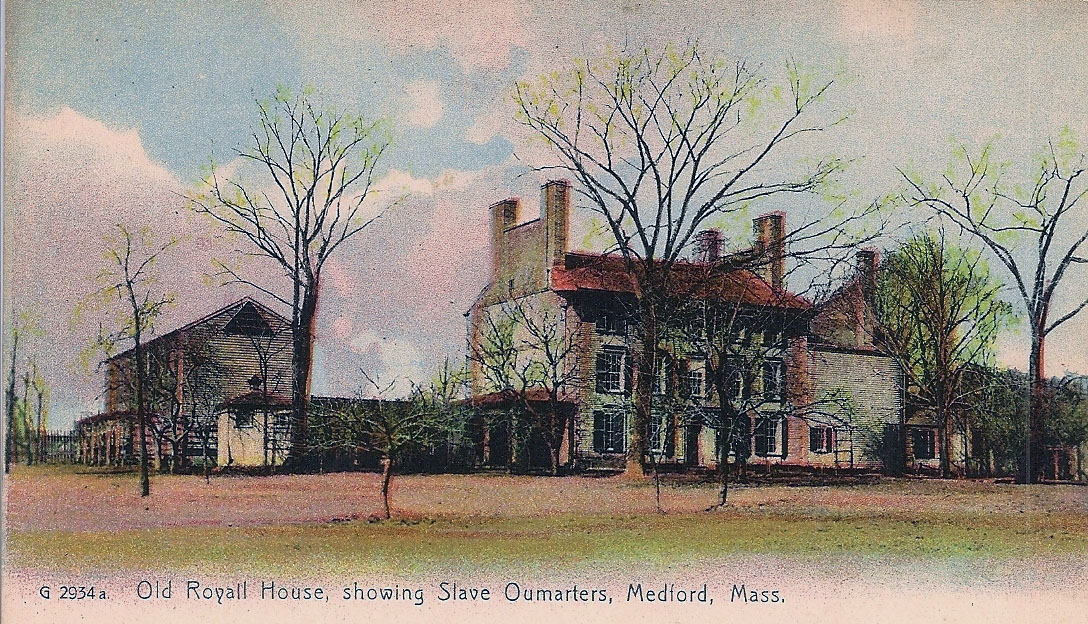
“Old Royall House, showing Slave Oumarters [Quarters], Medford, Mass,” c. 1906. Hand-colored photographic postcard printed by the Rotograph Company, New York. (Courtesy Royall House & Slave Quarters)
Between 1781 and 1783, several Massachusetts court decisions ruled that slavery was incompatible with the new state constitution, which declared in 1780 that all men “are born free and equal.” Although it undoubtedly took several years for the rulings to become widely known and fully implemented, no slaves were reported in Massachusetts in the 1790 census. For Belinda Sutton, however, freedom came from a will written up in 1778 by the slaveholder Isaac Royall, Jr., who died in exile in England in 1781, when she was in her late sixties: “I do also give unto my said daughter my negro Woman Belinda in case she does not choose her freedom; if she does choose her freedom to have it, provided that she get Security that she shall not be a charge to the town of Medford.” We know of Belinda Sutton, one of 64 people enslaved by Royall on his Medford estate, through a series of remarkable documents dating from the 1780s, as detailed in the following introduction from the just-published anthology Black Writers of the Founding Era, edited by James G. Basker and Nicole Seary:

Arguably the first slave narrative by a woman, a petition was presented to the Massachusetts legislature on February 14, 1783, by Belinda, who for fifty years had been enslaved by the landowner and businessman Isaac Royall. Born around 1713, probably in what is now Ghana or Nigeria, kidnapped at age twelve, and transported to the New World, Belinda began working for Royall and his family after they moved to Massachusetts from Antigua in 1732. Little is known of her life except that she had two children (both baptized in 1768), a son Joseph and an invalid daughter Prine, and that she was still caring for Prine when she wrote this appeal in 1783.

Meanwhile Royall, through various businesses, including trade in rum and slaves, became one of the wealthiest men in Massachusetts and an overseer of Harvard College. A Loyalist, he fled at the outbreak of the war, eventually settling in England. In 1778, he was named in the Massachusetts banishment act, which put his property at the disposal of the state and gave Belinda hope for her petition.

In her pioneering request for reparations, Belinda’s personal travails during fifty years of enslavement are visible beneath the embellishments of the amanuensis who transcribed her story. The government ordered Royall’s executors to pay her a pension of £15, 12s. But within a year the payments had stopped. Belinda would petition again in 1785, 1787, 1788, 1790, and 1793. The second text reprinted here, more businesslike and direct, is her petition from 1793, using what is presumably her married name of Sutton. The “Sir Wm Pepperell” who cut her off was Isaac Royall’s son-in-law. The name of the executor of Royall’s estate, Willis Hall, appears at the bottom of the petition, along with “Priscilla Sutton,” who may be Belinda’s invalid daughter Prine. A clerk’s note on the backside of the docket indicates that the state had to re-enforce the pension order yet again two years later, on February 25, 1795.

Versions of her story circulated in the antislavery press of the 1780s, before disappearing. The quiet heroism of her life resurfaced in the twenty-first century, when the disgrace of her treatment led Harvard University to remove the symbols of Isaac Royall’s patronage from the insignia of its Law School, which had been partially founded with proceeds from his estate.

Notes: The Rio da Valta is the Volta River, in what is now Ghana. Orisa is a deity or spirit in the Yoruba language and religion.

*   *   *
The Petition of Belinda an Affrican, humbly shews that seventy years have rolled away, since she on the banks of the Rio da Valta, received her existence. . . . If you don't see the full selection below, click here (PDF) or click here (Google Docs) to read it—free!

This selection may be photocopied and distributed for classroom or educational use.

Sunday, January 29, 2023

The Epocha of the Stamp Act

John Adams (1735–1826)
From John Adams: Revolutionary Writings 1755–1775

“Burning of Stamp Act, Boston.” Photomechanical print of a postcard, 1903. The framed artwork in the center is a hand-colored reproduction of one of twelve engravings about the American Revolution that were drawn in 1784 by German artist Daniel Chodowiecki (1726–1801). (Library of Congress)
After a hiatus of nearly three years, on December 18, 1765, John Adams resumed his habit of keeping a diary. In that day’s entry, he noted, “The Year 1765 has been the most remarkable Year of my Life.” In fact, the entire period during which he neglected his diary proved most consequential for a Harvard graduate in his late 20s who had once aspired to follow in his father’s footsteps and live a quiet life as a farmer.

In late 1762, Adams renewed his acquaintance with Abigail Smith prior to the wedding of her older sister, Mary, and his close friend Richard Cranch. He had been unimpressed with all three Smith sisters when he met them three years earlier. At the time, he was on the verge of proposing marriage to their second cousin Hannah Quincy, the daughter of Josiah Quincy, a leading town citizen and justice of the peace. Comparing the sisters’ demeanor to Hannah’s compassionate character, he wrote, “Parson Smiths Girls have not this fondness, nor this Tenderness,” but John nevertheless seemed to have second thoughts—and Hannah had several suitors. A rival, the physician Bela Lincoln, proposed first.

Abigail was only fifteen when she first failed to make an impression on John, but as an eighteen-year-old she no longer paled next to Hannah Quincy. A month before the Cranch wedding, he sent her a letter that begins:
By the same Token that the Bearer hereof satt up with you last night I hereby order you to give him, as many Kisses, and as many Hours of your Company after 9 O’Clock as he shall please to Demand and charge them to my Account. . . .
They were married two years later, in October 1764. “His marriage to Abigail Smith was the most important decision of John Adams’s life, as would become apparent with time,” writes historian David McCullough. “She was in all respects his equal and the part she was to play would be greater than he could possibly have imagined, for all his love for her and what appreciation he already had of her beneficial, steadying influence.” McCullough wryly points to the abandonment of Adams’s diary, with the resulting absence of any mention of his courtship of and marriage to Abigail, as “a sure sign of how preoccupied he was.”

In early 1764, while John was still courting Abigail, a smallpox outbreak occurred in Boston; on March 13, the town voted to allow anyone to be inoculated during the next five weeks. Until Edward Jenner’s discovery in the 1790s of vaccination (which used a milder but immunizing disease, cowpox), inoculation with the smallpox virus was itself very dangerous, not only to the patient receiving inoculation but to others who had not had the disease, and many physicians generally resisted inoculation unless an outbreak of the disease threatened to get out of control. By March 30 there had been 699 cases of natural smallpox with 124 deaths, and 4,977 cases of inoculated smallpox with only 46 deaths. Adams decided to endure the treatment and on April 13 he was successfully inoculated under the care of Dr. Joseph Warren, who later became a close friend. During the month he quarantined himself in Boston, he and Abigail exchanged a total of 21 letters.

Before the end of the first year of their marriage, John became active in the struggle against implementation of the Stamp Act. Issued in March 1765 and scheduled to take effect on November 1, the Act imposed a hefty tax on the paper used in the colonies for newspapers, almanacs, pamphlets, broadsides, and legal and commercial documents. By the time word of the Act reached the colony, Adams had begrudgingly become an official in his hometown of Braintree, twelve miles south of Boston: he had been nominated for—and then elected—surveyor of highways, responsible for the maintenance of roads and bridges. “I was very wroth, because I knew no better, but said Nothing,” he wrote years later in his autobiography. “My Friend Dr. Savil came to me and told me, that he had nominated me to prevent me from being nominated as a Constable: for said the Doctor, they make it a rule to compell every Man to serve either as Constable or Surveyor, or to pay a fine. I said they might as well have chosen any Boy in School, for I knew nothing of the Business.” The position, however, pushed him into a more prominent role at town meetings.

That summer, protests against the Stamp Act occurred throughout the colonies. In Boston, on August 14, mobs looted the home of Andrew Oliver, a prominent merchant who had been appointed stamp distributor for Massachusetts, and they hanged him in effigy. In Adams’s diary is an extended passage that may have been meant as a letter to a newspaper but was apparently never published. On the one hand, Adams wrote, “to be carried thro the Town, in such insolent Tryumph and burned on an Hill, to have his Garden torn in Pieces, his House broken open, his furniture destroyed and his whole family thrown into Confusion and Terror, is a very attrocious Violation of the Peace and of dangerous Tendency and Consequence.” On the other hand, he reminded his would-be readers how Thomas Hutchinson, the Lieutenant Governor of Massachusetts, had filled prominent government posts with almost a dozen members of his own family—including Andrew Oliver, his brother-in-law. “Is not this amazing ascendancy of one Family, Foundation sufficient on which to erect a Tyranny? Is it not enough to excite Jealousies among the People?” And would it not be prudent, he continued, “to remove these Jealousies from the Minds of the People by giving an easy solution of these Difficulties?” Two weeks later another mob attacked Hutchinson’s three-story mansion, looting the valuable objects and destroying virtually everything else, including his papers and manuscripts and even the walls and roof. Hutchinson and his family escaped only moments before the crowd arrived.

The following month, Adams wrote “Instructions to Braintree’s Representative Concerning the Stamp Act,” directing the town’s representative in the Massachusetts legislature, the General Court, to oppose the Stamp Act. Adopted unanimously at a town meeting, Adams’s document denounced the Act as unconstitutional: “We have always understood it to be a grand and fundamental Principle of the Constitution, that no Freeman should be subjected to any Tax, to which he has not given his own Consent, in Person or by Proxy.” After it was printed on October 10 in the Massachusetts Gazette the Braintree Instructions were adopted by about forty other towns.

Between 1802 and 1807, with the Revolution and his Presidency behind him, Adams worked on his autobiography. “It is not for the Public but for my Children that I commit these Memoirs to writing,” he states in the preface, and all three volumes of the unfinished work remained unpublished until 1961. Early in the first volume, Adams recalls the events that unexpectedly altered his life and career—from the smallpox epidemic to his marriage to the Stamp Act—and we present those passages below.

Notes: Adams’s preparatory treatment for smallpox inoculation with a milk-and-vegetable diet and purgatives was popularized by Dr. Adam Thomson of Philadelphia in 1750. Draper’s paper was the Massachusetts Gazette, published by Richard Draper. The Mr. Paine mentioned by Adams should not be confused with Thomas Paine, referred to earlier. Instead, he is Robert Treat Paine, who later became a member of the Continental Congress.

The refusal of colonial lawyers to purchase stamped legal paper resulted in the closing of the court system in Massachusetts. On behalf of Boston townsmen, Adams, accompanied by lawyers Jeremiah Gridley and James Otis Jr., appeared before Governor Francis Bernard on December 20 and argued unsuccessfully for the reopening of the courts, particularly the Court of Common Pleas, the main trial court in Massachusetts. Otis was a celebrated lawyer whose speeches and writings Adams revered, but by this time the mental illness that would end Otis’s political career was beginning to reveal itself. “He is liable to great Inequalities of Temper—sometimes in Despondency, sometimes in a Rage,” Adams wrote in his diary at the end of December 1765.

Faced with the intransigence of all the American colonies, the British House of Commons repealed the Stamp Act on February 24, 1766.

*   *   *

In the Winter of 1764 the Small Pox prevailing in Boston, I went with my Brother into Town and was inocculated under the Direction of Dr. Nathaniel Perkins and Dr. Joseph Warren. . . . If you don't see the full story below, click here (PDF) or click here (Google Docs) to read it—free!

This selection may be photocopied and distributed for classroom or educational use.

Saturday, July 3, 2021

The Battle of Long Island

Philip Vickers Fithian (1747–1776)
From The American Revolution: Writings from the War of Independence 1775–1783

The Battle of Long Island, 1858, oil on canvas by American painter Alonzo Chappel (1828–1887). Wikimedia Commons.

When the British broke through American lines in their advance on the Continental Army headquarters in Brooklyn Heights on August 27, 1776, Brigadier General William Alexander (Lord Stirling) led a regiment of several hundred soldiers from Maryland against 2,000 British troops at the Old Stone House on Gowanus Creek. Alexander’s action, depicted in Chappel’s painting, allowed much of his brigade to retreat safely off the battlefield and rejoin the remainder of Washington’s army. Many of the Maryland 400, as they came to be known decades later, were killed or captured in battle before Stirling finally surrendered. The edifice in the painting is one of the two mills that were near the Old Stone House. The foreground shows American soldiers retreating across the marshy Brouwer’s Millpond to Brooklyn Heights.
Philip Vickers Fithian, a recently ordained Presbyterian minister, arrived in Manhattan in early July 1776, and he wrote in his journal how the city was “full of Soldiers—the streets barricaded—the Shores & neighbouring Parts, lined with Fortifications—Women, Children, & the Aged fled.” Weeks earlier, he had left his new post at the Greenwich Presbyterian Church in New Jersey and enlisted as a chaplain in the Continental Army, joining more than three hundred soldiers in the battalion led by Colonel Silas Newcomb, in the division commanded by Major General Nathanael Greene.

Fithian is known to historians and scholars primarily for the journal he kept while employed as a tutor in 1773 and 1774 at Robert Carter’s plantation in Virginia. In fact, “Philip’s Virginia diary was a staple of undergraduate and graduate history seminars for two generations of students trained during the cold war,” writes the historian John Fea in his biography of Fithian. “One would be hard-pressed to find a book on eighteenth-century Virginia that does not mention him.” Beginning in May 1775, Fea points out, the tone of Fithian’s journal changed. Aware that he was living through important historical events, which he believed to be ordained by God, the entries are more clearly written for “who shall read these Papers a couple of hundred Years hence,” as well as for his wife and children. “He wanted to represent as accurately as possible for his readers, whoever they might be, the story of American liberty and his place within it,” notes Fea, who adds that “if Philip were alive today, he would have been surprised to find that his Carter diary has received so much attention, especially since it was the 1775–76 journal (and not the plantation diary) that he tailored most specifically for future readers.”

George Washington had arrived in New York in April 1776 with approximately ten thousand troops, and Greene’s division was headquartered on Long Island, in the area that is now Brooklyn. Meanwhile, the British commander-in-chief William Howe and his brother, Admiral Richard Howe, built up their forces on Staten Island. By mid-August, the British army had amassed 32,000 troops, including 8,000 Hessians, against approximately 19,000 Continental soldiers and state militia members. On August 20, after Greene became ill, Major General John Sullivan took command of the division on Long Island.

Between July and August, Philip moved back and forth between Long Island and Manhattan. As a chaplain, he was allowed to take lodgings and avoid many of the hardships faced by ordinary soldiers. In mid-August he and another chaplain from Greenwich, his longtime friend Andrew Hunter, Jr., moved to a new place closer to the East River.
Our Situation, & Living now are most fine. A genteel, sober, patriotic Family, of which, in order to be agreeable, I need say no more. We have a small neat Room, free of Noise, well furnished, & with a good Bed—But our Situation—! From the Door of our Room, we have a good View of the Fleet—A perfect View of New-York; Governors Island; Powles-Hook; & Red-Hook—We live on the very Bank of the Water opposite to Governors Island.

Some say our Situation is dangerous; but all places in the Neighberhood of York are, I think, equally dangerous—We fear not Tory George, & his War-worn Army!
Fithian’s separate quarters did not spare him from the dysentery raging through the Continental army, however, and he spent a good part of July and August sick in bed and nursed to health by the women who let him his rooms.

On August 22, Howe began landing troops at Gravesend Bay on eastern end of Long Island; five days later he ordered an attack during which 1,400 American soldiers were killed or captured. (Many of those taken prisoner later died from disease and malnourishment.) General Sullivan and one of his officers, Brigadier General William Alexander, were both captured during the battle. Faced with certain defeat, the Americans retreated behind fortified lines in Brooklyn Heights. In one of the most famous actions of the war, Washington ferried 9,000 men and their supplies across the East River under cover of night and heavy fog on August 29–30. The Howes did not realize the entire rebel army had escaped to Manhattan until the morning fog lifted.

“We have been, it is true, under the prudent Necessity of leaving all our Lines on Long Island last Fryday Night,” Fithian wrote to his wife, Betsy, “but we have left them with Profit & Honour, for they could have surrounded us. . . . The whole Army is now in Town.” His diary entries offer a firsthand account of the scene in Brooklyn during the Battle of Long Island—including how, skeptical of his landlady’s claim that the Americans were evacuating, he nearly missed the boats transporting the troops to Manhattan.

In mid-September, when British forces conducted an amphibious landing on the east side of Manhattan, the Americans took flight, retreating to the north end of the island. They were followed by the dysentery that had been plaguing the army all summer, and soon Fithian fell ill again. No longer able to avail himself of a room, much less a bed, Fithian spent a week on the floor of a tent, beset by fever and covered with boils, and he died on October 8.

Notes: To sleep “sub-jove” is to spend the night beneath the open sky. Fithian refers to Brigadier General William Alexander as General Lord Sterling. Born in New York City to a Scottish father, Alexander had unsuccessfully claimed the earldom of Stirling while living in England between 1756 and 1762, and he continued to use the title Lord Stirling after returning to America. After his capture during the Battle of Long Island, Alexander was freed in a prisoner exchange in October 1776 and promoted to major general in 1777.

*   *   *
All at Alarm-Posts by two. No Approach of the Enemy. About eight we hear heavy firing. . . . If you don't see this week's selection below, click here (PDF) or click here (Google Docs) to read it—free!

This selection may be photocopied and distributed for classroom or educational use.

Friday, July 3, 2020

“The natural right of all Men—& their Children”

Lancaster Hill, Peter Bess, Brister Slenser, Prince Hall, et al.
From Black Writers of the Founding Era

The top of the copy of the 1777 petition in the Massachusetts Archives Collection. The documents and transcriptions in the collection were gathered into 241 scrapbook volumes between 1837 and 1846 by the Rev. Joseph Barlow Felt.
Although it is one of at least five petitions against slavery presented by African Americans to the Massachusetts government between 1773 and 1777, this document marks a pivot from pre-Revolutionary colonial government to that of the newly independent state. The language itself bears signs of this transition. The first 125 and last 130 words repeat almost exactly the phrasing of a petition submitted by “a Great Number of Blacks” on May 25, 1774. But the middle section, from the term “unalienable right” borrowed from Jefferson’s Declaration through the sentence about America’s “unhappy difficulties with Great-Britain,” bases its arguments on natural law and the idea that in seeking their freedom African Americans are inspired by and seek to imitate the American struggle for independence. Little is known of Lancaster Hill and most of his associates, but all the petitions submitted in Massachusetts in the 1770s seem to have emerged from the same group of community leaders. The exceptional figure among the eight signers is Prince Hall (c.1735–1807), whose remarkable life as an activist, abolitionist, and founder of Black Freemasonry has been the subject of numerous articles and at least four books.

A bill to abolish slavery in Massachusetts was drafted on June 9, 1777, and then allowed to die. But others took up the cause and slavery was found incompatible with the state constitution by the courts in 1783.

The above description of the petition was supplied by James G. Basker, editor of the forthcoming Library of America volume Black Writers of the Founding Era, which gathers this document with nearly 200 other texts composed between 1770 and 1800 by 110 different authors representing all thirteen original states. Featuring poems, letters, civil rights petitions, slave narratives, autobiographies, sermons, speeches, and letters to the editor, the collection shows how the long-neglected voices of Black men and women from a variety of backgrounds—both free and enslaved, urban and rural, illiterate and highly educated—were essential members of the founding generation of the United States.

*   *   *
For this week’s selection, we depart from the usual format and reproduce the selection, in its entirety, below.

To the Honorable Council & House of Representatives for the State of Massachusetts-Bay in General Court assembled January 13th 1777—

The Petition of a great number of Negroes who are detained in a state of Slavery in the Bowels of a free & Christian Country Humbly Shewing—

That your Petitioners apprehend that they have, in common with all other Men, a natural and unalienable right to that freedom, which the great Parent of the Universe hath bestowed equally on all Mankind, & which they have never forfeited by any compact or agreement whatever—But they were unjustly dragged, by the cruel hand of Power, from their dearest friends, and some of them even torn from the embraces of their tender Parents—from a populous, pleasant and plentiful Country—& in Violation of the Laws of Nature & of Nation & in defiance of all the tender feelings of humanity, brought hither to be sold like Beasts of Burthen, & like them condemned to slavery for Life—Among a People professing the mild Religion of Jesus—A People not insensible of the sweets of rational freedom—Nor without spirit to resent the unjust endeavors of others to reduce them to a State of Bondage & Subjection—Your Honors need not to be informed that a Life of Slavery, like that of your petitioners, deprived of every social privilege, of every thing requisite to render Life even tolerable, is far worse than Non-Existence—In imitation of the laudable example of the good People of these States, your Petitioners have long & patiently waited the event of Petition after Petition by them presented to the Legislative Body of this State, & can not but with grief reflect that their success has been but too similar—They can not but express their astonishment, that it has never been considered, that every principle from which America has acted in the course of her unhappy difficulties with Great-Britain, pleads stronger than a thousand arguments in favor of your Petitioners—They therefore humbly beseech your Honors, to give this Petition its due weight and consideration, & cause an Act of the Legislature to be passed, whereby they may be restored to the enjoyment of that freedom which is the natural right of all Men—& their Children (who were born in this Land of Liberty) may not be held as Slaves after they arrive at the age of twenty one years—So may the Inhabitants of this State (no longer chargeable with the inconsistency of acting, themselves, the part which they condemn & oppose in others) be prospered in their present glorious struggles for liberty; & have those blessings secured to them by Heaven, of which benevolent minds can not wish to deprive their fellow Men.

And your Petitioners, as in Duty Bound shall ever pray.

Lancaster Hill
Peter Bess
Brister Slenser
Prince Hall
Jack Pierpont
Nero Funelo
Newport Sumner
Job Look

(January 13, 1777)

Transcribed from the copy in the Massachusetts Archives Collection, volume 212: “Revolution Resolves, 1777.” A similar text, made from a different manuscript copy, was published in 1877 by the Massachusetts Historical Society; the two sources vary primarily in their spelling.

Sunday, March 1, 2020

The Bloody Tragedy of the Fifth of March, 1770

Joseph Warren (1741–1775)
From The American Revolution: Writings from the Pamphlet Debate 1764–1776

Boston Massacre, March 5th, 1770, 1855, original painting by illustrator William L. Champney (fl. 1850–1857), reproduced as a chromolithograph and published by Henry Q. Smith, Boston. Courtesy of the Boston Athenaeum. In the center is Crispus Attucks, a Boston resident of African and Native American descent who was the first to die during the confrontation. Champney’s painting was modeled after the famous hand-colored engraving by Henry Pelham, versions of which were sold as prints by both Paul Revere and Pelham only weeks after the event took place.
The following introduction is adapted, with minor changes and the addition of an excerpt from John Adams’s diary, from headnotes by Gordon S. Wood in the two-volume Library of America collection The American Revolution: Writings from the Pamphlet Debate 1764–1776.
In his testimony before the House of Commons in 1766, Benjamin Franklin drew a distinction between “internal” taxes, such as the stamp taxes on newspapers and legal documents, and “external” taxes, such as duties levied on imports. Although few colonists made much of this distinction, the British government seized on it. The following year the chancellor of the exchequer, Charles Townshend, admitted that he could not see “any distinction between internal and external taxes; it is a distinction without a difference, it is perfect nonsense.” But “since the Americans were pleased to make that distinction,” he was “willing to indulge them.”

Consequently, Parliament went on to levy “external” taxes or duties on colonial imports of lead, glass, paper, and tea, the revenue from which was to be applied to the salaries of royal officials in the colonies, thereby affording them a measure of independence from the colonial assemblies, their traditional paymasters. At the same time the British government decided that the North American colonies had at long last become important enough to require their own ministerial department. Lord Hillsborough, a hard-liner, was appointed the first secretary of the new American department.

The reforms accompanying the Townshend Duties created three new vice-admiralty courts in Boston, Philadelphia, and Charleston to supplement the one in Halifax. To oversee these institutions of trade enforcement, Parliament also established a new American Board of Customs located in Boston. This was scarcely the best place to put it, for Boston—in fact the entire colony of Massachusetts—was seething. Attacked by mobs, customs officials in Boston found it impossible to enforce the new trade regulations, and they pleaded for military support. When a British warship arrived in Boston in June 1768, emboldened customs officials promptly seized John Hancock’s ship Liberty for violating the trade laws. This set off one of the fiercest riots in Boston’s history.

Following Governor Francis Bernard’s dissolution of the Massachusetts assembly, Boston’s town meeting ordered the town’s inhabitants to arm and called upon all the towns in the colony to send delegates to an extra-legal convention. Lord Hillsborough concluded that all order had broken down in Massachusetts, and he sent two regiments to Boston. By 1769 there were nearly four thousand armed redcoats in the crowded seaport of fifteen thousand inhabitants. Since the colonists shared the traditional English fear of standing armies, relations between the townspeople and soldiers rapidly deteriorated. On March 5, 1770, a party of eight British soldiers fired on a threatening crowd, killing five civilians (three died at the scene and two later from their wounds).

This “Boston Massacre,” as it was called, immediately aroused American passions and inspired some of the most sensational rhetoric of the period. That fall, John Adams and Josiah Quincy as co-counsels successfully defended the soldiers against the charge of murder. As Quincy told his father, he and Adams took the case only after the leading patriots, including Samuel Adams, John Hancock, and Dr. Joseph Warren, had urged them to do so. Three years later, on the anniversary of the event, John Adams wrote in his diary:
The Part I took in Defence of Captn. Preston and the Soldiers, procured me Anxiety, and Obloquy enough. It was, however, one of the most gallant, generous, manly and disinterested Actions of my whole Life, and one of the best Pieces of Service I ever rendered my Country. Judgment of Death against those Soldiers would have been as foul a Stain upon this Country as the Executions of the Quakers or Witches, anciently. As the Evidence was, the Verdict of the Jury was exactly right.

This however is no Reason why the Town should not call the Action of that Night a Massacre, nor is it any Argument in favour of the Governor or Minister, who caused them to be sent here. But it is the strongest of Proofs of the Danger of standing Armies.
Boston began commemorating the incident with an annual oration, an observance that would continue until independence, when it was replaced by orations celebrating the Fourth of July. Warren, who was called on to deliver the oration in 1772, had become a prominent radical in 1767 when he published in the Boston Gazette under the pseudonym of “A True Patriot” a series of protests against the Townshend Acts. They were so incendiary that Governor Bernard sought to have him prosecuted for libel. Warren would be asked to deliver the Massacre oration once again in 1775, just three months before he was killed at the battle of Bunker Hill. The second time he delivered the oration while wearing a Roman toga—a vivid sign of the republicanism that was by then fast approaching.

Notes: The quote by Virgil on the title page is from the Aeneid, which reads in the Fairclough translation: “What Myrmidon or Dolopian, or soldier of stern Ulysses, could in telling such a tale refrain from tears?” The quote by Cicero in the footnote on page 748 is from Orations against Cataline: “All ranks support the preservation of the republic with heart and will, with zeal and virtue, and with their voices.” The rape of Lucretia, a noblewoman, led to the end of the Roman monarchy in 510–509 BCE. The second quote from Virgil (page 756, footnote) is from the Eclogues: “But soon as thou canst read of the glories of heroes and thy father's deeds, and canst know what valour is.”

*   *   *
When we turn over the historic page, and trace the rise and fall of states and empires; the mighty revolutions which have so often varied the face of the world strike our minds with solemn surprize, and we are naturally led to endeavor to search out the causes of such astonishing changes. . . . If you don't see the full selection below, click here (PDF) or click here (Google Docs) to read it—free!

This selection may be photocopied and distributed for classroom or educational use.