Showing posts with label Women's suffrage. Show all posts

Sunday, May 8, 2022

Is Woman’s Suffrage a Failure?

Ida M. Tarbell (1867–1944)
From American Women’s Suffrage: Voices from the Long Struggle for the Vote 1776–1965

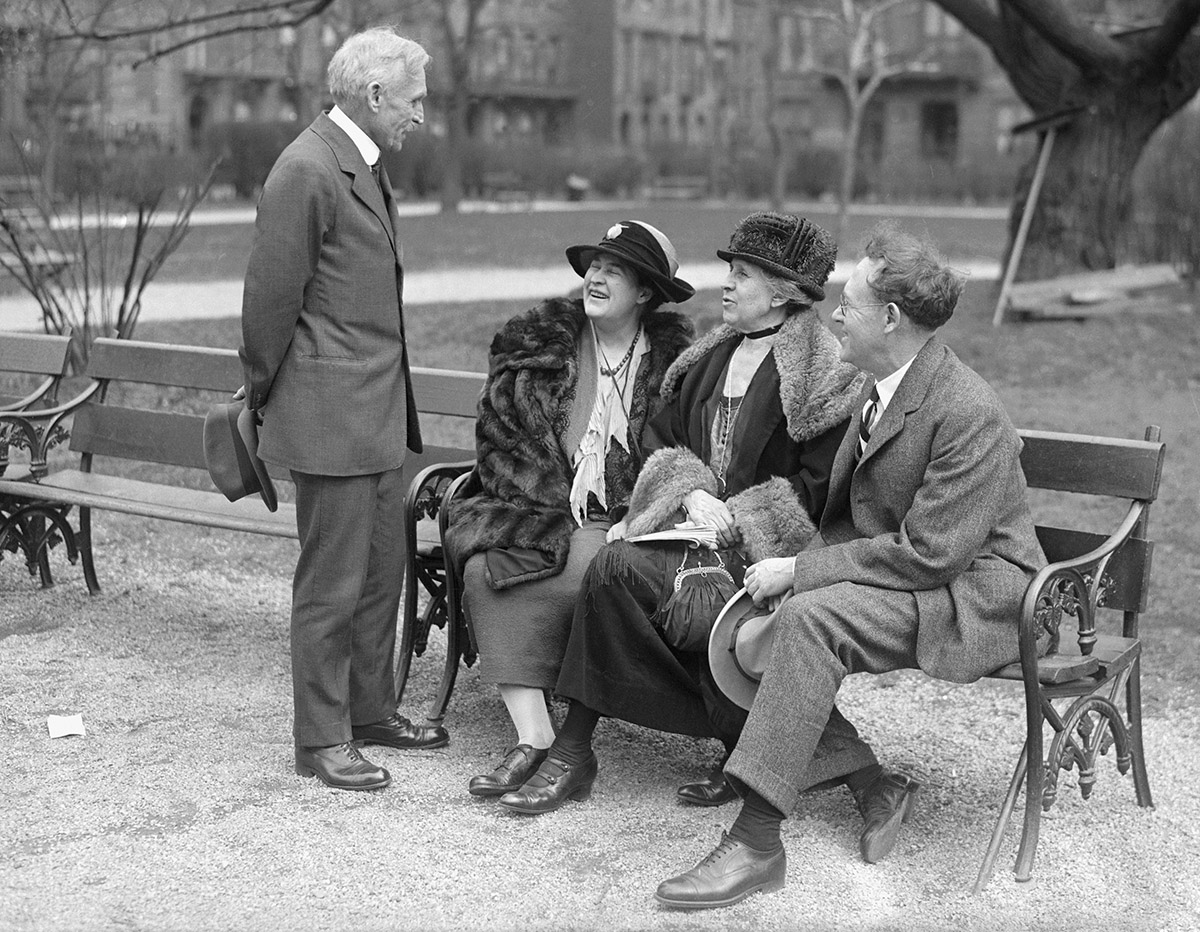
Publisher S. S. McClure (standing) in Washington Square Park during the fall of 1924 with three former contributors to McClure's Magazine: the novelist Willa Cather and muckraking journalists Ida M. Tarbell and Will Irwin. Scholars have speculated that McClure was hoping to convince them to contribute again to the magazine, which had been struggling to survive ever since Cather resigned as editor in 1911, the year McClure lost financial control of the firm because of his profligate spending. Tarbell is the only one of the three who submitted writing—a biography of Elbert Henry Gary, the founder of United States Steel—before the magazine folded in 1929. (Bettmann Archive / Getty Images)
Early in the second decade of the twentieth century, the pioneering journalist Ida M. Tarbell surprised her friends and colleagues when her name was listed as a member of the executive committee of the New York State Association Opposed to Woman Suffrage. Helen Keller, who at 32 was twenty years younger than Tarbell, was mortified, and she told friends that Tarbell was “getting too old to understand and sympathize with the aspirations of a growing world!” Jane Addams pithily commented, “There is some limitation to Ida Tarbell’s mind.” In 1912 John Sanborn Phillips, one of Tarbell’s closest friends and her editor at The American Magazine, asked her to clarify her “illiberal and contradictory” position. Her fourteen-page letter in response claimed that she was largely indifferent on the subject and explained that she believed that suffrage was a secondary goal—and a distraction. “Nothing but the slow processes of education will put an end to [war and poverty], and believing this, how can I fight for that which I believe will hamper the direct use of the tools which will do the work?” She concluded, “You will gather from this that the chief reason I am not interested in the extension of suffrage is because I feel that it is part of what seems to me the most dangerous fallacy of our times—and that is that we can be saved morally, economically, socially by laws and systems.”

As Susan Ware remarks in her headnote to this week’s selection, it’s something of a surprise, given this background, that the editors of Good Housekeeping asked Tarbell to comment on the success or failure of the Nineteenth Amendment a mere four years after its passage. In the article, Tarbell subtly restates some of her criticisms—she mocked the claim supposedly made by some suffragists that women, through their votes, would quickly “cure all our ills”—but her tone has changed to one of hope: a new conviction that the increased involvement of women in local elections and politics might well result in future social and economic change. The article was informed by her travels on the lecture circuit across the nation earlier that year. “These long rides, these night waits, brought unforgettable looks into human lives,” she wrote years later, always amazed by how much people were willing to tell her. “Strange how travelers will confide their ambitions, unload their secrets, and show their scars to strangers.”

Born and raised in western Pennsylvania, Ida Minerva Tarbell was one of the leading “muckrakers” of the era. During the 1890s, she became a reporter for McClure’s Magazine, which published her hugely popular serial biographies of Napoleon and Lincoln. At the turn of the century, she began work on the articles that brought her fame: an exposé on the unfair business methods employed by John D. Rockefeller and the Standard Oil Company, including the secret schemes that had brought ruin to dozens of smaller competitors, such as the firm owned by her father, who had been a producer and refiner when the first oil fields began appearing in Erie County in the 1860s. Based on the evidence from a mountain of documents—some of which Rockefeller believed had been destroyed—and interviews with company executives and government officials, the devastating series ran in nineteen consecutive issues of McClure’s and then appeared in 1904 as a book, The History of the Standard Oil Company. Her report led to both the Supreme Court decision that dissolved Standard Oil’s monopoly in 1911 and the Clayton Antitrust Act in 1914.

Sixteen years after Tarbell’s article on suffrage appeared in Good Housekeeping, the magazine’s editors asked another famous woman to write on the same theme for the twentieth anniversary of the Nineteenth Amendment. First Lady Eleanor Roosevelt responded to the request with a three-part article titled “Women in Politics,” in which she described the achievements of several of the many women in elected and appointed positions, most of which had previously been open only to men. Regarding suffrage itself, she acknowledged that she couldn’t prove the connection but “only one thing stands out—namely, that on the whole, during the last twenty years, government has been taking increasing cognizance of humanitarian questions, things that deal with the happiness of human beings, such as health, education, security.” Her conclusion to the article struck the same hopeful note and urged the same patience as did Tarbell’s article: “It will always take all kinds of women to make up a world, and only now and then will they unite their interests. When they do, I think it is safe to say that something historically important will happen.”

Notes: Kentucky novelist George Madden Martin (the pen name of Georgia May Madden Martin), author of the 1902 best-selling children’s book Emmy Lou, published the skeptical “American Women and Public Affairs” in the February 1924 issue of the Atlantic Monthly; Tarbell’s article is, in part, a response to it. Alfred E. Smith was a four-term New York governor who ran for president in 1928; William Gibbs McAdoo, Woodrow Wilson’s son-in-law, unsuccessfully ran for the Democratic nomination for president in 1920 and 1924. The Volstead Act provided enforcement procedures to carry out the Eighteenth Amendment, which prohibited the manufacture and sale of alcoholic beverages. Lincoln’s comments on the “bad laws” and “mob rule” were made in his 1838 Lyceum Address. The Teapot Dome Scandal involved the leasing of petroleum reserves in 1922 by Secretary of the Interior Albert Fall, who was later convicted of accepting bribes from oil companies. Alice Bentley served as a Republican member of the Pennsylvania House of Representatives from 1923 to 1928. Jeannette Rankin was elected to the U.S. House of Representatives in 1916 from Montana, becoming the first woman to serve in Congress. Alice Robertson was the second woman elected to Congress, winning election in 1920 as a Republican from Oklahoma but failing to win reelection in 1922. Cornelia Bryce Pinchot was a Progressive reformer married to Gifford Pinchot, the governor of Pennsylvania in 1922–26 and 1930–34.

*   *   *
One of several dismal refrains, more or less popular at the moment, celebrates the failure of woman’s suffrage. . . . If you don't see the full selection below, click here (PDF) or click here (Google Docs) to read it—free!

This selection may be photocopied and distributed for classroom or educational use.

Saturday, October 3, 2020

Women in Politics

Fannie Barrier Williams (1855–1944)
From American Women’s Suffrage: Voices from the Long Struggle for the Vote 1776–1965

African American women used women’s clubs and churches as launch pads for political activism, including women’s suffrage. Here Nannie Burroughs and eight other delegates gather for the Banner State Woman’s National Baptist Convention in 1915. Library of Congress.
The following introduction is adapted, with minor changes and the addition of an excerpt from Williams’s speech at the 1893 world’s fair, from the headnote by Susan Ware in the Library of America collection American Women’s Suffrage.
Fannie Barrier Williams, born in Brockport, New York, and the first African American to graduate from Brockport Normal School, quickly became part of Chicago’s black elite when she moved there with her lawyer husband in 1887. The only African American woman appointed to a position on the Board of Lady Managers that oversaw the Woman’s Building at the 1893 World’s Columbian Exhibition in Chicago, Williams spoke to its World’s Congress of Representative Women, one of the few African American women offered a public role at the world’s fair. Her speech, “The Intellectual Progress of the Colored Women of the United States Since the Emancipation Proclamation,” presented a sweeping survey of black women’s aspirations and accomplishments and reminded her mostly white audience of the insurmountable challenges tackled in the three decades since the end of the Civil War:
How few of the happy, prosperous, and eager living Americans can appreciate what it all means to be suddenly changed from irresponsible bondage to the responsibility of freedom and citizenship!

The distress of it all can never be told, and the pain of it all can never be felt except by the victims, and by those saintly women of the white race who for thirty years have been consecrated to the uplifting of a whole race of women from a long-enforced degradation.

The American people have always been impatient of ignorance and poverty. They believe with Emerson that “America is another word for opportunity,” and for that reason success is a virtue and poverty and ignorance are inexcusable. This may account for the fact that our women have excited no general sympathy in the struggle to emancipate themselves from the demoralization of slavery. This new life of freedom, with its far-reaching responsibilities, had to be learned by these children of darkness mostly without a guide, a teacher, or a friend. In the mean vocabulary of slavery there was no definition of any of the virtues of life. The meaning of such precious terms as marriage, wife, family, and home could not be learned in a school-house. The blue-back speller, the arithmetic, and the copy-book contain no magical cures for inherited inaptitudes for the moralities. Yet it must ever be counted as one of the most wonderful things in human history how promptly and eagerly these suddenly liberated women tried to lay hold upon all that there is in human excellence.
Not mentioned in her speech was involvement in politics. In this 1894 article, Williams challenged women to use their newfound political power wisely: “We ought not to put ourselves in the humiliating position of being loved only for the votes we have.” More specifically, she worried that if black women voted along strict party lines, such a stance might benefit the interests of whites in power more than the general interests of African Americans. To avoid that outcome she called on women “to array themselves, when possible, on the side of the best, whether that best be inside or outside of party lines.” For African Americans traditionally loyal to the Republican Party for its role in ending slavery, the invitation to jump party lines on matters of principle was a fraught issue.

Notes: Williams refers to an Illinois election in which women could participate. In 1891, Illinois passed a bill that allowed women to vote for the University of Illinois board of trustees. In 1894, four women were among the thirteen candidates who ran for the board, and white Republican candidate Lucy Flower (1837–1921) won a place, aided by the votes of African American women.
This selection may be photocopied and distributed for classroom or educational use.

*   *   *
For this week’s selection, we depart from the usual format and reproduce the selection, in its entirety, below.
You may also download it as a PDF or view it in Google Docs.

Women in Politics

American women are beginning to see the end of their years of struggle for equality of suffrage. The arguments are nearly all in and the signs of a favorable verdict are everywhere apparent to those who understand the trend of things.

Fragmentary suffrage, now possessed by women in nearly all the states of the union, carries with it the triumph of the principle contended for, and its extension to complete and national suffrage is as logically certain as any thing can be. Just how soon the complete enfranchisement of women will be realized depends largely upon the use we make of our present gains. The false reasoning of the opposition having been overcome, we have now to fight only the prejudices in opposition. When the opposing man sees women actually voting, and looks in vain for the evils predicted, his prejudices will yield and he will gladly join the forces that are fast making for their complete emancipation.

Nothing in the whole social progress of humanity is more interesting and more suggestive of the persistency of rightness than the steady gain of womankind in those larger relationships of human life and civilization, in which the stronger, as well as the gentler virtues, are tending to increase her importance.

Are women ready to assume the responsibilities of this new recognition of their worth? This question is of immense importance to colored women. For the first time in our history we are to receive public attention and have our womanly worth tested by the high standards of important public duties.

Must we begin our political duties with no better or higher conceptions of our citizenship than that shown by our men when they were first enfranchised? Are we to bring any refinement of individuality to the ballot box? Shall we learn our polities from spoilsmen and bigoted partisans, or shall we learn it from the school of patriotism and an enlightened self-interest? If our enfranchisement means only a few more votes added to the republican and democratic sides, respectively, of political issues, there certainly has been no gain for the cause of principle in American politics. If our enfranchisement is to contribute nothing to the corrective forces of independence in American politics, there will be much disappointment among those who believed that the cause of temperance, municipal reform and better education would be more surely advanced when the finer virtues of women became a part of the political forces of the country.

Our women in Chicago are now, for the first time, getting a taste of politics. By virtue of a recent act of wholesome generosity of our legislators, women are permitted to vote for trustees of the state university. Two women have been duly nominated on the republican and democratic tickets respectively for this office. Fortunately, the nominees are equally meritorious candidates. Although the offices to be filled are purely nonpartisan, our newly fledged suffragists are ranging themselves eagerly in the democratic and republican camps and are campaigning for their respective sides on purely party grounds. So far the campaign speeches and methods have not been elevated in the least degree above the dead level of partisanship. Our own women, too, have gone into the fight with a party zeal that would be satisfactory to the most exacting “boss.” Without wishing to discredit the good motives of our women, or to criticise captiously their conduct in the campaign, I believe this new opportunity for self-help and advancement ought not to be lost sight of in our thirst for public favors, or in our eagerness to help any grand old “party.” We ought not to put ourselves in the humiliating position of being loved only for the votes we have. The sincerity of white women, who have heretofore so scorned our ambitions and held themselves aloof from us in all our struggles for advancement, should be, to a degree, questioned. It would be much more to our credit if we would seek, by all possible uses of our franchise, to force these ambitious women candidates and women party managers to relent their cruel opposition to our girls and women in the matter of employment and the enjoyment of civil privileges. We should never forget that the exclusion of colored women and girls from nearly all places of respectable employment is due mostly to the meanness of American women, and in every way that we can check this unkindness by the force of our franchise should be religiously done. If, however, we burden our hearts and minds solely with the anxiety for the success of a party ticket for party reasons, we shall be guilty of the same folly and neglect of self-interest that have made colored men for the past twenty years vote persistently more for the special interests of white men than for the peculiar interests of the colored race.

There is no good reason why our women should not be made to feel sufficiently independent not only to make their peculiar interests a motive in the exercise of the franchise, but also to array themselves, when possible, on the side of the best, whether that best be inside or outside of party lines. Much more ought to be expected of colored women in 1894 in the exercise of their suffrage than was expected of the colored men who first voted under the 15th Amendment.

It is now a good time in woman’s clubs and organizations of all kinds for women to prepare themselves, by the best lessons of citizenship, to exert a wholesome influence in the politics of the future. The importance of the suffrage, as a means to complete emancipation from the impositions of prejudice should be eagerly taught, and brought home to the conscience of our women everywhere. It is more than probable that issues of immeasurable importance to the weal of our country, and requiring for their adjustment a larger amount of intelligent patriotism than has yet been exacted from the American conscience, will make demands on us by the time universal suffrage becomes one of the organic laws of the land.

Originally published in The Woman’s Era (November 1894).

Sunday, August 23, 2020

A Perfect Moment

Maud Wood Park (1871–1955)
From American Women’s Suffrage: Voices from the Long Struggle for the Vote 1776–1965

National Woman’s Party activists, including Mabel Vernon (seated far left) and Anita Pollitzer (standing, right), watch Alice Paul sew a star onto the NWP Ratification Flag, representing another state's ratification of the Nineteenth Amendment. National Photo Co., Washington, D.C., 1919–20. (Library of Congress)
When Maud Wood Park transformed notes and documents on the women’s suffrage movement into a memoir describing how, from 1916 to 1920, she and her colleagues worked to ensure the ratification of the Nineteenth Amendment, she titled the manuscript Front Door Lobby. As she explained in the first sentence of the introduction, “The Front Door Lobby was the half-humorous, half-kindly name given to our Congressional Committee in Washington by one of the press-gallery men there, because, as he explained, we never used backstairs methods.”

The suffragists’ more open and assertive methods of petitioning and persuading lawmakers made a few of the more tradition-bound members of the coalition uncomfortable. Helen Hamilton Gardener, a longtime National American Woman Suffrage Association (NAWSA) leader who was the organization’s liaison to Woodrow Wilson, “hated to be called a lobbyist,” according to Park. Even though it was meant as a compliment, the nickname “to her mind, always connoted the objectionable kind of lobbying done in earlier days by women of another sort. She herself rarely went to see any member [of a legislature] whom she did not already know or to whom she had no means of getting a formal introduction.”

Meanwhile, the younger members of the rival National Woman’s Party grew impatient with NAWSA’s well-mannered efforts, whether through the front door or via friendly introductions, and they employed more unorthodox and combative methods to focus public attention on the cause. Led by Alice Paul, NWP activists in early 1917 began the then-unheard-of tactic of picketing the White House; they also organized demonstrations to provoke arrests and went on hunger strikes while in jail. “Rather than impeding the final victory, these two competing approaches actually enhanced prospects for success,” Susan Ware notes in her introduction to the just-published Library of America anthology American Women’s Suffrage.

In the 1923 account Woman Suffrage and Politics, former NAWSA president Carrie Chapman Catt and fellow suffragist Nettie Rogers Shuler summarized the all-consuming efforts by American women during the previous half century to gain the right to vote:
During that time they were forced to conduct fifty-six campaigns of referenda to male voters; 480 campaigns to get Legislatures to submit suffrage amendments to voters; 47 campaigns to get State constitutional conventions to write woman suffrage into State constitutions; 277 campaigns to get State party conventions to include woman suffrage planks; 30 campaigns to get presidential party conventions to adopt woman suffrage planks in party platforms, and 19 campaigns with 19 successive Congresses.
Initially introduced in 1878, the “Susan B. Anthony Amendment” was finally approved by Congress when, after repeated attempts, it passed the U.S. Senate 56 to 25 in June 1919, with two votes to spare. (With 14 senators not voting, 54 were required for passage.) Still ahead was the need to convince the legislatures of thirty-six states, and in our Story of the Week selection—the final chapter of Front Door Lobby—Maud Wood Park describes the fourteenth-month marathon that culminated in Tennessee’s ratification of the amendment on August 18, 1920. Even then, movement leaders had to fight off various last-minute shenanigans, and they all but escorted Tennessee’s certificate of ratification into the hands of Secretary of State Bainbridge Colby, who certified the document at home and issued a proclamation on August 26, making it the law of the land.

The passage of the amendment was a major victory, and most of us take women’s suffrage for granted as we celebrate it a century later. Yet the struggle continued. “The 1920 milestone had very little meaning for various groups of prospective female voters,” writes Ware. “American Indian women did not become fully eligible to vote until 1924, and Puerto Rican women only in 1935. African American women, most of whom still lived in the South, found their right to vote restricted by Jim Crow legislation alongside black men.” In a recent interview with LOA editors, Ware adds, “Whenever we say ‘women won the right to vote in 1920,’ there should always be a mental asterisk next to that statement.”

Note: Edna Lamprey Stantial, who had been active in suffrage organizations in the 1910s and ’20s and who became the NAWSA archivist in the 1950s, rescued Maud Wood Park’s manuscript from the organization’s files in 1960 and shepherded it to publication as a book, which provides the text used here.

*   *   *
Ratification by at least thirty-six states—that was the mountainous load that Mrs. Catt took upon her shoulders as soon as the amendment was through the Congress. . . . If you don't see the full selection below, click here (PDF) or click here (Google Docs) to read it—free!

This selection may be photocopied and distributed for classroom or educational use.