Showing posts with label S. S. McClure. Show all posts

Sunday, January 22, 2023

The Bookkeeper’s Wife

Willa Cather (1873–1947)
From Willa Cather: Stories, Poems, & Other Writings

Hand-colored photograph, c. 1905–1910, from one of a series of postcards issued by Metropolitan Life to advertise its services. The caption reads “Metropolitan Life Insurance Co.’s Home Office Bldg. N.Y. City. Glimpse of the Filing Section. The largest outfit of steel filing cases in the world.” (Image from eBay)
In October 1917 Willa Cather made tentative arrangements with Century magazine to publish a thematically linked series of short stories, and she sent a letter about the matter to Ferris Greenslet, her editor at Houghton Mifflin.
The Century people begin the series “Office Wives” in January. They want the book rights also. I don’t imagine you will mind, as there is not much money in a book of short stories, and this series would not be ready for book publication until next fall. I told [Century editor Douglas Zabriskie Doty] I thought they could have the book all right, but I did not absolutely promise. At least, I don't think I did.
The stories would be ostensibly informed by Cather’s firsthand experiences in the business world. She had worked as an editor, columnist, and occasional business manager at Home Monthly in Pittsburgh; as the telegraph desk reporter and headline writer for the Pittsburg Leader, a daily newspaper; and, most significantly, as a staff member from 1906 to 1912 at McClure’s magazine, where she became the managing editor.

By the time she began working at McClure’s, Cather had published some three dozen stories (most of which would never be collected or reprinted in her lifetime), a book of poetry (she later destroyed all the copies she could get her hands on), and The Troll Garden, a collection of seven short stories that had impressed, among others, Sarah Orne Jewett. She had not yet finished a novel and, in December 1908, Jewett warned Cather, in a letter often quoted by biographers, that her writing career was “being hindered by such incessant, important, responsible work as you have in your hands now.” Cather’s background—her “Nebraska life, a child’s Virginia, and now an intimate knowledge of what we are pleased to call the ‘Bohemia’ of newspaper and magazine-office life”—were “uncommon equipment” for a writer, and Jewett urged Cather to leave her job and turn those experiences into the stuff of literature.

Cather had been hired after Ida M. Tarbell, Lincoln Steffens, and several other prominent staff members had walked out on publisher Samuel McClure, and she responded to Jewett:
What Mr. McClure wants is to make me into as good an imitation of Miss Tarbell as he can. He wants me to write articles on popular science, so called, (and other things) for half of each week, and attend to the office work in the other half. That combination would be quite possible—and, I fear, perfectly deadening. He wants, above all things, good, clear-cut journalism. The which I do not despise, but I get nothing to breathe out of it and no satisfaction.

Mr. McClure tells me that he does not think I will ever be able to do much at writing stories, that I am a good executive and I had better let it go at that. I sometimes, indeed I very often think that he is right.
Although the job kept her from writing fiction—Cather managed to finish only half a dozen stories while she was at McClure’s—another three years went by before she took Jewett’s advice, left the magazine, and became a full-time author, publishing her first four novels between 1912 and 1918. Nevertheless, her experiences as an editor doubtlessly improved both her writing and her confidence, not to mention her connections in the publishing world. “It is not nothing for a woman from the provinces in the West to exert power in the literary circles of the East,” writes Ellen Gruber Garvey in an essay about Cather’s magazine work. “Cather figured out what she liked and wanted to develop in her own writing by considering what she didn’t like in other people’s writing; she learned eventually to avoid the stock characters and visible plotting of much magazine fiction (and her own early fiction), while still absorbing what did occasionally appeal to her.”

Later in the decade, when she was between novels, Cather revisited Jewett’s suggestion to transform the “Bohemia” of the business world into fiction. In 1916, Century published “The Bookkeeper’s Wife,” her first story about the dynamic between women and men in the workplace. She then submitted two stories, “Ardessa” and “Little Annie,” for the proposed “Office Wives” series. Doty paid $350 for “Ardessa” but declined the other tale, telling Cather’s agent that it was too depressing to publish during the war. (It was accepted a year later by H. L. Mencken and published as “Her Boss” in The Smart Set.) The rough draft for a fourth story, “Explosives,” was submitted to Century but never appeared; the manuscript is lost and all we have is its rather suggestive title. Cather then gave up on the series; Woodress speculates that she was simply too busy finishing her next novel, My Ántonia, to give “Office Wives” the attention it deserved, but her enthusiasm for the collection may well have been tempered by the tepid reception of the last two stories.

The very title for the series, “Office Wives,” seems to have been a subtle act of provocation; of the five working women featured in Cather’s three stories—stenographers, typists, clerical workers—only Stella Bixby, “the bookkeeper's wife,” is married. (It would be another decade before Faith Baldwin’s best-selling novel The Office Wife and its mildly scandalous pre-Code movie adaptation popularized the term.) Cather explores the ways in which working women and their male supervisors mirror, in a distorted fashion, the domestic arrangements between wives and husbands. Ardessa, for example, is “like a sultan’s bride” in her exalted position as secretary to a magazine editor; when she is demoted and transferred to a new department, she becomes a “bartered bride.” The stories depict how the freedom and independence available to women in the workplace are still limited by their dependence on and subservience to men. “Through these female characters, Cather avoids the formulaic fantasy of popular stories of New Women and instead presents a realistic portrait of many an urban working woman’s experience,” writes Amber Harris Leichner in an article for Cather Studies. “Ultimately, Cather’s office stories are pessimistic about clerical work as a means for urban women to accomplish something more individually meaningful than an economic independence that may prove temporary.”

Notes: A Floradora pompadour is the hairstyle of the six “Floradora Girls” featured in the popular musical comedy Floradora (1899) by Leslie Stuart and Owen Hall. First performed in England, it opened in New York on November 10, 1900, ran for more than 500 performances, and was frequently revived.

For more on Cather’s relationship with S. S. McClure and her employment at his magazine, see the introduction to “The Enchanted Bluff,” a previous Story of the Week selection.

*   *   *
Nobody but the janitor was stirring about the offices of the Remsen Paper Company, and still Percy Bixby sat at his desk, crouched on his high stool and staring out at the tops of the tall buildings flushed with the winter sunset, at the hundreds of windows, so many rectangles of white electric light, flashing against the broad waves of violet that ebbed across the sky. . . . If you don't see the full selection below, click here (PDF) or click here (Google Docs) to read it—free!

This selection may be photocopied and distributed for classroom or educational use.

Sunday, May 8, 2022

Is Woman’s Suffrage a Failure?

Ida M. Tarbell (1867–1944)
From American Women’s Suffrage: Voices from the Long Struggle for the Vote 1776–1965

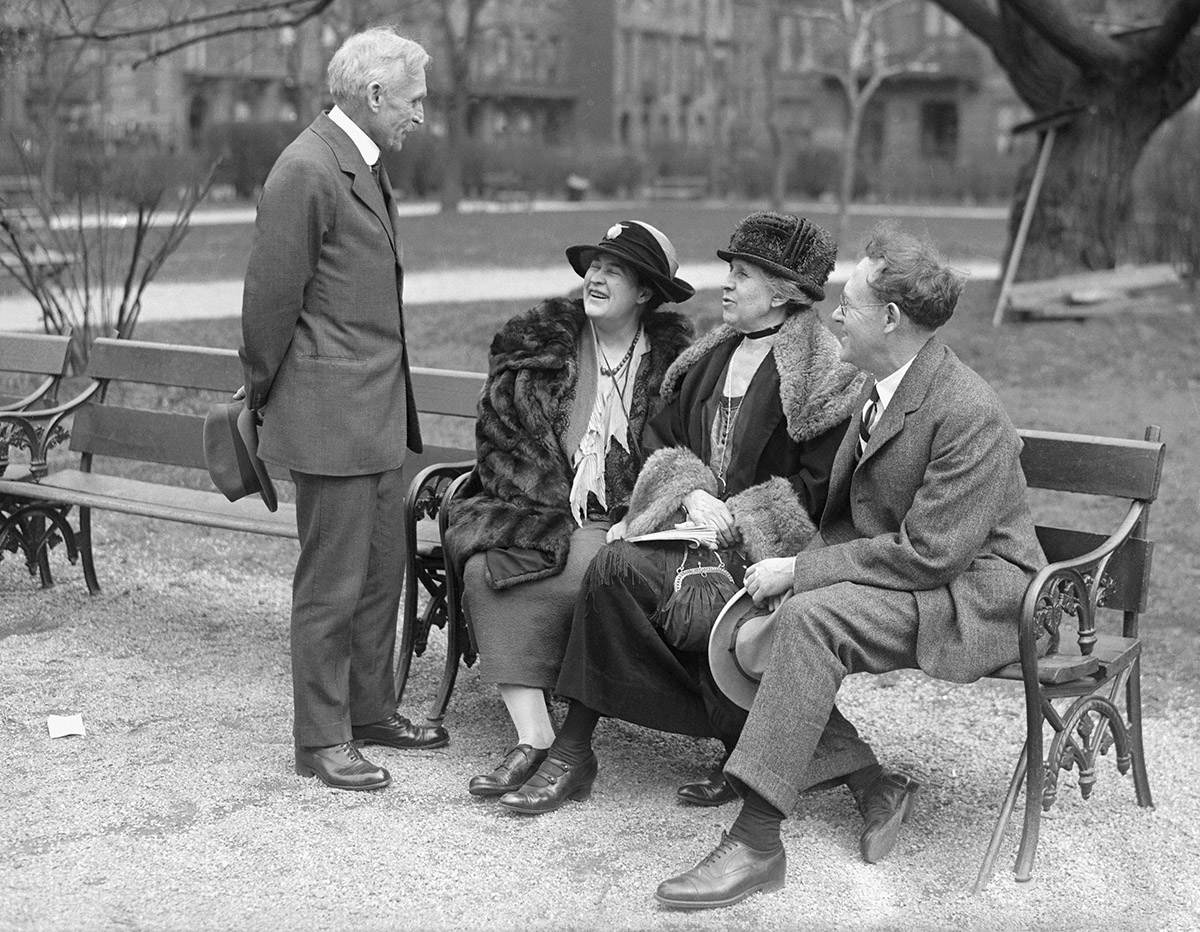
Publisher S. S. McClure (standing) in Washington Square Park during the fall of 1924 with three former contributors to McClure's Magazine: the novelist Willa Cather and muckraking journalists Ida M. Tarbell and Will Irwin. Scholars have speculated that McClure was hoping to convince them to contribute again to the magazine, which had been struggling to survive ever since Cather resigned as editor in 1911, the year McClure lost financial control of the firm because of his profligate spending. Tarbell is the only one of the three who submitted writing—a biography of Elbert Henry Gary, the founder of United States Steel—before the magazine folded in 1929. (Bettmann Archive / Getty Images)
Early in the second decade of the twentieth century, the pioneering journalist Ida M. Tarbell surprised her friends and colleagues when her name was listed as a member of the executive committee of the New York State Association Opposed to Woman Suffrage. Helen Keller, who at 32 was twenty years younger than Tarbell, was mortified, and she told friends that Tarbell was “getting too old to understand and sympathize with the aspirations of a growing world!” Jane Addams pithily commented, “There is some limitation to Ida Tarbell’s mind.” In 1912 John Sanborn Phillips, one of Tarbell’s closest friends and her editor at The American Magazine, asked her to clarify her “illiberal and contradictory” position. Her fourteen-page letter in response claimed that she was largely indifferent on the subject and explained that she believed that suffrage was a secondary goal—and a distraction. “Nothing but the slow processes of education will put an end to [war and poverty], and believing this, how can I fight for that which I believe will hamper the direct use of the tools which will do the work?” She concluded, “You will gather from this that the chief reason I am not interested in the extension of suffrage is because I feel that it is part of what seems to me the most dangerous fallacy of our times—and that is that we can be saved morally, economically, socially by laws and systems.”

As Susan Ware remarks in her headnote to this week’s selection, it’s something of a surprise, given this background, that the editors of Good Housekeeping asked Tarbell to comment on the success or failure of the Nineteenth Amendment a mere four years after its passage. In the article, Tarbell subtly restates some of her criticisms—she mocked the claim supposedly made by some suffragists that women, through their votes, would quickly “cure all our ills”—but her tone has changed to one of hope: a new conviction that the increased involvement of women in local elections and politics might well result in future social and economic change. The article was informed by her travels on the lecture circuit across the nation earlier that year. “These long rides, these night waits, brought unforgettable looks into human lives,” she wrote years later, always amazed by how much people were willing to tell her. “Strange how travelers will confide their ambitions, unload their secrets, and show their scars to strangers.”

Born and raised in western Pennsylvania, Ida Minerva Tarbell was one of the leading “muckrakers” of the era. During the 1890s, she became a reporter for McClure’s Magazine, which published her hugely popular serial biographies of Napoleon and Lincoln. At the turn of the century, she began work on the articles that brought her fame: an exposé on the unfair business methods employed by John D. Rockefeller and the Standard Oil Company, including the secret schemes that had brought ruin to dozens of smaller competitors, such as the firm owned by her father, who had been a producer and refiner when the first oil fields began appearing in Erie County in the 1860s. Based on the evidence from a mountain of documents—some of which Rockefeller believed had been destroyed—and interviews with company executives and government officials, the devastating series ran in nineteen consecutive issues of McClure’s and then appeared in 1904 as a book, The History of the Standard Oil Company. Her report led to both the Supreme Court decision that dissolved Standard Oil’s monopoly in 1911 and the Clayton Antitrust Act in 1914.

Sixteen years after Tarbell’s article on suffrage appeared in Good Housekeeping, the magazine’s editors asked another famous woman to write on the same theme for the twentieth anniversary of the Nineteenth Amendment. First Lady Eleanor Roosevelt responded to the request with a three-part article titled “Women in Politics,” in which she described the achievements of several of the many women in elected and appointed positions, most of which had previously been open only to men. Regarding suffrage itself, she acknowledged that she couldn’t prove the connection but “only one thing stands out—namely, that on the whole, during the last twenty years, government has been taking increasing cognizance of humanitarian questions, things that deal with the happiness of human beings, such as health, education, security.” Her conclusion to the article struck the same hopeful note and urged the same patience as did Tarbell’s article: “It will always take all kinds of women to make up a world, and only now and then will they unite their interests. When they do, I think it is safe to say that something historically important will happen.”

Notes: Kentucky novelist George Madden Martin (the pen name of Georgia May Madden Martin), author of the 1902 best-selling children’s book Emmy Lou, published the skeptical “American Women and Public Affairs” in the February 1924 issue of the Atlantic Monthly; Tarbell’s article is, in part, a response to it. Alfred E. Smith was a four-term New York governor who ran for president in 1928; William Gibbs McAdoo, Woodrow Wilson’s son-in-law, unsuccessfully ran for the Democratic nomination for president in 1920 and 1924. The Volstead Act provided enforcement procedures to carry out the Eighteenth Amendment, which prohibited the manufacture and sale of alcoholic beverages. Lincoln’s comments on the “bad laws” and “mob rule” were made in his 1838 Lyceum Address. The Teapot Dome Scandal involved the leasing of petroleum reserves in 1922 by Secretary of the Interior Albert Fall, who was later convicted of accepting bribes from oil companies. Alice Bentley served as a Republican member of the Pennsylvania House of Representatives from 1923 to 1928. Jeannette Rankin was elected to the U.S. House of Representatives in 1916 from Montana, becoming the first woman to serve in Congress. Alice Robertson was the second woman elected to Congress, winning election in 1920 as a Republican from Oklahoma but failing to win reelection in 1922. Cornelia Bryce Pinchot was a Progressive reformer married to Gifford Pinchot, the governor of Pennsylvania in 1922–26 and 1930–34.

*   *   *
One of several dismal refrains, more or less popular at the moment, celebrates the failure of woman’s suffrage. . . . If you don't see the full selection below, click here (PDF) or click here (Google Docs) to read it—free!

This selection may be photocopied and distributed for classroom or educational use.
Friday, August 12, 2016

The Enchanted Bluff

Willa Cather (1873–1947)
From Willa Cather: Stories, Poems, & Other Writings

“He led us into marshes and stubble fields.” Detail from illustration by Howard E. Smith, engraved by F. A. Pettit to accompany Cather’s story when it appeared in Harper’s Magazine. Click on the image to see the full illustration.
Willa Cather’s debut story collection, The Troll Garden, appeared in 1905 and attracted the attention of the editor S. S. McClure, who convinced her to move from Pittsburgh to New York City and work at his magazine. McClure was notoriously difficult to work for; the job was offered to her when much of the staff, including the popular writers Ida Tarbell and Lincoln Steffens, quit in protest and established a competing magazine. Nevertheless, Cather accepted the position and eventually became the managing editor. She moved into a Washington Square apartment building that was also home to Edith Lewis, whom she had met three years earlier in Nebraska, and the two women would live together until Cather’s death four decades later.

The years at McClure’s were both rewarding and grueling; she proved a perfect foil to her boss’s temperament and was even the ghostwriter of his 1914 autobiography. McClure admitted to his wife, “The best magazine executive I know is Miss Cather.” But the long hours made it difficult for Cather to attend to her career as an author. The novelist Sara Orne Jewett, an admirer of her first book, warned, “I cannot help saying what I think about your writing and its being hindered by such incessant, important, responsible work as you have in your hands now. I do think it is impossible for you to work so hard and yet have your gifts mature as they should. . . . Your vivid, exciting companionship in the office must not be your audience.”

Lewis, who left a job at another publisher to join Cather at McClure’s, described life at the magazine as “working in a high wind” in which magazine cofounder S. S. McClure was the “storm center.” In the 1953 memoir Willa Cather Living, she recalled that Cather managed to write and publish several short pieces of fiction but felt that none of them “reached the level of the best stories in The Troll Garden”—with one notable exception:
. . . in 1909 she wrote a brief sketch which she called “The Enchanted Bluff,” and sent it to Harper’s Magazine. This slight narrative, so unlike anything she had written heretofore, was like an excursion into the future, a tentative foreshadowing of what was to come. It was as if she had here stopped trying to make a story, and had let it make itself, out of instinctive memories, deep-rooted, forgotten things. It was almost like a song without words—so little was it written, so little was set down on the page; just the talk of some young boys around a camp fire at night; yet it was curiously impressive in its suggestion of an intense experience.
At the center of “The Enchanted Bluff” is the legend of the lost tribe of the Enchanted Mesa, the famous 430-foot-high sandstone butte in New Mexico. Like the boys in her story, Cather had been fascinated by the legend since she was a child but had never visited the region. Finally, in 1912, she and Lewis stayed in the Southwest for several months—and they would return again and again for many years. Cather would re-use the legend of the lost tribe in two of her novels: once in the “Tom Outland’s Story” section of The Professor’s House (1925) and again in Death Come for the Archbishop (1927).

Notes: The Divide mentioned on page 65 is the tableland in southern Nebraska between the Republican and Little Blue rivers. On pages 67–68 the boys share bits of knowledge culled from both classroom texts and popular children’s magazines, such as Golden Days for Boys and Girls. In 1492 Columbus observed during his voyage that the ship’s compass varied as compared to the position of the North Star and realized that this was due both the variation of magnetic north from true north and from the movement of the North Star relative to the surface of the earth. In addition, because of the precession of the earth’s axis, the star identified as the North Star has changed over the millennia. A number of sources posthumously claimed that Napoleon—a believer in signs and omens—told them he was guided to military glory by a lucky star.

*   *   *
We had our swim before sundown, and while we were cooking our supper the oblique rays of light made a dazzling glare on the white sand about us. . . . . If you don't see the full selection below, click here (PDF) or click here (Google Docs) to read it—free!

This selection may be photocopied and distributed for classroom or educational use.