From American Women’s Suffrage: Voices from the Long Struggle for the Vote 1776–1965
Interesting Links
National Women’s Hall of Fame: Ida Tarbell
For educators: Investigative Journalists: The Muckrakers (PBS NewsHour Classroom)
Previous Story of the Week selections
• “Flying—A Dream Come True!,” Ida M. Tarbell
• “Women in Politics,” Fannie Barrier Williams
• “A Half-Pint of Old Darling,” Wendell Berry
Buy the book
 American Women’s Suffrage: Voices from the Long Struggle for the Vote 1776–1965
761 pages
List price: $40.00
Web store price: $28.00
National Women’s Hall of Fame: Ida Tarbell
For educators: Investigative Journalists: The Muckrakers (PBS NewsHour Classroom)
Previous Story of the Week selections
• “Flying—A Dream Come True!,” Ida M. Tarbell
• “Women in Politics,” Fannie Barrier Williams
• “A Half-Pint of Old Darling,” Wendell Berry
Buy the book
American Women’s Suffrage: Voices from the Long Struggle for the Vote 1776–1965761 pages
List price: $40.00
Web store price: $28.00
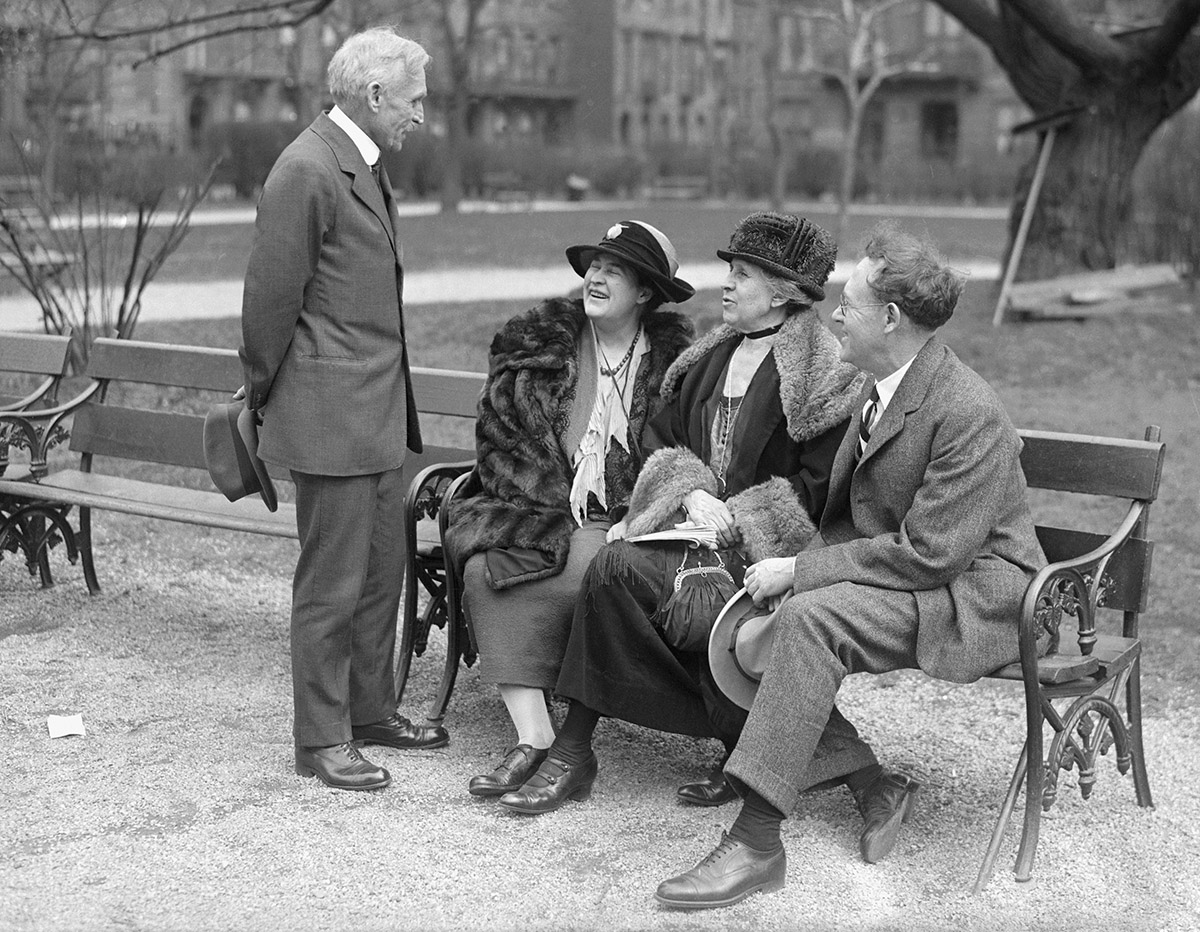 |
| Publisher S. S. McClure (standing) in Washington Square Park during the fall of 1924 with three former contributors to McClure's Magazine: the novelist Willa Cather and muckraking journalists Ida M. Tarbell and Will Irwin. Scholars have speculated that McClure was hoping to convince them to contribute again to the magazine, which had been struggling to survive ever since Cather resigned as editor in 1911, the year McClure lost financial control of the firm because of his profligate spending. Tarbell is the only one of the three who submitted writing—a biography of Elbert Henry Gary, the founder of United States Steel—before the magazine folded in 1929. (Bettmann Archive / Getty Images) |
As Susan Ware remarks in her headnote to this week’s selection, it’s something of a surprise, given this background, that the editors of Good Housekeeping asked Tarbell to comment on the success or failure of the Nineteenth Amendment a mere four years after its passage. In the article, Tarbell subtly restates some of her criticisms—she mocked the claim supposedly made by some suffragists that women, through their votes, would quickly “cure all our ills”—but her tone has changed to one of hope: a new conviction that the increased involvement of women in local elections and politics might well result in future social and economic change. The article was informed by her travels on the lecture circuit across the nation earlier that year. “These long rides, these night waits, brought unforgettable looks into human lives,” she wrote years later, always amazed by how much people were willing to tell her. “Strange how travelers will confide their ambitions, unload their secrets, and show their scars to strangers.”
Born and raised in western Pennsylvania, Ida Minerva Tarbell was one of the leading “muckrakers” of the era. During the 1890s, she became a reporter for McClure’s Magazine, which published her hugely popular serial biographies of Napoleon and Lincoln. At the turn of the century, she began work on the articles that brought her fame: an exposé on the unfair business methods employed by John D. Rockefeller and the Standard Oil Company, including the secret schemes that had brought ruin to dozens of smaller competitors, such as the firm owned by her father, who had been a producer and refiner when the first oil fields began appearing in Erie County in the 1860s. Based on the evidence from a mountain of documents—some of which Rockefeller believed had been destroyed—and interviews with company executives and government officials, the devastating series ran in nineteen consecutive issues of McClure’s and then appeared in 1904 as a book, The History of the Standard Oil Company. Her report led to both the Supreme Court decision that dissolved Standard Oil’s monopoly in 1911 and the Clayton Antitrust Act in 1914.
Sixteen years after Tarbell’s article on suffrage appeared in Good Housekeeping, the magazine’s editors asked another famous woman to write on the same theme for the twentieth anniversary of the Nineteenth Amendment. First Lady Eleanor Roosevelt responded to the request with a three-part article titled “Women in Politics,” in which she described the achievements of several of the many women in elected and appointed positions, most of which had previously been open only to men. Regarding suffrage itself, she acknowledged that she couldn’t prove the connection but “only one thing stands out—namely, that on the whole, during the last twenty years, government has been taking increasing cognizance of humanitarian questions, things that deal with the happiness of human beings, such as health, education, security.” Her conclusion to the article struck the same hopeful note and urged the same patience as did Tarbell’s article: “It will always take all kinds of women to make up a world, and only now and then will they unite their interests. When they do, I think it is safe to say that something historically important will happen.”
Notes: Kentucky novelist George Madden Martin (the pen name of Georgia May Madden Martin), author of the 1902 best-selling children’s book Emmy Lou, published the skeptical “American Women and Public Affairs” in the February 1924 issue of the Atlantic Monthly; Tarbell’s article is, in part, a response to it. Alfred E. Smith was a four-term New York governor who ran for president in 1928; William Gibbs McAdoo, Woodrow Wilson’s son-in-law, unsuccessfully ran for the Democratic nomination for president in 1920 and 1924. The Volstead Act provided enforcement procedures to carry out the Eighteenth Amendment, which prohibited the manufacture and sale of alcoholic beverages. Lincoln’s comments on the “bad laws” and “mob rule” were made in his 1838 Lyceum Address. The Teapot Dome Scandal involved the leasing of petroleum reserves in 1922 by Secretary of the Interior Albert Fall, who was later convicted of accepting bribes from oil companies. Alice Bentley served as a Republican member of the Pennsylvania House of Representatives from 1923 to 1928. Jeannette Rankin was elected to the U.S. House of Representatives in 1916 from Montana, becoming the first woman to serve in Congress. Alice Robertson was the second woman elected to Congress, winning election in 1920 as a Republican from Oklahoma but failing to win reelection in 1922. Cornelia Bryce Pinchot was a Progressive reformer married to Gifford Pinchot, the governor of Pennsylvania in 1922–26 and 1930–34.
* * *
One of several dismal refrains, more or less popular at the moment, celebrates the failure of woman’s suffrage. . . . If you don't see the full selection below, click here (PDF) or click here (Google Docs) to read it—free!This selection may be photocopied and distributed for classroom or educational use.

