Showing posts with label W.E.B. Du Bois. Show all posts

Sunday, June 7, 2026

Cornelius Johnson, Office-Seeker

Paul Laurence Dunbar (1872–1906)
From The American Short Story: The Nineteenth Century

The new bookstacks in the Thomas Jefferson building of the Library of Congress when it was completed in 1897, the year Paul Laurence Dunbar was hired as an assistant librarian. Photographer unknown. (Library of Congress)

Dunbar’s wife, Alice Dunbar-Nelson, later claimed that the shelving supplied him with the metaphor he used in “Sympathy,” his most famous poem: “The iron grating of the book stacks in the Library of Congress suggested to him the bars of the bird’s cage. June and July days are hot. . . . The torrid sun poured its rays down into the courtyard of the library and heated the iron grilling of the book stacks until they were like prison bars in more senses than one. The dry dust of the dry books (ironic incongruity!–a poet shut up with medical works), rasped sharply in his hot throat, and he understood how the bird felt when it beats its wings against its cage.”
“We are now in the throes of feverish delight over industrial education,” asserted Paul Laurence Dunbar. “It is a good thing, and yet one of which we can easily have too much.” He warned against “the danger we court of going to the other extreme of educating the hand to the exclusion of the needs of the head.” The essay, titled “Our New Madness,” appeared in the August 18, 1898, issue of The Independent, a political weekly based in New York, and Dunbar argued that the overemphasis on skilled training not only proceeded from principles of racial inequality but also reinforced them:
You say: “But we can’t all be doctors and lawyers and preachers.” No, to be sure not, but let some of us be; for we cannot all of us be carpenters, tinners, and bricklayers. There has been here, of late, too great an insistence upon manual training for the negro. . . .

At this late day the negro has no need to prove his manual efficiency. That was settled fifty years ago when he was the plantation blacksmith and carpenter and shoemaker. . . . [But] there has not, in the history of this country, risen a single intellectual black man whose pretensions have not been sneered at, laughed at, and then lamely wondered at. If he was fair of complexion, they said that he derived his powers from his white blood. If he was convincingly black, they felt of his bumps, measured his head, and said it was not negro in conformation.
Dunbar’s essay aimed its ire at Booker T. Washington and the Tuskegee Institute; he acknowledged “the efficiency of the work being done there” but he was concerned that Washington’s focus in his public speeches on “industrial education” had been used to support the idea “that we must not have anything else.”

As if to prove Dunbar’s point, the essayist Charles Dudley Warner, president of American Social Science Association, delivered the keynote speech at the group’s annual convention in May 1900. With the title “The Education of the Negro,” the essay argued for the reduction or elimination of financial support of higher education for Black Americans and the reallocation of the funds toward more basic schooling for skilled careers—and Warner cited Washington in support of the idea:
[Slavery] taught the negro to work, it transformed him, by compulsion it is true, into an industrial being, and held him in the habit of industry for several generations. Perhaps only force could do this, for it was a radical transformation. I am glad to see that this result of slavery is recognized by Mr. Booker Washington, the ablest and most clear-sighted leader the negro race has ever had. . . . On almost all the Southern plantations, and in the cities also, negro mechanics were bred, excellent blacksmiths, good carpenters, and house-builders capable of executing plans of high architectural merit. Everywhere were negroes skilled in trades, and competent in various mechanical industries. . . .

Among the witnesses to the failure of the result expected from the establishment of colleges and universities for the negro are heard, from time to time, and more frequently as time goes on, practical men from the North, railway men, manufacturers, who have initiated business enterprises at the South. . . . We have been disappointed in our extravagant expectations of what this education could do for a race undeveloped, and so wanting in certain elements of character, and that the millions of money devoted to it might have been much better applied.
Warner’s premise was that the “development of a race” is “a gigantic task, and generations may elapse before it can in any degree be relaxed”; his evidence, such as it was, consisted of his anecdotal observations about the Black population of New Orleans and the racial breakdown of prison camps.

Deriding the speech as “an essay founded upon observation of the South from a car window,” Dunbar published a response countering Warner’s arguments in The Philadelphia Times. “If the Negro has been crowded out of the many occupations by the more vigorous races, was it because of their vigor, or because of the prejudice which preferred the alien to the citizen? Was it the vigor of the foreign miners in Illinois that drove the negroes from their work, or the prejudice of a narrow people which allowed it?”

Dunbar’s criticisms of Washington and Warner echoed arguments voiced during the same period by W.E.B. Du Bois. For his part, Washington opted not to respond directly to either critic; instead, he made the strategically friendly suggestion to the two younger men that they share the stage one evening in Boston and, after a couple of postponed attempts, Washington, Du Bois, and Dunbar appeared together at Tuskegee’s fundraising event at the Hollis Street Theater in March 1899. Du Bois read one of his stories; Dunbar read several poems, and Washington delivered a version of his usual speech on racial uplift. By all accounts, it was a successful evening—although the two guests apparently upstaged their host, whose hoarse voice and obvious exhaustion undercut the aim of his pitch. Dunbar never abandoned his support for classical education, but the evening was one of a series of olive branches he and Washington extended to each other, leading Dunbar to write several positive articles about Tuskegee, a sonnet dedicated to Washington, and even a song that would eventually be published in celebration of the school’s twentieth anniversary. The differences between Washington and Du Bois, however, would deepen, culminating in the latter’s full-throated denunciation of the Tuskegee founder in The Souls of Black Folk.

When Dunbar published his initial criticism of Booker T. Washington, he was an assistant librarian at the Library of Congress, a job he had to relinquish at the end of 1898 because of various illnesses. While living in Washington, D.C., Dunbar observed and experienced the prejudices and obstacles arrayed against Black activists and leaders who had benefited from the very kind of liberal education Warner would have denied them. When his next story collection, The Strength of Gideon, appeared in 1900, he included alongside his popular dialect stories several tales about politics and race relations, including “A Council of State,” about a convention of African American political leaders; “The Tragedy at Three Forks,” focusing on a white girl who commits a crime for which two Black men are lynched; and our Story of the Week selection, “Cornelius Johnson, Office-Seeker,” a satirical tale targeting both certain politicians who take for granted the loyalty of Black voters and an overconfident Alabama job applicant who misguidedly places his trust in the patronage mill.

Notes: In John Bunyan’s allegorical work The Pilgrim’s Progress (1678), Vanity Fair is a bustling marketplace filled with worldly goods and pleasures, temptations and distractions.

*   *   *
It was a beautiful day in balmy May and the sun shone pleasantly on Mr. Cornelius Johnson’s very spruce Prince Albert suit of grey as he alighted from the train in Washington. . . . If you don't see the full selection below, click here (PDF) or click here (Google Docs) to read it—free!

This selection may be photocopied and distributed for classroom or educational use.
Sunday, June 9, 2024

An Army with Banners

James Weldon Johnson (1871–1938)
From Jim Crow: Voices from a Century of Struggle (Part One: 1876–1919)

Silent parade protesting the East St. Louis massacre and other recent atrocities, July 28, 1917. The procession, numbering between 10,000 and 15,000 men, women, and children, began at 57th Street and proceeded downtown to Madison Square at 23rd Street. The placard at front says, “The First Blood for American Independence Was Shed by a Negro | Crispus Attucks.” Photograph by Underwood & Underwood, NY. Image from the Library of Congress.
On the morning of Monday, July 2, 1917, Daisy O. Westbrook, a teacher of music at Lincoln High School in East St. Louis, Illinois, was at home with her sister, mother, grandmother, and a baby they had adopted. In a letter to her friend, Louise Madella, she described the horrors of that day:
Louise, it was awful. I hardly know where to begin telling you about it. First I will say we lost everything but what we had on and that was very little—bungalow aprons, no hats, and sister did not have on any shoes.

It started early in the afternoon. We kept receiving calls over the ’phone to pack our trunks & leave, because it was going to be awful at night. We did not heed the calls, but sent grandma & the baby on to St. Louis, & said we would “stick” no matter what happened. At first, when the fire started, we stood on Broadway & watched it. As they neared our house we went in & went to the basement. It was too late to run then. They shot & yelled some thing awful, finally they reached our house. . . .
All over the city, mobs of white residents were attacking, beating, and killing Black men, women, and children, and torching their homes and public buildings, while the city police and National Guardsmen stood by or, in numerous instances, joined the crowd. “Instead of being guardians of the peace they became a part of the mob by countenancing the assaulting and shooting down of defenseless negroes and adding to the terrifying scenes of rapine and slaughter,” reported the House Select Committee created that year to investigate the massacre.

One group reached the Westbrook home but left because they initially thought that “white people lived in that house.” Twenty minutes later, however, they returned, apparently having learned otherwise.
When they were about to surround the house & burn it, we heard an awful noise & thought probably they were dynamiting the house. (The Broadway Theatre fell in, we learned later.) Sister tipped to the door to see if the house was on fire. She saw the reflection of a soldier on the front door—pulled it open quickly & called for help. All of us ran out then, & was taken to the city hall for the night—(just as we were). The next morning, we learned our house was not burned, so we tried to get protection to go out & get clothes, & have the rest of the things put in storage. We could not, but were sent on to St. Louis.

On Tuesday evening at 6 o'clock our house was burned with two soldiers on guard. So the papers stated. We were told that they looted the house before burning it. We are in St. Louis now trying to start all over again. Louise it is so hard to think we had just gotten to the place where we could take care of our mother & grandmother well, & to think, all was destroyed in one night.
The day after the massacre, journalist Carlos F. Hurd began his front-page report for the St. Louis Post-Dispatch as follows:
I have read of St. Bartholomew’s night. I have heard stories of the latter-day crimes of the Turks in Armenia, and I have learned to loathe the German army for its barbarity in Belgium. But I do not believe that Moslem fanaticism or Prussian frightfulness could perpetrate murders of more deliberate brutality than those which I saw committed, in daylight, by citizens of the State of Abraham Lincoln.

I saw man after man, with hands raised, pleading for his life, surrounded by groups of men—men who had never seen him before and knew nothing about him except that he was black—and saw them administer the historic sentence of intolerance, death by stoning. . . .
During the previous decade, thousands of Black workers had migrated from southern states to jobs at the steel and iron factories in East St. Louis, where production had rapidly increased because of the war in Europe. In the mid-1910s, there had been frequent labor disputes and strikes in the city. “In nearly every case the employers had refused the demands of the strikers and had put Negroes in their places,” wrote Hallie E. Queen, a journalist on the staff of Howard University who traveled to the city after the massacre and wrote a report for Illinois senator William Yates Sherman. “The owner of a certain Aluminum Plant testified that in order to prevent strikes he had maintained his business on a principle of hate. He employs one third white Americans, one third Negroes and one third foreigners, knowing that each group hates the other so heartily that they will never combine against the shop.” The congressional committee cataloged evidence that city and business leaders had deliberately fueled the antagonisms between the groups.

On May 28, 1917, after a tumultuous labor meeting at City Hall, as many as three thousand white men streamed into the downtown area and began randomly beating African American men. “The mob stopped street cars and interurban cars in its search, and at 1 o’clock was threatening to storm the jail, where a score of negroes had been taken for safekeeping,” according to a report published in The New York Times the following day. Although several men were seriously injured, no fatalities were reported, and the National Guard was able to restore order by the following morning. Tensions during the following month were exacerbated by occasional altercations and outlandish rumors—including the ludicrous idea that Black workers had planned an Independence Day massacre of the white residents who outnumbered them seven-to-one. On July 1 a group of white men in a Ford Model T drove through the Black areas of town, shooting into homes and at people on the street. When residents defending the neighborhood shot at a second car of the same model, they inadvertently killed two white plainclothes detectives. The massacre occurred the following day.

“It is not possible to give accurately the number of dead,” concluded the congressional committee report. “At least 39 negroes and 8 white people were killed outright, and hundreds of negroes were wounded and maimed.” The fatality counts, however, were based largely on the reports from the coroner’s office. “It is impossible to say,” the report added, “how many people perished in the 312 houses that were burned by the mob, but many negroes who lived in those houses still are missing and it is not possible to get an accurate report as to just how many found death in the flames.” Anyone who attempted to escape was either shot at, beaten, or—in some cases—thrown back into the conflagration. Among the list of uncounted deaths reported by the congressional select committee: “A negro child 2 years old was shot and thrown into the doorway of a burning building, and nothing ever was found of the remains.”

Only three months earlier, the United States had declared war on Germany. “In the name of world democracy we land black soldiers in France to fight for our white allies, while white soldiers in East St. Louis kill black Americans for daring to compete in the world of labor with their white fellowmen,” wrote W.E.B. Du Bois in the next issue of The Crisis, the magazine of the NAACP. James Weldon Johnson, who was the field secretary of the organization, worked with other civil leaders to organize a protest in New York on July 28, and he described the Silent Protest Parade in an article for the weekly newspaper The New York Age.

Notes: The letter by Daisy O. Westbrook and the report by Hallie E. Queen both were discovered in 1972 among Senator Sherman’s papers and published by Robert Asher in “Documents of the Race Riot at East St. Louis,” Journal of the Illinois State Historical Society, from which the above excerpts are taken. Westbrook returned to East St. Louis and resumed her position as a director of music at Lincoln High School, where she taught for at least another four decades. Miles Davis was among several notable students in the program during her tenure. She died in 1970.

*   *   *
For this week’s selection, we depart from the usual format and reproduce the selection, in its entirety, below.
You may also download it as a PDF or view it in Google Docs.

An Army with Banners

Last Saturday the silent protest parade came off, and it was a greater success than even the committee had dared to hope it would be. Some of the New York papers estimated the number of marchers in line as high as fifteen thousand. It was indeed a mighty host, an army with banners.

No written word can convey to those who did not see it the solemn impressiveness of the whole affair. The effect could be plainly seen on the faces of the thousands of spectators that crowded along the line of march. There were no jeers, no jests, not even were there indulgent smiles; the faces of the onlookers betrayed emotions from sympathetic interest to absolute pain. Many persons of the opposite race were seen to brush a tear from their eyes. It seemed that many of these people were having brought home to them for the first time the terrible truths about race prejudice and oppression.

The power of the parade consisted in its being not a mere argument in words, but a demonstration to the sight. Here were thousands of orderly, well- behaved, clean, sober, earnest people marching in a quiet, dignified manner, declaring to New York and to the country that their brothers and sisters, people just like them, had been massacred by scores in East St. Louis for no other offense than seeking to earn an honest living; that their brothers and sisters, people just like them, were “Jim Crowed” and segregated and disfranchised and oppressed and lynched and burned alive in this the greatest republic in the world, the great leader in the fight for democracy and humanity.

The impact of this demonstration upon New York city was tremendous. And it is not strange that it was so. More than twelve thousand of us marching along the greatest street in the world, marching solemnly to no other music than the beat of muffled drums, bearing aloft our banners on which were inscribed not only what we have suffered in this country, but what we have accomplished for this country, this was a sight as has never before been seen.

But, after all, the effect on the spectators was not wholly in what they saw, it was largely in the spirit that went out from the marchers and overpowered all who came within its radius. There was no holiday air about this parade. Every man, woman and child that took part seemed to feel what it meant to the race. Even the little six year old tots that led the line seemed to realize the full significance of what was being done. And so it was that these thousands and thousands moving quietly and steadily along created a feeling very close to religious awe.
*   *   *

When the head of the procession paused at 30th Street I looked back and saw the long line of women in white still mounting the crest of Murray Hill, the men’s column not yet in sight; and a great sob came up in my throat and in my heart a great yearning for all these people, my people, from the helpless little children just at my hand back to the strong men bringing up the rear, whom I could not even see. I turned to Dr. Du Bois at my side and said, “Look!” He looked, and neither of us could tell the other what he felt.

It was a great day. An unforgettable day in the history of the race and in the history of New York City.

First published in The New York Age, August 2, 1917.

Sunday, January 16, 2022

The Experts

W.E.B. Du Bois (1868–1963)
From W.E.B. Du Bois: Black Reconstruction

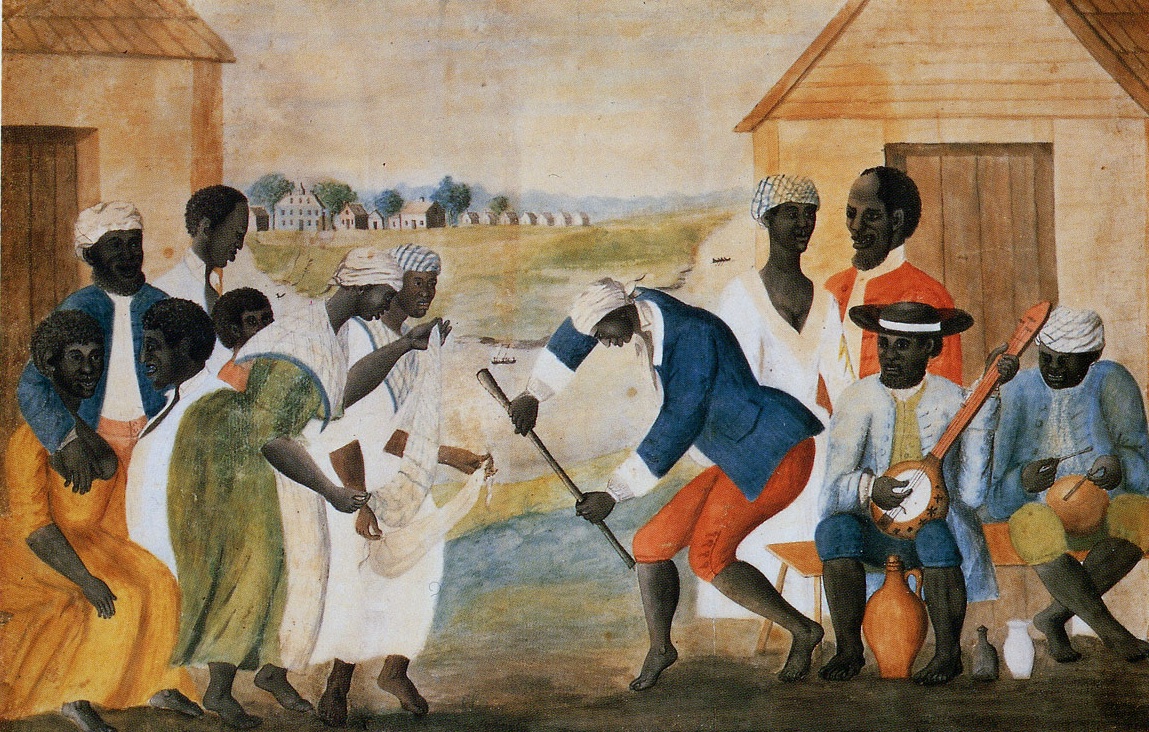
“The Old Plantation,” c. 1780s, artist unknown. Wikimedia Commons. Virginia: History, Government, Geography, the statewide history textbook for middle schools from 1957 to 1970, reprinted this piece of folk art with the caption, “When the day’s work was over, the plantation Negroes enjoyed themselves.” The accompanying text read, “The amusements of the adult slaves were very much like the amusements of the masters. The white people danced to the music of fiddles in ballrooms lighted by many candles. And the Negroes in the nearby slave quarters danced by the light of pine flares to the twang of the banjoes.”
A few years ago, the historians Blain Roberts and Ethan J. Kytle wrote in The New York Times about a disconcerting resurgence among prominent Americans of the belief that slavery was a largely benign institution, one of bonhomie between plantation owners and the people they enslaved. This “romanticized interpretation of slavery [is] indebted to a book published 100 years ago,” the authors point out. “In the spring of 1918, the historian Ulrich Bonnell Phillips published his seminal study, American Negro Slavery, which framed the institution as a benevolent labor agreement between indulgent masters and happy slaves. No other book, no monument, no movie—save, perhaps, for Gone with the Wind, itself beholden to Phillips’s work—has been more influential in shaping how many Americans have viewed slavery.”

When it first appeared, Phillips’s book was widely praised by white historians and critics, but it was excoriated by African American scholars—chief among them W.E.B. Du Bois, who pulled few punches in a review published by the genteelly academic American Political Science Review:
[Phillips] has made wide use of southern newspapers and pamphlets and some manuscript materials, but had done little with any Negro sources, most of which he regards as “of dubious value.” . . . This intrigues the reader, for a history of slavery would ordinarily deal largely with slaves and their point of view, while this book deals chiefly with the economics of slaveholders and is without exception from their point of view. . . .

Life among Negro slaves “promoted, and wellnigh necessitated the blending of foresight and firmness with kindliness and patience.” In fact the slave system was “analogous in kind and in consequence to the domestication of the beasts of the held.” With such masters, Mr. Phillips finds the treatment of slaves on the whole excellent. He notes the “interest of the master in the future of his workers.” The surviving vestiges of slave quarters prove how comfortably they were housed. . . .

It is a defense of American slavery—a defense of an institution which was at best a mistake and at worst a crime—made in a day when we need sharp and implacable judgment against collective wrongdoing by cultured and courteous men.
More recently, John David Smith, an expert on Phillips and his influence on historians, notes that “American Negro Slavery contained a virtual catalog of what even in Phillips’s day must have been considered derogatory remarks concerning blacks. Insensitive to Negroes as humans, he portrayed them as ‘impulsive and inconstant, sociable and amorous, voluble, dilatory, and negligent, but robust, amiable, obedient and contented.’”

Born and raised in Georgia, Phillips received his doctorate at Columbia University in 1902. He was one of numerous young men who studied nineteenth-century American history under William Archibald Dunning. “Southern graduate students like Phillips found Dunning’s seminar congenial to their social philosophies and racial attitudes,” notes Smith. In the same manner that the “Dunning School” warped Americans’ views of the Reconstruction era, so too would the “Phillips School” recast public opinion on the realities of slavery. As the historian John Blassingame acknowledged six years after he published his influential book, The Slave Community (1972), “The ghost of U. B. Phillips haunts all of us. Nineteenth-century racism haunts all of us.”

The book review was not the first time Du Bois criticized Phillips—nor would it be the last. Five years earlier, in 1913, he published a short comment under the title “The Experts” in the pages of the NAACP’s journal The Crisis, a magazine he edited. Freed from the constraints of writing for a scholarly journal, Du Bois let loose with devastating mockery of the reasoning in Phillips’s analysis of “Negro efficiency.” Du Bois’s target in these attacks, Smith argues, was not only Phillips’s rose-colored view of slavery but also at “what the Georgian represented—Jim Crowism, racism, and proscription.” Biographer David Levering Lewis notes how Du Bois’s criticisms “anticipated ‘The Propaganda of History,’ his jeremiad at the end of Black Reconstruction,” which challenged Dunning and his students for their omission of Black voices in their revisionist history of the postbellum American South. “One fact and one alone explains the attitude of most recent writers toward Reconstruction,” Du Bois wrote in the book. “They cannot conceive Negroes as men.”

Notes: Mississippi lawyer, public official, cotton planter, and author Alfred Holt Stone defended slavery as it had existed in the antebellum South and the plantation system; he published his racist and pro-segregation views in books such as Studies in the American Race Problem (1910). Massachusetts-born William H. Baldwin Jr. was president of the Long Island Rail Road until his death in 1905; he was actively involved in efforts to educate African Americans, including serving as a trustee at the Tuskegee Institute.

“The Experts” is reprinted in the just-published Library of America edition of Black Reconstruction, in an appendix of related essays by Du Bois.

*   *   *
For this week’s selection, we depart from the usual format and reproduce the selection, in its entirety, below.


The Experts

For deep insight and superb brain power commend us to Dr. Ulrich B. Phillips, of the University of Michigan.

Phillips is white and Southern, but he has a Northern job and he knows all about the Negro. He has recently been talking to the students of the University of Virginia, and he disclosed some powerful reasoning faculties. Consider this, for instance:

“To compare Negro efficiency in cotton production before and since the war, it is necessary to select districts where no great economic change has occurred except the abolition of slavery—where there has been no large introduction of commercial fertilizers, for example, and no great ravages by the bollweevil. A typical area for our purpose is the Yazoo delta in Northwestern Mississippi. In four typical counties there—Tunica, Coahoma, Bolivar and Issaquena—in which the Negro population numbers about 90 per cent. of the whole, the per capita output of cotton in 1860 was two and one-third bales of 500 pounds each, while in 1910 and other average recent years it was only one and one-half bales per capita. That is to say, the efficiency of the Negroes has declined 35 per cent. A great number of other black-belt counties indicate a similar decline.

“On the other hand, the white districts throughout the cotton belt, and especially in Texas, Oklahoma and Western Arkansas, have so greatly increased their cotton output that more than half of the American cotton crop is now clearly produced by white labor. Other data of wide variety confirm this view of Negro industrial decadence and white industrial progress.”

We are delighted to learn all this, for in the dark days of our college economics we were taught that it was labor and land, together, that made a crop; and that worn-out land and good labor would make an even poorer crop than rich land and poor labor. It seems that we were grievously in error. This is apparently true only of white labor. If you wish to judge white labor, judge it by the results on rich Texas and Oklahoma prairies, with fertilizers and modern methods; if, on the other hand, you would judge Negro labor, slink into the slavery-cursed Mississippi bottoms where the soil has been raped for a century; and be careful even there; pick out counties where there has been “no large introduction of commercial fertilizers,” and where debt peonage is firmly planted under the benevolent guardianship of Alfred H. Stone and his kind. Then, rolling your eyes and lifting protesting hands, point out that, whereas the slave drivers of 1860 wrung 1,200 pounds of cotton from the protesting earth, the lazy blacks are able (“with no large introduction of commercial fertilizers”) to get but 700 pounds for their present white masters. Hence a decline in efficiency of “35 per cent.” Why, pray, 35 per cent.? Why not 50 or 75 per cent.? And why again are these particular counties so attractive to this expert? Is it because Issaquena County, for instance, spends $1 a year to educate each colored child enrolled in its schools, and enrolls about half its black children in schools of three months’ duration or less?

Astute? Why, we confidently expect to see Phillips at the head of the Department of Agriculture if he keeps on at this rapid rate. Not that it takes brains to head our Department of Agriculture (perish the assumption!), but that it does call for adroitness in bolstering up bad cases.

And the bad case which the South is bolstering to-day must make the gods scream. Take this same State of Mississippi, for instance, where Negroes are so futile and inefficient: the property which they own and rent was worth $86,000,000 in 1900. In 1910 it was worth $187,000,000!

“That, of course,” says the Manufacturers’ Record, of Baltimore, being strong put to it to nullify such ugly figures, “is a merely flat statement and takes no account of the character of the holdings, whether burdened with mortgages or otherwise, and no account of what is being done with the holdings, especially land.”

And then this masterly sheet bewails the fact that “Intrusion, in the guise of special care for the Negroes, of influences bitterly hostile to the whites of the South, loosened the ties of sympathy and interest of the Southern whites and the Negroes and alienated the second generation of both races from each other. In that the Negroes lost much of the advantages their fathers had had in close contact with the directing minds of the South, and the results must be considered in studying Negro progress.”

The late William H. Baldwin, Jr., used to affirm that a few more generations of that “close contact with the directing minds of the South” would have left the whole South mulatto! But the Record ends with this master stroke:

“Another point to be borne in mind in measuring progress is the fact that the property of nearly 12,000,000 Negroes in the United States to-day has a value less than half the value that 3,954,000 of them in slavery, or 90 per cent. of their total number in the country, represented in 1860, at an average value of $600 each.”

Frankly, can you beat that?

Originally published in the March 1913 issue of The Crisis.

Sunday, June 14, 2020

The Souls of White Folk

W.E.B. Du Bois (1868–1963)
From W.E.B. Du Bois: Writings

Handwritten draft of “The Souls of White Folk,” which was published in The Independent, August 18, 1910. Image from W.E.B. Du Bois Papers / UMass Amherst.
“The race problem is not insoluble if the correct answer is sought,” W.E.B. Du Bois wrote in the original version of “The Souls of White Folks” in 1910. “lt is insoluble if the wrong answer is insisted upon, as it has been insisted upon for thrice a hundred years.”

The year proved to be a consequential one for Du Bois’s future. The National Association for the Advancement of Colored People was established in May, with Du Bois as the only African American on its thirty-member board of directors. He resigned from his position as a professor at Atlanta University and moved to New York City to serve both as the organization’s Director of Publications and Research and as the founding editor of its monthly magazine, The Crisis. The first issue had a circulation of 1,000, four years later the base had grown to 35,000, and by the end of the decade some issues were selling in excess of 100,000 copies. Its success insured his editorial independence and control, and for twenty-five years the NAACP’s board meetings were dominated by clashes with conservative trustees over Du Bois’s political opinions and his management of the magazine, which was effectively the public face of the association.

“The Souls of White Folk,” a coda of sorts to Du Bois’s famous collection The Souls of Black Folk, appeared in an issue of the weekly political magazine The Independent soon after his arrival in New York. The brief essay was, in part, a rumination on how whiteness was a historically recent concept and how the principles espoused by the adherents of this “new religion” had infected politics, science, and theology. Du Bois was particularly appalled by the misuse of “scientific” theories to justify white supremacy. The following year he gave a speech at the Universal Races Congress in London, a gathering of scholars and scientists devoted to the goal of promoting racial harmony and combating racism in academia. Again writing for The Independent, Du Bois reported that “the one thing that this congress could do of inestimable importance [would be to] make clear the present state of scientific knowledge concerning the meaning of the term ‘race.’” The assumptions supporting the idea of white supremacy “have become the scientific sanction for widespread and decisive political action,” and he prophetically warned the attendees of the consequences of such beliefs.

As the decade progressed, Du Bois worried increasingly that the battle was being lost on several fronts; his “already grim state of mind verged on apocalyptic bitterness,” as biographer David Levering Lewis puts it. In 1915 he took an active role in the NAACP’s unsuccessful campaign against the film The Birth of the Nation for its derisive depictions of African Americans and glorification of the Ku Klux Klan. He was concerned about the popularity of such books as The Passing of the Great Race, or the Racial Basis of European History (1916), a best seller by the zoologist Madison Grant, who espoused pseudoscientific theories on the superiority of Europeans and claimed that white people were heading toward “racial suicide” and domination by “inferior” races.

Then, in 1917, Du Bois decided that participation in America’s war effort was crucial to future political and economic gains and asked Crisis readers to “forget our special grievances and close our ranks shoulder to shoulder with our own white fellow citizens and the allied nations that are fighting for democracy.” He campaigned for the establishment of training camps for black army officers and urged men to work in war industries if they were barred from military service. After the war, however, black laborers and returning soldiers endured a series of violent disturbances, lynchings, and massacres that culminated in the “Red Summer” of 1919, including four days of riots and destruction of African American businesses in Washington, D.C., with 15 deaths and 150 wounded; thirteen days of mob violence and bombings in Chicago, during which 38 people were killed and more than 500 injured; and the Elaine Massacre in rural Arkansas, where hundreds of African Americans were murdered.

At the beginning of 1918, Du Bois began gathering material for his next book. One of the pieces he dusted off was “The Souls of White Folks,” which he overhauled and expanded, incorporating passages from an essay he had published the previous year in The Journal of Race Development, an academic publication on international relations. In the autobiographical essay that opened the new collection, he revealed that he finished the book, Darkwater: Voices from Within the Veil, on his fiftieth birthday, February 23, 1918. It already had a publisher, but during the next two years, as the war ended and the United States seemed to be coming apart at the seams, the book was delayed while he tinkered with several of the pieces. To “The Souls of White Folks” he added postwar comments about the “orgy” of homeland violence against black citizens, about “the American crusade to make the ‘World Safe for Democracy’” that he had supported three years earlier, and about the Great War itself. We present this version of his essay, which appeared in 1920, as our Story of the Week selection.

Notes: Du Bois makes a series of passing references to contemporary incidents that would have been known to his readers. From May to July in 1917 white mobs in East St. Louis, Illinois, often abetted by police and state militia, rioted, killing at least 50 black residents and leaving approximately 6,000 homeless. In May 1917 Ell Persons, a black man accused of the murder of a white girl, was taken from deputies by a mob and burned at the stake before a crowd of thousands in Memphis. In Waco, Texas, in May 1916, Jesse Washington, convicted of murdering a white woman, was taken from the courtroom by a mob, tortured, and lynched. In Estill Springs, Tennessee, on February 8, 1918, Jim McIlherron was assaulted by three white men and shot them, killing two. A black clergyman who helped him escape was killed by a mob. McIlherron was later captured, tortured, and burned alive.

E. J. Glave served with Sir Henry Morton Stanley in Africa and wrote In Savage Africa, Or, Six Years of Adventure in Congo-Land (1892). John Hobbis Harris wrote several books on Africa, including Down in Darkest Africa (1912) and Africa: Slave or Free (1919). Askia Muhammad I was the third ruler of Songhai, largest of the empires of West Africa in the fifteenth and sixteenth centuries; Sonni Ali became Songhai’s first king in 1464.

*   *   *
High in the tower, where I sit above the loud complaining of the human sea, I know many souls that toss and whirl and pass, but none there are that intrigue me more than the Souls of White Folk. . . . If you don't see the full selection below, click here (PDF) or click here (Google Docs) to read it—free!

This selection may be photocopied and distributed for classroom or educational use. Teachers: Note that in his condemnation of bigotry in all its forms, Du Bois mentions several ethnic and racist slurs, including the n-word.