Showing posts with label Nancy Hale. Show all posts

Sunday, April 30, 2023

The Bubble

Nancy Hale (1908–1988)
From Where the Light Falls: Selected Stories of Nancy Hale

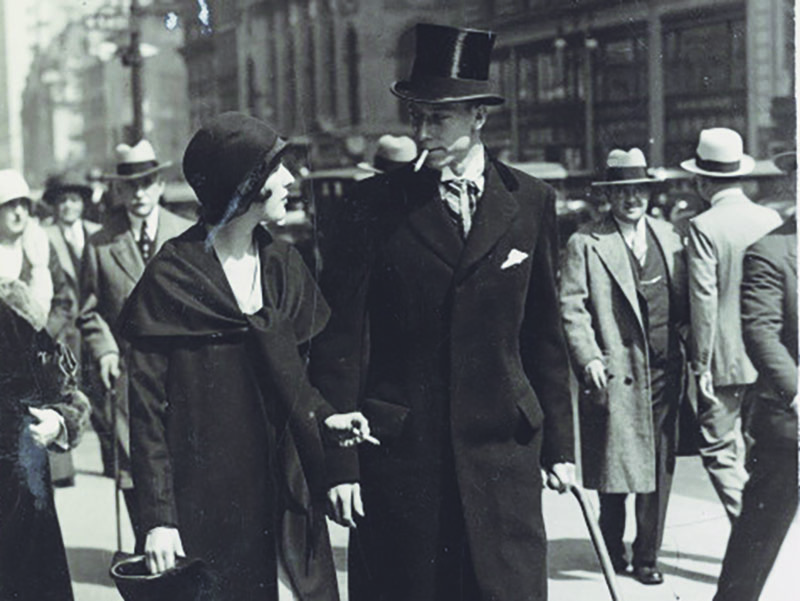
Nancy Hale and Taylor Scott Hardin at the Easter Day Parade, Fifth Avenue, New York, 1929. (Library of Congress, via the Trinity College website).
During the late 1920s, the American Tobacco Company struggled to expand the market for cigarettes among women; much of society still frowned upon women who smoked in public. “Damn it, if they spend half the time outdoors and we can get ’em to smoke outdoors, we'll damn near double our female market,” grumbled CEO George Washington Hill, who hired Edward Bernays to come up with a campaign to break down the lingering social barriers. Bernays convinced Ruth Hale—a prominent feminist and journalist and a member (with her husband Heywood Broun) of the legendary Algonquin Round Table—to help coordinate a publicity stunt disguised as a protest that presented cigarette smoking as a matter of equal rights. Bernays then hired ten young women to participate in New York’s Easter Sunday Parade of 1929 while holding “torches of freedom” in their hands, and Hale urged women to join the group to eliminate another “sex taboo.”

One of the hired models was eighteen-year-old Nancy Hale (no relation to Ruth), the only child of two prominent, bohemian artists from families whose ancestry included Harriet Beecher Stowe and Edward Everett Hale. She admitted to her mother that she was in it for the money: $10 for agreeing to be photographed and, later, “$100 for signing my name to some sort of letter they are going to send to the editors of magazines asking them to give the idea of smoking on the street publicity. . . . Pretty soft way to make money, isn’t it?” She had married Taylor Scott Hardin months earlier, and the newlyweds were photographed strolling down Fifth Avenue, cigarettes—er, torches of freedoms—in their hands.

In the introduction to Library of America’s reissue of Nancy Hale’s third novel, The Prodigal Women, Kate Bolick details Bernays’s cynical ploy and remarks, “It was precisely this sort of contradiction—the gap between what liberation looks like and what it actually is—that Hale often mined in her fiction.” Or, as her granddaughter Norah Hardin Lind writes, “She exposed the requirements for change of the era’s women and the conflicts inherent in expressing those goals.” Hale’s depictions of those conflicts and contradictions clearly appealed to women—and men—working on the home front during World War II; The Prodigal Women would end up on The New York Times Best Sellers list for 23 weeks during late fall and winter of 1942–43.

When asked by a New York Times reporter at the time why she “specialized in analyzing women” in her fiction, Hale responded drily, “That's quite interesting, because I suppose that I have specialized in women. . . . I feel that I know men quite thoroughly, that I know how, in a given situation, a man is apt to react. But women puzzle me.” She revisited this theme later in the interview:
Women’s fears are really terribly interesting. They are changing. They used to be so afraid of being run over or having a baby, and now that they are out in the world, going about on their own so much, some of the old fears are dying out and new ones are taking their places. . . . Perhaps the dominant fear now is the fear of being afraid, which probably means that they are moving farther toward maturity.
Less than a year after the Torches of Freedom stunt, Nancy Hale gave birth in Virginia to her first son; during her pregnancy, she stayed with her mother-in-law, and she adapted this experience for two of her more notable short stories. “To the Invader” (1933), which won the first of her ten O. Henry Awards, describes the geographical clash in attitudes when the narrator accompanies her husband to Virginia, with its “army of semi-tropic mothers,” and endures the old-fashioned judgments, duplicitous solicitude, and barely disguised hostility of his relatives. When her mother-in-law asks if she is expecting, the young woman answers that she is pregnant, in response to which “Mrs. Augustine coughed. That meant the word wasn’t a nice one.” Her hosts recall the only other time a Northern woman married into the family, two decades earlier; she walked the local roads alone at night and “was always off consortin’ with her Bohemian friends,” even after she gave birth to her son, and so they decided “she was, well, not quite sane” and had her committed to an asylum.

The second story, “The Bubble” (1954), revisits a similar scenario from an entirely different angle, when a young woman stays (by choice, this time) with her mother-in-law in Washington during the final months of her pregnancy, in order to get away from the heady excitement of New York—and, not incidentally, to avoid letting her friends see her less-than-svelte condition. The story pits “treasured bonds of marriage and motherhood against the era’s youthful hedonism,” writes Lind, and we present it below as our Story of the Week selection.

*   *   *
Now when Eric was born in Washington, D.C., I was eighteen, and most people thought I was too young to be having a baby. . . . If you don't see the full selection below, click here (PDF) or click here (Google Docs) to read it—free!

This selection is used by permission.
To photocopy and distribute this selection for classroom use, please contact the Copyright Clearance Center.

Sunday, May 3, 2020

Those Are as Brothers

Nancy Hale (1908–1988)
From Where the Light Falls: Selected Stories of Nancy Hale

Detail from Strange Worlds, 1928, oil on canvas by American artist Todros Geller (1889–1949), a Ukrainian immigrant whose work often focused on the intersection of Jewish tradition with American life. See the full image at the Art Institute of Chicago website.
Five years ago, Lauren Groff’s “At the Round Earth’s Imagined Corners” was selected for inclusion in the anthology 100 Years of The Best American Short Stories, edited by Lorrie Moore and Heidi Pitlor. The volume gathered forty works from the two thousand published during the previous century in the annual editions of The Best American Short Stories. After she received her copy of the book, Groff was reading through it and, she says, “I was stopped short by the wickedly smart Nancy Hale’s story, ‘Those Are as Brothers.’ That night, I went into the archives of The New Yorker, where Hale had published over one hundred short stories in her lifetime. . . . I became a convert.”

Three years later, when Library of America editors were contemplating the publication of an anthology of Hale’s stories, managing editor John Kulka, contacted Groff and, unaware of her late-night conversion as a Hale devotee, asked her if she might be interested in helping out with the volume. She immediately signed on as its editor, and the resulting collection, Where the Light Falls, appeared last fall to advance fanfare and considerable acclaim. The enthusiasm among book dealers was such that the first printing sold out before the publication date. Showcasing twenty-five of Hale’s nearly two hundred stories (ten of which won O. Henry Awards), the book finally brought a largely forgotten author back to the attention of the reading public.

In the introduction to Where the Light Falls, Groff wonders, “Over these months of living with Hale's voice in my head, I have asked myself over and over how we could have turned our eyes from her.” When interviewed for All Things Considered, Kulka was unable to pinpoint why Hale’s literary contribution had been neglected: “Did the stories fall out of favor? Did she lack a publisher who was willing to do enough for her? Or was it just that there wasn't at the time, the same kind of interest in literary fiction by women writers? It is hard to say, but I suspect it is some combination.”

When Hale’s name has appeared in print during the last thirty years, it is usually in passing reference to her blockbuster 1942 novel, The Prodigal Women (now out of print), or her much-lauded biography of the painter Mary Cassatt. In addition, “Those Are as Brothers”—the story that first caught Groff’s attention—will occasionally be found in lists of stories about the Holocaust. Published in May 1941, it is an early entry in that literature, written months before Hermann Göring ordered preparations for the “Final Solution”—before the already-lethal concentration camps truly became death camps. Hale’s story is set four thousand miles away from Germany, however, in a Connecticut suburb, where the memory of those camps haunts a Jewish refugee as he grapples with the challenges posed by his new life in America.

Note: The story’s title is taken from “Speech to Those Who Say Comrade,” a 1936 poem by Archibald MacLeish: “Those are as brothers whose bodies have shared fear / Or shared harm or shared hurt or indignity.”

*   *   *
The long, clear American summer passed slowly, dreaming over the Connecticut valley and the sound square houses under the elms and the broad living fields and over the people there that came and went and lay and sat still, with purpose and without but free. . . . If you don't see the full selection below, click here (PDF) or click here (Google Docs) to read it—free!

This selection is used by permission.
To photocopy and distribute this selection for classroom use, please contact the Copyright Clearance Center.

Sunday, September 29, 2019

The Earliest Dreams

Nancy Hale (1908–1988)
From Where the Light Falls: Selected Stories of Nancy Hale

With an appreciation by Ann Beattie

Lilian Wescott Hale in the Fenway Studios, undated oil on canvas by Philip Leslie Hale (1865–1931). This portrait by Nancy Hale’s father of her mother is currently at the Davis Museum, Wellesley, Massachusetts. Image courtesy of The Athenaeum.
“If Nancy Hale can be forgotten, what hope is there for any of us literary folk whose final harvest will likely be neither as plentiful nor prestigious?” wonders Maureen Corrigan in this weekend’s edition of The Wall Street Journal, reviewing the collection of Hale’s stories published this past week by Library of America. In her appraisal of the volume, Corrigan finds that in stories such as “The Empress Ring,” a previous Story of the Week selection, and “The Earliest Dreams,” which we present below, “Hale was particularly deft at placing herself within the psyches of unhappy children afflicted by a conviction that there was something essentially wrong with them.”

We are especially pleased to present, alongside “The Earliest Dreams,” an essay by the acclaimed novelist and story writer Ann Beattie, who became acquainted with Hale in 1975 while teaching at the University of Virginia, where the older writer had cofounded the Virginia Center for the Creative Arts. The author of eleven story collections and ten novels, Beattie has been the recipient of the 1992 American Academy of Arts and Letters award for excellence, the 2000 PEN/Malamud Award, and the 2005 Rea Award for the Short Story, as well as five O. Henry Awards. Following the text of the story itself, Beattie provides a brief personal reminiscence and a close reading of Hale’s story.

*   *   *
For this week’s selection, we depart from the usual format and reproduce the selection, in its entirety, below.
You may also download it as a PDF or view it in Google Docs.

The Earliest Dreams

That was long, long ago.

Your bed was maple, the color of brown sugar, and upon the small round posts of it in the darkness some moonlight danced in the hush, in the quiet. Your mother had rustled away, far away and bright and legendary, and your window stood open to the great stars and the wide dark snow. It was so quiet, and the air of the night and the snow came through the window and smelled so cold, so sweet, and of faraway sad promises. What was it you wanted so? From miles and miles away you heard a late train breathing across the countryside, hurrying distantly through the white winter night to the yellow lights and the little quiet towns. Its whistle blew, so far far away, three times, Ah, Ah, Aaaah. . . . You longed for something, lying still between two smooth slices of sheet, but you could not think what it was, and now you will never know what it was.

Downstairs they were all laughing in the dining room, and you could hear both the two sounds, the waves of cool mythical laughter underneath your room, and from the back of the house, coming up the back stairs, the comfortable low clatter in the kitchen. Bridie and Catherine, moving about in the hot yellow light in the kitchen, over the dry brown boards of the floor, between the white table and the sink, from the pantry with all the cups on hooks, the bags of flour and the crocks of potatoes and the jugs of molasses and vinegar that stood in a black cupboard under the marble slab, up a little creaking step to the stove. You thought of the stove, as black as your hat with strange wonderful things to eat steaming in covered pots, and the piles of plates heating up on the shelf at the back. You could hear the footsteps heavy and busy across the old boards, and your heart caught in your throat when they opened the door to go in to wait on the dinner-party, and all the laughter came upstairs suddenly in a gust.

Outside the house a car drove by up the dark road, with a broken chain around its wheel, rapping as fast and muffled as a heart-beat upon the frozen snow, louder and louder, and the lights came in the window and ran along the wall until they came to the bed. For just a minute your bed was blue-white and bright, and then the lights scraped along the other wall, bobbing up and down along the pictures and over the book-case, and ran out of the window so fast. Far up the road the broken chain beat on the snow on the road, farther and farther and then it was gone away. It was enormous and still outside, deep in the breathing snow, with the stars a million miles deep in the high sky.

They were laughing downstairs. It rang like bells, like the wind running in and out among little bells, fewer and fewer and then all at once another and another until the bells were all tinkling and singing in different keys. You heard the important clatter of plates, fragile, impossible, fairy plates. What were they all laughing at? Something you knew nothing about, something beautiful and exalted. You wondered why they always laughed so much in the evenings after you had gone to bed. In the lovely evenings, in the pale candle-light shut in from the white night, they were all so beautiful downstairs in their dresses and their little colored slippers. They knew about strange things, places, and shining people, great singers, and dancers from Russia, balls in Vienna and cities in China, and they knew slender little jokes that nobody but they could understand. You never knew what they were laughing at when they laughed so long in the evenings.

II
You lay very still in your bed and listened to something, perhaps a dead leaf, perhaps a twig from the top of the house, fall with the gentlest pat upon the surface of the vast, murmurous snow. Forever, all over the round smooth world it was dark and still and beautifully cold, fatefully and eternally hushed; under you only was a house full of lights and the sound of people laughing. Lying there you felt yourself rising higher and higher into the dark sky where the stars shone; where the stars burned like heavenly secrets, high and coldly radiant.

You were suspended in a dark tower above the world. Planets and great winds, chimeras and islands lost under the sea, and archangels striding among the stars. And a great bell tolling.

You heard the peal of the front-doorbell sing through the house, and some one opened a door and all the laughter came up to you in a clear sudden burst. And then they closed the door, somewhere, and the sound clapped shut, and you could hear them laughing faintly, far away.

You thought about the little animals in the woods beyond the snow, the rabbits packed together in warm clusters in holes, and little mice among the roots of trees. You thought about the unheard fall of cold leaves at intervals, among the trees upon the drifted snow. You thought of the silent woods, where there were no lights and no sound, with perhaps the infinitely small track of an animal running momentarily under the trees in the dark. Beyond lay the meadows rolling over the hills, with the moon shining blank white and pure upon the snow, with the wind sliding like a skimmer over the crust, and the great stars in the sky above the world.

You held the pillow up to your face and fitted it to your cheek, and lay still in the room you knew so well. You alone were alive in this still, unbelievable world, in your own room with its long window.

The moonlight lay along the glass of the pictures and across the bookcase, and you thought about the books in their shelves and the three white chairs and the black table and your desk, all ranged in the darkness around you.

III
Then downstairs some one began to play the piano, and you listened to the muted music. What was it that you did not know about, what was it that the music had known and wept for, something that was over and could never be forgotten, but for you it had never been begun. You felt so sad, so happy and so sad, because something that was all the beauty and the tears in the world was over, because something lovely was lost and could only be remembered, and still you knew that for you the thing had not yet started. Perhaps you were sad for the regret you knew you would feel some day for this sadness. The music was bitter and sweet and sorrowfully reckless, very fast and resigned and gay in a minor key. You wondered what it was that had made the music so sad, that made you so sad.

Then they stopped playing and it was all still again. The moon moved as slow as a cloud into the frame of your window, and stood still in the sky outside, and you lay in your bed in the dark and watched the moon. Outdoors the quiet snow and the sky beat like a pulse, and then you heard a leaf scrambling across the crust of the snow, scratching minutely with fingers of wire; it slid, and ceased.

They were all laughing in the drawing-room below. You wondered what they were laughing at, that made the laughter sound so wise, so gay, so confident and foreign. You never knew what things they laughed at when they laughed so long in the evenings, and now you never will know.

Continue to Ann Beattie’s essay, “The Laughter Downstairs”

Originally published in The American Mercury (April 1934) and collected in The Earliest Dreams (1936). Copyright © 1934 by Nancy Hale; published by arrangement with the Estate of Nancy Hale.

Saturday, July 13, 2019

The Empress’s Ring

Nancy Hale (1908–1988)
From Where the Light Falls: Selected Stories of Nancy Hale

Two paintings (oil on canvas) by American artist Lilian Westcott Hale (1880–1963): When She Was a Little Girl, c. 1918 (Pennsylvania Academy of Fine Arts), and Nancy and the Map of Europe, 1919 (Books and Art). Nancy Hale wrote in her memoir, “A prize-winning painting of my mother's called Nancy and the Map of Europe shows me and my large doll dressed in identical blue cotton-crepe dresses with waistlines up under the armpits, and white guimpes. I hated dresses with high waistlines, because the other girls wore dresses with low waistlines. For that matter, I hated my doll, too. . . . I had to pose so much in my childhood that when I reached the age of about thirteen I finally figured out a requirement of my own. I wouldn’t pose, I said, unless I could be painted with a book. So all subsequent pictures of me show me in the act of reading.”
The year she turned fifty, Nancy Hale recalled a childhood incident that might seem prophetic for someone who would grow up to be a magazine editor, a news reporter, and the author of seven novels, four books for young readers, two memoirs, two plays, a collection of literary essays, a much-admired biography of Mary Cassatt, and nearly two hundred stories:
I am told that when I was about to turn eight years old, my mother reported in some astonishment to my father . . . that I seemed to think I wanted a printing press for my birthday. “Don’t be alarmed,” he is supposed to have said. “All Hale children ask for printing presses when they are eight.” With the small press I got, I used to put out a family newspaper at wildly irregularly intervals, called the Society Cat.
Nancy Hale’s parents—Philip Leslie Hale and Lilian Westcott Hale—were both painters (her mother became particularly renowned for her portraits), but their extended family included a surplus of writers and editors. “To write a book, for one of the Hales, was as natural as to breathe,” Van Wyck Brooks wrote of Hale’s nineteenth-century forebears. Her great-grandfather was the founding editor of the Boston Daily Advertiser, which is how his children and grandchildren learned the business of running a print shop. Her grandfather was Edward Everett Hale, best known for the short story “The Man Without a Country”; his sister was Lucretia Peabody Hale (author of the children’s classic The Peterkin Papers) and his wife’s aunt was Harriet Beecher Stowe. You don’t have to go out that much further on the family tree to find Charlotte Perkins Gilman (“The Yellow Wall Paper”) and Helen Keller.

Despite her deep New England roots, Hale moved in 1928 to New York City and began working as an editor at Vogue, which published her earliest short fiction. She was soon writing for The New Yorker, which would accept more than eighty of her stories over the next four decades. Ten of her stories won O. Henry Awards and four appeared in Best American Short Story collections. In 1935 she was hired as a journalist for The New York Times, and is believed to have been the paper’s first woman reporter to cover the city news beat. The following year she settled in Charlottesville with her second husband and remained there for the rest of her life, eventually cofounding (with Elizabeth Coles Langhorne) the Virginia Center for the Creative Arts.

Most of Hale’s stories, with settings in Massachusetts, New York, and Virginia, track the path of her own biography. “Reflecting on Nancy Hale’s writing necessarily also evokes her life,” writes her granddaughter Norah Hardin Lind, “for despite any claims she made to the contrary, her work is largely autobiographical. She writes of her remarkable artistic family, successful career years, troubled marriages, and emotional breakdowns. . . . Nancy Hale’s short stories are snatches of life largely drawn from her own experience, which open possibilities for the audience.” It would be a mistake, however, for any reader to get the impression that Hale’s stories are exercises in nostalgia or odes to the upper crust. In her introduction to a new collection of Hale’s best stories, Lauren Groff writes, “One can be lulled by the hard and brilliant glaze of the prose into believing that Nancy Hale subscribes to the good manners and the elegant world that she’s so adept at describing; in truth, though, she was quietly yet ferociously committed to undermining them.”

In her memoir A New England Girlhood (the title of which is a nod to Edward Everett Hale’s A New England Boyhood), Hale acknowledged the indistinctness of the boundary between her imagination and autobiography:
My pieces, although their background is the scenery and characters that bounded my childhood, are intended less about the real and ascertainable past than about the memory of it; and memory as a mode of thinking tends to burst spontaneously into fantasy at every turn. Some of the events in the stories are true to fact, some not. What interested me in writing them was to try to catch the reverberations from childhood that sometimes make it seem as if the first few years of all our lives constitute a riddle which it is a lifework to solve.
One of her more popular stories, “The Empress’s Ring,” most clearly straddles the line between fiction and memoir. Originally published in The New Yorker in 1954, she chose it as the title selection of her next short story collection and then, in 1958, she reprinted it again, this time as the third chapter of A New England Girlhood.

*   *   *
I worry about it still, even today, thirty odd years later. . . . If you don't see the full selection below, click here (PDF) or click here (Google Docs) to read it—free!

This selection is used by permission.
To photocopy and distribute this selection for classroom use, please contact the Copyright Clearance Center.