Showing posts with label Maxwell Perkins. Show all posts

Monday, September 18, 2023

Absolution

F. Scott Fitzgerald (1896–1940)
From The Great Gatsby and Related Stories

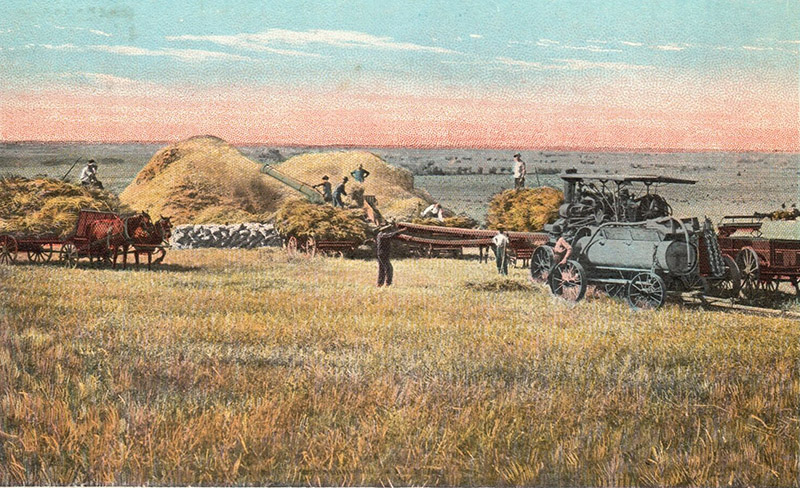
“From his window, as far as he could see, the Dakota wheat thronged the valley of the Red River. The wheat was terrible to look upon. . . .” Above: Wheat-threshing scene in the Red River Valley, c. 1900–1910. The hand-colored image for this postcard was also used in advertising for Washburn-Crosby Flour Mills in Minneapolis, which produced Gold Medal Flour. (eBay)
In 1919, after leaving the Army, F. Scott Fitzgerald began keeping a detailed business ledger, listing all his publications and the money he earned through his writing. The last section of this journal was a month-by-month chronicle of his life, told in the third person, looking back to his birth (“1896 Sept 24th at 3-30 P.M. a son Francis Scott Key Fitzgerald to Edward and Mary Fitzgerald”), and he kept it up to date through the summer of 1935. Fitzgerald’s childhood memories are often half-joking embellishments, such as the day he went with his family to Atlantic City, “where some Freudean complex refused to let him display his feet, so he refused to swim, concealing the real reason. They thought he feared the water. In reality he craved it.” More relevant to our current selection was part of the entry for September 1907: “He went to Confession about this time and lied by saying in a shocked voice to the priest ‘Oh no, I never tell a lie.’” From this memory sprang the story “Absolution,” written while he was struggling to work on the novel that would become The Great Gatsby.

Fitzgerald came up with the idea for his third novel in the spring of 1922, when he and his wife, Zelda, were still living in Minnesota. “Its locale will be the middle west and New York of 1885 I think,” he wrote to Maxwell Perkins, his editor at Scribner’s. “It will concern less superlative beauties than I run to usually + will be centered on a smaller period of time. It will have a catholic element.” He worked on the novel in earnest the following year, but in April 1924 he updated Perkins: “Much of what I wrote last summer was good but it was so interrupted that it was ragged + in approaching it from a new angle I’ve had to discard a lot of it—in one case 18,000 words (part of which will appear in the Mercury as a short story).” A novel originally set forty years earlier had become something altogether different, and Fitzgerald sent an episode from the discarded material to H. L. Mencken, who published it in The American Mercury. Two months later, Fitzgerald responded to a letter from Perkins, “I’m glad you liked ‘Absolution.’ As you know it was to have been the prologue of the novel but it interfered with the neatness of the plan.”

Ten years later, Fitzgerald received a copy of a letter sent to Hound & Horn by the librarian John Jamieson, who objected to an essay in the literary quarterly positing that Flaubert should be considered Fitzgerald’s “ultimate master.” Jamieson argued that the more obvious influence was Thackeray—which impressed Fitzgerald, who had read Thackeray’s novels “over and over by the time I was sixteen” and had even compared Gatsby to Henry Esmond and Vanity Fair in a letter to another critic. Fitzgerald sent a short letter to Jamieson and, in subsequent correspondence, wrote:
I agree with you entirely, as goes without saying, in your analysis of Gatsby. He was perhaps created on the image of some forgotten farm type of Minnesota that I have known and forgotten, and associated at the same moment with some sense of romance. It might interest you to know that a story of mine, called ‘Absolution,’ in my book All the Sad Young Men was intended to be a picture of his early life, but that I cut it because I preferred to preserve a sense of mystery.
This later letter has fueled the belief that “Absolution” is the “deleted prologue” of The Great Gatsby. Arthur Mizener, in the first full-length biography of Fitzgerald, claimed bluntly that it “was written, not as a short story, but as a prologue for Gatsby,” and the inference has reappeared frequently over the decades. During the 1970s, a professor suggested in the pages of College Literature that teachers could use the story to reignite students’ interest in the novel by presenting Rudolph Miller, the boy in the “prologue,” as “undoubtedly the pre-adolescent James Gatz.” And a decade ago, Slate resurrected the story, celebrating it as “The Forgotten Childhood of Jay Gatsby.”

Many scholars downplay both the importance of “Absolution” in the development of Gatsby’s character and Fitzgerald’s later claim that the story was “cut” in the final novel. “This surely cannot have been literally the case,” protested the novelist Thomas Flanagan in The New York Review of Books, “there seems little connection between Jimmy Gatz . . . and Rudolph Miller.” Similarly, the late Matthew J. Bruccoli, a foremost expert on all things Fitzgerald, wrote in his 1981 biography:
It is not certain that Rudolph Miller, the boy whose dreams of metropolitan glamour are reinforced by his encounter with the deranged priest, is Jimmy Gatz. As Fitzgerald told Perkins, “Absolution” was salvaged from a discarded version before he approached the novel from “a new angle”—by which he meant a new plot. While Miller and Gatz share a romantic disposition, there is no clear evidence that they are the same characterization from the same novel. Fitzgerald’s 1922 plan was that his third novel would have a “catholic element”—which is entirely absent in The Great Gatsby, though central to “Absolution.” Indeed, there is no clue to Gatsby’s religious background beyond the fact that his funeral is conducted by a Lutheran minister. The safest way to regard Rudolph Miller is as a preliminary treatment of the figure who developed into Jay Gatsby; they share the conviction that “There was something ineffably gorgeous somewhere that had nothing to do with God.”
It is perhaps more accurate, then, to think of “Absolution” not as the chapter that was omitted from the finished novel but as an episode from a novel that was never finished.

Notes: The slang phrase twenty-three Skidoo, popular in the early decades of the twentieth century, means “Beat it!” or “Scram!” James J. Hill was a Canadian American railroad executive and financier whose base of operations was in St. Paul, Minnesota, Fitzgerald’s hometown. A self-made man, Hill was a hero to many midwestern boys. American author Horatio Alger, Jr., wrote Ragged Dick (1868) and numerous other rags-to-riches stories extolling honesty, hard work, and perseverance. One of Rudolph’s pennants is from Hamline University, a small Methodist institution in St. Paul.

Dómini, non sum dignus, ut intres sub tectum meum: sed tantum dic verbo, et sanábitur ánima mea. . . . is from the Ordinary of the Roman Catholic Mass: “Lord, I am not worthy that Thou shouldst come under my roof; but only say the word, and my soul will be healed.” Corpus Dómini nostri Jesu Christi custódiat ánimam meam in vitam ætérnam: “May the Body of our Lord Jesus Christ preserve my soul unto life everlasting.” Sagitta Volante in Die: “The arrow flying in the day” (from Psalms 90:6, Douay–Rheims version).

The German cuirassiers at Sedan were Prussian cavalry, who wore breastplates and plumed or spiked helmets, at the Battle of Sedan on September 1–2, 1870, which resulted in the capture of Napoleon III and the effective defeat of the French.

*   *   *
There was once a priest with cold, watery eyes, who, in the still of the night, wept cold tears. . . . If you don't see the full selection below, click here (PDF) or click here (Google Docs) to read it—free!

This selection may be photocopied and distributed for classroom or educational use.
Sunday, September 18, 2022

How to Live on $36,000 a Year

F. Scott Fitzgerald (1896–1940)
From F. Scott Fitzgerald: The Great Gatsby, All the Sad Young Men & Other Writings 1920–1926

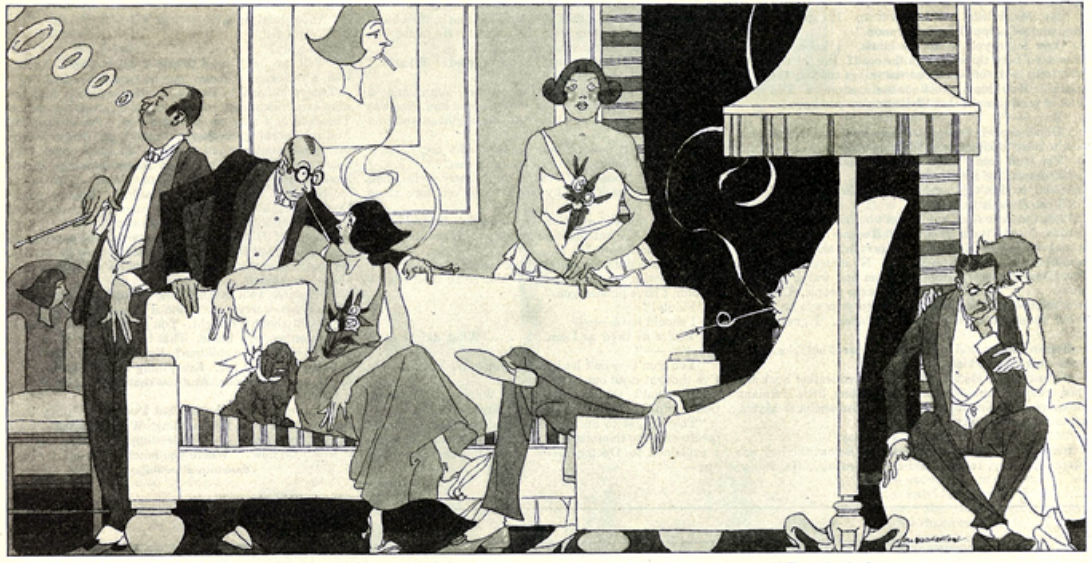
“It became a habit with many world-weary New Yorkers to pass their weekends at the Fitzgerald house in the country.” Illustration by American artist Moses Lawrence Blumenthal (1879–1955) for “How to Live on $36,000 a Year,” The Saturday Evening Post, April 5, 1924.
Two weeks before F. Scott Fitzgerald’s new play, The Vegetable, made its debut, the author sent a frantic letter to Max Perkins, his editor at Scribner’s:
I have got myself into a terrible mess. As you know for the past month I have been coming every day to the city to rehearsals and then at night writing and making changes on the last act and even on the first two. It’s in shape at last and everybody around the theatre who has seen it says it’s a great hit. I put aside the novel three weeks ago and wrote a short story but it was done under such pressure that it shows it and [Metropolitan editor Carl Hovey] doesn’t want it. I am so hard pressed now for time trying to write another for him that I'm not even going [to] the Harvard Princeton game Saturday. . . .

If I don’t in some way get $650 in the bank by Wednesday morning I’ll have to pawn the furniture.
As Perkins had in the past and would again so many times in the future, he arranged have additional funds put into Fitzgerald’s bank account.

Fitzgerald had spent nearly two years trying to find a Broadway producer willing to take on The Vegetable, the first play he had written since his student days. Finally, in the summer of 1923, Sam H. Harris, owner of a Broadway theater on 42nd Street in Manhattan, agreed to finance the production. Sam Forrest, who was currently staging the hit Owen Davis play, Icebound (which would win the Pulitzer Prize), signed on as the director. Ernest Truex, star of the popular 1921 play (and 1923 movie) Six-Cylinder Love, played the lead role. Convinced that the show would be a critical and commercial success, Scott and Zelda eagerly anticipated the royalties a Broadway hit and national tour would bring. Accompanied by their neighbors Ring and Ellis Lardner, the Fitzgeralds went to Atlantic City for the tryout run, and Zelda sent an account of the opening night to her friend Xandra Kalman in Minnesota:
In brief, the show flopped as flat as one of Aunt Jemima’s famous pancakes—Scott and Truex and Harris were terribly disappointed and so was I as I had already spent the first week’s N.Y. royalty for a dress to wear to the opening night that could not be exchanged. . . . The first act went fine but Ernest says he has never had an experience on the stage like the second. . . . People were so obviously bored! And it was all very well done, so there was no use trying to fix it up.
For much of 1923, work on the play had kept Fitzgerald from writing short stories for magazines—his bread and butter—and he published only two that year. His earnings nevertheless totaled nearly $28,750, comprising an unexpected $10,000 for the movie rights to his first novel, This Side of Paradise (a film that would never be made); an additional $3,500 for other work for the movies, including title cards for the silent-film adaptation of Edith Wharton’s Glimpses of the Moon; advances of $3,939 for his next novel, which would eventually be titled The Great Gatsby; and the remaining amount from book royalties, essays, and short stories (including four that would appear the following year).

Unfortunately, the Fitzgeralds somehow managed to spend close to $36,000—an exorbitant sum in 1923, when the average American earned $1,400. After the show flopped, Scott owed several thousand dollars to various friends and to his agent, Harold Ober. His ineptitude with finances inspired him to write the self-mocking autographical account, “How to Live on $36,000 a Year,” as well as a sequel sent from Europe, “How to Live on Practically Nothing a Year,” both of which The Saturday Evening Post enthusiastically published. A decade later, Fitzgerald told Perkins that the two articles “attracted such wide attention in their day that I have yet to hear the last of them.”

At the end of 1923, Fitzgerald stopped drinking and in a matter of months wrote ten stories, which earned him $16,450 from the magazines and allowed him both to pay his outstanding bills and to spend the summer of 1924 finishing up The Great Gatsby. Yet he was soon in debt again. “That was the mystery of the Fitzgeralds’ finances: they never knew where their money had gone because they had nothing to show for it,” writes Matthew J. Bruccoli. “The cycle of debt kept Fitzgerald in bondage to the magazines. It seemed he could always write another story, and his story price kept going up. Writing stories provided Fitzgerald with no satisfaction and generated guilt because he knew that his chance for greatness depended on novels.”

In all, Fitzgerald published 164 short stories in magazines but included only 46 of them in his four collections. There are few masterpieces among the uncollected stories, but, as Bruccoli reminds us, “even his weak stories are redeemed by glimpses of what can be conveniently called ‘the Fitzgerald touch’—wit, sharp observations, dazzling descriptions, or the felt emotion.” More recently, the distinguished Fitzgerald scholar James L. W. West III described the author’s mixed record of success and his struggle to balance commercial demands and artistic goals: “He knew how to reach his audience; he also knew how to be compensated for what he wrote. He wanted to make money and to be taken seriously—a difficult combination for any author to pull off.”

Notes: Liberty Bonds were U.S. government bonds issued to help finance American participation in World War I. The bonds paid 3.5 percent interest. The “large check from the movies” mentioned by Fitzgerald was the $2,500 he received when his short story “Head and Shoulders” was sold to Metro Films. The “town about fifteen miles from New York” was Great Neck, Long Island, where the Fitzgeralds lived from October 1922 to April 1924. The “small windfall” was the $10,000 for the film rights to This Side of Paradise, mentioned above. Heavyweight champion Jack Dempsey defeated Argentinian Luis Firpo, at New York’s Polo Grounds on September 14, 1923. As most of his readers would have known, ringside tickets cost at least $27.50 each, undercutting his claim that he and Zelda spent only $55.00 each month on tickets for “between three and five shows.”

*   *   *
“You ought to start saving money,” The Young Man With a Future assured me just the other day. . . . If you don't see the full selection below, click here (PDF) or click here (Google Docs) to read it—free!

This selection may be photocopied and distributed for classroom or educational use.
Sunday, September 19, 2021

The Lees of Happiness

F. Scott Fitzgerald (1896–1940)
From F. Scott Fitzgerald: Novels & Stories 1920–1922

Franz Heinrich Corinth on His Sickbed, 1888, oil on canvas by German artist Lovis Corinth (1858–1925). WikiGallery.
A few months after the publication of his debut novel, This Side of Paradise (1920), twenty-three-year-old F. Scott Fitzgerald sent a letter to the editor of his books, Max Perkins. “Just finished the best story I've done yet,” he wrote, “& my novel is going to be my life masterpiece.” Neither half of this statement would prove true. His second novel, The Beautiful and Damned, is widely regarded as his weakest and the story, “The Lees of Happiness,” has been largely ignored by critics and readers alike since its inclusion in Tales of the Jazz Age (1922), Fitzgerald’s second collection.

Edmund Wilson, who reviewed Tales of the Jazz Age for Vanity Fair shortly after it appeared, wrote that Fitzgerald “lets his fancy, his humor and his taste for nonsense run wild; it is the Fitzgerald harlequinade with a minimum of magazine hokum.” (He likely knew that Fitzgerald had originally suggested Sideshow as the title for the book.) Wilson, who had been a year ahead of Fitzgerald at Princeton University and had become his friend, mentor, and rival, could be unsparing in his sarcasm and criticism, and he spent much of the review discussing “The Lees of Happiness.” The story appeared in the book’s last section with two selections Wilson called “delightful burlesques,” including one that had its origin in a sketch that had appeared in the Princeton magazine he had edited when both men were undergraduates. Wilson claimed, then, that he initially assumed Fitzgerald was employing his “mastery of the ridiculous” to satirize “the bitter short story of [Edith] Wharton and of fiction since Maupassant” but was startled to realize at the end of “The Lees” that the tale “was intended to be serious.” He then launched his zinger: Fitzgerald “always has some surprise: just when you think the joke is going to be on you, it may turn out to be on him.”

Several selections in Tales of the Jazz Age, including “The Lees of Happiness,” exhibit what The Cambridge Companion to F. Scott Fitzgerald calls “his flirtation with naturalism” during 1920–21, when he was “working under the spell of ‘the meaningless of life’ philosophy.” This cynicism, not uncharacteristic among members of his generation in the years immediately following World War I, pervades his stories during this period, as well as The Beautiful and Damned. After Fitzgerald sent “The Lees of Happiness” to the Chicago Tribune, he admitted in a follow-up letter to the editor, Burton Rascoe, “It’s perhaps a little gloomy.” Rascoe decided to publish it anyway, even though he damned the story as “sentimental” when he reviewed Tales of the Jazz Age three years later.

In sum, as British literary scholar Lionel Kelly notes in an essay that takes a fresh (and more appreciative) look at the story, “It has not had a good press from Fitzgerald’s critics, though it persistently appears in English collections of his stories.” For his part, Kelly admits he hadn’t previously discussed it in his own writing because he “had formed a sentimental attachment to it which has something to do with its capacity to deal in romantic illusion.” The lack of “good press” is largely due to those romantic (however illusory) and sentimental aspects—unusual for a story by Fitzgerald, who had just married Zelda Sayre three months earlier—and several critics have suggested that the story reflects his anxiety about both his marriage and his writing career. In the three decades since the publication of Kelly’s essay in 1989, however, the story and especially the collection that contains it have received renewed attention among readers, aided unexpectedly by the 2008 film adaptation of another story in the book: “The Curious Case of Benjamin Button.”

While Fitzgerald was assembling Tales of the Jazz Age, he came up with the idea of describing in the book’s table of contents the inspiration and background for each story; one of the remarkable things about the annotations is that several weigh a story’s strengths against its faults—especially the weaknesses pointed out by critics and admirers after the selections appeared in periodicals. The overall impression is that Fitzgerald didn’t think much of many of his own stories, because (he admits) he had written some of them for the money magazine editors were willing to pay the century’s newest literary ingenue. It is hardly an exaggeration to say that this annotated listing has received more attention from scholars and biographers than have many of the stories in the book.

Fitzgerald’s initial draft for the annotation for “The Lees of Happiness” apparently contained an unambiguous comparison to the fiction of Henry James. After reviewing the copy for the table of contents, Perkins wrote to his author: “I don’t think Henry James had anything in the world to do with you at all, and so is not appropriate—but in all but details this material is admirable for our purposes.” When he returned the edited draft, Fitzgerald responded, “I have followed your suggestion about cutting the Henry James episode.” Yet he still mentions James in the final version, linking the story to an unidentified (and possibly fictitious) critic who anthologizes stories that all begin with hemming and hawing as if they were written by James—thereby suggesting to readers that Fitzgerald’s story, too, starts out like a Henry James tale:
Of this story I can say that it came to me in an irresistible form, crying to be written. It will be accused perhaps of being a mere piece of sentimentality, but, as I saw it, it was a great deal more. If, therefore, it lacks the ring of sincerity, or even of tragedy, the fault rests not with the theme but with my handling of it.

It appeared in the “Chicago Tribune,” and later obtained, I believe, the quadruple gold laurel leaf or some such encomium from one of the anthologists who at present swarm among us. The gentleman I refer to runs as a rule to stark melodramas with a volcano or the ghost of John Paul Jones in the rôle of Nemesis, melodramas carefully disguised by early paragraphs in Jamesian manner which hint dark and subtle complexities to follow. On this order:

“The case of Shaw McPhee, curiously enough, had no bearing on the almost incredible attitude of Martin Sulo. This is parenthetical and, to at least three observers, whose names for the present I must conceal, it seems improbable, etc., etc., etc.,” until the poor rat of fiction is at least forced out into the open and the melodrama begins.
We present the story below and leave it to our readers to decide if it resembles in any way a story by James or Wharton or Maupassant—or if it simply represents a unique contribution to Fitzgerald’s oeuvre.

Notes: In his reappraisal of Fitzgerald’s story, Lionel Kelly notes the ambiguity of the title. In modern English, “lees” is the plural of lee, referring to shelter and protection from wind and storm. But a less common use of “lees” refers to the sediment or dregs at the bottom of a barrel of wine. Kelly points out a reference in the Oxford English Dictionary to this excerpt from Macbeth:

Had I but died an hour before this chance,
I had lived a blessed time; for, from this instant,
There 's nothing serious in mortality:
All is but toys: renown and grace is dead;
The wine of life is drawn, and the mere lees
Is left this vault to brag of.

Richard Harding Davis was a novelist and playwright but was perhaps most famous as a war correspondent in the late 1800s and early 1900s. His contemporary, Frank Norris, was an editor and novelist whose works included McTeague and The Octopus. Port Arthur (Lüshun) in Manchuria is the location where a Russian garrison surrendered to the Japanese on January 2, 1905, after a siege lasting over six months. At Château-Thierry, a town on the Marne River 40 miles east of Paris, American troops helped stop a major German offensive in early June 1918. The Florodora Sextette were six actresses who sang the hit song “Tell Me Pretty Maiden” in the Broadway musical comedy Florodora (1900). A Gibson girl was the image of a fashionable young woman of the upper classes, based on the popular drawings of illustrator Charles Dana Gibson. Lillian Russell was one of the most famous musical theater stars from 1880 to 1920, appearing in several Gilbert & Sullivan productions; Stella Mayhew was a vaudeville and Broadway singer who appeared in numerous musicals in the first decade of the twentieth century, costarring in several with Al Jolson; the Polish actress Anna Held became famous by starring in several plays produced by Florenz Ziegfeld, her common-law husband.

*   *   *
If you should look through the files of old magazines for the first years of the present century you would find, sandwiched in between the stories of Richard Harding Davis and Frank Norris and others long since dead, the work of one Jeffrey Curtain. . . . If you don't see the full selection below, click here (PDF) or click here (Google Docs) to read it—free!

This selection may be photocopied and distributed for classroom or educational use.

Sunday, September 13, 2020

This Side of Paradise?

Heywood Broun (1888–1939)
From The Great American Sports Page: A Century of Classic Columns

Yale-Princeton Football Board Game, 1895, published by McLoughlin Brothers. The cover scene shows players wearing Yale blue and Princeton orange and black under moleskin vests. Image: BoardGameGeek.com.
When F. Scott Fitzgerald’s This Side of Paradise appeared a century ago, the notices were largely positive, with most reviewers either hailing a new literary star or treating the book as the work of a young writer with a promising career ahead of him. A major exception was the acerbic New-York Tribune journalist Heywood Broun, one of the original members of the infamous Algonquin Round Table and, over the course of three decades, a sports writer, war correspondent, political columnist, theater critic, book reviewer, and novelist. “Paradise and Princeton,” his review of Fitzgerald’s debut novel, appeared on April 11, 1920, two weeks after the book was published. Broun acknowledged that the book had received “enthusiastic praise from most American reviewers,” but he confessed that the novel “makes us feel very old” (he was 31) and he was “unconvinced as to the authenticity of the atmosphere” in the book’s portrait of campus life. Deriding the students portrayed by Fitzgerald as “male flappers,” Broun found it “inconceivable that the attitude toward life of a Princeton undergraduate, even a freshman, should be so curiously similar to that of a sophomore at Miss Spence’s” (an all-girls private school in New York).

But the comment that would sting most was Broun’s comparison of 23-year-old Fitzgerald to 9-year-old Daisy Ashford, whose best-selling book The Young Visiters, a too-precious novella published the previous year with misspellings and malapropisms intact, had become an international sensation (and was parodied that year by Ring Lardner as The Young Immigrunts). Broun’s sideswipe obliquely pointed to a significant problem with This Side of the Paradise that had been mentioned (or ridiculed) by many other reviewers: the book contained an unusual number of errors and typos. It turned out that the galleys hadn’t been properly proofread, since the young editor Maxwell Perkins thought his first newly signed author had looked over the pages and Fitzgerald assumed Scribner’s would take care of the task. Both were horrified.

Broun’s jibe stuck and Fitzgerald became “the Princeton Daisy Ashford” to several influential members of the press. Never one to let things go (especially if he started it), Broun scattered throughout future columns additional criticisms of the upstart author. “The self-consciousness of Fitzgerald is a barrier which we are never able to pierce. He sees himself constantly not as a human being, but as a man in a novel or in a play,” he wrote in one follow-up piece. Based on the actions of various characters in the book, Broun claimed to be “rather afraid that not a few undergraduates are given to the sin of not kissing and then telling anyway.”

In a later column, he took Fitzgerald’s “self-interview” that had been distributed to the press to promote the book and published choice excerpts  with the conclusion, “Having heard Mr. Fitzgerald, we are not entirely minded to abandon our notion that he is a rather complacent, somewhat pretentious, and altogether self-conscious young man.” The mockery was so pervasive that a month after publication, Scribner’s placed ads showcasing a list of glowing reviews under the headline “Heywood Broun Snorts and Scoffs, But—” That didn’t slow down the onslaught of darts thrown by the critic, who continued right through the summer until the fall, when Fitzgerald’s story collection Flappers and Philosophers appeared and Braun begrudgingly singled out “The Ice Palace” as evidence that maybe he “did have something to say and knew how to say it.”

Years later, while acknowledging the ludicrousness of the self-interview stunt, Fitzgerald recalled how he finally invited Broun for lunch and “in a kindly way told him that it was too bad he had let his life slide away without accomplishing anything.” He got further revenge in 1923 by beginning a remarkably favorable review of Broun’s first novel, The Boy Grew Older, with some thoughts about his nemesis’s shortcomings as a novelist: “His literary taste, when it is not playing safe, is pretty likely to be ill-considered, faintly philistine, and often downright absurd. . . . He seems unacquainted with anything that was written before 1900, possibly excepting the English units required for entering Harvard” (where Broun dropped out fifteen years earlier).

So “This Side of Paradise?”—Heywood Broun’s account of Princeton’s annual football game against archrival Yale—was in no small part the latest in a series of columns referencing and skewering Fitzgerald, his writing, and Princeton. The game, with a record-breaking 52,000 fans in the stands, provided a perfect vivarium for studying the new breed of undergraduate described in This Side of Paradise. For half a century the rivalry between the two colleges, which between them had snagged most of the national championships, had been the top draw of each season—and the intensity reached a fever pitch in the 1920s. Armed with Fitzgerald’s insights into the latest generation of undergraduates, Broun attended the game. What he found were young men who seemed remarkably like students of old.

Broun’s column ran in the next day’s Tribune, alongside Grantland Rice’s more traditional account of the game. (The sports page editor W. O. McGeehan kept the honor of writing the front-page story to himself.) As both Rice and Broun noted, the only Yale player who proved to be a match for the Princeton powerhouse was left tackle Albert Into, who (Rice reported) “played high-grade football,” leading a defensive line that allowed only four pass completions out of twelve attempts. The headline above Broun’s piece highlighted the lineman’s contribution to the game: “Into in Right and Is Yale’s One Lone Hero.” Subsequent reprints of the article have changed the title to “This Side of Paradise?”—but Into remains the star of Broun’s pun-fortified first paragraph.

Notes: Broun mentions three friends who also attended the game: Franklin Pierce Adams, a fellow Tribune columnist and member of the Algonquin Round Table; Damon Runyon, a sports writer for the Hearst syndicate and, later, a successful short story writer; and Frank Ward O’Malley, a longtime reporter and humorist for The New York Sun. When Broun jokes about the size of the numbers on the players’ uniforms, he uses the names of two type sizes: agate (5½ pt.) and nonpareil (6 pt.)

Broun refers to players simply by their last names. Here is additional identification for a few pivotal players for curious readers.
      For Princeton: halfback Hank Garrity, would go on to serve as head football coach at Wake Forest University from 1923 to 1925; quarterback Donold Lourie would be president of the Quaker Oats Company from 1947 to 1970, with a one-year leave of absence to be Under Secretary of State for Administration under Eisenhower; fullback Frank Murrey, was long remembered for his 77-yard touchdown run against Navy earlier that year; Stan Keck, named years later by Princeton coach William Roper as “the greatest tackle that ever played on a Princeton team,” became a sports program administrator at various colleges; only two weeks prior to the game, fullback Joseph Durand Scheerer, lost his older brother William (one of Fitzgerald’s classmates at Princeton), who died shortly before surgery to have his tonsils removed.
      For Yale: quarterback Thorne Murphy later became a vice president of McLouth Steel Company; Eddie Eagan had won the gold medal for light-heavyweight boxing in the 1920 Summer Olympics and went on to win a gold medal for four-man bobsled racing at the 1932 Winter Olympics. He remains the only person to win a gold medal at both the Summer and Winter Olympic Games in different disciplines.
This selection may be photocopied and distributed for classroom or educational use.

*   *   *
For this week’s selection, we depart from the usual format and reproduce the selection, in its entirety, below.
You may also download it as a PDF or view it in Google Docs.

This Side of Paradise?

Princeton, hitherto believed to be this side of paradise, sent a line smash through the pearly gates of this afternoon and defeated Yale by 20–0. The score would have been larger but for the brilliant work of Into. He was a tough proposition. It might even be said that he was a tough preposition. He was stalwart on defense, good on attack, but a bad man to end a sentence with.

This, however, is supposed to be a skipping story of the game and ought to start at the beginning. We trust that the reader will take it for granted that the Palmer Stadium was full, the hotels crowded, the town gay with bunting and pretty girls. This year they are wearing woolen stockings.

Just before the whistle blew, Captain Tim Callahan of Yale and Mike Callahan of Princeton walked out into the middle of the gridiron. The referee said: “I guess I don’t have to introduce you boys,” and he was quite right, because the Callahans are brothers.

Mrs. Callahan believes in scattering her sons. She follows the old adage of “Don’t put all your eggs in one basket.” There is still another Callahan who is preparing for Ursinus. Mrs. Callahan believes that by trying all the colleges at least one of her sons is going to get an education.

Tim asked, “What’s the news from home?” And Mike said, “Well, I had a letter last week,” but before he could read it the referee interrupted by tossing a coin, and, as Tim is the elder, Mike let him win and choose his own goal. It was the only thing Yale won during the afternoon.

The two captains then returned to the side lines and gathered their respective teams around them for a few last words. Tim said, “Fight hard boys!” and Mike said, “Smash ’em boys!” These are brave words, but it’s in the breed.

Then the game began, and we noticed as it went along that, though the passes tossed by the Murphys, the Gilroys, and the Garritys did not always go to the designated receiver, there was generally some Irishman there to catch them.

Franklin Pierce Adams, who sat in the next seat, promised to give us first chance on anything he might say during the game, but after two periods the best he could do was to remark that there were three great plunging backs on the gridiron. “And the greatest of these is Garrity.” Then he left to go to another place in the stand where he had some friend who hadn’t heard it.

Princeton began as if to sweep Yale right off the field. Yale had punted and, following the kickoff, Lourie went around right end for thirty-five yards. Whenever a Yale man approached, Lourie stuck out his thumb, like little Jack Horner, and proceeded about his business. It was most enjoyable.

Damon Runyon immediately declared that he was going to send his son to Princeton and Frank O’Malley said he was also going there. That will be mighty convenient in the big game of 1936, because whenever Harvard needs five or six yards for a first down the quarterback will give the ball to H. Broun III and say, “Smash Runyon!” And if a scoring play is needed he can be sent around O’Malley.

However, although Princeton gained a lot of ground nothing came of it in the first period and Runyon began to weaken a little on his decision and said he heard Penn State well spoken of.

Just after the second period began Murrey sent a beautiful drop kick over from the thirty-five-yard line at a hard angle. Your correspondent thinks it safe to assume that the readers of the Tribune will realize that much cheering from the Princeton stands followed and all that will be omitted.

With the half almost ended, Princeton had the ball on Yale’s forty-yard line and big Keck dropped back for what seemed to be a try for a placement goal. Many in the stands and some on the field were suspicious, but Princeton carried out the deception admirably. The ball was passed to Lourie, who lay prone, and he made a motion as if to place it on the ground. Then he jumped up and began to run.

Keck was ahead of him, and it was hard to see Lourie from in front. He ran toward the Yale goal. One man in Blue was chasing him and seemed to stretch out his hand and say “Tag.” He failed to think of this, and in the race for the goal Lourie was first, with the Yale man a good second.

Musing between the halves as Yale and Princeton sang about God and Country, and Yale and Old Nassau and Princeton’s honor, and the rest of the sentiments which go to make up an afternoon, we began to reflect that numbering the players didn’t help as much as we thought it would. After all it would be almost as satisfactory to know that a touchdown had been scored on a pass from one Princeton man to another as that it had come from 16 to 28 to somebody who looked a little like 39, but might be 7. Of course, it might help a little if they would use nonpareil instead of agate.

Princeton’s touchdown in the third quarter was easy, for Murphy muffed a twisting punt from Scheerer and Mike Callahan carried the ball over the line. We noticed when Murphy went out of the game a little later that he buried his head in his hands and seemed terribly broken up about his error.

It is a great pity that all the circumstances of a big game compel young college players to take everything so seriously. Looking at the universe from a cosmic point of view, it doesn’t make much difference that Murphy dropped the punt, but he could not see it that way.

Princeton scored again when Keck kicked a placement goal from Yale’s thirty-six-yard line after a fair catch. Keck has great dramatic ability as well as skill in kicking goals. In the third period they carried him off the gridiron, and a few minutes later he turned up in the line-up and hit the crossbar from the fifty-yard line. But for his injury, he would undoubtedly have booted the ball over the wall of the stadium. At this point there was not a little sparring back and forth, and Yale sent in Eddie Eagan, the Olympic light heavyweight champion.

By and by the whistle blew, and again we think it is safe to assume that the reader knows that all the Princeton men from years and years back came to the field to snake-dance and throw their hats over the goal posts.

Mike went over to Tim and took out the letter to begin where he had been interrupted by the referee.

“Aunt Sally’s a little better,” he said.

“Damn Aunt Sally!” said Tim.

Originally published under the headline “Into in Right and Is Yale’s One Lone Hero” in the November 14, 1920, issue of the New-York Tribune and reprinted in Wake Up the Echoes: From the Sports Pages of the New York Herald Tribune (1956).

Saturday, March 7, 2020

Quick Returns

Ring Lardner (1885–1933)
From Ring Lardner: Stories & Other Writings

“‘Listen!’ I said. ‘What did them two girdles cost?’” Illustration by American artist May Wilson Preston (1873–1949), drawn for “Quick Returns” when it appeared in March 27, 1920, issue of The Saturday Evening Post and reproduced the following year as a plate in the collection The Big Town. Preston illustrated most of Lardner’s stories in the Post.
In the mid-1920s Ring Lardner, at the urging of his neighbor F. Scott Fitzgerald, changed his publisher from Bobbs-Merrill to Scribner’s, and Maxwell Perkins became his editor. Scribner’s purchased the plates for all of Lardner’s previous books and made plans to issue them in a five-volume collector’s set. Instead of asking other writers to write forewords, Perkins wrote to his new author and asked him to provide prefaces for the edition. Perkins insisted that Lardner, perhaps America’s most famous columnist at the time, was simply too famous to ask anyone else to do the job. “The theory of an introduction is that the author needs someone who is of higher standing than himself, and you are not in a position where from this point of view anyone is available.”

Lardner was happy to oblige, and the short piece he sent Perkins to introduce his 1921 collection The Big Town begins:
This book deals with the adventures of a man and his wife and his sister-in-law who move to New York from a small Middle Western city. Because the writer and she who jokingly married him moved to New York from the Middle West, and because the writer has almost as many sister-in-laws as Solomon, several Nordic blondes have inquired whether the hero and heroines of the book are not actually us. Fortunately, most of the inquirers made the inquiry of me, the possessor of a notoriously sweet disposition. Two of them, however, asked the madam herself and were both shot down.

In the first place, the ladies of the book are supposed to have enough money to make them and the gent more or less independent. Nothing like that in our family.

In the second place, the sister-in-law of the book has a hard time getting a man. The sisters-in-law in real life acquired permanent men while still in their nonage, you might say, and didn't have to move out of the Middle West to do it. . . .
Behind a veil of humor, Lardner slightly underplays the similarities between himself and his narrator. Both the real and fictional families have roots in Niles, Michigan (where Lardner was born), both husbands launched their careers in South Bend, Indiana, and readers can easily find other surface resemblances between Lardner’s biography and the fiction of The Big Town. Furthermore, Lardner intentionally blurred the boundaries between life and literature in his nationally syndicated columns, writing in character as “Ring Lardner,” a comical and somewhat fictionalized version of himself—the “wise boob,” as he later called the type of character he was famous for creating. Part of Lardner’s popularity depended on his whimsical disregard for the lines between truth and fiction, sincerity and satire, reporting and exaggeration—not to mention the reader’s uncertainty over whether any given piece was by Ring Lardner or “Ring Lardner” or some entirely new creation.

Unlike his alter ego in The Big Town, however, Lardner was not dragged reluctantly to a new life in New York. For at least five years Lardner had toyed with the possibility of moving there. In 1914 he received a fan letter of sorts from Franklin P. Adams, a columnist who had moved from Chicago to New York and who would later become an influential promoter of up-and-coming writers. Adams wondered whether Lardner had ever considered moving to Manhattan, and Lardner responded, “It’s dough and the prospect of it that would tempt me to tackle the New York game. I think a gent in this business would be foolish not to go to New York if he had a good chance.”

In 1919 that chance arrived. Lardner was in New York, still working for the Chicago Tribune, when he met up with John Neville Wheeler in a bar. Three years earlier Wheeler had launched the Bell Syndicate, which distributed columns, fiction, comics, and the like to newspapers across the nation. As Wheeler later recounted, Lardner agreed to a deal after several rounds of drinks. A few weeks later, however, the newspaperman became nervous about whether Lardner believed they had really come to an arrangement, and he sent a follow-up note suggesting they draw up a written agreement. Lardner responded by telegram: “If you knew anything about contracts you would realize we made one in the Waldorf bar before five witnesses, three of whom were sober.” The “contract” lasted eight years.

Eventually, more than 150 local newspapers signed up for the new column, guaranteeing Lardner an annual income of at least $30,000. Excited by the addition of Lardner’s name to their pages, many editors ginned up enthusiasm among their readers weeks before the first column appeared. In mid-October, for example, an article on the front page of the El Paso Herald, under the day’s lead story (“AUSTRIANS RATIFY TREATY OF PEACE”), announced that Lardner would soon be publishing his column in the paper—and readers might well have thought the man was on his way to Texas. “It’s a name to conjure with, isn’t it?” the editors bragged. “Ring Lardner has a wider circle of readers than any humorist today. . . . Now Lardner is to join the staff.” The paper continued to promote Lardner’s arrival as a coming attraction nearly every day, often on the front page. Finally, on November 1, 1919, the first column appeared in El Paso (and in newspapers all across the country) under the title “Moving to the East.” In it, Ring Lardner explains to his readers that he has just arrived in New York to try his hand at writing a Broadway play and from there he will submit a weekly column: “I have excepted the kindly editor’s genial offer and wile I do not claim merits as a literary man the editor says that does not matter and if I will just write in my own breezy style (the way I talk as he expressed it) he and his readers will be more than satisfied.”

The move “to the East” also provided Lardner with the inspiration for two books: The Young Immigrunts (a previous Story of the Week selection) and the five stories published as The Big Town: How I and the Mrs. Go to New York to See Life and Get Katie a Husband. According to biographer Donald Elder, when Lardner began writing “Quick Returns,” the first of the Big Town stories, “he probably did not have the last episode in mind.” The stories reflect in myriad ways Lardner’s own adventures (and misadventures) as a greenhorn in New York. For instance, after he wrote the first two stories, he moved to Great Neck with his wife and sons and likewise changed the setting for the next story to Long Island. (The third story also contains a single mention each of the protagonist’s first and last names, Tom Finch. Neither name appears again.)

Although its components were written and published separately in The Saturday Evening Post over a period of eighteen months, The Big Town is perhaps the closest Lardner came to writing a novel. “No other book of Ring’s, You Know Me Al included, has the coherence and structure that The Big Town has,” notes Jonathan Yardley in his biography of Lardner. “The city has changed and so has the country, but the clash between the one and the other still goes on; the story Ring tells here of how one couple conducts its own little struggle is an enduring delight.”

Notes: Lardner scatters throughout the story a few references to various celebrities and other cultural touchpoints from the era. John Pierpont Morgan Jr. took over the family’s banking and financial empire when his father died in 1913. Oliver Lodge was a British physicist known for his interest in psychic phenomena and the afterlife. The Oliver Hotel, which opened in 1899, was South Bend’s most luxurious inn; it was demolished in 1967. Composed in 1863 by Joseph Barnby and popular for more than a century, “Sweet and Low” is a musical setting of a poem by Alfred Tennyson. George M. Cohan was a preeminent musical comedy performer, playwright, and composer; his more than three hundred songs included “Over There” and “Give My Regards to Broadway.” Frederick “Doc” Cook was an American explorer mostly remembered for falsely claiming to have reached the North Pole in 1908.

Lardner alludes a couple of times to Jack Dempsey, Jess Willard, and the boxing match in Toledo in 1919, when Dempsey won the heavyweight title by defeating Willard, who was the much larger fighter. Other athletes mentioned include Harvard fullback and placekicker Charles Brickley, University of Chicago quarterback Walter Eckersall (a good friend of Lardner’s), Purdue quarterback Edward C. Robertson, Boston Beaneaters second baseman Bobby Lowe, and Philadelphia Phillies left fielder Ed Delahanty.

*   *   *
This is just a clipping from one of the New York papers; a little kidding piece that they had in about me two years ago. . . . If you don't see the full selection below, click here (PDF) or click here (Google Docs) to read it—free!

This selection may be photocopied and distributed for classroom or educational use.

Friday, February 26, 2016

The Golden Honeymoon

Ring Lardner (1885–1933)
From Ring Lardner: Stories & Other Writings

“The crowd began to chafe Frank and pass remarks. Like one of them said: ‘Whoever told you you was a checker player.” One of several illustrations by American illustrator T. D. Skidmore for “The Golden Honeymoon” in the July 1922 issue of Cosmopolitan.
When George Horace Lorimer, editor of The Saturday Evening Post, read the latest submission from Ring Lardner, one of his most popular writers, he decided it was too unlike the author’s previous stories to satisfy the magazine’s readers, who were accustomed to farcical tales of semiliterate baseball players and slang-impaired demimonde characters. “The humor in it is so quiet,” Lorimer responded, that readers “would miss it.” And so he turned down the opportunity to publish “The Golden Honeymoon.” Ray Long, an associate editor at Cosmopolitan, concurred with Lorimer’s decision: “I see what the Post meant. That story isn’t the usual Ring Lardner story. All it is is a fine piece of sympathetic human interest writing. I should be glad to trade you a check for $1500 for it and I shall be very proud to publish it.” The story appeared in the July 1922 issue of Cosmopolitan. It would be ten years before Lardner sent another story to the Post.

F. Scott Fitzgerald, Lardner’s close friend, drinking buddy, and neighbor in Great Neck, New York, played a role in encouraging him to write stories more “literary” than what had been appearing in the Post. Clifford M. Caruthers, who published Lardner’s correspondence, writes:
Fitzgerald admired Lardner’s deflating humor, stoical cynicism, insistence on accuracy, and general knowledge of human nature, and he saw Lardner as potentially a great literature talent. . . . Whereas Lardner often imposed restraints on Fitzgerald’s enthusiasms, Fitzgerald apparently succeeded in convincing Lardner to take himself more seriously as a writer.
In 1923 Fitzgerald urged Maxwell Perkins, his editor at Scribner’s, to consider publishing a collection of Lardner’s stories and recommended that he read “The Golden Honeymoon.” Lardner had already published twelve books, most of them with Bobbs-Merrill, but Perkins read the story “with huge enjoyment” and sent off a respectful note: “I would hardly have ventured to do this if Scott had not spoken of the possibility, because your position in the literary world is such that you must be besieged by publishers.” Flattered, Lardner agreed to switch publishers and the collection, How to Write Short Stories (with Samples), appeared in 1924, with very brief introductions to the “sample” stories and a preface that parodied the advice found in writing manuals. The headnote to “The Golden Honeymoon” was a single line: “A story with ‘sex appeal.’”

During the last century “The Golden Honeymoon” has been one of the most frequently anthologized of Lardner’s stories—perhaps second only to “Haircut.” (John Updike included it in his Best American Short Stories of the Century.) It is deceptively simple: an elderly couple, Charles and Lucy (“Mother”), head off for a fiftieth-anniversary vacation in Florida, but their enjoyment is unexpectedly interrupted by an encounter with Mother’s former fiancé and his wife. “When this story was first published,” the young editor and critic Clifton Fadiman wrote ten years after its publication, “most readers thought it very touching, even a trifle sentimental.” Instead, he argued, “it is one of the most smashing indictments of a ‘happy marriage’ ever written, composed with a fury so gelid as to hide completely the bitter passion seething beneath every line.” Fadiman certainly overstated the case. More recently Jonathan Yardley has suggested that the truth is somewhere in the middle, some distance away from the “venomous vision” conjured by Fadiman: “Ring understood . . . the unwritten rules that permitted these people to have their minor spats and running arguments while maintaining a foundation of affection and mutual understanding.”

Notes: On page 539 is a reference to Willie boys, late-nineteenth-century slang for tramps or hobos. “Hearts and Flowers” (p. 541) is an 1893 song composed by Theodore Moses-Tobani, with lyrics by Mary D. Brine, using a melody from the Wintermärchen Waltzes by Hungarian composer Alphons Czibulka. The song was ubiquitous in the 1910s and its title became synonymous with melodrama and sentimentality. Popular in the early twentieth century, roque was a form of croquet played on a hard court with banks along the sides. Usually affecting horses, glanders (p. 544) is an infectious disease, since eradicated in North America and Europe. “Home to Our Mountains” (p. 547) is an English-language adaptation of “Ai Nostri Monti” from Giuseppe Verdi’s opera Il Trovatore (1853).

*   *   *
Mother says that when I start talking I never know when to stop. But I tell her the only time I get a chance is when she ain’t around, so I have to make the most of it. . . . If you don't see the full selection below, click here (PDF) or click here (Google Docs) to read it—free!

This selection is used by permission.
To photocopy and distribute this selection for classroom use, please contact the Copyright Clearance Center.