Showing posts with label poetry. Show all posts

Sunday, March 21, 2021

In the Home Stretch

Robert Frost (1874–1963)
From Robert Frost: Collected Poems, Prose, & Plays

Three of the pen-and-ink drawings by American illustrator John Wolcott Adams (1874–1925) for Robert Frost’s “In the Home Stretch” in the July 1916 issue of The Century Illustrated Monthly Magazine. First panel: “Where will I put this walnut bureau, lady?” Second: “Come from that window where you see too much.” The third panel appears above the stanza that begins, “You’re tired. / I'm drunk-nonsensical tired out.” Three decades later, Frost inscribed an issue of the magazine to his friend and biographer Louis Mertins with the comment, “The places resemble neither the Derry nor the Franconia farm in any least detail.” Library of Congress.
When Edward J. O’Brien issued The Best Short Stories of 1916, he included his usual “honor roll” with individual summaries of the fifty best selections of the year. In the list are tales by such still-familiar names as Sherwood Anderson, Edith Wharton, and Theodore Dreiser, but there are two surprising entries, “Snow” and “In the Home Stretch,” by a writer relatively new to the literary scene, Robert Frost. Those readers who know Frost’s oeuvre might be perplexed, since both of these pieces are, in fact, poems. In his commentary, however, O’Brien anticipates this objection and explains in his note for one of the “stories”:
“In the Home Stretch” by Robert Frost is truly a masterpiece of the short story regardless of the fact that it is also an admirable poem. It has passion, magic, and truth for its virtues as poetry; rich human characterization, finely conceived background, and quiet dramatic power for its virtues as a short story.
Both story-poems appeared in magazines in 1916 before they were collected late that year in Mountain Interval, Frost’s third book of poetry. The poems are the only two in the collection that resemble the blank verse dialogues, like “The Death of the Hired Man” and “The Housekeeper,” that had made him suddenly famous in America two years earlier, when North of Boston had become an unexpected best seller. In the new collection Frost largely eschewed longer story-like poems in favor of shorter meditations and vignettes, such as “The Road Not Taken” and “Out, Out—.” He later told Daniel Smythe, a poet and friend, that he was ultimately unhappy with the book, which he had reluctantly rushed into print under pressure from his publisher, who wanted a quick follow-up to capitalize on Frost’s popularity. “It was just a bunch of poems slapped together, not judged and weighed like the previous volumes,” Symthe recalled Frost saying during their conversation. “What was the result? The book was his least successful; it did not sell very much.”

“In the Home Stretch” is one of Frost’s most autobiographical poems, an evocation of the many times he and his wife uprooted their lives and moved to a new place. It was inspired by one such relocation, to the farm in Derry, New Hampshire, where they lived for the first decade of the twentieth century. In an interview published in April 1921 in Boston Traveler, Frost recalled:
We are patient people, my wife and I. We had to be. Affairs were not looking very well when one day Mrs. Frost went to Grandfather and asked him to buy me a little farm. Grandfather had no use for me whatever, but he bought the place on the ground that I had to die somewhere and it might as well be on some out-of-the-way farm.

It was a little two-thousand-dollar affair up in Derry, New Hampshire. I had to teach in the academy to make both ends meet, and then they did not meet. There came a time when our bread and butter was a serious affair.
The financial hardship, the work at the farm, and his duties at the school kept Frost from his writing. He eventually sold the farm and in 1912 moved his family to England with the half-baked idea of writing a novel. Instead, within a year he captured the attention of several prominent British poets and managed to find a publisher in London for his first book, A Boy’s Will.

“In the Home Stretch” is set on the day an older couple moves to a farm. Published during an era when Americans were rapidly migrating from country to city, the poem describes how, by moving in the other direction, the older husband and wife “puzzle” the movers, who are eager to get back to town and who leave the aging couple, in dusk, to their “pasture slope”—out to pasture, as it were. (“It’s not so bad in the country, settled down, / When people’re getting on in life,” one of the young men says to them.) The poem focuses on the “husband-wife relationship, evoking Elinor confronting her husband, who had himself initiated countless relocations and redefinitions of home,” writes Karen L. Kilcup in Robert Frost and Feminine Literary Tradition, a reappraisal of Frost’s poetics. “The poem’s central tension resides in the husband’s guilt that perhaps he has imposed the move on his wife, but, in spite of the ostensible disparity in their experiences and attitudes, their perspectives ultimately do not conflict but come together.” It is this coming together, as well as an almost nostalgic warmth and optimism, that makes it one of Frost’s “happier poems,” to borrow literary critic Warren T. Hope’s phrase.

Note: According to Robert Frost’s granddaughter Lesley Lee Francis, ten-step was “a game played with two lines of players; each line attempted to kick-catch the ball before it hit the ground, and thereby gain ten steps toward the opponent’s goal.”

*   *   *
If you don't see the full selection below, click here (PDF) or click here (Google Docs) to read it—free!

This selection may be photocopied and distributed for classroom or educational use.

Saturday, December 21, 2019

Christmas Trees

Robert Frost (1874–1963)
From Robert Frost: Collected Poems, Prose, & Plays

Illustrations for two of Robert Frost’s annual Christmas cards, both inscribed to Dartmouth librarian Harold Goddard Rugg. The card on the left, sent in 1941, features a woodcut by J. J. Lankes that was commissioned (but not used) for Frost’s forthcoming collection A Witness Tree. The inscription reads: “Picture of a Witness Tree / As in my book about to be / Which see.” The 1942 card on the right is adorned with a hand-colored illustration by J. O’Hara Cosgrave. Images and details courtesy of the blog of the Rauner Library at Dartmouth College.
In 1947 a student from the University of Maine, N. Arthur Bleau, attended a lecture Robert Frost gave at Bowdoin College. During the Q&A session Bleau asked Frost to name his favorite poem, and the poet declined to answer. But afterward Frost spoke to the young man privately and said, “I’d have to say ‘Stopping by Woods on a Snowy Evening’ is that poem.” Frost then related an anecdote, which Bleau recorded in an essay thirty years later.

In one of the early years of the century, three days before Christmas on the night of the solstice (in the poem, “The darkest evening of the year”), Frost hitched up his horse to the sleigh and, with a snowstorm on the horizon, journeyed two miles to Derry Village, New Hampshire, to sell some farm produce so he could buy Christmas presents for the children. Unable to sell anything, he returned home. “It had started to snow, and his heart grew heavier with each step of the horse.”
Around the next bend in the road, near the woods, they would come into view of the house. He knew the family was anxiously awaiting him. How could he face them? What could he possibly say or do to spare them the disappointment he felt?

They entered the sweep of the bend. The horse slowed down and then stopped. It knew what he had to do. He had to cry, and he did. I recall the very words he spoke. “I just sat there and bawled like a baby”—until there were no more tears.
In a postscript to the essay, Frost’s daughter Lesley confirmed the story, which her father had told her separately, also during the 1940s, almost “word for word” as it was told to Bleau.

Some scholars and critics have cast doubt on whether such an incident was really the primary inspiration for the poem—still one of Frost’s most famous—or if it ever even occurred. In a recent book containing an extensive analysis of “Stopping by Woods,” William Logan reports that he scanned through Frost family journals and letters from the period, which often list the “cornucopia” of presents given each year to the children, and even pored over weather records in Derry from 1900 to 1910; he concludes that, at best, the anecdote was greatly embellished. “He was a Yankee fabulist, known to stretch a blanket, his myths carefully nursed, elaborated, curated.” Yet Logan notes at the outset that, for an understanding of the work, the “tale is not particularly revealing, because the elements not in the poem—the failed journey to market, the unbought presents, the horse’s decision to halt (which would change the implication of the title), the tears—are not necessary. Rather, they provide to the tone and tenor of criticism Frost’s shrewdness in knowing what to leave out.”

What the story does confirm, though, is the importance of Christmas to Frost and his family. Details of the elaborate holiday festivities pervade their diaries and letters, weeks before—and after—the occasion each year. His daughter Lesley later recalled:
I doubt whether any children, in any clime, in any Christian land, could have anticipated the joy of Christmas Eve and Christmas dawn (early dawn!) with any more excitement than was felt by the four Frost children. . . . Christmas was for us a long-drawn-out anticipation. It began as early as October-November.
The denouement and memories continued well into the following year. In mid-January 1907 seven-year-old Lesley wrote a journal entry entitled “Papa Goes to See Santa Claus,” describing how, several days before Christmas, her father hiked off into the woods on their farm to get the tree, telling the children he was going to visit Santa. When he came home, “he would not tell us what Santa Claus said.” It was only on Christmas Day that they realized what he had been doing.
An early version of “Christmas Trees,”
sent as a holiday greeting to Louis Untermeyer
in December 1915 and illustrated by Frost’s
daughter Lesley. Library of Congress.
Click to enlarge.

In the summer of 1915, the family moved to Franconia, New Hampshire, where the trees on and around Frost’s land became an essential part of the family’s daily lives—and of Frost’s poetry. As Lesley wrote that year to a friend in England: “We have enough of Christmas trees this year, for we have many acres of lovely firs of different sizes. I wish we could bring one in with the heavy snow on its branches.” In December the trees provided her and her father with the inspiration for Christmas letters they sent to friends and neighbors. Frost wrote by hand a draft of a new poem, “Christmas Trees,” while Lesley illustrated the top of the each first page. Frost later told a local reporter, “The poem was written on Christmas morning, and it was written on the spur of the moment.” Yet the only two extant copies—one to the nearby Tilley family, dated December 19, and the other to Louis Untermeyer on Christmas Eve—indicate that the poem was written at least a week earlier. Both letter-poems are signed “from Robert Frost and the children” with a postscript: “And Mrs Frost wishes to be remembered though she had no part in this nonsense.” The following year Frost revised the poem and included it as the second selection in his third collection, Mountain Interval. It imagines a visit by a stranger from the city looking to buy all the “lovely firs of different sizes” Lesley had mentioned in the letter to her friend.

The poem had a subsequent life as a Christmas greeting card. In 1929 Joseph Blumenthal, owner of the Spiral Press, with the permission of Frost’s publisher, used “Christmas Trees” for the firm’s annual card. Frost, however, did not learn of the project until after the booklets had been printed, and he gently insisted on receiving a few of the 275 copies to send to his own friends. Five years later, in 1934, Frost and Blumenthal agreed to work together to produce annual limited editions of similar Christmas chapbooks, each with a new poem by Frost and illustrated by a well-known artist. These “cards” (which ranged in size from 6 to 20 pages) grew in popularity among friends, family, and collectors over the years; the press run for the final, not-really-limited-edition chapbook, published the Christmas before Frost’s death in January 1963, topped 17,000 copies. Two covers from the series are shown above, and below we present the version of “Christmas Trees” that appeared in Mountain Interval.

*   *   *
For this week’s selection, we depart from the usual format and reproduce the selection, in its entirety, below.
You may also download it as a PDF or view it in Google Docs.

Christmas Trees
A Christmas Circular Letter

The city had withdrawn into itself
And left at last the country to the country;
When between whirls of snow not come to lie
And whirls of foliage not yet laid, there drove
A stranger to our yard, who looked the city,
Yet did in country fashion in that there
He sat and waited till he drew us out
A-buttoning coats to ask him who he was.
He proved to be the city come again
To look for something it had left behind
And could not do without and keep its Christmas.
He asked if I would sell my Christmas trees;
My woods—the young fir balsams like a place
Where houses all are churches and have spires.
I hadn’t thought of them as Christmas trees.
I doubt if I was tempted for a moment
To sell them off their feet to go in cars
And leave the slope behind the house all bare,
Where the sun shines now no warmer than the moon.
I’d hate to have them know it if I was.
Yet more I’d hate to hold my trees except
As others hold theirs or refuse for them,
Beyond the time of profitable growth,
The trial by market everything must come to.
I dallied so much with the thought of selling.
Then whether from mistaken courtesy
And fear of seeming short of speech, or whether
From hope of hearing good of what was mine,
I said, ‘There aren’t enough to be worth while.’

‘I could soon tell how many they would cut,
You let me look them over.’

                                                 ‘You could look.
But don’t expect I’m going to let you have them.’
Pasture they spring in, some in clumps too close
That lop each other of boughs, but not a few
Quite solitary and having equal boughs
All round and round. The latter he nodded ‘Yes’ to,
Or paused to say beneath some lovelier one,
With a buyer’s moderation, ‘That would do.’
I thought so too, but wasn’t there to say so.
We climbed the pasture on the south, crossed over,
And came down on the north.

                                                 He said, ‘A thousand.’
‘A thousand Christmas trees!—at what apiece?’

He felt some need of softening that to me:
‘A thousand trees would come to thirty dollars.’

Then I was certain I had never meant
To let him have them. Never show surprise!
But thirty dollars seemed so small beside
The extent of pasture I should strip, three cents
(For that was all they figured out apiece),
Three cents so small beside the dollar friends
I should be writing to within the hour
Would pay in cities for good trees like those,
Regular vestry-trees whole Sunday Schools
Could hang enough on to pick off enough.
A thousand Christmas trees I didn’t know I had!
Worth three cents more to give away than sell,
As may be shown by a simple calculation.
Too bad I couldn’t lay one in a letter.
I can’t help wishing I could send you one
In wishing you herewith a Merry Christmas.

Originally published in Mountain Interval (1916).

Friday, August 26, 2016

The Deacon’s Masterpiece: or the Wonderful “One-Hoss-Shay”

Oliver Wendell Holmes (1809–1894)
From American Poetry: The Nineteenth Century, Volume One: Freneau to Whitman

Two illustrations by American artist Howard Pyle (1853–1911), drawn for the 1892 edition of The One-Hoss Shay, with Its Companion Poems and reissued in color in 1905.
While attending medical school in 1831–32, twenty-two-year-old Oliver Wendell Holmes stayed in a Boston boarding-house. His experiences in communal living inspired two essays he submitted to New England Magazine, each published under the title “The Autocrat of the Breakfast-Table” and each conveying the fictionalized dialogue of boarding-house residents at mealtime. The stories were well received but soon forgotten; Holmes later referred to them as “crude products of [an] uncombed literary boyhood.” He never allowed them to be reprinted: “I find it hard to pardon the boy’s faults, others would find it harder.”

Although he anonymously published a collection of poems in 1836, Holmes spent the next quarter-century establishing himself as a highly regarded physician, medical researcher, and (from 1847 to 1853) dean of the Harvard Medical School. His second book, alliteratively titled Puerperal Fever as a Private Pestilence (1855), was considered a landmark in the field of obstetrics—but hardly a work to insure an enduring legacy to the American public. For a short period he delivered well-received lectures on the English poets but found that the out-of-the-way country stops on the lecture circuit wearied him. Approaching fifty (what he called the “five-barred gate”), he worried that he had reached that period of life when “a man must move upward, or the natural falling off in the vigor of life will carry him rapidly downward.”

Everything changed in 1857 when James Russell Lowell, a fellow professor at Harvard, was hired as the editor of a new magazine, and he in turn insisted that his friend Holmes become one of its founding contributors. Initially hesitant, Holmes agreed and even suggested the magazine’s name, The Atlantic Monthly. Holmes then lit on the idea that would make him famous: reviving the Autocrat of the Breakfast-Table as a monthly column. Far more mature in style and content than the essays from a quarter-century earlier, each piece is written as a table conversation monopolized by the unnamed Autocrat, with interruptions (including poetry, stories, and jokes) from other residents—including the Professor, the Landlady’s Daughter, the Schoolmistress, the Poet, the Old Gentleman, the Divinity-Student, “the young fellow called John,” and others. The new and improved “Autocrat of the Breakfast-Table” appeared in the debut issue of The Atlantic (November 1857) and immediately became the most popular feature in a magazine that boasted works by such celebrities as Emerson, Whittier, and Longfellow. The first twelve installments were collected at the end of 1858 in book form, selling over 10,000 copies in three days and going through several printings and editions during the following decades.

In the eleventh installment, which appeared in the September 1858 issue, “the Professor” shares with his fellow residents “a rhymed problem” titled “The Deacon’s Masterpiece,” describing a one-horse chaise built to last a hundred years. The poem became famous in its own right and was published separately in 1892 as an illustrated book, for which Holmes wrote the following preface:
“The Wonderful One-Hoss Shay” is a perfectly intelligible conception, whatever material difficulties it presents. It is conceivable that a being of an order superior to humanity should so understand the conditions of matter that he could construct a machine which should go to pieces, if not into its constituent atoms, at a given moment of the future. The mind may take a certain pleasure in this picture of the impossible. The event follows as a logical consequence of the presupposed condition of things.

There is a practical lesson to be got out of the story. Observation shows us in what point any particular mechanism is most likely to give way. In a wagon, for instance, the weak point is where the axle enters the hub or nave. When the wagon breaks down, three times out of four, I think, it is at this point that the accident occurs. The workman should see to it that this part should never give way; then find the next vulnerable place, and so on, until he arrives logically at the perfect result attained by the deacon.
A semi-farcical ode to Yankee ingenuity and New World rationality, “The Deacon’s Masterpiece” would be interpreted by later critics as Holmes’s satirical allegory of the demise of Calvinism. Curiously enough, the poem’s fame was such that one-hoss shay became a term used in economics and statistics, designating “a capital asset that exhibits neither input decay nor output decay during its lifetime.”

Notes: A few historical references are packed into the second verse of the poem. Georgius Secundus . . . from the German hive refers to King George II of England, who was of the German House of Hanover. Most of the city of Lisbon was destroyed by an earthquake on November 1, 1755. Earlier that year, on July 9, British forces commanded by Edward Braddock were ambushed by French and Canadian forces in Pennsylvania; over half were killed and Braddock himself was mortally wounded. The third stanza mentions various parts of a horse-drawn chaise, including the felloe (rim of a wheel) and the thill (the shaft connecting to the horse).

*   *   *
If you don't see the full selection below, click here (PDF) or click here (Google Docs) to read it—free!

This selection may be photocopied and distributed for classroom or educational use.

Friday, May 20, 2016

Spring Day

Amy Lowell (1874–1925)
From Amy Lowell: Selected Poems

Girl in Bathtub [cropped], 1903, pastel on paper by American artist Everett Shinn (1876–1953). The full image is posted at Wikimedia Commons.
In March 1912, six months before her first book of poems was published, Amy Lowell met Ada Dwyer Russell, a formerly prominent stage actress who was separated from her husband. During the next two years, the pair became intimate companions, and they lived together at Sevenels, the Lowell family mansion in Brookline, Massachusetts, for the rest of Lowell’s life. “Ada took on the household of Sevenels,” summarizes Honor Moore, “releasing Amy further to her poetry. . . . To Amy’s friends and correspondents, Ada was affectionately ‘Mrs. Russell’—to Amy, she was ‘Peter,’ becoming so integral to the life of her writing that Amy imagined for the Sevenels driveway a sign saying ‘Lowell and Russell, Makers of Fine Poems.’”

Russell also coached and managed Lowell’s public readings. “The term readings, however, does not adequately describe the way she presented her poems: these were theatrical events,” explains literary scholar Melissa Bradshaw. In one of his own poems John Brooks Wheelwright called Lowell “the Biggest Traveling One-Man Show since Buffalo Bill caught the Midnight Flyer to Contact Mark Twain.” When she finished a poem, the audience often didn’t know what to do, and she would just as often demand, “Well?—Clap or hiss, I don't care which; but for Christ’s sake do something.”

And some audiences did come to hiss—or worse. Bradshaw opens the first chapter of her book Amy Lowell, Diva Poet with a description of Lowell’s first public event outside of Boston: the March 1915 meeting of the Poetry Society of America. Lowell read the polyphonic prose of “Spring Day,” the first section of which describes a narrator beginning a beautiful day with a bath. A member in the audience recalled that “as the vivid picture continued there was a suppressed snicker which rose to a roomful of undisguised laughter.” For years the incident spawned comments in the press about “Amy’s bathtub.” And much of the reaction was due to her physical appearance: Lowell was tremendously overweight. “Perhaps because of her very bulk,” biographer Jean Gould wrote, “the effect of it was almost as shocking as if she had actually appeared in her bathtub in public.” The poet Alice Corbin Henderson later told Ezra Pound, “300 pounds and a charmer,” and he responded, “Poor Amy, poor Amy," before writing in tasteless exaggeration how his favorite armchair still suffered from her recent visit.

As Bradshaw admits in her study, “These observations should seem out of place in a serious book about a literary figure. After all, what Lowell looked like should be less important than what she wrote, where it was published, its influence, and the place it occupies in modernist poetry. And yet her body and her personality find their way into much of what has been written about Lowell. . . .” Bradshaw supports her justification with numerous cringe-worthy quotes both from Lowell’s contemporaries and from subsequent critics. Yet she argues that it would be a “misreading” to assume that Lowell wanted her own personality and physicality to be ignored when one reads her poems. Instead, she contends, “Lowell willfully draws attention to her corporeality [and] implicitly demands that her personality, or rather, her body, not be forgotten.” For the last decade of her life, Lowell tirelessly crisscrossed the country, giving lectures and readings at which (in the words of Van Wyck Brooks) “she whizzed and she whirred, and she rustled and rumbled, and she glistened and sparkled and blazed and blared”—and by the time of her death at the age of fifty-one she was one of the most famous and popular writers in America.

*   *   *
The day is fresh-washed and fair, and there is a smell of tulips and narcissus in the air. . . . If you don't see the full selection below, click here (PDF) or click here (Google Docs) to read it—free!

This selection may be photocopied and distributed for classroom or educational use.

Friday, March 18, 2016

The Death of the Hired Man

Robert Frost (1874–1963)
From Robert Frost: Collected Poems, Prose, & Plays

Haymaking, undated, oil on canvas by American artist Dwight William Tryon (1849–1925). Image courtesy of The Athenaeum.
During the earliest years of the twentieth century, long before he became a household name, Robert Frost wrote short stories and articles for such periodicals as Eastern Poultryman and Farm Poultry. (Two of these tales, “The Original and Only” and “The Question of a Feather,” were presented previously as Story of the Week selections.) While writing these amusing sketches about imperfect pullets and over-productive poultry, he began planning several narrative poems based on farm-life in New Hampshire. He dreamed of a future career as a fiction writer and, according to Frost biographer Lawrance Thompson, the poems “were very closely related to his hopes that someday he might also write psychological studies in the form of novels, stories, and plays.” His early poems combined homespun narrative with colloquial-filled dialogue; Frost claimed that “he dropped to an everyday level of diction that even Wordsworth kept above.”

Frost finished “The Death of the Hired Man”—or at least an early version of it—around 1905, but it wouldn’t appear in print until a decade later, when it was included in his second book, North of Boston. By this time, Frost was living in Beaconsfield, England, and had given up his original goal of writing fiction and planned instead to become a poet—but one who bucked the current modernist trends. He wrote to his friend John Bartlett, “I must get outside that circle to the general reader who buys books in their thousands. . . . I want be a poet for all sorts and kinds.”

To promote his work, he enlisted the assistance of a new acquaintance, Poetry magazine’s London-based editor Ezra Pound, who had favorably reviewed Frost’s first book, A Boy’s Will, upon its publication in England in April 1913. Frost gave a copy of “The Death of the Hired Hand” to Pound, who wrote to his own father that it “was better than anything” in A Boy’s Will and boasted that he would have no problem placing it somewhere. Frost both hoped and assumed that Pound would convince Harriet Monroe, the founding editor of Poetry, to accept it. Instead, as Frost related to his friend Sidney Cox, Pound “failed to sell it. It was even worse than that. I had demanded the poem back when I learned the name of the magazine he was offering it to but he went ahead in spite of me. And there began our quarrel.” The magazine in question was The Smart Set—a commercial “high society” monthly that was in a period of abysmal decline. (Its famous years under the editorship of H. L. Mencken and George Jean Nathan were yet to come.)

As it happened, The Smart Set decided not to publish Frost’s poem after all, but tensions remained between Frost and Pound for years to come. “I could never make a merit of being caviare [sic] to the crowd the way my quasi-friend Pound does,” he wrote, and he bristled at Pound’s demands that he “write something much more like vers libre or he will let me perish by neglect.” Frost especially resented being treated as Pound’s pet discovery, and the inability to predict what Pound might do made him nervous. In late 1913, Frost complained to his friend Thomas Mosher, “Pound is an incredible ass and he hurts more than helps the person he praises.”

Soon after North of Boston appeared in England in May 1914, Pound published a favorable review of it, yet (as he did in his review of Frost’s first book) he trashed American editors for “refusing” to publish Frost and he even mocked the editor who had turned down “The Death of the Hired Man.” Frost wrote to friends that Pound’s insistence on adding him to “his party of American refugees in London” didn’t resemble the truth of the situation; many poems had in fact appeared first in U.S. magazines and Frost was currently shopping his first two books to receptive American publishers. As he quipped to Cox, “Another such review as the one in Poetry and I shan’t be admitted at Ellis Island.” Fortunately for both Frost and readers, he returned to New York without incident in February 1915, only three days after Henry Holt & Company published the American edition of North of Boston. It sold 20,000 copies within a year—phenomenal for a book of poetry—and two months later, in April 1915, Holt also published A Boy’s Will.

*   *   *
If you don't see the full selection below, click here (PDF) or click here (Google Docs) to read it—free!

This selection may be photocopied and distributed for classroom or educational use.

Friday, October 9, 2015

Curfew Must Not Ring To-Night

Rose Hartwick Thorpe (1850–1939)
From American Poetry: The Nineteenth Century, volume two: Melville to Stickney

“At his feet she tells her story.” Detail from illustration by Frank Thayer Merrill (1848–1923) for the 1882 edition of Curfew Must Not Ring To-Night.
In the fall of 1870 the editors of the weekly Detroit Commercial Advertiser received a poem from a recent high school graduate and published it in the newspaper. Not a single copy of the issue has been unearthed, but no matter: by the time an illustrated book edition appeared in 1882, Rose Hartwick Thorpe’s “Curfew Must Not Ring To-Night” had been reprinted in newspapers across the country, in Canadian and British magazines, and even in the Australian Journal; in anthologies of poetry and handbooks for orators; and in collections of pieces suitable for school programs. It is impossible to overstate the popularity and ubiquity of Thorpe’s ballad at the turn of the century. In 1916 the popular journalist George Wharton James opened his sixty-page study of the sixty-line poem by asking his readers, “Who is there that has not read ‘Curfew Must Not Ring Tonight’?” and presented a lengthy biographical sketch of the poet, an analysis of the work, the sources of the “legend,” and a few samples from the dozens of parodies (“Rooster must not crow tonight!”) and vaudeville skits created since the poem’s publication.

In the late 1880s Thorpe recalled for a Chicago magazine how the poem came to be. While reading the September 1865 issue of Peterson’s, a popular women’s journal that published verse and fiction among articles on fashion and homemaking, she stumbled upon “Love and Loyalty,” an anonymously written short story by “a new contributor.”* The tale features a young woman, Bessie, whose lover, Basil, has been condemned to die at curfew by a council of Cromwell’s Puritan associates during the English Civil War. Rose, who was supposed to be working on her math homework, couldn’t get the story out of her head:
The figures became a confused unintelligible jumble of meaningless characters; but clearly and distinctly before my mental vision arose these words: “Curfew must not ring tonight.” Again and again I resolutely banished them, but they returned persistently, until in sheer desperation I swept the exasperating figures from my slate and wrote “England’s sun was slowly setting.”
The notebook containing this first draft, with the title “Bessie and the Curfew,” is dated April 5, 1867—when Rose was only sixteen years old. Three years later the finished poem with its familiar title was accepted for publication, and she received as payment a one-year subscription to the newspaper (value: $1.50). She agreed to delete the last stanza, both for reasons of space and because she wasn’t quite happy with it; as a result, it is omitted from many versions of the poem. She subsequently revised the final stanza and included it in her 1887 collection Ringing Ballads, the source of the text used here.

Before the end of the century, Thorpe published three collections of her poetry and a number of children’s books, but none of her efforts ever received a modicum of the attention paid to her debut. Financial considerations at the dawn of the twentieth century compelled her and her husband to move to the San Diego area and they eventually settled in La Jolla, where she continued to write and publish occasional essays and poems while working for temperance and women’s suffrage causes.

* In recent years “Love and Loyalty” has been mistakenly attributed, without substantiation, to poet Lydia Huntley Sigourney, who died in 1865 two months before the story appeared in Peterson’s. It seems implausible that the editors would have disguised as a “new contributor” one of their most popular (and recently deceased) writers; as late as 1901 an inquiry published in The New York Times indicated that the author’s identity remained a mystery. In addition, in the 150 years since the story appeared, commentators have often asserted that it is based on an actual historical event, but it was likely inspired instead by Albert Smith’s play Blanche Heriot, or The Chertsey Curfew and story “Blanche Heriot: A Legend of Old Chertsey Church,” both published in 1842. Smith’s works feature a strikingly similar heroine and plot but take place during the fifteenth-century War of the Roses rather than the seventeenth-century English Civil War.

*   *   *

England’s sun was slowly setting o’er the hilltops far away,
Filling all the land with beauty at the close of one sad day; . . .
If you don't see the full selection below, click here (PDF) or click here (Google Docs) to read it—free!

This selection may be photocopied and distributed for classroom or educational use.

Friday, May 9, 2014

The Armies of the Wilderness

Herman Melville (1819–1891)
From The Civil War: The Final Year Told by Those Who Lived It

Skull and bones of unburied soldiers along Orange Plank Road in the Wilderness of Spotsylvania, photographed by G. O. Brown, 1864. Image courtesy of Civil War Saga.
Herman Melville and his brother Allan arrived in Virginia on April 16, 1864, to visit their cousin Lieutenant Colonel Henry Gansevoort— but the soldier was away from base when they arrived. By the time Gansevoort returned to camp, the Melville brothers had departed on a scouting mission in search of the Confederate rangers led by John S. Mosby, whose guerilla tactics plagued Union troops in a region around Middleburg known widely as “Mosby’s Confederacy.” A full five days after their arrival, then, the brothers finally met up with Gansevoort, and they were able to spend less than two days together.

During this period General Ulysses S. Grant was amassing his forces for a push against the Army of Northern Virginia, led by General Robert E. Lee. In early May Grant moved his army across the Rapidan River and the two sides clashed in the Wilderness of Spotsylvania, where the ground was already littered with the unburied skulls and bones from the previous year’s Battle of Chancellorsville. By mid-May the action moved from the Wilderness to the crossroads at Spotsylvania Court House.

For the forty-four year old novelist, the journey in April was something of a lark; “I enjoyed my visit very much, & would not have missed it on any count,” he wrote to his cousin on May 10, when Gansevoort would have been in the midst of one of the bloodiest battles of the Civil War. Melville closed this same letter with effusive well-wishes: “Farewell. May two small but choice constellations alight on your shoulders. May your sword be a terror to the despicable foe, & your name in after ages be used by Southern matrons to frighten their children by. . . . Farewell, my hero & God bless you.”

Yet, in spite of the holiday-like spirit of Melville’s jaunt (and the patriotic bravado of his letter), the horrors of the war were very much in evidence and presented him with the raw material for his first book of poetry, Battle-Pieces and Other Aspects of the War, published in 1866. The experiences of his visit to the front in April 1864 are immediately obvious in two of the book’s poems, “The Scout Toward Aldie,” about Mosby and the fear he instilled among Union forces, and “The Armies of the Wilderness.” A century later Robert Penn Warren would write:
It is, in many ways, a very remarkable document in the history of American poetry, and a remarkable commentary on the moment in American history. . . . In a very profound way it can be said that the Civil War made Melville a poet. . . . [It gave him] the kind of big, athletic, overmastering subject which he always needed for his best work, and it was bloodily certified by actuality.
Melville’s book, Warren notes, “reads like a log of the conflict, running in chronological order from the execution of John Brown to the Reconstruction.” In a more recent study, Cynthia Wachtell examines how these poems defied the conventions of the day by scorning comfortably bloodless images of the battlefield: “Melville boldly ventures to address topics that other Civil War writers of his day studiously avoided. . . . He refuses to disguise war’s horror.”

Notes: In Genesis 21, Paran (page 104) is the wilderness dwelling place of the outcast Ishmael. In 1719 Thomas, sixth Lord Fairfax of Cameron, inherited title to more than five million acres of land in Virginia—i.e., Lord Fairfax’s parchment deeds (p. 105). A stanza on page 107 refers to Confederate Lieutenant General Stonewall Jackson’s successful attack against Union forces during the Battle of Chancellorsville (May 3, 1863)—and his death when his own men accidentally opened fire on a returning scouting party.

*   *   *
If you don't see the full selection below, click here (PDF) or click here (Google Docs) to read it—free!

This selection may be photocopied and distributed for classroom or educational use.

Friday, March 14, 2014

The Birds of Killingworth

Henry Wadsworth Longfellow (1807–1882)
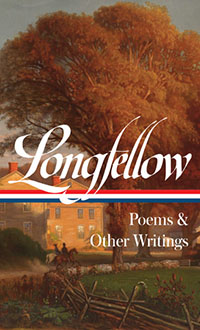
From Henry Wadsworth Longfellow: Poems & Other Writings

Wayside Inn (1870), Thomas Hill, oil on canvas. Image courtesy of the Skinner Auctioneers website.
Inspired by Chaucer and Boccaccio, Longfellow published Tales of a Wayside Inn in three parts between 1863 and 1873. Each part features a cycle of seven tales told by seven travelers staying at the Wayside Inn, established as Howe’s Tavern in 1716 and still in operation today in Sudbury, Massachusetts. Longfellow used friends as models for the characters, and the traveler who relates the tale “The Birds of Killingworth” was based on Thomas William Parsons, a now-forgotten poet who was the first American translator of Dante’s Inferno. It is not surprising, then, that the tale’s prophetic hero, the Preceptor, is also a poet—but, as Christoph Irmscher points out in a recent study, the “satire cuts both ways, and it is characteristic of [Longfellow’s] deflated view of authorship that his stand-in, the poet, would not be exempted from his mockery.”

“The Birds of Killingworth” is the only episode in Tales of a Wayside Inn that Longfellow had not adapted from an older textual source. For many years readers suggested that Longfellow might have likewise based this tale, describing the massacre of pestilent birds by the citizens of the town in Connecticut, on some forgotten legend or historical incident. Shortly after Longfellow’s death a literary sleuth wondered whether the tale originated on the other side of the Atlantic, since Killingworth got its name from Kenilworth, in England. A letter was sent to Kenilworth’s town clerk, and the reply appeared in The New York Evening Post:
[I] looked in the record of town votes, supposing the town gave a bounty for killing certain birds and animals, but I did not find any vote. One thing I know by actual knowledge. When I was young, say fourteen years, the men in the northern part of the town did yearly, in the spring, choose two leaders and then the two sides formed. Their rules were: The side that got beaten should pay the bills. Their special game was the hawk, the owl, the crow, the blackbird, and any other bird considered to be mischievous in pulling up corn and the like.
Convinced that this account was more than a coincidence, the editors of the 1886 Riverside Edition of Longfellow’s writings referred to this letter in a note to the poem, and subsequent editions repeated this explanation for decades. But in 1890 American Notes and Queries published a note from Samuel Longfellow (Henry’s brother), saying that he had “found among his [brother’s] papers a newspaper cutting—a report of a debate, in the Connecticut Legislature, upon a bill offering a bounty upon the heads of birds believed to be injurious to the farmers; in which debate, a member from Killingworth took part. The name may have taken his fancy, and upon this slight hint he may have built up his story.”

And there the matter rested until, prompted by Longfellow’s centenary in 1907, British librarian and journalist William E. A. Axon reported in The Nation that, a year before Longfellow died, he had written to him, asking “whether this narrative had any basis of fact or was merely the fantasy of a poetic brain”—and the great poet himself had replied. Thus, a quarter century after his death, Longfellow himself confirmed for readers what his brother’s discovery had suggested:
The poem is founded on fact. Killingworth is a farming town, on Long Island Sound, in the State of Connecticut. Some years ago there was an animated debate in the State Legislature, and the birds were doomed, as stated in the poem. Of course, the details of the poem are my own invention, but it has substantial foundation of fact.

Notes: The Saxon Cædmon, mentioned in the first stanza, is the earliest English poet known by name; he flourished in the seventh century. The reference to St. Bartholomew on page 445 is to the Saint Bartholomew’s Day Massacre in 1572, which resulted in the deaths of thousands of French Huguenots in Paris and elsewhere.

*   *   *
If you don't see the full selection below, click here (PDF) or click here (Google Docs) to read it—free!

This selection may be photocopied and distributed for classroom or educational use.

Friday, March 8, 2013

The Ballad of the Brown Girl

Countee Cullen (1903–1946)
From Countee Cullen: Collected Poems

In “Criteria of Negro Art,” a speech delivered at the 1926 NAACP conference, W.E.B. Du Bois extolled the “the growing recognition of Negro artists” and shared the following anecdote: “A professor in the University of Chicago read to a class that had studied literature a passage of poetry and asked them to guess the author. They guessed a goodly company from Shelley and Robert Browning to Tennyson and Masefield. The author was Countée Cullen.”*

Du Bois, like other (mostly older) black writers of the era, was thrilled by the prospect that a new generation of writers would help overcome the stereotypes and conventions of minstrel shows, black plantation dialect, and Uncles Remus and Tom. But many younger writers, such as Cullen’s friend Langston Hughes, worried that the pendulum was swinging too far in the other direction, decrying “the urge within the race toward whiteness, the desire to pour racial individuality into the mold of American standardization.” As Major Jackson writes in the introduction to the just-published and (surprisingly) first-ever edition of Cullen’s collected poems, his reputation as “the Black Keats” was a mixed blessing in a decade that had “begun to favor . . . the raw potential of black vernacular forms over seemingly exhausted Anglo-American gentilities.”

The Ballad of the Brown Girl is a good example of Cullen’s debt to time-honored forms. It was published in 1927 as a small booklet, a format that emphasized “the book’s traditional structure as a medieval ballad,” notes Charles Molesworth in a recently published biography. The original legend on which the poem is based actually features two women with hair of different color, but Cullen altered the descriptions to suggest they are of different races. Molesworth also quotes a letter from Cullen that provides more detail about the origin of the poem: “My latest endeavor is a ballad, quite a gruesome affair with no less than three murders in it. It is founded on an old song which every colored Kentuckian knows.”

This quote inadvertently reveals a biographical detail about Cullen himself. Throughout his life, Cullen often maintained that he was born and raised in New York City, but he was probably born Countee Lucas in Louisville, Kentucky. When he was nine, his mother sent him to live with a family friend (possibly his grandmother) in the Bronx. His new caretaker died when Countee was fourteen and he was adopted by Reverend Frederick A. Cullen, pastor of the vast and influential Salem Methodist Church in Harlem. Excelling in high school and later at NYU and Harvard, the young writer would go on to publish all his books as Countee Cullen (although he signed all his correspondence as Countée and pronounced his name “Coun-tay”).

* Two years later, in 1928, Cullen married Du Bois’s daughter in an extravagant Harlem ceremony attended by thousands of well-wishers and officiated by Cullen’s adopted father. The marriage was a catastrophe; Cullen was beginning to acknowledge he was attracted to men and, after living together for only a few months, the couple divorced in 1930.

About the illustrator: The 1927 edition of The Ballad of the Brown Girl features a centerfold illustration by Charles Cullen, who illustrated several of Countee Cullen’s books. The illustration is included in the PDF for with this week’s selection. Not related to Countee, Charles was a familiar presence in Harlem during the 1920s and was later described (with typical snideness) by the artist Richard Bruce Nugent as “White, blonde, and insipid.”

Oh, this is the tale the grandams tell
In the land where the grass is blue,
And some there are who say ’tis false,
And some that hold it true. . . . This story is no longer available. Read other recent selections from Story of the Week.

Saturday, November 17, 2012

Three Poems

Signs of the Times, Compensation, & When Malindy Sings
Paul Laurence Dunbar (1872–1906)

From American Poetry: The Nineteenth Century

Paul Laurence Dunbar on horseback, c. 1900. (Ohio History Collection)
Born in Dayton, Ohio, seven years after the end of the Civil War to two former Kentucky slaves, Paul Laurence Dunbar was initially educated by his mother, who encouraged his early interest in literature. (His father, who escaped to Canada before the war and served with the Massachusetts 55th Regiment, divorced his mother soon after his birth and died when Paul was only twelve.) Dunbar was the only black student in his class at Dayton’s Central High, where he was editor of the school paper and the class poet. While he was still in school, he founded a paper, the short-lived Dayton Tattler that supported the Republican Party and covered the concerns of African Americans. The friend and classmate who operated the printing press was none other than future aviator Orville Wright.

Over the next few years, Dunbar worked as an elevator operator and, briefly, as a clerk to Frederick Douglass in Chicago. In 1893 Dunbar self-published his first collection of poems; he hand-sold every copy, and earned back his investment. Two years later, this time sponsored by white patrons, his second book, Majors and Minors, was published by a regional printer and eventually fell into the hands of William Dean Howells, the influential editor, novelist, and critic. Howells wrote an appreciation in Harper’s Magazine, praising Dunbar as “the only man of pure African blood and of American civilization to feel the negro life aesthetically and express it lyrically.” (Many commentators made much of the fact that Dunbar’s ancestry was wholly African rather than multiracial.)

The review made Dunbar suddenly—and unexpectedly—famous. Overwhelmed with gratitude, the young poet wrote Howells:
Now from the depths of my heart I want to thank you. You yourself do not know what you have done for me. I feel much as a poor, insignificant, helpless boy would feel to suddenly find himself knighted. . . .
In the collection that Howells reviewed, the “majors” were the poems written in standard English; the “minors” were dialect pieces, many of them humorous. When Howells revised his essay for the introduction of Dunbar’s third book, Lyrics of Lowly Life (1896), he made clear which he preferred:
In nothing is his essentially refined and delicate art so well shown as in these [dialect] pieces. . . . Some of [the poems in literary English] I thought very good, and even more than very good, but not distinctively his contribution to the body of American poetry. What I mean is that several people might have written them; but I do not know any one else who could quite have written the dialect pieces.
The result of Howell’s recommendation was popular demand for Dunbar’s trademark dialect poems; he soon found it difficult to publish anything else. Nevertheless, before his life was cut short by tuberculosis at the age of thirty-three, he managed to publish a dozen volumes of poetry, four collections of short stories, and four novels, and he wrote the lyrics for In Dahomey, a minstrel- and vaudeville-influenced comedy that was the first full-length Broadway musical composed and performed by African Americans.

Below we present three of Dunbar’s poems: the Thanksgiving poem “Signs of the Times,” which a contemporary reviewer described as “an excellent example of Mr. Dunbar’s roguish humor”; “Compensation,” a superlative example, in two short stanzas, of his verse in non-dialect English; and one of his most famous poems, “When Malindy Sings,” a tribute to his mother, Matilda.

*   *   *

If you don't see the full selection below, click here (PDF) or click here (Google Docs) to read it—free!

This selection may be photocopied and distributed for classroom or educational use.

Friday, July 1, 2011

Immigrant Picnic

Gregory Djanikian (b. 1949)
From Becoming Americans: Four Centuries of Immigrant Writing

Gregory Djanikian’s poetry explores topics as wide-ranging as his boyhood in Egypt, the Armenian genocide of 1915, and the intersection of family, history, and culture. In other poems, such as “I Ask My Grandmother If We Can Make Lahmajoun,” “In the Elementary School Choir,” and “How I Learned English,” he takes a lighthearted but perceptive look at the American immigrant experience and the joys and frustrations of “that great melting pot that is the English language.” These themes also come together in “Immigrant Picnic,” one of his most popular poems, about a Fourth of July family gathering during which mangled English results in exuberant hilarity. When he appeared last year on PBS Newshour, he remarked on how “for many of us who have come from different countries, our difficulties with American idioms often lead to unexpected syntactic constructions and surprising turns of phrase which enrich the language and by which we all are enriched.”

*   *   *
If you don't see the full story below, click the right button at the top of the reader to view the story in Google Docs or click here (PDF) to read it—free!

This selection is used by permission.
To photocopy and distribute this selection for classroom use, please contact the Copyright Clearance Center.

Friday, May 20, 2011

Sunday Morning

Wallace Stevens (1879–1955)
From American Religious Poems: An Anthology by Harold Bloom

In the November 1914 issue of Poetry, Harriet Monroe wrote about one of the contributors: “Mr. Wallace Stevens [is] unknown as yet to the editor.” The following year, after she accepted another of his poems, “Sunday Morning,” for publication, Stevens would write to her the simplest of biographical notes. “I was born in Reading, Pennsylvania, am thirty-five years old, a lawyer, reside in New York and have published no books.” With the confidence of an editor dealing with a new author, Monroe would print only five of the poem’s eight stanzas, rearranging their order and altering the wording.

Eight years later, Stevens would finally publish the original poem—with all eight stanzas intact and restored—in his first book, Harmonium (1923). In the meantime, his poems and plays had achieved moderate notice from writers and critics; in 1916 he won a $100 prize for best one-act play in verse, Three Travelers Watch a Sunrise (staged by the Provincetown Players in 1920 for one performance), and his poetry had been published in a number of “little” magazines and reprinted in a scattering of anthologies. Yet, other than a few notices (incuding a positive review by Marianne Moore), Harmonium was largely overlooked and, in a letter to Monroe, Stevens indicated that his “royalties for the first half of 1924 amounted to $6.70.” Undoubtedly discouraged, Stevens wrote relatively little during the next few years, earning his living at the Hartford Accident and Indemnity Company (he would become its vice-president in 1934).

Nearly a century later many readers regard “Sunday Morning” as among the best of Stevens’s poems (as the scholar Robert Rehder puts it: “Stevens wrote many poems as good as this, but none better”). It was recommended as a Story of the Week selection by Richard Palma, a poetry lover from Jackson Heights, New York, who perceptively summarizes its themes: “drawing images from ancient mythology and the New Testament, the poem glories in ancient pagan rites and insists that beauty must be found in our ever-changing, ephemeral, perishing world.”

“Sunday Morning” opens with a description of a woman lazing in her dressing gown (peignoir). “In that comfort, that complacency or lack of urgency due to her presumed station in society,” critic Harold Bloom writes, “she is able to muse, to ‘dream a little’ on religious matters. So genteel are her environs that even the bloody Crucifixion becomes the ‘holy hush of ancient sacrifice.’ Her comfort seems to ‘dissipate’ the reverence of a Sunday. . .” The remainder of the poem is a meditation on her meditation; the woman “speaks” twice in the poem but the stanzas, notes Rehder, “record her thoughts and feelings—part meditation, part daydream.” She ponders and questions her beliefs—much as Stevens during his lifetime had questioned his own religious heritage.

*   *   *
Complacencies of the peignoir, and late
Coffee and oranges in a sunny chair,
And the green freedom of a cockatoo
Upon a rug mingle to dissipate
The holy hush of ancient sacrifice. . . .
If you don't see the full poem below, click the right button at the top of the reader to view the file in Google Docs or click here (PDF) to read it—free!

This selection may be photocopied and distributed for classroom or educational use.

Friday, May 28, 2010

World War II

Edward Field (1924–2026)
From Poets of World War II

Second lieutenant Edward Field (bottom row, second from right) with other members of the 384th Bombardment Group. Courtesy of the author.
This Memorial Day, as we remember Americans who died while in military service, we call upon an eyewitness to one of the many tragedies (“a minor accident of war”) during World War II.

A second lieutenant in the 8th Air Force, Edward Field served in Europe as a navigator for heavy bombers. During the period he was flying missions over Germany, he frequented the Officers’ Club in the evenings to relax and there met Coman Leavenworth, his “first poet ever,” and he soon began writing poetry himself. After the war, Field’s first published poem appeared in London’s Poetry Quarterly, but he never saw the issue containing it until a friend tracked down a copy for him almost six decades later. It was not until 1963 that his first collection of poetry, Stand Up, Friend, With Me, was published and was chosen as the year’s Lamont Poetry Selection.

“World War II,” which appeared in 1967, looks back a quarter of a century, remembering those who died and recalling the “time I believed in being heroic, in saving the world, / even if, when opportunity knocked, / I instinctively chose survival.” In a recent interview, Field summarized the background of the poem:
The European war ended just before I completed my tour of duty. On twenty-five missions, I'd helped bomb numerous historic cities. I had five planes destroyed by flak under me. That meant forced landings at any airport we could get to, but once, we had to ditch our plane in the North Sea, as I've described in a poem called, “World War II.”

*   *   *
It was over Target Berlin the flak shot up our plane
just as we were dumping bombs on the already smoking city
on signal from the lead bomber in the squadron. . . .
If you don't see the full poem below, click here (PDF) or click here (Google Docs) to read it—free!

This selection is used by permission.
To photocopy and distribute this selection for classroom use, please contact the Copyright Clearance Center.