From Herman Melville: Pierre, Israel Potter, The Piazza Tales, The Confidence-Man, Billy Budd, & Uncollected Prose
Interesting Links
“Walking Tour: Herman Melville's Downtown New York City” (Elizabeth Kray, Academy of American Poets)
“Herman Melville and Nathaniel Hawthorne first meet” (Library of America)
Previous Story of the Week selections
• “The Fiddler,” Herman Melville
• ““The Deacon’s Masterpiece: or the Wonderful ‘One-Hoss-Shay,’” Oliver Wendell Holmes
• “Rip Van Winkle,” Washington Irving
• “Peter,” Willa Cather
Buy the book
 Herman Melville: Pierre, Israel Potter, The Piazza Tales, The Confidence-Man, Billy Budd, & Uncollected Prose
1,478 pages
List price: $50.00
Save 40%
Web store price: $30.00
“Walking Tour: Herman Melville's Downtown New York City” (Elizabeth Kray, Academy of American Poets)
“Herman Melville and Nathaniel Hawthorne first meet” (Library of America)
Previous Story of the Week selections
• “The Fiddler,” Herman Melville
• ““The Deacon’s Masterpiece: or the Wonderful ‘One-Hoss-Shay,’” Oliver Wendell Holmes
• “Rip Van Winkle,” Washington Irving
• “Peter,” Willa Cather
Buy the book
Herman Melville: Pierre, Israel Potter, The Piazza Tales, The Confidence-Man, Billy Budd, & Uncollected Prose1,478 pages
List price: $50.00
Save 40%
Web store price: $30.00
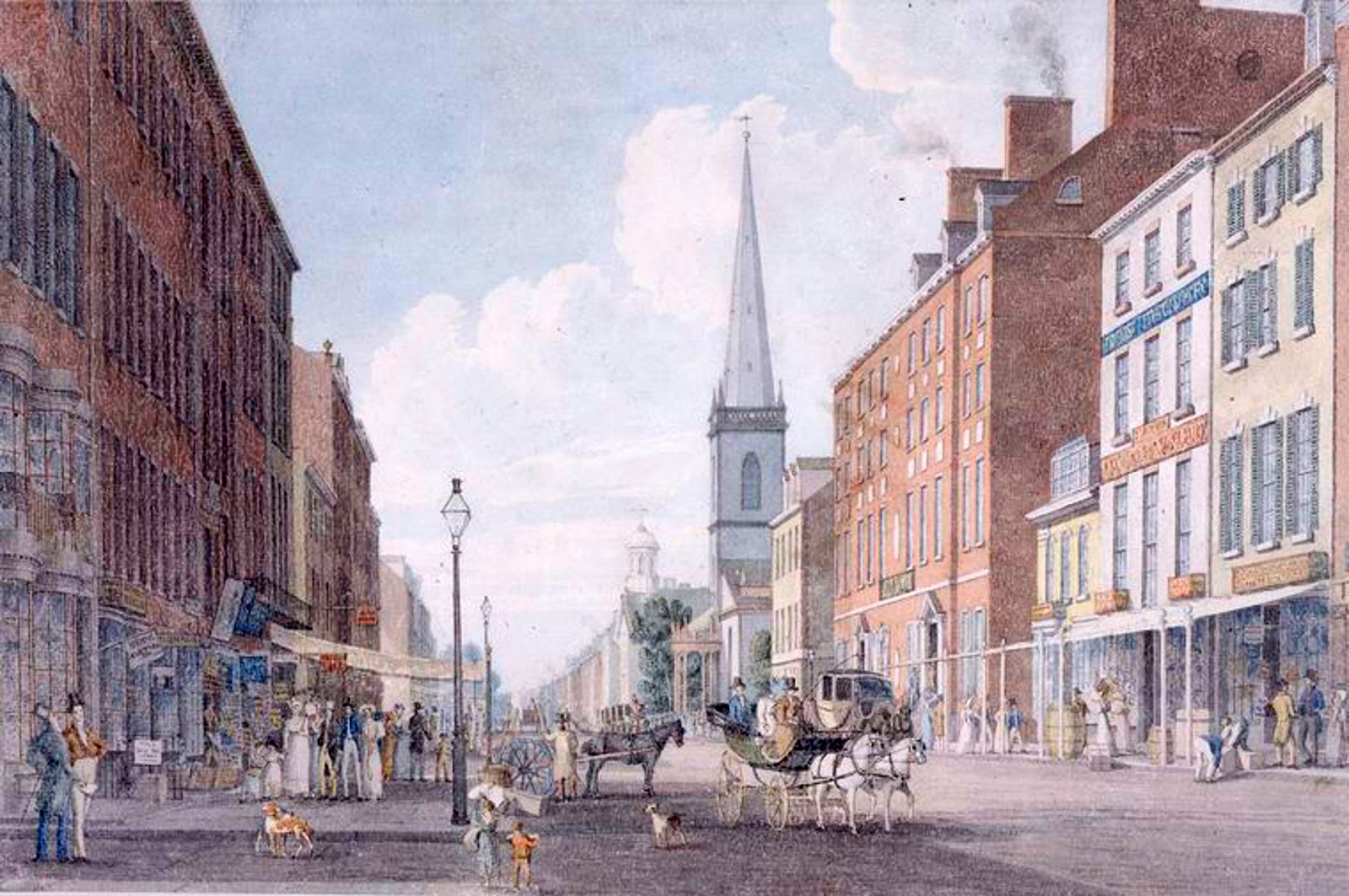 |
| “Broadway and Trinity Church” (looking south from Liberty Street; Grace Church in the distance), 1830, watercolor by John William Hill (1812–1879). New York Public Library. |
They say that in his prime,
Ere the pruning-knife of Time
Cut him down,
Not a better man was found
By the Crier on his round
Through the town.
But now he walks the streets,The elderly man had become something of an eccentric figure, dressed in his “old three-cornered hat / And the breeches, and all that.” A half century later, in an afterword for a limited illustrated edition of the poem, Holmes revealed the identity of the townsman who inspired it:
And looks at all he meets
Sad and wan,
And he shakes his feeble head,
That it seems as if he said,
“They are gone.”
The Poem was suggested by the sight of a figure well known to Bostonians of the [early 1830s], that of Major Thomas Melvill, “the last of the cocked hats,” as he was sometimes called. The Major had been a personable young man, very evidently, and retained evidence of it in “the monumental pomp of age”—which had something imposing and something odd about it for youthful eyes like mine. He was often pointed at as one of the “Indians” of the famous “Boston Tea-Party” of 1774. His aspect among the crowds of a later generation reminded me of a withered leaf which has held to its stem through the storms of autumn and winter, and finds itself still clinging to its bough while the new growths of spring are bursting their buds and spreading their foliage all around it.Thomas Melvill was Herman Melville’s grandfather, and Oliver Wendell Holmes was Melville’s neighbor in Pittsfield, Massachusetts. Melville must have known of the poem, which was ubiquitous within a few years of its publication, and of its association with his grandfather. Although the story “Jimmy Rose” is set in New York rather than Boston, both “The New Leaf” and Melville’s own memories of his grandfather almost certainly served as inspirations. In the poem, Holmes writes that his “grandmamma” said Major Melvill’s “cheek was like a rose / In the snow”; in Melville’s story, “the most touching thing of all” about Jimmy Rose “were those roses in his cheeks”—a characteristic repeated several times. Jimmy becomes an old relic who has lost the fame of his youth, and he grows “somewhat musty, smacking of cocked hats and small clothes”; the italicized phrase, occasionally used by writers to describe veterans of the Revolutionary era, is one Melville would use again, at a later date, to describe his grandfather’s costume.
William Dillingham, in his study Melville’s Short Fiction 1853–1856, first detailed the similarities between the poem and the story and between Melville’s grandfather and Jimmy Rose. Yet, Dillingham points out, Jimmy is not only “a man whom time has passed by” but also a bankrupt, and Herman Melville “had known both types in his own family.” His father, Allan Melville, was a wealthy merchant whose career ended with insolvency. Likewise, his uncle Thomas Melvill, Jr., had been a success in France before a series of reversals forced him to return to Massachusetts and eke out a living on the family farm in Pittsfield, “reduced as a refugee, to humble employment in a region far from the gilded Versailles,” as Herman would later put it.
In the summer of 1850, Melville and his wife rented his late uncle’s lodgings from the new owners, who had renamed the place “Broadhall.” (The estate adjoined Arrowhead, the property purchased by Melville later that year with funds provided by his father-in-law.) The scholar Merton M. Sealts has pointed out that Melville’s descriptions of his uncle’s farmhouse are similar in wording to passages about the interior of Jimmy Rose’s home in downtown New York. “Though in [the story] the ‘great old house’ described in the opening paragraphs is given an urban rather than a rural setting,” notes Sealts, “its identity with Broadhall is unmistakable.” Other scholars have pointed out how the “lower wards” around Jimmy’s place “in C———— Street” resemble the neighborhood of Melville’s childhood home in New York, located at 55 Courtlandt Street (later Cortlandt Street, and currently the site of the World Trade Center).
In this story, then, Herman Melville was “probing his own life, . . . his familial past,” writes Dillingham. “The old house is a composite of Melville homes, and Jimmy Rose is a composite of Melville’s father, uncle, and grandfather.” But Jimmy is one of two characters featured in the story: his downfall and later life is witnessed and narrated by yet another old man, William Ford, who exhibits both an ambivalence toward Jimmy’s pathetic, bygone glory and an anxiety that he, too, will become “the last leaf.”
Notes: The first sentence of “Jimmy Rose” echoes the opening of the first chapter of Moby-Dick (1851): “Call me Ishmael. Some years ago—never mind how long precisely— . . .”
Nikolaus I, Prince Esterházy, was an eighteenth-century Hungarian prince remembered for his ornate style and clothing and for his patronage of the composer Joseph Haydn. Cosmo the Magnificent is Melville’s conflation of the fourteenth-century Italian banker Cosimo de’ Medici and his fifteenth-century grandson Lorenzo de’ Medici, also known as Lorenzo the Magnificent.
The compliment Jimmy “plagiarizes” when he flatters the general was allegedly made by Napoleon when he presented two jeweled pistols to Moreau: “The beauty of the pistols was greatly admired. ‘They appear very apropos.’ observed the First Consul, as he presented them to Moreau; and then turning to the Minister without alluding to their original object, he said, ‘but, Citizen Minister, here is a grand omission: Cause some of the victories gained by General Moreau to be engraven upon them. Do not order them all to be engraved, for it would be necessary to take off too many of the diamonds.’” (The Life of Napoleon Buonaparte, by Willem Lodewyk Van-Ess, 1810).
One of the narrator’s acquaintances suggest they go to “the Coffee-house” and arrange “a sleighing party to Cato’s.” The former establishment was probably Tontine Coffee House, the birthplace of the New York Stock Exchange, which from 1817 to 1834 had been converted into a tavern (and later a hotel). Cato’s Tavern, owned by Cato Alexander, was more than four miles to the north (now 54th Street and 2nd Avenue). Alexander, who had been freed from slavery, probably in 1799, opened his tavern in the early 1800s and served a largely white, often upscale clientele; in 1860, it was remembered as “the fashionable out of town resort for the young men of the day. . . . In sleighing times, it was almost impossible to obtain accommodation for the crowds that frequented the house.” Bad loans and investments forced Alexander to sell his building in the mid-1840s. In 1852 he opened an oyster saloon downtown, at 556 Broadway (in present-day SoHo); it closed within a year.
Nikolaus I, Prince Esterházy, was an eighteenth-century Hungarian prince remembered for his ornate style and clothing and for his patronage of the composer Joseph Haydn. Cosmo the Magnificent is Melville’s conflation of the fourteenth-century Italian banker Cosimo de’ Medici and his fifteenth-century grandson Lorenzo de’ Medici, also known as Lorenzo the Magnificent.
The compliment Jimmy “plagiarizes” when he flatters the general was allegedly made by Napoleon when he presented two jeweled pistols to Moreau: “The beauty of the pistols was greatly admired. ‘They appear very apropos.’ observed the First Consul, as he presented them to Moreau; and then turning to the Minister without alluding to their original object, he said, ‘but, Citizen Minister, here is a grand omission: Cause some of the victories gained by General Moreau to be engraven upon them. Do not order them all to be engraved, for it would be necessary to take off too many of the diamonds.’” (The Life of Napoleon Buonaparte, by Willem Lodewyk Van-Ess, 1810).
One of the narrator’s acquaintances suggest they go to “the Coffee-house” and arrange “a sleighing party to Cato’s.” The former establishment was probably Tontine Coffee House, the birthplace of the New York Stock Exchange, which from 1817 to 1834 had been converted into a tavern (and later a hotel). Cato’s Tavern, owned by Cato Alexander, was more than four miles to the north (now 54th Street and 2nd Avenue). Alexander, who had been freed from slavery, probably in 1799, opened his tavern in the early 1800s and served a largely white, often upscale clientele; in 1860, it was remembered as “the fashionable out of town resort for the young men of the day. . . . In sleighing times, it was almost impossible to obtain accommodation for the crowds that frequented the house.” Bad loans and investments forced Alexander to sell his building in the mid-1840s. In 1852 he opened an oyster saloon downtown, at 556 Broadway (in present-day SoHo); it closed within a year.
* * *
A time ago, no matter how long precisely, I, an old man, removed from the country to the city, having become unexpected heir to a great old house in a narrow street of one of the lower wards, once the haunt of style and fashion, full of gay parlors and bridal chambers; but now, for the most part, transformed into counting-rooms and warehouses. . . . If you don't see the full selection below, click here (PDF) or click here (Google Docs) to read it—free!This selection may be photocopied and distributed for classroom or educational use.

