Showing posts with label Thornton Wilder. Show all posts

Sunday, November 9, 2025

Something I’ll Tell You Tuesday

John Guare (b. 1938)
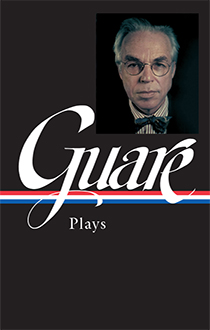
From John Guare: Plays

Entrance of Caffe Cino, 31 Cornelia Street, in the West Village of Manhattan, 1965. Photo by James D. Gossage. The poster advertises Lanford Wilson’s short play This Is the Rill Speaking. Guare’s first production there, A Day for Surprises, was staged in August 1965; Something I’ll Tell You Tuesday and The Loveliest Afternoon of the Year were performed as a double bill in October 1966. Image from NYC LGBTQ Historic Sites Project.
Boris Karloff and Jean Arthur starred on Broadway in the 1950 Leonard Bernstein musical adaptation of Peter Pan, and John Guare, a stagestruck twelve-year-old boy from Queens, attended a performance. During the production, as John Lahr tells us in his introduction to the just-published Library of America volume of Guare’s plays, Arthur, cast as Peter Pan, approached the edge of the stage and “urged the audience to keep Tinkerbell alive by clapping.” Guare was stunned. “I wondered,” he recalled. “Did this happen at every performance or is this just now? It was so shocking the way she stopped the play and spoke to us. It was a revelation.”

His subsequent exposure to the plays of Thornton Wilder confirmed the dramatic possibilities presented by breaking the fourth wall. “I remember the revelation when, as a boy, I read Thornton Wilder’s Our Town. The Stage Manager says: ‘See that boy. He will be killed in the war.’ And there’s no boy onstage, of course. So I realized you are not bound by four walls. That simple, direct address across the stage creates a whole life and death for an audience.”

From the very beginning of Guare’s career, Wilder was a major influence. In an introduction to a collection of Wilder’s shorter plays, Guare asked, “What do we do with this man who was a playwright, novelist, actor, teacher, musician, essayist, translator, adaptor, opera librettist and screenwriter (for what some people think is Hitchcock’s finest film, Shadow of a Doubt)?” He continued:
Thornton Wilder is so hard to get a handle on because he embodies the basic American dilemma. In the enormous mass of America, where do we go for experience?

One Thornton lived in Hamden, Connecticut, on Deepwood Drive with forays into New Haven for lunch and the library, and wrote about New Hampshire and New Jersey and Rhode Island. The other Thornton summoned up the Ice Age and Atlantic City in high extravagance, peopled with philosophers who spoke in ancient Greek and Latin and Hebrew, and wrote novels of ancient Rome, and traveled to Europe and America receiving prizes and acclaim.
“What Guare got from Wilder were practical ways to transfer into straight plays the theatricality he loved in the musicals he started seeing as a child,” remarked dramaturg Michael Paller in a recent interview. “He was attracted to plays that didn’t just imitate the way the surface of our everyday world looks, sounds, and operates.” Or, as Guare put it more bluntly to a New York Times critic in 1999, “Naturalism kills; it’s deadly to the theater.”

In 1961, while enrolled at the Yale School of Drama, Guare finished the short play The Happy Journey from 58th St. and Ninth Avenue to 59th St. and Eighth Avenue, a work inspired by Wilder’s one-act play The Happy Journey from Trenton to Camden. Four years later, Guare revised the play and retitled it Something I’ll Tell You Tuesday. The stage directions call for few design elements beyond a chair or two and only a small number of props. Wilder’s influence remains strongly evident throughout, particularly his departure from the scenic realism of most American drama and, harking back to the Greeks and Elizabethans, his adoption of multiple theatrical conventions from these precursors, including the bare stage. When Agnes and Andrew move from the street to the coffee shop simply by sitting in chairs and miming the drinking of coffee, Guare is evoking the scene in Our Town when Emily and George similarly enter Mr. Mogan’s drugstore and sit at the soda fountain, represented by two stools and a board laid across two chairs.

Something I’ll Tell You Tuesday made its “off-off-Broadway” debut on October 25, 1966, at the storied Caffe Cino, part of a double bill that also featured the debut of The Loveliest Afternoon of the Year, another of Guare’s one-act plays. The venue “could hold about 45 people and was officially full when two people were seated on top of the cigarette machine,” recalls Magie Dominic, one of the actor-directors who performed there. The “stage,” such as it was, was an eight-square-foot wooden platform placed on the floor, which perfectly suited the bare sets required for Guare’s early plays. Established near the end of 1958 by Joe Cino as a coffeehouse and a place for art exhibits, “The Cino,” as it was known, began hosting poetry readings and, eventually, plays and sketches featuring gay themes by such future prominent playwrights as Tom Eyen and Lanford Wilson. By the mid-1960s, the venue attracted such new playwrights as Guare and Sam Shepard and helped launch the careers of such celebrated actors as Bernadette Peters, Harvey Keitel, and Al Pacino.

Note: The Collyer brothers, Homer and Langley, were reclusive hoarders who in the spring of 1947 were found dead in their Harlem townhouse.

*   *   *
The action of the play is the West 59th Street block between Eighth and Ninth avenues in New York City on a pleasant April day, . . . If you don't see the full selection below, click here (PDF) or click here (Google Docs) to read it—free!

This selection is used by permission.
To photocopy and distribute this selection for classroom use, please contact the Copyright Clearance Center.

Sunday, April 13, 2025

Mozart and the Gray Steward

Thornton Wilder (1897–1975)
From Thornton Wilder: Collected Plays & Writings on Theater

Mozart Composes the Requiem, 1854, oil on canvas by English artist William James Grant (1829–1866). Research Gate / CC BY-NC 4.0
Wolfgang Amadeus Mozart died at the age of thirty-five on December 5, 1791, and within months rumors began spreading about his life, his music, and especially his death. Perhaps no story, however, captured the public imagination more than the mystery surrounding his unfinished Requiem, the work he was composing during his final weeks. And no part of that story spawned more speculation than the messenger who brought from an anonymous patron the commission and partial payment for the work. In 1828, when the British poet Felicia Hemans published her poem, “Mozart’s Requiem,” she included a note summarizing the version of his death that seemed most prominent among English-speaking audiences:
A short time before the death of Mozart, a stranger of remarkable appearance, and dressed in deep mourning, called at his house and requested him to compose a requiem, in his best style, for the funeral of a person of distinction. The sensitive imagination of the composer (who was at the time out of health) immediately seized upon the idea that this was an omen of his own decease, and that the requiem would be for himself. The nervous excitement under which he laboured to complete the task, produced the effect of realizing this impression, and the music was actually performed at his interment.
Hemans’s poem presumed that the requiem was ultimately written for the composer’s own death and that the exhaustion of creating it killed him. Across the Atlantic two years earlier, Rufus Dawes published a poem, also titled “Mozart’s Requiem,” which included stanzas imagining that the messenger was Death itself:
He was tall, the stranger who gazed on him
     Wrapped high in a sable shroud
His cheek was pale, and his eye was dim,
And the melodist trembled in every limb,
     The while his heart beat loud.

“Mozart, there is one whose errand I bear,
     Who cannot be known to thee;
He grieves for a friend, and would have thee prepare
A requiem, blending a mournful air
     With the sweetest melody.” . . .

Mozart grew pale when the vision fled,
     And his heart beat high with fear;
He knew ’twas a messenger sent from the dead
To warn him, that soon he must make his bed.
     In the dark, chill, sepulchre. . . .
The anonymous messenger, the unexpected death, and the celebrated requiem continued to inspire additional poems, short stories, novels, plays, and even an opera over the course of the next two centuries.* In 1856 an excerpt from Otto Jahn’s masterful biography of Mozart appeared in translation in Dwight’s Journal of Music. It described the messenger as “a stranger” to Mozart, “a tall, lean man, clad in gray, with a serious, solemn face,” and the passage cemented for English and American readers the image of a mysterious “messenger in gray.”

The reality is far more prosaic: The man supposedly clad in gray was Anton Leitgeb, a servant sent in the summer of 1791 by Count Franz Georg von Walsegg-Stuppach to commission a requiem mass in memory of his wife, Anna. Walsegg was notorious for commissioning pieces that he would then claim to have written himself—a ruse that appears to have been the worst-kept secret in Vienna—and part of the deal was that Mozart would keep mum about his involvement. Mozart received a generous and much-needed advance and would collect a final payment upon the work’s completion. Busy with other projects (including the premiere of The Magic Flute), Mozart could not start on the requiem until October; two months later he was dead. Parts of the finished work were indeed played at Mozart’s memorial service, as Hemans noted.

The challenge facing Constanze Mozart after her husband died, leaving her almost penniless, was to get one of Mozart’s former students to finish the work while convincing Walsegg that her husband was responsible for the entire piece and that the authorship was still a secret. When the work was completed and she had been paid for it, she assembled witnesses and proof that her husband wrote it (including a public performance of the entire work before Walsegg’s mass in memory of his wife), and the work was eventually accepted as Mozart’s. The contradictions in her stories both to secure payment of the commission and to retain her rights as her husband’s executor helped fuel the confusion over how one of his most famous works came to be.

A century after Dawes and Hemans published their poems, Thornton Wilder made use of the story for one of his “three-minute plays.” During the previous decade, Wilder had written about forty such playlets, most of them during his years in college. In 1928, the year after the publication of his best-known novel, The Bridge of San Luis Rey, he was able to use his new status as an international best-selling author to collect and publish sixteen of them, including four that had been written specifically for the book. One of the new pieces, “Mozart and the Gray Steward,” was the longest in the collection—a six-minute play, one might say.

Most readers in the 1920s would have been familiar with the history behind Mozart’s Requiem, yet Wilder succeeds at making the story his own. Skillfully blending both fact and legend, the playlet promotes the aesthetic ideal that underlies much of Wilder’s writing: a work, be it music, painting, or writing, becomes art not when it concerns an individual but rather (as the Gray Steward says) when it gives “a voice to all those millions . . . who have no one but you to speak for them.” In a 1940 journal entry, Wilder elaborated:
The emotion of a Mr. C. D. Forrester of Portland, Oregon, over the death of his daughter, his dog, or the soldiers of Finland does not concern the citizens of the United States, however sincere they are. If he were a great artist the expression of his emotion might concern us all, but not by reason of the object mourned, but by reason of the emotion itself in its expression. Neither the mourner nor the mourned is the subject of the work of art. So beyond counting are, and have been, and will be, the subjects of pity that to emphasize one example—either as object or as agent—is to offend the law of proportion and to intrude an egotism. By art the emotion is raised to the plane of generalization and all mourners and all sufferers are included.

This is the meaning of my definition: a poet is one who realizes the separate existence of a million souls. . . .
Or, as Wilder famously told a reporter in 1961, “I am not interested in the ephemeral—such subjects as the adulteries of dentists. I am interested in those things that repeat and repeat and repeat in the lives of the millions.” He believed that the theater offered a unique opportunity to transform specific people and events into art. As he wrote in a preface to one of his books, “It is through the theatre’s power to raise the exhibited individual action into the realm of idea and type and universal that it is able to evoke our belief.”

* The works inspired by Mozart’s Requiem include, of course, Amadeus, the 1984 film directed by by MiloÅ¡ Forman, which imagines that the mysterious messenger was Mozart’s archrival, Antonio Salieri. The film’s fictional plot caps a long tradition; it was adapted from an 1897 opera by Nikolai Rimsky-Korsakov, which was inspired in turn by an 1831 play by Alexander Pushkin.

For more information about Thornton Wilder’s three-minute plays, see the introduction for “The Angel That Troubled the Waters,” a previous Story of the Week selection.

*   *   *

Note: The Italian composer Antonio Salieri was appointed the director of the Italian opera by the Habsburg court, a post he held from 1774 until 1792. Some of Mozart’s letters earlier in his career complain of Salieri’s treatment; the perceived rivalry between the two composers was greatly exaggerated after Mozart’s death and eventually led to rumors that Salieri had poisoned him.

*   *   *
Mozart is seated at a table in a mean room in Vienna orchestrating the “Magic Flute.” Leaves of ruled paper are strewn about the floor. His wife enters in great excitement. . . . If you don't see the full selection below, click here (PDF) or click here (Google Docs) to read it—free!

This selection may be photocopied and distributed for classroom or educational use.

Sunday, April 10, 2022

Eddy Greater

Thornton Wilder (1897–1975)
From Thornton Wilder: The Bridge of San Luis Rey & Other Novels 1926–1948

Detail from Soubrette, 1883, oil on canvas by British artist Alexander Mann (1853–1908). Courtesy of Bonhams. Click on image to see full painting. Wilder’s short story features “Eddy Greater, the soubrette of the seventies, who was in the height of her fame during the years of Sebastian Torr’s last illness.” Originating in French comedy, a soubrette was often a flirtatious, cheeky chambermaid or servant in nineteenth-century opera and musical theater.
In 1961 a group of Yale alumni, faculty members, and students went through the 32,000 pages published in the Yale Literary Magazine (“the Lit”) during its first 125 years and winnowed the material down to 150 pages showcasing 67 of the best stories, essays, poems, and other short pieces written by the college’s undergraduates. Among the contributors to the collection, titled Art and Craftsman, are the novelist Sinclair Lewis, the short story writer Thomas Beer, and the poets Archibald MacLeish and Stephen Vincent BenĂ©t, each of whom were represented by two selections. The book also included two works by Thornton Wilder, the first and last pieces he published in the magazine during his student years. The first, from the October 1917 issue, was one of his so-called three-minute plays, “The Angel on the Ship,” later included in the 1928 collection The Angel That Troubled the Waters and Other Plays. The second selection, from the June 1920 issue, was the short story “Eddy Greater,” which had never been reprinted. Among Wilder’s other works that appeared in the Lit during his years at Yale was his first full-length play, The Trumpet Shall Sound, published in four consecutive issues. It was eventually produced off-Broadway in 1926, opened to moderately negative reviews (which Wilder considered fully justified), and ran for thirty performances.

A cursory examination of any copy of the Lit reveals what you’d pretty much expect: largely unremarkable and clichĂ©d undergraduate work. For example, in the issue containing “Eddy Greater,” which is far and away the standout selection, readers will come across the following:
Hark! The footfalls of the past!
Many a graduate at last
      Comes back to the fold.
Time has peopled with its throngs
All the walks—and Yale belongs
To the vanished, while their songs
      Echo as of old.
That bit of collegiate spirit is from the “Campus Evening Hymn,” by Thornton’s brother and senior-year roommate, Amos, who would go on to become a distinguished professor of divinity at Harvard and the author of nearly a dozen books on theology—as well as an award-winning poet. “Most writers, of course, would pay to have their earliest work destroyed, but readers are fascinated by an author’s early efforts,” wrote the late J. D. McClatchy, who edited the Library of America’s Thornton Wilder edition and who for a quarter century was the editor of the prestigious Yale Review—which most definitely has not made a habit of publishing student work. “In Thornton Wilder’s case, it’s fascinating to watch him experiment with ironic situations and sophisticated dialogue. Just like the plays he was writing as a Yale undergraduate, these early stories show him becoming himself.”

For “Eddy Greater,” Wilder returned to the character and premise of “‘Spiritus Valet’,” a story he had published two years earlier in the Lit’s rival magazine, the Courant. “The Lit was solemn, awesome, grammatical, traditional, and completely useless as a workshop, the Courant was frivolous, humble, and of the greatest use,” recalled Sinclair Lewis, who had also published his apprentice work in both magazines—“long mediaeval poems, with (O God!) ladys clad in white samite.” In “‘Spiritus Valet’,” Wilder introduces the fictional Sebastian Torr, an elusive and reclusive poet who had died many years earlier. Torr’s biographer pesters a New York City widow whom he believes is the mysterious “golden-haired lady” of Torr’s masterpiece and who must therefore have in her possession letters or even poems from the great author. When the woman decides to oblige the scholar by forging letters from Torr, she seems to be visited by the poet’s ghost. In “Eddy Greater,” all hints of the spiritual world are gone; while in London, the biographer happens upon a different woman, a former opera singer, who appears to have Torr’s journals and who might be willing to sell them.

In later writings, Wilder would explore more fully the topics he touches on in these stories: the intersection of life and art, the differences in “truth” between letters or diaries and fiction or poetry, and the chasm between literary biography and life. In his 1928 essay “On Reading the Great Letter Writers,” Wilder asks, “What would Keats or Walt Whitman or Queen Victoria say if they read their biography? Wouldn’t they cry out: But this is only one tenth of the truth; all that is really myself escaped?”

Note: The German-born French composer Jacques Offenbach was a dominant force in French theater from the 1850s to the 1870s, staging more than 100 operettas. La boĂ®te au lait (1876) and Madame Favart (1878) were two of his last productions; the latter, an extraordinary success, marked his final triumph in London before the advent of the new style epitomized by the musical comedies of Gilbert and Sullivan—a transition noted by Wilder in his story. Offenbach died in 1880.

*   *   *
The fall of 190- I spent in London collecting material for my Life and Works of Sebastian Torr for the English Sebastian Torr Society. . . . If you don't see the full selection below, click here (PDF) or click here (Google Docs) to read it—free!

This selection may be photocopied and distributed for classroom or educational use.

Sunday, April 12, 2020

New Haven, 1920

Thornton Wilder (1897–1975)
From Thornton Wilder: The Eighth Day, Theophilus North, Autobiographical Writings

Hand-colored photo of the original Dwight Hall, Yale University, ca. 1905, from a postcard produced by the Paul C. Koeber Co. “It was a center of elevating ‘discussion groups,’ prayer meetings, and social service programs,” wrote Thornton Wilder. “The members of the most sought after (that is, most exclusive) Senior society were all drawn from the leaders of Dwight Hall.” Designed by architect J. Cleaveland Cady, built in 1886, and named after former Yale president Timothy Dwight, the hall originally housed the Yale chapter of the YMCA. Eventually the umbrella organization governing the various religious and service-based campus groups that met within its walls also became known as Dwight Hall. The building was demolished in 1926.
Nearly fifty years after he graduated as a member of Yale’s Class of 1920, Thornton Wilder wrote, “My father was a stone’s throw [from] my successive rooms in the dormitories. I was very much under his eye.” A devout Congregationalist, Amos Parker Wilder was an American diplomat in Hong Kong and in mainland China from 1906 to 1914. Forced by poor health to resign his post, he moved to New Haven and eventually returned to his previous career as a journalist and public speaker. The Wilder family lived a peripatetic lifestyle, spread across several continents, separated from each other in various schools, homes, and summer programs, and sent hither and thither by the decrees and whims of their patriarch. Only Amos’s wife, Isabella, seemed able to repel his commands, and she often objected to the micromanagement of their children’s upbringing well into their adult years. He was, to use the current vernacular, an archetype of helicopter parenting.

In letters to his children, Dr. Wilder had no qualms about making comments to one sibling on the strengths and weaknesses of the others. He confided to Thornton about his older sister Charlotte: “I can never make a college president of her while she carries a basket of chips on her shoulder and is too keen in judgments.” He urged his oldest son, Amos, to apply himself more steadily because “in the years to come you will have not only yourself but some of these others, especially hopeless Thornton, to finance.” Even his wife was subject to criticism in his letters, and he complained to Thornton about her interference with his schemes for their children’s education and future careers: “Everybody has his burden; this is mine.”

“Dr. Wilder’s chess pieces did not always move willingly,” writes Penelope Niven in her recent biography of Thornton, “but, ultimately, everyone moved as he ordained.” When his four oldest children were young adults, he was still able to boast, “I usually get things I want where the welfare of my children is concerned.” Still, there were limits. In 1918, when he suggested that he would use his contacts in the diplomatic service to get his sons discharged from the military soon after the war’s end, Thornton replied tersely, “Nothing on earth can get me out of the Army that doesn’t originate in this very building so please don’t try.”

Thornton’s father sent both of his sons to Oberlin College for two years before allowing them to transfer to Yale, where he had received his undergraduate degree and a PhD. Thornton bridled at the path his father had arranged for him, writing with scorn to his older brother about “Oberlin with its compulsory chapels and prescribed Scripture-class-work and its suggested Christian endeavors, Bible-class, YMCAs, and Temperance Society.” As always, Dr. Wilder got his way, adamant that Oberlin would prepare his son to “resist the shocks” of the secular temptations lurking at his alma mater. So Thornton was shipped off to Ohio when his brother, two years older, transferred to Yale—but only after the brothers spent the summer working together without pay on a farm in Vermont, a character-building project arranged by their father. “You with your sheaf of plans won,” he wrote bitterly to Dr. Wilder in 1915, after his future had once again been decided for him.
Thornton Wilder in his senior class portrait.
Beinecke Library.

In 1916 Dr. Wilder convinced Amos to volunteer for the ambulance corps of the American Field Service rather than complete his senior year at Yale, and the young man was in France by November. A year later, after the U.S. entered the war, he enlisted in the Army. Meanwhile, in September 1917, Thornton transferred to Yale and learned that his two years’ coursework at Oberlin would only count as one, so he was enrolled as a sophomore. In September 1918 he joined the Army’s First Coast Artillery Corps stationed at Fort Adams, Rhode Island, but the war ended before he could be sent to France. He was discharged at year’s end and resumed his studies at Yale. Amos returned from Europe the following summer, and the two brothers roomed together on campus for their senior year and graduated in June 1920.

Many years later, Thornton wrote that after he graduated, “my father was faced with the problem of what to do with me. . . . I had been constantly reminded that I lacked concentration and perseverance. I was a woolgatherer. I was a dilettante.” Dr. Wilder’s short-term solution was to commit the 23-year-old to another character-building summer on a farm. But Thornton realized that the other problem was what he should do about his father. With the help of his mother and a family friend, he applied and was accepted for an eight-month residency in classical studies at American Academy in Rome. His father ultimately approved, since his son might then be able to make a living as a teacher of Latin (which, ironically, was one of three courses Thornton flunked at Yale). His escape to Europe inspired Thornton’s first novel, the critically acclaimed The Cabala (1926), about a young American who spends a year in the decadent environment of postwar Rome. The year after his debut as a novelist, his second book, The Bridge over San Luis Rey, made him a household name.

In the late 1960s, Thornton Wilder began work on a semi-autobiographical project. He “had trouble writing directly about himself, and late in life discovered that he could take incidents and occasions from his past and ‘fictionalize’ them.” J. D. McClatchy told Library of America in an interview in 2011. “The fact that he was a twin whose brother died at birth was the most riveting of these occasions and led him to write Theophilus North, which he published at age seventy-six. But he kept on writing up other facts of his life, using the basics while changing the specifics.” Wilder never completed the project, and a few unfinished chapters survive in his papers—three of which were published for the first time in Thornton Wilder: The Eighth Day, Theophilus North, Autobiographical Writings. The following fragment recalls his days at Yale, and his father—just “a stone’s throw” away—is portrayed as a larger-than-life figure in the memory of this “missionary’s son.”

*   *   *
Some of the above biographical details and all of the quotes from members of the Wilder family are from Penelope Niven’s Thornton Wilder: A Life.

Notes: Founded in 1909 at Yale, the Whiffenpoofs is the oldest collegiate acapella singing group in the U.S. The name of the group originated in Irish American composer Victor Herbert’s opera Little Nemo (1908). Die Kaiser Wilhelm Schule sogar translates as “Even the Kaiser Wilhelm School.” Dramat is the commonly used appellation for The Yale Dramatic Association

*   *   *
It was widely believed, in my time, that Yale College was attended solely by clear-eyed, clean cut, high-minded, upright, downright, forthright Christian young men; and—give a little, take a little—this was true. . . . If you don't see the full selection below, click here (PDF) or click here (Google Docs) to read it—free!

This selection is used by permission.
To photocopy and distribute this selection for classroom use, please contact the Copyright Clearance Center.

Friday, April 13, 2018

The Angel That Troubled the Waters

Thornton Wilder (1897–1975)
From Thornton Wilder: Collected Plays & Writings on Theater

The Pool of Bethesda, 1877, oil on canvas by British artist Robert Bateman (1836–1889). Wikimedia Commons.
“It is a discouraging business to be an author at sixteen years of age,” wrote Thornton Wilder at the ripe old age of thirty-one. “Such an author is all aspiration and no fulfillment. He is drunk on an imaginary kinship with the writers he most admires, and yet his poor overblotted notebooks show nothing to prove to others, or to himself, that the claim is justified.” Precocious teenagers—and he includes his younger self among them—eagerly assemble the basics (“especially the title”) of a long book, or they spend hours “adjusting the tables of contents of works they have neither the perseverance nor the ability to execute.”

Wilder made these comments in the foreword to his 1928 collection, The Angel That Troubled the Waters and Other Plays. “This book is what is left of one of these projects,” he admitted. The title was to have been Three-Minute Plays for Three Persons, and he had recently unearthed “one of my early tables of contents for it, written in the flyleaves of a First Year Algebra. Quadratics in those days could be supported only with the help of a rich marginal commentary.” Over the previous fifteen years, Wilder had written about forty such playlets, having “discovered a literary form that satisfied my passion for compression.” Wilder selected sixteen of them for the book; they were designed more to be read than performed, although several of them have been staged at various times during the last century. The book went on to sell over 10,000 copies, which is remarkable for a book of plays—especially considering it was a full decade before Wilder made his Broadway debut with Our Town.

Most of the playlets, Wilder wrote in the foreword, “are religious, but religious in that dilute fashion that is a believer’s concession to a contemporary standard of good manners.” The last four in the book, however, “plant their flag as boldly as they may.” They were also the last written, having been completed in the eighteen months before the volume’s publication. “The Angel That Troubled the Waters,” which concludes the book, was finished in June 1928, shortly after Wilder won the Pulitzer Prize for his novel The Bridge of San Luis Rey, and was inspired by the New Testament description of the Pool of Bethesda:
Now there is at Jerusalem by the sheep market a pool, which is called in the Hebrew tongue Bethesda, having five porches. In these lay a great multitude of impotent folk, of blind, halt, withered, waiting for the moving of the water. For an angel went down at a certain season into the pool, and troubled the water: whosoever then first after the troubling of the water stepped in was made whole of whatsoever disease he had. (John 5:2–4, King James Version)
The playlet depicts a visitor to the pool who must suffer in order to heal others—a theme readers will encounter again and again in Wilder’s writings.

*   *   *
The Pool.— A vast gray hall with a hole in the ceiling open to the sky. Broad stone steps lead up from the water on its four sides. . . . If you don't see the full selection below, click here (PDF) or click here (Google Docs) to read it—free!

This selection may be photocopied and distributed for classroom or educational use.

Saturday, May 3, 2014

The Drunken Sisters

Thornton Wilder (1897–1975)
From Thornton Wilder: Collected Plays & Writings on Theater

Detail from The Fates Gathering in the Stars, 1887, oil on canvas by American painter Elihu Vedder (1836–1923). (Click on image to see the full painting.) Wikimedia Commons.
In an introduction to the 1977 edition of Thornton Wilder’s The Alcestiad and The Drunken Sisters, Isabel Wilder recalled what first attracted her brother to Greek mythology in general and the myth of Alcestis in particular:
Thornton’s tapestry was minute when at the age of seven or eight in Madison, Wisconsin, he first heard the name Alcestis while reading or being read to from Bulfinch’s The Age of Fable. The story of the daughter of King Pelias, princess of princesses in the myth and the song of pre-Christian Greece, captured his imagination—and his heart.
Alcestis, whose story is most famously depicted in a tragedy by Euripides, offers her own life so that her husband, King Admetus, might be spared. Wilder first began working on a modern adaptation as early as 1938, but events intervened. (“The Alcestiad was not a play for a war-torn world,” noted his sister, who was Wilder’s agent for most of his career.) He took the manuscript with him when he was commissioned as an Air Force captain, but his papers were lost when he returned to the States towards the end of the war. He made an attempt to reconstruct the work, but eventually put it aside for nearly a decade.

At long last the play premiered at the 1955 Edinburgh Festival as A Life in the Sun, but generally unfavorable reviews led Wilder to withdraw the rights for the production. (The director admitted to the playwright, “I did not serve your play well.”) Wilder revised the play and decided to make a significant addition. A journal entry from December 1956 reveals, “How long I have aspired to write one of the lost plays of antiquity or to furnish . . . a satyr-play to a real or assumed trilogy.” Satyr plays are brief one-acts designed to lighten the mood after a three-part tragedy; Wilder emulated the Greek dramatic tradition by adding his own satyr play, The Drunken Sisters,  to the end of The Alcestiad. The irony, as Wilder noted in his journal, is that Euripides’s Alcestis was itself originally a satyr play.

The Alcestiad, with The Drunken Sisters, was translated into German and successfully produced in Zurich in 1957—nearly twenty years after Wilder began writing it and half a century after his boyhood encounter with the myth. An operatic version of The Alcestiad, with music by Louise Talma, had its world premiere in Frankfurt in 1962 and ended with a twenty-minute standing ovation and several dozen curtain calls, although a number of German opera critics dismissed the performance, in no small part out of antagonism towards the very idea of a female American composer born in France. The first professional American production of the two plays was not staged until 1977—two years after Wilder’s death.

*   *   *
The three FATES are seated on a bench largely hidden by their voluminous draperies. They wear the masks of old women, touched by the grotesque but with vestiges of nobility. . . . If you don't see the full selection below, click here (PDF) or click here (Google Docs) to read it—free!

This selection is used by permission.
To photocopy and distribute this selection for classroom use, please contact the Copyright Clearance Center.

Friday, February 24, 2012

Chefoo, China

Thornton Wilder (1897–1975)
From Thornton Wilder: The Eighth Day, Theophilus North, Autobiographical Writings

Photograph from 1912, showing the boys and teachers at the China Inland Mission School in Chefoo. “It was a good school,” Thornton wrote. “All the teachers and administrators were English or Scottish. Of the one hundred and twenty students in the Boys’ School one hundred were English, about a dozen were American; there were a few Scandinavians. Much attention was given to religion, but there was none of the “hell-fire” evangelism that I was later to encounter occasionally at Oberlin College and even at Yale.” One of Thornton’s classmates was Henry Luce, the founder of Time Inc. Image courtesy of the Yale Collection of American Literature, Beinecke Rare Book and Manuscript Library. Reprinted by permission of the Wilder Family, LLC.
In the forthcoming, definitive biography of Thornton Wilder, Penelope Niven describes one of the more exciting adventures of his childhood: his family’s move in 1906 from Madison, Wisconsin, to Hong Kong, where his father Amos Parker Wilder would serve as U.S. consul general, appointed by President Theodore Roosevelt. The family traveled cross-country to San Franscisco, then to Hawaii, and on to their final destination; the young boy’s ninth birthday, on April 17, actually “disappeared” during the trip when their ship crossed the International Date Line.

After several months in Hong Kong, the Wilders became increasingly concerned about the limited educational opportunities available to their children. Their anxiety added a new dimension when a typhoon and tsunami struck Hong Kong in September, killing over ten thousand people. At the end of October, Amos Wilder sent his wife and four children back to the States, where they set up home in Berkeley and remained for three years, until May 1909, when Amos was appointed consul general in Shanghai. A brief reunion in Berkeley before his transfer resulted in a fifth child, and at the beginning of 1911 thirteen-year-old Thornton, along with his mother and three of his siblings, moved back to China to live with his father. (His older brother stayed behind at school in California.)

Again dissatisfied with the available schools, the Wilders opted to send Thornton to the China Inland Mission School in Chefoo, 450 miles to the north in Shandong province. In late April the teenager traveled by coastal steamer to the port of Chefoo, where a plague had just killed tens of thousands of people. He arrived safely at the school and was joined in July by his sister Charlotte when his mother, who could no longer bear life in Shanghai, left for Europe with the two youngest children. (One of their schoolmates at Chefoo was Henry Luce, who would go on to establish the Time-Life magazine empire.) The Wilder children remained at the missionary school until the summer of 1912—largely sheltered from the Xinhai Revolution that ended two thousand years of imperial rule and established the Republic of China.

During the late 1960s Wilder worked on a memoir, which he never finished, and left among his papers about twenty manuscript pages titled “Chefoo, China.” Blending memory and fact with fictional flourishes, this previously unpublished piece appears with two other unpublished excerpts in the new LOA volume, Thornton Wilder: The Eighth Day, Theophilus North, Autobiographical Writings. It opens with a perceptive description of the luxurious life afforded to Western residents in China, who were not “entirely unaware of the ocean of suffering around them.” The account then offers a portrait of one of his schoolmates, “a seasoned veteran in that unremitting war” against the “unfairness of adults.”

Note: Wilder’s manuscript cites Heraclitus as the source for the quote, “Man is the measure of all things” (p. 717). The correct attribution is Protagoras.

*   *   *
It used to be said that to have lived in China during those years between the Boxer Rebellion and the 1911 Revolution was to have enjoyed a foretaste of Heaven. . . . If you don't see the full story below, click here (PDF) or click here (Google Docs) to read it—free!

This selection may be photocopied and distributed for classroom or educational use.

Friday, July 16, 2010

“Spiritus Valet”

Thornton Wilder (1897–1975)
From Thornton Wilder: The Bridge of San Luis Rey and Other Novels 1926–1948

As an undergraduate at Yale during World War I, Thornton Wilder experimented writing short stories—a form to which he would rarely return after the publication of his first novel in 1926. One of these stories, “Spiritus Valet,” won Yale’s John Hubbard Curtis Prize for 1918, which was established in 1900 to honor student achievement in English and which is still given to worthy Yale undergraduates today. (The following year, the prize was awarded to a fellow member of the Class of ’20, Stephen Vincent BenĂ©t.) It was a harbinger of Wilder’s career; among his many future honors were the National Book Award and three Pulitzer Prizes; he is the only author to win the latter for both drama and fiction.

The story was also published in one of Yale’s literary magazines, the Yale Courant—which Wilder’s father had edited as an undergraduate three decades earlier—and, unless you somehow had access to a copy of the hard-to-find issue in which the story appeared, you could not have read it until last year, when the text was reprinted in a Library of America edition that includes six of Wilder’s early stories.

J. D. McClatchy, who edited the LOA edition, acknowledges that “Spiritus Valet” is “apprentice work”—but it is very good apprentice work, displaying Wilder’s experiments with “ironic situations and sophisticated dialogue” that he would perfect in his later fiction and drama. Its three parts follow a widow who, earlier in life, had briefly known a famous poet—but the poet’s biographer is convinced that the pair had an affair, the evidence for which is found in the poems themselves. Perhaps the prevailing force of “Spiritus Valet” (Latin for “the spirit is strong”) is the larger-than-life, ghostly, background presence of Sebastian Torr, the “great self-concealing poet, the eternal incognito.” This description of Torr, notes Eric Ormsby in a recent essay in the New Criterion, is Wilder’s “own most prescient epithet.” The subtle intersections of life and art—of “secret” and “confession”—would reappear frequently in Wilder’s writings, and he advised in the 1928 essay “On Reading the Great Letter Writers” that “art is not only the desire to tell one’s secret; it is the desire to tell it and to hide it at the same time.”

*   *   *
“The record of Sebastian Torr’s life is the meagrest we have of any great poet’s life since antiquity. . . . If you don't see the full story below, click here (PDF) or click here (Google Docs) to read it—free!

This selection is used by permission.
To photocopy and distribute this selection for classroom use, please contact the Copyright Clearance Center.