Showing posts with label Thomas Jefferson. Show all posts

Wednesday, July 1, 2026

A Discourse in Commemoration of the Lives and Services of John Adams and Thomas Jefferson

Daniel Webster (1782–1852)
From The Living Declaration: A Biography of America’s Founding Text

“Funeral thoughts, excited by the death of John Adams and Thos. Jefferson on the Fourth of July, 1826, the jubilee of independence,” a broadside published in Boston following the deaths of John Adams and Thomas Jefferson on July 4, 1826. Printed by Howe & Norton. (Library of Congress)
The introduction to this week’s selection is by Ted Widmer, excerpted from his new book, The Living Declaration, published by Library of America:

With exquisite timing, Adams and Jefferson both died on July 4, 1826: Jefferson at noon, Adams a few hours later. It was the perfect day for the two elderly statesmen to meet “the Great Legislator of the Universe,” as Adams once referred to God, in a declaration of his own, the preamble to the Massachusetts Constitution.

Americans were already inclined to see the hand of Providence in all that they did; here, it seemed, was confirmation that they had a special destiny. The co-demise is still regarded as one of the more remarkable coincidences in American history, and it has cast an enduring, almost supernatural glow on the Declaration of Independence. Sixteen years earlier, in 1809, another signer, Benjamin Rush, described a dream in which he had a premonition that Adams and Jefferson would expire “nearly at the same time.” Now it had come to pass.

Of the many eulogies delivered around the country for these two giants, none captured the public imagination more than the one Daniel Webster delivered to a packed crowd in Boston’s Faneuil Hall. At a time when oratory served to entertain as well as edify, Webster (then a congressman, soon to be a U.S. senator) took his audience back to Philadelphia, fifty years earlier, and offered an almost minute-by-minute account of the tense deliberations that led to the Declaration. Five days later, the Boston city council ordered that seven thousand copies be printed “for the use of the citizens.”

Webster had done his research well. The imagined language he put into the mouth of John Adams often echoed actual quotations. A case in point: just days before Adams’s death, the Reverend George Whitney, who would preach the sermon at the former president’s funeral, paid a call on the old patriarch. He later recorded the encounter: “Spent a few minutes with him in conversation, and took from him a toast, to be presented on the Fourth of July as coming from him. I should have liked a longer one; but as it is, this will be acceptable. ‘I will give you,’ said he, ‘Independence forever!’ He was asked if he would not add any thing to it, and he replied, ‘not a word.’”

*   *   *

Notes: John Hancock (1737–1793) served as president of the Continental Congress. The “venerable colleague” to whom Adams refers is Samuel Adams. In April 1775, Massachusetts’s last royal governor, the British general Thomas Gage, received instructions from Lord Dartmouth, the British secretary of state for the colonies, to arrest Hancock and Adams as “the principal actors and abettors in the Provincial congress whose proceedings appear in every light to be acts of treason and rebellion.”

*   *   *
For this week’s selection, we depart from the usual format and reproduce the text of the excerpt from Webster’s speech below. You may also download it as a PDF or view it in Google Docs, and this selection may be photocopied and distributed for classroom or educational use.

A Discourse in Commemoration of the Lives and Services of John Adams and Thomas Jefferson, delivered in Faneuil Hall, Boston, August 2, 1826.
. . . Let us, then, bring before us the assembly, which was about to decide a question thus big with the fate of empire. Let us open their doors, and look in upon their deliberations. Let us survey the anxious and care-worn countenances, let us hear the firm-toned voices, of this band of patriots.

HANCOCK presides over the solemn sitting; and one of those not yet prepared to pronounce for absolute independence, is on the floor, and is urging his reasons for dissenting from the declaration.

‘Let us pause! This step, once taken, cannot be retraced. This resolution, once passed, will cut off all hope of reconciliation. If success attend the arms of England, we shall then be no longer colonies, with charters, and with privileges; these will all be forfeited by this act; and we shall be in the condition of other conquered people, at the mercy of the conquerors. For ourselves, we may be ready to run the hazard; but are we ready to carry the country to that length? Is success so probable as to justify it? Where is the military, where the naval power, by which we are to resist the whole strength of the arm of England, for she will exert that strength to the utmost? Can we rely on the constancy and perseverance of the people? or will they not act, as the people of other countries have acted, and wearied with a long war, submit, in the end, to a worse oppression? While we stand on our old ground, and insist on redress of grievances, we know we are right, and are not answerable for consequences. Nothing, then, can be imputable to us. But if we now change our object, carry our pretensions further, and set up for absolute independence, we shall lose the sympathy of mankind. We shall no longer be defending what we possess, but struggling for something which we never did possess, and which we have solemnly and uniformly disclaimed all intention of pursuing, from the very outset of the troubles. Abandoning thus our old ground, of resistance only to arbitrary acts of oppression, the nations will believe the whole to have been mere pretence, and they will look on us, not as injured, but as ambitious, subjects. I shudder, before this responsibility. It will be on us, if relinquishing the ground we have stood on so long, and stood on so safely, we now proclaim independence, and carry on the war for that object, while these cities burn, these pleasant fields whiten and bleach with the bones of their owners, and these streams run blood. It will be upon us, it will be upon us, if failing to maintain this unseasonable and ill-judged declaration, a sterner despotism, maintained by military power, shall be established over our posterity, when we ourselves, given up by an exhausted, a harrassed, a misled people, shall have expiated our rashness and atoned for our presumption, on the scaffold.’

It was for Mr. Adams to reply to arguments like these. We know his opinions, and we know his character. He would commence with his accustomed directness and earnestness.

‘Sink or swim, live or die, survive or perish, I give my hand, and my heart, to this vote. It is true, indeed, that in the beginning, we aimed not at independence. But there’s a Divinity which shapes our ends. The injustice of England has driven us to arms; and, blinded to her own interest for our good, she has obstinately persisted, till independence is now within our grasp. We have but to reach forth to it, and it is ours. Why then should we defer the declaration? Is any man so weak as now to hope for a reconciliation with England, which shall leave either safety to the country and its liberties, or safety to his own life, and his own honor? Are not you, sir, who sit in that chair, is not he, our venerable colleague near you, are you not both already the proscribed and predestined objects of punishment and of vengeance? Cut off from all hope of royal clemency, what are you, what can you be, while the power of England remains, but outlaws? If we postpone independence, do we mean to carry on, or to give up, the war? Do we mean to submit to the measures of parliament, Boston port-bill and all? Do we mean to submit, and consent that we ourselves shall be ground to powder, and our country and its rights trodden down in the dust? I know we do not mean to submit. We never shall submit. Do we intend to violate that most solemn obligation ever entered into by men, that plighting, before God, of our sacred honor to Washington, when putting him forth to incur the dangers of war, as well as the political hazards of the times, we promised to adhere to him, in every extremity, with our fortunes and our lives? I know there is not a man here, who would not rather see a general conflagration sweep over the land, or an earthquake sink it, than one jot or tittle of that plighted faith fall to the ground. For myself, having, twelve months ago, in this place, moved you, that George Washington be appointed commander of the forces, raised or to be raised, for defence of American liberty, may my right hand forget her cunning, and my tongue cleave to the roof of my mouth, if I hesitate or waver, in the support I give him. The war, then, must go on. We must fight it through. And if the war must go on, why put off longer the Declaration of Independence? That measure will strengthen us. It will give us character abroad. The nations will then treat with us, which they never can do while we acknowledge ourselves subjects, in arms against our sovereign. Nay I maintain that England, herself, will sooner treat for peace with us on the footing of Independence, than consent, by repealing her acts, to acknowledge that her whole conduct towards us has been a course of injustice and oppression. Her pride will be less wounded, by submitting to that course of things which now predestinates our independence, than by yielding the points in controversy to her rebellious subjects. The former she would regard as the result of fortune; the latter she would feel as her own deep disgrace. Why then, why then, sir, do we not as soon as possible, change this from a civil to a national war? And since we must fight it through, why not put ourselves in a state to enjoy all the benefits of victory, if we gain the victory?

If we fail, it can be no worse for us. But we shall not fail. The cause will raise up armies; the cause will create navies. The people, the people, if we are true to them, will carry us, and will carry themselves, gloriously, through this struggle. I care not how fickle other people have been found. I know the people of these colonies, and I know that resistance to British aggression is deep and settled in their hearts and cannot be eradicated. Every colony, indeed, has expressed its willingness to follow, if we but take the lead. Sir, the declaration will inspire the people with increased courage. Instead of a long and bloody war for restoration of privileges, for redress of grievances, for chartered immunities, held under a British king, set before them the glorious object of entire independence, and it will breathe into them anew the breath of life. Read this declaration at the head of the army; every sword will be drawn from its scabbard, and the solemn vow uttered, to maintain it, or to perish on the bed of honor. Publish it from the pulpit; religion will approve it, and the love of religious liberty will cling round it, resolved to stand with it, or fall with it. Send it to the public halls; proclaim it there; let them hear it, who heard the first roar of the enemy’s cannon; let them see it, who saw their brothers and their sons fall on the field of Bunkerhill, and in the streets of Lexington and Concord, and the very walls will cry out in its support.

Sir, I know the uncertainty of human affairs, but I see, I see clearly, through this day’s business. You and I, indeed, may rue it. We may not live to the time, when this declaration shall be made good. We may die; die, colonists; die, slaves; die, it may be, ignominiously and on the scaffold. Be it so. Be it so. If it be the pleasure of Heaven that my country shall require the poor offering of my life, the victim shall be ready, at the appointed hour of sacrifice, come when that hour may. But while I do live, let me have a country, or at least the hope of a country, and that a free country.

But whatever may be our fate, be assured, be assured, that this declaration will stand. It may cost treasure, and it may cost blood; but it will stand, and it will richly compensate for both. Through the thick gloom of the present, I see the brightness of the future, as the sun in Heaven. We shall make this a glorious, an immortal day. When we are in our graves, our children will honor it. They will celebrate it, with thanksgiving, with festivity, with bonfires, and illuminations. On its annual return they will shed tears, copious, gushing tears, not of subjection and slavery, not of agony and distress, but of exultation, of gratitude, and of joy. Sir, before God, I believe the hour is come. My judgment approves this measure, and my whole heart is in it. All that I have, and all that I am, and all that I hope, in this life, I am now ready here to stake upon it; and I leave off, as I begun, that live or die, survive or perish, I am for the declaration. It is my living sentiment, and by the blessing of God it shall be my dying sentiment; independence, now; and INDEPENDENCE FOREVER.’

And so that day shall be honored, illustrious prophet and patriot! so that day shall be honored, and as often as it returns, thy renown shall come along with it, and the glory of thy life, like the day of thy death, shall not fail from the remembrance of men. . . .

Excerpted from Daniel Webster’s A Discourse in Commemoration of the Lives and Services of John Adams and Thomas Jefferson, delivered in Faneuil Hall, Boston, August 2, 1826 (Boston: Cummings, Hilliard and Company, 1826) and reprinted in The Living Declaration.
Sunday, January 14, 2024

Letter to Thomas Jefferson

Benjamin Banneker (1731–1806)
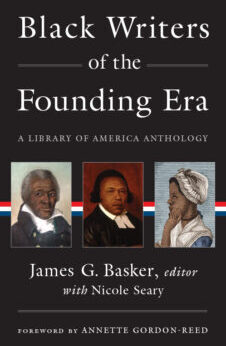
From Black Writers of the Founding Era

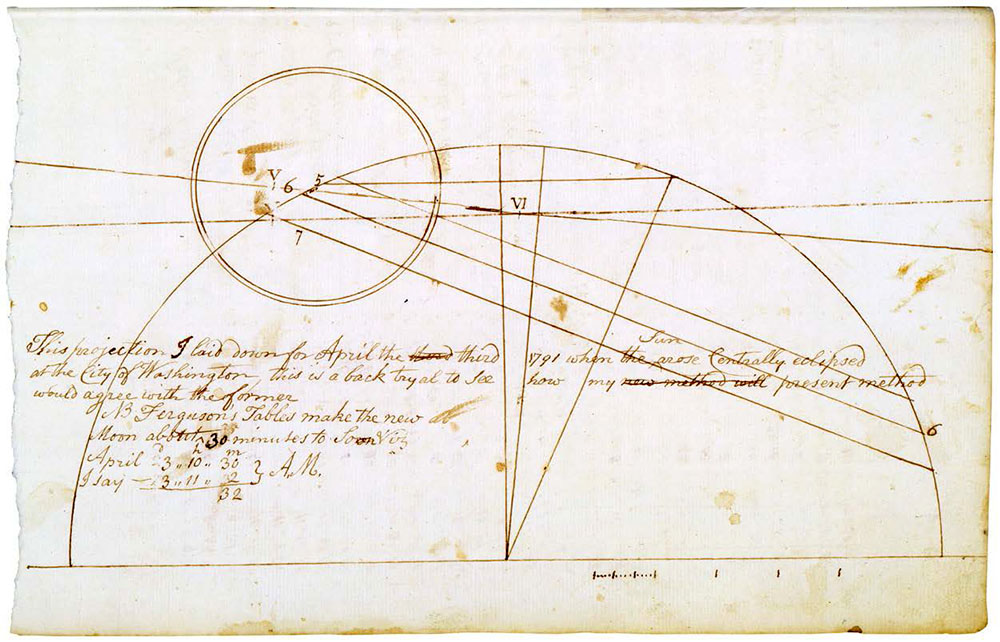
Manuscript page depicting a 1791 solar eclipse, from Benjamin Banneker’s Astronomical Journal, drawn while he was working on the survey team to establish the boundaries of Washington, D.C. Banneker’s notes read: “This projection I laid down for April the third 1791 when the Sun arose centrally eclipsed at the City of Washington. This is a back tryal to see how my present method would agree with the former. N.B. Ferguson’s Tables make the new Moon about 30 minutes to[o] soon | April 3, 10:30 | I say [April] 3, 11:32 AM." (Courtesy of the Maryland Center for History and Culture)
In 1791 Thomas Jefferson, then Secretary of State under President George Washington, sent a manuscript to the French mathematician Nicolas Caritat, Marquis de Condorcet, who was the Permanent Secretary of the French Academy of Sciences. The cover letter explained:
I am happy to be able to inform you that we have now in the United States a negro, the son of a black man born in Africa, and of a black woman born in the United States, who is a very respectable Mathematician. I procured him to be employed under one of our chief directors in laying out the new federal city on the Patowmac [Potomac], and in the intervals of his leisure, while on that work, he made an Almanac for the next year, which he sent me in his own handwriting, and which I inclose to you. I have seen very elegant solutions of Geometrical problems by him. Add to this that he is a very worthy and respectable member of society. He is a free man. I shall be delighted to see these instances of moral eminence so multiplied as to prove that the want of talents observed in them is merely the effect of their degraded condition, and not proceeding from any difference in the structure of the parts on which intellect depends.
A decade earlier, Condorcet published RĂ©flexions Sur L'Esclavage des NĂ©gres (Reflections on the Slavery of Negroes), a strident condemnation of slavery, and Jefferson purchased two copies of the work. Its opening preface, “Epistle dedicatory to the Negro slaves,” which Jefferson translated for himself in his personal notes, began, “Tho’ not of your colour, my friends, I have ever considered you as my brethren. Nature has endowed you with the same genius, the same judgment, the same virtues as the Whites.” When Jefferson lived in Paris between 1784 and 1789, he had known Condorcet; as biographer Fred Kaplan points out in His Masterly Pen, it’s not clear whether Condorcet and his associates knew that Jefferson was a slaveowner—or that James and Sally Hemings, the two servants staying in his hotel, were in fact enslaved by him, contrary to French law.

It is also not known if Condorcet ever received the manuscript sent to him by Jefferson. The French revolution had turned the city of Paris into a center of chaos, and Condorcet died in a prison three years later, probably from poisoning. The author of the manuscript in question, which featured among its calculations astronomical data and tide tables for 1792, was Benjamin Banneker, the most accomplished African American mathematician and scientist in the early history of the United States. The child of a free Black mother and a formerly enslaved father from Africa, Banneker was an autodidact with limited schooling but a lifelong intellectual curiosity. In his forties he took on astronomy and, with the support of members of the prominent Ellicott family who lived near him in rural Maryland, he was appointed to the surveying team that laid out the District of Columbia in 1791—an assignment mentioned by Jefferson in his letter to Condorcet. Banneker produced annual almanacs from 1792 to 1797 in seven cities, including Baltimore, Philadelphia, and Richmond.

When Banneker sent Jefferson the handwritten copy of his first almanac, he included a cover letter that, as he put it, took “a liberty which seemed to me scarcely allowable, when I reflected on that distinguished and dignified station in which you stand.” He chided the Secretary of State for his views on Africans and their descendants, such as those expressed in Notes on the State of Virginia (“in reason [they are] much inferior, as I think one could scarcely be found capable of tracing and comprehending the investigations of Euclid”), and for the hypocrisy between the professed ideas of the Declaration of Independence and the realities of slavery. Jefferson’s brief response acknowledged receipt of the manuscript and indicated he would send it to Condorcet—but he left unanswered most of the points raised in Banneker’s letter, which we reprint below. Both Banneker’s letter and Jefferson’s reply were reprinted several times, including in the Baltimore edition of his 1793 almanac and in a standalone pamphlet printed in Philadelphia.

Much of the above paragraph detailing Banneker’s biography is adapted from Black Writers of the Founding Era (edited by James G. Basker, with Nicole Seary).

*   *   *
For this week’s selection, we depart from the usual format and reproduce the selection, in its entirety, below.
You may also download it as a PDF or view it in Google Docs.
Letter to Thomas Jefferson

Maryland, Baltimore County, Near Ellicotts Lower Mill, Augt 19th 1791

Thomas Jefferson Secretary of State
Sir,

I am fully sensible of the greatness of that freedom which I take with you on the present occasion; a liberty which seemed to me scarcely allowable, when I reflected on that distinguished and dignified station in which you stand, and the almost general prejudice and prepossession, which is so prevalent in the world against those of my complexion.

I suppose it is a truth too well attested to you, to need a proof here, that we are a race of beings, who have long labored under the abuse and censure of the world, that we have long been seen rather as brutish than human, and scarcely capable of mental endowments.

Sir I hope I may safely admit, in consequence of that report which hath reached me, that you are a man far less inflexible in sentiments of this nature, than many others; that you are measurably friendly, and well disposed towards us, and that you are willing and ready to lend your aid and assistance to our relief from those many distresses and numerous calamities to which we are reduced.

Now, Sir, if this is founded in truth, I apprehend you will readyly embrace every opportunity, to eradicate that train of absurd and false ideas and oppinions, which so generally prevails with respect to us, and that your sentiments are concurrent with mine, which are that one universal Father hath given Being to us all, and that he hath not only made us all of one flesh, but that he hath also without partiality afforded us all the same sensations and endued us all with the same faculties, and that however variable we may be in society or religion, however diversified in situation or color, we are all of the same family, and stand in the same relation to him.

Sir, if these are sentiments of which you are fully persuaded, I hope you cannot but acknowledge, that it is the indispensible duty of those who maintain for themselves the rights of human nature and who profess the obligations of christianity, to extend their power and influence to the relief of every part of the human race, from whatever burden or oppression they may unjustly labor under, and this I apprehend a full conviction of the truth and obligation of these principles should lead all to.

Sir, I have long been convinced, that if your love for yourselves, and for those inestimable laws which preserve to you the rights of human nature, was founded on sincerity, you could not but be solicitous that every individual, of whatever rank or distinction, might with you equally enjoy the blessings thereof; neither could you rest satisfied, short of the most active diffusion of your exertions, in order to their promotions from any state of degradation, to which the unjustifiable cruelty and barbarism of men may have reduced them.

Sir, I freely and chearfully acknowledge, that I am of the African race, and in that colour which is natural to them of the deepest dye, and it is under a sense of the most profound gratitude to the supreme Ruler of the universe, that I now confess to you, that I am not under that state of tyrannical thraldom, and inhuman captivity, to which too many of my brethren are doomed; but that I have abundantly tasted of the fruition of those blessings, which proceed from that free and unequalled liberty with which you are favoured, and which I hope you will willingly allow you have mercifully receiv’d, from the immediate hand of that Being, from whom proceedeth every good and perfect gift.

Sir, suffer me to recall to your mind that time, in which the Arms and tyranny of the British Crown were exerted with every powerful effort in order to reduce you to a state of servitude: look back I entreat you on the variety of dangers to which you were exposed, reflect on that time, in which every human aid appeared unavailable, and in which even hope and fortitude wore the aspect of inability to the conflict, and you cannot but be led to a serious and grateful sense of your miraculous and providential preservation; you cannot but acknowledge, that the present freedom and tranquility which you enjoy you have mercifully received, and that it is the peculiar blessing of Heaven.

This Sir, was a time in which you clearly saw into the injustice of a state of slavery, and in which you had just apprehensions of the horrors of its condition, it was now Sir, that your abhorrence thereof was so excited; that you publickly held forth this true and invaluable doctrine, which is worthy to be recorded and remembered in all succeeding ages. “We hold these truths to be self evident, that all men are created equal; that they are endowed by their creator with certain unalienable rights, and that among these are, life, liberty, and the pursuit of happiness.”

Here Sir, was a time in which your tender feelings for yourselves had engaged you thus to declare, you were then impressed with proper Ideas of the great violation of liberty, and the free possession of those blessings to which you were intitled by nature; but Sir, how pitiable is it to reflect that altho you were so fully convinced of the benevolence of the Father of mankind, and of his equal and impartial distribution of these rights and privileges which he had conferred upon them, that you should at the same time counteract his mercies, in detaining by fraud and violence so numerous a part of my brethren under groaning captivity and cruel oppression, that you should at the same time be found guilty of that most criminal act which you professedly detested in others, with respect to yourselves.

Sir, I suppose that your knowledge of the situation of my brethren is too extensive to need a recital here; neither shall I presume to prescribe methods by which they may be relieved, otherwise than by recommending to you and all others, to wean yourselves from those narrow prejudices which you have imbibed with respect to them, and as Job proposed to his friends “Put your Souls in their Souls Stead,” thus shall your hearts be enlarged with kindness and benevolence toward them, and thus shall you need neither the direction of myself or others in what manner to proceed herein.

And now Sir, altho my sympathy and affection for my brethren hath caused my enlargement thus far, I ardently hope that your candour and generosity will plead with you in my behalf, when I make known to you, that it was not originally my design; but having taken up my pen in order to direct to you as a present, a copy of an Almanac which I have calculated for the succeeding year, I was unexpectedly and unavoidably led thereto.

This calculation Sir, is the production of my arduous study in this my advanced stage of life; for having long had unbounded desires to become acquainted with the secrets of nature, I have had to gratify my curiosity herein through my own assiduous application to Astronomical Study, in which I need not recount to you the many difficulties and disadvantages which I have had to encounter. And altho I had almost declined to make my calculation for the ensuing year, in consequence of that time which I had allotted therefor being taken up at the Federal Territory, by the request of Mr. Andrew Ellicott, yet finding myself under several engagements to Printers of this state to whom I had communicated my design, on my return to my place of residence, I industriously applyed myself thereto, which I hope I have accomplished with correctness and accuracy, a copy of which I have taken the liberty to direct to you, and which I humbly request you will favorably receive; and altho you may have the opportunity of perusing it after its publication, yet I choose to send it to you in manuscript previous thereto, that thereby you might not only have an earlier inspection, but that you might also view it in my own hand writing.

and now Sir, I shall conclude
       and subscribe myself with the most profound respect
              your most obedient humble servant
B Banneker

NB any communication to me may be had by direction to Mr Elias Ellicott merchant in Baltimore Town.
On August 30, 1791, writing from Philadelphia, Jefferson responded to Banneker as follows: “Sir, I thank you sincerely for your letter of the 19th instant and for the Almanac it contained. No body wishes more than I do to see such proofs as you exhibit, that nature has given to our black brethren, talents equal to those of the other colours of men, & that the appearance of a want of them is owing merely to the degraded condition of their existence both in Africa & America. I can add with truth that no body wishes more ardently to see a good system commenced for raising the condition both of their body & mind to what it ought to be, as fast as the imbecillity of their present existence, and other circumstance which cannot be neglected, will admit. I have taken the liberty of sending your almanac to Monsieur de Condorcet, Secretary of the Academy of sciences at Paris, and member of the Philanthropic society because I considered it as a document to which your whole colour had a right for their justification against the doubts which have been entertained of them. I am with great esteem, Sir, Your most obedt. humble servt. Th. Jefferson.”
“Letter to Thomas Jefferson” was transcribed from the manuscript, Banneker Astronomical Journal, MS2700, Maryland Historical Society. Courtesy of the Maryland Historical Society.

Sunday, February 16, 2020

The President in Peril

James Monroe (1758–1831)
From The War of 1812: Writings from America’s Second War of Independence

“A boxing match, or another bloody nose for John Bull,” 1813, political cartoon by engraver William Charles (1776–1820). The artist gloats over naval losses suffered by England early in the War of 1812, in particular the defeat of the warship Boxer by the American frigate Enterprise in September 1813. King George III stands at left, his nose bleeding and eye blackened, saying, “Stop . . . Brother Jonathan, or I shall fall with the loss of blood — I thought to have been too heavy for you — But I must acknowledge your superior skill — Two blows to my one! — And so well directed too! Mercy, mercy on me, how does this happen!!!” On the right, James Madison says, “Ha-Ah Johnny! you thought yourself a ‘Boxer’ did you! — I'll let you know we are an ‘Enterprize’ing Nation. and ready to meet you with equal force any day.” Brother Jonathan was an imaginary character signifying the United States; he was supplanted by Uncle Sam after the Civil War. Similarly, John Bull was a cartoon representation of England. Image and caption details courtesy of Library of Congress Prints and Photographs Division.
The pale and delicate James Madison—“Little Jemmy” to his detractors—was never an imposing figure. He was five foot four, weighed only a hundred pounds, and was prey to worry and depression. When Washington Irving met Madison in January 1811, he remarked in a letter to a friend: “Ah! poor Jemmy!—he is but a withered little apple-john.”

Madison’s near-fatal illness of the summer of 1813, possibly mosquito-borne malaria from the wetlands in and around Washington, occurred at the height of that year’s congressional activity and military campaigning in the War of 1812. His maladies further compromised his image as a capable chief executive and strengthened the resistance of the anti-war Federalists. Thomas P. Grosvenor, a freshman Congressman from New York, prayed for a speedy end to the President, that he might “soon appear at the bar of Immortal Justice” and be judged for his “bloody crime.” Major John Lovett, wounded the previous year at the Battle of Queenston Heights and also a New Yorker newly elected to Congress, wished good riddance to both him and his vice president, the “scant-patterned old skeleton of a French barber” Elbridge Gerry, then sixty-nine and struggling back from a stroke.

While the President and Vice President were in ill health, the War of 1812 raged on. American forces lost two crucial battles that month in a series of conflicts that would eventually leave American forts along the Niagara River in British hands and civilian settlements from Youngstown to Buffalo in ruins. In addition, the British navy was expanding its blockade to include all major ports of the middle and southern states, crippling both the economy and the treasury.

On the political front, things weren’t any better for the President. The anti-war Federalists and their allies in the Democratic-Republican Party had increased their numbers in the previous year’s elections, and they resisted Madison’s proposals for new trade restrictions, militia reform, and the enlistment of minors. Every attempt to raise taxes for the war effort strained the fraying Republican front. Diplomatic appointments were blocked, with confirmation hearings dissolving into what Madison biographer Ralph Ketchum has described as “weeks of bitter, futile debate over the origins and causes of the war.” Speaker of the House John C. Calhoun decried, “Party sperit is more violent than I ever knew.” So violent, in fact, that Calhoun himself nearly engaged in pistol duels with Grosvenor, who stridently contested every measure, and with William Gaston of North Carolina, his nemesis on the Ways and Means Committee.

Reprinted below is the brief letter Secretary of State James Monroe wrote to Thomas Jefferson about Madison’s illness—the next President writing to the previous President about the current President, as it were. He lamented how opponents were already planning for Madison’s death and how they were capitalizing on his illness by blocking the diplomatic appointments of Jonathan Russell to Sweden and Secretary of the Treasury Albert Gallatin to the Russian peace mission. Fortunately, Madison’s fever broke a few days later; on July 2 his wife, Dolley, wrote to a cousin that “for the last three days his fever has been so slight as to permit him to take bark every hour and with good effect.” (The bark of the cinchona tree was thought effective for fevers—and, in fact, it does contain quinine, which is effective for treating malaria.) After hearing of Madison’s incipient recovery, former President John Adams, who had supported his reelection, wrote empathetically to a friend, “His agitations of mind and incessant labours, I know by sad experience must be too great for any but the most robust Constitutions.”

*   *   *
We reproduce this week’s selection in its entirety below, followed by notes explaining the most important of its many references. You may also download the letter as a PDF or view it in Google Docs.

Washington June 28th 1813

Dear Sir,—From the date of my last letter to you the President has been ill of a bilious fever; of that kind called the remittent. It has perhaps never left him, even for an hour, and occasionally simptoms have been unfavorable. This is I think the 15th day. Elzey of this place, & Shoaff of Annapolis, with Dr. Tucker, attend him. They think he will recover. The first mention’d I have just seen, who reports that he had a good night, & is in a state to take the bark, which indeed he has done on his best day, for nearly a week. I shall see him before I seal this, & note any change, should there be any, from the above statement.

The federalists aided by the malcontents have done, and are doing, all the mischief that they can. The nominations to Russia, & Sweden, (the latter made on an intimation that the Crown prince would contribute his good offices to promote peace on fair conditions) they have embarrassed, to the utmost of their power. The active partizans are King, Giles and (as respects the first nomination) S. Smith. Leib, German and Gilman, are habitually in that interest, active, but useful to their party by their votes only. The two members from Louisiana, Gailliard, Stone, Anderson, & Bledsoe, are added to that corps, on those questions. They have carried a vote 20. to 14. that the appointment of Mr. Gallatin to the Russian mission, is incompatable, with his place in the treasury, & appointed a committee, to communicate the resolution to the President. They have appointed another committee to confer with him on the nomination to Sweden. The object is to usurp the Executive power in the hands of a faction in the Senate. To this, several mention’d are not parties, particularly the four last. A committee of the Senate ought to confer with a committee of the President, that is a head of a dept. and not with the ch: Majistrate, for in the latter case a committee of that house is equal to the Executive. To break the measure, & relieve the President from the pressure, at a time when so little able to bear it, indeed when no pressure whatever should be made on him, I wrote the committee on the nomination to Sweden, that I was instructed by him to meet them, to give all the information they might desire of the Executive. They declin’d the interview. I had intended to pursue the same course respecting the other nomination, had I succeeded in this. Failing, I have declined it. The result is withheld from the President. These men have begun, to make calculations, & plans, founded on the presum’d death of the President & Vice-President, & it has been suggested to me that Giles, is thought of to take the place of the President of the Senate, as soon as the Vice President withdraws.

Genl. Dearborn is dangerously ill, & Genl. Lewis doing little. Hampton has gone on to that quarter, but I fear on an inactive command. Genl. Wilkinson is expected soon, but I do not know what station will be assign’d him. The idea of a comr. in Ch: is in circulation, proceeding from the War dept., as I have reason to believe. If so, it will probably take a more decisive form, when things are prepar’d for it. A security for his (the Secys.) advancement to that station, is I presume the preparation desir’d.

Your friend, etc.


Portions of the above introduction and the notes below were adapted from material in The War of 1812: Writings from America’s Second War of Independence, edited by Donald R. Hickey.

Notes: Arnold Elzey was Madison’s primary physician in Washington during his Presidency; John Thomas Shaaf and Thomas Tudor Tucker (who was U.S. Treasurer from 1801 to 1828), both prominent physicians, also attended Madison during his illness.

Among Monroe’s list of various “partizans” in Congress opposing the diplomatic appointment of Secretary of the Treasury Gallatin, William Branch Giles, Senator from Virginia, should be singled out. A member of Madison’s own party who opposed the administration’s war policies, Giles is suggested later in the letter as someone who might be chosen by Madison’s opponents as President pro tempore of the Senate, thus becoming next in line to the Presidency should Madison and Gerry both die.

Monroe also refers to General Henry Dearborn, whose illnesses increasingly aggravated his inability to forcefully press early advantages gained in the Niagara River frontier, and Major General Morgan Lewis, who was in command of the Canadian outpost Fort George, captured by the Americans a month earlier. Madison sent Major Generals Wade Hampton and James Wilkinson to replace Dearborn, with Wilkinson in command of American forces for the campaign against Canada and Hampton in a subordinate role. The two generals had despised each other for more than five years, and their feud was a contributing factor to the collapse of the American plan to attack Montreal. In the letter’s closing, Monroe mentions (the Secys.), referring to John Armstrong Jr., who had been appointed Secretary of War despite the opposition of Monroe and Gallatin. Monroe’s insinuation was that Armstrong wanted to become commander in chief of the war effort.

Monroe's letter was originally published in The Writings of James Monroe, vol. 5 (1901).

Friday, February 12, 2016

“The Urgent Necessity”

George Washington (1732–1799) & John Adams (1735–1826)
From John Adams: Writings from the New Nation 1784–1826 and George Washington: Writings

Christopher Jackson (center, as George Washington) and Lin-Manuel Miranda (as Alexander Hamilton) in the Broadway musical Hamilton. Photograph posted on Twitter by David Korins, the show’s set designer.
In a profile of George Washington written fourteen years after his death, Thomas Jefferson recalled, “His temper was naturally irritable and high toned but reflection and resolution had obtained a firm and habitual ascendency over it. If ever however it broke its bonds he was most tremendous in his wrath.” During his own term as president John Adams found himself on the receiving end of that wrath when he brought Washington out of retirement to lead a fledgling U.S. Army against the French.

As tensions mounted between the two countries during the 1790s (climaxing in what became known as the Quasi-War), fears of an invasion by French forces increased. In early July 1798 Washington made it known privately that, if Alexander Hamilton were his deputy, he might be willing to come out of retirement to defend the country against France. Adams subsequently appointed Washington as commander-in-chief of a new army created by Congress to resist the threat—but he did so without consulting the retired general, who learned of his confirmation from accounts in the press. The Secretary of War, James McHenry, subsequently delivered the commission to Washington, who in the end decided to accept the appointment.

As Ron Chernow writes, “Adams had asked McHenry to sound out Washington on his preferred officers without realizing that Washington would regard his advice as binding. . . . Here lay the dilemma in a nutshell: neither Hamilton nor Washington would serve without Hamilton being the main deputy, while Adams found this intolerable.” Washington thus indicated that his chief officers should be, in order, Hamilton, Charles Pinckney, and Henry Knox—even though the latter two outranked Hamilton, who was merely a colonel during the Revolution. In addition, Adams simply detested Hamilton. As he later wrote, “His origin was infamous; his place of birth and education were foreign countries; his fortune was poverty itself; the profligacy of his life—his fornications, adulteries, and his incests—were propagated far and wide.” Adams exercised his prerogative as President and recommended to the Senate that the order of the ranking be reversed.

That decision whipped up Washington’s indignation, and he sent a harshly worded letter to Adams in late September. In the face of his predecessor’s anger, Adams was left with little choice but to acquiesce. And so Washington, with Hamilton as deputy, traveled to Philadelphia in November to direct planning of the new army. By December 19 he was back in Mount Vernon, and the easing of rancor between France and the United States the following spring allowed him to return semi-permanently to retirement. Most of the command duties were carried out by “General Hamilton,” who almost singlehandedly created the new army—which only increased the belief by some civil leaders that he meant to spearhead some “mischievous plot” against Adams.

For this week’s selection, we present three pieces of correspondence that detail this story: Adams’s short missive informing Washington of his appointment, followed by Washington’s gracious acceptance and, two months later, his angry follow-up letter upon learning his assignment of officers had been countermanded.

There was a sequel to this kerfuffle: After Washington’s death on December 18, 1799, Adams refused to elevate Hamilton to commander of the Army and instead left the position unfilled. Still saddled with the responsibilities—yet still without the honor—Hamilton saw what was coming and wrote to an ally that it was “certain that my present station in the army cannot very long continue.” In May 1800, to Adams’s relief and with his encouragement, Congress disbanded the army that Hamilton had built over the previous two years—an act that unleashed Hamilton’s fury toward the President and cemented a mutual antipathy that carried over into the next election and beyond.

*   *   *
If you don't see the full selection below, click here (PDF) or click here (Google Docs) to read it—free!

This selection may be photocopied and distributed for classroom or educational use.

Friday, June 25, 2010

A Virginia Barbecue

John M. Duncan (1795?–1825)
From American Food Writing: An Anthology With Classic Recipes

Barbecues and picnics—activities that today bring people together in parks and parking lots, in backyards and back lots—were regarded as a regional Virginia curiosity by John Duncan, a Scottish visitor to the United States in 1818. But, as food writer Molly O’Neill points out in her preface to our latest Story of the Week, Duncan’s assumption was not quite accurate: barbecues had already spread across the young nation and would be ubiquitous by mid-century.

Duncan arrived at Mount Vernon as a guest of U. S. Supreme Court Justice Bushrod Washington (the first President’s nephew and the current owner of the estate). The first impression was a mix of awe and reverence:
You look round upon scenery which Washington often contemplated; you tread the turf over which he walked; you see the gardens in which he amused himself; the trees which he planted; the house, the rooms, the chair which he occupied; and the humble vault which he himself chose for the repose of his dust.
Yet, because the money for upkeep was in short supply, Mount Vernon was showing signs of decline:
The flower garden and greenhouse have nearly gone to decay; the tea-house on the bank of the river is almost in ruins. . . . Even the door of the vault is to all appearance so crazy that I think a kick would go far to knock it to pieces.
From Mount Vernon, Washington and Duncan went to the “rural fĂȘte” and, in this selection, he describes a daytime Barbecue at which slaves (“servants”) handled the “various processes of sylvan cookery” while “thirty ladies and somewhere about an hundred gentlemen” gave up the afternoon to eating, drinking, and dancing.

*   *   *
After having spent an hour or two at Mount Vernon, Judge Washington politely invited us to accompany him to a Barbecue, which was to take place in the afternoon close by the road to Alexandria. . . . If you don't see the full selection below, click here (PDF) or click here (Google Docs) to read it—free!

Plus: See Thomas Jefferson's recipe for ice cream (PDF, also from American Food Writing)

These selections may be photocopied and distributed for classroom or educational use.