From Adrienne Kennedy: Collected Plays & Other Writings
Interesting Links
Interview: “Adrienne Kennedy by Suzan-Lori Parks” (Bomb)
“At 91, Adrienne Kennedy Is Finally on Broadway. What Took So Long?” (Scott Brown, The New York Times)
Previous Story of the Week selections
• “Portrait of the Author as a Working Writer,” Virginia Hamilton
• “Tall Tale Blue Over Mobile Bay in Harlem,” Albert Murray
• “Thesis Turned Broadway,” Katherine Dunham
• “New Haven, 1920,” Thornton Wilder
Buy the book
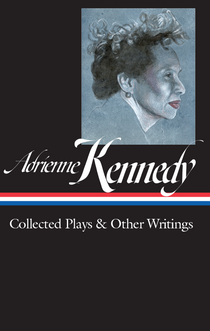 Adrienne Kennedy: Collected Plays & Other Writings
Funnyhouse of a Negro | The Owl Answers | A Movie Star Has to Star in Black and White | Ohio State Murders | 23 other plays | adaptations of Euripides | short stories, memoirs, essays, other works
List price: $45.00
Save 29%
Web store price: $32.00
Interview: “Adrienne Kennedy by Suzan-Lori Parks” (Bomb)
“At 91, Adrienne Kennedy Is Finally on Broadway. What Took So Long?” (Scott Brown, The New York Times)
Previous Story of the Week selections
• “Portrait of the Author as a Working Writer,” Virginia Hamilton
• “Tall Tale Blue Over Mobile Bay in Harlem,” Albert Murray
• “Thesis Turned Broadway,” Katherine Dunham
• “New Haven, 1920,” Thornton Wilder
Buy the book
Adrienne Kennedy: Collected Plays & Other WritingsFunnyhouse of a Negro | The Owl Answers | A Movie Star Has to Star in Black and White | Ohio State Murders | 23 other plays | adaptations of Euripides | short stories, memoirs, essays, other works
List price: $45.00
Save 29%
Web store price: $32.00
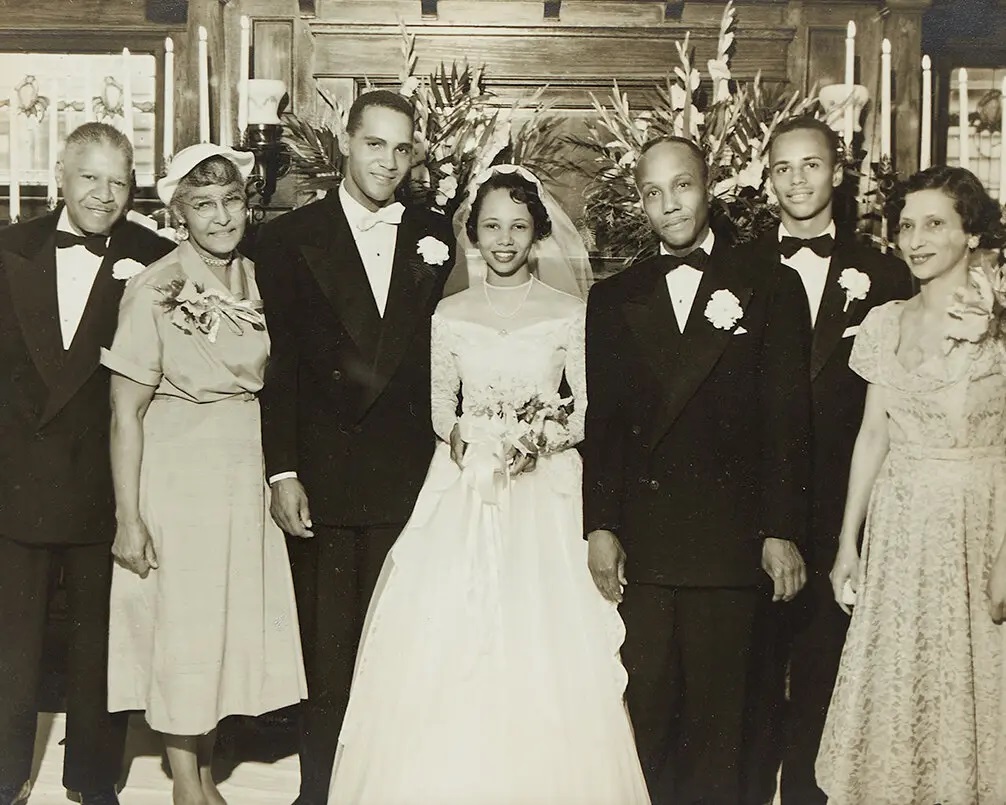 |
| Adrienne Kennedy and Joseph Kennedy on their wedding day, May 15, 1953, at her family’s home in the Glenville neighborhood of Cleveland. To the left are his parents, Leon and Cara Kennedy, and to the right are her father, Cornell Wallace Hawkins; her brother, Cornell Jr.; and her mother, Etta. (Courtesy of Adrienne Kennedy via The New York Times) |
Kennedy has often referred to her lifelong fascination with Williams’s plays in her writings and interviews. “When I saw The Glass Menagerie, I decided I could write scenes of family turmoil, but not until I was about 22 did I want to be a playwright,” she told author and film producer Tanya Selvaratnam in 2016. “I lived in New York then, and I was intoxicated by Tennessee Williams’s career, his plays, movies. People paid so much attention to him, and I was quite taken with that.” She recalled in an earlier essay, “In the spring of 1956 I registered for a course in playwriting at the New School. I hoped to write a play like The Glass Menagerie. In my mind at that time Laura and Amanda as well as Blanche in A Streetcar Named Desire spoke the way people onstage were supposed to speak.” For several years she worked on a three-act family drama, “The Pale Blue Flowers,” which, she admits now, “was as much like The Glass Menagerie as I could make it,” and she even sent it to Williams’s agent, Audrey Wood, who responded with a friendly and encouraging letter of rejection.
“It took ten years to stop imitating him, to stop using his form and to stop stealing his themes, which were not mine,” Kennedy wrote in her 1987 memoir, People Who Led to My Plays. By the end of the 1950s, she had found new inspiration in the works of Federico García Lorca; in particular, his play Blood Wedding and the poetry collection The Poet in New York showed her “that imagery is multilayered, that it comes from recovering connections long ago lost and buried.” In addition, Kennedy mined her own life for the “scenes of family turmoil” that she had so loved in Williams’s plays. As she explained in her essay “A Growth of Images”:
Autobiographical work is the only thing that interests me, apparently because that is what I do best. I write about my family. . . . I feel overwhelmed by family problems and family realities. I see my writing as being an outlet for inner, psychological confusion and questions stemming from childhood. . . .Kennedy’s brother, Cornell Hawkins, Jr., younger by three years, was one source of inspiration. References to him, both fictionalized and factual, are scattered throughout her plays and prose. When they were children, the two were very close, traveling by train each summer “in the dirty Jim Crow car” to their paternal grandparents’ home in Montezuma, Georgia, and playing together for hours (“we sat side by side next to the Philco radio and listened to the shows and then played games acting out the characters”). As they grew older, her brother’s relationship with his family became strained, and past events took on new meaning, as she noted in People Who Led to My Plays: “As a child my brother Cornell was quiet, and he ran away for a few hours (when it was snowing) when he was ten. And I know there was an unseen sadness in him.” She added, “In his twenties my brother spoke bitterly of his life in a way I could not fathom. He often said he felt hopeless, and then he joined the army.”
In Kennedy’s often-anthologized play A Movie Star Has to Star in Black and White, one sees echoes of Cornell in Wally, the brother of the lead character, Clara:
When my brother was in the army in Germany, he was involved in a crime and was court-martialled. He won’t talk about it. I went to visit him in the stockade. . . .When Cornell died in 1972, Kennedy realized how little she’d known about him, and she wrote about the mystery and loss in “Secret Paragraphs about My Brother.”
His head was shaven and he didn’t have on any shoes. He has a vein that runs down his forehead and large brown eyes. When he was in high school he was in All City track in the two-twenty dash. We all thought he was going to be a great athlete. His dream was the Olympics. After high school he went to several colleges and left them; Morehouse (where my father went), Ohio State (where I went) and Western Reserve. I’m a failure he said. I can’t make it in those schools. I’m tired. He suddenly joined the army.
In an interview with fellow playwright Suzan-Lori Parks published in Bomb, Kennedy observed, “I’m genuinely fascinated and I will always be—by that pool of stories I heard when I was growing up,” to which Parks responded, “But supposedly black people don’t tell things. I’m fascinated by the tension: the pool of stories, and yet those things that aren’t told. All those things that aren’t talked about. . . .”
“The secrets,” Kennedy replied.
Notes: The 1988 Dutch movie The Vanishing, directed by George Sluizer, is about a woman who disappears at a highway rest stop. Vertigo is a 1958 film noir in which James Stewart, playing a private detective, grows obsessed with a pair of apparent doubles, both played by Kim Novak. Guys and Dolls is a 1955 film adaptation, directed by Joseph L. Mankiewicz, of the 1950 musical by Frank Loesser, Jo Swerling, and Abe Burrows
* * *
There have been killings in Cambridge.They want me to help them find the murderer, but I can’t concentrate. . . . If you don't see the full selection below, click here (PDF) or click here (Google Docs) to read it—free!
This selection is used by permission.
To photocopy and distribute this selection for classroom use, please contact the Copyright Clearance Center.
To photocopy and distribute this selection for classroom use, please contact the Copyright Clearance Center.

