Showing posts with label Jane Bowles. Show all posts

Friday, July 21, 2017

A Stick of Green Candy

Jane Bowles (1917–1973)
From Jane Bowles: Collected Writings

Detail from Landscape with Flight of Stairs, c. 1922, oil on canvas by Russian-French artist Chaim Soutine (1893–1943). Click on image to see entire painting. Courtesy of The Athenaeum.
In July 1947, using the money from the advance for a novel, Paul Bowles left for Morocco, a country he had visited years earlier on the advice of Gertrude Stein. His wife, Jane, remained behind in the U.S. and began an affair with Jody McLean, a New England woman who owned a tea shop. Paul, who with a friend bought a house in the Casbah of Tangier, encouraged Jane to join him in Africa. Fearful of a transatlantic journey, she kept putting it off but in January finally went to Morocco with Jody and found herself enthralled by their new home. Jody returned to the U.S. in the spring, and Jane decided to stay alone in Morocco when Paul went to New York to finish the incidental music for Tennessee Williams’s new play, Summer and Smoke. During Paul’s absence, Jane befriended—and became a bit obsessed with—a group of women she met in the grain market, including Cherifa, who operated a stall in the market and who would become Jane’s closest companion for two decades.

Paul returned to Tangier in December 1948 and suggested that he and Jane travel into the Sahara. Somewhat to Paul’s surprise, she was as enchanted by the desert as she had been with Tangier. “It is not like anything else anywhere in the world (and I do remember New Mexico), not the sand—or the oasis,” she wrote in March to friends. “It is very quiet, no electricity, no cars. Just Paul and me. And many empty rooms. The great sand desert begins just outside my window. . . . We plan to be in the desert about a month and then back to Fez. Then to Tangier, where I can resume my ‘silly life’ with the grain market group.”

During their Sahara trek, while staying in Taghit, Algeria, Jane broke through her recurring writer’s block and finished “A Stick of Green Candy.” Paul—whose famous novel The Sheltering Sky was published that year—was excited that Jane was writing again, but according to his biographer Virginia Spencer Carr he “feared that she would never stop tinkering with it.” When they returned to Tangier, Jane ended up stashing the story in a closet. In 1956 Tennessee Williams and his partner Frank Merlo visited Tangier, and Jane dusted off the manuscript for Merlo to read. Jane allowed him to take it back to the U.S. and he sent it to Vogue, which immediately accepted the story. It appeared in the magazine a couple of weeks shy of Jane’s fortieth birthday.

Millicent Dillon, Jane Bowles’s biographer and the editor of the recently published Library of America edition of her collected writings, explains how “A Stick of Green Candy” evokes Jane’s insecurity as a writer of fiction, and more specifically her “loss of belief in her imagination”:
Jane was telling of the breakdown in her imaginative world. In the desert, as she wrote the story, her sense of its truth held her, and she could complete it. Like Mary, she had to believe in the truth of what she said. . . . But when the story was done, when she returned to Tangier, she began again to disbelieve her own words, to mistrust her own imagination. . . . “A Stick of Green Candy” was to be the last work of fiction she was ever to complete.

*   *   *
The clay pit had been dug in the side of a long hill. By leaning back against the lower part of its wall, Mary could see the curved highway above her and the cars speeding past. . . . If you don't see the full selection below, click here (PDF) or click here (Google Docs) to read it—free!

This selection is used by permission.
To photocopy and distribute this selection for classroom use, please contact the Copyright Clearance Center.

Friday, February 17, 2017

East Side: North Africa

Jane Bowles (1917–1973)
From Jane Bowles: Collected Writings

Street scene, Tangier, Morocco, c. late 1920s–1930s. Detail from a hand-tinted photograph on a postcard.
In 1965, after the publication of the UK edition of Jane Bowles’s novel Two Serious Ladies, the London publisher Peter Owen proposed a collection of her shorter fiction. Jane was hesitant to republish her stories, and she claimed that she had lost all her copies anyway. But, as her husband Paul Bowles later told biographer Virginia Spencer Carr: “I was able to come up with tear-sheets of everything at hand, including the travel article ‘East Side: North Africa’ that she had written [in 1950] for Mademoiselle. I saw that in ten minutes it could be transformed into a story. As I expected, she refused to consider it. So I did it myself, called it ‘Everything Is Nice,’ and included it. . . . When I showed her the result, she said angrily: ‘Do whatever you like.’”

Paul condensed the original Mademoiselle piece and turned what Jane had written as a first-person memoir into a third-person work of fiction. He then edited and prepared six other stories for the collection, which was published in England as Plain Pleasures. In the United States, Farrar, Straus and Giroux included the stories with her novel Two Serious Ladies and her play In the Summer House in an omnibus edition, The Collected Works of Jane Bowles, which Jane regarded dismissively as the “Dead Jane Bowles.” Thirty years later, Paul seemed to express regret for his dabbling with the Mademoiselle essay: “I believed that because we had collaborated before when she was having difficulties getting something down on paper that she desperately wanted to say and asked me to look at it and make suggestions, it would be fitting for me to tinker with this one. I was wrong, of course.”

“East Side: North Africa” describes a single day in Tangier during which Jane (“Jeanie”) is invited to visit with Moroccan women who know her housekeeper and companion Cherifa. Literary scholar Brian T. Edwards, in Morocco Bound: Disorienting America’s Maghreb, from Casablanca to the Marrakech Express, explains the significance of the central expression in both the original essay and the story:
“Everything is nice” seems at once to translate and not to translate a common Moroccan expression (kulshi mizzian) and more generally a Moroccan manner of speech in which precision of meaning gives way to a refusal to condemn or to judge God’s world. Indeed, whatever the expression Jane Bowles would have heard in the context, it would likely have been followed by hamdullah (“praise to God”), a phrase Bowles doesn’t render or include. In this sense, the phrase “everything is nice” is not a translation of the Moroccan expression but rather the representation of the failure of communication.
In early 1950, about the time Jane was working on the article for Mademoiselle, she wrote to her husband and mentioned how Morocco makes her feel “connected” with her work. Her main aggravation was learning to speak Arabic. “I just can’t accept having gotten this far in the damn language, and not getting any further,” she wrote. “With me, as you know, it is always the dialogue that interests me, and not the paysages [scenery] so much or the atmosphere.” And, as readers will discover, it is the dialogue—and her frustration with it—that forms the center of her text.

Both versions—“East Side: North Africa” and “Everything Is Nice”—are included in the Library of America volume Jane Bowles: Collected Writings. We present here, as our Story of the Week selection, the original article Jane wrote for Mademoiselle.

*   *   *
The highest street in this blue Arab town skirted the edge of a cliff. I walked over to the thick protecting wall and looked down. . . . If you don't see the full selection below, click here (PDF) or click here (Google Docs) to read it—free!

This selection is used by permission.
To photocopy and distribute this selection for classroom use, please contact the Copyright Clearance Center.

Friday, December 10, 2010

All Parrots Speak

Paul Bowles (1910–1999)
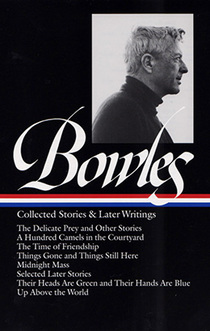
From Paul Bowles: Collected Stories & Later Writings

Paul Bowles with parrot. Photograph by Roy Round for the back jacket cover of the US edition of Up Against the World (1966)

During the early 1960s the New York poet and photographer Ira Cohen lived in Morocco for four years and, while there, he became friends with Paul Bowles (who was born 100 years ago this month). Cohen interviewed Bowles in 1965* and mentioned the author’s famous predilection for pet animals, resulting in a lengthy exchange about parrots, including the following bits:
Cohen: I somehow always think of you as a scorpion, with a cat somewhere in the background, a parrot maybe on its shoulder.

Bowles: I used to carry the green parrot around on my shoulder. I carried him all over the Sahara. They’re good to travel with. They’re happy, they’re not miserable traveling. You try to travel with a cat, and it’s miserable. . . .

My gray parrot lives in the kitchen in [Bowles’s wife] Jane’s apartment downstairs. It’s better for her to be with people and they worship the bird, talk to it, give it things. . . . It won’t let anyone touch it at all except Cherifa and me.

Cohen: I know it pecked a real piece out of my finger one day.

Bowles: Well, it bites everybody.
Bowles’s fondness for parrots (and his guests’ terror of them) dated back nearly three decades, when he first encountered the birds during his and his wife’s honeymoon in Costa Rica in 1938; afterward he was rarely without one or more of them. Although his household could sometimes be filled with exotic animals (the story below mentions an armadillo, an ocelot, and a tejon), he was particularly proud of his parrots, complaining in a letter to a friend about a “libelous” article that painted him “as distant, chilly, and eccentric, and, even worse, describing my parrot as skinny and featherless, which is certainly not the case.”

In 1956 he gathered some of the more memorable of his adventures as an avian aficionado in “Parrots I Have Known,” which was published in the popular travel magazine Holiday; he later retitled the piece when he included it in the 1963 travel writing collection Their Heads Are Green and Their Hands Are Blue.

* Some of the interview was lost, and part of the extant portion was published in Conversations with Paul Bowles (1993).

*   *   *
Parrots are amusing, decorative, long-lived, and faithful in their affections, but the quality which distinguishes them from most of God’s other inventions is their ability to imitate the sounds of human speech. A parrot that cannot talk or sing is, we feel, an incomplete parrot. . . . If you don't see the full story below, click here (PDF) or click here (Google Docs) to read it—free!

This selection is used by permission.
To photocopy and distribute this selection for classroom use, please contact the Copyright Clearance Center.