From Nathanael West: Novels & Other Writings
Interesting Links
“Nathanael West as online muse” (Reader’s Almanac)
“Nathanael West: Funny, but desperately sad” (Martin Chilton, The Telegraph)
Previous Story of the Week selection by Nathanael West
“Business Deal”
Buy the book
 Nathanael West: Novels & Other Writings
The Dream Life of Balso Snell • Miss Lonelyhearts • A Cool Million • The Day of the Locust • screenplays and correspondence • 829 pages
List price: $40.00
Save 20%, free shipping
Web store price: $32.00
“Nathanael West as online muse” (Reader’s Almanac)
“Nathanael West: Funny, but desperately sad” (Martin Chilton, The Telegraph)
Previous Story of the Week selection by Nathanael West
“Business Deal”
Buy the book
Nathanael West: Novels & Other Writings The Dream Life of Balso Snell • Miss Lonelyhearts • A Cool Million • The Day of the Locust • screenplays and correspondence • 829 pages
List price: $40.00
Save 20%, free shipping
Web store price: $32.00
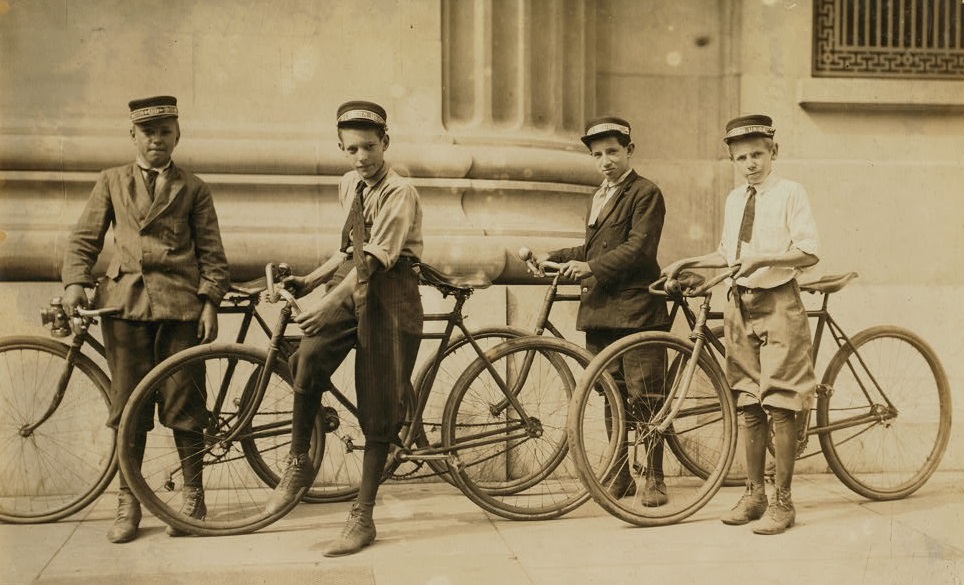 |
| A group of Western Union messenger boys in Norfolk, Virginia, June 1911. Photograph by Lewis Wickes Hine (1874–1940). Working as an investigative photographer for the National Child Labor Committee, Hine documented working and living conditions of children in the United States between 1908 and 1924. Courtesy of Library of Congress Prints and Photographs Division. |
In 1926, when Weinstein began to work on his first novel, The Dream Life of Balso Snell, he legally changed his name to Nathanael West. (Years later, William Carlos Williams asked, “How did you get that name?” and West answered, “Horace Greeley said, ‘Go West, young man.’ So I did.”) One can change a name, but it’s harder to forget the past. Biographer Jay Martin notes that West’s summer camp experiences “so haunted his imagination that eventually, a decade later, he would attempt to free himself from the bitterness it left by writing a story called ‘Western Union Boy.’” The tale turns around the bumbling failure of its protagonist at a pivotal point of a baseball game—and, on several occasions, West had described to a number of friends a similarly embarrassing incident from his own past. How much of the story is autobiographical is unclear, however, since (as Martin avers), “West was the first writer to discover, or at least the first to dramatize in vivid fictions, the psychological fact that once a fantasy is perfected, it may be lived over and over in further fantasies precisely as if it had been a real experience.”
West completed “Western Union Boy” sometime in the early 1930s, while he was working on his novel Miss Lonelyhearts, but—like his other stories written at the time—he was unable to sell it. It was never published during his lifetime, and the story appears in the Library of America edition of his collected works. We are pleased to present it here exclusively—for a limited time—as our Story of the Week selection.
Note: The Traction Interests, mentioned at the end of the story, was a term often used for the trolley and bus companies and mass transit authorities, which in the early twentieth century were often assailed in the press for corruption and strong-arm tactics.
* * *
If you're not very busy, a grown man in the uniform of a Western Union boy should make you feel a little sick. . . . This story is no longer available. Read other recent selections from Story of the Week.
